
[Ed: They now have the illusion of safety. But only for a short time.]
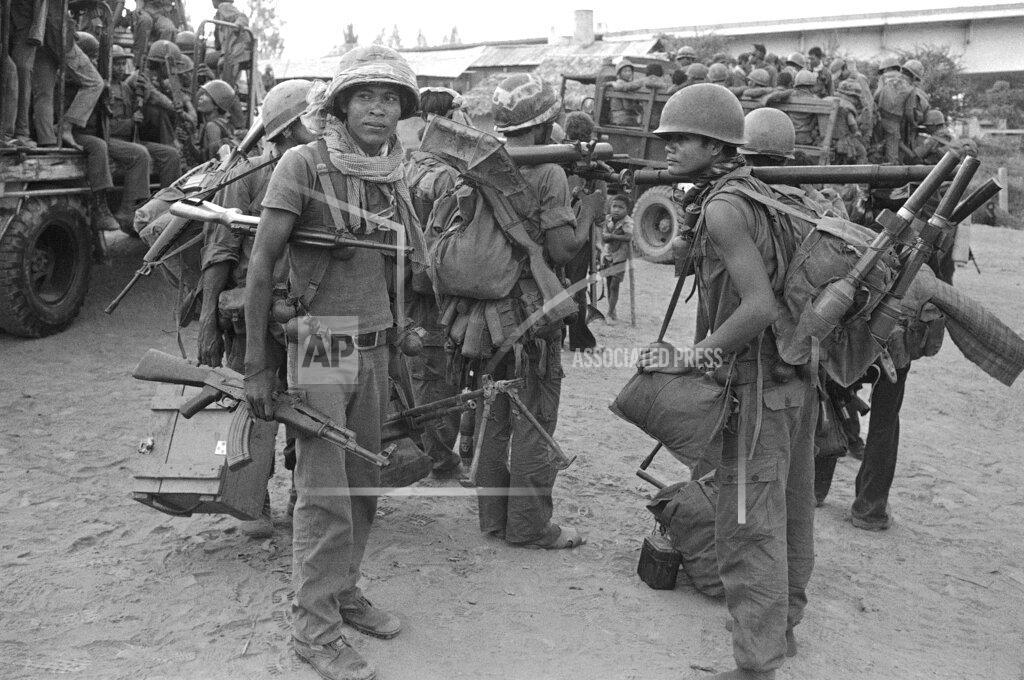
The North Vietnamese advanced southward along the central coastal plains of South Vietnam today. Behind it virtually all the northern part of South Vietnam had been engulfed. Only the enclave of Đà Nẵng, South Vietnam’s second largest city, remained in Saigon government hands, and the central coastal port of Quy Nhơn, the country’s third largest city, appeared threatened, as Communist forces sent more than 600 rounds of rocket and artillery fire into Bình Khê, a district capital 25 miles away. The Saigon command said this morning that the Communist offensive was continuing in all military regions of the nation and that attacks had increased near the capital in the south. At least eight South Vietnamese army regiments — a total of about 19,000 men — have reportedly fled, leaving equipment behind. The retreat, a Western military analyst said, was “a rout beyond our wildest fears.”
From yesterday morning until late afternoon, the command said, the district headquarters of Chánh Thành, 45 miles north of Saigon, was assaulted by tank‐led infantrymen and struck by more than 400 rounds of artillery, rocket and mortar fire. The command said that the attack had been repulsed. Yet the strength of the attacks — and their proximity to Saigon — raised new fears of an assault on the capital itself. The Thiệu Government was reportedly preparing for the possibility that the northern city of Đà Nẵng would be lost.
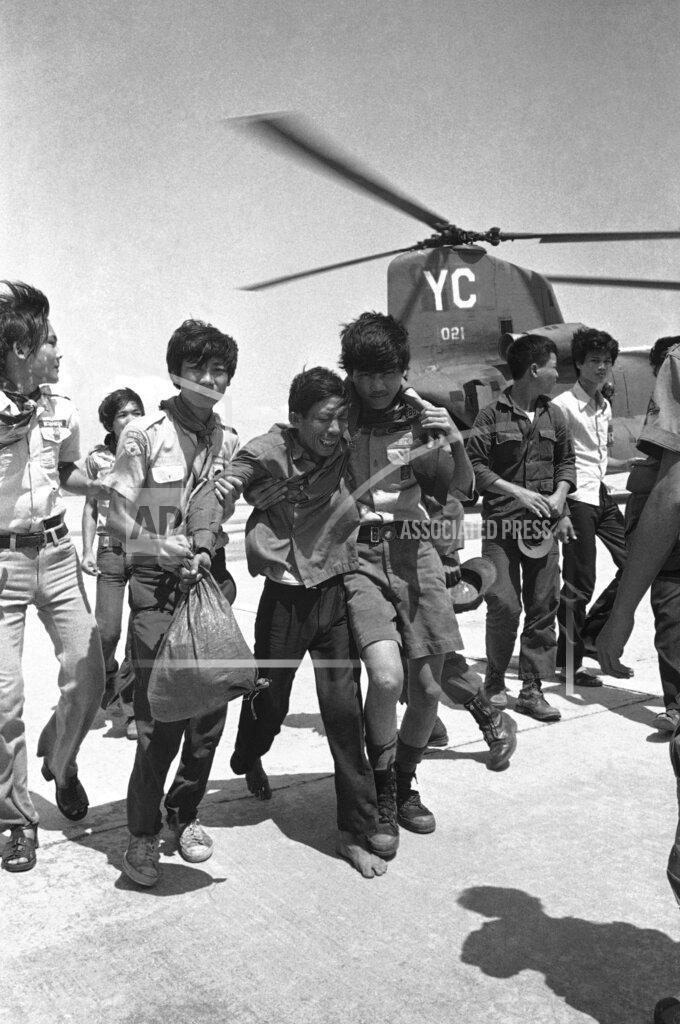
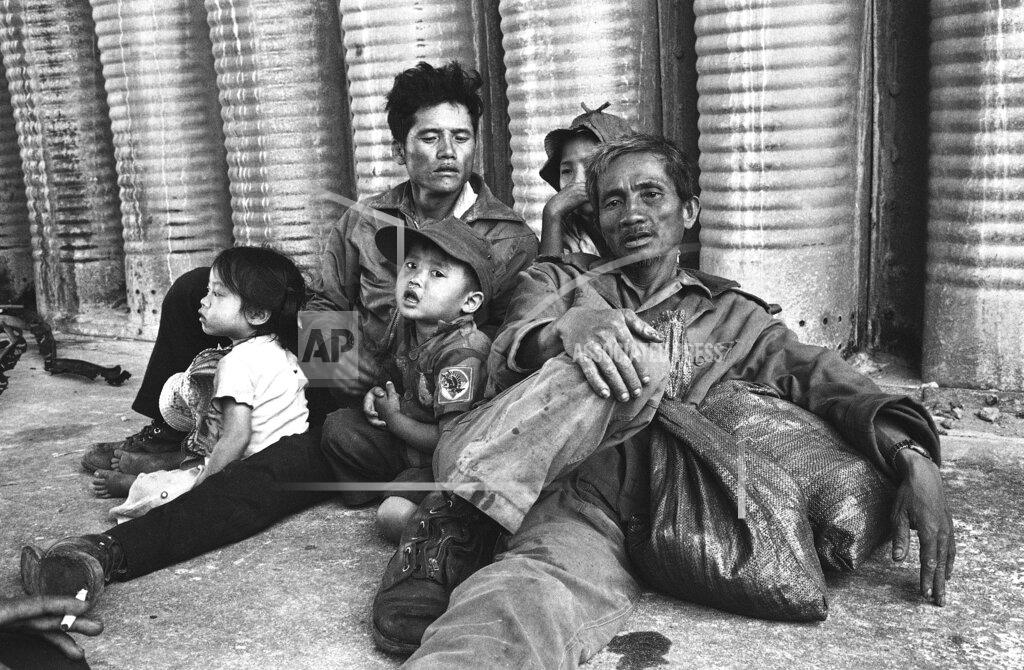
With refugees pouring in from abandoned provinces north and south of the city, Đà Nẵng’s population, normally about half a million, has doubled in recent days. Reports from Đà Nẵng yesterday told of unrest in the streets and, at the huge airport as families fought to climb into evacuation planes bound for Saigon and Nha Trang. This morning, before the flights reportedly halted, a World Airways 727 jet was forced to take off with only a partial load of refugees as others clung to the plane’s ramp. However, the only sounds of war reported in the area were the occasional firing of government howitzers. Communist troops nearby were said to have made no reply.
The United States agency for International Development had said that it was planning to hire a Boeing 747 jumbo jet for an airlift, but the planes flying out of Đà Nẵng during the day were smaller charter craft or regular Air Vietnam planes. Saigon’s Tân Sơn Nhứt Airport, meanwhile, has been crammed with South Vietnamese C‐130 cargo planes that have remained parked at the airfield. Đà Nẵng itself is said to be crowded with army deserters and stragglers from Huế, the abandoned cultural heart of South Vietnam 50 miles to the north; also with frightened families, lost children and hungry, terrified old people. But reports from the city also said that thousands seemed content to stay in the city and that the food market was functioning normally.
The Saigon forces’ strategy, ordered by President Thiệu two weeks ago, was to abandon most of the Central Highlands and the northern provinces with the aim of retaining population centers along the coast together with an arc around Saigon and the Mekong delta, the nation’s rice belt. But the strategy has largely resulted in panicky flights by soldiers and civilians. At least eight army regiments numbering about 19,000 men near the fallen city of Huế have reportedly fled, leaving artillery, mortars, armored personnel carriers and even rifles behind. A Việt Cộng spokesman announced in Saigon, according to Reuters, that “the People’s Revolutionary Government is now in complete control of Huế.” He said the Việt Cộng flag was raised over the city at 6 AM Wednesday.
A Western military analyst said that the North Vietnamese were now sending soldiers into the south at the rate of 1,500 a day and that their troop strength in the south had climbed to a record 400,000. The South Vietnamese armed forces total 1.1 million, but more than half are said to be in defensive positions, guarding government installations, protecting buildings and bridges. As the Communist drive continued, the Saigon command announced yesterday that its troops had reopened the highway from the capital to Tây Ninh, about 65 miles northwest. Fighting has flared around Tây Ninh city for several weeks and the reopening of the highway was viewed as one bright spot in an otherwise gloomy picture.
The State Department said today that more United States commercial aircraft were being rushed to Đà Nẵng to aid in the evacuation of refugees. Robert Anderson, a department spokesman, said a Boeing 727 and two DC‐6’s operated by Bird Airways would go into service tomorrow, joining the World Airways 727 that has been flying refugees to Camh Ranh since yesterday. A stripped‐down Boeing 747, capable of carrying 1,200 to 1,600 South Vietnamese refugees, is expected to go into service Tuesday on a threeflights‐a‐day schedule. Mr. Anderson said that six barges and five tugs were also due to arrive at Đà Nẵng tomorrow to assist in the removal of refugees. He said that the South Vietnamese Government had appealed throughout the world for refugee relief and that the United States was considering further assistance.
The South Vietnamese forces are not critically short of either ammunition or fuel, despite congressional reductions in military aid, the Defense Department said, but its officials assert that congressional cutbacks had contributed to the Saigon government’s recent military setbacks by forcing its troops — as they sought to conserve military supplies — on the defensive. Various Administration officials have been emphasizing that because of reduced funding, the United States has been unable to replace destroyed weapons and South Vietnamese Government units have been forced to cut back on ammunition and fuel. But the Defense Department said that it was partly because of these conservation measures that Saigon’s forces had been able to maintain adequate stocks of ammunition and fuel as they faced the current North Vietnamese drive.
For the fiscal year that ends on June 30, Congress has provided $700‐million in military aid for South Vietnam, half the amount requested by the Administration. In the renewed debate developing over Vietnam policy. this Congressional cutback is becoming a controversial element as the Administration seeks to link South Vietnamese military reversals with Congressional reductions in military aid. The Defense Department made public figures showing that over the last nine months, $430‐million in military assistance has been delivered to South Vietnam, including about $200‐million in ammunition. Of the $700‐million appropriated by Congress, the Defense Department has already committed $525‐million, with $94.7‐million of the orders still in the pipeline to South Vietnam. The remaining $175 million will be committed next week to cover the final three months of the fiscal year.
Operations in South Vietnam in the last 24 hours have underscored the weaknesses of Saigon’s forces, including a tendency toward wishful thinking on the part of the high command, according to United States officers studying the rapidly deteriorating military situation. These sources cited a failure of command at the corps, division and brigade level, a lack of tactical enterprise in situations where the Americantaught doctrine of massive firepower and bombing was useless because of shortages and an apparent unwillingness to launch counterattacks whose success might raise morale.
The officers studying the situation believe that the best the South Vietnamese Government can hope for is to hold the Saigon area with the forces now on that front. They regard the Mekong River Delta, where the troops are reported to be short of fuel and ammunition, as ripe for a successful Communist offensive from across the Cambodian frontier. Taking a general view of the South’s outlook, one source said that “the prospects for restoring the old situation in the north are pretty slight and everything rests on the four divisions around Saigon.” A single, spectacular victory by South Vietnam forces might raise morale and lead to a general stiffening of defenses, they conceded, but they doubted that the right forces were available or that the Saigon command had sufficient tactical enterprise to take the bold and costly measures necessary.
An immediate shake‐up of field commanders was recommended as a remedy for the military ills. Most officers saw rapid improvement in leadership at the corps, divisional and brigade levels as vital to a successful defense of Saigon—more important even than a new influx of munitions from the United States, they feel. Operations in the last 24 hours underscored weaknesses and what the sources consider a tendency to wishful thinking in the high command.
An example of what was viewed as wishful thinking was a statement by an officer of the high command that the forces in Đà Nẵng were strong enough to counterattack the Communist troops around the city. But American sources do not know of any such attack, planned or under way, and fear that the tactics of holding Đà Nẵng as a fortified enclave are a dead letter. “You can’t hold a fortified position without guns,” an officer said, “and the friendlies are leaving their guns behind.”
Militarily, the North Vietnamese eruption onto the central coast is regarded as a severe blow to any remaining hopes of resistance north of the Sai gon enclave. The Communists took Tam Quan, 120 miles southeast of Đà Nẵng, with a strong force of armor, infantry and artillery after a seven-hour battle. Three other Government positions in the area are under attack, and Bình Khê, a district capital 25 miles inland from Quy Nhơn that is considered by American officers as a suitable site for a major defensive battle, is under strong artillery fire. Successes in this central coastal area, the sources emphasized, will enable the North Vietnamese to mount an offensive in the Saigon area without worry about possible attack by southern forces now in coastal ports. There was one small government success: Troops recaptured an outpost 12 miles from Tây Ninh on Route 22 northwest of Saigon.
Officers who helped train the Vietnamese are perplexed by reports of the army’s dissolution under battle, and the almost universal reaction is to blame senior commanders. Repeatedly the Americans emphasized that the enlisted men and noncommissioned officers were as good as their foe and that they could more than hold their own under able commanders. The officers conceded that senior commands had gone to political appointees and that corruption, always a problem, had become worse since the American withdrawal in 1973. A major success through a strike into Communist territory, they argued, might stop the deterioration, but they pointed out that the best troops for such an enterprise, including airborne and marine divisions, were unavailable.
Under the Vietnamization program, Saigon’s forces were equipped with American weapons and vehicles and trained under American doctrine. “We taught them to plaster an objective with a thousand rounds of artillery, bomb it and then go in,” a major said. “Now they haven’t got the shells or the fuel for the planes and choppers, and apparently they can’t alter their tactics to suit the new conditions.” The implication is that the only alternative the Vietnamese commanders can see is retreat. Despite the continuing setbacks there is some optimism among qualified military sources over the prospects for a successful defense of the Saigon area. The divisions there — the Fifth, the 18th and the 25th and elements of the airborne division — are highly regarded. They have apparently not been infected by the loss of morale among units in the central and northern sectors and they have supply dumps in the capital area.
The sources noted that the Hanoi command, while adopting bold tactics on the other fronts, had been relatively cautious in the Saigon area. If morale is as bad there as it appears to be on other fronts, they said, “the Communists would have been in Saigon yesterday.” North Vietnamese tactics in the capital sector may also be influenced by political considerations. Some officers believe that Hanoi, after winning positions from which an assault can be launched and stepping up harassment of the suburbs, will delay in the hope that President Nguyễn Văn Thiệu’s Government will be ousted and peace can be made with a caretaker regime. Although the consensus was that shortages of spare parts, fuel and artillery ammunition had contributed to the losses in the north and center, most officers believed that the Saigon garrison had adequate supplies.
A group of opposition politicians and former Vice President Nguyễn Cao Kỳ called on President Nguyễn Văn Thiệu of South Vietnam to “turn over full powers to a new government” that would pursue new policies to save the nation. The declaration did not demand, however, that Mr. Thiệu leave office. Mr. Kỳ, who has long been an opponent of the President, said, “Thiệu can stay until the expiration of his term.” The terms ends in October, when a national election is scheduled. The declaration was made public hours after the Saigon Government had announced that a number of persons have been arrested for having “plotted to overthrow” the president. Later it became known that seven had been seized and that two of these had attended a meeting of opposition members with Mr. Kỳ at the Tân Sơn Nhứt Air Base yesterday to discuss the declaration.
Two of Cambodia’s Asian allies have quietly withdrawn their ambassadors from Phnom Penh and there were indications that others may soon follow. The ambassadors of Indonesia and Malaysia both slipped out of the capital late yesterday, together with their skeleton staffs, hours after insurgent rockets struck in or around the compounds where the embassy staffs live and work. The Thai ambassador has been recalled to Bangkok for “security” discussions. The Japanese Embassy has been reduced to a staff of three—the ambassador, military attaché and cable clerk.
The diplomatic community here has contracted sharply in recent weeks. Among the Western nations — only the Americans still have a functioning embassy, and the South Koreans and South Vietnamese, Taiwan and a few eastern European caretaker missions still remain. But what is left of the diplomatic community still maintains its activity. Reports circulated today in this community that Premier Long Boret has prepared a “scenario” for a peaceful governmental transition and showed this to some Asian ambassadors. The scenario, diplomatic sources said, would involve the replacement of the Premier by the First Deputy Premier, Hang Thun Hak, and the opening of talks with the insurgents, at which time Marshal Lon Nol would also bow out.
The busy Phnom Penh rumor mill had it that Marshal Lon Nol was preparing to fly this weekend to Kompong Som, the seaside beach resort where he frequently vacations. A United States Navy helicopter carrier is reported to be standing by off Kompong Som in the Gulf of Siam in the event that American nationals or others have to be evacuated from Cambodia. The embassies, as well as the presidential palace and the home of Premier Long Boret, continued under rocket attack. One Western military source said that captured prisoners had disclosed that the insurgent gunners were aiming particularly at embassies and the presidential palace.
On the battlefronts, according to Western military sources, there was no movement in the government operation to retake the town of Tuol Leap northwest of Phnom Penh, and then move into the nearby areas that are the rocketlaunching sites harassing Pochentong Airport. At Battambang, the second largest Cambodian city, heavy insurgent shelling is still being reported, and fires have been started along a nearby rail line, according to these same Western officials.
Almost all of Cambodia is now occupied by the forces opposed to the Phnom Penh Government of President Lon Nol, according to the insurgents’ press agency. In a French‐language dispatch monitored here today, the agency said: “In March, 1975, the liberated zone of Cambodia covers 97 percent of national territory with six to seven million inhabitants.”
Thailand is ready to offer her good offices to help restore peace in Cambodia, Foreign minister Chatichai Choonhavan said in Bangkok today. The Thai Government wanted Cambodia to solve her own problems by peaceful means through negotiations, he told reporters. Mr. Chatichai’s statement indicated that the new government of Premier Kukrit Pramoj was prepared to renew an offer from a previous government to host Cambodian peace talks in Bangkok, observers said.
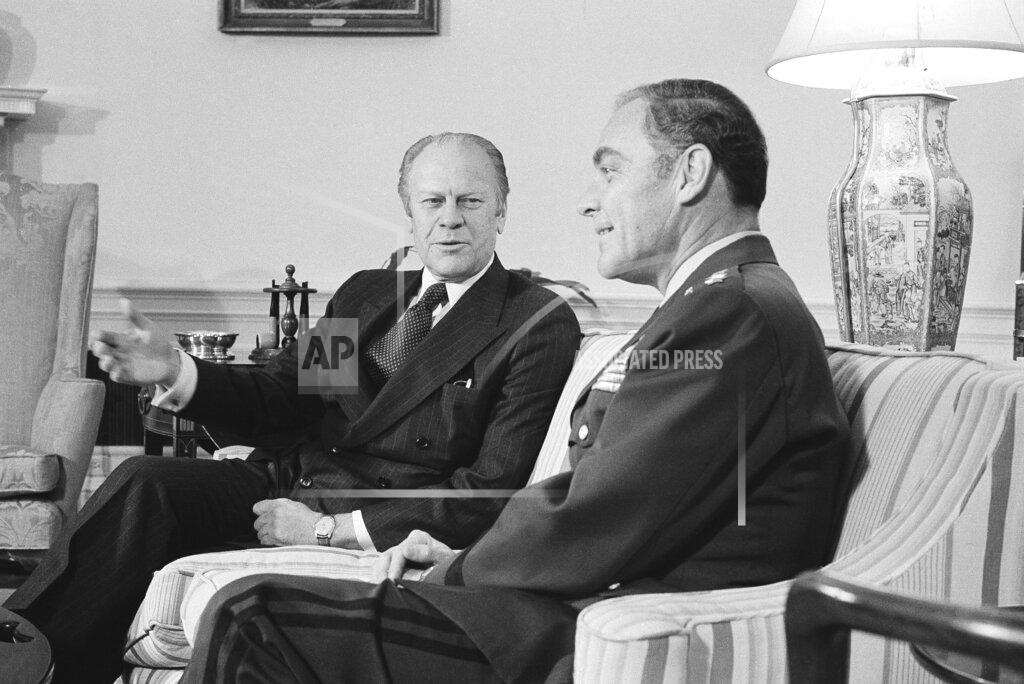
President Ford said in an interview soon after Secretary of State Kissinger returned to Washington that chances for peace in the Middle East would have been enhanced if Israel had shown more flexibility in the negotiations for a new Sinai agreement with Egypt. Publicly, Mr. Kissinger has said no blame should be assessed, but privately he has indicated displeasure with Israel’s position. Mr. Ford seemed to reflect Mr. Kissinger’s views. Although Mr. Ford stopped short of actually blaming Israel for the collapse of Secretary of State Kissinger’s latest mediation efforts, he neyertheless seemed to chide the Israelis for their refusal to give up strategic Sinai passes in return for Egyptian security pledges that constituted less than a nonbelligerency pledge.
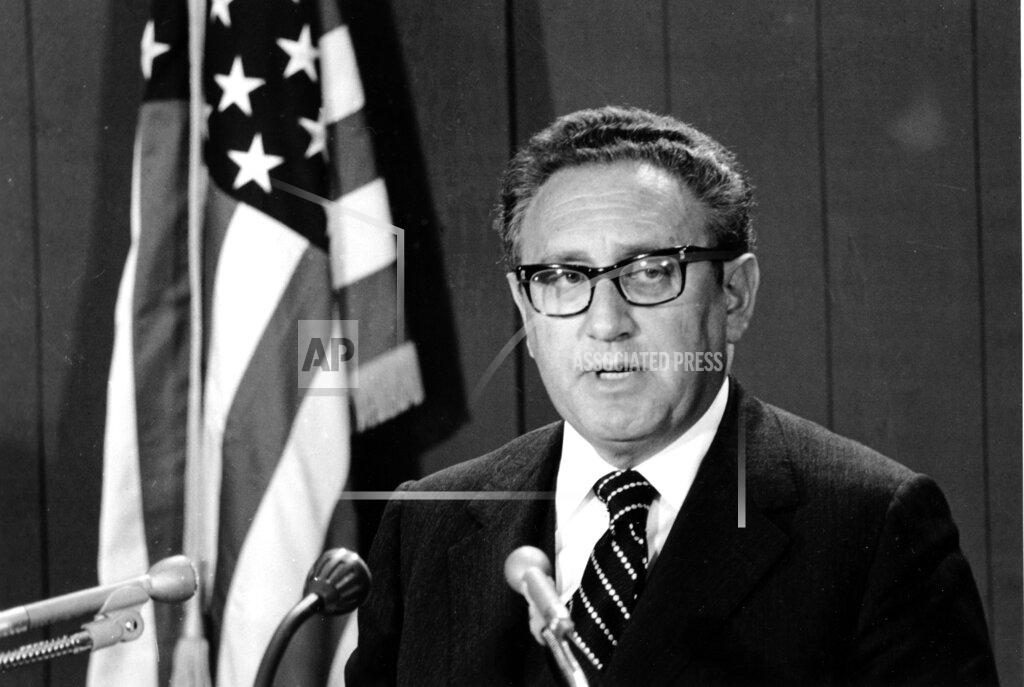
Officially, the Administration refused to fix responsibility on either Egypt or Israel. Mr. Kissinger said yesterday that this “was not the time to assess blame between the parties or to indulge in recrimination.” But while avoiding a public statement on responsibility for the collapse of the talks. Mr. Kissinger, on the way home from the Middle East on Sunday, left a clear impression with newsmen, who promptly passed it on to the public, that Israel had been shortsighted in not going further in making concessions. He contended that as a result of Israel’s refusal to give up more than half of the territory of the strategic passes sought by Egypt in return for less than a nonbelligerency declaration, Israel has increased the risks for war and faced a much more difficult political confrontation at the Geneva conference on the Middle East, which would soon have to be reconvened.
The government told the British people today that if they voted to withdraw from the Common Market in a referendum in June, they would face rising unemployment and inflation. The government said that the political stability of Western Europe would be threatened, Britain would have trouble raising credit on world money markets and the country would run into difficulty in selling its products abroad. In short, the British were urged strongly to vote “Yes,” to remain in the nine‐nation European Economic Community. A white paper, outlining government policy, gave the first public explanation by Prime Minister Harold Wilson of the drawbacks to a retreat from Europe. The document will serve as the target for all those opposed to British membership, including seven of the 23 members of Mr. Wilson’s Cabinet. Nearly half of the governing Labor Party’s Members of Parliament are also fighting to get Britain out of the Market.
Administration officials expressed satisfaction today that five Atlantic alliance countries had voiced concern to Portugal this week about the leftward turn there and that more were expected to follow. The messages, the officials said, were similar to that conveyed Tuesday to President Francisco da Costa Gomes by the United States Ambassador, Frank Carlucci. The five countries are West Germany, Belgium, the Netherlands, Denmark and Italy, according to diplomatic officials. They said that neutral Sweden had also advised the Portuguese military leadership through diplomatic channels that she was worried about the leftist trend in Portugal and that the nine members of the European Economic Community were drafting a joint message voicing similar concern.
President Nicolae Ceaușescu says Romania will continue trade negotiations with the United States although he regards the decision by Congress linking trade with emigration of minorities as “coercion.” In an exclusive interview marking his 10th anniversary as Romania’s Communist leader, Ceaușescu told The Associated Press that the US. trade act and its amendment covering emigration “undoubtedly create a series of difficulties to Romania, too.”
A prize-winning Soviet Jewish cameraman and his family left Moscow for the United States after two years of being denied exit visas and a prominent Jewish geneticist received Soviet permission to emigrate to Israel. Five members of his family were Mikhail Suslov, the cameraman, as he left for the United States. Dissident biologist Alexander Goldfard, 28. was told he could pick up his visa to leave for Israel after filling out proper forms and paying $2.800 in administrative costs. His wife, Valya, will accompany him.
A strong earthquake hit northwest Turkey on both sides of the Strait of Dardanelles and officials reported extensive property damage but no fatalities. Istanbul’s Kandilli Observatory said the quake registered 5.6 on the Richter scale, “intense enough to result in devastation at the origin.” The epicenter of the quake was near the town of Gallipoli, on the north side of the strait.
Turkey proclaimed martial law along its border with Iraq in the face of a reported threat by rebel Kurds to fight their way in as they flee from northern Iraq. Caretaker Premier Sadi Irmak told parliament that the government had rejected a plea for refuge from up to 150,000 Kurds, whose struggle for greater autonomy in Iraq apparently is collapsing. The Kurds then “bluntly replied” that they would use force to enter. Irmak declared.
Vice President Rockefeller gave assurances today to President Anwar el-Sadat of Egypt and King Khalid of Saudi Arabia that the United States was striving for a “just, equitable and lasting peace” in the Middle East. Mr. Rockefeller, representing President Ford, came to Riyadh to express official condolences over the assassination of King Faisal on Tuesday and to reassure the new Saudi leaders of continued military and ecohomic cooperation. The meeting with President Sadat, who was one of many foreign dignitaries who came to King Faisal’s funeral, provided Mr. Rockefeller with an opportunity to review the breakdown of Secretary of State Kissinger’s efforts for an Egypaian‐Israeli disengagement accord on Sinai.
The United States announced that it would give 30,000 tons of food grains for workers on development projects in India. The grain, worth about $9.6 million including transportation charges, is scheduled to start arriving in three months under the U.S. Food for Peace Program.
The leader of the major opposition party in South Korea challenged a new censorship law today by urging President Park Chung Hee to permit revision of the nation’s Constitution and to resign. Kim Young Sam, president of the New Democratic party said in an interview that the Constitution should be revised “to provide institutional guarantees for a fair election.” It should also provide for a peaceful transition of government, Mr. Kim said. The opposition leader added that he would not object if Mr. Park ran for office again after resigning if it was in a “democratic election.”
Two more victims of politically motivated assassins have been found in Argentina, one of them a young metal worker employed at the country’s largest steelworks from which police have dislodged about 1,000 strikers. Police said that the bullet-riddled body of the metal worker was found on a small farm near Villa Constitucion, 190 miles north of Buenos Aires, where police had entered the Acindar plant to remove the strikers, protesting against the arrest of union leaders.
Organized labor, the backbone of the Peronist movement, is threatening to withdraw its support from the Argentine Government, which could further undermine President Isabel Martinez de Perón’s weakening hold on power. Although conservative labor leaders emphasized in private conversations that a confrontation with the Government was not inevitable, few thought that Mrs. Perón could halt the continuing political and economic decline or accede to key demands being pressed by organized labor. In a policy statement drawn up by the labor leadership this week—and not yet made public —conservative unionists are demanding the resignation of José López Rega, the controversial right‐wing strongman who is Minister of Social Welfare and the President’s private secretary.
Shooting continued in the Angolan capital of Luanda in the wake of earlier clashes between two rival liberation movements that left more than 50 dead. The Angolan official radio, in a special broadcast carried on the Portuguese state radio, said troops of the Zaire-based National Front for the Liberation of Angola had defied an order confining them to barracks.
Troops in the Zambian capital of Lusaka have arrested the entire Supreme Council of Zanu, the Rhodesian nationalist organization, and many of the movement’s military commanders, a Zanu official said in Stockholm. Claude Chokwenda, Nordic representative of the Zimbabwe African National Union, said about 50 Zanu officials and members were detained at gunpoint.
President Ford believes that the House would sustain a veto of the $22.8 billion tax cut bill passed by Congress, but it will be “several days” before he decides whether to sign or veto it the White House press secretary, Ron Nessen said. Representative John Rhodes of Ohio, the House Republican leader, predicted that the bill would be vetoed.
The White House announced that President Ford would appoint Secretary of the Interior Rogers C.B. Morton as head of the Commerce Department. There were reliable but officially unconfirmed reports that Mr. Ford would name former Gov. Stanley Hathaway of Wyoming as the new Secretary of the Interior.
President Ford has decided to set up an independent presidential campaign committee to raise money and seek delegate commitments late next summer. Mr. Ford has been saying for months that he would campaign for a full term under the auspices of the Republican National Committee, but he has been persuaded by his advisers that this would be impossible in the pre-convention phase of the campaign because of the new campaign finance law.
The Commerce Department reported that a huge and probably temporary drop in oil imports moved the United States balance of trade from a deficit in January to a record surplus of $917 million in February. The decline in oil imports — by $1.5 billion in a single month — was attributed mainly to the distorting effect of the imposition February 1 of a new $1-a-barrel import tax.
Susan Edith Saxe, a young radical fugitive who had eluded capture for more than four years despite being on the FBI’s most wanted list, was arrested in downtown Philadelphia, the FBI said. Miss Saxe, 26, was the fourth major radical taken into custody in recent weeks. FBI Director Clarence M. Kelley said she had been sought since 1970 on charges of interstate flight to avoid prosecution for the murder of a Boston police officer shot in a bank robbery in Boston on September 23, 1970. Still being sought on the same charges is Katherine Ann Power, another young radical on the most wanted list, the FBI said.
The woman who said she spied on the sex lives and drinking habits of prominent persons for the Internal Revenue Service says she has been told there will be retaliation for her disclosure of the operation. Havana-born Elsa Gutierrez, known by the code name of Carmen, has been under guard by the Dade County (Miami) state attorney’s office since she told about Operation LEPRECHAUN. “Third parties have passed the word to me that there will be retaliation by IRS people,” she said. Mrs. Gutierrez’ statement about the work she did for the IRS during 10 weeks in 1972 have prompted investigations by at least three congressional panels.
A federal judge in Washington ordered the U.S. Army Corps of Engineers to greatly expand its jurisdiction over the nation’s waterways, a ruling that attorneys said was a victory for conservationists as it would significantly limit coastal and inland waterside development. In combating the expansion, the corps had estimated it would cost an additional $53 million a year and require the hiring of 1,750 more employees. But U.S. District Judge Aubrey E. Robinson Jr. said the Army Corps now was responsible for the nation’s waterways along non-navigable streams and also waterways farther inland from the coastline than the corps had maintained.
The Supreme Court said it would hear arguments on April 21 on whether the death penalty is constitutional. This means a decision is likely before the justices end their work year in late June. At present, 208 men and 2 women are awaiting execution nationwide. But states, looking to the court for guidance, have not made any move to carry out the sentences. In 1972 the Supreme Court struck down all state capital punishment statutes on the grounds that they left too much discretion to judge and jury. Since then, 31 states have enacted new death penalty laws, all aimed at taking out the element of chance.
William Sheehan, president of ABC-News, said he had rejected a deal with Rabbi Baruch Korff that could have cost his network $250,000 for an exclusive interview with former President Richard M. Nixon. Sheehan said an ABC correspondent on the West Coast approached Korff, one of Mr. Nixon’s staunchest supporters, about the possibility of an interview and was told Korff might. seek to arrange it in return for a $250,000 contribution to Mr. Nixon’s legal defense fund. Sheehan said when the New York office was notified of the offer, he, personally, rejected it. “We did not know if Korff was just fishing or was actually representing Nixon.” Sheehan said. Korff, however, has confirmed he made the offer.
Skeptical residents of Key Biscayne, Florida, warned that their island’s drinking water was unsafe, said they could not find anything wrong with it. But many of them were boiling it anyway. Drinking fountains were turned off in most public buildings, including the elementary school. where pupils were sold orange juice at 10 cents a container and given water out of 20-gallon jugs brought from Miami. Dade County Health Director Milton Saslaw has said the water pressure on the island of 35,000 persons is dangerously low and could result in contamination. He said the order to boil the water would remain in effect as long as the pressure was low, which is a seasonal happening caused by the influx of both tourists and part-time residents.
Construction began on the 800 mile long “Alaska Pipeline” that would transport crude oil from Prudhoe Bay to Valdez.
A three‐year‐old girl was killed and at least 200 persons were left homeless today when tornado touched down in the Texas Panhandle oil town of Lefors, before striking again at a small community 60 miles from here. Sheriff Rufe Jordan said some 50 persons had been injured. He estimated that two-thirds of the buildings in this town of 900 had been damaged. The girl was killed when the tornado splintered her family’s mobile home. Her parents, Mr. and Mrs. Raul Anzaldua, were hospitalized. The tornado struck Lefors at 12:50 AM, then moved east. An hour later it slammed into the town of Higgins, northeast of here, cutting a 200‐foot‐wide path. No injuries were reported at Higgins.
At least seven members of a northeast Baltimore family died early this morning in a row house fire, officials said. Several others were injured in the single‐alarm blaze, which followed six others earlier in the morning in another neighborhood. Fire officials said the six blazes were of suspicious origin. The deaths brought the city’s fire toll this year to 24 or 25.
Billie Jean King was so happy at being back in the thick of a Virginia Slims tennis tourney tonight that she giggled her way through a 6-1, 6-0 rout of Wendy Overton to enter the semifinals of the $75,000 event at the Palestra. Then she “called off” a threatened boycott of the United States Open by the Women’s Tennis Association.
Dow Jones Industrial Average: 770.26 (+4.07, +0.53%)
Born:
Fergie [Stacy Ferguson], American pop/R&B singer/rapper of the Black Eyed Peas and actress; in Hacienda Heights, California.
Anthony Bass, NFL defensive back (Minnesota Vikings), in St. Albans, West Virginia.
Died:
Gertrude Niesen, 63, American actress, comedian, and songwriter (“Start Cheering”; “Rookies on Parade”), following a long illness.




 History Diaries