

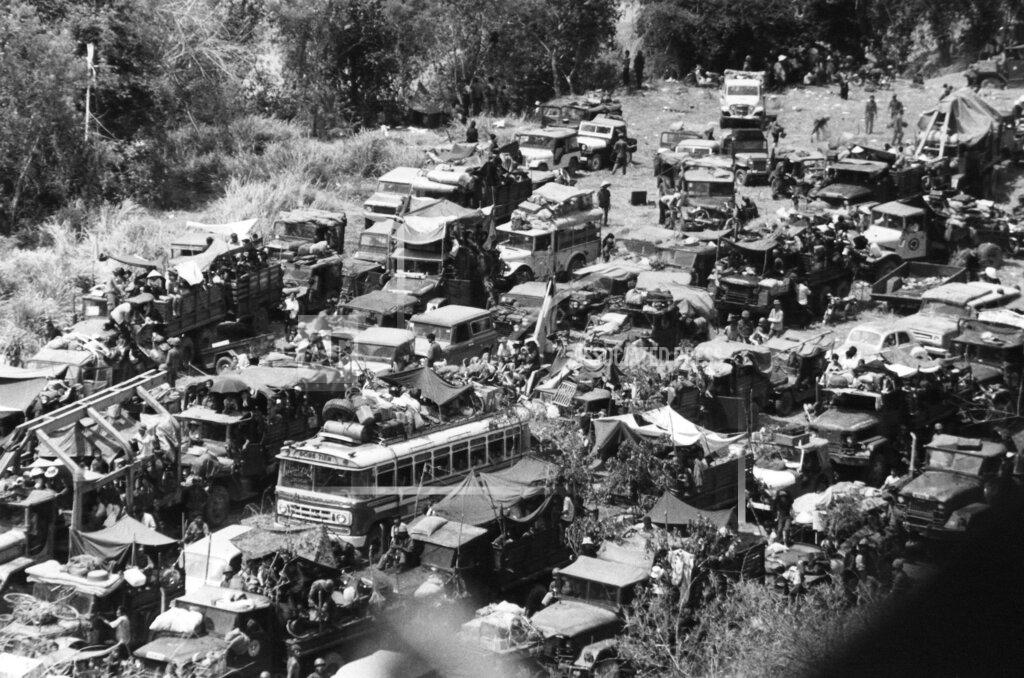



With all roads out of the major port city of Đà Nẵng cut, Western observers there said the North Vietnamese had more than 35,000 men increasing their pressure and able to strike at it. South Vietnam’s President, Nguyễn Văn Thiệu, broadcast an appeal to his people and armed forces to stop the enemy advance short and hold defense lines to the last. American charter planes evacuated many Americans and many of their South Vietnamese employees as well as some South Vietnamese officials from Đà Nẵng. A major airlift of refugees is being planned. But some doubted the demoralized government troops could hold.
Major Communist units passing through Huế, the city 50 miles to the northwest that Saigon Government troops abandoned Tuesday, were reported headed toward Đà Nẵng. In the center of the country, meanwhile, the Communist offensive was continuing, and the district capital of Tam Quan in Bình Định Province reportedly fell early today after heavy fighting. The Communists seemed to be pressing toward the provincial capital, Quy Nhơn.
Meanwhile, many of the 344 American residents of Đà Nẵng, many of their South Vietnamese employes and some South Vietnamese officials were flown out of Đà Nẵng yesterday in aircraft furnished by Air America, the airline that makes charter flights for the United States Government in Southeast Asia. American officials also hastened arrangements for evacuating as much of the poptilation as possible. The first of the Boeing 747 jumbo jets being engaged for this purpose were awaited later today. Besides the departures by smaller planes, there were others‐by boat.
Evacuation was also reported under way from other cities along the central coast still under Saigon Government control, among them Tuy Hòa. But despite the continued movement of vast numbers of people and the apparent threat to Đà Nẵng the situation around the country seemed somewhat less chaotic last night than in the last few days. President Thiệu, who addressed the nation for five minutes, said: “You fellow combatants must stop the enemy advance short, holding our positions and defense lines to the last, making exhaustive use of all our capacities to destroy the enemy arid counterattack.”
The President said that government forces, faced with “obviously overwhelming” Communist strength, had been forced to contract their areas of defense “to conform with the capabilities available to us in these areas.” He said that their struggle had gone through many ups and downs, “but we always grew stronger in every aspect after each test.” The President spoke as numerous rumors circulated that he was either dead or incapacitated. Reporting on military action in the region around the capital, the Saigon command asserted that 260 Communist troops were killed Tuesday by Government air strikes and infantry in countering an attack near the Tây Ninh Province town of Hiếu Thiên, 37 miles northwest of here.
The action was said to have begun with a Communist attack on a government militia unit guarding a bridge. The militia and South Vietnamese rangers were said to have repulsed the attack, and five of their own men were reported killed. Elsewhere in, that area government rangers were reported to have broken through to reopen the road between Tây Ninh and Saigon. Reports received here early yesterday that Communist forces, including tanks, had attacked or taken the towns of Hà Tiên and Rạch Giá near the Cambodian border on the Gulf of Siam appeared to have been unfounded. Travelers arriving here later in the day reported that both towns were safe.
According to some aviation sources, a civilian helicopter belonging, to Air America and carrying about 14 evacuees came under fire from Saigon Government troops yesterday after it took off from the air base at Chu Lai on the central coast. The informants said that the aircraft was struck some 20 times by the Saigon troops’ fire but that no one was hurt. Reuters reported from Đà Nẵng after the helicopter returned there that one crew member and one woman passenger had been wounded by troops, who had clamored for seats aboard the craft and had fired when their plea was rejected. A traveler arriving tonight from Tuy Hòa said that the American mission there, consisting of about 45 persons, was being evacuated and that by last night most had left the city. Farther up the coast at the important city of Quy Nhơn, civilians also were reported trying to leave as quickly as possible.
Tens of thousands of refugees jammed the piers today along the Hàn River, which runs through Đà Nẵng. Some were looking for relativeg among people still arriving from Huế, which was abandoned yesterday. Others were trying to buy passage on a fishing boat or barge to Saigon. An elderly woman in a brown ao dai, the traditional Vietnamese tunic dress, said she had been offered a ride for one million plasters — about $1,500. “But they said I would have to pay cash and I don’t have it,” she said.
Some small boats, already laden to the gunwales, sat in midstream waiting for even more passengers. One tugboat had two cars on its tiny foredeck and several hundred persons hanging over its sides, including some wounded soldiers, their feet dangling in the water. “They are the lucky rich,” commented a 20‐year‐old soldier sitting on the quay. He and a comrade had walked out to Đà Nẵng from Quảng Trị Province, a distance of 701 miles. It was the fourth time he had become a refugee, he said.
According to some unofficial estimates, at least a third of the population of Huế stayed behind or was unable to flee when the South Vietnamese abandoned it yesterday. Some people in Đà Nẵng also expressed a desire to stay rather than become refugees. “What is the difference between the two regimes,” asked an air force enlisted man who moonlights by driving one of the Honda motorbikes that serve as Đà Nẵng’s taxis.
Troops that left Huế abandoned most of their artillery and tanks in their hasty retreat and their weapons are presumed to have been captured by the Communists. Today many soldiers wandered aimlessly in Đà Nẵng without their rifles or even their boots. They mixed with the hundreds of thousands of refugees who have flooded into the city from the four northern provinces that have been given up to the Communists over the last two weeks — Quảng Trị and Thừa Thiên, north of Đà Nẵng, and Quảng Tín and Quảng Ngãi, south of the city. Many soldiers, including officers, did not seem to know where their units were or where to report for duty. One First Division major, who fled from Huế by sampan yesterday said that his commanding officer at Phú Bài had fled without giving any orders, either to hold or to retreat.
As of now, there appears to be no danger of starvation for the refugees in Đà Nẵng, whose normal population of 500,000 has been doubled in the last few days.
The South Vietnamese Army is stunned and demoralized by the North Vietnamese offensive and the government’s decision to abandon most of the northern two‐thirds of the nation, according to Western military analysts, Vietnamese observers and army officers in the field. These sources say that troops in the 1.1‐million‐man armed forces are puzzled and humiliated by the abrupt events over the last two weeks, “The army is in a state of trauma,” said one knowledgeable Western official. Another Western analyst said: “They’re going through a period of terrible confusion. A lot of these officers are from the North, and their families came here in 1954. They’re proud. They feel they weren’t given a chance to prove themseives.”
One deputy battalion commander from the Pleiku area said recently that his unit was abruptly told by the Saigon command to evacuate its camp within 30 minutes, despite only sporadic fighting in its locale, It was only when the troops moved through Pleiku and saw fellow soldiers destroying gas, and ammunition supplies, that the unit realized the government was abandoning the Central Highlands. “We were very angry, very ashamed,” the officer told a visitor recently in Tuy Hòa, a coastal city 235 miles northeast of Saigon and a refuge point for tens of thousands fleeing the highlands, “We wish we could fight to the death. It’s a shameful death by retreating and starvation and sniper fire on the road.” Another officer in Tuy Hòa said: “We are not cowards. Why did we do this?” In Đà Nẵng today, a First Division major, with helmet and field pack, told some visitors that he left the evacuated city of Huế by sampan and had no idea where his unit had gone. “I don’t even know where my wife and children are,” he said in Vietnamese. “Why should I care about my division command?”
At this point there seems too much confusion within the army — and among civilians — to weigh the overall and longrange impact on the military of the rapidly unfolding developments in Vietnam in the last two weeks, “ARVN morale is low and has been going downhill for some time,” said one Vietnamese observer, discussing the South Vietnamese Army. “There just can’t be any major engagements in the days to come if ARVN morale is not redressed at least to some degree.” Even before the current offensive, the army faced somber problems: corruption among division commanders, indiscipline and desertion in the ranks, a lack of incentive to keep fighting because of inept leadership, favoritism and poor pay. Moreover, the South Vietnamese Army had been hampered — some Western diplomats say crippled — by shortages of gasoline lubricants and oil for helicopters and the whittling down of American military assistance. In the current fiscal year ending in June, military aid here totals $700‐million, compared with $1.2‐billion in the previous year. There is some question about future military assistance to South Vietnam, a nation whose army is hard-pressed for spare parts, ammunition and hand grenades.
Several military units are first rate, say Military analysts. These include a marine division in the tense city of Đà Nẵng and the nation’s airborne division, whose three regiments, of 2,400 men each, are divided between Đà Nẵng, the coastal city of Nha Trang and Saigon. There are about a dozen ranger regiments — a once‐impressive group — but the battle losses in these units are heavy and they have been seriously weakened by many cases of heroin addiction in the Central Highlands. But the bulk of the 11 Government infantry divisions have proved vulnerable and shaky. Some sources say that the desertion rate may he as high as 24,000 a month, and South Vietnamese casualties, including killed and wounded, total about 1,000 a day. The army, with no ammunition to waste, scant air mobility imd haphazard air support, has turned in some sloppy performances. An example is the case of Buôn Ma Thuột, the highlands city whose unexpected fall to the Communists prompted President Nguyễn Văn Thiệu to abandon the northern two‐thirds of the nation.
The South Vietnamese government announced the arrest of a number of persons for plotting to overthrow President Nguyễn Văn Thiệu. The Ministry of Interior said that the conspiracy was linked to the current Communist military offensive and sought to upset the constitutional regime. Vietnamese sources said that one of the arrested men met yesterday with former Vice President Nguyễn Cao Kỳ, who held a private conference with opposition anti‐Communist figures at an officers club at Tân Sơn Nhứt Air Base. Mr. Kỳ has been a long‐standing opponent of President Thiệu, but there was no immediate indication, that he was involved in the reported conspiracy.
The Saigon bureaus of The Associated Press and United Press International were accused by the South Vietnamese Government today of “flagrant violation” of official rules on press disclosure of troop movements. The two news agencies were publicly warned that sanctions would be taken against them if similar incidents occurred again. Specifically, they were accused of having reported the abandonment of Huế by Government forces before Saigon itself had announced such a development. Saigon has not so far announced the fall of Huế. Details of the departure of civilians and troops from the city became known yesterday from qualified military sources.
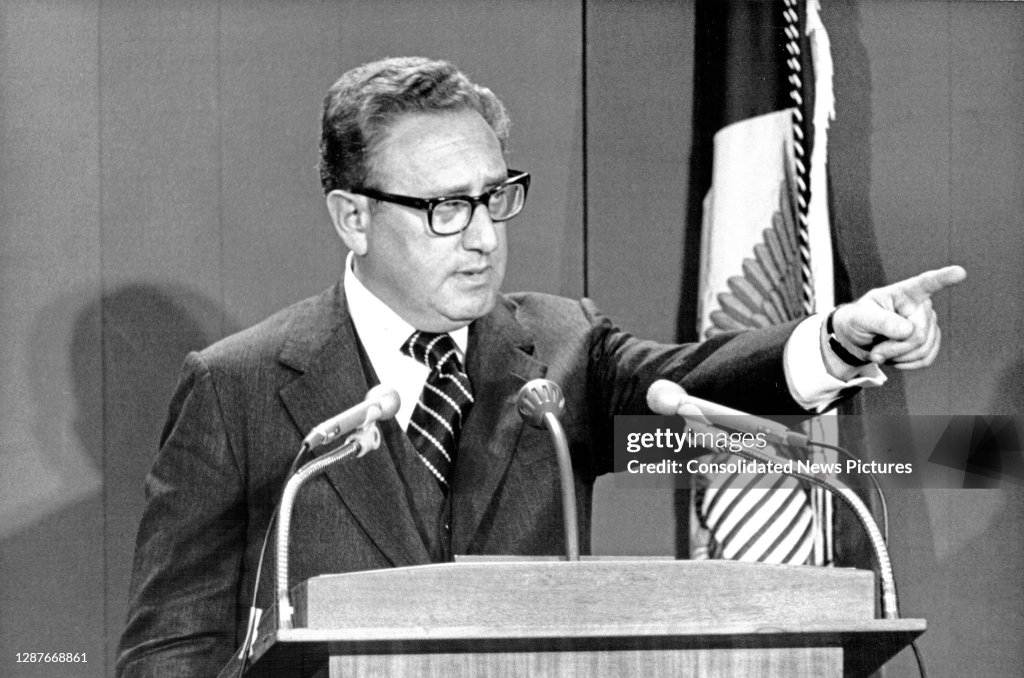
Secretary of State Kissinger, in an effort to break an impasse with Congress, revived the administration proposal for a three-year phase-out of military and economic aid to South Vietnam. To withhold aid now, he said at a news conference, would destroy an ally in its moment of extremity and violate a moral commitment. He acknowledged strong feelings in Congress against the annual aid appropriation and said there was a chance that in three years, with adequate aid, South Vietnam could become more self-sustaining. “We told the South Vietnamese Government,” he explained, “not as a commitment of the United States that aid would continue, but in our judgment, if the South Vietnamese cooperated in permitting us to withdraw our forces and therefore to reclaim our prisoners, that the Congress would then vote the aid that would be necessary to sustain Vietnam economically and militarily… We’re not talking here of a legal American commitment. We’re talking here of a moral commitment.”
Pope Paul VI appealed to the entire world to turn its attention to the “indescribable agony of tears and blood” the Vietnamese people are suffering. Addressing a crowd of 20,000 in St. Peter’s Basilica, the Pontiff declared that the “frightening exodus which has really taken up very serious proportions” signifies a “sad and dangerous hour for mankind. Let us pray to the Lord in whose hands rests the destiny of man,” he said.
Prince Norodom Sihanouk, leader of the Cambodian insurgents, today rejected a reported new peace appeal by Premier Long Boret of the Phnom Penh Government. In a statement circulated to correspondents in Peking, the prince described the appeal as “a new comedy played out on the bloody Cambodian scene by United States imperialism.” Premier Long Boret’s appeal, according to the prince, called for a cease‐fire, negotiations and national reconciliation in Cambodia. The prince said Premier Long Boret was one of the Phnom Penh leaders condemned to death by the insurgents.
It was, again, a day of preparation out along Cambodia’s Route 4. The brigade of about 150 Cambodian troops moved off the strip of highway and headed north. About 200 feet into the bush they stopped and began cooking their lunch. They were, they said, waiting for the armored personnel carriers to push on the treeline where the enemy was supposed to be, but nearly an hour later they still had not appeared. The operation was typical of those that Cambodian and Western military officials have been hoping will clean up the rocket emplacements from where day after day insurgent troops have been pumping rockets into Pochentong Airport — the last supply route for the encircled Cambodian capital.
Two days ago, the latest head of the operation, Colonel Van Dy, and two of his officers were clapped in jail, Western military officials said, because their troops had fled their positions around Tuol Leap. Yet little more than two weeks ago Colonel Van Dy himself, sitting in his command bunker of discarded ammunition boxes and tree trunks, talked with disgust of the reinforcements he was given — of motor‐pool soldiers and crippies with no battle training who sometimes turned and ran before a shot was fired. Colonel Van Dy is now something of a rarity here — he is American‐trained and has a degree of competence. Whether he has in fact been jailed is open to serious question, but his removal is indicative of at least one key fact — the Cambodian command is eager to please the Americans. If it cannot win on the battlefield, it at least wants to prove it is not for lack of effort.
“If they want the airlift to continue, they must do this,” a senior Western military observer said today of the operation to clear out the rocket emplacements. “And they’ve been told this at the highest level.” Yet it has still not worked. New rocket positions have even begun to appear to the east of those that had been shelling the airport near Tuol Leap, the military observer said. It is all part of the pattern of war here — of a row of houses called a village suddenly being abandoned by the handful of frightened troops that are called a battalion, of a few hundred meters of ground lost.
This morning, northeast of the capital, two tiny, isolated outposts on opposite sides of the Mekong about 15 miles from downtown Phnom Penh were abandoned by government forces, and opposite Phnom Penh insurgents again pushed to the river’s edge. In these areas, the government forces generally offer little resistance. In many cases, units are at 30 percent of their full strength.
Western Europe’s first Communist-dominated cabinet was installed by Portugal’s Prime Minister Vasco dos Santos Gonçalves. The premier announced today a program of “total austerity” as well as further moves toward socialism through the nationalization of basic industries. The new Cabinet shows a big increase in Communist influence as well as what the Premier termed “a new impulse of the revolutionary process.” He called the 21‐member Cabinet of civilians and military officers a group of “militants” and combatants in the struggle for progress and well‐being. Despite a leftward trend that has caused alarm in Washington and other Western capitals, the American Ambassador, Frank Carlucci, in his first public speech here, stressed continuing American confidence in and help for Portugal.
The United States has warned the military leadership in Portugal that the leftward turn there is inimical to American and Atlantic alliance interests. The message, delivered yesterday to President Francisco da Costa Gomes, conveyed essentially the same admonition made public today by Secretary of State Kissinger at his news conference, United States officials said. Mr. Kissinger said: “We are disquieted by an evolution in which there is a danger that the democratic process may become a sham, and in which parties are getting into a dominant position whose interests we would not have thought were necessarily friendly to the United States.” Mr. Kissinger said that a leftward trend “will of course raise questions for the United States in relationship to its NATO policy and to its policy toward Portugal.” He added that Washington was “in close contact” with the 13 other members of the North Atlantic Treaty Organization about Portugal.
The Biological Weapons Convention, the first multinational treaty banning the production or use of a specific category of weapons, entered into force by its own terms. The Biological Weapons Convention (BWC) effectively prohibits the development, production, acquisition, transfer, stockpiling and use of biological and toxin weapons. It was the first multilateral disarmament treaty banning an entire category of weapons of mass destruction (WMD). States Parties to the Biological Weapons Convention undertook “never in any circumstances to develop, produce, stockpile or otherwise acquire or retain:
- Microbial or other biological agents, or toxins whatever their origin or method of production, of types and in quantities that have no justification for prophylactic, protective or other peaceful purposes;
- Weapons, equipment or means of delivery designed to use such agents or toxins for hostile purposes or in armed conflict.”
Senator Henry M. Jackson proposed today that the United States and the Soviet Union agree not to modernize 700 of their strategic weapons as a step toward future reductions in their nuclear arsenals. The Washington Democrat, who has considerable influence in the Senate on arms‐control issues, suggested such a new approach to assure that last year’s Vladivostok agreement setting a ceiling on strategic weapons would lead to subsequent mutual reductions in nuclear forces.
In a Senate speech, the Senator expressed concern that the Vladivostok agreement reached between President Ford and Leonid I. Brezhnev, the Soviet Communist party leader, would establish a floor rather than a ceiling on future levels of strategic weapons. His proposal, therefore, was that as part of the treaty now being negotiated to implement the Vladivostok agreement, both sides designated 700 weapons that would not be modernized before the treaty expires in 1985. Then, he argued, these older, probably obsolete weapons would become logical candidates for dismantling as the two nations enter into negotiations on reducing their strategic arsenals.
Publication in London of Britain’s largest daily newspaper, the Daily Mirror, was suspended indefinitely following the dismissal of 1,750 employees of the Mirror Newspaper Group. Unofficial strike action by members of the Society of Graphical and Allied Trades repeatedly has interrupted production of the Daily Mirror in London and led to the loss of about 1.5 million copies Monday night.
Vienna’s veterinary college was sealed off and authorities planned a crash vaccination program after diagnosing hoof and mouth disease in a cow at the college. About 250 persons were quarantined and expected to stay at the college until at least the end of the week. All endangered animals within six miles of the capital were to be vaccinated.
Secretary of State Kissinger told a televised news conference that the Middle East was in potentially grave danger because of his failure to achieve an Egyptian-Israeli agreement. He said the Geneva peace conference would probably have to be reconvened under more difficult circumstances to seek a way of avoiding a new war. Clearly worried by the general decline of American influence, he urged a renewed sense of national purpose to cope with the Middle East and other areas.
Khalid ibn Abd al-Aziz al-Saud, the Crown Prince and the younger half-brother of King Faisal, was crowned as the new King of Saudi Arabia. Faisal was buried, pursuant to Islamic custom, at sundown the day after his death, without a coffin and in an unmarked grave. King Khalid named his half-brother Fahd as the new Crown Prince.
King Faisal of Saudi Arabia was buried in Bedouin tradition near the grave of his father who founded the state, after prayers attended by 100,000 people. A stream of tribal elders, officials and ordinary people came to the palace to pledge their persons and property to the new King Khalid, who received them with simplicity and kindness. At his side was Fahd, the new Crown Prince. Chiefs of state of most Arab countries attended the funeral. Vice President Rockefeller, representing President Ford, is expected to meet the new King and Prince Fahd today.
French authorities released two terrorists and sent them to Aden in South Yemen, meeting one demand made by the kidnappers of Jean Gueury, French ambassador to the Somali Republic. But the abductors added two new conditions for Gueury’s release, the French Embassy in the Somali capital reported. When advised that all was clear for their departure, the embassy reported, the kidnappers demanded that a Somali personality should accompany them as an additional hostage. They also wanted a guarantee from the Somali government that they would not be prosecuted for the kidnapping.
Turkey has turned down an appeal for refuge by thousands of Kurds who want to cross into Turkey as their rebellion against Iraq loses momentum, Premier Sadi Irmak indicated in Ankara. “There is no need for the Kurds to cross our boundaries,” he said. “They can go to Iran from Iraq.”He was speaking to reporters after the cabinet urged parliament to proclaim martial law in four provinces strung along the 210-mile Turkish-Iraqi border.
Muslim rebels brutally hacked 150 men, women and children to death on Basilan Island 550 miles south of Manila in their campaign for autonomy in the southern Philippines, according to the governor of the province. The Yakans, or native islanders, were massacred March 6 as they returned to their farms in Buhebessy, Lamitan, from another part of the island where they had sought refuge during fighting, according to the Philippine military.
The secretary of runaway British legislator John Stonehouse was arrested in Australia on British warrants charging her with fraud involving $54,000 in travelers checks, police said. Officials said Sheila Buckley, 28, was arrested in Sale, 120 miles east of Melbourne. They said she would appear in court in Melbourne today. Stonehouse, who is out on bail, also is scheduled to appear in a Melbourne court today to face fraud charges.
The Supreme Court of Canada, in a landmark decision regarded as a defeat for women’s rights groups, today upheld the interpretation of the country’s five‐year‐old abortion law. The law which represented is substantial liberalization at the time of its enactment in late 1969, permits a doctor to perform an abortion only in a licensed hospital and only after a special committee of doctors at the hospital has agreed that “the continuation of the pregnancy would be likely to endanger” the woman’s “life or health.”
Premier Fidel Castro of Cuba said he would be willing to talk about resuming diplomatic relations with the United States if the U.S. trade embargo of his country is lifted. In an interview with Canadian newsman John Harbron, writing for the Miami Herald, Castro also said he rejected any reconciliation with Cuban exiles in the United States.
Fifty-one young recruits of the Popular Movement for the Liberation of Angola have been machine-gunned to death in the Angolan capital of Luanda by a rival group, the Portuguese Government news agency reported today.
Congress passed the Joint Senate-House conference committee bill that would reduce taxes by $22.8 billion. It would give a tax cut of at least $130 this year to every taxpaying individual or family. Persons earning up to roughly $30,000 would get more, as would those with one or more dependents. The bill would repeal the 22 percent oil depletion allowance this year for major companies, but smaller companies would keep it at a rate declining to 15 percent in 1984. The total tax cut reduction is considerably less than the $30.6 billion approved by the Senate, and less than the figure of $25 billion to $30 billion urged by many economists to halt the sharp business downturn. The bill will go to President Ford, who had proposed a $16.2 billion cut.
President Ford, former California Governor Ronald Reagan and Senator Barry Goldwater of Arizona are the top choices of Republican voters for their 1976 presidential nomination, according to a Gallup Poll survey. Mr. Ford leads with 35% of the vote, followed by Reagan with 22% and Goldwater with 17%. Next is Vice President Rockefeller with 10% among those surveyed. All others in the list of nine persons ranged from 1% to 4% of the vote.
President Ford has decided not to reestablish the White House Office of Science and Technology that had been dismantled by President Richard M. Nixon. An aide said Mr. Ford instead was considering the creation of a small board of science advisers, possibly consisting of three consultants. The office, created by President Dwight D. Eisenhower after the Soviet Union launched its first satellite, had been directed by the President’s official science adviser and had a staff of 50. Mr. Ford’s main objection was that he does not “want a large new bureaucracy at the White House,” the aide said.
IRS Commissioner Donald C. Alexander promised Congress that his agency would not participate in any more investigations like the one that led to buying information on the sex and drinking habits of 30 prominent Floridians. “Our people are not going. to engage again… in any collection of raw data until someone is shown to have avoided his tax responsibility.” Alexander told a House ways and means subcommittee. The Miami-area investigation, which was dubbed Operation Leprechaun, simply “got. out of hand,” Alexander said. He added that the IRS was making an internal study of the extent of its participation in the operation.
Three of six men accused of defrauding a Teamsters Union pension fund of $1.4 million were acquitted in federal court in Chicago. Acting on defense motions, the judge ordered charges dropped against two pension fund trustees-Albert Matheson of Detroit and Jack Sheetz of Dallasand Anthony Spilotro of Las Vegas. Sheetz, a Texas Trucking Assn. president, and Matheson, a Detroit lawyer, and three others were accused of obtaining money from a Teamsters’ pension fund through misrepresentation and of misapplying the funds and converting them “to their own use and benefit.” The money involved was lent to Gaylur Products, Inc., a plastic firm based in Deming, N.M.
An Episcopal Church board of inquiry in New York City declined to order four bishops to stand trial for ordaining 11 women as priests last. July 29. The board voted 8 to 2 that it lacked jurisdiction, finding that the case basically involved doctrine rather than church regulations. The action tossed the whole matter to the church’s House of Bishops, which meets next September. Only by a decision of two-thirds of the bishops can any of their number be ordered to stand trial on doctrinal charges, and such charges have to be instituted by at least 10 bishops. This left uncertain whether further action would be taken.
General Alexander M. Haig Jr. quietly flew home from his European post, had a weekend visit with former President Nixon at his estate and has an appointment today with President Ford, it became known yesterday. General Haig, now the military commander of the North Atlantic Treaty Organization and former White House chief of staff, played a key part in arranging the mechanics of Mr. Nixon’s resignation. Sources close to the general said he flew unannounced last Friday from his headquarters near Brussels and on to California, spending the night at a San Clemente motel.
The first license ever issued in the United States for a same-sex marriage was issued by Clela Rorex, the County Clerk for Boulder County, Colorado. Dave McCord and Dave Zamora had consulted with the county’s District Attorney, who decided that there was nothing in Colorado law that prohibited same sex marriage, and Rorex gave approval for the two men to marry. On April 24, State Attorney General Joyce Murdoch would invalidate the license, as well as five others issued by Rorex.
A national network of breast cancer detection clinics has uncovered two and a half times the expected number of malignancies in women screened during the clinics’ early months. The unusual number of cases is believed to largely represent the fact that many of the women’s cancers were discovered much earlier than they would otherwise have been, according to Dr. Benjamin F. Byrd, president‐elect of the American Cancer Society and professor of surgery at Vanderbilt Medical School.
More than one hundred scientists meeting in Wurzburg, Germany, this week have mapped out a new approach to solving the riddle of multiple sclerosis, based on the hypothesis that the disease is caused by a slow‐virus infection. Slow viruses, which get their name because they lie dormant in, humans for years and even decades before causing illnes have been identified as the cause of a small number of rare diseases of the nervous system, but have not yet been connected to more common diseases. They have raised interest in the scientific world because they may hold the key to major diseases about which little is known. Multiple sclerosis, which damages the brain and spinal cord causing paralysis and often death, attacks on an average of one out of every 1,500 persons in the United States and Europe.
Extreme fire risks and other “specific problems” were not adequately outlined in an environmental impact report on the proposed Walt Disney ski resort in Mineral King Valley, the Tulare County fire warden claimed. Raymond H. Banks said he is particularly worried about a road between Three Rivers and a proposed Oak Grove parking lot for 3,600 cars. In a letter to the U.S. Forest Service, he said a major fire during construction because of equipment and explosives is “very possible.”
The film “Jaws” was given its first preview showing before an audience, in advance of its June 20 nationwide release, at the Medallion Theater in Dallas, Texas.
Ken Russell’s film “Tommy”, based on the rock opera by The Who, premieres in London; Roger Daltrey and Ann-Margret star, Tina Turner and Elton John are featured.
Dow Jones Industrial Average: 766.19 (+18.30, +2.45%)




 History Diaries