The order is given to evacuate Huế by sea and abandon it to the Communists. By now more than one million refugees, driven by memories of the Communist slaughter of civilians during the 1968 Tet offensive, are streaming toward Đà Nẵng, which is already under heavy rocket fire. The northern city of Huế, the cultural heart of South Vietnam. was abandoned by the Saigon government’s forces, The fate of Đà Nẵng, the nation’s second largest city 50 miles to the southeast, appeared imperiled, coming under rocket attack.
With refugees continuing to pour in from abandoned areas both north and south of the city, reports from Đà Nẵng said it was expected to fall soon. A Saigon Government spokesman said that 14 heavy 122‐mm. rockets were fired in the outskirts of Đà Nẵng this morning, apparently marking the beginning of a Communist operation in the area. Six civilians were reported killed and 34 wounded. A new line of defense has been organized to protect what has become the enclave of Đà Nẵng, with Communist‐held provinces to both the north and south.
Meanwhile, the evacuation of South Vietnamese civilians and others from the city has been accelerated. An airlift was under way, and ships were reportedly available to take more people out. Most of the foreigners in Đà Nẵng, including Americans, were being flown out. An aviation official said pilots were worried that North Vietnamese MIG fighter planes would appear over Đà Nẵng soon. With new reverses reported for Government forces in many parts of the country, President Nguyễn Văn Thiệu announced last night that a “war cabinet” would be formed to stiffen national resistance to the Communists.
A statement from the President’s office, broadcast by the Saigon radio, said that Mr. Thiệu had instructed Premier Trần Thiện Khiêm to form a new Cabinet “to meet the urgent requirements of national defense, of relief and resettlement of war victims, to stabilize the economy in the rear areas, to increase production to support the front lines, to mobilize the anti‐Communist spirit and to defeat the Communist aggressors.” There was no indication who would be invited to serve or when the President expected the Cabinet reshuffle. Nor were there any indications whether present plans envisaged the sweeping improvement in leadership that many diplomatic observers consider necessary if the rest of South Vietnam is not to fall swiftly.
Government reverses during the day, military sources reported, included the fall of a district capital in the southernmost part of the country. The informants said Hà Tiên, on the Gulf of Siam near the Cambodian border, was overrun by Communist troops and tanks. Most of Hà Tiên was overrun as well during the Communist offensive of 1972 but was subsequently retaken by government troops. The loss now was considered significant because the presence of Communist tanks in the area, 115 miles southwest of Saigon, appeared to presage a major push.
According to the official Saigon Government spokesman, 12 tanks were destroyed in an engagement Monday even closer to Saigon. That was in Vĩnh Long Province, 65 miles southwest of the capital. The end of Saigon’s control over Huế reportedly came after the last installations there were blown up yesterday and troops embarked on ships off the coast. Reached by telephone in Đà Nẵng last night, a military source was asked whether the North Vietnamese army had yet moved in. “We presume so,” he replied.
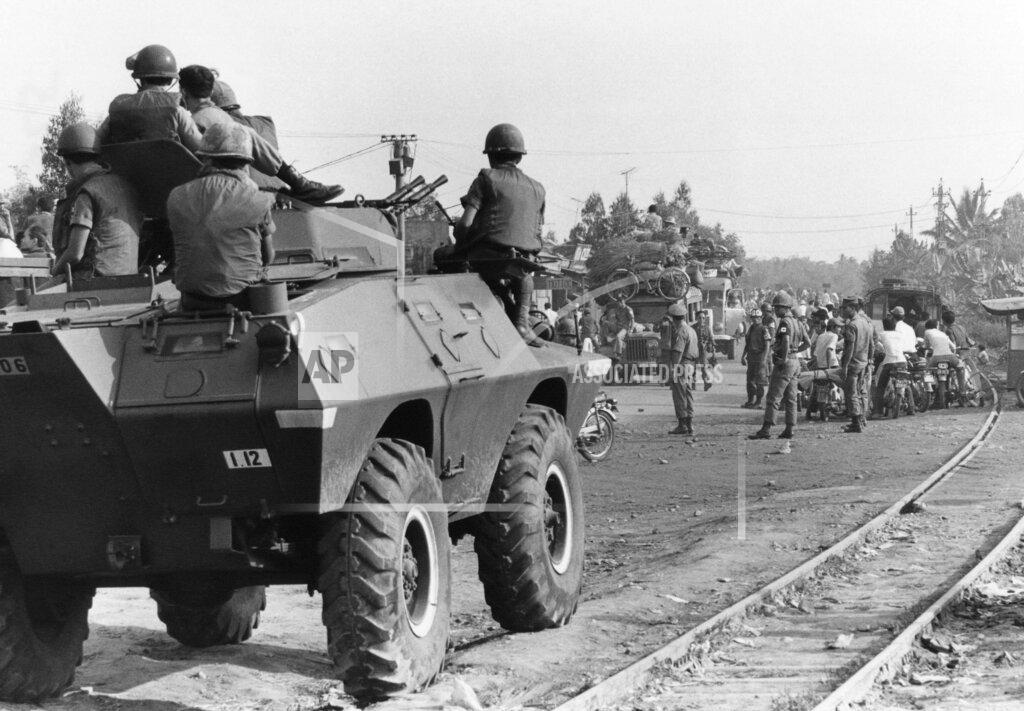
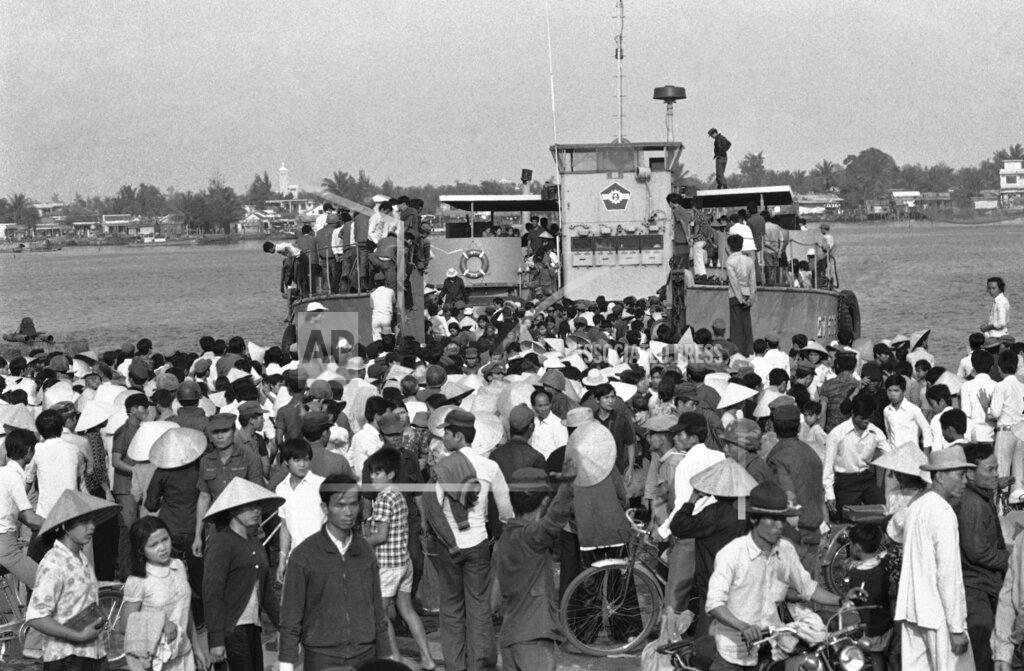
Approximately one‐third of the 200,000 people who lived in Hue were said to be left in the city, most of those remaining having elected to stay under Communist control. Refugees from Huế arrived in Đà Nẵng yesterday by boat, and other boatloads from southern provinces were also landing. Huế became isolated from the rest of the country on Saturday, when Route 1 leading southeast to Đà Nẵng was cut. Shelling thereafter effectively prevented air evacuation except for helicopter flights into the old part of the city on the northeast bank of the Hương River. Finally, access to Huế was reduced to a fleet of sampans, landing craft‐and other vessels handicapped by staggering loads and heavy seas.
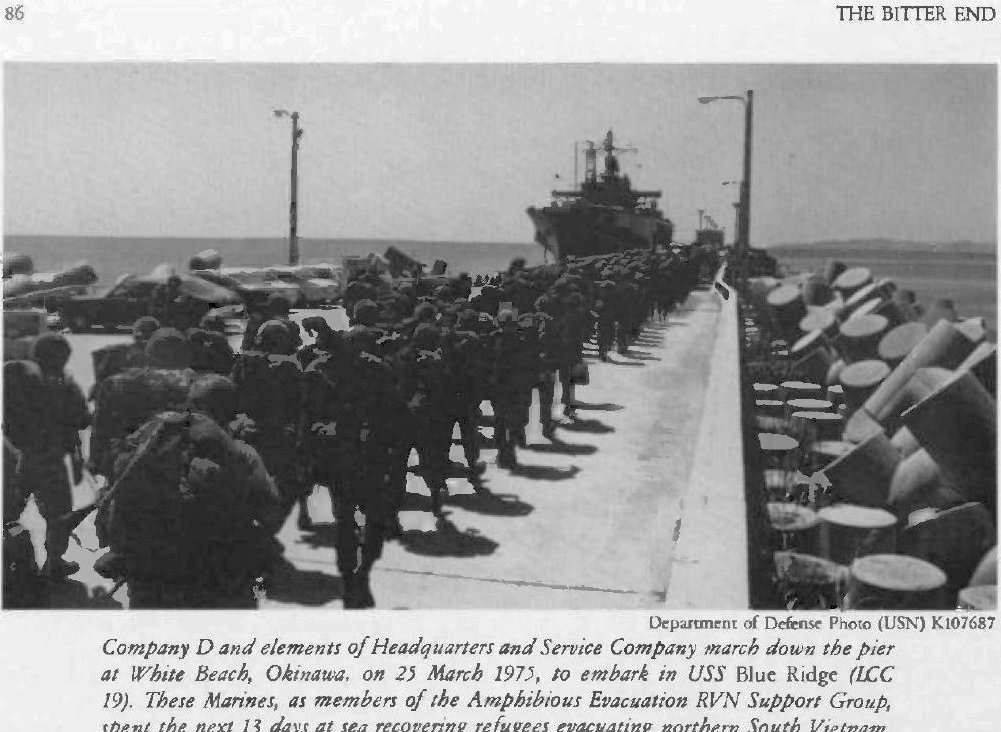
The loss of Huế will be an incalculable blow to the morale of the South Vietnamese people. While the city was not one of the country’s most populous and its strategic significance is limited, its importance as the old capital, cultural center and an almost mystical place are great. The Hanoi radio quoted foreign press reports as saying that American helicopter carriers were moving toward South Vietnam to evacuate Americans from Đà Nẵng. The broadcast urged all Saigon troops, police officers and administration personnel in central Vietnam to switch sides quickly. There are several hundred Americans in Đà Nẵng, includling about 40 officials of the consulate and associated agencies, businessmen, dependents, representatives of charitable organizations, and missionaries.
Communist pressure in other parts of the country continued to mount during the day, and it was expected that the next major enemy push would be against Tây Ninh, which has been increasingly threatened. Tây Ninh, near the Cambodian border, is of great importance because of its dominance over the highway leading into Saigon.
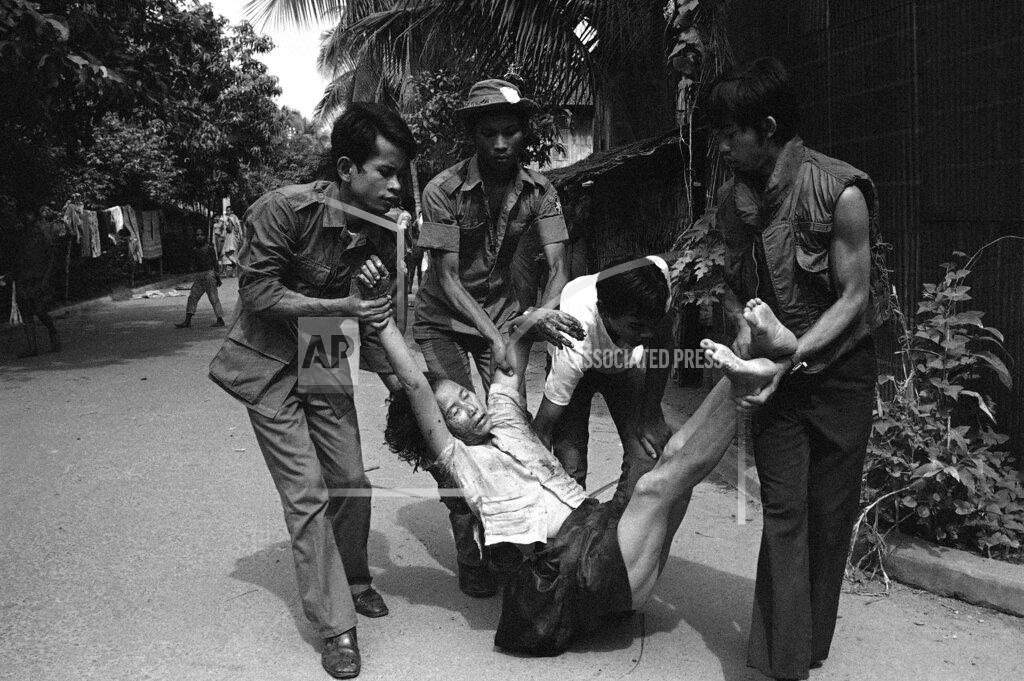
As dawn broke over the beaches near Huế today, an armada of South Vietnamese Navy and civilian vessels of all sizes stood 500 yards from shore. The city of Huế, 10 miles from the sea, was falling to the Communists, and thousands of soldiers and civilian refugees were on the shore at Thuận An scrambling to be evacuated. Some soldiers ripped off their boots and trousers and dropped their rifles before plunging into the mild surf and swimming out to the rescue vessels, according to the first groups to arrive here this afternoon.
“It was an ocean of people on the Thuận An beach waiting from early morning,” said a civil servant who arrived on the first ship. “We fought to get out there.” The exodus by sea followed a decision yesterday to abandon Huế rather than defend the former imperial city against what the South Vietnamese military described as an overwhelmingly superior force. A Vietnamese photographer who was on one of the last helicopters to land at Huế yesterday afternoon said troops of the South Vietnamese First Division were fleeing with their families down the 10‐mile highway to the beach. He said they did not seem to be withdrawing in units. Several large transports moored to a jetty today were loading 75‐mm. artillery guns and trucks. There were thousands of vehicles and artillery pieces in and around Huế, and it was believed unlikely that many of these could be moved out in time.
North Vietnam has reportedly extended its offensive into the Mekong Delta, compounding the military problems faced by the Saigon high command. South Vietnamese troops preparing to defend the delta, considered the economic heart of the country, lack fuel for their helicopters and are short of ammunition and even hand grenades. Officers in Cần Thơ, the major delta city, say these critical shortages leave the area increasingly vulnerable.
American military sources reported that North Vietnamese troops had pushed out of Cambodia and seized Hà Tiên, 115 miles southwest of Saigon. This appeared to be the opening move of operations designed to take advantage of Saigon’s weakness in the delta. The sources, surveying the general situation marked yesterday by the abandonment of Huế, saw only two developments to offset the psychological impact of the loss of that northern city and the tightening of the net around the Saigon area. One, they said, was a second repulse of Communist troops trying to push past Khánh Dương, south of Buôn Ma Thuột, toward the Saigon front. The second was said to be an expectation, based on reports from South Vietnamese staff officers, that Đà Nẵng could be defended along a perimeter running from Thanh Bình on the south to beyond the Hải Vân Pass north of the city with supplies brought in by ship at night.
American officers believe that Communist troops will be directed from Huế, against Đà Nẵng, but that some days will elapse before they can be regrouped. When the attack starts, these sources said, North Vietnam will have an advantage it has had in almost every battle in the offensive. The South Vietnamese will be fighting from fixed positions. This allows Hanoi’s artillery, superior in numbers, and in weight, to be used against set targets. The South Vietnamese have not been able to fight a maneuver battle, partly because of shortages of fuel, partly because they have been committed to the static defense of towns. Such withdrawals into defense positions enable the attackers to assemble forces for new operations and move up tanks and artillery without fear of spoiling attacks by the Saigon forces. The North Vietnamese are said to be improving their positions in the Saigon area where accordingto intelligence reports, they have concentrated about 200 tanks around Tây Ninh.
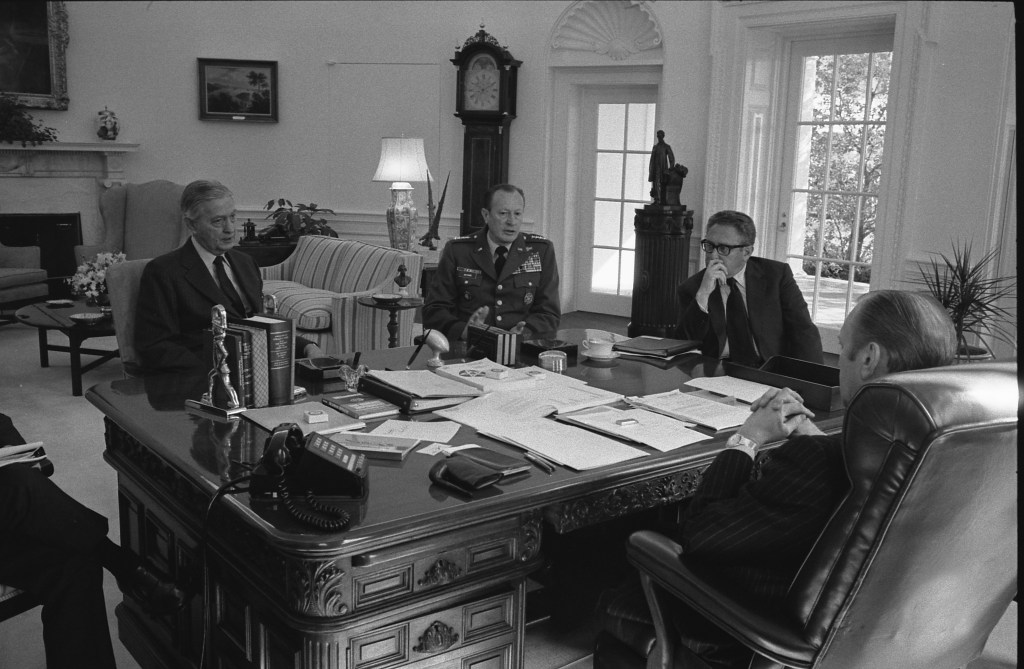
President Ford directed the Army Chief of Staff, General Frederick Weyand, to fly to Saigon to assess the military situation and recommend whether any further American assistance is needed. The White House said Mr. Ford wanted to tell the South Vietnamese of the President’s strong support and all-out effort to persuade Congress to give more aid. At the same time, the State Department announced that the United States would begin an airlift tomorrow to evacuate thousands of refugees from Đà Nẵng in northern South Vietnam. In Saigon, the United States Embassy asked airline contractors to provide aircraft to evacuate immediately an initial total of 40,000 people from Đà Nẵng and it was expected that the airlift would be carrying at least 10,000 a day.
With the four‐nation International Commission of Control and Supervision for the Vietnam cease‐fire in growing disarray, part of Indonesia’s delegation was planning to leave the country today, and there was a possibility that Indonesia would quit the commission. Indonesian officials said they did not know how many of their delegates would remain in Saigon after today’s evacuation. Other sources said that 32 of Indonesia’s 290 delegates would leave today. Commission sources said that Indonesia was the only one of the four countries to have a full delegation here in the first place, and that since many sites in Vietnam were no longer accessible to the peacekeeping observers. There was no point in keeping on such a large number.
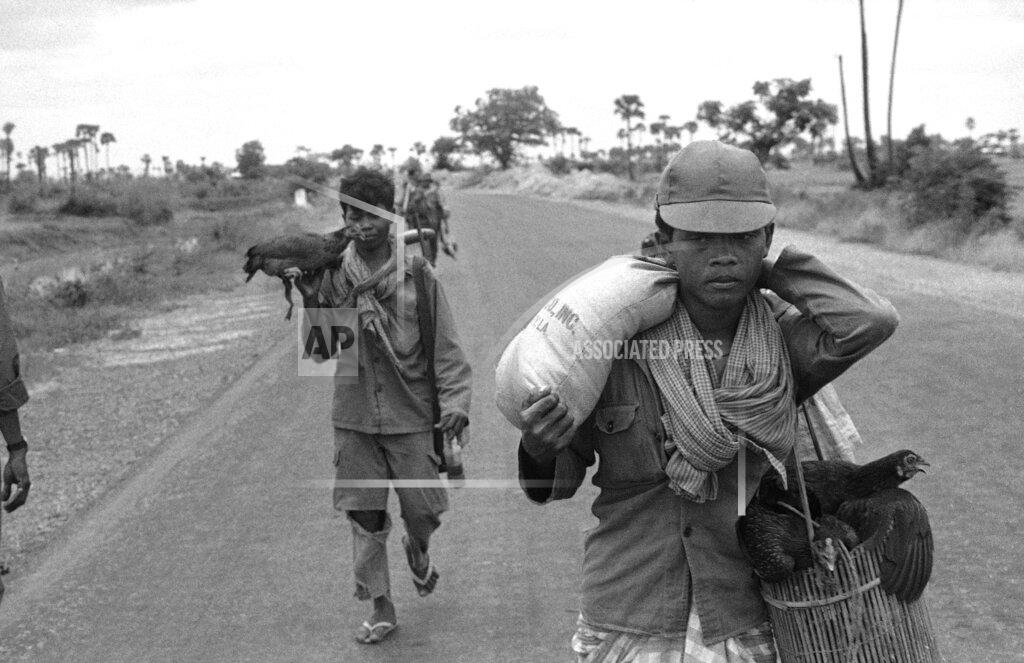
Communist-led insurgents continued their pressure northwest of Phnom Penh’s airport yesterday, using the apparent momentum of their push Monday night that, according to reports, took them through the town of Tuol Leap. Government forces, operating at less than peak strength in this area because troops have been diverted to other fronts, appeared unable to push the rocket positions out of range of the airport, Pochentong.
William Bird, president of Bird Air, one of whose C‐130’s was one of two planes hit Saturday, forcing a two‐day suspension of the United States airlift supplying Phnom Penh, paid a brief visit to review the safety situation. He said that he felt the airport was still dangerous and that if any of his pilots was killed he would consider suspending his part of the airlift, which is done under contract. After the incident Saturday, he added, a crew member of the C‐130 resigned, saying he had been forced to change tires on the plane himself amid exploding rockets.
There appeared to be substantial military activity in the region northwest of the airport but little real movement. The area has the highest priority due to the disruption caused by rebel rockets and artillery at the airport. Since the Mekong River was cut by the insurgent forces late in January the American airlift of rice, ammunition and petroleum has been the capital’s only supply link to the outside world. Repeatedly over the last month, and with increasing success in the last two weeks, the insurgents, firing from positions five miles northwest of the airport, have disrupted the flights. Saturday they were suspended for two days.
While fighting has continued in and around Tuol Leap, long since abandoned by its population, the rocket positions have remained relatively untouched. About a dozen rockets fell on the airport yesterday, most on the military side, where the airlift is operating. However, there was no significant damage or injury.
Elsewhere around the capital there was little important military activity. The troops diverted from Tuol Leap went to areas southwest of the capital where there was thought to be increased rebel activity. Rebel gunners increased their shelling of the southern Mekong River town of Neak Luong after a lull of nearly two days, according to Western military observers.
The Pentagon announced today that a fifth airline, Seaboard World of New York, would join the airlift to Cambodia next week. The airlift was originally due to end Thursday, but the Agency for International Development has extended it for 30 days at a cost of $8‐million. Four airlines are flying DC‐8’s from Saigon to Phnom Penh with rice and fuel for the civilian population, in addition to the Bird Air operation from Thailand.
King Faisal of Saudi Arabia was shot and killed by his nephew, Prince Faisal bin Musaid, during a meeting with a visiting delegation from Kuwait. Prince Faisal, who had a history of mental illness, knew one of the members of the Kuwaiti delegation, and followed the group in to meet the King. When the King recognized the Prince, he approached his nephew to be greeted. Prince Faisal then drew a .38 caliber revolver from his robes and fired three shots at close range, killing one of the most powerful men in the world almost instantly. His brother, Crown Prince Khalid, succeeded him on the throne. Another brother, Prince Fahd, was named Crown Prince and is expected to be the real political power in the country. The assassination appeared to be an individual act, with no change in the military and security support for the monarchy.
In Washington, administration officials said King Faisal’s death had removed a major force of political moderation in the Middle East. The predominant State Department view was that the new king’s heart trouble made it likely he would leave the running of the country to Prince Fahd, regarded as a sound business-like leader with a relatively relaxed approach to life. They were not expected to match King Faisal’s influence in the Arab world.
In a speech in New York former West German Chancellor Willy Brandt told the American Council on Germany that it was vital that the U.S. position toward the European Economic Community be “solidly anchored.” But he said this was possible only “if we free ourselves from the unrealistic idea that Europe should follow American advice all the time and in all matters.”
President Valéry Giscard d’Estaing said today in a television speech that France must be able to guard her security with an independent military force equipped with nuclear arms. France remains a member of the North Atlantic Treaty Organization, he said, adding: “But she must be capable of insuring her defense herself, independently, and it must be ourselves who decide in which circumstances to use our arms.” The President made these points in a fireside chat in response to a recent Communist campaign demanding the scrapping of France’s atomic arms. The Communists also charged that the Government was moving secretly toward a return of France into the North Atlantic military system. De Gaulle pulled France out of that system in 1967.
The Communists based their charge on indications that since President Giscard d’Estaing took office last May, relations between France and the Atlantic alliance had somewhat eased. There have been joint naval maneuvers and last year the French and West German staffs reportedly came closer to a joint strategic concept. Training facilities were recently granted in France to some 100 American marines, and there reportedly has been French participation in an arms production committee of the Atlantic alliance. President Giscard d’Estaing said the United States had 2,150 nuclear weapons, the Soviet Union 2,400, and “more than 10,000” tactical devices were scattered across Europe. “Under the circumstances,” he continued, “to imagine that France could assure her defense independently without nuclear arms is a stupid proposition.”
The fourth and most left‐leaning Government of the 11‐month old Portuguese revolution was formed here today after centrist forces largely lost their battle to halt what they fear is movement to a military‐led Communist state. The Cabinet of 21 ministers, seven of them military men, was formed mainly to execute basic policy decisions of an equally left‐leaning High Council of the Revolution. The next scheduled major development will be the election April 25 of a constituent assembly, which, according to a high military source, will be forced to accept the council’s rule for at least four years. The council was formed the night of an abortive right‐wing military coup March 11 that brought an upsurge of Communist influence and created deep concern throughout the Western world. With decisions to nationalize the banking and insurance sectors already behind them, the military leaders have made it clear that they intend to put Portugal on the road to socialism.
British Prime Minister Harold Wilson set May 1 as the date for new elections in Northern Ireland and appealed to rival Catholics and Protestants to settle their differences by debate instead of by bullet and bomb. The voters will select 78 members for a constitutional convention that will produce a blueprint for Catholic-Protestant power-sharing government. Wilson announced the election date during a one-day visit to Belfast.
Britain’s high court ordered fishing boat owners to lift a blockade of three English ports imposed to protest low fish prices caused by competition from imported fish. The fishermen are protesting fish imports from Iceland, Norway and Poland at what they claim are highly subsidized prices. The court order applies only to the ports of Grimsby, Immingham and Tynemouth, although dozens of east coast ports have been blocked.
The British government doubled its charges for private treatment within the state-run National Health Service. It was the second big increase in a year. The British United Provident Association, largest of the country’s private health insurance groups, called the increase “punitive… a little bit like profiteering.”
For the first time in eight years, Greece celebrated her independence day today free from the shackles of military rule. This capital was in an ebullient mood. Every door and balcony seemed to sprout a national flag, turning the streets into a forest of blue and white. In their public statements, however, Greek leaders struck a cautious tone. Premier Konstantine Karamanlis warned that Greece was passing through “difficult times,” an allusion to continuing tensions with Turkey over Cyprus and rights in the Aegean Sea. General Dionysus Arbouzis, commander of the armed forces, recalled that the Greeks who started the rebellion against the Ottoman Empire on March 25, 1821, almost destroyed their own cause through internal wrangling.
The Italian government announced that the luxury liners Raffaello and Michelangelo and three other passenger ships would be retired over the next three years in an economy move. The nation has been operating the liners at an annual loss of more than $160 million.
Secretary of State Kissinger said at a closed session of the House Foreign Affairs Committee that President Anwar Sadat of Egypt had sent word that as a result of the breakdown in talks with Israel he would agree to extend the United Nations peace-keeping force in Sinai only for a few months instead of the usual six-month renewal. Mr. Kissinger was reported to have said this meant that a flash point could develop by July. The force’s present mandate expires April 24.
Senator Charles H. Percy (R-Illinois) made a secret effort to improve relations between Pakistan and Afghanistan by meeting with leaders of the two nations during last month’s coronation in Nepal, diplomatic sources said. “But it would seem the initiative was not very successful as there has been no obvious letup in the war of words,” one source said.
South Korea’s supreme court lifted an 8-month-old house arrest order imposed on former President Yun Po Sun, convicted last year of aiding an alleged anti-government student plot. Yun has been under house arrest since last July on charges of giving money to a clandestine student group that was alleged to have plotted the government’s overthrow.
South Korean jet aircraft drove off 30 North Korean fighter planes that threatened South Korean airspace off the western coast today, the Defense Ministry said. The ministry said that the North Korean aircraft had “threatened the airspace over Paengnyong Island 130 miles northwest of Seoul.” It did not say whether the planes had entered South Korean airspace.
France agreed to meet all the demands of Somalia nationalist gunmen who kidnaped Jean Gueury, French ambassador to Somalia. The kidnapers have been holding Gueury hostage for three days in a villa on the outskirts of Mogadishu, the capital. The decision came within minutes of the guerrillas’ deadline for the diplomat’s execution. The kidnapers, members of the Front for the Liberation of the Somali Coast, had demanded the release of two colleagues jailed in France, a $100,000 ransom in gold bars and a plane to take them to Aden in South Yemen.
Rhodesian nationalist leader Rev. Ndabaningi Sithole refused to continue his case before a special tribunal in Salisbury which was trying to determine whether he should be prosecuted for plotting to assassinate three rival nationalist leaders. He said the tribunal was bringing in allegations other than the one charging an assassination plot and that he preferred to return to jail.
The House passed two compromise bills today that rejected most of the $21‐billion in budget rescissions that had been requested by President Ford. The cuts that had been sought by the White House were mainly in the areas of health, education, conservation and jobs, but the House after a conference with the Senate approved only $260‐million, and these were primarily in defense appropriations. Mr. Ford had pleaded that the reductions were needed to help contain the huge budget deficits in the fiscal years 1975 and 1976, but was rebuffed by both houses. The bill disapproving the bulk of the proposed rescissions, which had been agreed to by a House‐Senate conference, was approved by the House by a vote of 346 to 59 with relatively little discussion. The second measure was approved by voice vote.
If the cuts had been sustained, the biggest losers would have been a number of programs under the Department of Health, Education and Welfare. The House acted on three measures, two of which were compromise versions of bills earlier passed by both chambers. Final action on them now is up to the Senate. Some of the HEW requests would have cut $123 million for the National Cancer Institute, $106 million for alcohol, drug abuse and mental health programs and $102 million for educating the handicapped. The House also agreed to $183 million in cutbacks for the Defense Department.
The House voted tentatively to reject a proposal to place a government-guaranteed ceiling on the price of hot lunches for every school child in the nation, regardless of the family income. Faced with almost certain defeat of the original plan to place the ceiling at 25 cents per lunch, Democratic sponsors decided to try to set the ceiling at 35 cents. But the House adopted an amendment to eliminate any changes in the current program, which offers free or reduced price lunches to children of parents with low incomes. The bill. however, faces further amendments after the Easter recess.
The House also passed and sent on to the White House a two‐year extension of federally guaranteed riot and crime insurance for businessman and homeowners in high risk areas.
The joint Senate-House conference committee on the antirecession tax-cut bill agreed that all taxpayers should receive a 1974 tax rebate of at least $100, or of the total amount paid if under $100. The impact of decisions made thus far in reconciling House and Senate versions would eliminate $6.6 billion from the $30.6 billion of the Senate proposal. The House version would have produced a $17.6 billion cut.
The White House, seeking to influence the final shape of a multibillion-dollar tax bill now before Congress, said today that President Ford might veto the bill if it were passed with some of the provisions being contemplated by a joint Senate-House conference.
The investigation by the Senate Select Committee on Intelligence into the attempt by the Central Intelligence Agency to salvage a Soviet submarine will lead the committee into the relationships between Howard R. Hughes and the Watergate case, former Watergate investigators say privately.
First Lady Betty Ford got an X-ray examination of her back and White House Dr. William Lukash reported it showed no progression of the osteoarthritis she has suffered sporadically for a dozen years. While she was at the Regional Naval Medical Center in downtown Washington, Mrs. Ford also got an annual checkup of her eyes and found she was nearsighted, said her press secretary. Sheila Weidenfeld. She ordered sunglasses and another pair for reading. The President’s wife has been undergoing massage and heat therapy treatment for the painful back ailment and has had to cancel some of her activities.
Justice William O. Douglas of the Supreme Court said today that the idea of resigning from the high court after his stroke had “never entered my mind” and that he knew of no circumstances that could induce him to step down now.
The Supreme Court further reduced the jurisdiction of the Federal courts today by limiting their authority to hear challenges to the constitutionality of military courts-martial.
Twenty‐four United States Representatives introduced a bill today to ban discrimination based on a person’s sexual preferences. The bill, which would amend the Civil Rights Acts of 1964 and 1968, is designed to strengthen the rights of homosexuals. Its chief sponsor is Representative Bella S. Abzug, Democrat of Manhattan, who told a news conference that the measure was needed “to guarantee that all individuals, regardless of differences, are entitled to share” in the benefits of society.
The Interstate Commerce Commission, reversing its January 30 stand, granted a 7 percent freight rate increase to most of the nation’s railroads. The new decision said the railroads needed additional revenue to offset recently incurred operating costs and improve earnings. Without it, the I.C.C. said, earnings would be too low “to provide adequate and efficient” service. Products from some depressed industries including motor vehicles and parts, lumber and sugar beets, were exempted. The increase is expected to cost shippers $449 million a year, part of which will be passed on to consumers.
Former White House aide John D. Ehrlichman, who is appealing his conviction in the Watergate coverup trial, was disbarred as a lawyer in the state of Washington. The action came in a state supreme court order and was little more than a formality, since Ehrlichman and the state bar association both had agreed in advance that his conviction was at ground for disbarment. Before joining the Nixon White House, Ehrlichman had been a lawyer in Seattle. After his dismissal from the White House, he returned to his practice from time to time.
The Air Line Pilots Association obtained a federal appeals court order in New York City which temporarily bars airlines from carrying hazardous cargo. The court, citing a need to protect the public, stayed enforcement of a March 3 ruling by the Civil Aeronautics Board that the airlines were obligated to carry the dangerous cargo. ALPA lawyer Daniel Katz cited as an example the crash, caused by leaking nitric acid, in Boston in November, 1973, of a Pan American cargo plane in which three crewmen died.
Philadelphia’s striking transit workers ratified by a narrow margin a two-year contract ending an 11-day walkout that halted bus, trolley and subway service for 400,000 persons. The new contract calls for an increase of 60 cents an hour retroactive to March 15, another 15 cents effective December 15 and 35 cents next March 15. Union officials said full service would be restored by this morning.
Mothers living in three Ohio communities where there are polyvinyl chloride manufacturing plants appear to have given birth to an excess number of children with birth defects, according to Dr. Peter F. Infante of the Ohio Department of Health. He said the findings do not definitely link the vinyl chloride facilities with the birth defects, but indicate the need for further study of possible contributing factors. Exposure to vinyl chloride during its manufacture has also been associated with a rare liver cancer, angiosarcoma, and other cancers.
Budget cuts have halved the Coast Guard’s environmental protection work, including its efforts to prevent oil spills, Coast Guard Admiral Owen W. Siler said. The Coast Guard commander accused the federal Office of Management and Budget of “using a meat ax” on the Coast Guard budget, leaving it able to do only half of what is mandated by law. However, Siler said the guard has been able to respond to all search and rescue calls in spite of the financial squeeze.
The Interior Department said today that James M. Day, a 44-year-old former campaign aide of Richard M. Nixon and Barry Goldwater, has resigned effective July 1 as the chief Federal mine safety enforcement official.
Dow Jones Industrial Average: 747.89 (+4.46, +0.60%)



 History Diaries