
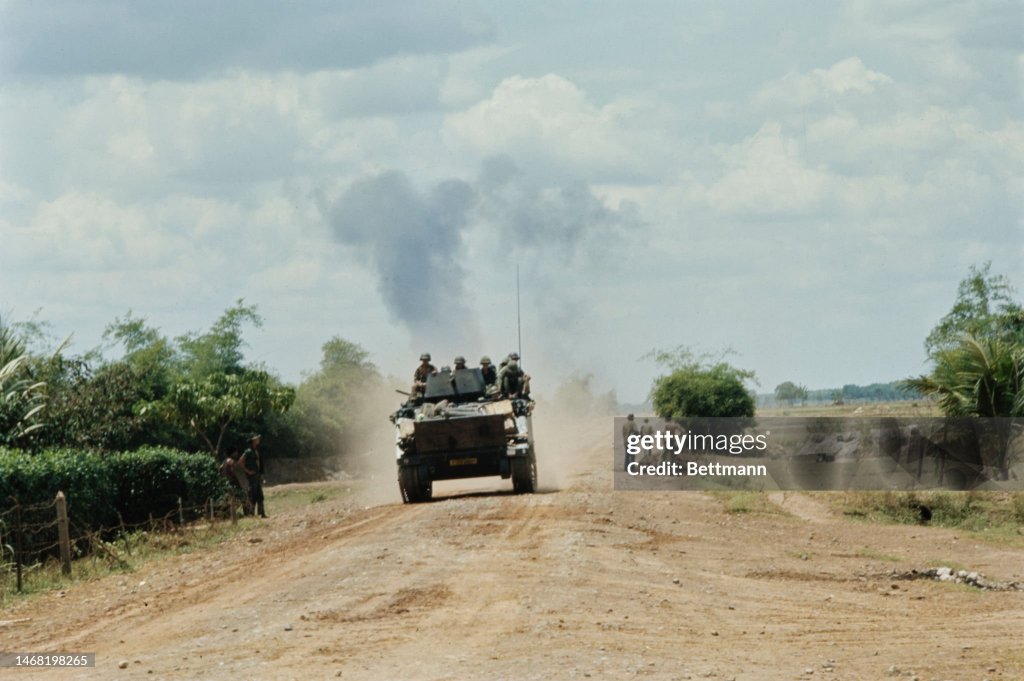

The ‘Hồ Chí Minh Campaign’ begins. Hanoi hands NVA General Văn Tiến Dũng a new timetable calling for the liberation of the South before the rains begin in May. To achieve this North Vietnamese troops must reach Saigon no later than the last week in April, before South Vietnamese forces can regroup to defend it.
Đà Nẵng, South Vietnam’s second largest city, was the only reasonably secure base of government authority in the northern two-thirds of South Vietnam, and refugees were converging on it, and enormous crowds fill the streets. Communist forces, which during the past week surrounded Huế to the northwest and occupied the western flank of the road leading south, were evidently meeting little opposition. While this northern city is isolated from the rest of the country and little normal business is conducted, there appeared to be no sense of panic but rather a feeling of deep uncertainty and anxiety. “Our lives are in the hands of Saigon’s leaders,” one woman said yesterday. “I hope they are still there.”
There are large contingents of Saigon Government forces here, and the city seems in no immediate military danger. But many people believe even Đà Nẵng will fall soon, limiting Government control to the environs of Saigon and the Mekong delta. American diplomats express optimism, but the embassy has reportedly asked Flying Tiger Airlines and Pan American World Airways to provide jumbo jets and other large aircraft to evacuate at least 40,000 persons from Đà Nẵng. During the past week Communist forces have surrounded the city of Huế to the northwest and occupied the western flank of the road leading south.
Among the refugees are many from the provinces to the southeast, which are being rapidly overrun. Some told of the fall of Tam Kỳ, the capital of Quảng Tín, 36 miles southeast of Đà Nẵng. “They began attacking the outposts near Tam Kỳ about 2 o’clock this morning,” a soldier said, soon after arriving yesterday by bus in Đà Nẵng. “Then about 4 A.M. the shelling began, and it was very, very heavy. Everyone left, including the regimental commander, and I was one of the last to get out. At 9 o’clock this morning, there were suddenly North Vietnamese tanks in the center of town, and the fighting was completely over, although there were still Government troops resisting farther north up the road at the province chief’s headquarters. I ran into a house to quickly get rid of my uniform and change into this white shirt,” he said,. “but there wasn’t any real trouble. The North Vietnamese weren’t shooting at anybody, and I had no trouble leaving town.”
Heavy attacks were reported by travelers against the district capital of Phú Lộc, midway between Huế and Đà Nẵng. The attack’s have closed Route 1, the last overland link between Huế and the rest of the country. Route 1, which two days ago was a chaos of trucks, bicycles, carts and pedestrians streaming away from Huế, was deserted. Communist forces severed the road on Saturday by blowing up a bridge. Government troops reportedly repaired the bridge, but last night it was destroyed again, and the Communists now are said to control a stretch of the road. Hải Vân Pass, a key point along the road, was deserted, except for a few troops looking listlessly north through blowing, chilly mists and occasional driving rain.
About one‐third of Huế’s population is said to remain there many still leaving in sampans, landing craft and any other kind of vessel available. But the South China Sea has been rough during the last two days, and at least one sampan is known to have capsized. Several dozen passengers were believed to have drowned. Helicopters were still flying into Huế to evacuate officials. Flights also brought up explosives for use in blowing up key installations at the last moment.
Another coastal town facing imminent collapse, travelers said, is Quảng Ngãi, also a provincial capital. Pilots said Quảng Ngãi Airport was under fire yesterday and the situation was apparently grave.
“Maybe Đà Nẵng will hold for a while, maybe even a year or two,” a businessman despondently said, “but now we are in the position Huế was in before — close to the line and therefore subject to shelling and attack with little warning. The Huế people could at least flee here. We have no place to go but into the sea.” People have been queuing outside a bank to withdraw money. A black market in airline tickets is active, with prices for a trip to Saigon starting at three times their official cost. There were apparently ample supplies of food in Đà Nẵng for the moment.
With shells falling heavily on the former imperial capital of Huế and military units having nearly completed the evacuation from the city by sea, the fall of Huế was expected imminently. Towns, including provincial capitals all along the northern coast of South Vietnam, were falling, leaving only Đà Nẵng as an enclave of government authority.
Although both Quảng Tín and Quảng Ngãi Provinces are traditional strongholds of Communist forces, major efforts had been made by the Saigon Government and American forces over the years to keep them under government control because of their large populations and economic importance. This morning the Saigon command conceded that radio contact had been lost with both cities. Yesterday, Tam Kỳ, which is 35 miles southeast of Đà Nẵng, was attacked after heavy shelling and by late morning North Vietnamese forces were reported in the center of town, having met little resistance. A similar situation had developed at Quảng Ngãi, which was also heavily shelled. The fall of Huế, about 55 miles northwest of Đà Nẵng, appeared imminent. The city itself was reported quiet, nearly deserted except for some Saigon Government troops, but the airport at Phú Bài just to the south was under constant fire and closed to traffic.
In the southern part of South Vietnam, heavy fighting was reported in the Tây Ninh area northwest of Saigon. A district capital, Khiêm Hanh, 35 miles from Saigon, was abandoned by government forces, according to military sources quoted by Reuters. Apparently concerned over the possibility of a North Vietnamese thrust on Saigon itself, President Nguyễn Văn Thiệu announced the appointment of a new governor of the capital military district. He is Lieutenant General Nguyễn Văn Minh, general inspector of the armed forces, who replaces Admiral Chung Tấn Cang. The appointment was said to be part of a plan to bolster the defense of the capital with airborne and ranger troops and to put trusted officers in commend of the Saigon area. The city has been swept with rumors of dissatisfaction in the army, especially among officers born in North Vietnam who fled to the South in 1954 when the Geneva accords divided the nation.
The U.S. Navy aircraft carrier USS Hancock loaded with Marine helicopters is being sent to waters off Indochina in case of a need to evacuate Americans and others. A Pentagon spokesman said the carrier, which has been at Alameda, California, would leave, later this week for the western Pacific. There were indications that the Hancock would take a position off Cambodia, where the helicopter carrier USS Okinawa and several other American ships have been for weeks. In discussing the move, Pentagon sources did not rule out the possibility that the Marine helicopters might he used to evacuate Americans and perhaps some South Vietnamese from the Đà Nẵng area.
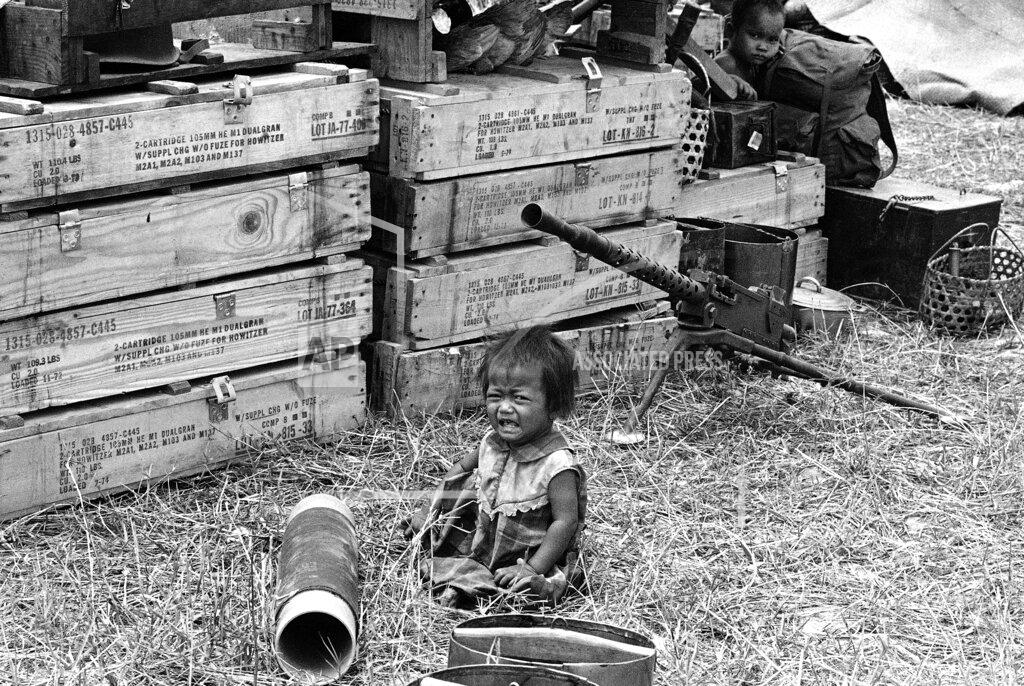
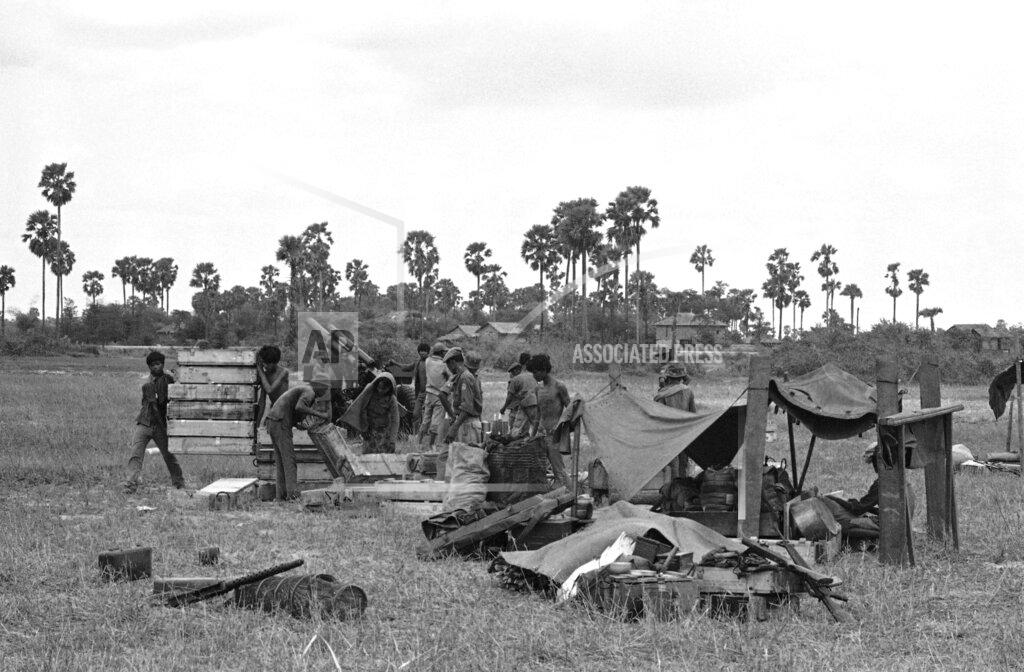
American officials in Phnom Penh, in what they conceded was a “calculated gamble,” ordered the resumption of the United States airlift into besieged Pochentang Airport, the last supply link open to the Cambodian capital. The insurgents kept up their attack on the airport area. The first DC‐8 touched down shortly after 11 AM yesterday land flights continued through the day, although nearly 30 rockets fell on the airport, many near the airlift planes as they were being unloaded. The airlift was halted early Saturday morning after rockets fired by insurgent forces struck two of the planes — a C‐130 and a DC‐8 — as they were unloading on the military side of the airport. On Sunday a United States Embassy official said that the airlift was being suspended “indefinitely — until the military situation near the airport improves.”
Yesterday, conceding that the military situation had not improved, an embassy spokesman said: “I can only say we are making a calculated gamble. The military situation has not changed substantially.” Embassy officials said that the decision to resume the airlift of rice, fuel and ammunition had been made after “consultation with all parties concerned,” including the private companies that supply the DC-8’s and the civilian pilots who fly those jets and the C-130 military transports that are on loan from the Air Force to Bird Air, a private company operating under contract here. The rebel troops, however appeared to be having little difficulty in finding the range of the military area of Pochentong Airport and, some airport workers observed, it was purely chance that no planes or workers were hit. On Saturday 14 Cambodian ground workers were injured when the DC‐8 was struck.
The rockets are being launched from rebel positions northeast of Tuol Leap, a town a little more than four miles west of the airport Cambodian forces abandoned Tuol Leap last night under heavy rebel pressure and fell back 1,000 yards toward the airport United Press International reported. For weeks, Cambodian Government forces have been making unsuccessful efforts to clean out the strongly entrenched rebel positions, situated in thick bamboo groves along the Khsach River. There were some reports circulating in Phnom Penh that the 48‐hour suspension of the airlift had been, in some measure, aimed at increasing Pressure on the Cambodian military to make a determined push in this direction.
If this was the case, the military action gave no indication of it. Correspondents were, for the first time this year, barred from the forward command post for operations west of the airfield, but wounded soldiers returning from the front lines said that the rebels had pushed nearly two miles south of Tuol Leap and closer to the airport, although there was still considerable confusion as to which side actually held the town. The government forces, all observers agreed, posed no threat to the rocket positions themselves.
Elsewhere in the country little significant action was reported. Western Military observers reported a lessening of pressure around most of the other major provincial capitals that are encircled, and on the cast bank of the Mekong River opposite Phnom Penh Government forces have established a defensive line more than a mile inland, according to these Western sources.
In Phnom Penh, the new Cabinet that was formed last week was sworn in yesterday before a special session of both houses of Parliament, and Premier Long Boret delivered an appeal for peace and unity among all Cambodians. The government intends to try to convince “the great powers to help us in finding a political solution to our problem in Cambodia,” the Premier said.
The Defense Department said today that the airlift of food and supplies into Phnom Penh was being extended another month. In reply to a question, a Pentagon spokesman said the Agency for International Development had notified the Defense Department that $8‐million in aid funds would he used to extend the present commercial contracts, which expire Thursday, for approximately 30 days.
The president of the U.N. conference on the law of the sea in Geneva set an April 7 deadline to see whether there are any prospects of reaching agreement. H. Shirley Amerasinghe of Sri Lanka told the more than 2,000 delegates from 138 countries that he would call them to account on that date on what they had accomplished in the first three weeks of the eight-week session.
The European Common Market called for a cease-fire in its “cheese war” with the United States. A Common Market spokesman said the nine-nation bloc had decided to eliminate subsidies on exports to America of two cheddar-type cheeses, to reduce by 20% the subsidies on other cheddar-type cheeses and to maintain its practice of no subsidies on cheddar itself. The move was taken to keep the U.S. government, under pressure from American dairy farmers, from introducing “countervailing duties,” which would wipe out any advantage that European cheese exporters got from the subsidies.
Captain Joao Tomaz Rosa, a leading member of Portugal’s ruling Armed Forces Movement, said today that his country would travel “a socialist path,” but would never become Communist or a dependency of the Soviet Union.
Andrei D. Sakharov, the physicist, said today that his wife expects to go blind within months but that Soviet authorities have refused to let her travel to Italy for critical eye treatment.
Two men were sentenced in London to three years in prison for waging a guerrilla war against government agencies and private firms using animals in medical and other experiments. Ronald Lee, 23, and Clifford Goodman, 31, were convicted on 14 counts of setting fires and inflicting other damage on buildings. boats, trucks and other facilities used in the experiments.
Alexander Mitchell, a 50-year-old bricklayer in the English town of King’s Lynn, literally died laughing, while viewing a TV episode of the British comedy “The Goodies.” Mitchell laughed for 25 minutes before his heart failed. His widow reportedly sent a letter to the comic group, thanking them for making his final moments happy.
President Ford ordered a total re-examination of United States policy toward the Middle East following the collapse of Secretary of State Kissinger’s efforts to attain a new agreement between Egypt and Israel. The White House and the State Department said the policy review would include “all aspects and all countries.” Several congressional leaders who attended a briefing held by President Ford and Mr. Kissinger said later they had the impression that a principal objective of the study would be to re-evaluate United States policy toward Israel. Top Congressional leaders attended a briefing at the White House given by Mr. Ford and Mr. Kissinger this morning. Several of them reported later that Mr. Kissinger had said that neither Egypt nor Israel should be blamed for the breakdown in his talks with each side. But the leaders said that they had gained the impression that a principal focus of the study would be a re‐evaluation of the American policy toward Israel. Mr. Kissinger is understood to believe that Israel missed a crucial chance to move the Middle East toward peace when she failed to he more flexible in the negotiations.
Israeli government officials responded bitterly to the White House announcement of a reassessment of United States policy on the Middle East. The statement’s significance was not immediately clear in Jerusalem, but it tended to confirm the Israelis’ worst fears that Washington would place the major blame on Israel for the breakdown of the mediation efforts for a new Sinai agreement between Israel and Egypt. “It’s a stab in the back,” a senior Israeli official said after having heard the first news reports of the statement. “We are being blamed for the breakdown when in fact it was Egypt that refused to alter its opening position in the talks.” From the moment it was announced Saturday night that Secretary of State Kissinger was suspending his talks with Egypt and Israel, the principal concern of Israeli officials has been the possibility that this would lead to a serious strain in relations with the United States and, conceivably, a reduction in economic and military aid, on which Israel is increasingly dependent. The Israelis feel that the United States reaction is unwarranted since, in their view Egypt contributed more than her share to the eventual deadlock in the negotiations.
Prime Minister Indira Gandhi welcomed William B. Saxbe, the new U.S. ambassador to India, with at warm handshake as he made the courtesy call paid by all new envoys. The former attorney general and Republican senator from Ohio, who had arrived in New Delhi March 2, said his meeting with Mrs. Gandhi was excellent. But Ambassador Saxbe also said today that a “mature relationship” between India and the United States was not possible so long as the Indians failed to appreciate “the realities first.”
Philippine President Ferdinand E. Marcos called on “all rebel groups” to meet with the government in a “freewheeling” dialogue next month. It was a reversal for Marcos, who earlier had indicated he was preparing for war after efforts had collapsed to arrange peace talks with secessionist Muslims in the rich southern islands of the nation. He said the meeting would be in Zamboanga city April 17.
The beaver became the official “symbol of the sovereignty of Canada”, after Royal Assent was given, by the Governor-General, to legislation passed by both houses of Parliament.
One soldier was killed and another seriously wounded in a shootout between cattle rustlers and an army patrol on the edge of the Sierra Madre Mountains, Mexico City police said. Unconfirmed reports said 13 cattle thieves were gunned down. The shootout occurred in the southern Mexico state of Guerrero between the towns of Huamuxtitlan, 120 miles south of Mexico City, and Tlapa.
Four Latin American chiefs of state have asked the United States to celebrate its bicentennial by handing the Panama Canal to Panama. The presidents of Colombia, Costa Rica, Venezuela and Panama said that Panama should have sovereignty over the canal because, among other reasons, it was in Panamanian territory and was a nuclear target. The joint communique said Panama and its neighbors would be exposed to “risks and dangers” of a nuclear war even though they favored neutralization of the canal.
Guerrillas attacked police and Coast Guard stations in and around the Argentine river port of Villa Constitucion but were driven off in a series of gun battles. There were no casualties. Police said the guerrillas apparently intended to release three left-wing insurgents jailed after an alleged plot to paralyze Argentina’s heavy industry.
A special court in Salisbury began a hearing today to determine whether the detention of the Rev. Ndabaningi Sithole, the Rhodesian nationalist leader, on charges of plotting to kill some of his political rivals and of continuing to support terrorism in Rhodesia was justified.
Administration officials said that the potential budget deficit for the fiscal year 1976 had reached the $100 billion level and was still rising under the tax reduction and spending proposals being considered by Congress. The $100 billion would be nearly twice the $51.9 billion deficit projected by President Ford in his budget message two months ago. In Congressional testimony last week, Secretary of the Treasury William E. Simon raised the Administration’s estimate to $80‐billion. The chairmen of the two Congressional budget committees, Senator Edmund S. Muskie, Democrat of Maine, and Representative Brock Adams, Democrat of Washington, both said they agreed that uncoordinated spending by Congress could raise the budget deficit beyond acceptable levels. Mr. Adams said that his committee also had put the current potential deficit at around $100‐billion.
The joint Senate-House conference committee closed its doors to the press and the public today and began work in secret on the final version of the multibillion-dollar tax bill.
The Interior Department took its first official step to bring oil and gas development to the Atlantic coast, inviting the oil industry to propose specific tracts for leasing to private companies off the beaches of New York, New Jersey, Delaware, Maryland, Virginia and North Carolina. Such leasing would allow drilling for the first time in the Atlantic opposite some of the nation’s most popular beach resorts. Last month the department issued a similar invitation but had to withdraw it a day later when it realized it was legally blocked by a then-pending dispute over offshore ownership. That obstacle was removed March 17 when the Supreme Court ruled in favor of the federal government.
The Apollo spacecraft and Saturn IB booster for the joint Apollo-Soyuz Test Project is rolled out to the launch pad at the Kennedy Space Center. Twenty years ago it would have been all but unthinkable, except in science fiction. Another Saturn rocket moved to the launching pad today, taking a slow, grinding step on the way to thrusting men into space. Ten years ago, when the United States and the Soviet Union seemed neck‐and‐neck rivals in the lunar sweepstakes, it would have been improbable. The Apollo spacecraft, borne atop the rocket today, is designed for a rendevous in earth orbit this July between American and Soviet astronauts, the first hands‐across‐space gesture of détente between the earth’s two space powers.
The American astronauts who will have the rendezvous in space with Soviet cosmonauts next July took a slow ride to the launch pad at the Kennedy Space Center along with the Saturn-Apollo rocket they will use for the historic international mission. “This is the end of one era and the beginning of another,” said Brigadier General Thomas Stafford, mission commander. With him were the other two crew members — Donald K. Slayton and Vance Brand.
After it had sent back photographs of the planet Mercury, Mariner 10 was switched off at 1221 UTC. Nearly an hour earlier, it had exhausted its supply of fuel to its attitude control system, preventing it from maintaining a steady fix on the planet. Further such exploration of Mercury would not take place again until 2008, after the 2004 launch of the satellite MESSENGER.
The U.S. Army has decided that all women soldiers donning their new uniform after June 30 must become qualified with the M‐16 rifle. Although women are barred from serving in combat units, the Army says it believes they should be trained to help defend their supporting outfits if emergencies arise while they are stationed overseas. The Marine Corps is reported to be considering a similar step, although it will probably be on a selective basis determined by a woman Marine’s assignment.
The U.S. Supreme Court cleared the way today for a full re-examination of the question of state financial aid for private colleges and universities with religious sponsorship.
The U.S. Postal Service said it had awarded more than $500,000 in contracts for outside firms to find out why the mail does not move faster. The test mailings will be made in addition to those already conducted by the service. A Washington management consultant firm will handle mailings to 3,150 addresses in 676 cities this spring for a contract worth $387,443. Another 151 mass mailing companies competed for contracts worth $158,000 for receiving and recording some of the test mail.
William H. Rentschler, manager of former President Richard M. Nixon’s campaign in Illinois in 1968, was indicted in Chicago by a federal grand jury investigating a $100,000 swindle scheme. The government charged Rentschler, 49, and two other men with conspiracy and mail fraud in attempts to obtain money from prospective investors in a Malaysian timber-cutting scheme. Rentschler currently is awaiting trial on federal charges of swindling financial institutions out of more than $1.4 million in loans.
Jurors in the murder trial in Houston of Ignacio Cuevas watched a videotape of the gunbattle at Texas State Prison last summer but apparently learned little from it about who shot to death two hostages. The tape, taken by the Department of Corrections of the battle that ended Fred Gomez Carrasco’s 11-day escape siege showed graphically the deaths of inmates Carrasco and Rudolfo Dominguez and hostages Julia Standley and Elizabeth Reseda and the wounding of the Rev. Joseph O’Brien. But it was unclear who fired the shots. Officials have contended the inmates fired first. The defense claims the hostages and inmates might have been killed by rangers and guards. Cuevas is the only surviving escapee.
A spokesman denied claims by a former aide that the Divine Light Mission was in serious financial trouble as a result of expensive tastes of its leader, teenaged Guru Maharaj Ji. National spokesman Joe Anctil said in Denver that the organization was paying off back bills and said Michael D. Garson, the former aide, was only a clerk and did not know the full extent of mission finances. “Our assets are growing,” said Anctil, and “our financial picture is getting steadily better.” Garson claimed the organization owed $300,000 in unpaid bills and said he resigned in February “because I could not tolerate the contradictions.”
Electricity rates of the nation’s 15 largest utilities soared 61.3% in the last 18 months and soon will be the highest in the world, a New York consulting firm reported. Already, the National Utility Service, Inc., said, rates at New York City’s Consolidated Edison Co. are the highest of any single electricity producer in the world. Another Northeast utility, General Public Utilities’ Jersey Central Power & Light Co., raised its charges by the fastest rate in the last year and a half — 105.6% according to a consulting firm’s study.
Some safety experts predict that the lower 55 mph speeds brought about by last year’s energy crisis will continue and keep down the death toll on the highways.
New Orleans R&B piano player Professor Longhair with the Meters perform at record release party for Paul McCartney and Wings’ “Venus and Mars”, aboard the Queen Mary in Long Beach, California.
Chuck Wepner, a relatively unknown boxer, went up against world heavyweight champion Muhammad Ali in a bout in Cleveland. Wepner, a “club fighter” who had been selected as an easy opponent for the champ, knocked Ali down to the canvas in the ninth round, then went on to do what few of Ali’s opponents had been able to do, “going the distance” for 15 rounds. Ali finally won by TKO in the 15th. The Ali-Wepner fight was watched on closed circuit TV by an out of work actor, Sylvester Stallone, who turned his own idea about an obscure boxer, getting a title shot, into the film “Rocky,” with Stallone portraying the Wepner-like Rocky Balboa.
The New York stock market had its largest loss in more than four months as prices tumbled in reaction to the breakdown of Secretary of State Kissinger’s negotiations for a Middle East peace settlement. The selloff in accelerated trading affected the entire market, except for gold mining issues, which generally run against the market trend. Losses of a point or more were not unusual.
Dow Jones Industrial Average: 743.43 (-19.63, -2.57%)
Born:
Thomas Johansson, Swedish tennis player (Australian Open, 2002), in Linköping, Sweden.
Ladislav Benýšek, Czech NHL defenseman (Edmonton Oilers, Minnesota Wild), in Olomouc, Czechoslovakia.
Thabiti Davis, NFL wide receiver (New York Giants), in Charlotts, North Carolina.
Lauren Ervin, WNBA forward (Connecticut Sun), in Inglewood, California.
Kenny Kimes, American murderer, in Los Angeles, California.
Died:
Willie Ritchie, 84, former world lightweight boxing champion (1912–1914).
Muriel Hutchison, 60, American actress (“Another Thin Man”).






Before the fight, Wepner was lying in bed with his wife when he told her something like “Even if I don’t win, I just want to prove I belong there.” Wepner later shared this line with Sylvester Stallone who used it in “Rocky.”
“He doesn’t know it’s supposed to be a show! He thinks it’s a damn fight!”
The fight was sufficiently inspiring for Sylvester Stallone (who watched the fight live) to partly base the character of Rocky Balboa on Wepner, and of Apollo Creed on Ali. Stallone would later rush home after the fight and in less than four days of near constant writing, had completed his screenplay about an underdog fighter who gets a shot at the heavyweight title. The screenplay, titled “Rocky,” would be purchased by United Artists, with the agreement that Stallone would also star in the film. Released the following year, “Rocky” would go on to win three Oscars (including Best Picture) and became the highest-grossing film of 1976.
 History Diaries