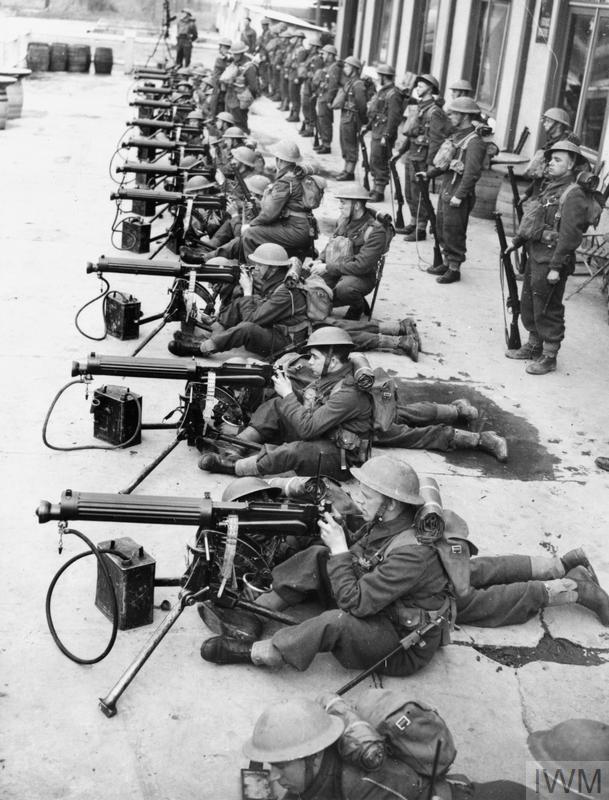
The only news of any moment from the Western Front is that the British forces in the line are participating more and more in scouting and patrol work in No Man’s Land and that, simultaneously, the enemy is again showing aggressiveness in skirmishes.
Twelve Irish Republican Army convicts rioted in HM Prison Dartmoor. The inmates took two warders prisoner, locked a third one in a cell and started a fire that took 90 minutes to put out. Apparently marking the anniversary of Ireland’s Easter rebellion of 1916, Irish Republican Army convicts in Dartmoor Prison today bound and gagged two guards and set fire to one cell block, but did not attempt to escape during the ensuing excitement. As soon as the alarm was given, heavy police guards from nearby towns were flung around the grim “moor,” which is the most hated of jails by criminals, in whose jargon it is called “the granite jug.” Although the fire lasted for an hour and a half, damage was slight, being confined to the clothing stores. The flames were extinguished by the prison’s fire crew, who declined to summon help from the communities fringing the desolate moor. The disturbance was well timed. It began while many members of the prison staff were having supper and while others were enjoying their Easter weekend holiday.
The European war is but “another episode in the bloody game of power politics,” C.A. Smith said in his presidential address to the National Council of the far-left Independent Labor party today.
Deportation of Jews in German-occupied Eastern Europe continued despite of Hermann Göring’s order for a temporary pause.
Official Germany apparently is convinced that Russia’s Premier and Foreign Commissar, Vyacheslav M. Molotov, will at last visit Berlin to cement anew the recently formed Berlin-Moscow friendship and remove any obstacles to Russian-Italian cooperation for the duration of the European war.
Rumors that Premier Molotov would visit Germany were officially denied in Moscow.
Relations between the Vatican and Germany have been getting worse in recent weeks, it was reported today. Reports that a new modus vivendi was being negotiated were denied.
Dr. Karl Clodius, head of the German Economic Mission to Rumania, apparently expects long trade negotiations, because his wife accompanied him when he arrived in Bucharest a few days ago. The chief interest for the Germans is petroleum. They want to raise the monthly quota and base their claim on the fact that Rumania will increase her output considerably this year. The exact amount of the demand is not known, nevertheless it is the hardest for Rumanía, for in addition to Germany and Italy she has to supply petroleum products to other countries — Egypt, Turkey, Yugoslavia, Greece, and the Western powers — to obtain the foreign currency she needs for buying raw materials.
The Rumanians object that Germany had not even been able to transport the actual quota allowed her at present. In January only 38,000 tons went to Germany and even the Russian lubricating oil, some of which the steamer Sakhalin brought to Constanta a few weeks ago, is still there and only a small part, about 2,000 tons, could be delivered. The Germans hope to increase the transport from the Danube port of Giurgiu after the reopening of river navigation to such an extent that a far greater export will be possible.
The solemn Easter ceremony tomorrow promises to attract the largest crowd of faithful ever assembled in and before St. Peter’s. From the balcony at the close the Pope will give the Apostolic benediction “Urbe et orbi.” The plenary indulgence that accompanies the benediction will be extended to those listening throughout the world over their radios who are in a state of grace.
The Red Army occupied the Finnish stronghold of Hangoe today after it had been abandoned and almost everything movable carried away.
In an analysis of the present war and its consequences today, Y. Varga, the Comintern’s economic specialist, concludes that it will result in fresh proletarian revolutions and extension of Communist power.
This Easter finds the Near East bristling with troops and armament and the belief is increasing among the population that a turn of the European war in this direction is almost inevitable and perhaps not far off.
Dutch fighters accidentally shot down a RAF bomber near Rotterdam.
The Royal Naval trawler HMT Loch Assater struck a mine in the North Sea 61 nautical miles (113 km) north of Kinnaird Head, Aberdeenshire and sank. All crew were rescued by HMT Strathtummel.
The Schiff 16-Atlantis anchored in Süderpiep Bay, Norway and adopted her first operational disguise as the Norwegian motorship Knute Nelson.
The German cargo vessel Edmund Hugo Stinnes IV was torpedoed and damaged in the Skaggerak off Jutland, Denmark by the Royal Navy submarine HMS Truant (N 68) at 2330 hours and subsequently scuttled. The captain was taken as a prisoner of war. The rest of her crew reached land safely.
Convoy OA.115G departs Southend.
Convoy OB.115 departs Liverpool.
Convoy MT.36 of thirty three ships departed Methil escorted by destroyers HMS Whitley and HMS Westminster. Destroyer Westminster attacked a submarine contact 6½ miles 135° from May Island. The contact was later found to be a wreck. After MT.36 arrived off the Tyne, destroyers Whitley and Westminster escorted convoy FS.127.
Convoy FN.127 departed Southend, escorted by destroyer HMS Vimieria and sloop HMS Londonderry. The convoy arrived at the Tyne on the 24th.
Convoy FS.127 departed the Tyne, escorted by destroyers HMS Whitley and HMS Westminster. The convoy arrived at Southend on the 25th.
The War at Sea, Saturday, 23 March 1940 (naval-history.net)
Armed merchant cruisers CIRCASSIA and LETITIA arrived in the Clyde from Northern Patrol.
Destroyer EXPRESS was damaged in a collision with trawler MANX ADMIRAL (219grt) ten miles due north of Kinnaird Head. EXPRESS was taken to Hartlepool for repairs arriving on the 28th.
At 1430, lookout trawler LOCH ASSATER (210grt, Temporary Skipper G.D. Greening RNR) was sunk on a British defensive minefield 61 miles north east of Kinnaird Head. The entire crew was picked up by trawler STRATHTUMMEL (210grt). LOCH ASSATER had only been hired on 24 February 1940.
Destroyer BRILLIANT on patrol searched unsuccessfully for the pilot of a downed Hurricane southeast of Folkestone.
German merchant ship EDMUND HUGO STINNES IV (2189grt), en route to Copenhagen, was intercepted by submarine TRUANT (TRIDENT – Seekrieg) at 2330 in the Skagerrak six miles 306° from Bovbjerg. The submarine fired five warning shots, but the German steamer entered territorial waters, scuttled herself and was finished off by TRUANT with two torpedoes two miles 294° from Thors Minde Light House. The Master was taken prisoner.
Light cruisers GALATEA, ARETHUSA, and PENELOPE arrived at Rosyth after DU. Light cruiser AURORA and destroyers SOMALI, MASHONA, MATABELE, and SIKH arrived off Scapa Flow, but were unable to enter due to low visibility until early on the 24th. SOMALI, MATABELE, MASHONA, and SIKH carried out an independent anti-submarine sweep and entered Scapa Flow at 0900/24th. AURORA and destroyers FAME, FORESIGHT, FOXHOUND, and FIREDRAKE of operation DU arrived at Scapa Flow at 1100.
Destroyer NUBIAN departed Rosyth for Scapa Flow.
Destroyer ESK arrived at Invergordon.
Sloop AUCKLAND arrived at Rosyth.
Submarine SPEARFISH and destroyer FAULKNOR were engaged in anti-submarine exercises from Scapa Flow.
Submarines SUNFISH and SNAPPER arrived at Harwich after patrol.
Hunt-class destroyer ATHERSTONE was completed, the first of a large class of escort destroyers. Following working up at Portland, she was attached to the Home Fleet.
Convoy MT.36 of thirty-three ships departed Methil escorted by destroyers WHITLEY and WESTMINSTER. Destroyer WESTMINSTER attacked a submarine contact 6½ miles 135° from May Island. The contact was later found to be a wreck. After MT.36 arrived off the Tyne, destroyers WHITLEY and WESTMINSTER escorted convoy FS.127.
Convoy FN.127 departed Southend, escorted by destroyer VIMIERIA and sloop LONDONDERRY. The convoy arrived at the Tyne on the 24th.
Convoy FS.127 departed the Tyne, escorted by destroyers WHITLEY and WESTMINSTER. The convoy arrived at Southend on the 25th.
At 1144, armed boarding vessel NORTHERN REWARD sighted a submarine near wreckage and empty rafts and attacked the submarine west of Foula Island in 60‑12N, 3‑50W. No damage was done to U-38. Contact was later lost in rain squalls. Destroyers ELECTRA and ENCOUNTER and armed boarding vessel DISCOVERY II joined to assist in the hunt. Destroyer FAULKNOR (D.8) departed Scapa Flow at 1500 to join the search. At 1705, a British flying boat dropped bombs on a submarine contact in this area in 60-16N, 3-22W. At 0600/24th, FAULKNOR departed the search area for Kirkwall.
Anti-submarine trawler ST KENAN (565grt) made an attack on a submarine contact in 59-04.20N, 06-00.04W of Salisker. Anti-submarine trawler ASTON VILLA (546grt) was also in the area. Off the Butt of Lewis in 58-41.5N, 6-14W, anti-submarine trawler ANGLE (531grt) made an attack on a submarine contact.
Armed yacht ALICE (527grt) made an attack on a submarine contact in Liverpool Bay in 53-29.5N, 0-39W.
GERMAN MERCHANT SHIPS IN DUTCH EAST INDIES
The British Malaya Force was formed to watch German merchant ships in Dutch East Indies harbours. Destroyers STRONGHOLD and TENEDOS departed Singapore on the 26th and were stationed off Sabang to watch LINDENFELS (8457grt), MONI RICKMERS (5272grt), SOPHIE RICKMERS (7033grt), WASGENWALD (4990grt), and WERDENFELS (6318grt). Light cruiser DAUNTLESS patrolled off Batavia to watch NORDMARK (7750grt), RENDSBURG (6200grt) and VOGTLAND (6608grt). Light cruiser DURBAN departed Singapore on the 25th, and patrolled off Padang to watch BITTERFELD (7659grt), FRANKEN (7789grt), RHEINLAND (6622grt), SONECK (2191grt), and WUPPERTAL (6737grt). Light cruiser DANAE departed Singapore on the 21st, and patrolled off Surabaya to watch CASSEL (6047grt), ESSEN (5158grt), and NAUMBURG (5878grt). Sloop FALMOUTH watched STASSFURT (7395grt) at Tjilitjap.
Submarines PERSEUS departed Singapore on the 27th and RAINBOW departed Singapore on the 25th, and were stationed in the Sunda Strait to guard the German ships’ escape route. These patrols were maintained until mid-April. Some six weeks later when Germany invaded Holland, all the merchant ships, except SOPHIE RICKMERS which scuttled herself in harbour, were seized by Holland for service under the Dutch flag. Steamers BITTERFELD, WUPPTERTAL, and RHEINLAND were captured by boarding parties from Dutch cruiser JAVA in Padang.
German name — Dutch name
LINDENFELS — MANGKALIHAT
MONI RICKMERS — SALANDO
WASGENWALD — SEMBILANGAN
WERDENFELS — BALINGKAR
NORDMARK — MANDALIKA
RENDSBURG — TOENDJOEK
VOGTLAND — BERAKIT
BITTERFELD — MARISO
FRANKEN — WANGI-WANGI
RHEINLAND — BERHALA
SONECK — KARSIK
WUPPERTAL — NOESANIWI
CASSEL — MENDENAU
ESSEN — TERKOELEI
NAUMBURG — KENTAR
STASSFURT — LANGKOEAS
In addition, German steamer SCHEER (8298grt) at Makassar and German steamer FRIDERUN (2464grt) at Menado were taken over as MANGKAI and MEROENDOENG, respectively.
A test vote to show sentiment on proposals to curb activities of the National Labor Relations Board is expected in the House next week. It probably will come Tuesday when Representative Howard Smith, chairman of the special committee investigating the board, tries to strike from a $2,843,000 appropriation for the board the $23,700 which remains of a $69,600 fund asked for its economics division. The House Appropriations Committee, in approving a $954,000,000 appropriation for 1941 needs of the Labor Department, the Federal Security Agency and related activities, recommended a $45,900 reduction to be applied against the salaries of economists in the NLRB economics division, which is headed by David Saposs. But it did not recommend elimination of a related item of $23,700 for clerical and stenographic help in the same branch.
“We’re going to see whether that $23,700 item can’t be cut out, too,” Representative Smith said today. The Appropriations Committee said in its report that “no need exists for a division of economic research and it is expected that this section will be entirely eliminated.” Mr. Saposs has been called before both the Smith committee and the Dies committee for questioning about complaints that some of his writings presented communist ideas. He declared that the writings in question represented a summary of the views of others, not his own opinions.
Representative E. E. Cox, Georgia Democrat, a critic of New Deal labor policies, charged today that the National Labor Relations Board was “lobbying” in Congress for larger appropriations. He declared that the Democratic party could not “afford” to enter the coming national elections “under the necessity of defending this outfit.” J. Warren Madden, chairman of the board, denied that it was lobbying in connection with the appropriations. He added that no employee of the board was doing so. so far as the board could learn.
The White House issued a formal denial today that James H. R. Cromwell, Minister to Canada, had submitted his controverted pro-Ally speech to President Roosevelt for approval before it was delivered.
Battle lines continue to deepen between President Roosevelt and Vice President Garner over this year’s Democratic nomination. Making the first major campaign address for Vice-President Garner, Senator Sheppard, Texas Democrat, declared tonight his fellow Texan had been one of the leaders in the new deal fight for “greater liberalism.” This liberalism and Garner’s 37 years’ experience in the federal government, Sheppard declared, make him “the ideal successor to the presidency in 1940.”
Word spread on Capitol Hill today that President Roosevelt would veto legislation continuing the reciprocal trade program If congress adopted a proposal to require senate ratification of trade agreements. It was said Mr. Roosevelt and Secretary Hull had agreed, and passed this word on to legislative leaders, that the ratification proposal would destroy the usefulness of the trade program. The question whether the treaties should be subject to senate ratification, by a two-thirds vote, is expected to be a major issue of contention when the senate debates continuance of the trade program.
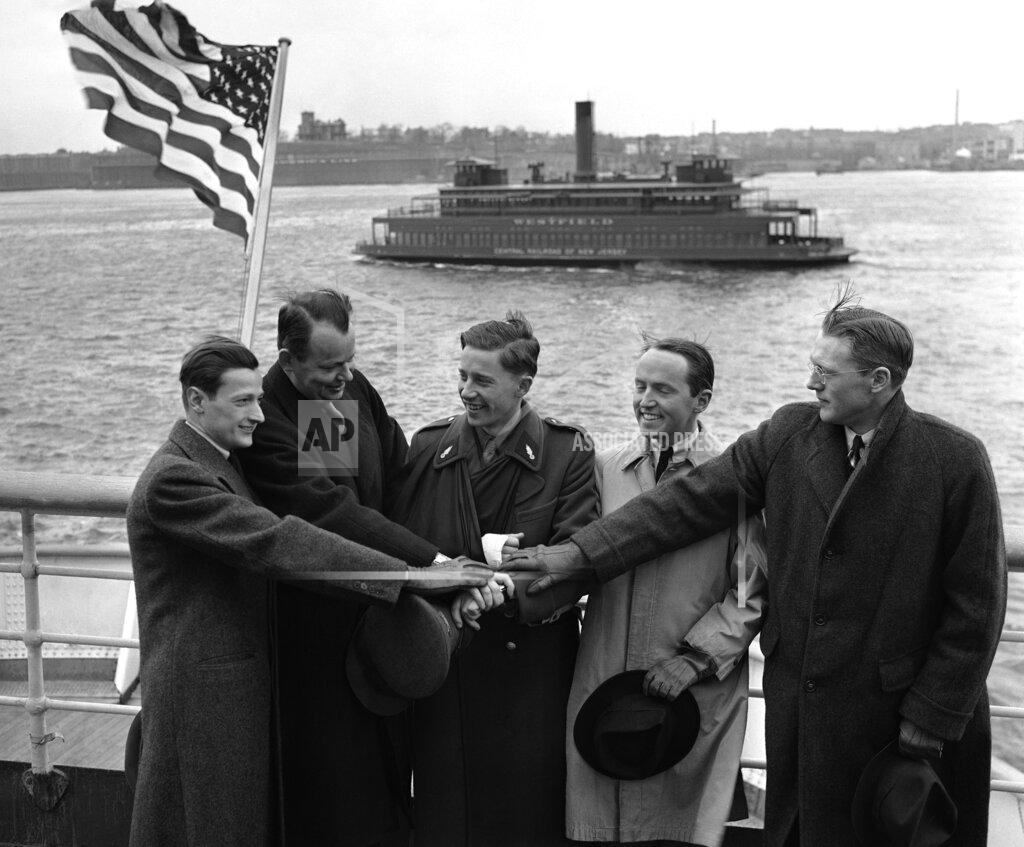
Twenty-one Americans, whose average age is 28, sailed yesterday on the United States liner Manhattan to drive ambulances in France. In their own words, they went partly for “adventure,” partly “to help out France.”
Senator Gerald P. Nye, Republican isolationist leader of North Dakota, in a speech to a lecture group this morning renewed his attacks on President Roosevelt, accusing him of being the inspiration for the pro-Ally speech in Canada of James H. R. Cromwell, United States Minister. The Senator declared the President was leading this country down the road to war. Asserting that he favored a constitutional amendment to require a referendum of the people for a declaration of war by the United States, except in case of a direct attack. Senator Nye repeated his proposal that youths of 18 to 21, who would be “directly concerned” with the business of fighting, be permitted to vote in such a referendum.
Frank Gannett, campaigning for the Republican Presidential nomination, declared today he believed President Roosevelt would run for a third term and asserted that his re-election would mean a totalitarian government in the United States.
Despite the demand of Senator Van Nuys of Indiana, a supporter of Paul V. McNutt for President, that Postmaster General James A. Farley resign as chairman of the Democratic National Committee in fairness to other aspirants for the Presidential nomination, it was learned yesterday that Mr. Farley has no thought of resigning as national chairman before the convention.
The “practical liberalism” of Vice President Garner was pictured by Senator Sheppard tonight as his best qualification in his race for the Presidency.
District Attorney Thomas E. Dewey will leave on Tuesday on what may prove to be the most important trip in his campaign for the Republican nomination for President. He will speak in St. Louis Wednesday night, in Chicago Thursday night and in Milwaukee Friday night, but the important part of his trip will be his two days of campaigning in Wisconsin, with stops in twenty cities scheduled on Friday and Saturday. The Wisconsin primary, to be held on April 2, is the most important contest Mr. Dewey is facing because he is opposed in that State by Senator Arthur H. Vandenberg of Michigan. Victory for Mr. Dewey would serve a double purpose. It would not only win for him all or a majority of Wisconsin’s twenty-four delegates to the national convention and increase his prestige throughout the country but would damage seriously the candidacy of the Michigan Senator, whom many regard as Mr. Dewey’s leading opponent.
A close race between Thomas E. Dewey and Senator Arthur Vandenberg in the forthcoming Republican primaries in the Middle Western States was predicted yesterday by the American Institute of Public Opinion as a result of a special survey of Presidential sentiment in the region.
A new attack on the foreign policies of President Roosevelt as pointing toward the possibility of this country’s involvement in the European war climaxed Senator Robert A. Taft’s delegate-seeking campaign in Kentucky tonight.
Federal guarantee of a minimum income of $15 a week for individuals living alone, and higher rates for families, was asked today by the Workers Alliance of America in a program issued to mark the commemoration of this date as “National End-Unemployment Day.”
The quiz show “Truth or Consequences” premiered on NBC Radio.
Easter Eve, which by tradition is connected in the Mexican mind with the public burning amid much firing of firecrackers of puppets representing Judas, assumed a pronouncedly political character this year. There are protests in Mexico City, and a battle of peasants ina Veracruz village left twenty people dead.
The Canadian election campaign is now in its final stages. The battle lines have been drawn and the party organizations are working at fever heat to complete their arrangements for bringing out the vote next Tuesday.
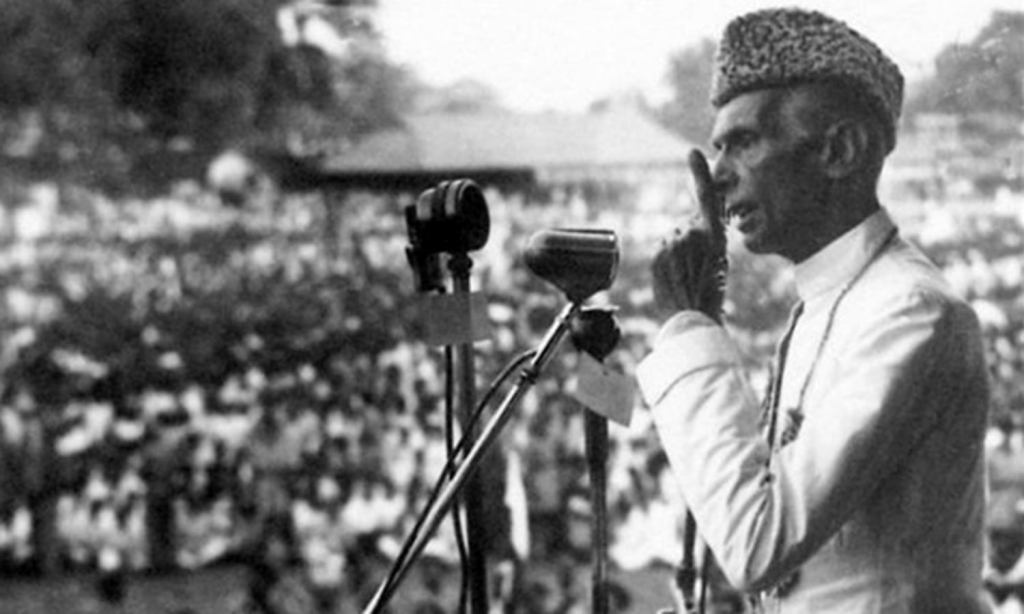
The Lahore Resolution was adopted by the All-India Muslim League and its principles formed the foundation for Pakistan’s first constitution.
Resolved at the Lahore Session of All-India Muslim League held on 22nd-24th March, 1940.
(1) While approving and endorsing the action taken by the Council and the Working Committee of the All Indian Muslim League as indicated in their resolutions dated the 10th of August, 17th and 18th of September and 22nd of October, 1939, and 3rd February 1940 on the constitutional issues, this Session of the All-Indian Muslim League emphatically reiterates that the scheme of federation embodied in the Government of India Act 1935, is totally unsuited to, and unworkable in the peculiar conditions of this country and is altogether unacceptable to Muslim India.
(2) Resolved that it is the considered view of this Session of the All India Muslim League that no constitutional plan would be workable in this country or acceptable to Muslims unless it is designed on the following basic principle, namely that geographically contiguous units are demarcated into regions which should be so constituted, with such territorial readjustments as may be necessary, that the areas in which the Muslims are numerically in a majority as in the North-Western and Eastern Zones of India, should be grouped to constitute “Independent States” in which the constituent units shall be autonomous and sovereign.
(3) That adequate, effective and mandatory safeguards should be specifically provided in the constitution for minorities in these units and in these regions for the protection of their religious, cultural, economic, political, administrative and other rights and interests in consultation with them; and in other parts of India where the Mussalmans are in a minority, adequate, effective and mandatory safeguards shall be specially provided in the constitution for them and other minorities for the protection of their religious, cultural, economic, political, administrative and other rights and interests in consultation with them.
(4) This Session further authorizes the Working Committee to frame a scheme of constitution in accordance with these basic principles, providing for the assumption finally by the respective regions of all powers such as defense, external affairs, communications, customs and such other matters as may be necessary.”
Second Battle of Wuyuan: Japanese 26th Infantry Division counterattacking Chinese 8th War Area around Wuyuan.
Battle of South Kwangsi: Chinese 46th Army attacking Japanese 22nd Army around Lingshan.
The Chinese Central News Agency reported tonight that Chinese troops had recaptured Lingshan, in the South China Province of Kwangtung, Friday morning, and that Japan had suffered more than 4,000 casualties in fighting in that sector during the past five days. Earlier a Chinese spokesman said the Japanese had suffered heavy blows in a thrust northward from Lingshan and that the Chinese had retaken more vantage points around the Nanning-Yamchow highway.
The news agency said the Japanese were in full retreat toward their base at Yamchow. It reported the Japanese northeast of Lingshan had started to retreat three days ago. Chinese dispatches declared that the course of fighting was turning in favor of the Chinese in the Kwangsi Province. A Chinese military spokesman said that while the Japanese might appear to have made progress, they “are finding it difficult to extricate themselves, as their lengthening lines are exposed to flank and rear attacks.”
Royal Navy forms the “Malaya Force” to shadow 17 German merchant ships trapped in Netherlands East Indies ports.
Japan, in a report to the League of Nations on her 1938 administration. of the Pacific mandate islands, has omitted all reference to whether or not she is fortifying them, it was learned today. This is in sharp contrast to the 1937 report, which said categorically that they were not being fortified. A copy of Japan’s report was received by the State Department several days ago from the American Embassy in Tokyo. Japan is required by a treaty with the United States to provide this government with a duplicate of the report.
The islands — 623 in number, in three groups, the Mariannas, the Carolines and Marshalls — were taken by Japan from Germany during the World War. Peleliu, one of the islands, is about 400 miles east of the Philippines, and the American island of Guam is surrounded by Japanese mandate islands. The report shows that only twelve foreigners (no Americans) visited the islands in 1938. The visitors were: one Filippino, two Netherlanders, two White Russians, two Frenchmen, four Netherland Indians and one Australian.
The Japanese Premier, Admiral Mitsumasa Yonai, and the Navy Minister, Admiral Zengo Yoshida, assured Parliament today that the Japanese Navy is ready to meet any situation resulting from the expansion of the United States Navy. A member’s question on the American naval program evoked this reply from Admiral Yonai: The navy is ready to meet any situation. There is nothing to fear from the standpoint of national defense.”
A questioner in Parliament asked Premier Yonai today if the United States was preparing war against Japan. The Premier did not reply. He then was asked: “Why does not the government make it clear that Japanese-American relations are in a crisis?”
“A complete United States embargo against Japan,” Admiral Yonai replied, “would result in an extremely grave situation and if either side makes a mistake in this connection what naturally followed would be a crisis.”
Dow Jones Industrial Average: 146.73 (+0)
Born:
Ted Green, Canadian NHL and WHA defenseman (NHL All-Star, 1965, 1969; NHL: Boston Bruins; WHA: New England Whalers, Winnipeg Jets), in Eriksdale, Manitoba, Canada (d. 2019).
Luis Gasca, American jazz trumpeter and flugelhorn player, in Houston, Texas.
Naval Construction:
The Royal Navy Flower-class corvette HMS Nasturtium (K 107) is laid down by Smiths Dock Co., Ltd. (South Bank-on-Tees, U.K.).
The Kriegsmarine (German Navy) Type IXC U-boat U-161 is laid down by Deutsche Schiff und Maschinenbau AG, Bremen (werk 700).
The Royal Navy Bar-class boom defense vessel HMS Barndale (Z 92) is commissioned.
The Royal Navy Hunt-class (Type I) escort destroyer HMS Atherstone (L 05) is commissioned. Her first commanding officer is Commander Hugh Waters Shelley Browning, RN.



 History Diaries