
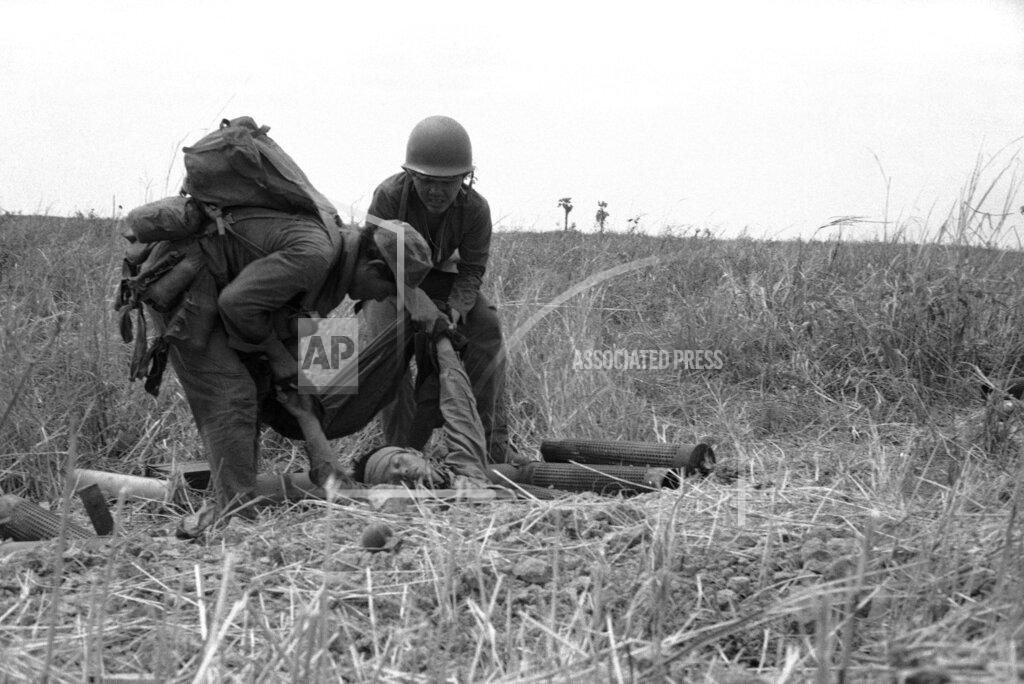
The North Vietnamese offensive virtually engulfed Thừa Thiên, a major northern province whose capital is Huế, and pressed toward Saigon’s eastern and western flanks, and fought government troops near the Cambodian border, the Saigon command reported. The North Vietnamese mined a bridge on Route 1, the escape path for thousands of refugees fleeing Huế towards Đà Nẵng. They also shelled Huế and military sources in Saigon said that the North Vietnamese had cut all overland routes to Huế. Huế —the former imperial capital and a city of enormous psychological importance — was struck by several shells amid evidence that the government would abandon the city to the Communists.
This morning the army command reported major fighting near Kiếm Hành, a capital 40 miles northwest of Saigon and about 15 miles from Cambodia. Military officials said that 182 North Vietnamese soldiers were killed and two tanks destroyed in yesterday’s fighting. The clashes took place in Tây Ninh Province, heavily beleaguered and emerging as major battleground for government troops. The province is on the northwest corridor leading to Saigon.
Late last night, military sources said that the North Vietnamese had cut all overland routes to Huế. Communist forces had destroyed a bridge south of the city, the sources said, and overrun a militia post on Route 1, the main road south. The city is reportedly isolated overland, the military sources said, although government forces were seeking to reopen the road.
Most evidence indicated that Huế, which was invaded by the North Vietnamese and the Việt Cộng in the 1968 Tet offensive when savage street fighting flared for 26 days until South Vietnamese and American troops regained control, was fated to be taken by the communists, possibly in a few days. The Saigon command virtually conceded yesterday that Thua Thien was rapidly slipping into North Vietnamese hands. The command said that the North Vietnamese struck army positions throughout the province with artillery, mortars, and rockets and that the South Vietnamese First Division headquarters had been shelled seven miles south of Huế. Many soldiers normally posted in the defense of Huế, including about 1,000 paratroopers, have been flown to the Saigon area, 400 miles southeast.
Several Western officials are worrying about an attack on Saigon, and some embassies are making contingency plans for emergency evacuations. Western intelligence sources say that there are North Vietnamese demoition units in the city’s suburbs and that recent daylight ambushes coupled with troop movements in nearby Biên Hòa, Hậu Nghĩa, and Tây Ninh Provinces are ominous signs. Some American officials are expecting a wave of anti-American sentiment—which has been building up in the Saigon press — and the mood of “abandonment” following the decision by President Nguyễn Văn Thiệu to virtually hand over the northern two‐thirds of the nation to the Communists. One knowedgeable Western official saw a possibility of violence against Americans by South Vietnamese as Communists surged toward Saigon.
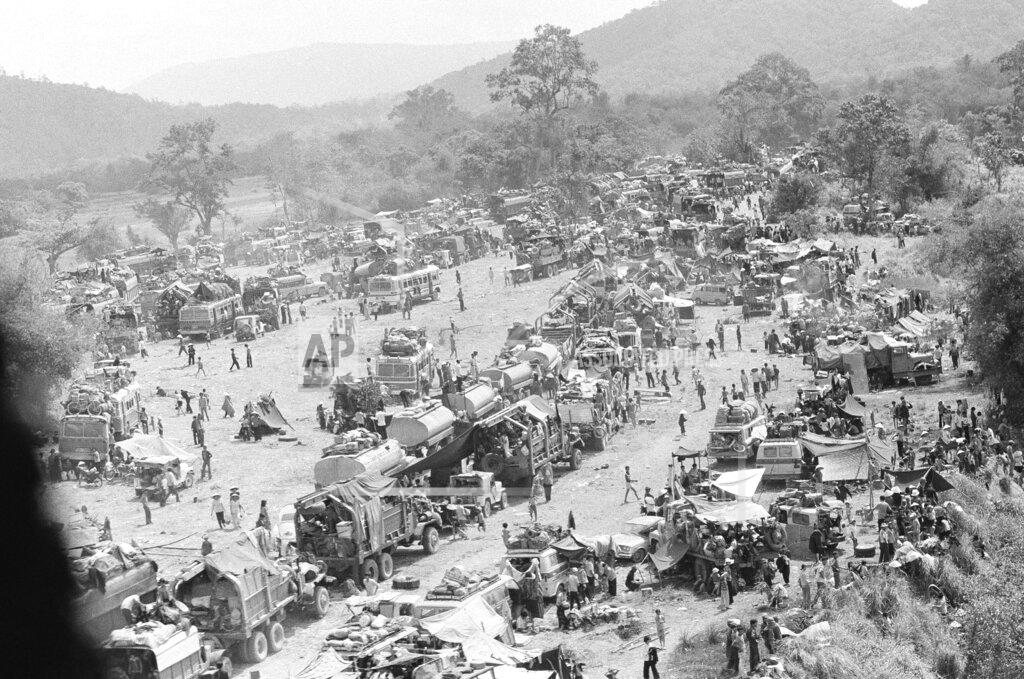
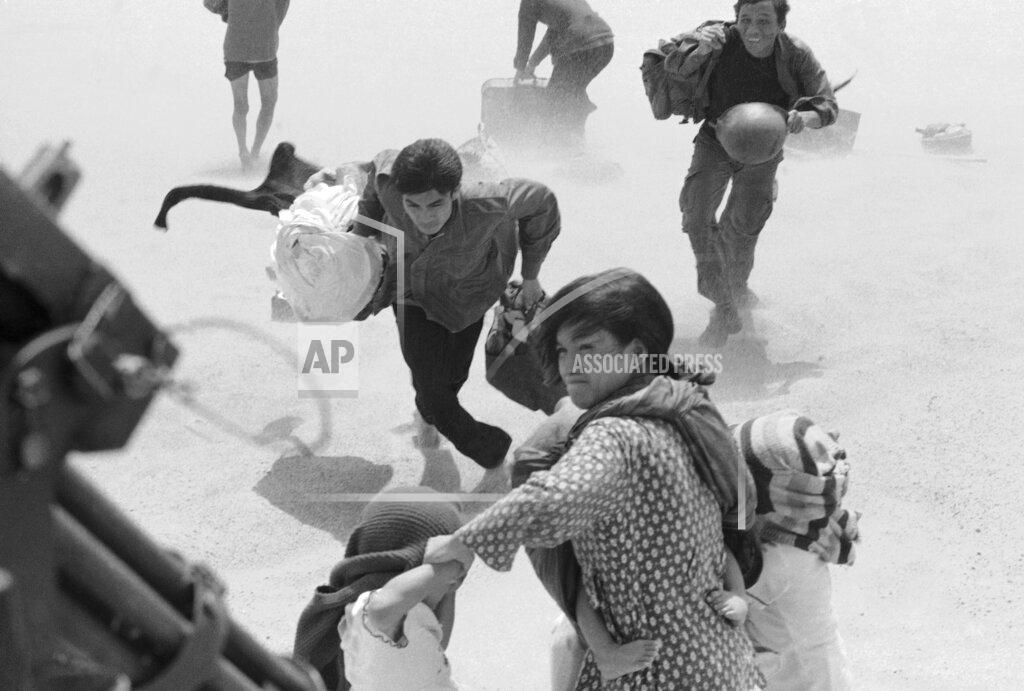
As the North Vietnamese pressed across most of South Vietnam, tens of thousands of refugees in the Central Highlands and on the northern coast were caught in the heavy fighting. It was the first time in a week that the road from Huế to Đà Nẵng, 50 miles. southeast, was cut, thwarting the flow of refugees. Reports from the field said the North Vietnamese shelled and attacked government forces on Route 1, the key coastal road — less than 10 miles north of Đà Nẵng as well as south of the city. Refugees from Thừa Thiên Province to the north and from Quảng Tín and Quảng Ngãi Province to the south are streaming into Đà Nẵng. A number of refugees were killed and wounded and vehicles were set on fire, the reports said. The refugees are also fleeing in fishing boats, sampans and ferries moving along the South China Sea coast.
Further south in the Central Highlands, the North Vietnamese attacked government infantrymen at a district capital on Route 21, the only possible escape route for soldiers and refugees fleeing from Buôn Ma Thuột, which fell to the Communists three weeks ago. As government troops and refugees sought to move toward the coast Saturday, North Vietnamese tanks and infantry en circled and seized the district town of Khánh Dương, which is on Route 21 and 30 miles from the coast. Another government force seeking to reopen a Route 21 escape path also appears to have been stopped by sharp Communist attacks, military sources said.
South Vietnamese fighter-bombers flew nearly 80 sorties against the North Vietnamese, and one of the planes, an A‐37, was shot down. Military sources said the pilot was rescued. Pilots reported having destroyed 15 tanks, the Saigon command said. It also estimated that 80 North Vietnamese soldiers were killed by ground and air action.
To the northeast, near Tuy Hoa, a coastal city awaiting as many as 200,000 people fleeing from the Central Highlands, the bulk of the refugees remain stranded beyond the Đà Rằng River (Sông Ba) because an emergency pontoon bridge had not yet been completed. Without food and water, many refugees are facing starvation. Closer to Saigon, the North Vietnamese overran two Government outposts and a hamlet near the threatened province capital of Tây Ninh, 55 miles northwest. Some military officials believe that Tây Ninh Province, along the Cambodian border, as well as Hậu Nghĩa closer to Saigon, will be the next targets of the offensive. Northeast of Saigon, in Long Khánh Province, North Vietnamese took over a hamlet less than two miles from Xuân Lộc, the province capital. Xuân Lộc itself was struck by 105‐mm. guns and military officials expect this to be the start of a “softening up” of the eastern and northeast flanks of Saigon.
White House Press Secretary Ron Nessen said today the United States had shipped no military equipment to South Vietnam this year and was providing less than 40 percent of the Saigon’s ammunition and fuel needs. He blamed Congressional cuts in military aid for the shortages.
There is a feeling among many Vietnamese officials and Western diplomats in Saigon that South Vietnam is facing a leadership crisis potentially much more dangerous than the sweeping Communist advances throughout the country. In another time, the current situation could well have prompted dissident military men into action to change the order of things by force. Today the possibility that any group would attempt a coup in the face of such great national difficulties seems remote. But among the common people most isolated from the centers of Vietnamese power the rumor is spreading that a coup is imminent, if only because the present leadership seems so unequal to the crisis. And even among the best informed, there is a very uneasy feeling. “To put it mildly, the entire administration of South Vietnam, including Saigon, is in disarray,” a highly informed Vietnamese said.
“What troubles many of us.” a foreign diplomat said “is the possibility that in the somewhat mystifying political atmosphere of Saigon at the moment, something could happen, in a matter of hours that would raise the Việt Cộng flag over Độc Lập Palace before we even realized what had happened.” The uneasiness has come up in the last two weeks, following the fall of Buôn Ma Thuột in the Central Highlands, abandoned by Government authorities with scarcely a fight. Vietnamese everywhere were stunned by the development. But they were even more alarmed last week when Kon Tum and Pleiku Provinces were given up with barely a shot fired. Since then, government control and influence has been collapsing like a pricked balloon in much of the countryside. Even the normally tightly controlled Saigon press has started asking whether Saigon still has a government and leaders, or whether the nation is drifting to destruction.
The general military situation in South Vietnam, as United States military analysts see it, is one of steady Communist gains on the northern, central and southern fronts with the exception of a battle developing in the Khánh Hòa area 200 miles northeast of Saigon. At this juncture, South Vietnam’s strategy of trading territory for time to concentrate on the protection of Saigon has not proved effective. Two brigades of airborne troops had to be detached from the covering force around the capital to help check a strong thrust from the Khánh Hòa area toward Nha Trang on the coast. There are reports that the Communists were surprised by the speed of their initial advances, a source said, but that they are now meeting stronger opposition in the center and southern areas.
The comparative inactivity of the South Vietnamese forces in the south, where their enemies are continuing to probe the capital’s outlying defenses, continues to puzzle American sources. They recognize that major counterattacks cannot be mounted overnight and that a shortage of space parts inhibits mobility. But they argue that one successful countermove would upset North Vietnamese timing and help civilian and military morale. The only offensive move reported, however, has no direct bearing on the defense of the South Vietnamese heartland around Saigon. Two airborne brigades were moved to the Khánh Hòa area to help hold a thrust that has developed out of the Buôn Ma Thuột area toward Nha Trang on the coast. This Communist drive, which is led by what the South calls strong tank forces, also has been under attack by South Vietnamese fighter-bombers. The other Saigon unit in the area, the 23d Division, which fought for Buôn Ma Thuột and lost it, is reported regrouping south of the town.
Vietnam’s 86‐year‐old Queen Mother was reported missing today as North Vietnamese troops encircled the former imperial capital of Huế in apparent preparation to attack it. The South Vietnamese sent two helicopters from Đà Nẵng to Huế to evacuate the Queen Mother, Từ Cung, from her ramshackle old French villa where she had been spending her days praying for peace, it was reported from Đà Nẵng. Informed sources in Da Nang said that the former queen and a few relatives disappeared three days ago and were believed to be on the road to Đà Nẵng, 50 miles to the south.
Earlier, she had told relatives she would remain in Huế as she did during the 1968 and 1972 offensives. Born in Huế, she was the wife of Emperor Khải Định. When Khải Định died in 1926, their only son, Bảo Đại, assumed the throne, but by then Vietnam’s emperor was powerless under the domination of the French. Following the Geneva conference in 1954, the South became the state of Vietnam with Bảo Đại as its titular head. But in 1955 South Vietnam became a republic. President Ngô Đình Diệm seized power and Bảo Đại and his family went to Paris.
An aviation record was established in Vietnam today when an aging DC‐3 evacuated 98 refugee orphans accompanied by five attendants from the Central Highlands town of Đà Lạt — by far the greatest number of passengers ever carried by this type of plane. With Communist pressure mounting rapidly around Đà Lạt, the orphans were among the last to be evacuated. The DC‐3, owned and operated by Continental Air Services, is normally chartered to an oil prospecting company but was pressed into emergency evacuation work in cooperation with Air Vietnam. According to Jim W. Eckes, an official of Continental Air Services here, the previous record for the number of passengers carried by the two-engine DC‐3 was established in 1949, when 84 refugees were evacuated during the fall of China to the Communists. The orphans, ranging from less than 1 year old to 14, arrived silent and wide-eyed in Saigon, where they were loaded aboard buses and taken to a new sanctuary.
[Ed: It will only be a sanctuary very briefly, of course.]
The American airlift of food, fuel and ammunition to Phnom Penh, the last supply link to Cambodia’s capital from the outside world, has been suspended indefinitely until “the military situation near the airport improves,” an official of the United States Embassy in Phnom Penh disclosed. The suspension was described as a “mutual decision of all sides,” including American officials, the civilian flight crews and the private airline companies involved. The airlift was halted yesterday after enemy rockets struck two of the planes at Pochentong Airport. Last night one plane, a C‐130 transport, was repaired and flew off to U Taphao Air Base in Thailand, and this afternoon the other, a DC‐8, was patched up and returned to its base in Saigon.
The suspension was expected to continue at least through tomorrow when a major “multi‐brigade operation” is expected to begin northeast of the town of Tuol Leap, in the area where Cambodian insurgents have been launching rockets against the airport. Each day that the suspension continues eats heavily into the stockpiles of rice, military and, civilian oil and fuel stores and ammunition that have been accumulated here. American officials refuse to divulge the size of the stockpiles, declaring that this is “strategic information,” but it is believed that present supplies could not last any longer than two weeks without stricter rationing. In discussing the suspension of the airlift, the American Embassy official would say only: “We can’t afford to have these planes hit”
Yesterday one American official noted that after previous close calls some of the civilian pilots who fly in the airlift had expressed concern over safety conditions at Pochentong Airfield. The airlift is technically a civilian operation undertaken by private carriers — Bird Air from U Taphao in Thailand and the Flying Tiger Line, Trans International and Airways International from Saigon. The Bird Air operation consists of United States Air Force C‐130 transports with the Air Force insignia painted out and on loan to Bird Air. The other planes are all owned by the companies. Most are being flown by former Air Force pilots.
There are other alternatives to the present airlift, such as airdrops of supplies without the planes’ landing and use of Air Force planes and personnel, but embassy officials refused to discuss any such possibilities today. The White House announced only last Thursday that the airlift contracts had all been extended until April 30. It was just two days later, early Saturday morning, that rockets fired by the insurgents hit the unloading area of the airport, crippling the two planes. For weeks insurgent troops have been firing 107‐mm. rockets at the airport, but only recently have they begun to pinpoint with any accuracy the military side of the airfield where the supply planes unload.
The news from the other military fronts around the capital was grim today. Some government units are still reported encircled on the east bank of the Mekong River opposite Phnom Penh, according to Western military observers although the main rebel forces there have been pushed back more than a mile from the river. Government forces were also reported under increasing pressure at a few of the other scattered government enclaves around the country. Steady mortar and ground attacks by insurgent troops against a number of provincial capitals — Kompong Cham, Kampot, Siem Reap and Battambang — were reported.
At Battambang, in the northwest, not far from the Thai border, government forces were reported by Western officials to have abandoned a position just south of the city and to have fallen back to a new defensive line. Government forces in Neak Luong, the key Mekong River town 38 miles southeast of Phnom Penh, continued to hold out although fierce artillery barrages by, insurgent forces continued.
A Defense Department spokesman said today that the Pentagon was “committed not to use the Air Force”—planes or pilots—in the airlift to Phnom Penh. “We haven’t been doing it and don’t plan to do it,” he said.
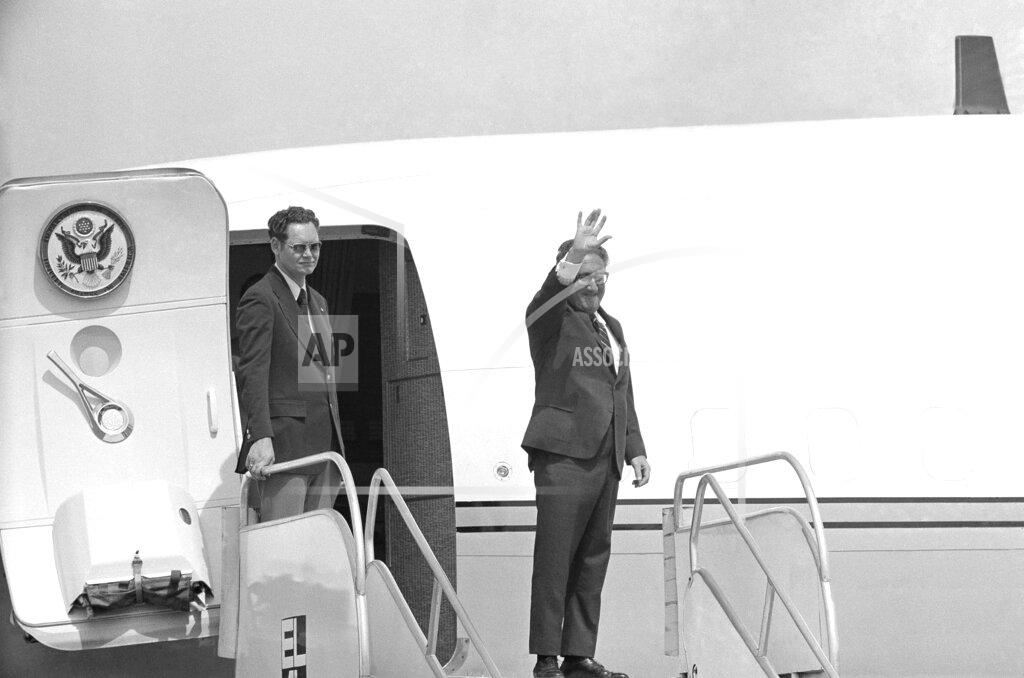
Secretary of State Kissinger returned to Washington, convinced that his step-by-step approach to Middle East settlement has been shattered by the failure to achieve a new Egyptian-Israeli accord, and that a return to the Geneva conference seemed inevitable. Mr. Kissinger’s plane landed at Andrews Air Force Base at 7:55 PM and he went by helicopter to the White House to confer with President Ford. Before they began their talks, President Ford and Mr. Kissinger pledged that the United States would continue to do everything possible to achieve peace in the Middle East. “It is in the national interest as well as in the international interest that we do everything we can with the emphasis on peace,” Mr. Ford said. Mr. Kissinger, appearing weary, said: “The necessities that produced the mission continue and the need for a lasting peace remains.”
Aboard the Air Force Boeing 707 flight from Israel to the United States, with a fueling stop at London, reporters were told that Mr. Kissinger refused to fix responsibility publicly for the collapse of his latest “shuttle diplomacy” on either Israel or Egypt. He was said to believe that both sides had found themselves unable for political reasons to make the kind of major compromise needed to prevent a deadlock. But in private, as he flew home to report to President Ford, Mr. Kissinger seemed upset by what he regarded as a shortsighted attitude in Israel in not taking a more flexible approach. Israel’s interests would have been better served, he believed, by making a compromise rather than in facing the Arabs in a group at Geneva. Mr. Kissinger had looked upon the last two weeks of talks as a possible “turning point” in which an accord would open the way to a serious move toward peace.
Mr. Kissinger acknowledges that he may come under criticism for having failed to bring about an accord and he is said to feel that this is “fair” since if he had achieved an accord he would have received praise. He left Washington on March 5 believing that since each side knew the other’s position on withdrawals and nonbelligerency, it was a near certainty that they mould both show some flexibility. But the Israeli Government, he believes, was unable for political reasons to move away from the nonbelligerency pledge sought by Premier Yitzhak Rabin; the Egyptians, fearing criticism in the Arab world, found it impossible to make a nonbelligerency pledge. Mr. Kissinger was prepired to announce the suspension of his efforts Friday night after five and a half hours of talks with the Israeli negotiators. But Mr. Rabin asked for a day to think about a possible new proposal. When Israel and Egypt both refused to alter their stands Mr. Kissinger announced his decision to return to Washington.
Officials in Washington said that President Ford was in touch with both sides during Secretary of State Kissinger’s Middle East talks, but refused to confirm that he had sent a last-minute message to Israeli leaders, even though Premier Yitzhak Rabin said he had received a message. Their remarks, however, indicated that a message had been sent and that it was stiff.
Egypt firmly maintained her position that Secretary of State Kissinger’s mediation in the Middle East had collapsed and could not be revived. The Egyptian Foreign Minister, Ismail Fahmy, said “this is the end” when he was asked by reporters whether Egypt would “accept renewal of Mr. Kissinger’s mission.” He said that he would make a formal request within the next few days to the United States and the Soviet Union to reconvene the Middle East peace conference at Geneva. Mr. Fahmy indicated that he might ask Syria to join Egypt in the request. The two Arab countries have been watching each other with open mistrust over the last several months—Syria suspecting that Egypt might be persuaded by Mr. Kissinger to enter into a separate agreement with Israel at Syria’s expense, and Egypt suspecting that Syria was seeking to thwart Mr. Kissinger’s efforts. Mr. Fahmy was asked whether Egypt expected military action as a result of Mr. Kissinger’s inability to achieve another troop disengagement accord. “It is not excluded” he replied. “The tension has grown now and will become much greater.”
In a rare display of political unity, Israelis on the left and right stood behind the government’s firm stand on its decision not to relinquish the strategically valuable Sinai passes and the oilfield at Abu Rudeis for less than a firm Egyptian commitment to nonbelligerency. But there was disappointment over the breakdown of Secretary of State Kissinger’s mediation efforts and fear about the impact it might have on Israel’s relations with the United States. The national mood seemed to be one of defiant satisfaction that the Government had clung to its position despite heavy pressure from the United States — pressure that included a personal message from President Ford that the Israeli newspapers today described as bitter and accusatory. The message, which official sources said was received through diplomatic channels in the final hours of the negotiations, reportedly called on Israel to make the concessions necessary to reach a new agreement and warned that if the effort failed, it could lead to a “new assessment” of Israeli‐United States relations.
The breakdown of Secretary of State Kissinger’s negotiations came as a relief to Syrians and Palestinian officials and it was reported that fighting broke out in southern Lebanon between Israelis and guerrilla forces. Syrian and Palestinian guerrilla groups have viewed Mr. Kissinger’s efforts to obtain a separate Sinai agreement between Israel and Egypt as an attempt to divide the Arab bloc. The spokesman, Abdul‐Mohsen Abou Maizer, said the breakdown of Egyptian‐Israeli talks demonstrated that Israel was intransigent in occupying Arab territory and denying Palestinian rights “because of American political and military support.” The official Syrian radio reported the suspension of Mr. Kissinger’s mission in broadcasts early today and called for an early resumption of Middle East peace negotiations at Geneva, which have been suspended for 15 months.
The governing British Labor party is in the midst of a struggle over whether Britain should remain in the Common Market. The party began to tear itself apart in earnest this weekend, with some Cabinet ministers attacking decisions of the Cabinet, some Labor members of Parliament attacking the ministers and Prime Minister Wilson attacking all the attacking. And there is much more to come because the referendum on the issue of membership is still more than two months away. It will be a rather uncomfortable time for Mr. Wilson, who announced last week that a majority of the Cabinet had decided to recommend to the British to vote “Yes” on remaining in the nine‐nation European Economic Community. Seven of the 23 Cabinet ministers argued for withdrawal from the market and Mr. Wilson agreed to allow them the rare freedom to campaign against it without losing their jobs.
British fishermen protesting imports of frozen fish from countries outside the European Common Market extended their blockade to a third port as 40 vessels blocked Tyne” harbor on England’s northeast coast. More than 70 boats with 260 fishermen aboard already had blocked the ports of Grimsby and Immingham on the Humber River farther south..
A Portuguese military official charged tonight that a “highly dangerous” rightist group called the Portuguese Liberation Army is operating in Spain with the aim of overthrowing Portugal’s revolutionary government. Col. Eurico Corvajo, chief of staff of northern military head quarters in Oporto, warned the country in a televised news conference to remain vigilant, because “the group has not yet given up and will refine its methods.” The charges were likely to create new strains in the uneasy relations between Spain, governed by a rightist, anti-Marxist Government, and Portugal, which has taken a sharp turn to the left, particularly after a reported abortive attempt at a rightist military coup March 11. At that time a large number of Portuguese were said to have fled across the frontier to join others who had fled after the downfall of the rightist regime here last April.
Italy’s Communists ended their 14th party congress with demands for inclusion in the government and a pledge not to take Italy out of the North Atlantic Treaty Organization. They endorsed party leader Enrico Berlinguer’s declaration that Italy can emerge from its crises only with the help of the Communists. They urged coexistence and cooperation among the world’s power blocs and assailed the current Christian Democratic leadership as being short-sighted with “strategies of tension and adventure.”
Four Arab guerrillas were sentenced to life in prison by an Israeli military court in the occupied West Bank town of Nablus. The four, who were not identified, were arrested last August on the West Bank after crossing over from Jordan. The Israelis said they were caught carrying large quantities of explosive materials and weapons. The men said they had planned to take hostages and kill as many Israelis as possible.
Pilgrims waving palm branches and. singing songs of peace and love walked along Christ’s Palm Sunday route into Jerusalem in an ancient rite opening Easter week. The celebration seemed remote from the collapsed Mideast peace mission of Secretary of State Henry A. Kissinger. “I’m here to observe Easter,” said a German pilgrim, “and I’m not very interested” in the Kissinger failure.
A group of Kurdish rebel military and political leaders intend to fight on against the Iraqi Government despite a statement by their chieftain, General Mustafa Barzani, that “the fighting is over,” well‐placed Kurdish supporters of the general reported here today. Nonetheless, the rebel leadership has requested an extension of the present Iraqi‐Kurdish cease‐fire, which is to end on April 1. Western diplomats reported, and there were further reports among the Kurds and their friends here of disintegration within the 100,000‐man rebel fighting force. “Now the soft boys are getting out,” a Kurdish rebel sympathizer snapped, as word circulated here in the Iranian capital that Rashid Sindi, formerly an important rebel commander in the south of Iraqi Kurdestan, had decided that it was useless to try to resist the Iraqi onslaught that is expected to begin next month. By some accounts the commander and hundreds of his men are making their way toward the Iranian border.
The new agreement for the supply of 800,000 tons of American wheat to India on concessional terms has been welcomed by officials here with much relief. “It’s most timely — it will solve a lot of our problems,” said one official at the Food Ministry. Although for political reasons the government is playing down the significance of the agreement that was signed in Washington on Thursday, officials here privately acknowledge the beneficial effect on food prices, stocks and government finances.
Two former Nationalist Chinese generals, imprisoned as alleged war criminals, have been freed, China’s official Hsinhua news agency said. It reported that Huang Wei and Wen Chiang, both former lieutenant generals, thanked Chairman Mao Tsetung for the special amnesty and promised to study the works of Marx, Lenin and Mao. The two men were free to go to Taiwan or remain in China.
John Stonehouse, the runaway member of the British Parliament, accused Australian police of illegally searching his Melbourne home, taking his personal papers and $5,200 in cash belonging to his wife. Stonehouse was arrested Friday and charged with 15 counts of forgery and theft in Britain. He was released on bail on condition he report daily to police. He said the police took the manuscript for a book he is writing and information concerning Scotland Yard.
Jean Gueury, France’s ambassador to Somalia, was kidnapped as he left worship services at a cathedral in Mogadishu. Somali police quickly located the house where Gueury was held hostage, and the French embassy negotiated with the kidnappers, agreeing to their demands only minutes before the threatened execution of Gueury. France released two Somali terrorists from prison, provided the kidnappers $100,000 in gold, and allowed them to fly to Yemen, where Gueury was freed unharmed.
Congo’s President Marien Ngouabi arrives in Moscow today at the head of a 40-man delegation and the press buildup indicates Soviet hopes for strengthening its ties with the Congo. The Kremlin also has had official visitors from Gambia and Guinea-Bissau in recent weeks in what amounts to a Soviet diplomatic offensive in West Africa.
Rhodesian nationalist leaders reaffirmed that African majority rule was not negotiable with the country’s white minority government. Observers saw the statement, issued by the executive committee of the African National Council in Salisbury, as a move to dispel speculation of a rift between moderates and hard-liners in the ANC, the umbrella group under which nationalist groups have been negotiating with the government.
President Ford met separately with his economic advisers and Representative Al Ullman, chairman of the House Ways and Means Committee, to discuss the tax reduction bill that Congress plans to send to the President by mid-week. Mr. Ullman said later that he and Mr. Ford were not in total agreement on the bill but “we’re not greatly apart either.” He said they differ on the size of the tax reduction and on details of how taxes are to be cut.
Senator Lloyd M. Bentsen Jr. of Texas predicted he would go into next summer’s Democratic National Convention with the most delegate votes. But he conceded that a first-ballot nomination by any candidate was unlikely. Bentsen predicted also that the convention would nominate a presidential candidate “who will appeal to the center” and shun anyone who had not run in the primaries. Bentsen is one of five who have announced they are candidates for the nomination. He will enter a “representative number of primaries,” Bentsen said, but added, “I think it is physically impossible with my obligations here in the Senate… to run in all the primaries.”
Representative Morris K. Udall scrubbed a Presidential campaign speech last weekend before the liberal California Democratic Council meeting in Fresno. The Arizona Democrat explained that near‐final floor action on his strip‐mining bill would keep him in Washington. But the Californian noted there was ample travel time between the House adjournment Friday and their Saturday dinner. And they concluded sourly that Mr. Udall was afraid of being outapplauded again (as at the California Democratic party’s state convention in January) by another Presidential guest of the council, former Senator Fred Harris of Oklahoma.
Transportation Secretary William T. Coleman Jr. said the states soon would have to prove they were enforcing the national 55 m.p.h. speed limit or risk losing some federal highway funds. “We have plans to take steps to see that it is enforced,” said Coleman. “We’re actually at this moment discussing what type of certification the governor of a state or someone else should give to indicate that it is being enforced.” Coleman said. He added, “We do intend to enforce the 55 m.p.h. speed limit. It does save fuel. Even more important-or equally as important-it saves lives. For example, the deaths on the highways since the time of the 55-mile speed limit were reduced by 9,400.”
Drug smugglers using stolen private boats are bringing significant amounts of heroin and other hard narcotics into Puerto Rico for eventual shipment to the United States, congressional investigators reported. About 80% to 85% of the drugs smuggled into Puerto Rico eventually wind up in the United States, the investigators said. The drugs, mainly from Columbia and Venezuela, are carried in private boats and deposited in secluded coves that dot the coastline, said a House Coast Guard subcommittee report, and are retrieved after the boats are cleared by customs. After that, they can be shipped on to the mainland without further customs checks, the report said.
Air travel in the United States is in the fourth month of its sharpest decline since World War II. The situation has precipitated a broad review of airline pricing policies that have raised domestic fares an average of 20 percent in the last 16 months. Airlines are looking for ways to stimulate travel by selectively lowering fares.
A dismal picture of an apathetic public, largely uninformed about the role and activities of the nation’s local school boards, has emerged from a survey conducted for the National School Boards Association by the Gallup Organization. Sixty‐three per cent of the adults polled across the country could not name a single action undertaken by their school boards during the last year and only 67 percent of those living in districts with elected school boards knew how members were chosen. “The national picture reveals that the people neither understand the functions of school boards nor believe that they should have most of the legal responsibilities which they now have,” Harold V. Webb says in the introduction to the report, “The People Look at Their School Boards,” released yesterday. This basic lack of information could mean “the entire structure of local, citizen control of public schools is jeopardized,” said Harold Webb, the association’s executive director. The study just released shows that much of the public would give school boards less authority than they have now. A majority thought also that the boards worked to further special interest groups, such as teachers and administrators, rather than in the best interest of the students.
After CBS became the first American TV network to openly practice checkbook journalism, former White House Chief of Staff H. R. Haldeman appeared in the first of two interviews by Mike Wallace on the CBS news program 60 Minutes. The appearance, and Haldeman’s answers to questions about ex-President Richard M. Nixon and the Watergate scandal, came in return for a payment of at least $25,000 by CBS News. Haldeman admitted in the first interview that he had talked President Nixon out of destroying tape recordings of conversations in Nixon’s office, saying that he “stupidly — didn’t really think the thing through.” Haldeman was serving a federal prison sentence at the time of the interview.
New York City Mayor Beame, declaring that “we’re dealing with a condition, not a theory,” announced that the city would sharply reduce its short-term borrowing, and explained how he intended to cut back city services — including police, fire, sanitation and education — to save $135 million in the next fiscal year. He held an unusual Sunday news conference, he said, to “clear the air of some misconceptions and misunderstandings, which if left unchallenged, could seriously damage the city’s economy and its position in the short-term and long-term money markets.”
Deadly nerve gas was flown around the country 21 times by the Army in 1974, according to Rep. Les Aspin (D-Wisconsin), who called for an investigation. Aspin, a former Pentagon analyst, asked the General Accounting Office “to investigate the adequacy of the safety measures employed by the Army.” The Pentagon had no immediate comment. Aspin said the deadly gas was transported in military aircraft that are required to have two engines, two pilots and personnel with special training. “What may sound like more than adequate safeguards to the layman may seem woefully inadequate to the expert,” Aspin said.
Two reactors at the Browns Ferry Nuclear Plant in Athens, Alabama, were shut down indefinitely after a fire raged for about six hours near the main control center. Officials of the Nuclear Regulatory Commission and the Tennessee Valley Authority, which operate the plant, said there were no injuries or risks of radioactive leaks. “A small candle flame normally used to check for any air flow apparently ignited sealant being used to plug a hole,” said Chris Eckl, a TVA spokesman. A decision when the reactors would return to service was not expected for several days.
A spring storm hit the northern and central plains, leaving up to 10 inches of snow covering parts of North Dakota. The snow, driven by strong winds, swept out of Nebraska into the upper plains and the northern Great Lakes regions while thunderstorms from the middle Mississippi River Valley to northeastern Texas created conditions favorable for tornadoes. A watch was issued for the area. Flash flood warnings were issued for southern Wisconsin, where rivers were already overflowing their hanks. Dust storms lowered visibility in parts of Nebraska. Kansas and Texas, where dust-laden winds gusted up to 45 m.ph.
Palm Sunday, the first day of Holy Week and the herald of Easter, was marked today in Roman Catholic and Protestant churches with traditional prayers, Scripture readings and special music.
The proof of Muhammad Ali’s disdain for Chuck Wepner was in the pudding of his belly today when the champion weighed 223 pounds at a playful weigh-in ritual for tomorrow night’s world heavyweight title bout here at the Coliseum outside Cleveland.
Born:
Joe Salave’a, Samoan NFL defensive tackle (Tennessee Oilers-Titans, San Diego Chargers, Washington Redskins), in Leone, American Samoa.
Derrick Ham, NFL defensive end (Washington Redskins, Cleveland Browns), in Merritt Island, Florida.
Chris Kelleher, NHL defenseman (Boston Bruins), in Cambridge, Massachusetts.
Rita Grande, Italian tennis star (3rd round, Australian Open, 1996), in Napoli, Italy.
Alydar, American racehorse, close second to Affirmed in all three races of the 1978 Triple Crown (d. 1990).





 History Diaries