
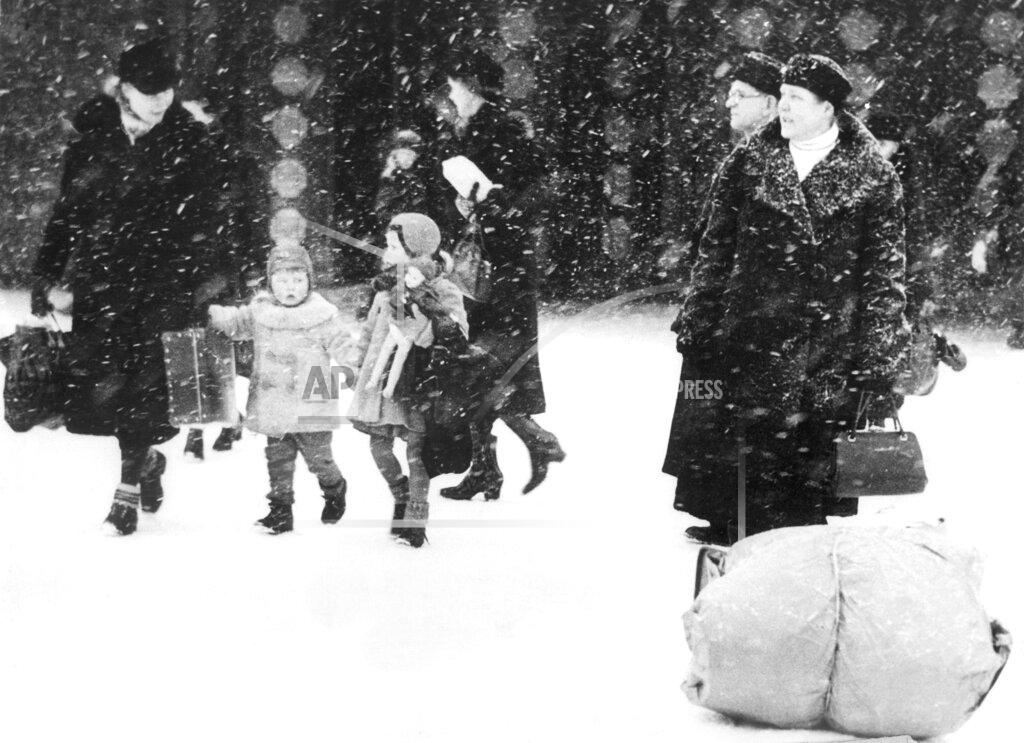
Finland formally hands over Hanko to the Soviet Union. Soviet military personnel began to arrive at the Hanko Peninsula in Finland, which had been leased to the Soviet Union for 30 years as part of the Moscow Peace Treaty that ended the Winter War. They rename it Hangö.
French Prime Minister Paul Reynaud is forced to name his predecessor Édouard Daladier as Minister of War despite their opposite political views. His cabinet wins a vote in the French Parliament by a single vote, and the new government’s hold on power is precarious. Saved by a bare majority of one vote in its first appearance before the Chamber of Deputies this afternoon, Premier Paul Reynaud’s Cabinet decided at 10 o’clock this evening to continue to brave the situation out at least until Parliament returns from the Easter vacation on April 2. While Reynaud has kept former Prime Minister Daladier in the cabinet, they find that they cannot agree on a strategy. This also has implications for relations with the British.
The speed with which a new French Cabinet was formed by Paul Reynaud and the new Premier’s announced intention of cooperating with Britain to carry on the war vigorously were welcomed by British officials and the press tonight.
Journalist William Shirer, based in Berlin, writes in his diary that “Germany can now try to force the issue on the western front, but this is improbable.”
Photographs taken by two British reconnaissance planes on Wednesday morning over Sylt Island a few hours after thirty bombers unloaded nearly 1,000 high explosive and incendiary bombs on that German seaplane base do not show the extent of the damage because the observers could not get near enough and atmosphere conditions were unsuitable, the Air Ministry announced tonight.
United States correspondents visited Sylt on Thursday and said they saw slight evidence of damage.
The British government was warned of the possibility of a German nuclear weapon.
Gerald Winter, a farmer from Sussex, is awarded an Empire Gallantry Medal for dragging an RAF pilot from a burning plane.
Four hundred armed men of the outlawed Irish Republican Army, defying the Ulster Government’s ban on demonstrations in commemoration of the Easter Week rebellion of 1916, paraded through Belfast today.
In a conversation today Norway’s Labor Premier, Johann Nygaardsvold, a former sawmill worker, showed that he was aware of those dangers facing Norway and Sweden which Prime Minister Chamberlain said had been brought closer by the Russo-Finnish peace.
The Royal Navy increased patrols in Norwegian waters.
New Rumanian-German negotiations for supplementary trade agreements began here today when, it was learned, Dr. Karl Clodius, German economic expert, presented a twelve-point letter to the Rumanian Government. He suggested that the letter form the basis of important German-Rumanian economic discussions. Official circles denied that the letter was an ultimatum and said that it should be regarded as a guide to discussions. The Ministry of Propaganda likewise formally denied that the letter was an ultimatum in any form, either in respect to a change in the Rumanian Government or in relation to the economic discussions. The letter, it was understood, said it was necessary to adjust the exchange rate between the mark and the Rumanian leu. It said also that it was necessary to speed up Rumanian oil production, increase the volume of Rumanian-German trade, speed up improvement of transportation facilities between the two countries and vastly increase Rumanian agricultural production.
Rumanian King Carol II vows to defend his country’s borders.
Hungary’s Count Pál Teleki, the Hungarian Premier, will arrive in Rome tomorrow morning, and before he leaves he, like Joachim von Ribbentrop, the German Foreign Minister, and Under-Secretary of State Sumner Welles, will have seen Premier Mussolini, Count. Ciano, the Italian Foreign Minister; Pope Pius and King Victor Emmanuel. His visit will not be so important as the others, but it will fit into the same dramatic picture of peace or war and the unhappy months that lie ahead. Hungary is a worried and fearful country these days, and whenever the Hungarians get into that state of mind either the Premier or the Foreign Minister comes to Rome. It almost always, in the last year or so, meant an appeal for help against Germany, and this time does not appear to be an exception. Hungary is under renewed pressure, and there are alarming indications and rumors involving the Balkans that Count Teleki will surely want to control. The proposed plan to guarantee Rumania’s frontiers is one of them. Count Stephen Csáky, the Hungarian Foreign Minister, agreed at the Venice meeting with Count Ciano in January to shelve the Hungarian claims against Rumania for the time being, but he did not abandon Hungary’s claims.
All large Turkish steamers in foreign waters are ordered, by the Turkish government, to return home as soon as possible.
General Konstantin Rokossovsky, arrested in 1937 during the purges that ended the lives of many of his colleagues, is released from prison and rehabilitated. This is part of Stalin’s pattern of imprisoning his top generals, torturing them, executing some, and somewhat arbitrarily restoring others to their former, or even more prominent, positions.
Cromer Knoll lightship in the U.K. is attacked by a lone Luftwaffe aircraft. The Luftwaffe conducts another sweep over the British east coast and attacks the Cromer Knoll lightship without scoring any hits.
One RAF Hurricane lost in engagements with Luftwaffe fighters along the Dutch border.
Handley Page Hampden bombers conduct a standard night reconnaissance and leaflet drop over the Ruhr industrial area and northwest Germany tonight. For the first time, though, Luftwaffe Bf 110 Zerstorer (destroyer) night fighters come up to challenge the British. One bomber is damaged.
The Norwegian cargo ship Bravore struck a mine and sank in the North Sea 4 nautical miles (7.4 km) off Ramsgate, Kent, United Kingdom.
The Swedish cargo ship Sandö (1,282 GRT) collided in dense fog with the Swedish ship Nujolla and sank in the Oslofjord 1.5 miles (2.4 km) southwest of Færder Lighthouse, Norway. There were no casualties.
The Estonian cargo ship Neme was damaged by ice and sank in the Baltic Sea. Her crew survived.
Convoy HN.21 with seven British, eighteen Norwegian, five Swedish, four Danish, four Finnish, one Estonian ship departed Bergen escorted by destroyers HMS Javelin, HMS Janus, and HMS Eclipse and submarine HMS Porpoise. Destroyer HMS Juno rendezvoused with the convoy later that same day. Cover for the convoy was supplied by light cruiser HMS Sheffield. Antiaircraft support was supplied by anti-aircraft cruiser HMS Calcutta. At 2158/22nd, Sheffield attacked a submarine contact west of Utvaer in 61-05N, 3-35E, and at 0215/23rd, a contact east of Muckle Flugga in 60-55N, 1-40E. The nine ships of the west coast ships were joined by destroyers HMS Cossack and HMS Gurkha, which departed the Clyde at 1200/21st, at daylight on the 22nd. Cossack and Gurkha arrived at Scapa Flow at 1730/24th after the west coast section of the convoy had been dispersed off Cape Wrath. Eclipse, which had been separated in heavy weather, patrolled off Buchanness until she could rejoin the convoy. Convoy HN.21 arrived at Methil at 1100/25th with Javelin, Janus, Juno, Eclipse and Porpoise.
Convoy TM.31 departed the Tyne escorted by the 19th Anti-submarine Group and sloop HMS Hastings.
Convoy FN.126 departed Southend escorted by sloop HMS Lowestoft and destroyer HMS Valorous. The convoy arrived on the 23rd.
Convoy BC.31 of steamers Baron Carnegie, Kerma, Lochee, Pembroke Coast, and Scholar (Commodore) departed Bristol Channel escorted by destroyer HMS Vivacious. The convoy arrived at Loire on the 24th.
Convoy SL.25 departed Freetown escorted by armed merchant cruiser HMS Esperance Bay until 5 April. On 5 April destroyers HMS Havant, HMS Vanquisher, HMS Walker, and HMS Windsor joined the convoy and escorted it to its arrival on 8 April.
The War at Sea, Friday, 22 March 1940 (naval-history.net)
Battleship BARHAM was undocked at Liverpool.
Aircraft carrier ARK ROYAL, after deplaning at Portland, sailed from Plymouth for the Mediterranean the afternoon of 22 March escorted by destroyers IMOGEN and ISIS which returned to Portsmouth the next day. On the 25th, ARK ROYAL was joined by destroyers ACTIVE and BULLDOG, which departed Gibraltar on the 24th. Australian destroyer HMAS VOYAGER departed on the 25th and relieved destroyer ACTIVE in 36N, 7-30W. ARK ROYAL, BULLDOG, and VOYAGER passed Gibraltar on the 25th and arrived at Malta on the 28th. She soon joined Aircraft carrier GLORIOUS for flying off exercises for their air crews.
Armed merchant cruisers MALOJA and DERBYSHIRE arrived in the Clyde after Northern Patrol.
Armed merchant cruiser TRANSYLVANIA departed the Clyde on Northern Patrol.
Light cruiser GLASGOW departed Belfast for the Clyde where she arrived later that day.
Destroyers HAVELOCK and HAVANT arrived at Plymouth.
Destroyer ZULU after conducting a full calibre shoot in the Firth arrived at Rosyth.
Destroyer WHITSHED, escorting convoy SL.23, dropped depth charges on a submarine contact ten miles south of Portland Bill. Destroyer HIGHLANDER, which had arrived at Portland that day to work up, departed Portland to assist. However, with defective anti-submarine gear, destroyer HIGHLANDER was recalled. Motor Anti-submarine Boats 2 and 6 also departed Portland to assist WHITSHED.
Convoy HN.21 with seven British, eighteen Norwegian, five Swedish, four Danish, four Finnish, one Estonian ship departed Bergen escorted by destroyers JAVELIN, JANUS, and ECLIPSE and submarine PORPOISE. Destroyer JUNO rendezvoused with the convoy later that same day. Cover for the convoy was supplied by light cruiser SHEFFIELD. Antiaircraft support was supplied by anti-aircraft cruiser CALCUTTA. At 2158/22nd, SHEFFIELD attacked a submarine contact west of Utvaer in 61-05N, 3-35E, and at 0215/23rd, a contact east of Muckle Flugga in 60-55N, 1-40E. The nine ships of the west coast ships were joined by destroyers COSSACK (D.4) and GURKHA, which departed the Clyde at 1200/21st, at daylight on the 22nd. COSSACK and GURKHA arrived at Scapa Flow at 1730/24th after the west coast section of the convoy had been dispersed off Cape Wrath. ECLIPSE, which had been separated in heavy weather, patrolled off Buchanness until she could rejoin the convoy.
Convoy HN.21 arrived at Methil at 1100/25th with JAVELIN, JANUS, JUNO, ECLIPSE, and PORPOISE.
Destroyers ELECTRA and ESCAPADE at 1050 were ordered to hunt a U-boat reported by air near Sule Skerry in 59-12N, 4-36W. At 1830, another aircraft sighted a U-boat in 59-26N, 3-54W. ELECTRA and ESCAPADE were ordered to this position and arrived on station at 2000.
Destroyers ESKIMO and PUNJABI departed the Clyde at 2200 escorting tankers WAR PINDARI (5559grt) and BELGOL (2648grt) to Scapa Flow. Tanker PETROBUS joined the convoy from Stornoway. She had been at Stornoway since 17 March when her escort was ordered post haste to Scapa Flow.
Destroyers DELIGHT, HUNTER, ILEX, and FEARLESS arrived at Sullom Voe at 1630 for refueling. They put to sea at 0740/23rd.
Submarine SWORDFISH departed Blyth on patrol.
Submarine SEAWOLF departed Harwich on patrol.
Submarine TRIBUNE departed Rosyth for trials and exercises, and returned later in the day. Her engine trials were not satisfactory and she was ordered to the Clyde for repairs.
After departing Brest on the 17th and calling at Cherbourg, French submarine depot ship JULES VERNE arrived at Harwich with 600-ton submarines SYBILLE, ANTIOPE, and AMAZONE of the 16th Submarine Division, escorted by French destroyer FOUDROYANT and sloop AMIRAL MOUCHEZ. In the Downs, the French escort was relieved by British destroyer CODRINGTON and Polish destroyers ORP BLYSKAWICA, ORP GROM, and ORP BURZA of the 1st Destroyer Flotilla. These ships were formed as the 10th Submarine Flotilla to aid the British in the patrol of the North Sea.
Destroyer BOADICEA was covering the operations of the 10th Minesweeping Flotilla between North Goodwin Bank and Fairy Bank Buoy.
Minesweeper LEDA of the 5th Mine Sweeping Flotilla with Trinity House Vessel ARGUS laid three light buoys along the North Goodwins-Wandelaar searched channel.
Anti-submarine trawler LE TIGER (516grt) was damaged when she struck wreckage in 58-12N, 02-28W. Another trawler of the 10th Anti-submarine Group was sent to assist and she safely arrived at Aberdeen later that day.
Convoy TM.31 departed the Tyne escorted by the 19th Anti-submarine Group and sloop HASTINGS.
Convoy FN.126 departed Southend escorted by sloop LOWESTOFT and destroyer VALOROUS. The convoy arrived on the 23rd.
Convoy BC.31 of steamers BARON CARNEGIE, KERMA, LOCHEE, PEMBROKE COAST, and SCHOLAR (Commodore) departed Bristol Channel escorted by destroyer VIVACIOUS. The convoy arrived at Loire on the 24th.
Convoy SL.25 departed Freetown escorted by armed merchant cruiser ESPERANCE BAY until 5 April. On 5 April destroyers HAVANT, VANQUISHER, WALKER, and WINDSOR joined the convoy and escorted it to its arrival on 8 April.
Heavy cruiser KENT completed her refit at Colombo.
In Washington today, President Roosevelt remained in bed with a slight cold and temperature of 99.2 degrees and was urged by his physician, Rear. Admiral Ross T. McIntire, to stay in bed through Sunday.
The Senate passed the $1,018,000,000 Agricultural Appropriation Bill. Hearings on making dairy products a basic commodity under the AAA were continued before. an Agriculture subcommittee, as were the Temporary National Economic Committee’s hearings on State trade barriers. The Senate recessed at 5:48 PM until noon Monday.
The House was in recess. Its Agriculture Committee continued questioning Albert S. Goss on the Farm Credit Bill.
Plans were nearing completion today to make available to Great Britain and France about 2,000 of the latest type. of planes ordered by the United States Army, officials said tonight. After staff conferences at the War Department, following earlier discussions by President Roosevelt, Secretary Morgenthau and army officials, it was reported that a decision in principle had been reached that nearly $1,000,000,000 in additional Allied plane buying would so increase United States production capacity that large plane reserves no longer would be essential. Of nearly 5,500 planes which Congress authorized for construction by July 1, about 2,000 were intended for use as reserves. With increased production making rapid building possible, the need for these reserve planes is said to have lessened. It was decided, therefore, that many planes ordered by the army, on which it has priority, could be made available for sale to the Allies.
Some of these planes, including apparently the latest dive-bombers and high-speed pursuit craft, will soon be offered to Britain and France, defense officials said. They said that exact details had not been settled but that a stagger system might be evolved. As President Roosevelt stated in his press conference on Tuesday, the P-40, on which the army is only beginning to get production, will be made available to the Allies and other foreign buyers. Some discussion apparently has developed whether equipment such as special superchargers should not be included on all late types for foreign sale.
The U.S. Senate passed the big $923,000,000 farm appropriation bill, $203,000,000 above the budget estimates, today in the face of a warning from Secretary Morgenthau that it should not expect the increase to be paid from the treasury’s cash balance. That balance, Morgenthau wrote to Senator Byrd (D-Virginia), will run “about as low as it can be permitted to go,” at the close of the present fiscal year, without dipping into it for unbudgeted agricultural expenditures.
Approval for the measure, to which the Senate added almost $300,000,000 above the amount voted by the House, came after a long day in which spokesmen made unsuccessful attempts to add new benefits for sugar growers, but in which economy spokesmen, led by Senator Byrd, also were unsuccessful in restricting sugar benefits now paid. The Senate amendments virtually wiped out all economies made in previous appropriations bills. This was in the face of a categorical statement by Secretary Morgenthau, in a letter to Senator Byrd, that the general fund of the Treasury contains no margin which may be used to offset Senate additions to the farm program and obviate the necessity of new taxes or a rise in the debt limit, as was indicated by Senator Barkley, the majority leader.
The Senate also passes and sends to conference a $1 Billion defense bill for 1941. It will within weeks be overtaken by events and be seen as inadequate.
Mrs. Anna Roosevelt Boettiger, daughter of President Roosevelt, said here today that “at the moment,” she did not personally favor a third term for the President and thought her father needed a rest. But, she said, “it always has been a woman’s prerogative to change her mind.”
In a Good Friday interlude to his campaign for the Republican Presidential nomination, Senator Taft of Ohio lashed out at religious intolerance and assailed “those who deliberately try to spread that kind of Prejudice” in the United States.
The U.S. Army Air Corps releases some details of its experimental Douglas XB-19 Super-heavy bomber. The aircraft has a 212 foot wingspan and impressive range and bomb load (though short of targets for each). It finally flies in 1941, but other designs have emerged and the new USAAF does not pursue production of the B-19. The one prototype serves during the war as a large transport airplane.
The U.S. Navy initiates the development of guided missiles at the Naval Aircraft Factory in Philadelphia, Pennsylvania, with the establishment of a project for adapting radio controls to a torpedo-carrying Great Lakes TG-2 torpedo bomber.
“Popeye the Sailor — Stealin Aint Honest # 78,” March 22, 1940, is released. Popeye battles Bluto for a gold mine!
James H.R. Cromwell has no intention of resigning as United States Minister to Canada, despite the public rebuke he received yesterday from Secretary of State Cordell Hull, according to a personal representative of Mr. Cromwell.
The Muslim League in the Lahore Resolution advocates splitting India into Muslim and Hindu countries. This is an idea that is highly controversial among other Indian revolutionaries. Muhammad Ali Jinnah’s address to the Lahore conference was the moment when Jinnah, once a proponent of Hindu-Muslim unity, irrevocably committed to force the creation of an independent Pakistan.
U.S. Navy gunboat USS Asheville arrived at Gulangyu island, an international zone, near Xiamen, China.
Second Battle of Wuyuan: Chinese 8th War Area attacking around Japanese strongpoints in Hsinglungchang sector. Chinese troops secured major roads leading into Wuyuan, Suiyuan Province, China. A small Japanese force was immediately deployed to counterattack, with more troops being transferred to reinforce the counteroffensive. The Chinese 101st Division, having bagged Wuyuan on the 21st, move on to capture the strongpoint at Hsin-an-chen in order to cut the road along the Yellow River that leads to Wuyuan. The Japanese send 80 trucks full of troops from Dashetai via Siyitang to make a forced crossing of the Wu-chia River at Ta-Tsai-chu 10 km (6.2 mi) north of Wuyuan. This is a Muslim region with Chinese troops that are full of fervor.
Battle of South Kwangsi: Chinese 46th Army attacking Japanese 22nd Army around Lingshan.
Members of Japan’s Diet, posing the question as to whether Japan should not take some positive role in support of “Germany and Italy,” were informed tonight by Foreign Minister Hachiro Arita that Japan already was “certain” of the way the European war would come out. The matter, he added, is too delicate to talk about further. However, he did say that “Japan, will not put any obstacles in Germany’s way by joining hands with Britain or America” during the European conflict, although Japan’s entry in the Western affair is inadvisable, since she is concerned solely with the construction of a “new order” in Asia. Mr. Arita was badgered with such leading questions as these:
“Don’t you think Japan should discard her policy of non-involvement and openly side with Germany and Italy?”
“Why, while mouthing phrases about non-involvement, has Japan promised Britain not to transport German nationals or armament to Germany?”
“Since both Germany and Italy appear to have recognized Japan’s aims in East Asia, should we not take some positive measures to cooperate with them?”
“Were not the expansion of the United States Navy and the recent tour of Europe by United States Undersecretary of State Sumner Welles predicated on the assumption that the Allies would be defeated?”
To Mr. Arita’s somewhat evasive replies, Admiral Zengo Yoshida, the Navy Minister, added this: “We are going to dispose of the China incident with our eyes wide open to the world situation.”
Earlier the War Minister, General Shunroku Hata, had assured the Budget Committee of the lower house that Japan would continue her efforts to crush Generalissimo Chiang Kai-shek, who, he said, still had 2,000,000 Chinese soldiers in the field. General Hata also insisted that Japanese military operations could not be restricted by the Nine-Power treaty because Japan’s ultimate purpose in China “transcends”any such pact. Thus neither the NinePower treaty nor the formation of the Japanese-sponsored Wang Ching-wei regime in China, he insisted, would halt the “holy war.”
The third meeting of the Wang Ching-wei group for the formation of a new national government in China was ended today by the creation of machinery for the inauguration of their government March 30.
Born:
Haing S. Ngor, physician, actor (“The Killing Fields”), and author, in Samrong Yong, Cambodia, French Indochina (d. 1996).
Dave Keon, NHL and WHA centre (Hall of Fame, inducted 1986; NHL Champions, Stanley Cup, 1962, 1963, 1964, 1967; NHL All-Star, 1962-1964, 1967, 1968, 1970, 1971, 1973; Toronto Maple Leafs; Minnesota Fighting Saints, Indianapolis Racers, New England-Hartford Whalers), in Noranda, Quebec, Canada.
Dick Ellsworth, MLB pitcher (All-Star, 1964; Chicago Cubs, Philadelphia Phillies, Boston Red Sox, Cleveland Indians, Milwaukee Brewers), in Lusk, Wyoming. (d. 2022)
Garland Boyette, NFL and AFL linebacker (AFL All-Star, 1968, 1969; St. Louis Cardinals, Houston Oilers), in Rayville, Louisiana (d. 2022).
Jim Simon, NFL guard, tackle, and defensive end (Detroit Lions, Atlanta Falcons), in Pittsburgh, Pennsylvania.
Naval Construction:
The Royal Navy Bar-class boom defense vessel HMS Barthorpe is launched by Lobnitz & Co. Ltd. (Renfrew, Scotland).


 History Diaries