

South Vietnamese Skyraider fighter-bombers, accompanied by United States Air Force fighter planes, attacked the North Vietnamese base at Vu Con, 15 miles north of the DMZ. Twenty-six A-1-H Skyraiders, three flown by Americans, blasted 40 buildings used as a staging barracks and supply depot. All the planes were reported to have returned safely to their bases. An American military spokesman refused to give the number of American planes involved, their types or the fields from which they flew.
American jets were used only for flak-suppression missions, hitting enemy gun positions before the South Vietnamese Skyraiders went in to bomb. Today’s raid was the second in North Vietnam in the last three days. More than 120 United States Air Force and Navy jets struck Friday at targets 110 miles north of the demilitarized zone. None of these aircraft was downed. Today’s strike was the 11th success in the series of raids that began February 7. A Government communiqué described the target as “an important military installation.” Its location was given as 15 miles north-northwest of the demilitarized zone. The 40 buildings were each over 40 feet in length. They were grouped in three compounds along a river.
“The North Vietnamese Communists have been using these installations as temporary quarters for their troops heading toward the Republic of Vietnam and as supply and ammunition store depots for support of Communist elements operating in Quảng Trị,” the communiqué said. Quảng Trị is the northernmost province in South Vietnam. The communiqué added that a battalion of North Vietnamese regulars was permanently assigned to Vu Con. An appraisal of damage to the base was not given by the Vietnamese. The planes were over the target for 10 minutes. The raid began at 3 PM and by 3:30 all the planes were back at their bases. This would indicate the flights had begun at the large American South Vietnamese field at Đà Nẵng, 90 miles south of the 17th Parallel dividing Vietnam.
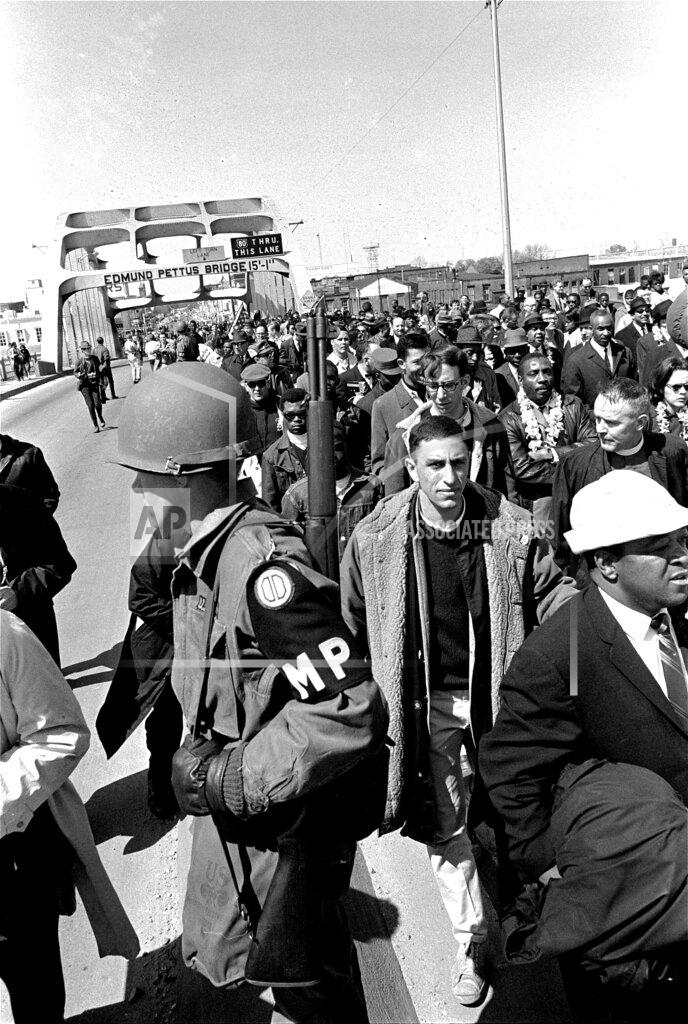
Other military action last night and today was light and confined largely to American and South Vietnamese air strikes within South Vietnam. Only four actions initiated by the Việt Cộng were reported last night. This was far below average — eight were reported each night last week. Twenty-four American B-57 bombers attacked a suspected Việt Cộng base today in Kiên Giang Province near the Cambodian border. Twelve B-57’s and seven F-100 Supersabers bombed and strafed a suspected guerrilla ammunition area 18 miles northwest of Saigon Airfield. Protection for American installations was increased with the arrival of the last of more than 400 military policemen of the 716th Military Police Battalion from Fort Dix, New Jersey.
The North Vietnamese filed a protest over the attack with the International Control Commission, charging the raid had caused “considerable damage to civilian homes” in the Vu Con area. North Vietnam asserted the attack was the sixth on its territory in eight days.
South Vietnamese Government forces killed 30 Việt Cộng in a large-scale operation in the Mekong Delta yesterday, an American military spokesman said today. He said that the battle in Kiến Hòa Province was continuing. Government casualties were four wounded, the spokesman said.
General Thomas S. Powers, recently retired chief of the Strategic Air Command, said tonight he would like to see S.A.C. bombers used against North Vietnamese targets. “They’re professionals,” he said of the crews. General Power appeared on “Meet the Press” on the National Broadcasting Company’s radio and television networks.
Communist China’s Foreign Minister, Chen Yi, was reported today to have said that if the United States crossed the 17th Parallel to attack North Vietnam “and if the Government of Vietnam asks us for aid, our help will be assured.”
Policy in Vietnam will be reviewed in talks in Washington this week between the British Foreign Secretary, Michael Stewart, and President Johnson and Secretary of State Dean Rusk.
The politically potent California Democratic Council sharply criticized the Administration’s “war widening” policy today and called on President Johnson to end bombing attacks on North Vietnam.
A preliminary settlement of the Cyprus problem is being pursued indirectly between Greece and Turkey with the help of Western diplomats, authoritative sources disclosed here today. The Greek Defense Minister, Petros Garoufalias, flew to Nicosia tonight to try to get President Makarios of Cyprus to back an effort that could alleviate fears of war between Greece and Turkey, which are allies in the North Atlantic Treaty Organization. The sources said Mr. Garoufalias would press Archbishop Makarios to ease the blockade of Turkish Cypriot strongholds by Greek Cypriot forces on the island. Ankara sent threatening notes to Athens last week over what it termed “inhuman treatment” of Turks in Cyprus.
The idea of steps to break the Cyprus deadlock emerged Friday when in an interview in the Greek press, Turkey’s new Premier, Suat Hayri Urguplu, suggested direct Greek-Turkish talks on Cyprus. He said “both sides must pledge not to take any unilateral action in Cyprus.” The Turkish Premier also suggested that if Archbishop Makarios relieved the plight of the blockaded Turkish Cypriotes the “question of the island’s final regime could be deferred until later.” Replying to the Turkish leader, Premier George Papandreou of Greece suggested that both sides should help the United Nations mediator on Cyprus, Galo Plaza Lasso. Mr. Papandreou skirted the issue of talks, but he did not reject the idea.
It was clear that there was at present no prospect for direct Greek Turkish talks about Cyprus. The Greek Premier in the past has rejected) all such suggestions so vehemently that a reversal might hurt his domestic prestige and wreck his relations with President Makarios, who opposes any Greek-Turkish settlement that he does not help arrange. Since the interview with Premier Urguplu, Greek leaders are known to have held repeated consultations with United States and British diplomats in Athens. After Premier Papandreou presided at a two-hour political-military conference today, it was announced that Defense Minister Garoufalias was flying immediately to Nicosia to see President Makarios.
The president of Bolivia, René Barrientos, was wounded by a gunman in an assassination attempt while his jeep was being driven past the city of Cochabamba. Barrientos, who had survived seven previous attempts on his life, was on his way back to La Paz from a visit to his hometown of Tarata when an assassin on a motorcycle pulled alongside him and fired with a machine gun. Although wounded in the right hip, Barrientos survived being struck by several bullets that hit his chest, because he was wearing a bulletproof vest.
Yemeni Republican forces killed 20 British soldiers when British armored cars entered Yemen in support of attacking Royalists. Yemen’s Minister of Tribal Affairs said today. Ahmed el-Awady said the British force had crossed into Yemeni territory to prevent Republican reinforcements from reaching an area being attacked by the Royalists.
Britain’s Middle East command in Aden said today that three British soldiers had been killed and four injured in the Dhalch area near the Yemen border in a clash yesterday with guerrillas.
Renewed fighting flared over the weekend between Syrian and Israeli forces along the border. an Israeli Army spokesman said today. He said the Syrians fired on the Israeli settlement of Ashmora from hill positions at Tel Hillel in the Upper Jordan River valley. There were no Israeli casualties, he said.
Another spokesman from the Israeli Foreign Ministry said that Israel had agreed to a United Nations request to permit an inspection team to check for possible violations of truce regulations on weapons along the border. The spokesman said he understood a similar request had been made to the Syrian Government by General Odd Bull, chief of staff of the United Nations truce observation organization. Mutual complaints have been made to the United Nations Security Council. Israeli crews are working on projects to divert Jordan water from the Sea of Galilee to the Negev desert. Syria has begun a counter-diversion project to block the river’s tributaries.
The Soviet Union’s two newest astronauts reappeared in public view today for the first time since they landed their spaceship Friday in a remote, snowbound northern forest. Colonel Pavel I. Belyayev, 39-year-old commander of the Voskhod 2, and his co-pilot, Lieutenant Colonel Aleksei A. Leonov, the first man to float in space, looked rested and in good spirits as they were photographed at the airport of the industrial city of Perm, in the Ural Mountains.
The Socialist Mayor of Marseilles, Gaston Defferre, emerged triumphant tonight from the race for control of Paris’ Municipal Council. This considerably reinforced his position as an anti-Gaullist contender for the French Presidency.
The second round of municipal elections, for those races where no candidate in the first round had attained a majority, took place in France. Candidates of the French Communist Party (Parti communiste français, or PCF) gained a majority in the city councils of Le Havre, Nîmes, and seven other cities, giving the PCF the lead in “34 out of the 159 towns with population of 30,000 or more.”
British farmers have taken to the roads in tractors and other slow vehicles to protest the Labor Government’s agricultural support plans. They are talking of bringing their pitchforks to London and picketing the House of Commons.
The third plenum of the Polish Workers (Communist) party which ended this weekend, emphasized that the Poles are demanding Communist unity at a time when other Soviet-bloc countries are pursuing courses of gradually increasing nationalism.
King Idris appointed Hussein Maziq as the new prime minister of Libya after the resignation of Mahmud al-Muntasir.
A strongly worded order from Washington forbidding United States Government personnel from selling their automobiles and other personal belongings at a profit while serving abroad has aroused United States officials in South America.
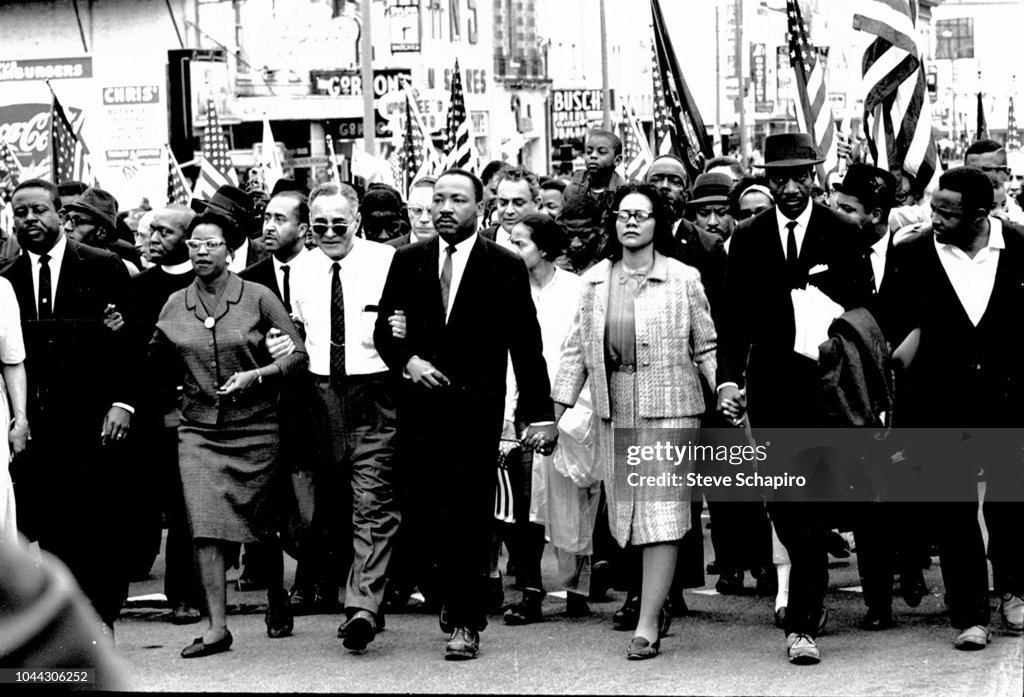
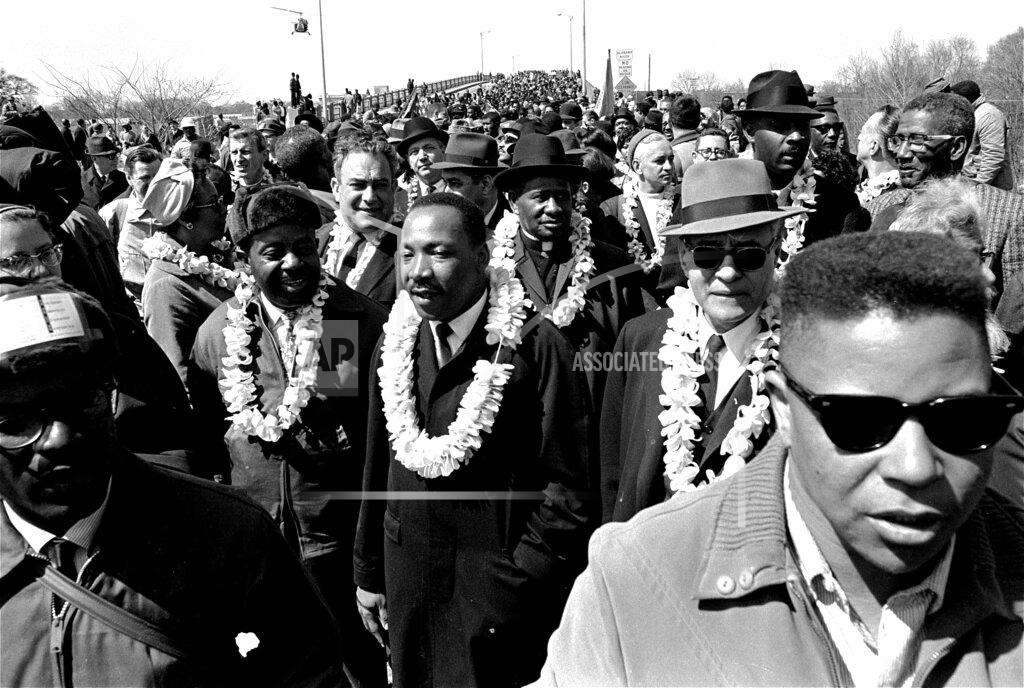
The third march from Selma to Montgomery began at 12:48 in the afternoon, as Martin Luther King Jr. and Ralph Bunche led 3,200 marchers from outside the Brown Chapel A.M.E. Church at 410 Sylvan Street, out of town, and to the other side of the Edmund Pettus Bridge, farther than the first two marches were able to get. Protected from white counterdemonstrators by regular army troops and federalized Alabama guardsmen, the group proceeded east along the 54-mile (87 km) stretch of U.S. Highway 80 before stopping for the night. As part of the federal court order permitting the march, all but 300 of the group had to depart after having walked 7 miles (11 km), while the rest got onto a chartered train to return to Selma until they could rejoin the marchers in Montgomery. The ones who remained stayed in large tents set up by organizers on the side of the highway. March 21 had been selected as the new Sunday date because it was the fifth anniversary of the Sharpeville Massacre in South Africa.
Backed by the armed might of the United States, 3,200 persons marched out of Selma today on the first leg of a historic venture in nonviolent protest. The marchers, or at least many of them, are on their way to the State Capitol at Montgomery to submit a petition for Black rights Thursday to Governor George C. Wallace, a man with little sympathy for their cause. Today was the third attempt for the Alabama Freedom March. On the first two, the marchers were stopped by state troopers, the first time with tear gas and clubs. The troopers were on hand today, but they limited themselves to helping federal troops handle traffic on U.S. Highway 80 as the marchers left Selma.
Hundreds of Army and federalized National Guard troops stood guard in Selma and lined the highway out of town to protect the marchers. The troops were sent by President Johnson after Governor Wallace said that Alabama could not afford the expense of protecting the march. The marchers were in festive humor as they started. The tone was set by the Rev. Ralph D. Abernathy, top aide to the Rev. Dr. Martin Luther King Jr. in the Southern Christian Leadership Conference, as he introduced Dr. King for an address before the march started. “When we get to Montgomery,” Mr. Abernathy said, “we are going to go up to Governor Wallace’s door and say, ‘George, it’s all over now. We’ve got the ballot.” The throng laughed and cheered.
The marchers, a large majority of them Blacks, walked a little over seven miles today. Governor Wallace is not expected to be at the State Capitol when the marchers arrive at the end of their 54-mile journey. An aide has said that he will probably be “in Michigan or someplace” making a speech Thursday. Not enough buses could be found to escort 2,900 of the 3,200 marchers back to Selma tonight in line with a federal court order limiting the number to 300 along a two-lane stretch of highway. The authorities feared for the safety of those returning to Selma. Justice Department officials finally arranged with the Southern Railway for a special train of the Western Railway of Alabama to take them back. The Western is a subsidiary of the Southern.
Highway 80 narrows from a four-lane to a two-lane road about five miles past the point where the marchers stopped tonight. It widens to four lanes again as it approaches Montgomery. In his talk at the start of the march, Dr. King praised President Johnson, saying of his voting-rights message to Congress last Monday: “Never has a President spoken so eloquently or so sincerely on the question of civil rights.” Then he turned to the crowd in front of Browns Chapel Methodist Church, the thousands of whites and Blacks from Alabama and around the country who were congregated for the march, and said: “You will be the people that will light a new chapter in the history books of our nation. Those of us who are Negroes don’t have much. We have known the long night of poverty. Because of the system, we don’t have much education and some of us don’t know how to make our nouns and verbs agree. But thank God we have our bodies, our feet and our souls. Walk together, children, don’t you get weary, and it will lead us to the promised land. And Alabama will be a new Alabama, and America will be a new America.”
Dr. King’s sense of history, if not his optimism, seemed well-placed. The Alabama march appears destined for a niche in the annals of the great protest demonstrations. The march is the culmination of a turbulent nine-week campaign that began as an effort to abolish restrictions on Black voting in the Alabama Black Belt and widened finally to encompass a general protest against racial injustice in the state. The drive has left two men dead and scores injured. Some 3.800 persons have been arrested in Selma and neighboring communities. The march got under way at 12:47 P.M., 2 hours 47 minutes late, after a confused flurry of last-minute planning and organizing.
The marchers reached the first night’s campsite, 7.3 miles east of Selma, at 5:30. When they got there they found four big tents pitched in a Black farmer’s field. Leading the march with Dr. King were Dr. Ralph J. Bunche, United Nations Undersecretary for Special Political Affairs; the Right Rev. Richard Millard, Suffragan Bishop of the Episcopal Diocese of California, and Cager Lee, grandfather of Jimmie Lee Jackson, the young Black killed by a state trooper last month at Marion, Alabama. Also among the leaders were John Lewis, president of the Student Nonviolent Coordinating Committee; Deaconess Phyllis Edwards of the Episcopal Diocese of California; Rabbi Abraham Heschel, professor of Jewish mysticism and ethics at the Jewish Theological Seminary in New York; Mr. Ralph Abernathy, and the Rev. Frederick D. Reese, a Black minister from Selma, who is president of the Dallas County Voters League.
Homemade time bombs were found in five locations in African-American neighborhoods in Birmingham, Alabama. The first was located inside a black Roman Catholic church, wired to 30 sticks of dynamite. Others were located at a lawyer’s house, a funeral parlor, outside of a high school, and in a home that had once been occupied by the brother of Martin Luther King Jr.; two demolition experts, Specialist 6 Robert Presley of Oneonta, Alabama, and M. Sgt. Marvin Bryon of Nitro, West Virginia, were rushed in from Fort McClellan, 60 miles away, to dismantle the bombs. “Those boys saved Birmingham some heartache and trouble,” Police Captain George Wall said. The funeral parlor where the third bomb was found was two blocks from the 16th Street Baptist Church, where a bomb killed four Black girls in their Sunday school classes September 15, 1963. The honie of Arthur Shores, where the second bomb was found, was bombed twice in 1963.
The military operation accompanying the Alabama Freedom March shared the time and attention of the Pentagon with the war in Vietnam today. A “hot line” telephone to the war room in Washington was available to the field commanders in Montgomery and at the National Guard armory in Selma, 50 miles west. Army spokesmen said both hot lines were used “fairly frequently.” In Montgomery, the hot line — a prosaic black telephone without a dial — stood on a walnut desk in the Post Office Building normally set aside for Senator Lister Hill, Democrat of Alabama.
James Farmer, national director of the Congress of Racial Equality, led more than 200 demonstrators from the White House to a park near the Capitol today for a civil rights rally. The white and Black marchers walked on the sidewalks to Judiciary Square, about seven blocks from the Capitol. Mr. Farmer told newsmen that the march was to emphasize demands for legislation to make it a federal crime to murder a person participating in a civil rights protest. He said that CORE was also demanding that Congress bar delegations from states where Blacks had been denied the right to register and vote. The march was also in sympathy with the civil rights march today from Selma to Montgomery, Alabama, Mr. Farmer said.
The Johnson Administration’s $1.3 billion school-aid bill is expected to move to the House floor as Congress enters another busy week. In scheduling action on the measure, House Democratic leaders conceded that there could be a delay. The bill is still in the House Rules Committee. The committee abruptly adjourned Friday without acting on the bill. Its chairman, Howard W. Smith of Virginia, said he wanted to hear testimony from Representative Edith Green, Democrat of Oregon, before allowing any vote. She was unable to testify Friday because of illness. Mrs. Green, usually one of the Administration’s most ardent supporters of education legislation, has expressed “grave misgivings” about the formula for distributing more than $1 billion to school districts in poverty areas.
President Johnson went to church today, previewed the restoration of his boyhood home, and then indulged for two hours in one of his favorite relaxations — political chatter on the front stoop.
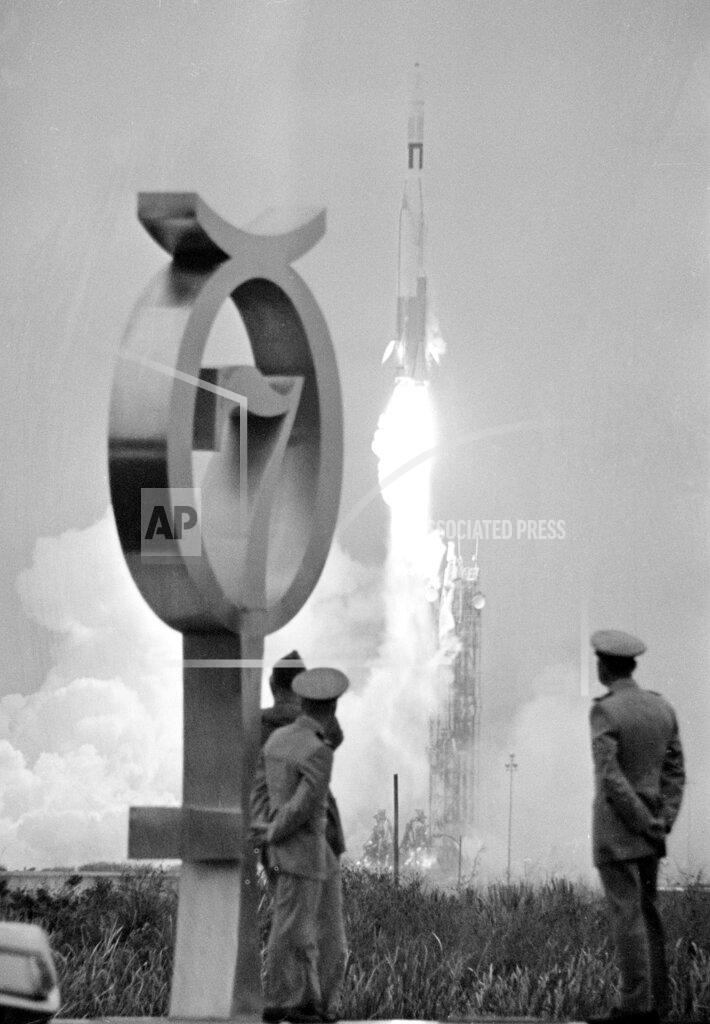
NASA launched Ranger 9 at 4:37 p.m., last in a series of uncrewed lunar space probes to scout for potential landing sites for crewed missions. Ranger 9 takes 5,814 pictures before lunar impact.
Born:
Cynthia Geary, American actress (‘Shelly’ – “Northern Exposure”), in Jackson, Mississippi.
Tim McIntosh, MLB catcher, outfielder, and first baseman (Milwaukee Brewers, Montreal Expos, New York Yankees), in Minneapolis, Minnesota.
Limbo Parks, NFL guard (San Francisco 49ers), in Kansas City, Missouri.
Russell Payne, NFL tight end (Denver Broncos), in Virginia Beach, Virginia.
Pat Morrison, NFL safety (New York Giants), in London, England, United Kingdom.

Cần Thơ Army Airfield was a U.S. Army, U.S. Air Force, Army of the Republic of Vietnam (ARVN), and Republic of Vietnam Air Force (RVNAF) base west of Cần Thơ in the Mekong Delta in Phong Dinh Province, RVN. The airfield at Cần Thơ was originally established during the French colonial period and was later used by the Japanese during World War II. On March 21, 1965, a U.S. Air Force Douglas A-1E Skyraider (#52-132649) attempted an emergency landing at Cần Thơ after enemy groundfire caused an in-flight fire. The aircraft overran the runway and flipped over into shallow water. Base personnel rushed to the scene but were unable to rescue the two pilots; both perished in the accident. The lost airmen were Captain William H. Campbell and Captain Jerry P. Hawkins from the 602nd Fighter Squadron, 34th Tactical Group, 13th Air Force. The Skyraider had to be winched upright before its two pilots could be extricated. The airplane was considered salvageable and was removed from Cần Thơ by a heavy-lift Sikorsky CH-54 Tarhe helicopter to Tân Sơn Nhứt Air Base near Saigon where it was repaired and returned to service in November 1965 with the 3rd Tactical Fighter Wing at Biên Hòa Air Base.
William is buried at DeLand Memorial Gardens, DeLand, Volusia County, Florida. He is honored on the Wall at Panel 1E, line 96.
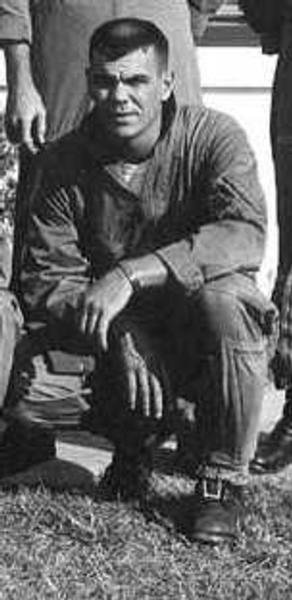
Jerry is buried at Donoho Prairie Cemetery, Marion County, Illinois. He is honored on the Wall at Panel 1E, line 97.



 History Diaries