



Heavy fighting flared near Saigon today and the Saigon command reported the loss of Đức Huệ, a key base camp 40 miles west of the city, and said that a 100-truck convoy carrying ammunition to beleaguered Tây Ninh City had been ambushed. There were reports that the North Vietnamese had moved tanks, demolition units and antiaircraft weapons within 30 to 40 miles of Saigon. “They’ve got everything they need to strike,” a Western military analyst said.
Military sources in Saigon said that more than 1,000 government paratroop reinforcements were building up the inner defenses of Saigon, taking up positions within 10 miles of the city on the western — the most vulnerable — flank. The wary mood of the capital of two million was evident in numerous ways. The local government has ordered the holding of alarm drills, and Saigon’s Self‐Defense Force, a street militia, was placed on alert “against Communist harassments.” A curfew of 10 PM has been imposed on the capital.
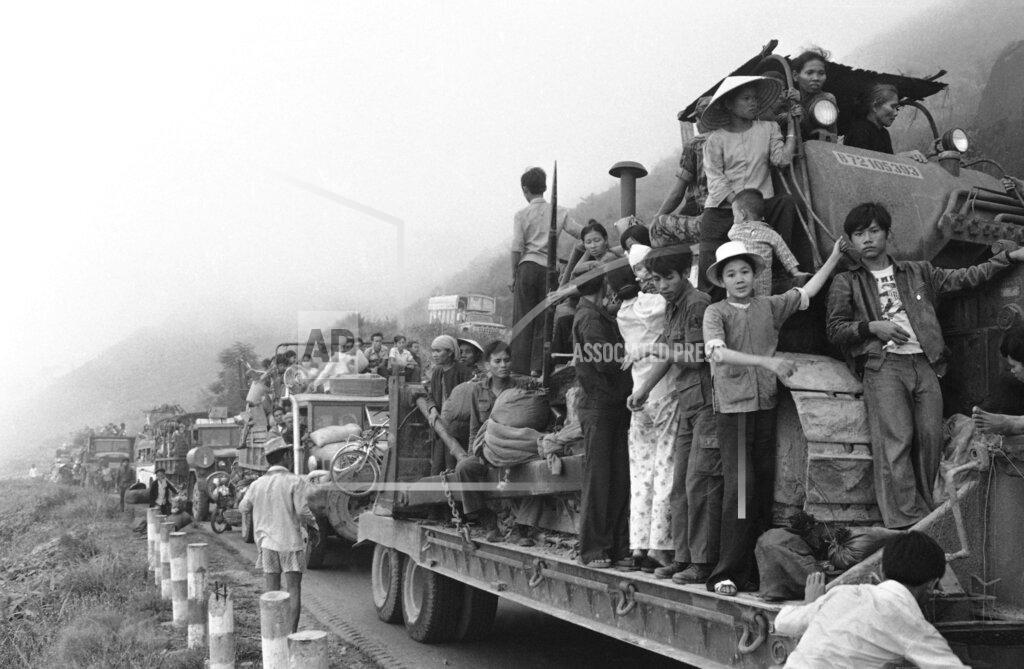
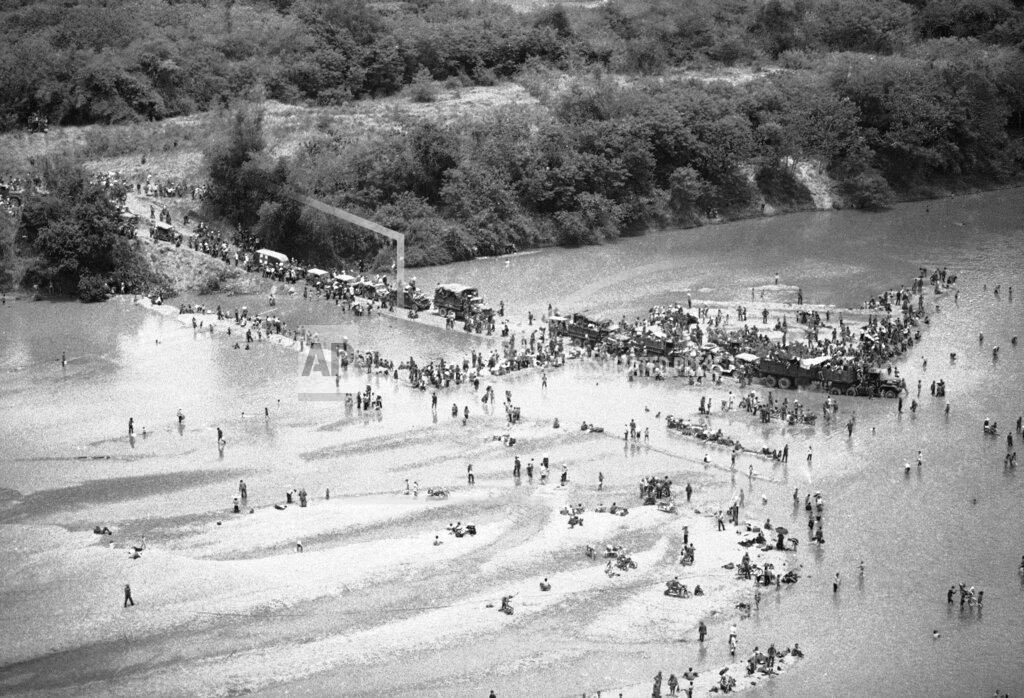
With fighting close to Saigon — and the withdrawal of South Vietnamese Government forces from the northern two-thirds of the nation — the exodus of the hundreds of thousands of refugees continued through the northern provinces and the Central Highlands. Reports from the field said that the huge migration through the Central Highlands, to the coastal city of Tuy Hòa, was marked today by heavy North Vietnamese rocket and mortar attacks against the civilians, especially near Hậu Bổn, the capital of Phú Bổn Province, 240 miles northeast of Saigon. But on other refugee routes, including Route 1 from Huế, the former imperial capital, to Đà Nẵng, the North Vietnamese and Việt Cộng allowed the flow of peasants, soldiers and families to move freely. It was unclear why the highlands exodus was so violent while the migration from the northern provinces seemed relatively peaceful.
Estimates of the number of people on the move ranged as high as half a million. Families were fleeing their homes in cities as far from each other as Huế to Đà Lạt, a mountain resort 140 miles from Saigon. The vast and abrupt military pullback conceded huge areas of South Vietnam to Communist control — and there were indications that other areas would fall to the North Vietnamese too. Military sources said that the district capital, Kiến Đức, in the lower Central Highlands, was lost after a 500-round shelling barrage and an infantry assault. The fall of the town, on a major arterial road, Route 14, threatens the loss of the entire province of Quảng Đức.
Government forces have already abandoned the provinces of Quảng Trị, Kon Tum, Pleiku, Đắk Lắk (Darlac), Phú Bổn, Phước Long and Bình Long. Thừa Thiên province, whose capital is Huế, a city steeped in tradition and the spiritual heartland of South Vietnam, is under heavy pressure. Huế was shelled yesterday by North Vietnamese troops, and thousands of refugees and soldiers climbed onto trucks, buses and military vehicles to flee the imperial capital southeast to coastal Đà Nẵng. By all accounts, Huế — the scene of fierce fighting in the 1968 Tet offensive — will be yielded to the North Vietnamese with scant fighting. President Nguyễn Văn Thiệu’s decision to abandon the northern two‐thirds of the nation remains a source of shock and incomprehension in Saigon. Government sources and Western officials deny any knowledge of a deal with the Communists under which people — in the form of refugees — are to be exchanged for territory.
The provinces that have been lost or written off — there are 44 in South, Vietnam — had a total of two million people, or 10 percent of the country’s 20 million. The area represents the northern two‐thirds of the nation. The English language Saigon Post, a daily owned by Bùi Diễm, a former ambassador to Washington and now a special representative of Mr. Thiệu’s, said today that the Saigon Government would have to cope with “possibly contagious sagging morale of troops retreating without a fight and a panicky population losing confidence in government protection.”
“Anarchy, misery and starvation are other problems of decisive importance to a Government dream of a powerful rear,” said the article, adding: “The most adventurous aspect of this newly adopted strategy is the almost inevitable Communist efforts to strangle Saigon‐controlled population centers. Western military analysts in Saigon say that there are at least 16 North Vietnamese regiments around Saigon. Each regiment has 2,000 men. The South Vietnamese Army is estimated to have 14 regiments and a large number of local and regional forces.
There was some speculation among Western military analysts that North Vietnamese field commanders were awaiting word from Hanoi on whether to launch an assault on the capital. The action around Saigon included the loss of the base camp at Đức Huệ, the ambush of a convoy of trucks nearer the city, and the heavy shelling of Gò Dầu Hạ, a district capital northwest of Saigon, and Route 21 leading to Tây Ninh City. Several Western military analysts said that the area around Tây Ninh and Củ Chi, closer to Saigon, was rapidly emerging as a gathering point for the North Vietnamese for a potential strike on the capital.
Continuing Communist success in the critical Saigon area may lead to an all‐out offensive aimed at winning the war this spring, according to United States military sources. A vigorous defense of the capital and the surrounding countryside, however, could halt rapidly developing drives in the Tây Ninh and Xuân Lộc areas, which these sources regard as the most dangerous elements in the situation. In that case, North Vietnam might be content to mop up opposition in the northern provinces. The Saigon forces’ resistance has stiffened in the Huế-Đà Nẵng area, according to sources in communication with the Saigon command. Combat reports reaching Washington indicate that if the Saigon area is to be held the major regular forces there must be employed soon. The pattern of defense thus far, demonstrated at An Lộc and at Đức Huệ, a base camp 33 miles from Saigon that fell yesterday, has been one of brief resistance by regular forces, in both cases rangers, and local militia — followed by the rangers’ retirement to the Fifth Division area near Bến Cát.
The Saigon command’s main problem, in the words of an American officer who served in a force defending the capital earlier in the war, is that it is very difficult to defend. There are no natural obstacles to impede an enemy advance, he said. In this situation, the defenders must rely on constant patrolling to prevent infiltration and to identify major attacks as they develop. Given sufficient mobility, the main body of troops would be directed at the major drive. Streams and canals run through the area and it would be virtually impossible to hold all the bridges, the source said. Even if the bridges were destroyed, the waterways would not present a serious obstacle to experienced troops.
The countryside was described as fairly open, offering the South Vietnamese Air Force, which has flown 12,000 sorties in the last eight days, good targets in the event of an attempt to breakthrough to the capital. Following American defensive doctrine, the government forces are unlikely to attempt to form a coherent, linear front. Defense will rest on armored and infantry counterattacks supported by helicopter gunships and fighter‐bombers. An effective defense is possible, officers said. But they added the inevitable caveat, “as long as morale holds up” The two most threatening drives by the North Vietnamese were those on Wednesday in the areas near Tây Ninh and Xuân Lộc to the northeast and northwest of Saigon.
American estimates are that two to three divisions are involved in the offensive southeast from the Tây Ninh area. North Vietnamese tanks, mostly Soviet‐built T‐34’s and T-55’s, have cut roads in the area. But units of the Fifth Division have “uncut” them, meaning that traffic has been restored temporarily at least. The deepest foray appears to have been a raid on Gò Dầu Hạ, a district capital northwest of Saigon on Route 21. The main forces, now reported assembling in the Củ Chi area between Tây Ninh and the capital, are believed to be in much greater strength than those attacking Xuân Lộc. Saigon’s Third Division is holding the southeastern approaches to Xuân Lộc against increasingly heavy enemy pressure. The advancing forces, in addition to their major assaults, are directing small units to ambush supply columns and to attack base areas.
By the thousands, the people are abandoning Huế, the former imperial capital of Vietnam. The road south from the city is a scene of suffering. The armed forces are also moving out and no one seems to have the slightest doubt that Huế is being left to the Communists. The refugees were moving toward the coastal city of Đà Nẵng. Trucks, buses, army vehicles, cattle herds, bicycles and people on foot jammed Route 1, a narrow, badly asphalted road.
The armed forces are also moving out, some by landing craft, some in military vehicles, some bundled into trucks with family members, furniture, and food. No one seemed in the slightest doubt yesterday that Huế and the rest of the north were being left to the Communists. A harried colonel stopped his jeep long enough to say, “Yes, yes, the evacuation will be finished in several days, several days.” Refugees were pouring toward the coastal city of Đà Nẵng not only from Quảng Trị and Huế to the northwest but also from provinces farther south, in the belief thal these were also finished.
At the Hải Vân Pass — a scenic cut in a small range of jagged hills projecting into the South China Sea between Huế and Đà Nẵng — the exodus was a nightmare. There was no real panic, but the sheer volume of trucks, buses, army vehicles, cattle, bicycles, motorcycles and pedestrians along narrow, badly asphalted Route 1, created conditions for countless accidents. In a short period at one spot, a correspondent witnessed three serious accidents, one of them probably fatal. Complicating the problem, the road, which is normally closed by a curfew, is open all night, unhindered by any Communist harassment despite the closeness of major North Vietnamese units. Thus, empty vehicles are flowing north in a volume nearly equal to those going south, to pick up more passengers.
The 120‐mile round trip from Đà Nẵng to Huế, normally covered in about four hours, is now taking vehicles 36 hours or more. Most wealthy residents have left by air, paying for enormously expensive flights out. The military is making some use of the road, but appears to be depending more on an airlift from Huế, in addition to a fleet of landing craft that has been embarking troops near Huế and taking them down the coast to Đà Nẵng. Their cargo has included artillery—even 175‐mm. guns —an indication that the government’s forces are abandoning Huế notwithstanding a denial made by President Nguyễn Văn Thiệu Thursday.
Cambodian Premier Long Boret last night announced the formation of a new government. The reshuffle largely involved familiar political faces. Only four ministers were removed from the cabinet after nearly two weeks of political maneuvering. As this shuffle took place, rumors strengthened in the capital that Marshal Lon Nol, marked for execution by the insurgents as one of the “traitors” with whom they will never negotiate, would depart from Cambodia fairly soon — in a step aimed at starting some movement toward negotiations with the insurgents.
It was not clear whether the President had yet decided to leave, but it was known that the subject had been discussed in high Government circles and perhaps by the Marshal himself with his entourage at the presidential palace. It was also a matter of increasing discussion in the forein diplomatic community, some of whose members have reportedly met with Lon Nol recently. The American Ambassador, John Gunther Dean, is of those who meets regularly with the Cambodian President and with his colleagues in the diplomatic community.
Marshal Lon Nol has indicated several times, and repeated recently, that he would step aside if he were an obstacle to peace. But past attempts to get him to leave — one of which was made by President Nixon in 1973 — have been unavailing. The new Cambodian Cabinet had none of the “active, young and progressive” figures that Marshal Lon Nol told the Cambodian people that he wanted when he announced nearly two weeks ago that he was asking the Premier to form a new government.
The Cabinet will include a new first deputy premier — Hang Thun Hak — who in the past attempted unsuccessfully to open contacts with the Comimunist‐led insurgents. With his new portfolio. “political affairs and special missions,” he may be asked to try again. However, Hang Thun Hak, as premier in an earlier government two years ago, had been listed as one of the “traitors” that the insurgents have demanded be executed before any negotiations commence. While his name was removed from this list after he left office, his earlier efforts at negotiation were distinctly unsuccessful.
Most political observers here were at a loss to explain some of the new cabinet changes — in particular the replacement of the young American‐educated information minister, Chang Song, with his deputy Thong Lim Huong, a protégé of Lon Non, the younger brother of Marshal Lon Nol. However, the premier did replace the Interior Minister, Ek Proeung, a politician linked by reputation to corruption, with the former interim defense minister, Hou Hong. The Culture Minister, Duong Sarin, was dismissed and a politician with a background in physics, Long Botta, replaced him. The cabinet will not contain any figures from either of the two opposition parties.
The government reshuffle is not expected to have any effect on what was generally considered here to be the two key aims of the change, particularly with this timing — placating the United States Congress and the insurgent leadership. United States Embassy officials here, responding to demands from Congressional leaders in Washington that the Marshal and the Premier both step down, had been pressing for some governmental show of good faith before the vote on new United States military aid to Cambodia. The insurgent leaders have demanded a complete replacement of the senior government leaders before they will give any consideration to contacts that might lead to an end to the fighting. It is for this reason that any moves that the new first deputy premier might attempt appear doomed. The atmosphere during negotiations and the announcement of the cabinet was one of secrecy.
American officials, meanwhile suspended the supply airlift into Cambodia for more than an hour yesterday after a rocket fired by insurgent forces killed four and wounded 14 Cambodian cargo handlers unloading a plane at Pochentong Airport. The supply operation was again halted Saturday morning, Reuters reported, when a DC‐8 cargo plane was hit and damaged after landing at Pochentong. The aircraft, carrying rice, belonged to Trans‐International Airlines. The airlift — bringing in rice, petroleum and ammunition—is the last remaining supply link between the capital and the outside world since insurgent troops cut the principal supply artery — the Mekong River — early in this year’s dry‐season offensive which began January 1.
So far insurgent troops have managed to disrupt the airlift on several occasions, firing 107‐mm. rockets and at times 105‐mm. artillery shells from positions northeast of the town of Tuol Leap, about five miles from the airport. The firing on the airport did not delay the departure of British Embassy officials, who left the country yesterday for Saigon. The embassy will technically remain open with a skeleton staff of Cambodian workers, but all diplomatic personnel will remain in Saigon indefinitely.
Insurgent troops continued their pressure on the key Mekong River town of Neak Luong, 38 miles south of Phnom Penh. At Del Eth, 15 miles south of Phnom Penh on Route 1, a few helicopters continued to land, bringing wounded civilians and soldiers from the besieged city to hospitals in the capital for treatment. The evacuees told of a continuation of insurgent shelling at a rate of up to 500 shells a day.
High administration officials say they have inadequate information about what is happening in Indochina and little control over events in Saigon. These officials are experiencing some of the feelings of frustration and visions of doom that American officials had at the time of the Tết offensive by the Communists in 1968. They also speak of a feeling of defeatism in Congress. In their view, certain circumstances conspire to make things worse. They note that Secretary of State Kissinger, who still has more influence in Congress than anyone else in the Administration, is off in the Middle East, and that the Ambassador to South Vietnam, Graham A. Martin, perhaps the only American to whom President Nguyễn Văn Thiệu will speak candidly, is in Washington lobbying in Congress for more funds for Saigon.
On the diplomatic front, several officials said that no peace negotiations were taking place and that Mr. Ford and Mr. Kissinger still believed that from a position of weakness only surrender could be negotiated. They said that neither Mr. Kissinger nor Mr. Ford was prepared to urge surrender on Phnom Penh or Saigon. The officials said that the United States did not expect diplomatic support or help from other nations because their leaders either favored a Communist victory or felt that nothing could be done to prevent defeat.
Some of the officials interviewed admit to serious misalculations several months ago. They said they did not expect the military situations in South Vietnam and Cambodia to deteriorate so rapidly. They overestimated the temper of Congress, thinking legislators would go along with a least some of the emergency‐aid package. But some said that what troubled them most was the mood in Washington, a mood reminiscent of February, 1968, when a Communist offensive seemed about to bring defeat to the American forces in Vietnam. Now some pivotal legislators whom the Administration hoped would support it believe that all is lost in South Vietnam, and that nothing can be done.
With congressional leaders preoccupied with Easter recess plans, parliamentary rules and considerable opposition to administration requests, it seemed it was hardly possible that Congress would act on emergency military aid for South Vietnam and Cambodia before mid-April. Senator Mike Mansfield, the majority leader, said that in view of delays within the Senate Foreign Relations Committee, it was “too late” to act on Cambodian aid legislation before the Senate begins an Easter recess, probably on Wednesday.
As a proposed compromise with the Administration’s request for $222‐million, the Senate Foreign Relations Committee on Monday approved $82.5‐million additional military aid for Cambodia with the stipulation that all military assistance would end on June 30. It was not until today, however, that the committee, which was awaiting the minority views of Senator Hubert H. Humphrey, the Minnesota Democrat, placed the legislation on the Senate’s legislative calendar. Under the Senate rules, legislation must remain on the calendar for three days before it can be considered by the Senate.
Portugal’s sharp swing to the left and the way it has come about have startled and upset Western Europe’s leftist parties They are watching for the problems the developments may cause them at home. The impact on each party is read primarily in terms of its domestic situation and its relations with existing or would‐be political allies. There is little tendency on the left to agree with what is considered the panicky overreaction of much American comment and some center‐right European journals, which foresee a Mediterranean “Red tide” about to sweep over Portugal, Spain, Italy, Greece and perhaps even France. Socialists, Communists and other leftists stress the important differences in political conditions between the countries.
Nonetheless, one highly respected French Socialist said: “Of course, people are beginning to say it looks like a precedent. Lots of people are talking and thinking about what it means in terms of alliance with Communist parties anywhere. There is no doubt that the Portuguese Socialist party is the hardest hit by what has happened in Lisbon.” The speaker did not want to be identified, because the French Socialist party is embarrassed and worried over what conclusions will be drawn from Portugal’s experience in view of its alliance with the French Communists.
The only remaining Portuguese conservative party still authorized to participate in the election scheduled for next month has come under such heavy attack that its leaders are sleeping in different places each night. The party, the Social Democratic Center, is considering withdrawing from the race. Half its members are said to favor such action. Diogo Freitas de Amaral, the 33‐year‐old head of the party’s executive committee, told foreign newsmen today that it would make a decision shortly. Withdrawal would leave the country with 11 parties, all representing leftist opinion. What is thought to be a considerable conservative sector would be without a party vehicle in the election for a constituent assembly scheduled for April 25. Mr. de Amaral said he expected such voters to cast ballots for the centerleft Popular Democrats or the Socialists as a way of registering their opposition to Communism.
Thirty‐nine persons were injured today by a bomb that exploded without warning in a restaurant in Belfast, Northern Ireland. The bombing was the first daylight attack in downtown Belfast since the Provisional I.R.A. declared an unconditional cease‐fire on February 10. Police said they believed Protestant extremists were responsible. The half‐pound bomb, hidden in a textbook, was left on a table in the cafe, which is owned by a Roman Catholic and is situated in an exclusively Catholic section of the city. The bomb was picked up by a waitress who toot it to the restaurant owner. He saw wires when he opened the book and threw it into a corner, where it exploded. Although there were about 100 persons in the restaurant, only three were seriously hurt. Police sources said the bombing could have been intended to divert the attention of Northern Ireland’s Protestant majority from a feud between two. Protestant paramilitary groups, the Ulster Volunteer Force and the Ulster Defense Association.
In Moscow, Pravda asserted today that an anti‐Communist campaign was under way in neighboring Finland and accused the largest Finnish newspaper of taking part in it. In a report from its correspondent in Helsinki the Soviet party newspaper said that a recent article in the Finnish daily Helsingin Sanomat had been “full of vicious inventions about the Communist party and anti-Soviet slander.” Recalling the years between the two World Wars when the Communist party was banned, in Finland, Pravda said the articte in Helsingin Sanomat “was couthed in the spirit and style of the provocative materials spread in the nineteen‐thirties ty the Finnish secret police.”
The negotiations for a new Egyptian‐Israeli agreement on Sinai seemed to have narrowed today to a crucial question of how much occupied territory Israel would agree to give up in return for Egyptian political assurances that fall short of Israel’s original demand. With the talks clearly entering a critical phase, the Israeli Cabinet held an extraordinary sabbath session to discuss the latest Egyptian “modifications” and demands brought back yesterday by Secretary of State Kissinger, who had made quick overnight “shuttle” trip to Aswan for consultations with President Anwar el‐Sadat of Egypt. The Cabinet session lasted five and a half hours. Israeli negotiators then met with Mr. Kissinger to pass on the results of the meeting. The meeting between Mr. Kissinger and the Israeli team lasted two hours and broke up shortly after midnight. Mr. Kissinger told newsmen that he would meet again with the Israelis tonight.
The Palestine Liberation Organization agreed today to create political and military commands with Syria. The Central Council of the Palestine National Assembly, similar to a parliament in exile, announced early today, after a six‐hour meeting, that discussions with President Hafez al-Assad on forming the commands would begin next week. Khaled al‐Fahoum, chairman of the Palestine National Assembly, and members of the Executive Committee of the Palestine Liberation Organization, headed by Yasir Arafat, said this alliance was necessary as a result of the “individual” action by President Anwar el-Sadat of Egypt toward a new disengagement agreement with Israel in the Sinai Peninsula. “If this comes about, it will weaken Syria and the Palestinians in their demands for a full withdrawal from the territories occupied by Israel,” Mr. Fahoum said in an interview. “We are not against President Sadat, but we are opposed to the methods of Secretary of State Kissinger, who is trying to divide the Arab front.”
The Indian Government has thrown a tight security ring around public figures because of apparent threats on the lives of at least two important officials. Home Ministry sources said that further drastic measures might be necessary if “the atmosphere of violence” persisted. Within a week Chief Justice Ajit Nath Ray was attacked by an assassin and a suspicious incident was directed at Prime Minister Indira Gandhi. Yesterday two hand grenades were lobbed by an unknown assailant almost onto Mr. Ray’s lap as he was going home in his car. The grenades failed to explode because of a loose spring and rust, the police said. In Allahabad an armed man was arrested Tuesday as he was trying to get into the court where Mrs. Gandhi was defending her election to Parliament against complaints that she had won by corrupt means. The arrested man, a local editor, told the police he was carrying the pistol for protection.
Malcolm Fraser, a wealthy 44‐year‐old landowner was elected leader of the Liberal party today in a victory that was seen as a shift to the right for Australia’s major opposition party. As Liberal leader he is also leader of the opposition alliance of Liberal and Country parties and would head the Government if Prime Minister Gough Whitlam and his Labor party lost the next election. The new leader has been described as urbane, intelligent and politically astute; critics say he is aloof and arrogant. Mr. Fraser, who has an 8,000‐acre ranch in the State of Victoria, has been a Member of Parliament since 1955. He served as Minister for the Army, for Defense and for Education and Science in successive Liberal‐Country cabinets.
New accusations of torture and other abuses were leveled today against Brazilian security services. The strongest charge came from a reserve army general who declared in a letter that his son, a civil engineer named Pedro Celestino da Silva Pereira Jr., had been arrested by Rio de Janeiro’s political police earlier this month and had suffered “10 days of terror.” Another protest came from a journalist, Antonio Carlos de Carvalho, released yesterday after being held by Rio’s political police for 15 hours, who charged that he had been subected to two hours of beating and torture. Meanwhile, in the southern city of Porto Alegre, the Bar Association pressed the authorities for information on the where‐abouts of three lawyers and two journalists who were arrested Tuesday. Opposition deputies in the state assembly protested against these, new arrests, which they said involved “lack of respect for constitutional guarantees.”
Political violence in Argentina has stepped up sharply, with the death of 16 people in the last two days. The victims of right‐wing and left‐wing terrorism have included three policemen, a priest, a lawyer, a doctor, a father and his two sons, three trade unionists, and an unidentified man and woman. Two leftist guerrillas were also shot down by policemen in Cordoba when they tried to steal a car. The violence has raged in the Atlantic coast resort of Mar del Plata, in the capital, and in the provincial cities of Tucumán, Cordoba and Bahia Blanca. The upsurge of terrorism coincides with a wave of rumors that the Government of President Isabel Martinez de Perón is in serious trouble.
The Dergue, the Ethiopian military junta that had overthrown the Emperor Haile Selassie I six months earlier, announced that it was abolishing the centuries-old Ethiopian Empire. A proclamation issued by the ruling Military Council annulled last September’s appointment of Crown Prince Asfa Wossen as king‐designate, canceled the titles of prince and princess and said it was up to the Ethiopian people to decide which type of government should run the country. The 58‐year‐old former crown prince, eldest son of the deposed Emperor, Haile Selassie, had been invited to return to Ethiopia to be crowned king three days after the military deposed his father last September 12. But tonight, the council announced that “the title of crown prince given to Asfa Wossen and the prerogatives vested in it as well as all titles including the titles of prince and princess given to others by virtue of their royal blood is hereby canceled.” According to Ethiopian tradition, the monarchy was almost 3,000 years old, dating back to 950 B.C.
Dislocations caused by the drought and famine besetting Somalia have been seized upon by the governing military council to speed up a timetable for resettling nomads. The nomads are thought to represent 80 percent of the 4.5 million people in this East African country, and the council wants to resettle them in a socialist form of ranching, farming and fishing. One Western diplomatic source has observed that the drought saved the council “the trouble of rounding up nomads for resettlement.” Somali spokesmen prefer to see the resettlement plans — for which Somalia is now discussing World Bank financing of about $30‐million — as the natural response to the disaster.
Jet fighters roared low over Nairobi and hundreds of troops paraded through the city today in an unannounced display of might. Observers interpreted the military show as President Jomo Kenyatta’s reaction to tensions aroused by recent terrorist bombings and the murder of a dissident legislator. The display was accompanied by precautionary movements of riot police through the capital. Mr. Kenyatta saluted the parading, soldiers and drove in an open car past silent crowds. Before the parade, Mr. Kenyatta called on Kenyans to reject rumors and intrigues. and declared: “The Kenya Government is not the government of Kenyatta of any one individual but the collective responsibility of all.” An unexplained series of bombings, including one blast that killed 27 persons and the murder of Kenya’s chief dissident spokesman, J. M. Kariuki, are keeping tensions high in the capital. The crimes remain unsolved.
The Inkatha Freedom Party was founded in South Africa to fight against white minority rule of the black majority population.
The Senate passed a $29.2 billion tax reduction bill after adding some more amendments including one that would remove all limitations on the deductions that working parents may take for child-care expenses. The measure now goes to a joint Senate-House conference committee which will work out a compromise with the House bill passed last month. The Senate also voted $150 million in tax relief for the Chrysler Corporation but rejected appeals for smaller bailouts of Lockheed Aircraft and Pan American World Airways.
The House passed today an emergency housing program that its sponsors said would revive the depressed homebuilding industry and ultimately help the entire economy recover. However, Republicans predicted that President Ford would veto the bill, passed by the House on a vote of 259 to 106. The same vote would be sufficient to override a veto. Earlier, the House defeated, 242‐126, a Republican substitute that had Administration backing. It would have extended existing government programs that funnel money into the private mortgage‐lending markets. As amended during nearly seven hours of debate, the successful Democratic‐backed bill would provide $1.3‐billion in subsidies to lower interest rates on $12‐billion worth of housing mortgages.
President Ford hinted tonight that he might be ready to sign into law the strip mine control bill that Congress has just passed a second time after a veto of a similar measure last December. In a dinner speech to about 120 executives of the coal industry and a dozen leaders of miners’ labor unions that capped a hastily organized “coal day” at the White House, Mr. Ford complained of “unnecessary provisions” still in the strip mine regulatory bill. He said they would “hinder coal production,” while imposing stringent environmental controls. But whether he was thinking of the overwhelming votes for passage of the latest version of the strip mine measure — 84 to 13 in the Senate last week, and 333 to 86 in the House of Representatives on Tuesday, more than enough in both houses to override a veto — the text of the President’s remarks to the coal men, prepared for delivery at a dinner tonight in the White House, nonetheless found room to praise “progress on some provisions” in the new bill.
The Central Intelligence Agency, with full cooperation from the Postal Service, illegally opened some mail that was sent between the United States and Communist countries between 1953 and 1973. Congressional testimony disclosed today. The mail surveillance operation was outlined to the House Civil Liberties Subcommittee in closed session last Tuesday by the chief postal inspector, William J. Cotter, and elaborated on today by Dr. Melvin Crain, a former C.I.A. agent who was involved in the operation. “The letters were opened, reproduced, resealed and sent on their way without interrupting mail flow or their opening in anyway being detected,” Dr. Crain said. According to law, any government agency wishing to open first‐class mail must obtain a search and seizure order from a federal court.
The Democratic National Committee picked its way through a pair of ideological minefields without mishap today. It approved a compromise resolution that will give preference in the competition for the Democratic National Convention in 1976 to cities in states that have approved the Equal Rights Amendment — a step short of women activists’ initial demands but a significant gesture in their direction. In addition, the committee referred to yet another committee disruptive questions on the reach and interpretation of reform rules relating to minority participation in party affairs.
Experts assigned by the Federal District Court in Boston to prepare a plan for next fall’s citywide school desegregation presented a draft that they said would desegregate more classrooms with less busing than the interim plan that caused controversy and sporadic violence. The draft also proposes an unprecedented “pairing” of Boston’s colleges and universities with individual high schools and city school districts.
New York City officials appealed to the federal government at a meeting here for the infusion of what one of them called “a massive amount of cash” into the city’s treasury. “We’re not talking budget gap or stuff like that,” he said. “We’re talking cash flow. We need cash and we need it in 30 days.” Several proposals to help the city were discussed, including the possible purchase of city securities by the United States Treasury or the Federal Reserve system or low-cost or no-cost Federal Reserve loans to the city with the city’s securities as collateral.
Puerto Rico is importing a massive dose of the United States recession, and paying for it is forcing equally massive austerities on the people and government of the sunny, productive but deeply troubled island commonwealth.
Jack Scott, the writer and radical sports figure who is being sought in connection with the Patricia Hearst kidnapping case, disclosed today that before his disappearance earlier this month he met twice with federal agents.
General of the Army Omar N. Bradley was making “excellent progress” yesterday from his cerebral stroke on Sunday, the medical center of the University of California at Los Angeles reported yesterday. The nation’s only five‐star general, who is 82, was still in an intensive‐care tinit, and a physician described the stroke as “very serious.” But General Bradleywas said to be alert during, his waking hours, and he was visited by his wife several times a day.
All 16 passengers and crew aboard a U.S. Air Force C-141A Starlifter were killed in the U.S. state of Washington when an air traffic controller at McChord Field gave the crew a descent command intended for another aircraft. The C-141A descended to an altitude of less than 7,756 feet (2,364 m) as it approached the Cascade Mountains and crashed into the side of Mount Constance.
The director of the National Cancer Institute said here today that substantial progress had been made under the 1971 National Cancer Act, but that it would take at least a decade for the benefits of this progress to be reflected in over‐all national survival statistics. The director, Dr. Frank J. Rauscher Jr., spoke at the opening session of the American Cancer Society’s annual seminar for science writers.
American country singer Tammy Wynette (33) divorces American country singer-songwriter George Jones (43), after 6 years of marriage.
Hall of Fame outfielder Joe “Ducky” Medwick died in Saint Petersburg, Florida. He was 63 years old and had been a batting instructor at the St. Louis Cardinals’ training camp. As one of the feared hitters on the famed “Gashouse Gang,” Medwick clubbed 205 home runs and batted .324 over a 17-year career. Medwick gained election to the Hall of Fame in 1968.
Yes, in baseball. Georgia Tech shuts out Earlham 41–0, setting an NCAA record for scoring and for winning margin.
Dow Jones Industrial Average: 763.06 (-0.94, -0.12%)
Born:
Fabricio Oberto, Argentine National Team and NBA center (Olympics, gold medal, 2004, bronze medal, 2008; NBA Champions-Spurs, 2007; San Antonio Spurs, Washington Wizards, Portland Trailblazers), in Las Varillas, Argentina.
Vitaly Potapenko, Ukrainian NBA center (Cleveland Cavaliers, Boston Celtics, Seattle SuperSonics, Sacramento Kings), in Kiev, Ukrainian SSR, Soviet Union.
Mark Williams, Welsh snooker player (World Championship 2000, 2003, 2018; Triple Crown 2002-03), born in Cwm, Blaenau Gwent, Wales, United Kingdom.
Died:
Joe Medwick, 63, American Baseball HOF left fielder (World Series 1934, Triple Crown & NL MVP 1937 St. Louis Cardinals; 10 x MLB All Star).
Ralph Hawtrey, 95, British economist (multiplier, quantity theory of money).




 History Diaries