
Military activity was unusually light throughout South Vietnam in the last 24 hours. No actions initiated by the Việt Cộng guerrillas were reported yesterday or this afternoon, There were no significant actions by Government ground forces either. American jet bombers and fighter planes continued to strike at Việt Cộng positions within South Vietnam, hitting targets at points stretching from Phước Thành, 50 miles east of Saigon, to Quảng Tín Province, near the border of North Vietnam. The largest raid was made by 12 B-57 bombers that bombed Việt Cộng concentrations in Bình Tuy, 65 miles northeast of Saigon.
In Saigon this morning, the police apprehended two young men riding a motor scooter in which seven pounds of powdered explosive was discovered. They were stopped at a checkpoint near a United States officers’ quarters on the road to Saigon airport. In Central Vietnam, South Vietnamese Government forces discovered another large cache of arms about 1,000 yards from the wreckage of a Communist arms ship that was sunk February 17. In the cache were more than 600 Mauser rifles, mortars, and machine guns. Some weapons were of Russian make and others were American. Divers also reached the hulk of another ship in Quảng Trị Province and recovered Communist small arms and explosives. The ship was sunk March 11 by aircraft in waters just below the 17th Parallel.
After hearing from General Harold K. Johnson, the U.S. Army Chief of Staff, that it would take five years of fighting and 500,000 American troops to win the Vietnam War, the Joint Chiefs of Staff recommended to Secretary McNamara to change the American mission from being “not simply to withstand the Việt Cộng… but to gain effective operational superiority and assume the offensive”, and that two additional divisions of combat troops be transferred to South Vietnam for that purpose. “To turn the tide of war,” the memo said, “requires an objective of destroying the Việt Cộng, not merely to keep pace with them, or slow their rate of advance.”
President Johnson approved an expansion of Operation ROLLING THUNDER, to escalate bombing of the “Hồ Chí Minh trail” that was the supply line for the Việt Cộng.
Ambassador Maxwell D. Taylor will come to Washington March 28 for talks with President Johnson and other Administration officials on South Vietnam. The talks were described as routine. The President disclosed the plan for the visit at his news conference in Johnson City, Texas, today. “There are no Immediate issues which make the meeting urgent,” President Johnson said. “It is a regular — repeat, regular — periodic visit, part of our continuous consultation to make sure that our effort in Vietnam is effective and as efficient as possible.” Ambassador Taylor, who was last in Washington in December for similar consultations, is to remain for about a week. He is to spend most of his time with Secretary of State Dean Rusk and Secretary of Defense Robert S. McNamara. He may also report in closed session to major committees of Congress.
President Johnson, in his news conference, also reiterated what appears to be a growing theme in the United States’ public discussion of the situation in South Vietnam — a demand that the North Vietnamese desist from support of the guerrilla war in South Vietnam coupled with an assurance that they need have no fear of any threat to their government. Referring to the North Vietnamese Communist leaders, the President said, “Those aggressors serve no peaceful interest, not even their own… No one threatens their regime,” He said. “There is no intent or desire to conquer them or to occupy their land. What is wanted is simply that they carry out their agreements, that they end their aggression against their neighbors.”
Mr. Johnson’s comment coincided with suggestions being repeated by officials in Washington with increasing regularity, that if the North Vietnamese want to bring a halt to the aerial attacks on their territory they need only respond to appeals for a halt in their effort to depose the South Vietnamese Government through the Việt Cộng. At the same time, the President repeated the basic provision of the United States’ commitment in South Vietnam. Quoting from a statement he made last year, Mr. Johnson said: “For 10 years, under three Presidents, this nation has been determined to help brave people to resist aggression and terror. It is, and it will remain, the policy of the United States to furnish assistance to support South Vietnam for as long as is required to bring Communist aggression and terrorism under control.”
The Soviet Union disclosed today that the spaceship Voskhod 2 had landed in deep snow with its outside radio antennas burned away. Official reports on yesterday’s landing indicated that the craft had come down in a remote forest of the northern Ural Mountains. The reports also revealed that the spaceship had landed by parachute after its manually controlled re-entry into the earth’s atmosphere in the 18th orbit.
Voskhod 2 was a poor design and had a troublesome re-entry in which malfunction of the automatic landing system forced the use of its manual backup. The spacecraft was so cramped that the two cosmonauts, both wearing spacesuits, could not return to their seats to restore the ship’s center of mass for 46 seconds after orienting the ship for reentry and a landing in Perm Krai. The orbital module did not properly disconnect from the landing module, not unlike Vostok 1, causing the spherical return vehicle to spin wildly until the modules disconnected at 100 km.
The delay of 46 seconds caused the spacecraft to land 386 km (240 mi) from the intended landing zone, in the inhospitable forests of Upper Kama Upland, somewhere west of Solikamsk. Although flight controllers had no idea where the spacecraft had landed or whether Leonov and Belyayev had survived, the cosmonauts’ families were told that they were resting after having been recovered. The two men were both familiar with the harsh climate and knew that bears and wolves, made aggressive by mating season, lived in the taiga; the spacecraft carried a pistol and “plenty of ammunition”, but the incident later drove the development of a dedicated TP-82 Cosmonaut survival pistol. Although aircraft quickly located the cosmonauts, the area was so heavily forested that helicopters could not land.
When night arrived, the temperature dropped to −5 °C (23 °F), and the spacecraft’s hatch had been blown open by explosive bolts. Warm clothes and supplies were dropped and the cosmonauts spent a freezing night in the capsule or Sharik in Russian. Even worse, the electrical system completely malfunctioned so that the heater would not work, but the fans ran at full blast. A rescue party arrived on skis the next day as it was too risky to try an airlift from the site. The advance party chopped wood and built a small log cabin and an enormous fire. After a more comfortable second night in the forest, the cosmonauts skied to a waiting helicopter several kilometers away and flew first to Perm, then to Baikonur for their mission debriefing.
Greek Premier George Papandreou balked today at a Turkish proposal for direct talks between Turkey and Greece on the Cyprus impasse. “There’s a mediator,” the Greek leader said. “We must help him fulfill his mission.” He was referring to the United Nations’ special mediator for Cyprus, Galo Plaza Lasso, The offer for talks was made by Premier Suat Hayri Urguplu of Turkey in an interview published yesterday in the Athens newspaper Ethnos. Mr. Urgupiu left it to Athens to decide how and when the talks would start, whether they would be open or secret and at what level they would be held. The Turkish Premier was quoted in the interview as having said that Greece and Turkey were “sitting in the dark, staring at each other and mumbling” to themselves, and that “problems are not solved by monologues, only by dialogues.”
Turkey informed the United States it is ready to risk a serious clash with Greece over the plight of Turkish Cypriots on Cyprus, a cabinet source reported. The tough message was delivered to John Jernegan, deputy assistant secretary of state for the Middle East and South Asia. It sent him flying to Athens ahead of schedule. Premier Suat Hayri Urguplu met with Jernegan and U.S. Ambassador Raymond Hare at a luncheon. The source said Urguplu told Jernegan and Hare what policy Turkey would follow to halt “the terror and pressure placed on the Turkish Cypriots” by Greek Cypriots and added: “If necessary, Turkey would consider a serious clash with Greece in this connection.”
Greece has warned Turkey to keep hands off Cyprus, where the Turks say the Greek Cypriots are blockading Turkish Cypriots around the northwest port of Lefka. Turkey is threatening air raids to relieve pressure on the Turkish Cypriots. Reliable sources said Turkey is planning to hand Greece a virtual ultimatum demanding that the blockade be lifted. This is to be coupled with a demand that Archbishop Makarios, Greek Cypriot president, lift “inhuman pressure” on the Turkish Cypriots, who are a minority on the island. Turkish officials said that Jernegan, who was scheduled to remain in Turkey for three more days, changed plans and decided to fly to Athens.
Urguplu’s reported statement to the Americans followed by a few hours a rejection by Premier George Papandreou of Greece of Turkey’s request for direct talks on Cyprus.
The Soviet Union accused Communist China today of fraud and lies in the case of Chinese students involved in clashes with Soviet policemen in front of the United States Embassy here March 4. Moscow dismissed as an anti-Soviet “propaganda farce” the heroes’ welcome given by Peking last Sunday to four students who alleged they had been injured by Soviet policemen. A violent demonstration by foreign students against United States policy in Vietnam was repressed by the policemen and troops. The latest Soviet denunciations came a day after Communist China condemned the recent Moscow meeting of 19 pro-Soviet Communist parties as an illegal move intended to deepen the schism in the Communist world. Hsinhua, the Chinese Communist press agency, in the first official comment on the conference, said it had been attended by such “notorious renegades” as the Indian party secretary, S. A. Dange, and “splinter revisionist groups” from other countries.
The Soviet statement today was in the form of three long dispatches by Tass, the official press agency. It quoted crew members of the Soviet airliner that carried the four students to Peking as having said that they were in perfect health before they arrived in the Chinese capital but that once there nurses rubbed, make-up on their faces to make them look pale and then carried them off on stretchers though they were able to walk. The second report quoted physicians from the Botkin Hospital in Moscow to the effect that one of the students involved simulated “convulsions” and then inflicted a slight wound inside his mouth so he was able to spit blood on the floor. The third dispatch quoted African and non-Chinese students, as having condemned “provocations” by the Chinese. Previously Moscow reported accusations against the Chinese students by personnel at the hospital.
An Aeroflot airliner crashed after landing short of the runway at the Khanty-Mansiysk airport at the end of its flight from Tyumen, killing all 42 passengers and one of its five-member crew.
The Soviet Government announced today that it had rescinded a rule promulgated by Nikita S. Khrushchev that allotted 80 percent of the university admissions quota to persons with at least two years work experience.
West Germany’s two biggest parties will gather in pre-election conventions next week to survey a political scene sharply altered by Chancellor Ludwig Erhard’s troubles in the Middle East.
The Arab oil congress meeting in Cairo is being urged to approve a resolution banning the sale of oil to West Germany if Bonn recognizes Israel.
Algerian President Ahmed Ben Bella told a cheering crowd of 10,000 tonight that “we will destroy Israel as we have destroyed French imperialism.”
A drive to tighten Communist party control over the Cuban armed forces is under way in Cuba. Commissions of Premier Fidel Castro’s Communist movement, the Unified Party of the Socialist Revolution, are canvassing military units to enroll party members and presumably to test servicemen’s loyalty to Communism. Comdr. Rolando Díaz Aztarain, the navy chief, said in a recent address that “an enormous leap in quality takes place in a unit” when a party commission finishes its work. The Castro Government has built a military establishment believed to number 100,000 regulars. They are supplemented by at least 300,000 members of the militia, male and female, who are available for part-time military service.
Four foreign oil companies that were seized by the Indonesian Government yesterday were told today that they might be allowed to retain management under Indonesian supervision and control.
Anthony Eden blamed Franklin D. Roosevelt for most of the Communist-inspired troubles that have hit the world since 1945. Former British Prime Minister and Foreign Secretary Anthony Eden (now the Earl of Avon) contends that Franklin D. Roosevelt was “vague and loose and ineffective” in his planning for the postwar situation. Specifically, Eden maintains that Mr. Roosevelt vacillated about Poland’s postwar boundaries, tacitly OK’d the 1940 Soviet takeover of Estonia, Latvia and Lithuania, approved Soviet moves (later frustrated) into the Dardanelles and said he had no objections to Soviet takeovers of Finnish and Romanian territory.
[Ed: Correct. FDR was a complete idiot in dealing with the Soviets.]
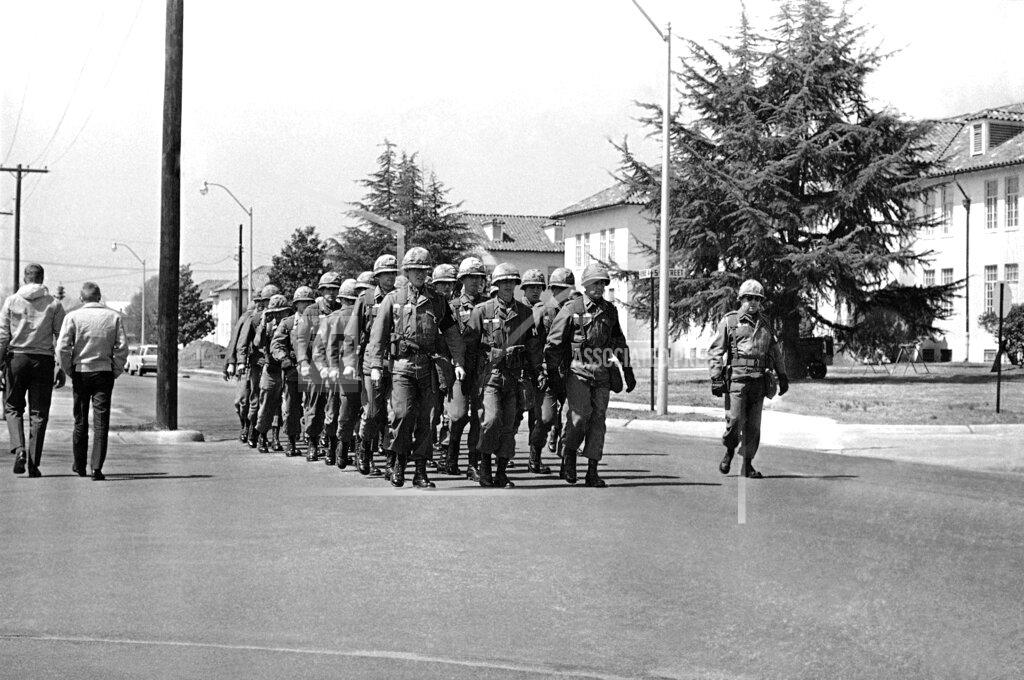
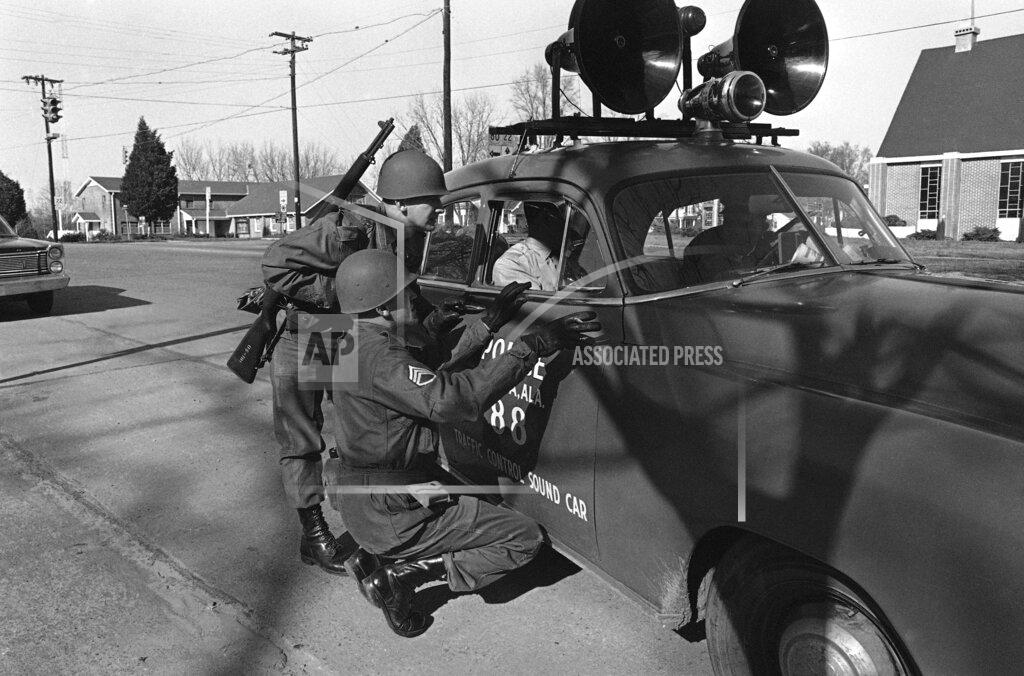
At 1:30 in the morning, President Johnson issued an Executive Order from the LBJ Ranch in Texas, federalizing the Alabama National Guard and authorizing U.S. Secretary of Defense Robert McNamara to send U.S. Army troops to protect civil rights marchers between Selma and Montgomery, Alabama. The move came hours after Alabama’s Governor Wallace sent Johnson a telegram saying that he was “willing to do whatever is necessary to maintain peace and order”, but that he concurred with the state legislature, which had voted against paying the $12 per day wages for each state guard member, that the state was “financially unable to bear this burden.”
President Johnson moved swiftly today in the pre-dawn hours and called up nearly 4,000 troops to protect the participants in the Selma-to-Montgomery civil rights march. The President followed his mobilization of National Guard and regular forces with a statement strongly critical of Governor George C. Wallace of Alabama. He read to a televised news conference in the yard of his ranch home a message he had sent to the governor.
His message said that responsibility for law and order properly rested with state and local governments. “On the basis of your public statements and your discussions with me I thought that you felt strongly about this and had indicated you would take all necessary action in this regard,” the President told the governor. “I was surprised, therefore, when in your telegram of Thursday you requested Federal assistance in the performance of such fundamental duties.
“Even more surprising was your telegram of yesterday stating that both you and the Alabama Legislature, because of monetary considerations, believed that the state is unable to protect American citizens and to maintain peace and order in a responsible manner without federal forces.”
The President said he had ordered moved to the critical area 1,863 federalized troops selected from units of the Alabama National Guard. In addition, he said, 500 men of military police units drawn from the Regular Army were stationed at Maxwell Air Force Base in Montgomery and 509 similar troops at Craig Field near Selma. The latter is the starting point and the former the terminus of a 50-mile civil rights march to protest vote discrimination, to begin tomorrow.
Governor Wallace declined to comment today on President Johnson’s criticism of the segregationist governor’s refusal to use his state powers to police the Selma-to-Montgomery freedom march.
Selma was hovering between festivity and chaos tonight as plans were carried forward for the Alabama Freedom March to Montgomery, scheduled to begin at 10 AM tomorrow. Hundreds of marchers poured into the city, which has a normal population of 28,000. Leaders of the demonstration expect 4,000 to 5,000 persons from all over the country to join the procession as it leaves Selma. They expect the caravan to swell to 10,000 to 20,000 by the time it arrives in Montgomery on Thursday. The march has taken on a strong sense of history. The marchers are well aware that the armed forces of the United States are poised to protect them and that no matter how peacefully or violently the thing is carried off, it will be long remembered. Violence is not expected. Almost 4,000 troops stand ready to provide security.
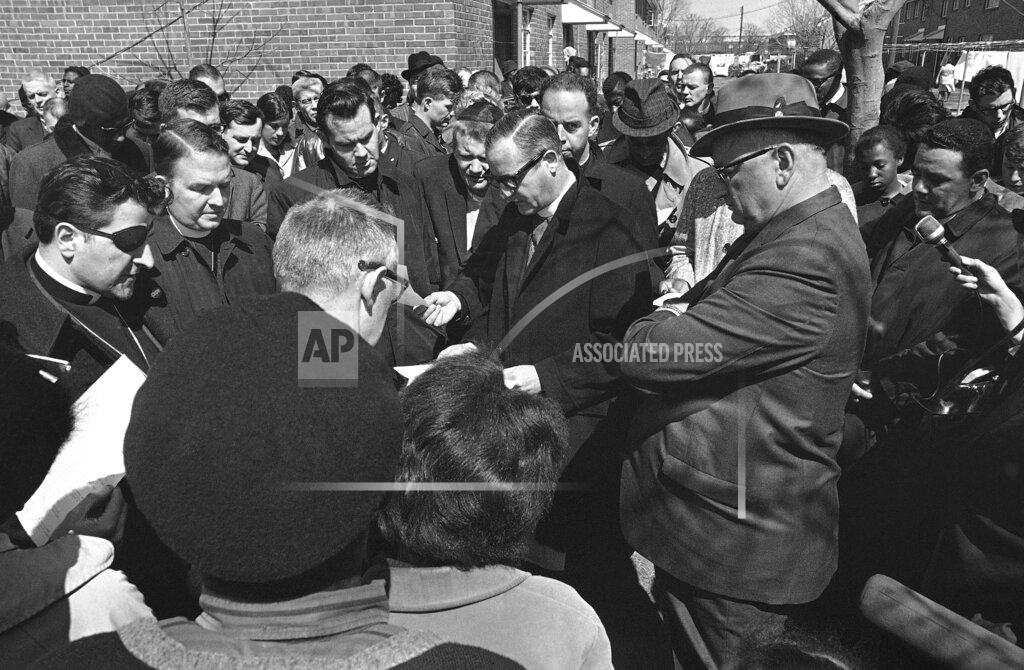
Ten days ago on the main street of Selma, Alabama, an angry resident confronted Sister Mary Peter of Chicago, who had come to join the voter-registration drive. “What are you doing to the white race?” the man shouted. “Educating it,” Sister Mary Peter said gently, and walked on to join the march. The appearance of Roman Catholic clergy in the front lines of civil-rights demonstrations in the last two weeks has gratified many laymen — and infuriated a few — and is the chief topic this weekend of a meeting in Memphis of the National Catholic Conference for Interracial Justice, a semi-official group of laymen and clergy that has been the spearhead of the church’s involvement.
Mobilization of Alabama National Guard units today marks the 11th time in the last decade that members of these military reserve forces have been called to duty in racial crises — the fourth time in Alabama.
President Johnson’s sweeping voting-rights proposal is viewed as clearly constitutional by most constitutional law professors interviewed in a nationwide poll last week.
President Johnson made today two appointments to the Federal Power Commission that left undisturbed the delicate balance of power in the consumer-oriented agency.
At Cape Kennedy, Florida, space officials said that plans for a two-man Gemini flight Tuesday were proceeding as scheduled despite a threat posed by the weather and that the outlook was good for launching an unmanned Ranger spacecraft toward the moon this Sunday. In Texas, President Johnson conceded that the Soviet Union was ahead in some aspects of space exploration. But Johnson said that it was a mistake to consider space exploration a contest that could be covered by a box score.
Altitude Chamber Tests of Gemini spacecraft No. 4, involving five simulated flights, began at McDonnell. The first run was uncrewed. In the second run, the prime crew flew a simulated mission, but the chamber was not evacuated. The third run repeated the second, with the backup crew replacing the prime crew. The fourth run put the prime crew through a flight at simulated altitude, and the fifth did the same for the backup crew. Altitude chamber testing ended March 25, and the spacecraft was prepared for shipment to Cape Kennedy.
Civil and Women’s Rights Activist Dorothy Height has her first column published in the weekly African-American newspaper called the “New York Amsterdam News.”
A political revolution in the form of reapportionment of state legislatures is taking place throughout the United States as a result of a Supreme Court decision handed down three years ago.
The nationwide strike against the country’s two largest manufacturers of metal cans may end early this week as the result of an agreement reached in Pittsburgh.
resident Johnson’s five-month delay in appointing a new Federal judge for the Western District of Wisconsin is resulting in a growing backlog of cases and what one high Democratic official calls “the deterioration of the Democratic party in Wisconsin.”
Spring arrived officially with record cold plastering a 15-state area of the midcontinent.
Louis (“Satchmo”) Armstrong wowed an East Berlin audience as he began his first East German tour.
10th Eurovision Song Contest: France Gall of Luxembourg wins singing “Poupee de cire, poupee de son” written by Serge Gainsbourg, in Naples, Italy. This is considered to have been the first pop song to win the Eurovision contest.
St. John’s captured its fourth National Invitation Tournament title yesterday by defeating top-seeded Villanova, 55-51, at Madison Square Garden in New York. The game was Joe Lapchick’s last as St. John’s coach.
The UCLA Bruins, coached by John Wooden, defeated the Michigan Wolverines, 91–80, to win the NCAA basketball championship. The finals, played in Portland, Oregon, marked the end of the 23-team tournament. The syndicated broadcast was seen in much of the U.S. on 135 participating television stations. Gail Goodrich scored 42 points to give UCLA its second consecutive title.
Born:
Chris Hoiles, MLB catcher (Baltimore Orioles), in Bowling Green, Ohio.


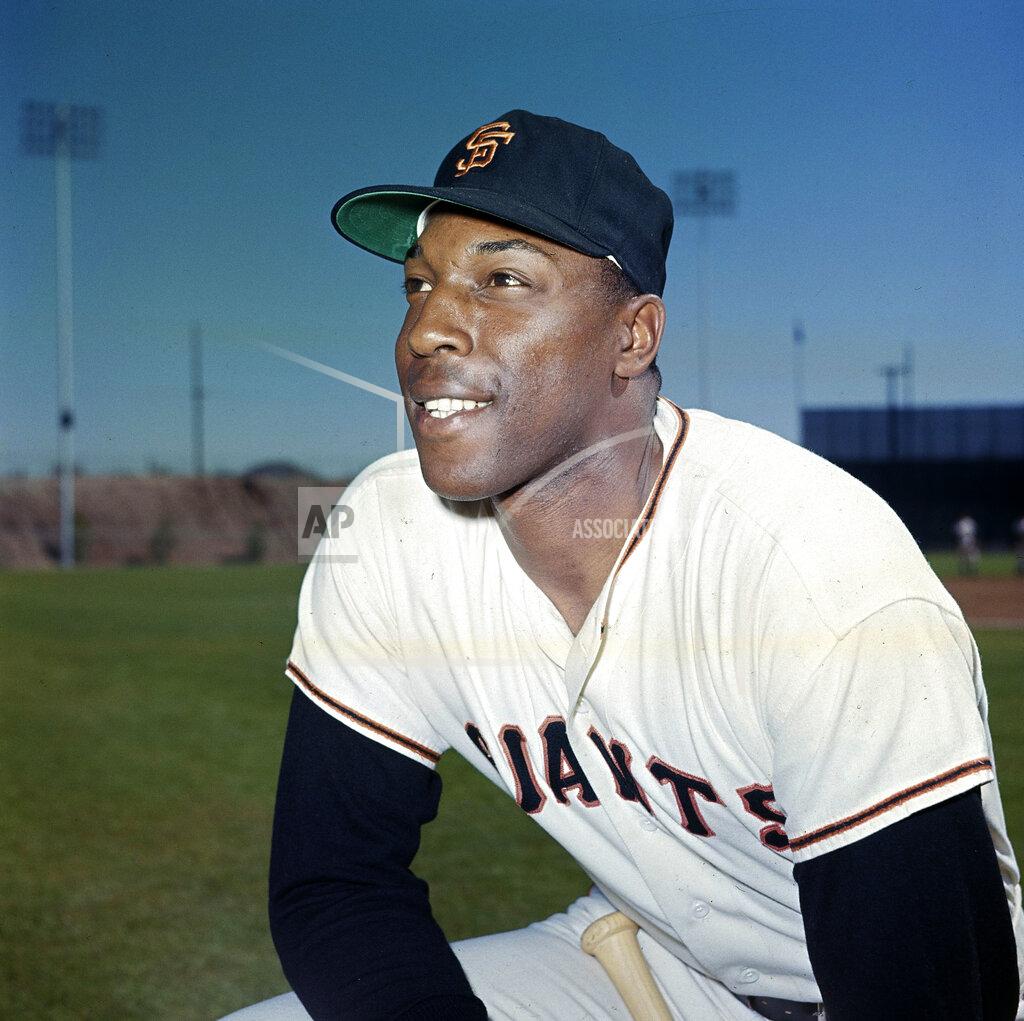
[Ed: One of my favorite players growing up. One the best pure pull power hitters of all time. But as an outfielder, he was… an adventure. McCovey’s knees were a mess and he could barely run. Still, he hit over .300 with power. Eventually, the Giants gave up, and traded Orlando Cepeda so that McCovey could play first base, his natural position. Didn’t seem like a great move when Cepeda had an MVP season. But McCovey continued to have an impact for another decade.]

[Ed: Another championship for UCLA…]

 History Diaries