
The evacuation of Huế and many other areas in the northern part of South Vietnam is being rushed to completion despite a public pledge by President Nguyễn Văn Thiệu to hold the line against further large Communist advances. The evacuation of civilians from Huế south to Đà Nẵng was reported to be nearly complete. In the coastal city of Tuy Hòa, conversations with arriving families of refugees made it clear that the North Vietnamese were attacking some of them as they fled. Such attacks were not evident earlier in the week when the exodus began.
Western sources said that since the column of North Vietnamese tanks that was advancing toward Huế last night had apparently halted, at least for the time being, the immediate fate of the former imperial capital was uncertain. On Wednesday night, government troops were hastily withdrawn from all of Quảng Trị Province, the northernmost of South Vietnam’s provinces. According to the Saigon Government spokesman, the withdrawal was prompted by a wave of Communist tanks that crossed the Thạch Hãn River line at about 11 PM. The river had formed the demarcation line between the two sides since the ceasefire of January, 1973.
It was unclear whether the South Vietnamese troop withdrawals were occurring only after battles, as the government asserted. Few major engagements were reported. Well‐placed military sources said yesterday that North Vietnamese forces had assisted a company of South Vietnamese soldiers in the evacuation of the citadel of Quảng Trị. It was impossible to determine whether that was an isolated incident or part of a pattern of North Vietnamese acquiescence. In some quarters, suspicions were voiced that the sudden and drastic withdrawals were not purely a result of military pressure.
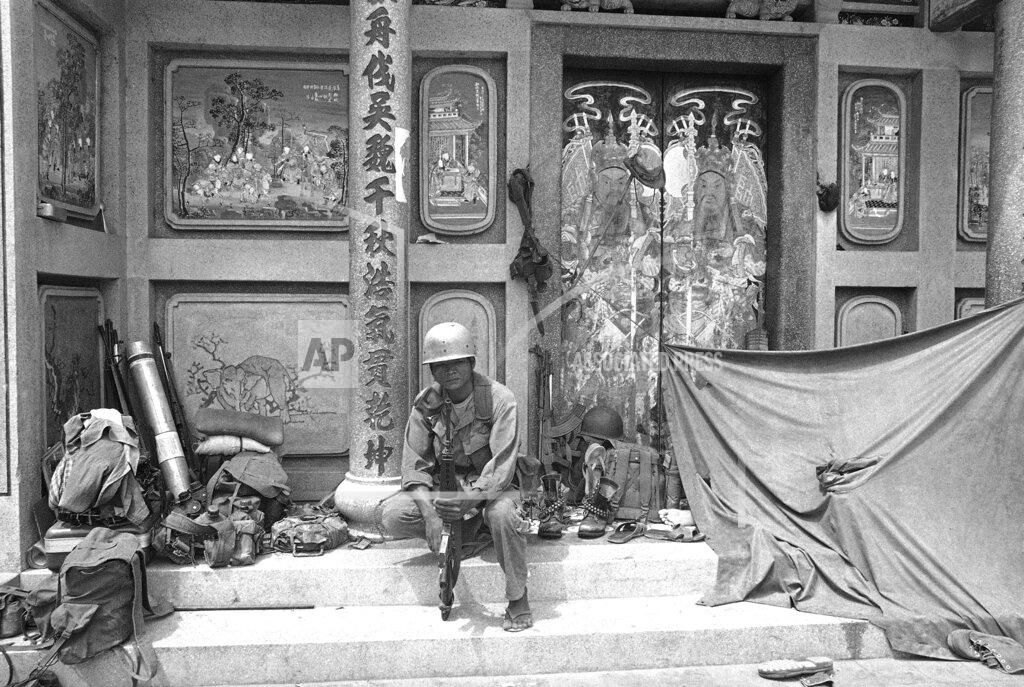
While the North Vietnamese pressure was potentially strong, growing numbers of South Vietnamese and others were speaking of an arrangement that may have been made with the Communists, perhaps one in which people, in the form of refugees moving south, were being traded for territory — the northern two‐thirds of the country. A Saigon spokesman said no major engagements were being fought near Huế, although some shells had fallen on the city. He said the equivalent of two divisions of government troops — marines and army infantrymen — were still in the area. That could be as many as 25,000 men. Other sources said, however, that most government troops were concentrated close to the South China Sea so that they could be evacuated quickly, either by sea or road. Earlier in, the week, the government moved the nation’s airborne division south to protect Saigon.
Vietnamese officials and some Westerners voiced concern that Saigon itself might be dangerously threatened and there are reports of large Communist demolition units near the capital. A government spokesman said that enemy tanks were spotted yesterday morning 2.1 miles northwest of the capital near Đức Huế in Hậu Nghĩa Province. One of the tanks was destroyed by Air Force planes, he said. Later, Communist infantrymen reportedly began a heavy attack on a nearby ranger base. In Saigon the government announced an earlier curfew, starting at 10 PM instead of midnight.
President Thiệu, who canceled a speech Wednesday night at the last moment, delivered his shortest address in a long time yesterday. Speaking for four minutes he told the nation that the North Vietnamese had augmented their normal strength of 14 divisions in South Vietnam with five divisions brought down from the North, along with tanks and artillery.
Speaking of the fall of Buôn Ma Thuột in the Central Highlands last week and the abandonment this week of Pleiku and Kon Tum, the President said: “In the highlands alone, where we had to fight at a 4 to 1 ratio, the forces were compelled to redeploy in order to preserve their strength and to create, for the present phase, more favorable conditions for their defense. For that reason, our armed forces did not endeavor to defend the cities of Kon Tum and Pleiku at any cost. In other front lines, from Thừa Thiên along the coast down to Military Region III and Region IV, we are determined to preserve our territory to the last.”
He conceded that Buôn Ma Thuột was overrun last week. This was the first time that Saigon officially acknowledged what was already generally known. But he added: “Rumors about the abandonment of Thừa Thiên or Đà Lạt or a few other places are merely aimed at creating confusion in the public and are entirely groundless.” He appealed for calm, for continued “anti‐Communist determination,” and he said he would be making further speeches.
The President’s remarks contrasted sharply with reports reaching Saigon from the 11 provinces that he is understood to have secretly designated as expendable. The flight of civilians from Đà Lạt is growing. On Wednesday. Air Vietnam was evacuating people at the rate of eight planes a day. Yesterday the airline operated 17 flights from the mountain town, and other military flights were also shuttling thousands of refugees. An airline official said that even more flights from Đà Lạt to Saigon were planned.
There were signs that the biggest flow of refugees in Vietnam, the hundreds of thousands moving from Pleiku southeast to the coast, has begun to assume some aspects of a death march. Although refugees reached the town of Hậu Bổn in Phú Bổn Province without much harassment, later an ambush was mounted against them in which many were believed to have been killed. Many refugees already were weak, exhausted and hungry from the March through the jungle that began last weekend.
The motives and intentions of the Saigon Government are far from clear. One American official said privately. “One of the hardest problems right now is that our Vietnamese friends have stopped telling us what’s going on.” Where fighting was reported, most of it appeared to be going badly for the government. The official spokesman said that early yesterday, for example, 1,000 shells and rockets fell on the district capital of Hoài Đức in jungle‐covered Bình Tuy Province, 60 miles northeast of Saigon. The barrage was followed by an infantry attack, and by 8:30 AM the “defenders had been forced to leave the town.” The situation in Tây Ninh was described by a reporter there as “dangerous.” He said that many Communist tanks had been seen moving toward the city near the Cambodian border from two directions.
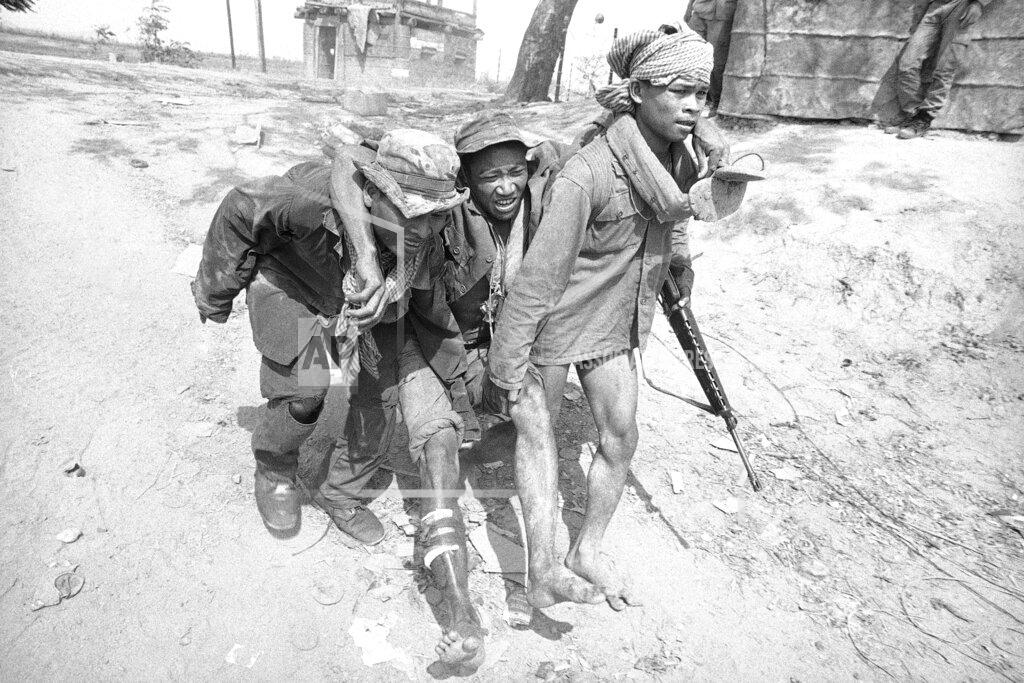
Hundreds of refugees, bloody and terrified — some of the many thousands fleeing the Central Highlands of South Vietnam — arrived in Tuy Hòa, a coastal city, and told of North Vietnamese rocket and artillery attacks against the civilian and army flight. Estimates of the number of refugees range up to 500,000. Conversations with refugees, villagers and young soldiers and with officials of Phú Yên Province made it plain that the North Vietnamese, firing rockets and artillery shells at the panicky refugees, were seeking to thwart their exodus. “The Communists are doing everything possible to prevent this withdrawal,” a senior official here said.
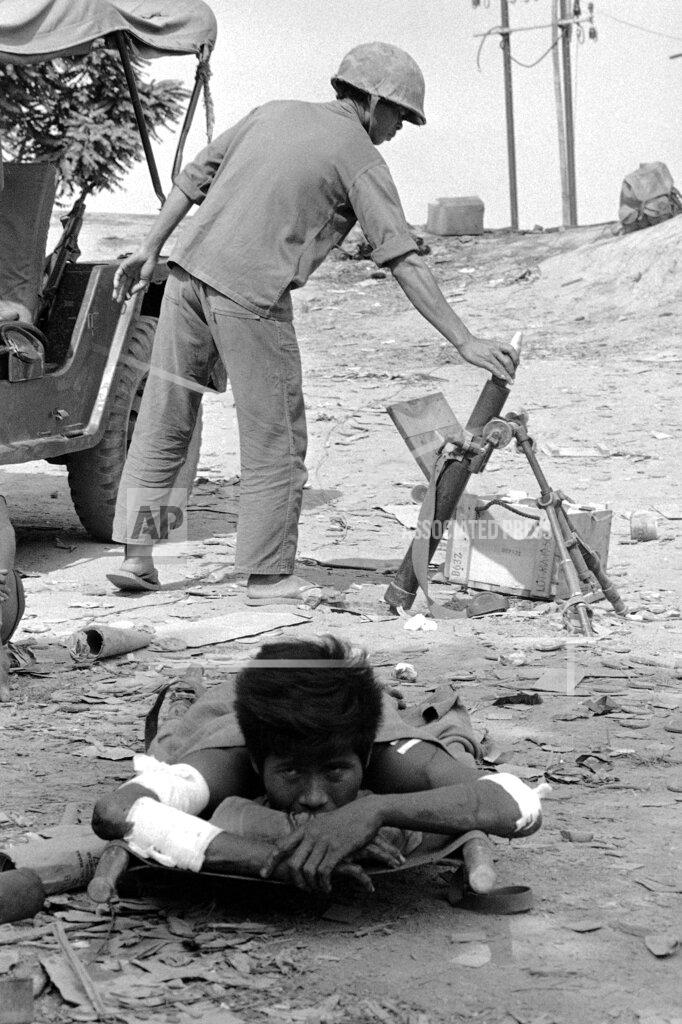
Young women, their faces smeared with blood, carried wounded and dying infants off evacuation helicopters. Old men and women, some swathed in muddy bandages, trembled and wailed. Wounded South Vietnamese sat beside a landing pad and waited for ambulances. Some were barefoot, with ripped, blood‐soaked uniforms; many wept. Such scenes of agony unfolded as groups of refugees moved into Tuy Hòa, a city that will serve as the gateway for the tens, perhaps hundreds of thousands fleeing the Central Highlands in the wake of the government’s reported decision to evacuate the northern two–thirds of South Vietnam. Estimates of the number on the move range up to half a million.
Witnesses told of hundreds, of bodies along Route 7B, the escape highway that meanders southeast from Pleiku, in the heart of the highlands, to Tuy Hòa, a distance of 135 miles. “The people die, the soldiers — terrible, terrible!” said Major Nguyễn Hệ, a ranger commander, who was sitting exhausted near the helicopter pad. Colonel Vụ Quốc Gia, the senior province official, said angrily in English: “They opened fire on the civilians. Look what they have done to our people! Why? I can’t say. They want to kill.”
A Pleiku woman holding child with leg wounds said in Vietnamese: “We were on a truck. They came from the jungle and told everyone to stop moving. We were on a slope. We kept moving. They just began firing on all of us.”
“You Americans — are you going to leave us like dogs?” asked a middle‐aged man who said that his wife and children were in Pleiku, “Will I see them again?” he pleaded, tears welling in his eyes. “Will I ever see my children?”
There were desperate and pathetic attempts at flight from this vulnerable area. Around Hậu Bổn helicopter pilots fought off villagers clawing to scramble aboard: A major who drove two journalist, American and Australian, to their chartered plane was accompanled by his wife and two small children. He asked the American civilian pilot if there was room for his family to go to Saigon; the pilot said no. His wife smiled, then began to weep. “We are so worried,” the major said. “All the roads here are closed. There’s no way of getting out but by plane, and there are no planes.”
Perhaps the most searing moment of the day was the first arrival of the wounded, among them children, breathing heavily, who seemed in shock. “She’s going to die! She’s going to die!” shrieked a woman with a bandage around her head who was cradling a child.
United States military experts regard the Saigon areas as the critical battlefield. The military situation there, as they view it, is becoming a race between South Vietnam’s ability to deploy four regular divisions and increasing pressures from Communist attacks to the northwest, northeast and east. North Vietnamese armored forces are reported near Tây Ninh, 80 miles northwest of Saigon. South Vietnamese troops have pulled out of An Lộc in the same area, and strong forces, including armor, are 50 miles east of Saigon on Route 1. The speed and force of the North Vietnamese advances, the Americans say, may prevent the establishment of a coherent defense for the Saigon enclave.
When the Communist offensive began, three South Vietnamese divisions were stationed in the area around Saigon — the Fifth, with headquarters at Lai Khê, the 18th, at Xuân Lộc, and the 25th, west of Saigon. The Fifth and 18th, already engaged, are expected by American analysts to fall back to shorter defensive positions nearer the capital. These divisions have been augmented by the transfer of an airborne division from the north at the outset of the fighting. This division is in Saigon but will probably be moved out to a defensive position. Three more divisions, the Seventh, Ninth and 21st, are to the southwest in the Mekong Delta. Of these the Ninth, with headquarters at Long Xuyên, is in the best position to reinforce the four divisions around the capital.
Reinforcement from troops deployed in the Central Highlands at the beginning of the campaign, if it develops, is likely to take the form of elements of the three divisions that were there and that have made their way south eluding North Vietnamese forces. These three divisions, the Second, 22d and 23d have all been in action in the last week American sources doubt if they can make their way south as organized divisions but speculate that groups in company and, battalion size may be able to get through the hills to safety. The tendency in American defense circles is to “write off” the four major units — the First, Third, Fourth and Marine divisions, which were stationed between the highlands and the demilitarized zone at the start of the northern offensive.
Another problem for Saigon is the reported deployment of sizable North Vietnamese forces from Cambodia. Armored units at Tây Ninh are believed to be the vanguard of a force heading southeastward toward the capital. Some American experts believe that this attack will develop into a major drive on the city. American analysts with combat experience in Vietnam are wary of making predictions at this point. Even if Saigon wins the race and establishes defensive, positions, they believe there are too many “unknowns” in the situation to encourage undue optimism. The principal unknown is said to be the psychological impact on the defenders of the loss of at least 20 percent of their country, and the spectacle of hundreds of thousands of helpless, fearful refugees and beaten troops fleeing from the Central Highlands.
In the face of Administration claims that Congressional reductions in military aid led to South Vietnam’s military setbacks a bipartisan move developed in the Senate today to cut off all military aid to Saigon this year. A Republican Senator, Charles McC. Mathias Jr. of Maryland, and a Democratic Senator, Adlai E. Stevenson 3d of Illinois, introduced legislation that would terminate all military aid to South Vietnam on June 30. Under their proposal, the President could continue the aid for 30 days more if he certified to Congress that such action would further a peaceful solution. The proposal of the two Senators, who have considerable influence in the moderate-to-liberal wings of their parties in the Senate was expected to provide the focal point for the developing Senate opposition to continuation of military aid to the Saigon Government. Some Senators said that the Mathias-Stevenson proposal had a serious chance of approval when it was considered this spring, probably as an amendment to the annual military authorization bill, which provides the military aid funds for South Vietnam.
Insurgent troops that penetrated to the eastern banks of the Mekong River opposite Phnom Penh’s naval base Wednesday were driven inland yesterday by Cambodian Government counterattacks, Cambodian and Western military officials reported. The Communist‐led infiltrators, who were apparently seeking a better position for shelling attacks against the base, which is on a peninsula between the Mekong River and the Tonle Sap, failed to inflict any major damage on the base, although they did hit it with mortar and rockets. It was not immediately clear how far the rebels had retreated yesterday. Western military estimates that had placed the rebel force at only 100 men were revised to more than 200. But witnesses in the area said there were almost 500 insurgents.
The key question during the action, in which the insurgent troops pushed within mortar range of the naval base and within about two miles of the capital, was how long the rebels could hold the position and whether they would be able to bring up rocket launchers. Despite the retreat, there are heavy concentrations of insurgents north and south of the riverfront area and further inland. It is from these positions that sporadic rocket attacks have continued across the river and the peninsula that separates the Mekong from Phnom Penh itself. It is considered unlikely that the insurgents would try to cross the Mekong River to attack the capital itself. The river in this area is broad, well lighted and heavily patrolled.
Thirty‐eight miles down the Mekong, the heavy shelling of the key town of Neak Luong continued, with the town’s defensive perimeter reportedly shrinking. Some reports say the Government‐held area is now less than two miles wide.
Relief workers who have been feeding the remaining residents in the city fear that the perimeter may shrink so sharply that airdrops of food and medicine will become impossible, Because of the heavy shelling, the residents are living in bunkers and trenches.
West and northwest of Phnom Penh, Western military observers reported that the latest drive against insurgent rocket positions north of Pochentong Airport, the capital’s last major supply route, had stalled, as have similar ones over the last six weeks. The rebels have used these positions in dense stands of bamboo for heavy rocket attacks. There was a slight increase in rocket fire at the airport, but no interruptions in the relief flights of rice, petroleum, and ammunition.
The British Embassy, the last important Western mission left in Cambodia aside from the American, has decided to shut and evacuate its staff.
A joint U.S. Senate-House committee tonight approved a final version of the foreign aid appropriations bill sharply cutting increases for food aid passed by the Senate. The compromise $3.69‐billion bill included $300‐million for food and nutrition aid to about 50 countries. The final compromise version, which added a total of $175‐million to the House’s vetsion, is expected to he anproved by both Houses and sent to the President early next week. In one of the more controversial areas of the bill, the military assistance program, the compromise version allocated $475‐million. The House had approved $490‐million in its version, and the Senate had included $450‐million in its $3.86‐billion bill that cleared the Senate yesterday.
Two former agents say the FBI as late as the mid-1960s kidnapped suspected spies who had entered the country illegally as a last-resort means of questioning them, the New York Times reported. One former agent said kidnapping also was used to persuade an operative to become a double agent. The practice reportedly was provoked by cold war incidents such as the Cuban missile crisis. The FBI has not acknowledged carrying out any kidnappings and refused comment on the newspaper report.
The major oil-consuming countries agreed at a meeting in Paris on an American-inspired concept of keeping oil prices high enough to encourage the development of alternative sources of energy. The agreement, by the 18-nation International Energy Agency, apparently opens the way for participation by the United States in a preliminary meeting of oil producers and consumers scheduled in Paris on April 7.
The Portuguese Communist party, more aggressive and influential than ever since last week’s abortive right-wing military uprising, moved today to eliminate a major centrist group from a role in government and called for greater control over the foreign press.
The wife of Britain’s escaped train robber, Ronald Biggs, is suing for divorce and papers will be served on him soon in Rio de Janiero, informed sources said in Brazil. Mrs. Charmain Brent (she changed her name from Biggs) has filed a suit in Australia, where she now lives with the couple’s two children. The papers will be filed through the Australian consulate and the Brazilian authorities, the sources said.
A House of Commons select committee said it has found no grounds… to expel runaway Labour Party legislator John Stonehouse from Parliament. Stonehouse, 49, a one-time cabinet member, disappeared from Miami Beach, Florida, last November 20. He turned up in Australia a month later. The select committee said that if Stonehouse did not return to Britain or resign within a few months, it would then wish to consider vacating his North Walsall seat on the grounds of non-representation.”
Three thieves using a smooth confidence trick got away with more than $500,000 worth of jewels from Christie’s, the London fine arts auctioneers, Scotland Yard said. The men went to Christie’s on March 12 for a sale of items listed as “magnificent jewels. The men all made bids and secured three lots of gems valued at $585,600. After the auction, the buyers presented forged Christie’s receipts, collected the jewels and vanished.
The U.S. Army dropped charges against an officer who grew his hair in an Afro in defiance of military regulations. The Army said it called off the trial of 1st Lt. Matthew R. Carroll, 27, of El Paso, Texas, after he had offered to leave the service on an honorable discharge. The Army also agreed to give him $3,600 severance pay and let him continue to wear his hair long during the three weeks he is being processed out of uniform.
The U.S. Navy said it had brought charges against 69 seamen from the transport Dubuque in the alleged sale and use of narcotics aboard the ship. In addition, a Navy spokesman said, one officer and one seaman were being detained at Yokosuka, Japan, for investigation but so far no charges have been made against them.
Christina Onassis, 24-year-old daughter of the late shipping magnate Aristotle Onassis, arrived in Geneva from Greece accompanied by shipowner Peter Goulandris, 28. Friends said the two may marry.
Victoria Fyodorova, a Soviet actress who had been born from the affair of U.S. Navy Admiral Jackson Tate and Soviet film actress Zoya Fyodorova, was finally granted an exit visa by the Soviet Union.
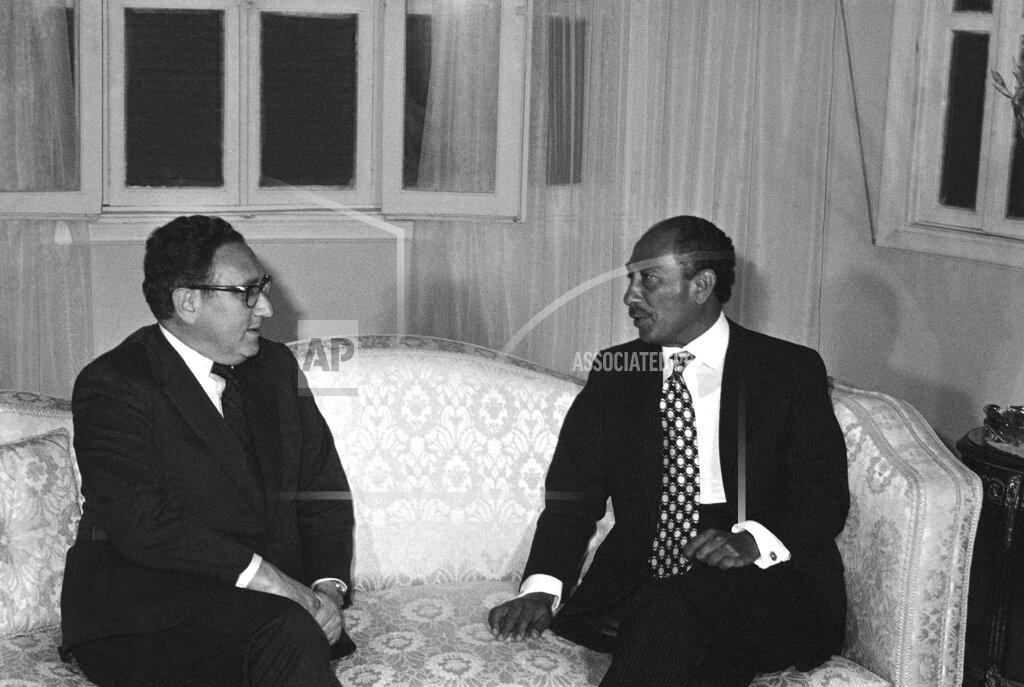
Secretary of State Kissinger brought modified Israeli proposals for a new Sinai agreement to President Anwar el‐Sadat tonight, and the negotiations were apparently at a decisive stage. Following two and a half hours of talks at Mr. Sadat’s villa, an Egyptian spokesman said Mr. Sadat had given Egypt’s counterproposals immediately to Mr. Kissinger and said: “We still have many difficulties to tackle.” He added that after flying to Israel tomorrow, Mr. Kissinger would probably come back to this tows on the upper Nile on Saturday or Sunday. No details were provided on either the Israeli position or the Egyptian responses. Neither American nor Egyptian officials would say whether an agreement was likely.
The Palestine central council unanimously approved Syrian President Hafez Assad’s offer to set up unified political and military commands with the Palestine Liberation Organization, it was officially announced in Damascus. The council recommended that the PLO executive committee set up a group chaired by PLO leader Yasser Arafat for meetings with the Syrians to effect unification.
The United States has agreed to ship 800,000 tons of wheat worth $128-million to India under the easy terms of the Food for Peace Program, officials announced today.
Brazilian security police reportedly have arrested six more journalists and lawyers in connection with the alleged activities of the banned Communist party. The arrests bring to more than 100 the number of people detained in the past two months following the dismantling of two clandestine Communist printing presses.
The Argentine Government announced today it had broken up a “vast subversive terrorist operation” designed to paralyze production in the industrial zones north of Buenos Aires and to assassinate labor leaders.
The Liberation Committee of the Organization of African Unity has appealed to Rhodesia’s nationalist guerrillas to prepare for a renewed war against the white minority Government.
President Ford is expected to appoint a special assistant in the White House to deal with the proliferating investigations of the United States intelligence community, reliable White House sources have disclosed.
The Labor Department reported that consumer price inflation continued in February at the somewhat reduced rate that prevailed in January, even though food prices were nearly stable. The Consumer Price Index rose six-tenths of 1 percent last month, after adjustment for normal seasonal changes in some prices, and reflected higher charges for services and goods, principally medical care and utility bills, rather than food.
The Senate scrapped all the work it had done on the tax bill and voted to start over again with a somewhat larger antirecession package, including a $100 special cash payment to every recipient of Social Security, railroad retirement or federal welfare benefits. It also approved a different version of the repeal of the 22 percent oil-depletion allowance, which would terminate the allowance for more companies than the plan the Senate approved last Tuesday.
Because Congress last year quietly reduced from five years to three the time in which the government can bring prosecutions against violators of the new “reform” Federal campaign finance law, an unknown number of potential criminal cases involving illegal contributions to President Nixon’s 1972 re-election campaign are “about to go down the drain,” a citizens’ group said today.
Robert S. Strauss, the Democratic National Chairman, pushed through his choice as president of the party’s State Chairmen’s Association today over the objections of an angry group of liberals.
A federal jury convicted Marshall H. Fields for destroying government property when he drove his car through a White House gate last Christmas morning. The judge scheduled hearings next week to determine Fields’ sanity at the time of the incident. Witnesses testified that Fields, who says he is a Muslim and was dressed in Arab clothing during the Christmas incident, crashed his car through the gates and stopped 20 feet from the diplomatic entrance to the executive mansion. He was brandishing what appeared to be sticks of dynamite but they turned out to be highway flares. Fields said his eyes were closed as he drove “in the general direction of the White House and the gate just happened to be there.”
House Democratic leaders announced a proposal to provide more money for public service jobs and eliminate bureaucratic delays they said had held up funds for projects already authorized by Congress. Chairman Robert E. Jones (D-Alabama) of the House Public Works Committee said the plan would cover $3.5 billion worth of public works projects already authorized but not yet funded, plus another $1.5 billion in projects to be authorized for the first time. He said the legislation would relieve needy communities of the requirement to match federal grants and would create 250,000 jobs.
Senator Hubert H. Humphrey (D-Minnesota) expects to owe the federal government about $240,000 in back taxes and interest because deductions claimed for donation of his vice presidential papers were disallowed by the Internal Revenue Service, an aide said. The IRS decision on Humphrey’s vice presidential papers given to the Minnesota Historical Society is based on a technical point, not on allegations of criminal fraud or negligence. Under law, charitable donations cannot be claimed if the donor retains control over the gift. The public access to Humphrey’s papers is restricted for 25 years.
Vice President Rockefeller will seek to ease his strained relations with Senate Republicans at a series of private dinner meetings this spring.
The Federal Aviation Administration is undertaking steps to require that jumbo jets operated by U.S. airlines be modified to better withstand hazards of sudden inflight depressurization, a spokesman said. Such a sudden loss of pressure, caused by failure of a cargo compartment door, was involved in the world’s worst aviation tragedy: the March, 1974, crash in Paris of a Turkish DC-10, killing 346 persons. A proposed FAA rule would call for strengthening the cabin floor in wide-bodied aircraft.
Union officials reversed themselves and approved a tentative agreement to end a six-day transit strike in Philadelphia that has forced 400,000 commuters to find other ways to work. But the strikers delayed returning to work until the state agrees to provide $13 million more in annual subsidies to the Southeastern Pennsylvania Transit Authority to pay for the two-year pact that provides 21% more in wages.
Nuclear warheads from torpedoes were believed to have been recovered from the Soviet submarine that the Central Intelligence Agency sought to salvage in the Pacific Ocean last summer, sources familiar with the operation said today. The Los Angeles Times reported yesterday that nuclear warheads from the torpedoes had been found by the C.I.A.. which spent more than $350‐million on a special salvage vessel to try to raise the submarine from the ocean floor northwest of Hawaii. The salvage vessel was built by Howard R. Hughes, the billionaire. The C.I.A. also operated a barge to bring back the Soviet sub.
Ronald Reagan, former Governor of California, today criticized the news media as “irresponsible” for disclosing efforts by the Central Intelligence Agency to raise a sunken Russian submarine. Mr. Reagan, a member of the blue‐ribbon panel investigating reported domestic spying by the C.I.A., told a news conference that the possible raising of the submarine gave the United States a “great opportunity” to learn something of the capability of the enemy. He said the United States was hurt when the effort was made public and said the media should have shown some ethics in not reporting the story. “I just think it was irresponsible to publish it,” Mr. Reagan said. “Freedom of speech and freedom of the press re wonderful, but sometimes I think we shouldn’t say something just because we have found it out.”
The electronics industry has developed a miniature device that is reportedly able to reduce the gasoline consumption of automobiles markedly and thus be a major factor in helping to realize the government’s energy conservation goals. The device, which is still in the testing stage, was also said to have other fuel-saving applications. The device is called a microprocessor.
Dow Jones Industrial Average: 764.00 (-5.48, -0.71%)
Born:
Eric Brown, NFL safety (Denver Broncos, Houston Texans), in San Antonio, Texas.
Paul Healey, Canadian NHL left wing (Philadelphia Flyers, Toronto Maple Leafs, New York Rangers, Colorado Avalanche), in Edmonton, Alberta, Canada.



 History Diaries