

What a colossal, stupid waste.
The Soviet press today denounced the Senate vote to release $1.5 billion for 21 MX missiles, saying that President Reagan had twisted senators’ arms to get his way. Reports in Izvestia, the Government newspaper, and by Tass, the Government press agency, ridiculed the argument that the missiles were necessary to bolster the American bargaining position in Geneva. “The logic is striking,” Tass said. “Arms are to be amassed to achieve their reduction.”
President Reagan meets with Secretary of State George Shultz and Assistant for National Security Affairs Robert McFarlane to discuss “Quiet Diplomacy” with the Soviet Union.
As the Reagan Administration and the Soviet Union gear up their strategies for the current arms control negotiations, the bargaining goes well beyond the the exchanges behind closed doors in Geneva to the political arenas of the United States and Western Europe. “This is going to be fought out in Western newspapers and legislative bodies,” said an Administration official. “It will not be settled by the force of logic and reason in Geneva.” As American officials and foreign diplomats see it, the key will be which side is able to convince Western public opinion that the other is not negotiating seriously. If the Washington wins, Moscow may have to come around. If not, President Reagan will find himself trapped either into making concessions or looking like the obstacle to peace.
The Belgian Parliament approved the deployment of cruise missiles today after an all-night debate, and NATO officials said the decision should push the Dutch Government to do the same. The vote, 116 to 93, came just before 5 A. M. after a 15-hour debate. The Government made the deployment decision last week, subject to parliamentary approval, and the first 16 missiles were deployed immediately afterward.
Italy’s Chamber of Deputies gave final approval to a new concordat between Rome and the Vatican that officially ends Roman Catholicism as Italy’s state religion. The vote, following approval by the Senate, was 350 to 75 with 39 abstentions. Prime Minister Bettino Craxi praised the agreement for ending “the forced cohabitation between constitutional guarantees and Lateran (church) privileges.” The agreement, establishing “freedom of religion and conscience,” replaces the so-called Lateran Pacts between the Vatican and Italy signed by Pope Pius XI and dictator Benito Mussolini in 1929.
The Lebanese Cabinet instructed the army today to put an end to factional clashes in southern Lebanon. The fighting has claimed the lives of at least eight people in the last 48 hours and created a new refugee problem for the Government. The Cabinet order came out of its first meeting since Christian militia commanders revolted last week against the authority of President Amin Gemayel and his policy of cooperation with Syria, Lebanon’s Muslim neighbor.
The State Department said it is recalling more than a dozen U.S. ambassadors from the Mideast and South Asia for consultations on recent efforts to promote Arab-Israeli peace talks and other issues. The talks are “not keyed to the recent events involving the peace process nor to the recent events in Lebanon,” said deputy spokesman Edward P. Djerejian. “It is truly a gathering of the clan, a periodic, routine gathering of the clan.” Nevertheless, the consultations coincide with a new round of diplomatic activity in the Middle East.
Libyan leader Muammar Qaddafi was quoted in a leftist Lebanese newspaper, As Safir, as saying that if Arab leaders do not reject American control, “I will take up responsibility and begin terrorism against the Arab rulers, threaten and frighten them and sever relations. And if I could, I would behead them one by one.”
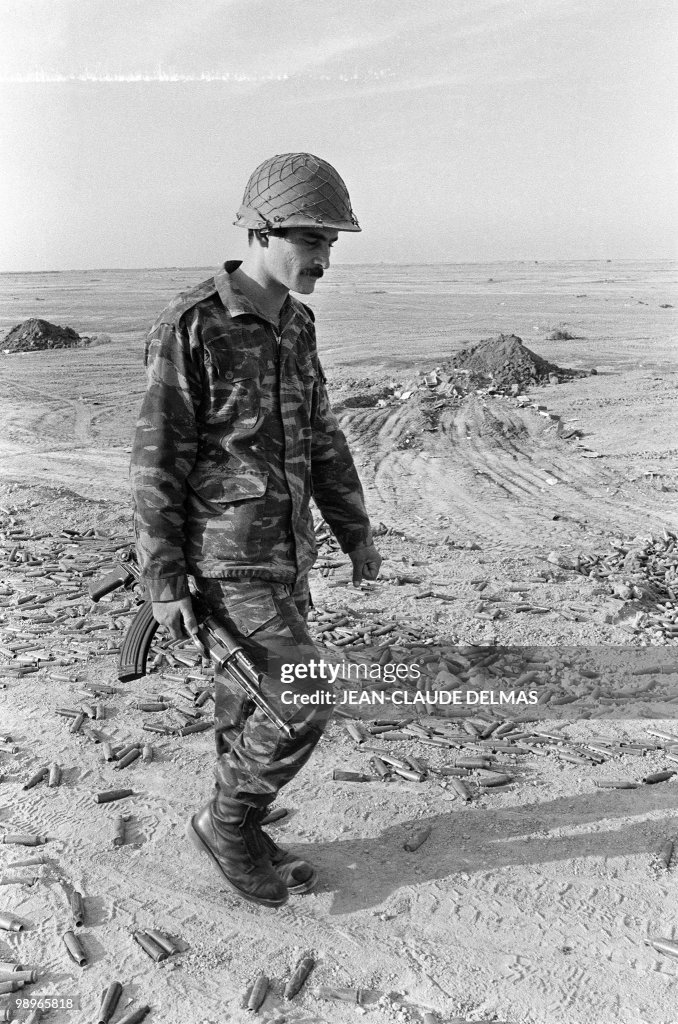
A Gulf War settlement was urged by Washington. The United States appealed to Iran today to acknowledge that a military victory could not be achieved in the four-and- a-half-year-old war and to accept a negotiated settlement. Officials conceded that the chances of Iran’s yielding to American and other international appeals were minimal, but a senior Administration official said, “We have to keep trying and hoping that the sheer numbers of Iranians killed on the battlefield will persuade Khomeini to try another tack.” Iraq has repeatedly agreed to accept a United Nations cease-fire and negotiation, but the Ayatollah Ruhollah Khomeini of Iran has refused to do so until President Saddam Hussein of Iraq resigns and Iraq agrees to pay reparations. Partly because of Iran’s refusal to negotiate unconditionally, the United States has been publicly sympathetic to Iraq and critical of Iran, even while officially professing neutrality in the war.
Iraqi jets were reported to have attacked six Iranian cities and Kharg Island today, raising the death toll at the Persian Gulf oil terminal to 18 in two days. Tehran airport was almost at a standstill because some airlines had suspended flights after Iraq’s imposition of a war zone over Iranian airspace. Shipping sources said six people had been killed at Kharg Island aboard an Iranian supply ship that had apparently been hit by an Iraqi missile. The sources said the oil terminal had not been damaged and operations continued. Diplomats in Baghdad said an explosion at Kharg on Tuesday killed 12 people and destroyed a storage tank.
The chemical accident in Bhopal, India, arose from various errors and procedural violations that would never be tolerated at a similar plant in Institute, West Virginia, according to the Union Carbide Corporation. It said the accident, which caused the death of more than 2,000 people in December, apparently occurred when a large amount of water entered a storage tank containing methyl isocyanate. But it said the reaction would not have had so deadly a result without the six or more errors and violations involved.
Lieutenant General H. M. Ershad, the President of Bangladesh, deployed troops at stations where the people will vote Thursday on whether they approve of his continuation in office until national elections can be held. Underground opposition leaders have called for a general strike and boycott. On March 1, General Ershad called the referendum and banned all political activity after canceling parliamentary elections that had been set for April. The opposition had refused to participate in the elections unless he lifted martial law.
Vietnam turned over to U.S. officials the remains of five people believed to be American servicemen missing in action during the Vietnam War. The remains, flown from Hanoi to Clark Air Base in the Philippines, will be taken to Honolulu for possible identification at the Army’s Central Identification Laboratory. It was the first such turnover of American remains in eight months and came a month before Vietnam celebrates the 10th anniversary of the capture of Saigon. Maj. Barry Glickman, spokesman at Clark Air Base north of Manila, said a C-130 transport plane flew to the Vietnamese capital of Hanoi early today to retrieve the remains and returned to the United States base in the evening. An American request to participate in excavation of sites where U.S. planes crashed in Vietnam was turned down, Foreign Minister Nguyễn Cơ Thạch said.
The House Foreign Affairs subcommittee on Asia voted today, for the first time, to allocate $5 million in funds for the non-Communist Cambodian rebels who are fighting against Vietnamese forces. At the initiative of Representative Stephen J. Solarz, Democrat of Brooklyn, the money was approved for use by the two non-Communist rebel groups, one headed by Son Sann, a former Prime Minister, and the other by Prince Norodom Sihanouk, the former Cambodian head of state. None would be made available to the third rebel group, the Khmer Rouge, which was responsible for the death of millions of Cambodians during the period it ruled. The funds could be used for military purchases, and this would be the first time such money would be provided by the United States. The subcommittee action must still be approved by the full committee and the full House and Senate. The Administration, until now, has opposed giving military aid to the Cambodian rebels. In another subcommittee action, military aid to the Philippines for the 1986 fiscal year was drastically cut, to $25 million in grants. The Administration had asked for $100 million, divided equally between grants and loans. The panel raised economic aid from $95 million to $155 million.
China said it would welcome a relaxation of U.S.-Soviet tensions and an arms-reduction pact if the agreement is not detrimental to the interests of a third country. Foreign Ministry spokesman Ma Yuzhen, describing talks this week in Peking by Michael H. Armacost, under secretary of state for political affairs, did not explain Peking’s position further. But China and Japan have said they oppose a superpower accord that would permit Soviet missiles removed from Europe to be transferred to Asia.
A reputed gang leader testified today that the chief of Taiwan’s military intelligence had ordered him to murder a Chinese-American journalist on the ground that the journalist had been a “double agent” who had spied for both Taiwan and China. Chen Chi-li, who is charged with the murder on October 15 of Henry Liu in Daly City, California, told a pretrial hearing that he had decided to disobey the order from the military intelligence chief, Vice Admiral Wong Shi-ling. Mr. Chen, 41 years old, who is reputed to be the leader of the Bamboo Gang in Taiwan, said he had told his associates “only to teach him a lesson” and “not to kill or disable him.” Mr. Liu, 52, whose writings were critical of the Nationalist Chinese Government here, was shot in the garage of his home. His widow, Helen Liu, says the murder was ordered by Taiwan authorities to silence him. The Government has denied any involvement.
The 26 defendants in the murder of Philippine opposition leader Benigno S. Aquino Jr. will have to be retried if the court hearing their case is stripped of jurisdiction, the chief justice of the Philippine Supreme Court said. Two lawyers have challenged the jurisdiction of the three-judge ombudsman’s court, contending that a decree by President Ferdinand E. Marcos gives military courts jurisdiction over soldiers. Justice Enrique Fernando said a decision on the issue is pending.
Salvadoran military officials said that 5,000 troops launched a sweep through Usulutan province in the eastern section of the country to prevent leftist rebels from carrying out a threat to disrupt highway traffic. The rebels, fighting since 1979 to topple the U.S.-backed government, had said that their highway campaign would begin on Wednesday. The sweep in Usulutan province came as about 5,000 other Salvadoran troops, responding to a series of guerrilla raids last weekend, moved against insurgent strongholds in La Union, Morazan, San Miguel and Chalatenango provinces.
The Vatican condemned teachings of a Brazilian exponent of liberation theology. In an 11-page document, the Vatican deplored the Rev. Leonardo Boff’s sharp criticism of the hierarchical structure of the Roman Catholic Church. Liberation theology often draws on Marxist analysis in stressing the church’s special commitment to the poor. In an 11-page document, the Congregation for the Doctrine of the Faith said the Rev. Leonardo Boff’s sharp critique of the hierarchical structure of the Roman Catholic Church could lead “to the destruction of the authentic sense of the sacraments and of the word of faith.” Father Boff, a Franciscan priest, could suffer church sanctions should he refuse to alter his teachings, but a Vatican official said it was too early to speculate on the outcome of the case.
No sooner had Daniel Ortega Saavedra finished attending funeral services for Konstantin U. Chernenko in Moscow last week than the Nicargauan President was back on an airplane. But instead of heading home, he was winging his way to Brasilia for the inauguration of Brazil’s new civilian Government and the start of a weeklong visit. Mr. Ortega’s current Brazilian tour is his second trip to South America this month and, like the first, it involves far more than a mere exercise in diplomatic protocol. His sudden burst of globetrotting, diplomats here say, is part of a drive to drum up support for the peace proposal he first made public late last month.
Bolivia’s authorities deployed troops and riot police in La Paz to maintain order as a general strike entered its 13th day. It was the first time that the left-of-center Government had mobilized troops for such duty. It was unclear how many soldiers had been deployed, but the number appeared to be well under 2,000. Mr. Siles Zuazo, the country’s first popularly elected head of state in two decades, repeated a refusal to accede to workers’ demands for an inflation- adjusted increase of 400 to 500 percent in the minimum wage. Talks broke down down Monday night after the workers refused to accept the Government’s offer of a 332 percent increase. Since Mr. Siles Zuazo took office in 1982 after a succession of military governments, the annual inflation rate has soared from 200 percent to more than 50,000 percent.
Brazil’s President-elect, Tancredo Neves, underwent new abdominal surgery today just five days after an emergency operation for an intestinal inflammation prevented him from taking the oath of office. After a three-hour operation to deal with an intestinal obstruction, Mr. Neves’s spokesman, Antônio Britto, said it had been “very successful.” A medical bulletin added that the patient had responded “very well.”
President Raul Alfonsin of Argentina told a joint meeting of Congress today that the debt crisis of Latin America threatened peace and stability in the Western Hemisphere. He also urged Americans to recognize “the convergence between our countries and our common interests.” His remarks were addressed to Congress on the last day of his three-day state visit to Washington, the first by an Argentine head of state in 26 years.
The Rev. Allan Boesak, president of the World Alliance of Reformed Churches and a prominent foe of the white South African authorities, was reinstated as pastor of his local congregation today after church elders dismissed reports that he had been embroiled in an adulterous relationship. Dr. Boesak, classifed in South Africa as a person of mixed racial descent, or a “colored” person, had denied having an extramarital affair with Di Scott, a white church worker, but had acknowledged a “relationship” with her. The case arose in January when a newspaper, The Star, reported that the Security Police had tried to discredit Dr. Boesak by disseminating tape recordings said to have been made in bugged hotel bedrooms and purporting to provide evidence of adultery.
The MX missile was opposed by the House Appropriations Committee, which voted narrowly against a resolution to release $1.5 billion to buy 21 additional strategic weapons. The 28-to-26 vote was advisory and will not prevent the full House from considering the issue next week. But the committee’s action indicates that the Administration could face a tougher fight than expected on the House floor. “This shows our work is still cut out for us over here,” said Representative Trent Lott of Mississippi, the Republican whip. “It’s winnable, but it will take some more work.’
President Reagan, who has worn a hearing aid in his right ear for the last 18 months, has begun using a similar device in his left ear “to achieve balance,” Reagan physician T. Burton Smith said. The second hearing aid first became evident at a White House state dinner Tuesday night. It is similar in size and design to the sophisticated corrective device prescribed for Reagan after an August 22, 1983, examination.
Agriculture Secretary John R. Block changed rules to allow the Farm Credit System, the nation’s largest farm lender, to qualify for quick action on federal guarantees of loans to debt-strapped farmers. Easing the regulations will also make it possible for an undetermined number of additional rural banks to qualify for fast processing of federal guarantee applications so they can continue to lend to financially weak farmers. The new rules are intended to speed processing of federal guarantees and bank loans.
The chairman of the House Budget Committee, Rep. William H. Gray III (D-Pennsylvania), bluntly ruled out tax increases of any kind as part of the 1986 budget, dismissing a plan offered by his predecessor for an oil-import fee. “It’s not an option,” he said of the plan proposed by Rep. Jim Jones (D-Oklahoma), who testified before the panel. “We’re going to do it with spending cuts.”
The last striking Mississippi teachers returned to their classrooms, ending nearly a month of wildcat walkouts, after they gained a partial victory in their fight for higher wages. In a pay package approved by the Legislature over the governor’s veto, teachers will get a total of $4,400 in raises over the next three years, with $1,000 in the third year tied to a yet-to-be developed merit pay plan. Salaries now average $15,971 — lowest in the nation.
The new Secretary of Labor nominated by President Reagan is Bill Brock, a former Republican Senator from Tennessee who has served as the United States Trade Representative since 1981. White House officials said the selection of Mr. Brock was a pointed effort by President Reagan to improve relations with organized labor, which grew strained in the tenure of Raymond J. Donovan.
The F.D.A.’s refusal to investigate the drugs used to carry out executions by lethal injection may not be challenged in court, under a 9-to-0 ruling by the Supreme Court. Writing for the Court, Associate Justice William H. Rehnquist said that as a general rule, a Federal regulatory agency’s decision not to take a particular enforcement action was beyond the scrutiny of the courts.
The forced removal of a bullet from the chest of an armed robbery suspect is barred by the Constitution, under a 9-to-0 ruling by the Supreme Court. Prosecutors in Richmond, Virginia, want to match the bullet with the gun of the intended robbery victim, who defended himself by shooting his assailant.
The Fed acted to calm markets that have been made uneasy by the abrupt closing last week of 70 Ohio thrift institutions. The Federal Reserve Board Chairman, Paul A. Volcker, said the central bank was ready to lend funds to the Ohio savings and loan associations. Mr. Volcker’s assurance of assistance, his first public comments since the thrift crisis began last week in Ohio, came a day after the dollar plunged and gold prices soared almost $36 an ounce on fears of the effect of the events in Ohio. “We are working with the Ohio authorities on the situation,” Mr. Volcker said, “and we will be prepared to lend to them as they are deemed to be in strong enough condition to reopen.”
A jury was empaneled today for the Los Angeles espionage trial of two Russian emigres after a screening process in which questions of the influence of pretrial publicity were overshadowed by questions about the right of immigrants to be vocally critical of America. One man was disqualified as a juror after telling the judge of his fears that he might not be impartial because “I have a concern and a deep feeling about anyone accused of being disloyal to this nation.” The judge, David V. Kenyon Jr., had instructed the prospective jurors to consider carefully whether they could be fair, since the crime alleged was espionage and the defendants “from a country where we’ve had lots of problems.”
New York subway gunman Bernhard H. Goetz will waive immunity and testify next week before a grand jury that is considering whether to charge him with attempted murder, his lawyer said. Barry Slotnick said he and other lawyers decided to let Goetz testify March 29 because they believe prosecutors will make “an overzealous presentation” to obtain an indictment for attempted murder. Goetz, 37, is charged with shooting four Bronx youths December 22 in the subway when, Goetz said, they tried to rob him.
Investigators strongly suspect that the January 21 crash in Reno that killed 70 persons aboard a Galaxy Airlines plane occurred because a service door was left open on the airplane’s wing and prompted severe vibrations, causing the pilot to cut engine power below safe limits, sources told the Washington Post. The National Transportation Safety Board said the recording of the flight crew’s conversation indicates that the Lockheed Electra stalled almost immediately after takeoff. Investigators say other Electra pilots have reported severe vibrations when a service door on the front underside of the left wing is left open. Ground crews have been interviewed to determine if anyone can remember whether the door was closed, but the interviews have been inconclusive.
A chemical used in hair sprays and paint removers as well as to decaffeinate coffee appears to cause cancer in laboratory animals when taken in high doses, the head of a federal research project said. Dr. John Mennear, a toxicologist with the National Toxicology Program, said the “tentative conclusion” of the group’s study is that the chemical methylene chloride causes tumors — or cancer — in mice and rats. James Greene, a spokesman with the Food and Drug Administration, said: “Our position is that the extremely small residue levels in decaffeinated coffee pose no hazard to health.”
One half of the Fox film company is to be bought by Rupert Murdoch, the Australian publisher who has built a worldwide communications empire. He agreed to purchase 50 percent of the financially troubled 20th Century- Fox Film Corporation for $162 million and to advance $88 million to the studio’s parent company. Fox, now privately owned by Marvin Davis, a wealthy oilman, is one of Hollywood’s best-known movie studios, but one that has suffered financial difficulties from a string of box-office disappointments. “They need the capital to get back on track with production,” said Harold Vogel, an analyst at Merrill Lynch, Pierce, Fenner & Smith Inc. “It’s been a rough period for them for the past one and a half or two years.” The purchase surprised the Hollywood community, and raised questions about what effect it might have on the kind of films the studio produces.
Rural Southern industry is hurt by cheaper foreign competition. Hundreds of labor-intensive plants, factories and mills in rural municipalities have been closed.
Bach’s music will be broadcast tonight from Leipzig into homes throughout East Germany and the United States. Johann Sebastian Bach would have had his 300th birthday today, and the public radio networks of both countries are celebrating with unusual harmony.
A woman won Alaska’s sled race for the first time. Libby Riddles, a 28- year-old Alaskan, mushed her exhausted dog team into Nome and won the arduous, 1,135-mile sled race across ice fields and snow-capped mountains. The course follows the Iditarod Trail, a turn-of-the-century mail and cargo route that linked the open-water port of Seward with the gold mines near Nome.
Dow Jones Industrial Average: 1265.24 (-5.85)
Born:
Ronnie Brewer, NBA shooting guard and small forward (Utah Jazz, Memphis Grizzlies, Chicago Bulls, New York Knicks, Oklahoma City Thunder, Houston Rockets), in Portland, Oregon.
Britton Colquitt, NFL punter (NFL Champions, Super Bowl 50-Broncos, 2015; Denver Broncos, Cleveland Browns, Minnesota Vikings), son of NFL punter Craig Colquitt, in Knoxville, Tennessee.
Marques Murrell, NFL linebacker (New York Jets, New England Patriots), in Fayetteville, North Carolina.
Jonny Venters, MLB pitcher (All-Star, 2011; Atlanta Braves, Tampa Bay Rays, Washington Nationals), in Pikeville, Kentucky
Ryan Stone, Canadian NHL centre (Pittsburgh Penguins, Edmonton Oilers), in Calgary, Alberta, Canada.



 History Diaries