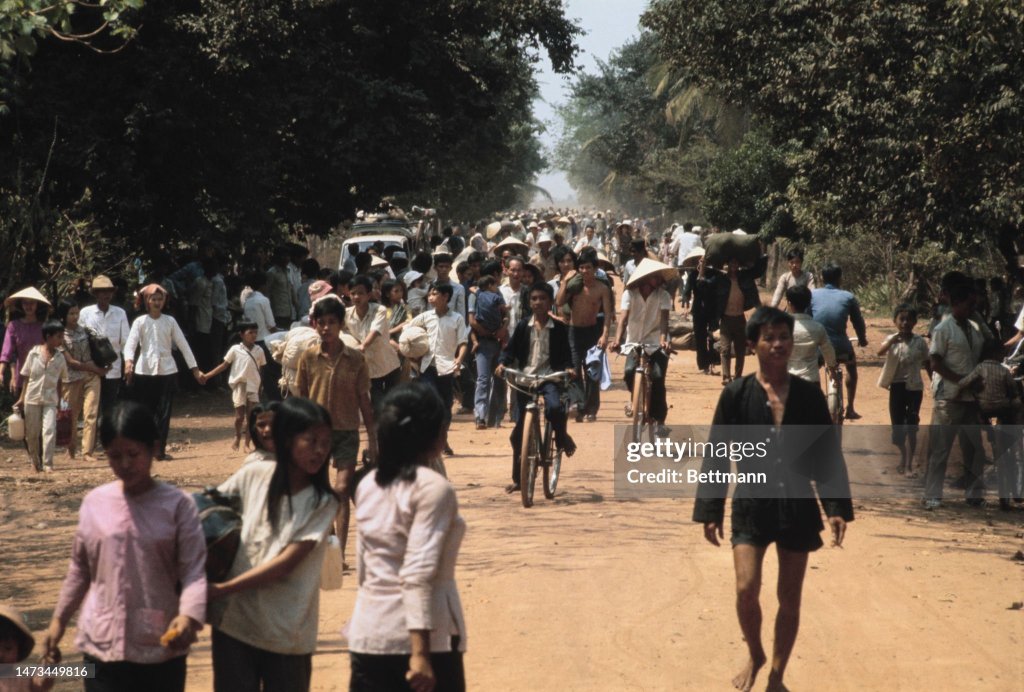
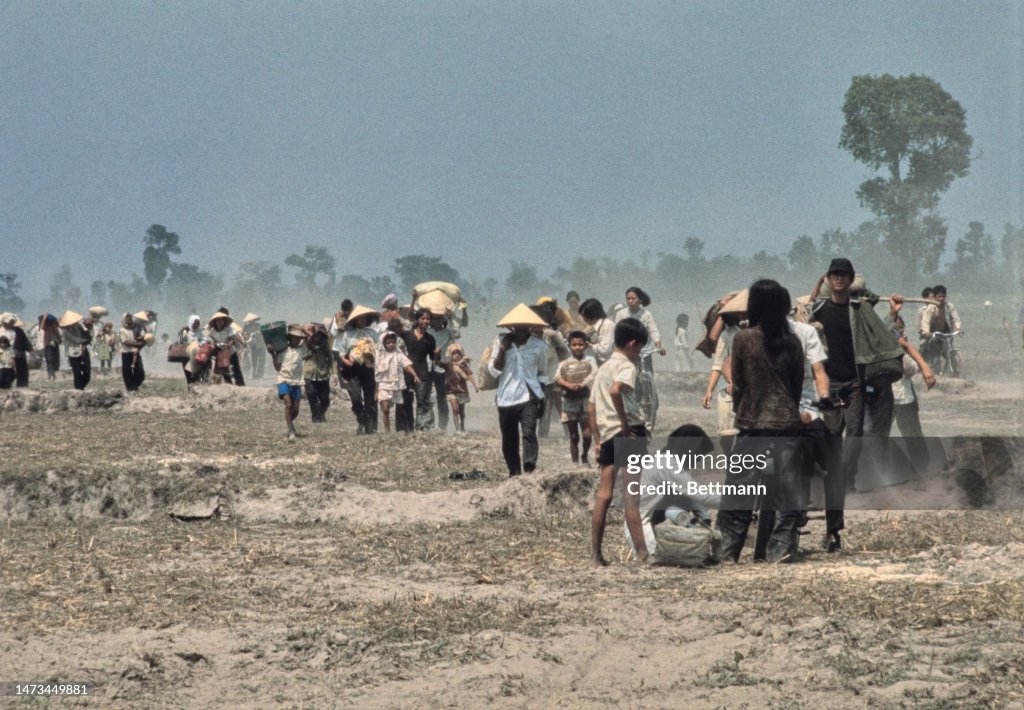
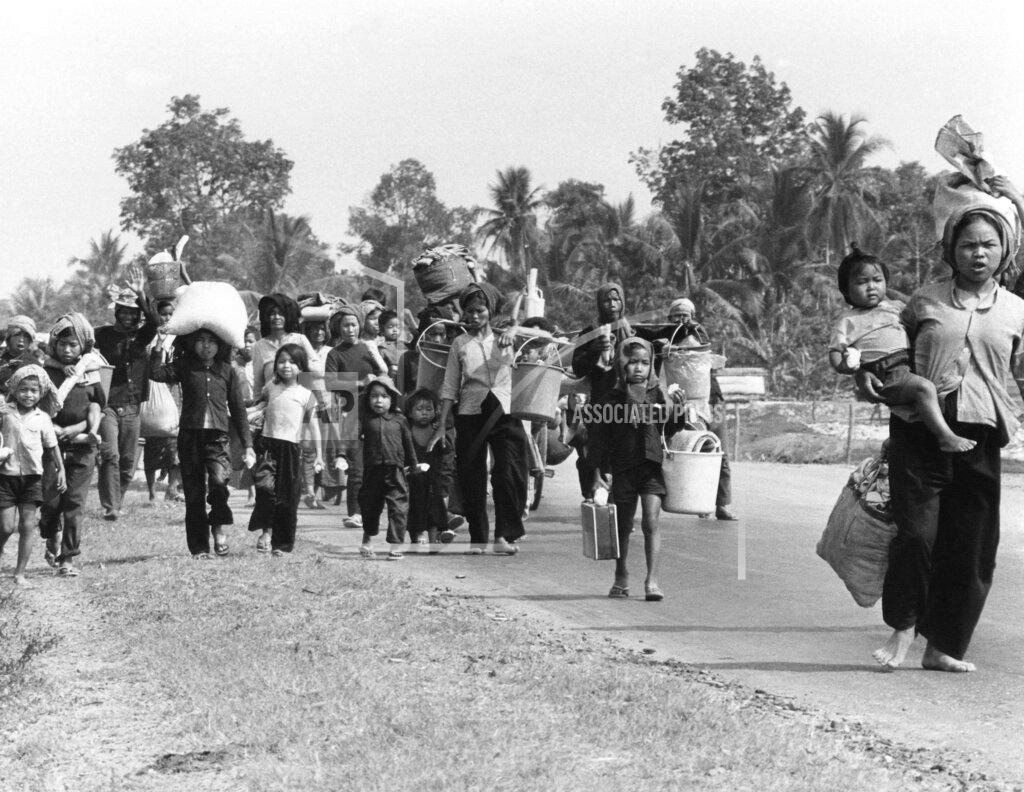
After initially hoping to maintain control of the area around Huế, the second largest city in South Vietnam, President Thiệu ordered the area to be evacuated, sending even more refugees toward Saigon. South Vietnamese forces have begun rapidly withdrawing from the northernmost part of the country and well-placed military sources said they were being assisted in their evacuation by Communist troops. The sources said all of Quảng Trị Province had been occupied. Sources close to the South Vietnamese command said that President Nguyễn Văn Thiệu had decided that 10 or more provinces must be sacrificed if necessary to save the rest. A Vietnamese military source reported that a company of 100 South Vietnamese soldiers guarding the smashed remains of the citadel of Quảng Trị had been ordered to withdraw toward Huế. As they moved out, North Vietnamese military units approached, but did not open fire, using the strong headlights of their tanks to light the way for the government troops. Quảng Trị was one of the main centers of fighting in 1972 and was completely destroyed.
A source close to the South Vietnamese command said that the former imperial city of Huế, along with the rest of Thừa Thiên Province, was being evacuated this morning, and that by late today Huế itself would be in Communist hands. In addition to the military evacuation, tens of thousands of refugees have started an exodus southward. Earlier this week many thousands more began fleeing the central Highlands after a series of government reverses. By some estimates, as many as half a million people were now fleeing their homes in five provinces. Two days ago, airborne troops in the north were withdrawn to the Saigon area, and today the marine brigades near Huế the other principal defense force in the area, was said to have moved to Hương Điền on the nearby seacoast for evacuation both by road and sea.
It appears clear that the Communists have been well informed as to developments, and have been avoiding any form of harassment or causing casualties. Throughout South Vietnam, ordinary people as well as officials were preparing for any eventuality as events moved swiftly. It was announced at noon that the curfew in Saigon starting tonight will go into effect at 10 PM instead of midnight, an indication of concern about a possible attack on the capital itself. Several Western Embassies, including that of the United States, reportedly were completing details on their longstanding evacuation plans. President Thiệu’s decision possibly to sacrifice 10 provinces was reportedly made last week, and some government forces immediately began leaving the areas. As units moved out, there has been civilian panic. While no official announcements have been made on this momentous strategic decision — and none are likely — its general outlines appear to be known to many people in and out of the government. The effect has been to step up the general exodus.
The provinces the Government reportedly is prepared to sacrifice were identified as Quảng Trị, part of which has been in North Vietnamese hands since 1972, Kon Tum, Pleiku and Phú Bổn, all three of which are now being evacuated; Đắk Lắk, most of which was overrun last week, Quảng Đức, Tuyển Đức, and Lâm Đồng and Bình Long, two traditional enemy strongholds, and Phước Long, which was captured by the Communists in January. The area left to be defended would be the rich and populous southern part of the country, or everything south of a line running roughly from the Cambodian border at Tây Ninh in the west, to Phan Thiết on the South China sea. In addition, the government would try to hold a narrow coastal strip northward at least to Đà Nẵng, and Huế if possible. Whether the coastal strip can be held has already become debatable. Military sources say Quảng Ngãi and several other coastal cities may soon be in grave danger.
The Presidential decision has obviously caused anguish on the government side. Junior officers are asking why so much territory must be abandoned without a fight. But the high command reportedly feels that Saigon itself may be in imminent danger and must be reinforced swiftly. Some generals have been urging President Thiệu to make such a decision for a long time. Earlier this week the government abandoned three Central Highlands provinces — Kon Tum, Pleiku and Đắk Lắk (Darlac) — and the stream of refugees and troops began.
In 1968, United States Marines led a bloody effort that retook Huế after it fell to the North Vietnamese and Việt Cộng during the Tet offensive. In 1970, mass graves of about 3,000 residents of Huế were uncovered, victims of a massacre during the one‐month occupation by the Communist-led forces. In the current exodus, refugees lucky enough to be near functioning airports and with enough money to buy blackmarket plane tickets at four times normal prices are flying to Saigon. The national airline, Air Vietnam, is operating eight flights a day from Đà Lạt instead of two, and these were augmented by military flights. A Government spokesman said that the people leaving Đà Lạt were refugees moving on from Buôn Ma Thuột, which fell last week.
Planes arriving at Saigon from Đà Lạt today were jammed with double their official capacities. One passenger was a young woman ticket agent who had decided against orders to abandon her job in the Air Vietnam office in Đà Lạt. The government has not said Đà Lạt is to be evacuated, but when school closed yesterday and teachers advised students to leave, most people felt it was time to go. According to those arriving today, Đà Lạt was emptying rapidly. A similar situation was reported in Huế, but most travellers were leaving by road. A stream of buses, taxis and other vehicles was said to be shuttling people all day from Huế to the comparative safety of Đà Nẵng, which presumably could be defended longer than Huế.
Even in coastal towns that have been considered among the safest in South Vietnam, such as Nha Trang, nervous residents are packing and taking to the roads heading south. The great column of people moving away from Pleiku along Route 7 toward the coast was reported bygone military source today to have swollen to nearly 400,000. The column, which began moving from the sacked, abandoned and partly destroyed. province capital over the weekend, extended all the way to Tuy Hòa on the coast. But the greatest concentration of refugees, many weak and exhausted, was reportedly still in the dense and dangerous jungle near the town of Hậu Bổn, the capital of Phú Bổn Province.
The focus of North Vietnam’s offensive in South Vietnam has switched to the southern part of the country, and United States military sources said yesterday that Saigon’s forces appeared to be establishing a perimeter defense to shield the capital and the rich Mekong delta. The pace of the North Vietnamese advance seemed to be such, however, that it may outstrip South Vietnamese efforts to build an effective defense. North Vietnamese units were reported in action near Xuân Lộc, the capital of Long Khánh Province, less than 50 miles from Saigon. The Saigon Government’s strategy of cutting commitments in northern parts of South Vietnam and concentrating on the defense of the south was reflected in reports that the northernmost provinces, Quảng Trị and Thừa Thiên, were being abandoned. Huế, the country’s former capital in Thừa Thiên, is expected by American sources to be surrendered, but they believe the government will attempt to hold Đà Nẵng further south on the coast.
General William C. Westmoreland, the former American commander in Vietnam, called the withdrawals by Saigon Government forces a “prudent action.” The Saigon high command, he said in a telephone interview, “cannot gamble” on holding northern outposts in view of the present shortages of supplies, especially ammunition and spare parts, and uncertainty over American Congressional action on future military aid. General Westmoreland said that since the Vietnam ceasefire accord was signed in Paris in January, 1973, the Soviet Union had doubled shipments of equipment to North Vietnam. He said the number of tanks deployed by the Communists was now triple what it was in 1972.
Within a week, North Vietnam has won control of the three provinces in the Central Highlands and it is now gaining control of Quảng Trị Province and most of Thừa Thiên. It is also strengthening its position in Phước Long, which Communist forces captured in January. The Saigon strategy appears to be to abandon the two northernmost military regions—I and II—so as to defend III, where the capital is, and IV, the area of the Mekong Delta. As United States military sources see the Saigon strategy, the first objective is to assemble sizable armored, infantry and artillery formations in the area north and west of Saigon.
The Communist forces that took Buôn Ma Thuột in the southern highlands are believed to be leading a drive south and southwest toward Saigon. On Tuesday, Route 20 between Đà Lạt and Saigon was cut at Định Quán about 70 miles from the capital and civilians were evacuated from Đà Lạt by air. Định Quán was heavily shelled yesterday, and one rereport said 1,000 rounds fell on the city. Hoài Đức in the same area was under intermittent artillery fire, American officers said.
The northern forces in this area probably have pushed on to Xuân Lộc. There are no reliable reports in Washington of the strength of these forces. The prospects of holding open Route 1, the main coastal road, are believed to be remote. Long stretches of the road run between the sea and high ground from which Communist artillery can sweep the highway. Four Communist infantry divisions have been identified in the Central Highlands and in the area to the north. The 968th Division is said to be in the Pleiku area, the 320th and 316th are farther south and the newly arrived 341st Division is reported moving on Quảng Trị city from Đông Hà. Saigon spokesmen report that the scattered South Vietnamese forces in the area are outnumbered two to one.
General George Brown, chairman of the Joint Chiefs of Staff, said that South Vietnamese “backs are against the wall” partly for lack of United States military aid. Unless more is provided he predicted that Saigon would be forced into an increasingly defensive position. His speech reflected the administration’s linking the military withdrawal from the Central Highlands to congressional cutbacks in military aid. “The principal difficulty of the South Vietnamese armed forces today is the lack of support,” he said in a speech prepared for delivery before a Navy League meeting in San Diego. A copy of the speech was made available here by the Pentagon.
Because of the cutbacks, General Brown said, aid has been limited largely to ammunition and fuel. The United States, he said, has not replaced losses in aircraft, tanks or armored personnel carriers. For lack of spare parts and maintenance, he continued, Saigon has not been able to keep large numbers of transport aircraft and helicopters in the air. As a consequence, he said, district capitals are falling to the Communists and Saigon must “make the tough decision which province capitals can still be saved.”
Communist-led insurgent troops broke through government lines to the east bank of the Mekong River across from Phnom Penh’s naval base and about two miles east of the capital. Artillery, air strikes and ground attacks failed to dislodge the insurgents, who were apparently seeking to improve their position for mortar attacks on the base, which is separated from the capital itself by a peninsula and another river, the Tonle Sap. They were apparently seeking to improve their position for mortar attacks on the base. Northwest of the capital, government forces were pushing out from Tuol Leap and the insurgents are apparently retreating to defend the positions from which they have been firing missiles against Phnom Penh’s airport.
Fewer than a half dozen rockets fell on the airport all day, although American officials reported that shortly before 8 A.M. one rocket damaged a Government C‐123 without causing any injuries. The relief flights set another record yesterday when 24 C‐130’s and 20 DC‐8’s arrived.
The American Embassy, meanwhile, denied that it had ordered the evacuation of American relief agency personnel from Cambodia. Discussing previous reports, the embassy said it had merely “suggested” to Catholic Relief Services, the largest Western relief organization operating here under the American aid program distributing food to refugees, that if any of their personnel were scheduled for home leave or were becoming nervous about the general situation, they should leave until the situation became clearer. Embassy sources implied that Catholic Relief overreacted by ordering half of its foreign staff out of the country. The agency’s decision was changed Tuesday after news embassy had ordered the staff dispatches reported that the reductions. The embassy then held further talks with the agency and now 11 workers who had been scheduled to leave will stay on.
Through all the confusion, the embassy has apparently been trying to avoid giving the impression that Phnom Penh is about to fall, while preparing for any seriously adverse reactions against Americans here should Congress vote against further aid to Cambodia. Still, the embassy and the State Department have conceded that embassy files are being burned and nonessential household items are being shipped out against the possibility of the need for a hasty evacuation. During the night, military sources reported more than 30 rockets fell on the capital, and early in the morning 15 more fell short of the old Royal Palace on the west bank of the Mekong.
Across the river fighting continued through much of the day. At first Western military sources reported that only about 100 insurgent soldiers had infiltrated Government lines. But later Cambodian Government officers directing the operation reported that 400 to 500 insurgents were involved in the assault. Heavy air strikes and artillery barrages were directed against the insurgents, but the government naval base was still being heavily shelled. Should the insurgents be able to hold the positions this time, they would be able to disrupt base traffic and would have yet another position for firing rockets and perhaps artillery at the capital.
The British Labour Government announced today that it would go ahead with controversial proposals to cut defense spending to save $11‐billion over the next 10 years. The plans, disclosed in December and outlined as official policy in a white paper today, were promptly criticized in an unusual statement issued in Brussels by the North Atlantic Treaty Organization. It expressed “alliance disquiet” over the scale of the reductions when the strength of the Warsaw Pact countries was growing. In particular, the alliance said it was concerned over the formal decision to remove naval and air forces from the Mediterranean, a problem area because of developments in Greece, Turkey and Portugual, all alliance members. The stateanent added that the cuts would weaken both the northern and southern flanks of NATO. Roy Mason, Secretary of Defense, said at a news conference that because of economic difficulties Britain had to recognize “that our international policing days are over.” He added, “We can no longer afford to patrol the world’s sea lanes.” He noted, however, that Britain still regarded NATO as the “linchpin of our security” and stressed that there would be no reduction in the 55,000‐man force maintained by the British in West Germany. He said Britain could make the most significant contribution to the alliance in that central region of Europe.
The Portuguese election for a constituent assembly was set back 13 days today by the High Council of the Revolution because of a confusion of Marxist party symbols. Less than an hour before the campaign was to open officially, the council announced that it would be delayed until April 2 and that the elections would be postponed from April 12 to April 25, the first anniversary of the military coup that overthrew an almost 50‐year‐old rightist regime. April 25 is the last possible date to hold the election if the promises of the armed forces, made after the coup, are to be respected. A year’s deadline was set before the country, through elections, was to take the road to constitutional government. One of the first constitutional laws passed called for voting March 31. In January, the date was set back to April 12 because of a prolongation of the period of voter registration.
Turkish Cypriots have rejected Geneva as the site for resumed Cyprus peace talks, informed sources at the United Nations said. The sources also said U.N. Secretary General Kurt Waldheim had turned down a counterproposal for a meeting in Tehran, Iran.
Former Turkish Premier Suleyman Demirel, a conservative, today assumed the task of forming a new government to end Turkey’s six‐month political crisis. Mr. Demirel, leader of the Justice party and head of a four‐party right‐wing alliance, said after a meeting with President Fahri Kuruturk that he would begin discussions on forming a new administration tonight. Turkey has been under caretaker administrations since the resignation last September of Premier Bulent Ecevit. Mr. Demirel was Premier from 1965 to 1971, when he was ousted by the military.
Troops in Glasgow, Scotland battled rats today during the cleanup of 70,000 tons of rotting garbage piled house‐high during a 10‐week strike by drivers of garbage trucks. The soldiers used shovels and their boots against the rats, and the city sent exterminators. About 500 members of the Royal Highland Fusiliers, usually on guard duty at Edinburgh Castle, were sent to prevent an outbreak of disease after last‐minute attempts to get the workers back on the job failed. The drivers were on a wildcat strike for an increase of up to $17 over their basic weekly wage of $77.
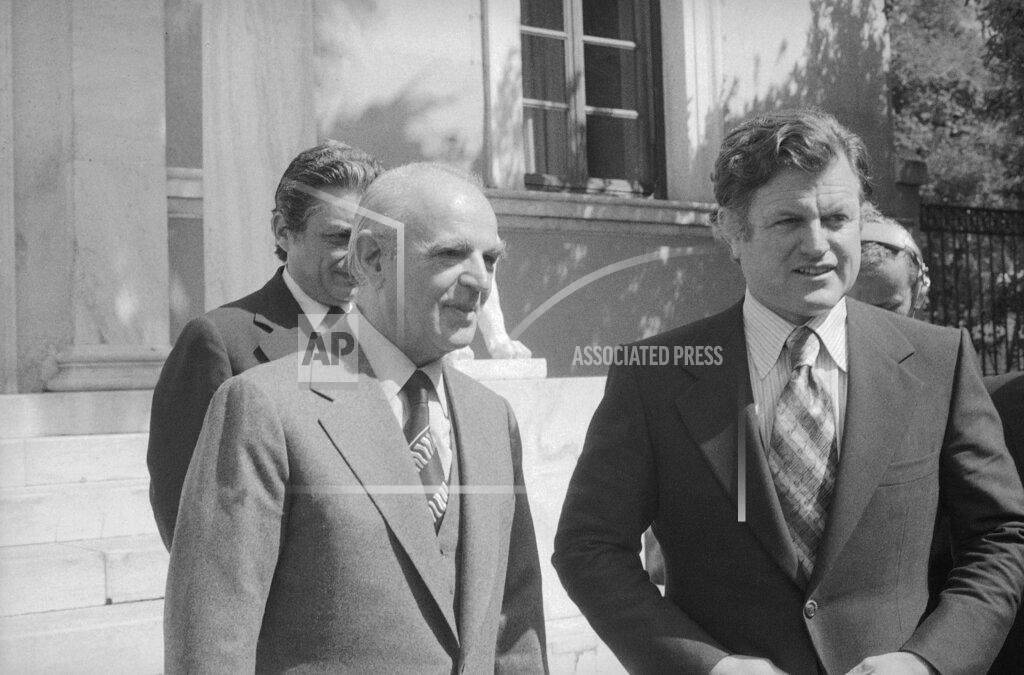
Jacqueline Kennedy Onassis flew to Paris within 24 hours of the burial of her husband, shipping magnate Aristotle Onassis, on his private island in the Ionian Sea. Before leaving Scorpios Island, Mrs. Onassis and Senator Edward M. Kennedy (D-Massachusetts) visited Onassis’ grave in a wing of the tiny island chapel of the Virgin Mary.. Then they boarded a private jet with her two children, 14-year-old John F. Kennedy Jr. and 17-year-old Caroline, and flew to Athens. After seeing Mrs. Onassis off for Paris, Kennedy flew to New York.
Nine Soviet artists announced that they would go ahead with a show of unorthodox works by painters from all over the Soviet Union and appealed to Culture Minister Ypotr Demichev to provide a hall. In an open letter to Demichev, the group warned that if the negotiations for an exhibition broke down, they would organize a permanent traveling show, including open-air displays at regular intervals.
The International Chess Federation rejected one of the changes demanded by Bobby Fischer in the rules of his scheduled title defense. At an extraordinary congress at Bergen Aan Zee, Holland, the federation rejected, 35 to 32, Fischer’s demand that he keep the title in the event of a 9–9 tie against Soviet challenger Anatoly Karpov. After the rejection, a U.S. Chess Federation official said Fischer will still refuse to play. The congress voted 37 to 33 to accept Fischer’s second demand to place no limit on the number of games in the championship match.
The Egyptian Government issued a declaration tonight reaffirming willingness to end the state of war with Israel within the framework of a final settlement of the Arab‐Israeli conflict in accordance with resolutions of the United Nations Security Council. Pending a final settlement, the Egyptian Government said, it is “evident” that Egypt and Israel will refrain from the use of force as long as a troop disengagement agreement is valid and there is progress “on all fronts” toward peace. The declaration appeared to be aimed at averting criticism from other Arab countries in the event Egypt signs a new disengagement accord with Israel.
The Israeli Cabinet met late into the night to decide how to respond to the Egyptian ideas for a Sinai agreement conveyed by Secretary of State Kissinger on Tuesday. Mr. Kissinger, who returns to Aswan today hopes that Israel will give him additional proposals that will move the sides closer together. He believes the talks are progressing too slowly and that a stalemate may develop. Newsmen waiting in the lobby of the King David Hotel were given a generally unenthusiastic report of Israel’s response to the Egyptian ideas. The Egyptian proposals were described as not going far enough to meet Israel’s conditions for withdrawing from the Singi mountain passes and the Abu Rudeis oilfield. Israel has insisted that Egypt must agree to measures that would change the current relations between Israel and Egypt and move them over a period of years to a more normal relationship.
A sense of almost fatalistic gloom seemed to pervade Secretary of State Kissinger’s party today. The cause might have been fatigue, the slow pace of Egyptian‐Israeli negotiations or the bad news from Washington. On the way from Israel to the Saudi royal capital, where Mr. Kissinger spent several hours with top Saudis including King Faisal, reporters aboard the plane were given an appraisal of the over‐all world situation that was the most pessimistic they had heard in some time. Some of the comments were clearly self‐serving and underlined Mr. Kissinger’s well-known concerns about Congress and the erosion of United States influence abroad. But reporters were inclined to take most of them seriously as at least reflecting what Mr. Kissinger and his closest aides were thinking.
The North Vietnamese decided to undertake their major attacks in the South because of sharp Congressional cuts in aid to Saigon, the reporters were told. Mr. Kissinger was said to have been impressed by a recent North Vietnamese article detailing this decision as well as by signs that recruits with only one month of training were being sent into the South. If Mr. Kissinger had known in 1972 and 1973 that Congress would cut aid to South Vietnam the way it has in the last year, the reporters were further told, he could not have in good faith negotiated the Paris cease‐fire accords the way he did. He assumed then that Saigon would receive sufficient military and economic aid to help defend itself and not be faced with shortages of ammunition, fuel and equipment. Cambodia’s imminent fall to insurgents has had an impact on the current Middle East negotiations, in the view of Mr. Kissinger. It has made the Israelis more cautious about accepting American or any other country’s assurances.
The Iraqi press agency said tonight that Iraq’s Revolutionary Command Council had rejected a Kurdish rebel offer to negotiate “an end to the bloodshed.” The offer was reportedly contained in a telegram sent by the political bureau of the Kurdish Democratic party, which has been leading an insurrection in an attempt to win autonomy for the Kurds living in northeastern Iraq. The message reportedly said that the Kurds would be prepared to send a delegation to Baghdad, Iraq’s capital, to negotiate. According to the Iraqi press agency, Ahmed Hassan al‐Bakr, chairman of the Revolutionary Command Council, and Saddam Hussein, the deputy chairman, had signed the reply rejecting the offer.
India’s prime minister, Indira Gandhi, charged with political campaign violations in 1971, was cross-examined in court about business activities of members of her family. Maintaining her innocence through nearly seven hours of testimony in Allahabad, her home city, India’s 57-year-old political leader said that her campaign for her seat in Parliament had been in accordance with the law. She also defended herself against accusations that the government had shown favoritism to her youngest son by granting him permission to manufacture cars in India.
Thailand’s second civilian government since World War II won a confidence vote after a 13-hour debate in the lower house of parliament. The house voted 140 to 124 in favor of Prime Minister Kukrit Pramojs cabinet, which plans seeking withdrawal of the 25,000 US. troops and 350 aircraft from the country within a year unless the Indochina war spills over into Thailand.
A new law forbidding Koreans to “damage the prestige” of President Park Chung Hee or his government in conversations with foreigners or statements to foreign correspondents was rammed through the NationalAssembly. Government party judiciary committee members approved the measure in a secret committee meeting, and 130 government-controlled legislators voted it into law behind locked doors of a lounge in the assembly building, according to news reports reaching Tokyo from Seoul.
The People’s Republic of China granted an amnesty for 290 Nationalist Chinese (Taiwan) whom they had convicted of “war crimes” against the Communist Chinese government. Scheduled for release were 219 military officers, 21 government officials and 50 secret agents.
Buenos Aires police found the charred, bullet-riddled bodies of four men in a burned pickup truck near a garbage dump favored by right-wing political assassins. Police said the truck was parked alongside Riachuleo Creek, the western borderline of the city, where police last week found an executed leftist suspect.
Suspicion mounted today that a Rhodesian nationalist leader assassinated here yesterday was killed by dissi dent members of his own organization. Herbert Chitepo, a leader of the Zimbabwe African National Union, died when an explosion blew up his car near his home. A bodyguard and a Zambian boy standing nearby also died in the blast believed caused by a mine. Officials of the Zimbabwe African National Union blamed the Rhodesian Government for Mr. Chitepo’s death, but sources close to Rhodesian Nationalist movements have hinted that he was killed by dissident elements in his own group.
[Ed: And, Who ultimately benefitted? A venal asshole named Robert Mugabe…]
President Ford has received the resignation of John H. Powell Jr. as chairman and as member of the Equal Employment Opportunity Commission, the White House announced. The President requested and received also the resignation of William A. Carey, the commission’s general counsel and a critic of Powell. Mr. Ford asked for both resignations “because of his increasing concern over management disputes” in the agency, White House Press Secretary Ron Nessen said. The President’s action was a move to reorganize a badly split commission that has been the object of public and congressional criticism.
The Commerce Department reported that a big increase in the net outflow of private long-term capital threw the nation’s basic balance of payments into a record deficit of $5.87 billion in the last quarter of 1974. For the year as a whole, large payments for imported oil and a rise in capital outflows produced a deficit of $10.58 billion, second only to the $11.2 billion deficit of 1972.
The Senate, after hours of what one Senator described as “fiddling and faddling and tarrying” on the tax bill today, approved amendments to the measure that would add about $1-billion annually to the Federal income taxes paid by oil companies and about $600-million to the taxes of other corporations with major-overseas operations.
A Federal grand jury late today charged six oil refiners with conspiring to fix wholesale gasoline prices in five Western states.
The Supreme Court unanimously struck down as unconstitutional the Social Security provision that authorizes survivors’ benefits for the widow of a deceased worker with children but denies them to a widower in the same position. It said this resulted in women workers who pay Social Security taxes providing less protection for their families than men. It was the Court’s strongest stand against discrimination based on sex.
The White House, the Pentagon and the Central Intelligence Agency refused any discussion of the attempted salvage of a Soviet submarine by the C.I.A. last year. There was no official reaction in Moscow. Two Senate committee chairman said they planned to investigate the project. Members of the Senate and House publicly disagreed on the intelligence value of the effort.
Former Senator Sam J. Ervin Jr. gave up retirement briefly today and came down from his beloved Blue Ridge Mountains to do battle on the Piedmont plain with an old enemy — the proposed Equal Rights Amendment. Florid, and with glasses perched on the end of his nose, the man who once was considered the leading Congressional expert on the Constitution inveighed for a solid, folksy hour against what he termed “this evil measure.” “You can pass all the constitutional amendments you want to,” he said with a final flourish of his arm, “but you cannot put equal responsibility on men for being mother to children.”
Leaders of the Socialist Workers Party said they had evidence that the FBI was continuing harassing tactics despite Director Clarence M. Kelley’s insistence that the operation had ended in April, 1971, Newly disclosed FBI documents show that FBI officials conspired “to try to drive a legal political party out of existence because they don’t like its ideas,” said Peter Camejo, the party’s 1976 presidential candidate. “Has it stopped? Absolutely not,” he added. The party already has filed a $27 million damage suit against the FBL The FBI refused comment on the latest charges
Earl M. (Duke) Crittenden, former Florida Republican Party chairman, pleaded guilty in Tampa to a misdemeanor conspiracy charge then took the stand to testify against former Senator Edward J. Gurney (R-Florida) and four co-defendants in their federal conspiracy-bribery trial. Crittenden, 44, testified about a system by which a fund raiser converted cash donations into checks in order to get the money into a Gurney boosters fund. Gurney and the others are accused of raising a $233,000 political slush fund by promising builders favored treatment from government housing agencies in return for contributions.
More than 1,000 demonstrators from Boston marched on the U.S. Capitol in a pouring rain to lobby for federal anti-busing legislation. “The rain represents to us the tears of our people,” Boston City Councilwoman Louise Day Hicks told a rally. None of the members of the Massachusetts congressional delegation attended the demonstration. At the same time, the Supreme Court was asked to review a lower court finding that the Boston School Committee operated a segregated school system, a ruling that resulted in court-ordered busing.
About 40 militant Indians, chanting to the beat of a tom-tom, marched out of a pork processing plant near Wagner, South Dakota, and ended a peaceful three-day occupation. There were no arrests. Armed members of the Eagle Warrior Society took over the Yankton Sioux Industries plant Monday and issued a list of demands, most of them dealing with labor issues at the Indian-owned but white-managed plant. The local head of the Bureau of Indian Affairs, Loren Farmer, said an agreement that included a 15% pay raise would be voted on April 5 by the general council of the 4,800-member tribe.
A 33-year-old prison guard testified here today that for nearly two years he had falsely accused an inmate of striking an officer who later died because he “wanted to further” himself and obtain a transfer from Attica to a prison closer to his home. Alton Tolbert, the witness, appeared embarrassed and meek as he told the court here that his original account of seeing an inmate that he recognized, strike Correction Officer William E. Quinn with a shovel was a complete fabrication. Mr. Tolbert, now a correction officer at Elmira, said that, in fact, he had not seen Mr. Quinn at all on the morning of September 9, 1971, when the Attica State Correctional Facility was first taken over by the inmates.
Elmer B. Staats, Controller General of the United States, urged Rogers C. B. Morton, Secretary of the Interior today to “define clearly” the Administration’s oil leasing goal on the Outer Continental Shelf and specify how that goal was to be met and relate it to a national energy plan.
Science learning in the nation’s schools has declined since Sputnik and man’s race to the moon, according to a nationwide educational study. The National Assessment of Educational Progress found that among 90,000 students aged 9, 13, and 17 the average science knowledge loss represented a half-year of learning. “This is a very poor time for such a decline because our society is becoming more technological and complex,” said J. Stanley Ahmann, the project director. The study showed the sharpest decline among big-city 17-year-olds, who dropped from just above the national average to 2% below.
The government has decided to propose a relief-vent system on all jumbo-jet airliners to protect them from explosive decompression when a large hole is punched in a pressurized fuselage. The change would cost an estimated $250,000 a plane. It would reduce the hazard of fuselage ruptures caused by disintegration of a jet engine, a mid-air collision or sabotage.
Silicosis from sandblasting has become a growing and deadly hazard for large numbers of industrial workers in the United States, medical investigators at Tulane University said today.
General of the Army Omar Bradley, the nation’s highest ranking military officer, has had a stroke, a military spokesman said today. The 82-year-old general was admitted to the U.C.L.A. Medical Center at 1:20 AM Monday after suffering the stroke at his home. His condition is serious but stable.
Buster Davis and Luther Henderson’s musical “Doctor Jazz” opens at the Winter Garden Theatre, NYC; runs for 5 performances.
Pennsylvania is the first state to allow girls to compete with boys in high school sports.
Dow Jones Industrial Average: 769.48 (-9.93, -1.27%)
Born:
Le Jingyi, Chinese swimmer (Olympics, gold medal, 100m freestyle, 1996; 3 silver medals, 1992, 1996) in Shanghai, China.
Antonio Daniels, NBA point guard and shooting guard (NBA Champions-Spurs, 1999; Vancouver Grizzlies, San Antonio Spurs, Portland Trailblazers, Seattle SuperSonics, Washington Wizards, New Orleans Hornets, Philadelphia 76ers), in Columbus, Ohio.
Brann Dailor, American heavy metal drummer (Mastodon), in Rochester, New York.
Vivian Hsu [Xu Ruoxuan], Taiwanese singer, actress and model, in Taichung, Taiwan.





 History Diaries