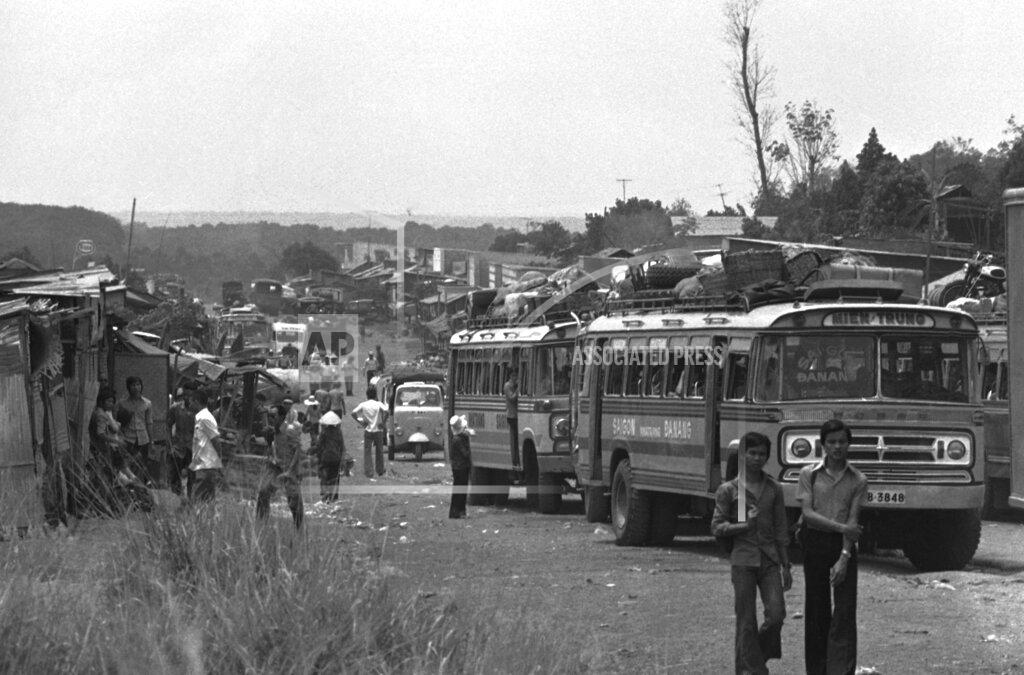
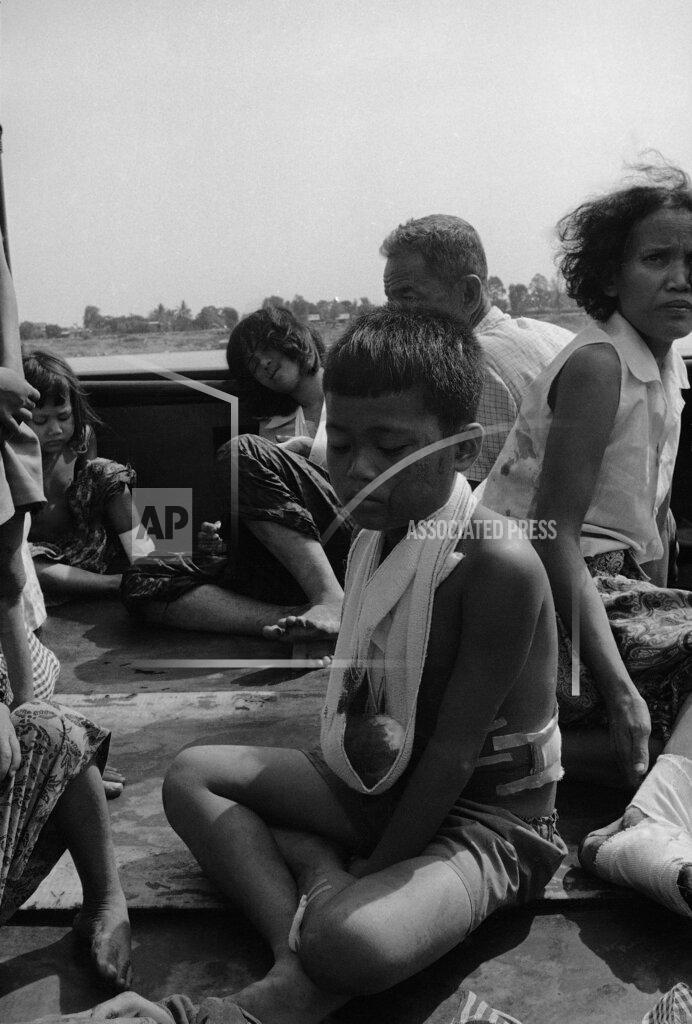
It was estimated that 100,000 persons were streaming down the one remaining road from South Vietnam’s Central Highlands to the safety of the seacoast. Behind them, Communist forces were poised to occupy the vast important area they had never before fully conquered. The exodus began with the fall of Buôn Ma Thuột but became a flood Sunday night after the Saigon government decided to evacuate its forces from the highlands. Its commanders were said to feel that this would give them a strategic reserve, ease supply problems and permit a credible defense of the heart of the country. But the psychological effect is incalculable. 100,000 people — farmers, businessmen, Montagnard tribesmen and soldiers — were strung out for 140 miles along the sole open road to the safety of the seacoast last night.
Last night, the Saigon Government spokesman, Lieutenant Colonel Lê Trung Hiền, repeated earlier denials that the government was abandoning the Central Highlands, but conceded that “for tactical reasons” some ground forces were withdrawing, and that all aircraft based at the large Pleiku base had been flown off. He also said that some government forces were still holding out in Buôn Ma Thuột. Reached by telephone, the North Vietnamese military spokesman, Major Nguyễn Phương Nam, asserted, however, that Buôn Ma Thuột had been completely under Communist control since last week. “You may be interested to know,” he said, “that on Sunday a meeting was held in the middle of the city at which Đặng Chung Thị, vice president of the Confederation of Workers of South Vietnam, addressed the workers of Buôn Ma Thuột. At another meeting, the new authorities had an opportunity to meet residents.” He added that he had no knowledge of the fate of nine American civilians stranded in Buôn Ma Thuột when it fell.
The picturesque city, of Kon Tum reportedly stood deserted, and only a few stragglers were said to remain in the city of Pleiku, where some 65,000 had lived. Along Route 7 extending southeast of Pleiku to Tuy Hòa on the South China Sea, moved a nearly continuous stream of people, animals and vehicles. Those who could get rides piled families and belongings into buses and trucks, many of which lay along the roadside after having broken down from the huge loads. Others rode on motorcycles, bicycles, ox carts or on foot.
Among the Vietnamese civilians and montagnard tribesmen, there were also military units, tanks and trucks dragging howitzers streaming toward the coast. A knowledgeable military source said that he knew of no ambushes, attacks or other Communist efforts to disrupt the refugee stream from the highlands thus far. “But you can be sure it’s coming,” he said. “It’s just a matter of time. The Communists don’t want to take over a completely depopulated region. They want to govern people, not wilderness.”
One of the witnesses to the flight of refugees has been a Vietnamese reporter, Nguyễn Tư, the only journalist known to be accompanying the refugees, and he is sending his dispatches to the Saigon newspaper Chính Luận. Mr. Tư wrote that when the first great column of trucks began moving out of Pleiku Sunday night, bumper to bumper with lights on, “it looked, like a column of traffic returning home for the weekend.” In the city behind, loud detonations announced the destruction of ammunition dumps by departing troops, and the sky glowed with the flames of buildings. There was shooting in town, too, Mr. Tư reported.
His report praised the leader of the military retreat, Brigadier General Pham Duy Tat, for the orderly way the armed forces were commanded. He said that ranger units and artillery were carefully deployed along the flanks of the road to assure passage for the travelers through the dense rain forests of gigantic trees, the rubber plantations and shrub. But Mr. Tư expressed bitterness that the civilian population was never informed or helped. “There was no explanation to the people so that they could withdraw in an orderly way, no help for the poor in getting any transport,” he wrote.
United States military sources in Washington believe that the North Vietnamese have entered the second phase of an offensive designed to cut South Vietnam in half. The North’s deepest penetration appears to be east of Buôn Ma Thuột, where South Vietnamese forces were reported to have fallen back to within 60 miles of the coast, apparently hoping to hold Route 1, the main north-south artery. The sources said a successful drive to the coast would not necessarily wreck Saigon’s plans to defend its northern provinces, since they have the ships and transport aircraft for supply and reinforcement there.
The South Vietnamese command has identified elements of 15 North Vietnamese divisions in the fighting, which Pentagon, sources said was now a conventional war in which guerrilla and local forces are playing little or no part. South Vietnamese forces recently engaged around the important highland city of Buôn Ma Thuột were reported to have fallen back to within 60 miles of the seacoast, apparently in an effort to hold Route 1, the main road to the north. By occupying the Central Highlands, the American sources said, the northern forces have apparently taken possession of Route 14, the inland highway north of the city of Pleiku where Route 19, an east‐west artery, crosses 14. The United States view, therefore, is that for the moment the North holds the strategically important commnnications over which it can launch a general drive to the coast.
This drive is likely to focus on three towns on Route 1—Ninh Hòa to the south, Tuy Hòa in the center and Qui Quy Nhơn just south of the junction of Routes 19 and 1. A successful northern drive to the coast would be a serious but not necessarily fatal blow to Saigon’s plans to conduct an active defense in its northern provinces, these sources said. They pointed out that the South Vietnamese now have sufficient transport aircraft and ships to resupply and reinforce their troops in those provinces.
The North’s switch from guerrilla to conventional warfare may be to the South’s advantage in the long run, the Pentagon sources said. The South Vietnamese Army was trained and equipped for mechanized mobile warfare by the United States, and the view of American officers who served with the southern forces is that they are more efficient in conventional warfare than the North and that this was demonstrated during the brief period of conventional warfare in 1972. The advantage to the South from a shift to more conventional warfare may be balanced, however, by the psychological impact upon the army and the Government of the loss of the Central Highlands. While there are efforts in Washington to discount the importance of the highlands, junior officers familiter with the country emphasize that the Vietnamese themselves accept the old belief that the power holding the highlands holds Vietnam.
President Ford, receiving unofficial reports that the South Vietnamese have retreated from three key provinces, says that he views the situation “with considerable concern,” the White House Press Secretary, Ron Nessen, said today. Mr. Nessed told reporters that the South Vietnamese suffered from a tack of guaranteed fuel and ammunition supplies. “This is one reason they have fallen back in some places,” he said, adding, “We don’t have an official confirmation that the South Vietnamese have withdrawn from those three provinces.” He said that the unofficial reports came from the United States Embassy in Saigon.
“We view the whole situation in South Vietnam with considerable concern,” Mr. Hessen said when asked about President Ford’s view. Mr. Hessen said the situation showed the need for Congress to approve the $300‐million in extra military aid that the President had asked for South Vietnam. Reporters asked Mr. Nessen if the White House meant to blame Congress it the aid was not authorized and the South Vietnamese suffered further defeats: “No one here has been assigning blame,” he replied.
Five years ago, in March, 1970, enthusiastic throngs of Cambodians, rallying behind their new anti-Communist, American‐backed Government, sacked and burned the North Vietnamese and Việt Cộng embassies — and the smoke and ashes filled the patriotic air. Today, with Phnom Penh largely encircled by the Communist‐led Cambodian insurgents, the United States Embassy is burning some of its files, in order to “thin itself down” to prepare for the possibility of evacuation—and the ashes drift slowly to the embassy yard. It is not surprising on this fifth anniversary of the overthrow of Prince Norodom Sihanouk and the beginning of this war, that there are contrasts between then and now. What is surprising is the starkness and grimness of the contrasts.
Five years ago, the loudest noise one heard in the soft Cambodian night was the shrieking of the locusts in the tamarind trees. Now mortars and artillery thump away through the hours of darkness, and the shock waves from bombs falling on nearby enemy positions rattle the windows of this fitfully sleeping capital. Phnom Penh was an uncrowded and untroubled city of flowering trees, temple bells, wide boulevards, floating river restaurants and gentle people who smiled a lot. The smiles are rarer today.
Now rockets fired from insurgent positions a few miles outside the city fall daily, leaving twisted bodies in the streets. Food is short. Fuel is too, so to conserve it, electric power is turned on only four hours every other night, leaving the nervous city in darkness the rest of the time. Barbed wire stretches down sidewalks, competing with the wretched cardboard and scrapwood lean‐tos of the swarming hundreds of thousands of refugees who have been driven from their homes in the countryside and now fill Phnom Penh to bursting. Paint peels dingily from buildings that used to be whitewashed every year.
Phnom Penh’s culture has peeled away too. The dulcet Malay strains of Cambodian music are never heard any more; they have been replaced by ear‐splitting rock music played by Filipino bands in sleazy Wild‐West bars, with names like Tropicana,” and “Foreigners Club,” that have opened to accommodate the influx of American Embassy personnel and civilian bush pilots. Phnom Penh’s ladies of the night, who used to speak polite French and had elegant mantantamount to mortal sin in this proud society. ners, have also been replaced—by rough bar girls and street girls who have learned to talk coarse G.I.‐style English.
On the same streets, soldiers on crutches and orphaned children with grimy stick‐thin bodies vie for space outside the better restaurants to beg a few pennies from emerging patrons. Before the war, begging was tantamount to sin the proud society. Prices have soared more than 1,000 per cent since the war began, which has put basic foods out of the reach of average people. Rice was fairly cheap in 1970, and even the very poor had enough to eat in this fecund, agricultural land. Now, rice is outragously expensive and five years of thinner and thinner diets have finally bent the population to a point where children by the scores are dying of malnutrition.
Cutting corners is often the only alternative to starvation. Orphaned beggar girls turn to prostitution. Sometimes married women of poor families do the same, discreetly, to feed their children. Some refugee women have offered their babies for sale to foreigners. In 1970, there were only about 600,000 people in Phnom Penh. Now there are more than two million. As the war has brought destruction to more and more of the countryside, it has driven waves of villagers into the capital. The sidewalks, alleys and gutters are where most of the newcomers must live. Not only the streets are crowded. The war‐wounded, civilian as well as military, long ago outnumbered the beds in hospitals here. So the wounded are put on the floors, in the corridors, even in small closets.
Perhaps the starkest contrast between then and now is in morale. In 1970, students, intellectuals, workers and peasants all rallied to the Lon Nol Government, enthusiastic about the overthrow of the autocratic, corrupt monarchy and the creation of a new “republic.” Volunteers flocked to the army, including young women who took their places alongside the men in the foxholes. They had no proper uniforms or transport, but they did not seem to mind. They went to war in Pepsi-Cola delivery trucks, wearing rubber sandals and carrying their food in mesh bags hooked onto a shirt button. They were full of spirit.
That spirit has evaporated. Government ineffectiveness, callousness and corruption have turned the populace sour and resentful. Some students and teachers have gone to the jungle to join the insurgents. People do not volunteer for the army any more; instead, they do everything possible to escape it. Those who can afford it buy draft exemption certificates with big bribes. Villagers and poor urban workers also try to avoid the draft, but they are often rounded up by military police and taken to training camps. In 1970 and 1971, students and others staged big demonstrations and marches in support of the Lon Nol government. The only demonstrations now are in protest against soaring prices and corruption, and these are quickly snuffed out by the military police.
Corruption is a key reason for the Government’s loss of public support. In the five years of war, Washington has announced a total of nearly $2‐billion in aid to Cambodia, most of it in military aid and very little for humanitarian refugee projects. That much of the aid money has been used improperly is evident from the condition of the troops in the field. Very few have a complete uniform or even a pair of boots. Most wear clothes that they bought themselves and have patched many times. They earn about $12 a month, which usually has to support a family of five.
Today’s anniversary of the birth of this Government was not marked by a single ceremony. “We supported this Government fully in 1970,” said a student leader at a recent meeting. “But we were fooled. These Government ministers care only about putting money in their own pockets. They don’t care who suffers from the terrible prices or who gets killed on the battlefields.”
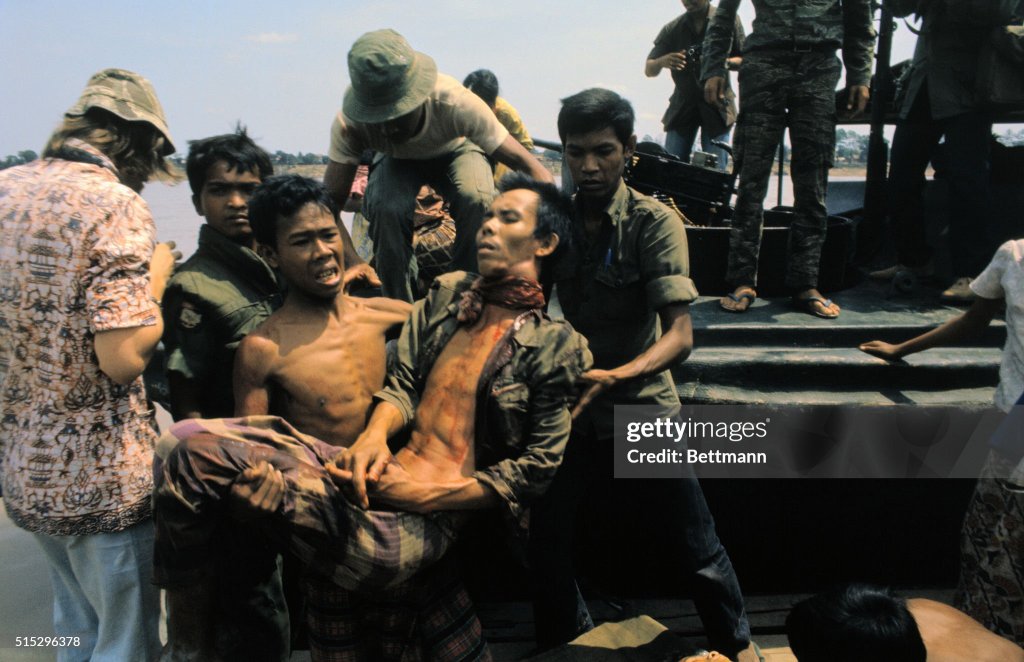
Hundreds of wounded soldiers and civilians have been waiting, many for weeks, to be evacuated from the besieged city of Neak Luong, the last government stronghold on the Mekong River. The scene, described by soldiers evacuated yesterday by two helicopters, was one of increasing hopelessness, unceasing shelling, near‐starvation and wounded men fighting for space on the helicopters. Some helicopter crewmen are afraid to land in Neak Luong for fear of being rushed by the wounded. Money bribes have no effect, but seats are occasionally won for 100‐pound bags of rice. Military officials said heavy shelling of Neak Luong continued today and the insurgents had begun burning houses on the west bank of the Mekong evacuated two days ago. In other military developments today, the insurgents fired 40 rockets into an island naval base in the Mekong River on the eastern limits of Phnom Penh. Military sources reported eight persons killed and at least 20 wounded. Pochentong airport was relatively quiet today. Fewer than a half dozen rockets fell on the area.
The former commander of the Cambodian Government’s armed forces arrived in Bangkok, Thailand today on the way to France and said his mission is over, for the moment. “I am waiting for new orders and a new mission,” the 51‐year‐old officer, General Sosthène Fernandez, added. The general, who was replaced last week following severe military, setbacks for the Government of President Lon Nol, told reporters that he planned to spend about a week here before traveling to France to be treated for diabetes. He was accompanied by his wife and seven young children. He vowed, however, to return to Cambodia. General Sosthene Fernandez said he had resigned command of the armed forces because “political problems” prevented him from carrying out his duties effectively. Speaking with apparent bitterness, he said that President Lon Nol had informed him that the National Assembly was not happy with the conduct of the war and so he had submitted his resignation.
Leonid I. Brezhnev renewed his commitment to détente with the West today as he delivered his first major speech since he re‐emerged from an unexplained period of seclusion. Speaking at the 11th Congress of the Hungarian Socialist Workers, or Communist, party, Mr. Brezhnev, the Soviet party leader, said: “The consolidation of détente and peace is a permanent, Ceaseless process, which demands constant progress. To stop on this road would jeopardize everything we have attained up to now.” This was Mr. Brezhnev’s first major public appearance since February 13, when he met Prime Minister Harold Wilson of Britain in Moscow after seven weeks of seclusion. Some Soviet officials reportedly explained that he had a cold, but there was speculation in the West that Mr. Brezhnev was battling with the Soviet leadership for the survival of his détente policy. The Soviet leader devoted about a fourth of his speech here to a new endorsement of that policy. Terming peace indivisible, he said: “That is why, simultaneously with the struggle for a lasting peace in Europe, we pay the most serious attention to the strengthening of relations between the Soviet Union and the United States of America, relations which are so important from the viewpoint of peaceful coexistence and are based on mutually advantageous cooperation.”
A group of Jewish activists asserted today that Soviet authorities were seeking to put an end to efforts of Moscow Jews to emigrate. The official approach was said to involve indictments on serious charges and scheduled trials of some activists; threats of indictment against others, and permission for selected activists to emigrate as another way of weakening the Jewish movement. Several Jews said at a news conference today that security police officers had told them in recent days that two detained Jews, Mark Nashpits and Boris Tsitlyonok, would soon be tried and found guilty, and that support for emigration efforts was fading in the West. The activists said the campaign against them began in the last few weeks and appeared designed not only to stifle them, but also to test international reaction to the situation.
Portugal’s military rulers banned the center-right Christian Democratic party and two militant extreme left-wing groups from participation in the elections scheduled for next month, accusing them of employing and stirring violence and of showing “disrespect” for the program of the armed forces. A major effect of the decision was to strengthen the hand of the Communist party against strong rivals on the left among workers, peasants and students. The banning of the Christian Democrats, a relatively new center‐right party with a large following in rural areas, left only one conservative group in the election. The elections are now scheduled for April 12, but the Ministry of Information indicated they may be postponed until April 25, the first anniversary of the 1974 coup that overthrew the authoritarian Government of Premier Marcello Caetano. The ministry cited “technical difficulties” for the possible delay. The swing to the left in the country, at least toward the orthodox left represented by the Communists and their allies, drew congratulations from the Soviet Union. It was announced that the Soviet Ambassador, Arnold Kalinin, handed a message to Premier Vasco dos Santos Gonçalves yesterday from the Soviet leadership expressing satisfaction and solidarity over last week’s “victory of democratic forces.”
The British government decided to recommend a vote to remain in the Common Market in a referendum next summer, but the cabinet was split on the issue. In a meeting preceding the announcement, seven of the 23 ministers called for withdrawal. Prime Minister Wilson said in the House of Commons he would allow the opposing ministers to speak out freely. Despite widespread predictions that a Cabinet majority would favor remaining in the Economic Community, or Common Market, Mr. Wilson’s appearance generated a sense of drama, with members crowding into the chamber to hear the announcement. “Her Majesty’s Government have decided to recommend to the British people to vote for staying in the Community.” Mr. Wilson said at the outset of a rambling speech that reviewed Britain’s efforts to win a relaxation in the terms of her membership. The decision was cheered by members of the Conservative party but was largely greeted in silence by Mr. Wilson” colleagues in the Labor party. The reaction reflected party divisions on the issue and the problems he has faced in trying to prevent his Government from breaking up over it.
Two Irish guerrilla sisters, Dolours and Marion Price, jailed for life for a terrorist bombing in London two years ago, were secretly moved from an English prison to Northern Ireland to serve their sentences, the British government announced. The surprise move met demands by the sisters and their guerrilla supporters, who had long sought their transfer to Northern Ireland. It came at a time when continued sectarian violence threatened a cease-fire called by the outlawed Irish Republican Army.
The Irish Government, embarrassed by a daring jailbreak attempt yesterday, is trying to discover how, for the second time, explosives were smuggled into the Portlaoise “maximum security” prison. The attempt by men or the Provisional I.R.A. to escape led to a battle between prisoners and troops last night in Which one prisoner was killed and two wounded. Outside the jail, members of the Provisionals, acting in support of the prisoners, clashed with security forces. The escape attempt began soon after nightfall when power lines in Portlaoise, 50 miles southwest of Dublin, were cut. This plunged the town and the jail into darkness, but the prison’s perimeter lights were kept on by emergency supply.
More Catholic priests in Madrid threatened to hang “no services” signs on their church doors to protest the banning of a church rally by the government. The rally last Saturday was to have considered resolutions relating the church to the lives of industrial workers. Priests in more than 20 parishes locked their doors Sunday.
After more than a week of public pronouncements and preliminary maneuvering that amounted to little more than diplomatic shadow‐boxing, Israel and Egypt have gotten down to hard bargaining in their search for a new Sinai agreement. Senior Israeli officials report that the talks, which have so far dealt largely in generalities, now are centering on specific issues, such as the wording of a mutual renunciation‐of‐force declaration and the precise arrangements, including demilitarization, that are to take effect in any area that Israel agrees to evacuate. Although Israelis say officially that serious differences remain, they are privately encouraged by the constructive tone of the talks. With each new shuttle by Secretary of State Kissinger between Cairo and Jerusalem, some progress is made, the officials say.
Secretary of State Kissinger said today that although the gap had narrowed between Israel and Egypt in the negotiations for a new Sinai accord, there were still “several substantial areas of disagreement.”
The National Assembly of Tunisia voted to proclaim Tunisian leader Habib Bourguiba as “President for Life.” A bill submitted by the ruling Destour Socialist Party recommending changes in the constitution to allow Bourguiba to be president until he dies was given an unopposed final approval in a full session of the assembly in Tunis. Bourguiba, 71, was appointed life president of the party — Tunisia’s only political organization — last year and he was reelected head of the republic in the last presidential election, in November, with 99.98% of the vote. Borguiba, who had become the North African republic’s first President in 1957, had been re-elected a fourth time in 1974 despite a provision in the Tunisian constitution that prohibited a president from being re-elected to more than three consecutive terms. Bourguiba, who would live to the age of 96, would be removed from office at the age of 83 in 1987 after increasing evidence of dementia.
The Kurds end their current fight against the Iraqi army.
Indian Prime Minister Indira Gandhi sat for nearly five hours today in the witness box of the High Court of Allahabad, her home town in Uttar Pradesh, defending herself against charges of having won her seat in Parliament by corrupt means.
Chinese leader Mao Tse-tung has ordered the granting of amnesty and release of “all war criminals” now in custody, the official Hsinhua news agency reported. It said 293 prisoners were affected — 219 officers of the armed forces, 21 party and government officials, 50 secret agents of “the Chiang Kai-shek clique, two war criminals of “the puppet Manchukuo (Manchuria)” and one war criminal “of the puppet inner-Mongolian autonomous government.”
Commenting publicly on Mexican insinuations that the US. Central Intelligence Agency was involved in the disorders at Mexico City’s National University during which President Luis Echeverria suffered a minor scalp wound, U.S. Ambassador Joseph John Jova said, “What I can state categorically is that, in the unfortunate events of last Friday, President Echeverria showed his dignity as a man, and as a Mexican, and demonstrated great courage, and I can assure you that no American agency has had the least connection, nor has any American agency inspired any act of that nature. Not at all!”
Secretary of State Henry A. Kissinger has sent a message to Premier Fidel Castro to try to improve relations between the United States and Cuba, according to the Lebanese newspaper Beirut. It said the message was sent through Syrian Foreign Minister Abdel Halim Khaddam, who left Damascus for Havana Sunday to attend a meeting of nonaligned nations.
Ethiopia’s ruling military council executed six men today after a military court had found them guilty of opposing Ethiopia’s popular movement and of acts of terrorism. News of the executions came this evening in an announcement by the official Ethiopian news agency. Today’s deaths bring to 63 the number of executions since the military assumed power last September. On November 23, 57 former government officials and military men were put to death on a number of charges. Ethiopia’s military rulers were strongly criticized around the world after the November executions. Ethiopian and foreign observers in Addis Ababa said today that the military council felt it was important to demonstrate to dissidents that they would be killed for opposing the Government.
Private schools were outlawed in the African nation of Equatorial Guinea by order of its dictator, President Francisco Macías Nguema. Macías had previously closed all libraries in the nation and prohibited use of the word “intellectual.”
Herbert Chitepo, the 51-year old leader of the Zimbabwe African National Union (ZANU), was assassinated by a bomb that had been wired to his car at his home in Lusaka, Zambia. Chitepo, his bodyguard Silas Shamiso, and a child who had been playing in a yard next door were killed by the blast. It was unclear whether the killing was done by forces of the white government in Rhodesia (now Zimbabwe), by a rival Zimbabwean organization, or by a rival within the ZANU group. Robert Mugabe would succeed Chitepo as the leader of ZANU and would become Zimbabwe’s first black African prime minister in 1980.
A congressional subcommittee voted overwhelmingly to reimpose the embargo on Rhodesian chrome imports and to make the United States comply with United Nations sanctions against the government of Prime Minister Ian Smith. The House foreign affairs subcommittee on international organizations also approved an amendment that would require imported steel products to carry a certificate stating that they do not contain Rhodesian chrome. The amendment was said to be designed to protect U.S. steel manufacturers from unfair competition by foreign producers who used Rhodesian chrome and to ensure that U.N. sanctions against the white minority government in Rhodesia were carried out. Congress lifted the embargo in 1971.
The Senate voted to keep the oil depletion allowance in effect for all but a small number of the biggest oil companies. Pro-oil forces were firmly in control as the Senate voted 47 to 41 to amend the House tax-cut bill that repealed the allowance. Lloyd Bentsen of Texas sponsored it.
The Central Intelligence Agency financed the construction of a multi-million-dollar deep-sea salvage vessel and used it in an unsuccessful effort to recover hydrogen-warhead missiles and codes from a sunken Soviet submarine in the Pacific Ocean, according to high government officials. The vessel, the Glomar Explorer, was built for the C.I.A. by Howard Hughes for Project Azorian. It recovered part of the submarine, but not the part containing the missiles or code room.
The Federal Bureau of Investigation’s internal record of harassment of the Socialist Workers party over a 10-year period was made public following a federal court order releasing 3,138 pages of documents to the party and its youth arm. The operation included efforts to have members dismissed from their jobs, the leaking of unsavory items about them to the press, and trying to start violence at demonstrations.
The Supreme Court in a 5 to 4 decision extended to theatrical productions the kind of protection against advance censorship and prohibition held by newspapers, books and motion pictures. It found that a Chattanooga municipal theater exercised an unconstitutional prior restraint of freedom of speech in banning “Hair.”
The Federal Energy Administration proposed today to increase gasoline prices twice as much as other petroleum products, under its demand-dampening fee program.
J. Walter Jones, longtime political confidant of former Vice President Spiro T. Agnew, has pleaded not guilty, along with the Singer Co. of New York and a Singer executive, to charges stemming from an alleged illegal corporate contribution to the Nixon-Agnew reelection campaign. Jones, named in a nine-count indictment by a Baltimore special federal grand jury, resigned as chairman of the Chesapeake National Bank shortly after he was charged March 6.
A Federal Reserve Board official denied to Congress that he had used government facilities to further the interests of an organization critical of the news media, as charged by columnist Jack Anderson. Reed J. Irvine, adviser in the international finance division of the Federal Reserve, which regulates the banking community, told a House banking and currency subcommittee that he had been cautioned by his superiors about some of his activities for Accuracy in Media when they concerned economics. Irvine described AIM as nonprofit, and “dedicated to correcting specific errors in the news media.” Anderson called it a propaganda outfit promoting right-wing causes.
The New York Telephone Co. was hit by its 10th suspicious fire in three weeks and the third blaze to break out at its New York City office building on E. 37th St. The blaze was confined to a locked record storage and training room on the 10th floor of the 23-story building. No one was injured and telephone service equipment was not damaged. A spokesman for the fire commissioner said. “Because of the previous fires and because of the nature of this fire, we’re labeling this one suspicious also.”
A juror who became ill near the end of the federal bribery-extortion trial in Oklahoma City of former Oklahoma Governor David Hall said she had felt pressured to vote for conviction while feeling the effects of a drug. Dell Meyer said in a television interview that she had taken a pain killer last Friday when she finally went along with the 11 other jurors and voted to convict Hall and Dallas financier W. W. (Doc) Taylor. Mrs. Meyer said also that she had been given a tranquilizer. Hall was accused of demanding a $50,000 bribe from Taylor and later offering to split the bribe with Secretary of State John Rogers.
The New York City League of Voluntary Hospitals made a new contract offer to 3,000 striking interns and resident doctors, seeking to end a two-day walkout over working hours. The terms, not disclosed, were expected to go before a meeting of 60 union delegates. The doctors-in-training at 22 private and municipal hospitals won backing earlier in the day from the powerful American Medical Association. “It is a strike for better patient care, AMA officers said. They called overly long hours “a threat to the quality of treatment the patient is getting.”
The city of Philadelphia received permission from the US. Environmental Protection Agency to discharge an average of 18 million gallons of raw sewage a day into the Delaware River for 30 days beginning June 1. This will permit the city to make repairs on a sewer main that collapsed in 1973. The sewage will be dumped downstream so as not to affect the quality of the city’s drinking water, which is pumped from upstream.
The bond required from conservationists seeking to halt expansion of San Francisco International Airport was reduced from $4.5 million to $1,000 by the 9th Circuit of Appeals in San Francisco. The court said the larger bond — to protect against city losses while the expansion project is debated — was “unreasonable” since the money would come from a private organization and citizens with limited resources. The high bond had been set February 4 after the U.S. District Court had granted an injunction to halt construction requested by Friends of the Earth. The injunction is currently under appeal.
Ants and primitive man used the sun more wisely than civilized society, according to a University of Washington professor. David MacGowan said ant hills and adobe huts in Africa are examples of efficient use of the sun. He told a legislative committee in Olympia, Washington, that proper construction and placement of buildings could cut fossil fuel costs by 50% to 80%. He suggested construction of heavy concrete walls with insulation on the outside of buildings, rather than inside.
Rep. William Cohen (R-Maine) appealed to major American auto firms to begin research on wood alcohol as a fuel in an effort to save energy and reduce fuel costs. In letters to firms, Cohen urged auto makers to follow the example of Sweden’s Volvo Co., which recently started experiments with wood alcohol, or methanol. Cohen estimated methanol could save more than a million barrels of crude oil a day if used in a 15% proportion with all petroleum consumed nationally.
A study of asbestos fibers in the Great Lakes expresses concern for human health but does not conclude that the fibers found in drinking water are harmful. The International Joint Commission, which conducted the study, recommended additional research into the effects of human consumption of water containing asbestos fibers. The fibers when inhaled are known to cause cancer and lung diseases that show up from 10 to 40 years after exposure. The commission said, however, “The effects of ingested asbestos have only recently come under study.”
Dow Jones Industrial Average: 779.41 (-7.12, -0.91%)
Born:
Brian Griese, NFL quarterback (Pro Bowl, 2000; Denver Broncos, Miami Dolphins, Tampa Bay Buccaneers, Chicago Bears); son of NFL quarterback Bob Griese; in Miami, Florida.
Kimmo Timonen, Finnish National Team and NHL defenseman (Olympics, silver medal, 2006; bronze medals, 1998, 2010, 2014; NHL Champions, Stanley Cup, 2015; NHL All-Star, 2004, 2007, 2008, 2012; Nashville Predators, Philadelphia Flyers, Chicago Blackhawks), in Kuopio, Finland.
Sutton Foster, American Tony Award-winning stage actress and singer (“Thoroughly Modern Millie”; “Anything Goes”; “The Music Man”), in Statesboro, Georgia.
Beverly Peele, American model (Mademoiselle, Elle), in Los Angeles, California.



*Doubt


 History Diaries