

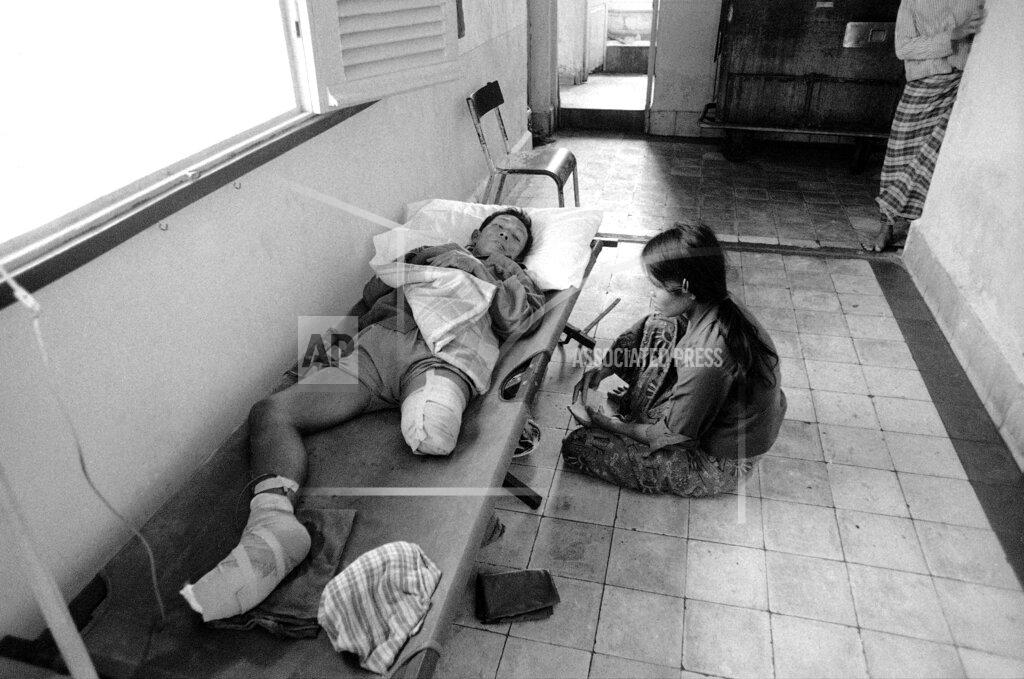
The Saigon government has decided to abandon most of the Central Highlands of South Vietnam because the region has become militarily indefensible, well-placed Western sources said. The decision, one of the most momentous of the Vietnam war, followed 14 days of sharp reverses. It was certain to have important political reverberations. The area to be abandoned was reported to include the pivotal border provinces of Đắk Lắk, Pleiku and Kon Tum. South Vietnam has 44 provinces but these three are among the largest. They were the cradle of American involvement in the war and cover most — but not all — of the high, mountain studded plains that are commonly regarded as making up the Central Highlands.
These provinces are divided along administrative lines, however, while the Saigon military command’s decision could be expected to follow lines of military defensibility, perhaps leaving parts of the three provinces still within its new line of defense and consigning parts of adjoining highlands provinces to the other side. The government might try to hold certain sections Of the highlands either as staging areas for further withdrawal or as staging points for future actions. One informant indicated that the government might even attempt to retake the city of Buôn Ma Thuột, giving itself an anchor in the southern highlands, but the sources doubted that such an attempt would be made. It could not be learned how swiftly the movement of government forces from the highlands — and particularly the important cities of Pleiku and Kon Tum—was unfolding. According to some accounts, government units were trekking down little used paths and provincial roads because the two main routes leading out of the region, 19 and 21, are cut.
“I think it can be said that the Vietnamese moved very quickly,” one Western analyst said this morning, “and that once the decision was made it was carried out with considerable speed.” The well‐placed Western sources said that, with the civilian populations alerted to the pullout, airports had become a difficult withdrawal route and that most of the troops — and civilians who wanted to leave — might have to fight their way out. The decision to abandon the area was reportedly made sometimes after Friday when President Nguyễn Văn Thiệu flew to the coastal city of Nha Trang to confer with Major General Phạm Văn Phú, commander of Military Region II, which includes a stretch of the central coast as well.
Starting late last week, after the North Vietnamese seized the important highlands town of Buôn Ma Thuột and began rocket attacks on the corps headquarters and airfield at Pleiku, General Phú quietly began moving his staff to Nha Trang. The western defenses of Pleiku itself were threatened with tank‐led attacks reported around the key district seat of Thành An. Reported to have weighed heavily in the decision to abandon the region were the vastness of the highlands, the enhanced North Vietnamese logistics and road systems, on which they have been feverishly working since the signing of the Paris peace agreements in January, 1973, and the increasing number of Communist troops in the area. Also, with Routes 19 and 21 cut since the Communists began their highlands offensive on March 4, the South Vietnamese Air Force, already restricted by cuts in American assistance, faced the prospect of a long, costly airlift to the embattled area, with little likelihood of its paying off in the long run.
On Saturday, according to one account, the National Security Council in Saigon ratified the decision that Mr. Thiệu and General Phú sketched out in Nha Trang. It could not be learned what kind of consensus Mr. Thiệu had built up for the move, which is expected to be a stunning blow to the morale of the nation. But there were no visible signs of dissent. Military analysts have long considered the withdrawal an eventual necessity. General Phú had only two regular infantry divisions, the 22d and 23d, to defend his vast corps command. The bulk of the 22d had been committed to the defense of Bình Định Province, which rises from the ricelands of the coast to the highlands. The 23d Division was believed to have been battered in the fight for Buôn Ma Thuột, which the North Vietnamese attacked early on March 10. In addition, the II Corps area had roughly the equivalent of a division, about 10,000 men, in rangers and perhaps another division of regional forces.
The exact strength of the North Vietnamese forces in the area is a matter of guesswork, though last month one reliable Western estimate put the total at 45,000. But since then there have been reports of heavy infiltrations of North Vietnamese into the area. The Saigon command charged last week that elements of the 316th Division, a famous one that fought at Điện Biên Phủ, had been seen in the highlands. In addition, the North Vietnamese 320th and 10th Divisions are believed to be operating in the Đắk Lắk‐Quảng Đức area of the southern highlands, the 968th around Pleiku and the 3d at Bình Định. The Communists also have regional forces and autonomous regiments — those not attached to a division — in the highlands.
Đắk Lắk, Kon Tum and Pleiku Provinces represent about 16 percent of South Vietnam’s land surface and their population of a half million compares with a nationwide population of 19.5 million. One Western military analyst said that the pullout decision was “not all black” in that it would permit the South Vietnamese forces to regroup in the more defensible coastal areas, where their lines of communication are shorter and those of their foes extended. A measure of the success of the regrouping operation, which is unparalleled in the recent history of the war, will be the number of troops and civilians who manage to walk, ride, fly or fight their way to the coast. One knowledgeable informant said that a possible escape route was the little used provincial route leading out of Phú Bổn Province to the town of Tuy Hòa on the coast.
It seemed possible that some military or civilian refugees might manage to move down Route 21 from Buôn Ma Thuột to Ninh Hòa on the coast. That highway is cut near the town of Khánh Dương, but Route 19 is cut in many places. Also, army engineers have been improving an old French colonial road descending from the Quảng Đức Province capital of Gia Nghĩa to Di Linh on Route 20. One of the last correspondents known to be in Pleiku, Nguyên Tử, who works for the respected daily Chính Luận, described the town on Sunday as a nightmarish place. He said people were running around the streets “as if they were caught in a trap,” clinging to their most precious possessions. He said every imaginable kind of vehicle was being used in efforts to get out of the city, but that there was no real exit.
In yesterday’s fighting, North Vietnamese tanks and troops mounted heavy assaults in remote, mountainous Quảng Đức Province and stepped up attacks around Saigon, the military command said. The regional thrusts, which the command called a nationwide Communist offensive, are now viewed with increased anxiety by Western military analysts. “It’s grim and it’s going to get grimmer, “ said one knowledgeable Western military source. “Every military region is in trouble now.”
In recent weeks, the South Vietnamese have lost a vital province capital, Buôn Ma Thuột, retained only a tenuous grip on the key city of Tây Ninh, 65 miles northwest of Saigon, shifted the II Corps headquarters to Nha Trang, lost a half dozen district capitals in the highlands and other areas and witnessed a series of increased attacks around Saigon.
The Saigon command’s spokesman, Lieutenant Colonel Lê Trung Hiền, said in response to a question on Monday that the, North Vietnamese attacks are “more serious” than the 1968 Tet offensive and the spring offensive of 1972. “The situation will be very critical if the enemy can cut the vital routes permanently,” he said.
Although most Western military analysts would disagree with the official South Vietnamese assessment, there is a feeling among them that the momentum of the attacks is increasing and that Saigon’s forces are hard‐pressed.
Perhaps the command’s most significant announcement was that North Vietnamese troops and tanks had mounted a series of assaults against the Kiến Đức district headquarters and at the Nhơn Ca airfield in Quảng Đức Province. The attacks, according to military sources, are aimed at Gia Nghĩa, the province capital. The district of Kiến Đức, 120 miles north‐east of Saigon, was the scene in December, 1973, of the first frontal assault by the Communists on a district capital since the cease‐fire agreement. The North Vietnamese seized the district capital, held it for several days and were finally repulsed by heavy South Vietnamese tank and fighter bomber attacks. At a press briefing this morning, Colonel Hien asserted that “there are movements of troops in the highlands but these movements of troops were made for tactical reasons.” He added that “no such withdrawal decision has been posed for the South Vietnamese forces in the highlands yet.”
The command reported heavy fighting at an important district town, Định Quán, 55 miles northwest of Saigon Colonel Hien said that the attack completed the cutting of all but one of the country’s principal roads leading out of the highlands to the coast. Định Quán lies on Route 20, which runs from the area north of Saigon to the hill resort of Đà Lạt. The command also reported heavy shelling and ground attacks around Bình Khê, a district town on Route 19 in the highlands.
South Vietnamese bombers struck across the Cambodian border today attempting to knock out North Vietnamese artillery and troops threatening the South Vietnamese provincial capital of Tây Ninh, reports from the field said.
The Vatican reported today that a Vietnamese Roman Catholic prelate had been killed and two bishops had been carried off by North Vietnamese troops. The Vatican newspaper L’Osservatore Romano said the Most Rev. Trịnh Chính Trực, the Vicar General of Buôn Ma Thuột in the Central Highlands of South Vietnam, had been killed in the siege of the city. The paper also said that the Bishop of Buôn Ma Thuột, the Most Rev. Nguyễn Huy Mai, and the Bishop elect, the Rev. Nguyễn Văn Hoá, as well as other Catholic priests “were carried away from the city” by its occupiers.
South Vietnamese President Nguyễn Văn Thiệu promised an investigation into the death of French reporter Paul Leandri of Agence FrancePresse, who was shot to death Friday outside Saigon’s security police headquarters. Thiệu expressed regret over the killing and told French Ambassador Jean-Marie Merillon that those responsible would be punished if they had committed a crime. A government spokesman called the killing an unfortunate accident that occurred when policemen were carrying out a security order.
The United States Embassy in Phnom Penh began evacuating international relief agency personnel as battlefront news continued to be discouraging. The Embassy insisted that it was only a temporary measure “until the situation clarifies a bit,” but Embassy personnel were packing and shipping household effects, and other countries were closing their embassies.
The move came on the eve of the fifth anniversary of the Cambodian Government’s coming to power; on March 18, 1970, Marshal Lon Nol and several colleagues deposed Prince Norodom Sihanouk. The Prince, now in exile in Peking, is the nominal head of the Cambodian insurgent government, whose Communist-led army has encircled Phnom Penh and is trying to bring down the Lon Nol regime
In the southeast, the crucial town of Neak Luong, the government’s last remaining major post on the Mekong River, is being choked by the rebels, who have advanced to the airstrip on the southern edge of town. Shelling of the town from all sides, including the opposite bank of the Mekong, has become so intense that not a single government helicopter could land today to take out wounded. About 30,000 civilians and perhaps 3,000 government soldiers are trapped there, and casualties are reported extremely heavy. “Bodies are all over the place,” said one military source. “There’s no way to get them out.” One report said that the insurgents had actually broken into the town, but this could not be confirmed.
Neak Luong, whose civilian population has been sliding toward starvation for two months now, is being kept alive by the dogged resistance of its military garrison and by daily American airdrops of ammunition. Some military observers in Phnom Penh feel Neak Luong could fall soon, though perhaps not on the Government’s anniversary tomorrow, as the insurgents might wish. However, there have been garrisons in similar straits in the Indochina war — such as An Lộc in the North Vietnamese offensive of 1972 in South Vietnam — that have managed to hold out.
If Neak Luong falls, it would be not only a severe psychological blow to the Phnom Penh Government, but also the virtual end of any government hope of ever reopening the Mekong to supply convoys. The river used to bring in 80 percent of Phnom Penh’s vital American supplies of food, fuel and ammunition. Since it was blockaded late in January by mines and heavy gun emplacements, the surrounded capital has been totally dependent on a big American airlift from South Vietnam and Thailand.
President Ford said that events in Southeast Asia tended to validate “the so-called domino theory” and that the continued existence of a non-Communist government in Cambodia was vital to American security. Answering questions at a news conference at Notre Dame University in South Bend, Ind., he said the military situation in Cambodia had become “very serious” and the North Vietnamese “have apparently launched a very substantial military effort against South Vietnam, against the Paris peace accord.”
The Senate Foreign Relations Committee approved today a measure that would provide $82.5‐million in additional military assistance to Cambodia but with the provision that the aid be terminated on June 30. The effect of the Senate committee’s action, by a vote of 9 to 7, was to give a temporary assist to the Administration in its efforts to obtain Congressional approval for additional military aid to Marshal Lon Nol’s Government. It remained doubtful, however, that the House and Senate would approve any more military assistance for Cambodia. The legislation adopted by the Senate committee today was similar to a proposal rejected last week by the House Foreign Affairs Committee after the proposal ran Into opposition, from the State Department. Through a transfer of existing funds, the Senate committee bill would permit the Administration to provide an additional $82.5‐million in military assistance to Cambodia in the final three months of this fiscal year, ending June 30, The Administration, which has been warning that the Lon Nol Government would fall without additional aid from the United States, had requested $222‐million in addition to the $275‐million in military assistance already approved by Congress.
A high international relief official who has worked with Cambodian refugees for more than a year under the American aid program spoke out yesterday against United States policy in the beleagured nation. “Military aid must be stopped now to end this senseless war,” she said. She is Dr. Gay Alexander, a Scot who is medical director for Catholic Relief Services, the biggest American‐funded relief group operating in Cambodia. She asked to have her views recorded in an interview because “one must do one’s best to try to stop this situation.” Dr. Alexander was evacuated today along with other relief officials as part of a reduction of relief agency personnel ordered by the United States Embassy.
This was the first time that any official working in a United States Government-financed program here had spoken for publication against American policy. Catholic Relief Services has the biggest program of all the humanitarian groups here — spending perhaps $10‐million a year to feed, shelter and provide medical care for hundreds of thousands of refugees. “They use and manipulate the ordinary people of this country,” Dr. Alexander said. “They hold back rice for the highest bidder, while hundreds are dying of malnutrition every day. Economic aid with no U.S. strings attached should continue, but military aid must be stopped now.” A number of relief officials and other foreigners in Phnom Penh, including Americans, have in private expressed opposition to American policy. No one with the status of Dr. Alexander, however, has made such a public declaration here in the five years of warfare.
The Senate Foreign Relations Committee voted 9 to 6 to recommend confirmation of John F. Lehman Jr., 32, to be deputy director of the Arms Control and Disarmament Agency. The vote overrode the objections of Senator Stuart Symington (D-Missouri), chairman of the subcommittee on arms control, and other senators who had cited what they said was Lehman’s hostile attitude toward Congress. The agency is responsible for U.S. negotiations in international arms control talks.
Secretary General Kurt Waldheim warned delegates to the U.N. Law of the Sea Conference, which resumed in Geneva, that failure to agree on an oceans convention would increase the danger of conflicts. The conference has been instructed by the General Assembly to decide how the oceans’ fish and mineral resources should be shared.
Britain’s Labour government has granted Alexander Shelepin, former head of the Kremlin’s secret police and now leader of the Soviet labor union movement, a visa to visit Britain in May to attend a world labor conference. Home Secretary Roy Jenkins told the House of Commons that refusing Shelepin a visa “would not be conducive to the public good.” Conservative British newspapers have conducted a campaign against Shelepin’s visit.
Workers at the state-run Westminster Hospital in London blockaded the section used by paying private patients, cutting them off from normal meals, cleaning and telephone service, but volunteers reached the 39 besieged patients with breakfast. Union workers imposed the blockade to protest plans to temporarily reduce the number of beds for patients. receiving free treatment under the National Health Service. The reduction in free care is planned to allow for structural alterations.
Hungarian Communists opened their 11th party congress in Budapest today to set medium and longrange goals for their once vaunted market‐oriented economy, which they concede has encountered problems. Janos Kadar, the party leader, said the problems had been caused by increased prices of energy and raw materials, which, he said, had cost Hungary “considerable losses.” Mr. Kadar turned toward the podium to express personal “sincere thanks” to the Soviet party leader, Leonid I. Brezhnev, for “understanding and readiness to help” in the solution of Hungary’s energy‐supply and raw‐material problems.
Secretary of State Kissinger brought the latest Israeli proposals to President Anwar el-Sadat tonight, as he sought to step up the pace of negotiations and prod both Egypt and Israel to make concessions necessary to produce a new Sinai agreement. Starting the third round of this diplomatic shuttle, Mr. Kissinger avoided making any predictions of success or failure in his mission, but he was clearly concerned about the slow progress recorded so far in a trip that has already taken him away from Washington for 13 days and may last a week or two more. After seven hours of detailed and reportedly tough talks last night and this morning in Jerusalem with the Israeli negotiating team, Mr. Kissinger flew to Aswan late this afternoon to see if Mr. Sadat would further modify his nation’s negotiating position, giving Mr. Kissinger something to take back to Israel tomorrow.
Iran and Iraq reached formal agreement in Tehran on settling their long-standing border dispute. The foreign ministers of both countries signed a protocol fixing the borders on the lines generally agreed on in Algiers earlier this month. Precise demarcation of disputed sections of the 500-mile frontier was left to three joint working committees, which were instructed to complete their work within two months.
Iraqi Kurdish rebels have reportedly appealed urgently to the United States that it urge Iran to give them more support. Meanwhile, Kurdish and Iranian relief administrations are said to be expecting a flood of perhaps as many as 200,000 Iraqi Kurds into Iran in the coming weeks in anticipation of heavy bombing and ground attacks by Iraqi forces in Iraqi Kurdistan. More than 140,000 are already housed in Iran. Both reports, made by sources sympathetic to the rebels, underscored the mounting anxiety among the Kurds with the approach of April, when the Iraqi Government has vowed to end the present ceasefire and try to crush them. The Kurdish leader, General Mustafa Barzani, is understood to have made one or two secret visits to Tehran in recent weeks and to have conferred there with the Shah of Iran, whose policy toward the Iraqi Kurdish rebels changed this month.
Thailand’s Premier Kukrit Pramoj said that his seven-party civilian coalition would seek the complete withdrawal of the 25,000 American troops and 350 aircraft from the country within a year. The statement, made after his coalition was confirmed by King Phumiphol Adulet, also said the government would seek to establish diplomatic relations with China and try to open talks with North Vietnam. The Pentagon had already indicated plans to cut United States strength in Thailand by about half during the coming year.
A strike by newsmen against South Korea’s largest and most powerful daily, Dong-A Ilbo, ended early today when the newspaper’s publisher had them evicted from newsroom and printing facilities they seized a week ago.
A Chinese official in Peking reportedly told a visiting Japanese over the weekend that Soviet ambitions were a danger to peace, but that China was not seeking a military alliance with Japan to counter them. Liao Cheng‐chin, president to the China‐Japan Friendship Association, was said to have told Masao Shimizu, head of a Japanese ballet troupe, that a Soviet quest for global hegemony was more dangerous than that of the United States and that the danger of war was increasing. But Mr. Liao, according to a dispatch today from Peking in Asahi Shimbun, a major daily newspaper, said charges that a proposed peace treaty between China and Japan would amount to a military alliance against the Soviet Union were an outrageous slander. Peking and Moscow are engaged in an intense struggle to win Japan as an ally against the other. The Chinese want a provision in the proposed treaty to say that both are against attempts by a third power to gain hegemony in Asia.
The Governor of Tokyo formally announced today that he would seek re-election, thus opening an election season that promises to be the most rousing in years.
The Mexican Government has accused the United States Central Intellience Agency of having bee behind the stoning of President Luis Echeverría Alvarez by a band of youths at National University last Friday. Several officials, among them the President himself, have made such charges, but they have offered no evidence. Asked about the charges today, the United States Ambassador, Joseph John Joya, said, “I can affirm categorically that there was no involvement of any agency of the United States Government in the regrettable incident involving President Echeverría at the National University.” After the incident, in which the president suffered a slight head wound, Mr. Echeverría said “Fascist youths manipulated by the C.I.A.” were to blame. Since then, several Cabinet ministers have also accused the C.I.A.
One Argentine guerrilla was killed and four were captured in a gun battle with police near Buenos Aires, police sources said. The two-hour battle erupted when police arrived to search a house in a western suburb. The sources said four more guerrillas, identified as members of the Marxist People’s Revolutionary Army, escaped.
The city of Lalibala, Ethiopia, noted for Coptic Christian churches carved out of solid rock, was reportedly captured Friday by an anti‐Government force and recaptured yesterday by an army battalion. Reports reaching Addis Ababa today from Ethiopian and foreign sources in the area said that the attackers, estimated to dumber 400 to 600, had no known connection with the secessionist Eritrean Liberation. Front. The anti‐Government force was said to have been led by an Ethiopian nobleman, BerhanMeskel Desta, a former district governor, member of Parliament and landowner with large holdings. There was speculation here that the attack on Lalibala had been staged to show opposition to the recently announced land reform decree.
Soviet weapons, including SAM-7 anti-aircraft missiles, have been supplied to Rhodesian guerrillas based in Mozambique, according to a South African newspaper. The Johannesburg Star, quoting Portuguese sources, said the guerrillas had received a large proportion of the arms landed at the port of Beira recently by a Russian freighter, the Akademick Shimansky.
President Ford, declaring that he condemned any involvement by the Central Intelligence Agency in alleged assassination plots against foreign leaders, said tonight that he was “personally analyzing” such charges. The President, speaking at a regional news conference on the campus of the University of Notre Dame at South Bend, Indiana, acknowledged that he discussed the matter last week with Vice President Rockefeller, who heads a Presidential commission investigating domestic activities of the C.I.A. White House sources disclosed over the weekend that the commission would investigate reports that the agency had been implicated in assassination plots against foreign leaders as an outgrowth of the commission’s domestic investigation. Mr. Ford said he had asked his staff to bring him information on all the charges of alleged assassination plots and added that he would determine “in the next few days” the best way for the executive branch to handle the matter appropriately. “This Administration does not condone under any circumstances any assassination attempts,” he said. When the question was raised again a few moments later, he said, “I condemn any C.I.A. involvement” in any “assassination planning.”
Secretary of the Treasury William E. Simon told Congress today that a “reasonable” estimate of the Government’s budget deficit was now “at least” $45-billion for the current fiscal year and $80-billion for the fiscal year 1976, a combined total of $37-billion more than estimated in President Ford’s budget only six weeks ago.
Upholding the federal government which had challenged the claim of 13 Atlantic states to seabed resources out as far as 100 miles offshore, the Supreme Court ruled unanimously that the government has exclusive rights to any oil and gas resources on the Atlantic Outer Continental Shelf beyond the three-mile limit. The ruling will clear the way for the Department of the Interior to proceed with its plans to exploit undiscovered oil and gas deposits in “frontier” areas off the Atlantic Coast, southern California and Alaska.
A comprehensive energy bill that would gradually add 37 cents a gallon to the federal gasoline tax by 1980, and provide cash rebates on the basis of using nine gallons a week was introduced by Representative Al Ullman, chairman of the House Ways and Means Committee. The refunds would be paid to all residents of the United States 18 years of age and older, whether motorists or not.
A federal investigation of nationwide bottled gas prices has turned up evidence that persons in rural communities were overcharged by $80 million in the winter of 1973 during the Arab oil embargo. The investigation is still going on and could uncover overcharges totaling $200 million or more, according to sources within the Federal Energy Administration,. which is conducting the investigation under the code name of Project Speculator. The FEA’s Office of Compliance and Enforcement says it already has forced rollbacks in propane prices amounting to almost $50 million.
Dr. Charles C. Edwards, who resigned in January as the nation’s chief health official, foresees a potentially disastrous tug of war soon between Congress and the Administration over national health insurance.
John D. Ehrlichman asked for a new trial in the White House “plumbers” case on grounds he had not. been permitted to claim national security as a defense and former President Richard M. Nixon had not testified. Ehrlichman said also that U.S. District Judge Gerhard A. Gesell “by gestures and facial expressions” might have created an impression of disbelief among the jurors. His attorneys filed the 80-page brief with the U.S. Circuit Court of Appeals for the District of Columbia. Ehrlichman was convicted in July of conspiring to violate the civil liberties of Pentagon Papers defendant Daniel Ellsberg and sentenced to 20 months to five years in prison.
The Watergate special prosecutor has for the first time won voluntary access to tape recordings made in the Nixon White House. Until now, the only tapes the special prosecutor had obtained were those demanded for trial purposes through suits and other court actions. But last Friday copies of two recordings were turned over to the special prosecutor’s office by former President Richard M. Nixon’s attorney, Herbert J. Miller Jr. “These are not for trial,” a special prosecutor’s spokesman said. “They’re for an ongoing criminal investigation, and they do indicate the beginning of us getting access to evidence we’ve been trying to get since August.”
The FBI mailed a fraudulent, and threatening letter to a black activist in 1969 in an effort to frighten him into leaving Mississippi, according to documents disclosed in Washington. The Rev. Muhammad Kenyatta, then known as Donald W. Jackson, now a community organizer in Philadelphia, left the area of Tougaloo College soon after receiving the letter, mailed in April by the Jackson FBI office and approved by FBI headquarters. The incident was part of an FBI counterintelligence program intended to disrupt “militant black nationalist-hate groups. The documents were turned. over to the American Civil Liberties Union in connection with a suit against the FBI.
Members of a group called the Eagle Warriors Society took over the Yankton Sioux Industries pork plant near Wagner, South Dakota. A spokesman for the society said, “We are protesting poor working conditions and lack of communications between the manager of the plant and the Indian people.” The spokesman said men, women and children were involved in the takeover and added, “We’re here to die.” The Sioux own 51% of the plant, which is under white management.
William Harris, a fugitive member of the self-styled Symbionese Liberation Army, has been identified by one witness as a visitor last June to the Upper West Side apartment of Jack Scott, the radical critic of the nation’s sports establishment who is being sought for questioning about the whereabouts of Patricia Hearst.
Members of St. Louis’ largest teachers union, the American Federation of Teachers, have rejected their leaders’ call for a strike at midnight. One teacher explained. “Now is not the time to strike. We should be electing a responsible school board and then consider a decision.” School Superintendent Clyde Miller expressed relief over the vote. He said it showed the teachers had the well-being of students in mind and recognized the district’s financial crisis.
A former Federal Housing Administration official testified today how he awarded $2,232million in contracts to Florida builders who agreed to contribute to a slush fund for then Senator Edward Gurney, Republican of Florida, and others.
As the prosecution in the Attica murder case today ended the presentation of its evidence, defense lawyers quarreled with the judge over the question of who is to pay for bringing their witnesses here from many Parts of the state.
Unable to get an emergency loan from the government, the Chicago, Rock Island & Pacific Railroad Company filed for reorganization under the Federal Bankruptcy Act and said it would cease operations after March 31.
The body of Aristotle Onassis, the Greek shipping magnate who died here Saturday of bronchial pneumonia, will be flown to Greece for burial tomorrow morning.
Television Electronic Disc (TeD), a form of videorecording, was introduced by West German electronic manufacturers Telefunken and Teldec.
Valeri Muratov skates a world record 1,000 meters (1:16.92).
Dow Jones Industrial Average: 786.53 (+13.06, +1.69%)
Born:
Justin Hawkins, British hard rock singer and guitarist (The Darkness – “I Believe in a Thing Called Love”), in Chertsey, Surrey, England, United Kingdom.
Natalie Zea, American actress (“Justified”), in Houston, Texas.
Paul Janus, NFL tackle (Carolina Panthers), in Edgerton, Wisconsin.






 History Diaries