

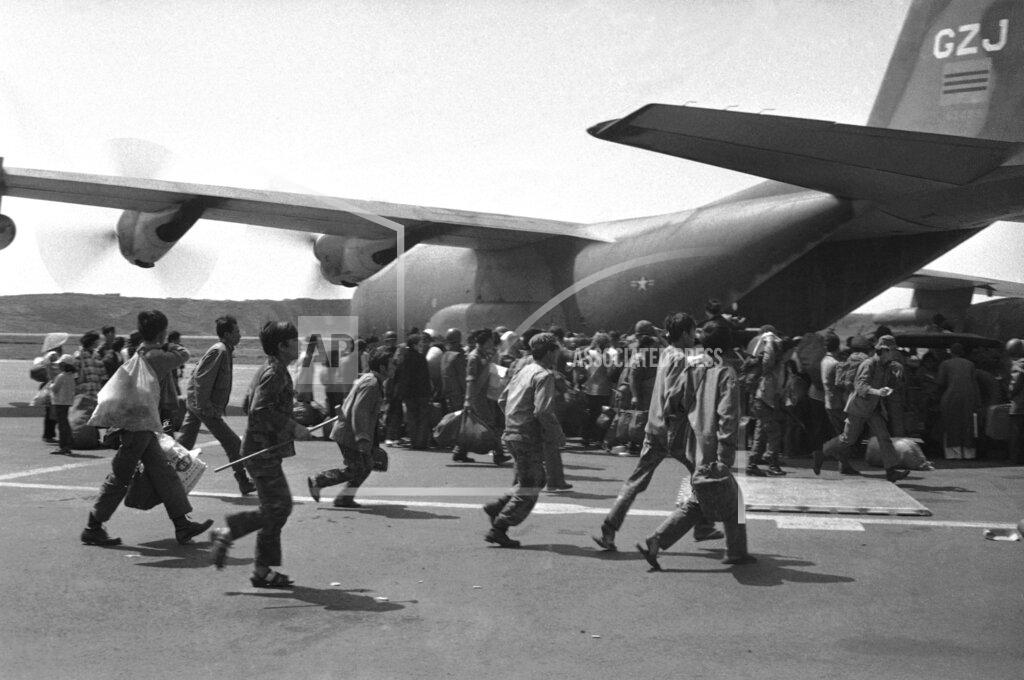

The withdrawal from Pleiku and Kon Tum begins, as thousands of civilians join the soldiers streaming down Route 7B. By 17 April, civilians and soldiers are both under heavy Communist attack; the withdrawal, scheduled to be completed in three days, is still underway on 1 April. Only 20,000 of 60,000 soldiers ever reach the coast; of 400,000 refugees, only 100,000 arrive: the fate of the rest is unknown.
Stepped‐up rocket attacks against the important airport at Pleiku, the cutting of two vital highways in the area and a build‐up of North Vietnamese forces were cited yesterday by knowledgeable Westerners in the transfer of a South Vietnamese corps headquarters from Pleiku to the coast. Reports in Saigon said that it was the first time that corps headquarters had been moved because of North Vietnamese military pressure. The headquarters of Military Region II — which controls the entire Central Highlands and sections of the central coast — were moved yesterday to Nha Trang, a city on the South China Sea 200 miles northeast of Saigon, a Western military specialist said.
Yesterday the Saigon command denied this. It said that only a “tactical command post” had been set up in Nha Trang — to meet the “tactical demands of the region.” But the Western sources left no doubt that the move had been made by the Region II command, under Major General Phạm Văn Phú. The shaky military situation around Pleiku was underscored this morning when the Saigon command disclosed that six rockets had been fired “into the vicinity” of the corps headquarters in the city and nearby Củ Hành Air Base. There were no casualties, a South Vietnamese spokesman said.
Because of the government’s deteriorating military situation in the Central Highlands, virtually all Americans in Pleiku and Kon Tum, the two key cities, were evacuated Saturday, an American Embassy spokesman said. These 27 Americans, mostly missionaries, were flown to Nha Trang “as a precautionary, temporary measure,” the spokesman said. The evacuees also included United States Embassy and AID employes. The fate of nine Americans in the highlands city of Buôn Ma Thuột remained unclear, the spokesman said. The city fell last week to the North Vietnamese, although the South Vietnamese insist that fighting is still taking place in the highlands provincial capital. Buôn Ma Thuột itself was reported quiet. The last radio contact with the nine trapped Americans — eight missionaries and one Embassy official — was on Wednesday. One Western source said that air photographs of the city indicated that the American compound had not been destroyed.
The capture of Buôn Ma Thuột, which straddles a vital highlands crossing, has left only two highlands cities of any consequence in government hands, Pleiku and Kon Tum. “Kon Tum and Pleiku will probably be the scene of heavy fighting,” said one Western source. The South Vietnamese military spokesman, Lieutenant Colonel Lê Trung Hiền, echoed this at a briefing yesterday. He said the government expected that “a decisive battle” would take place in the Central Highlands area. At least two regiments of South Vietnamese troops are said to be moving toward Buôn Ma Thuột down Route 21, which has been cut to the rear by the North Vietnamese and leads into the city. The South Vietnamese, who now control an airstrip four miles east of the city, are staging a helicopter shuttle near the city.
Within Buôn Ma Thuột, which has a substantial population of missionaries, tradesmen and European coffee planters, there are also believed to be one Indonesian and one Iranian delegate of the International Commission of Control and Supervision. Last year, the Polish and Hungarian missions withdrew from the Buôn Ma Thuột team site. As heavy fighting continued across South Vietnam, the government reported that 21 militiamen were killed and 17 wounded in a series of North Vietnamese attacks in northern Quảng Ngãi Province. Heavy fighting was also reported around the city of Tây Ninh, a province capital 60 miles north‐west of Saigon. This morning, the Saigon command said that intense fighting had flared west of the town of Gò Dầu Hạ, along Route 22 leading into Tây Ninh City. Gò Dầu Hạ is about 18 to 20 miles south of Tây Ninh, a capital and district of 250,000. Some sources speculated that the North Vietnamese were seeking to cut off Route 22 and that Gò Dầu Hạ was a key objective. The permanent cutoff of Route 22 would virtually strangle the city, force the South Vietnamese to mount a major airlift of food and supplies into Tây Ninh and divert substantial numbers of troops from towns around Saigon.
The South Vietnamese defenders of Pleiku fled only 15 days after the North Vietnamese invasion, with hundreds of thousands of troops and civilians evacuating so suddenly that North Vietnam’s General Văn Tiến Dũng was surprised at the result of what had been intended as a limited series of attacks. General Dung would recount later in a report to the Communist Party that his thought at the time was “Why such a retreat? And who had given the orders for it?” and notes that the original plan had been to foment an uprising in South Vietnam in 1976. The fall of Pleiku was followed by the retreat of South Vietnamese troops and civilians in provinces further south, and North Vietnamese and Việt Cộng troops toppled the government in Saigon within six weeks, on April 30.
The widow of a French correspondent who was shot dead by the Saigon police has lodged a complaint of premeditated murder, informed sources said today. A written statement containing the charge was handed to a Saigon police officer today, the sources said. Reliable reports raised new questions about the official police account of the death of Paul Leandri, a 37‐year‐old correspondent for Agence France‐Presse, at the national police headquarters here Friday night. Mr. Leandri told French officials shortly before he was killed that he was being held prisoner by the police, reliable sources said. He said this by telephone to a high French Embassy representative and in person to a consular official who visited him at an immigration center where he was being questioned about a dispatch he had written, the sources said. The Saigon police have said officially that he was killed accidentally by a policeman aiming at his car’s tires as he tried to leave the national police headquarters after becoming angry and offensive.
The Cambodian government troops who were reported yesterday to have seized the key town of Tuol Leap were apparently surrounded today and perhaps cut off in the town by the same troops they had driven off. Correspondents seeking to enter the town, less than five miles from Pochentong Airport, were told by Cambodian military officers that the road had been cut and that the soldiers in the village were under heavy artillery bombardment. Meanwhile, government military sources disclosed that Cambodian troops had abandoned positions on the west bank of the Mekong River across from Neak Luong, giving the insurgents better positions for their artillery attacks on that city. Neak Luong is the government’s last major stronghold on the river between Phnom Penh and the South Vietnamese border.
But the greatest concern of military officials today was the area around Tuol Leap that insurgent gunners have been using for weeks as a base for rocket and more recently artillery attacks on Pochentong Airport — the capital’s last supply link with the outside world. Today the fighting in the area of Tuol Leap apparently relieved the pressure on the airport, the landing point for an American‐financed airlift of food, fuel and ammunition. Only two rockets hit the airport during the morning and fewer than 10 all day. At Tuol Leap itself, however, the situation appeared more serious. At the Third Division command headquarters on Route 4, less than two miles from the town, soldiers described the previous day’s action. “There was no one there,” said Colonel Sun Than. “We just walked in. They had all gone.”
It appeared to be a familiar tactic of the Communists. Their outnumbered troops, faced with heavy artillery and armored strength together with rocket attacks from government gunships and pressure from Cambodian Air Force T‐28 planes, simply melted into the brush around the village — an area that the rebels have controlled for weeks. The Government forces entering the area found no resistance, and the inhabitants had long ago fled to refugee camps farther south on Route 4, joining the more than one million such refugees of the battles around the capital. But this morning the situation had apparently changed drastically. “I would not go there,” Colonel Sun Than said. They are taking heavy artillery fire.” Other officers said that there had been substantial government casualties in the town. The intensity of the insurgents’ artillery attacks was indicated by the fact that the division’s helicopters remained in their rear staging area rather than attempting to evacuate wounded from the battle area. This afternoon correspondents seeking to drive into Tuol Leap were told that insurgent forces had cut the road — actually a dirt track — leading into the town. It was not known how many government soldiers were still there.
Whatever the situation in Tuol Leap, it seemed clear that at least for the present there would be no attempt by government troops to move toward the main Communist rocket positions that are dug securely into stands of bamboo lining the Khsach River northeast of the town. As long as the insurgents hold these positions, the airport will continue to be threatened by rocket attacks, whict on several occasions have forced suspension of the emergency airlift. There have been reports in Cambodian newspapers that as a partial hedge against any permanent interruption in future, several alternate landing sites for supply planes have been selected within the capital. These sites however, would accommodate only small DC‐3 aircraft with far less cargo capacity than the big DC‐8 planes now flying into Pochentong Airport. At least one pilot is reported to have spoken of a paving operation in an area in southern Phnom Penh as a possible prelude for such flights. Presumabily it could be used for evacuation planes as well.
The evacuation of the French Embassy staff and other French nationals in Phnom Penh, which was to have begun today, was postponed until tomorrow, embassy officials said, because of a delay in the arrival of the French Air Force transport plane that will take the evacuees to Bangkok. Only a French consul and a cultural attaché will remain. The evacuation of the west bank of the Mekong River opposite Neak Luong occurred late yesterday aftenoon but was not disclosed until this morning. The main part of the town is situated on the east bank, about 38 miles southwest of here, but since the siege of the town began nearly two months ago, Government forces had managed to keep at least a toehold on the west bank to prevent Communist gunners from training their artillery directly on the towns’ center from across the river. However, persons who visited Neak Luong late last week reported that the insurgents had been firing 105‐mm howitzers almost point blank into the town from the opposite bank above and below the positions that the government troops now have abandoned.
The United States has proposed a draft treaty to the Soviet Union to encompass an agreement reached last November at Vladivostok to limit offensive missiles and bombers. Reporters aboard Secretary of State Kissinger’s Air Force jet were told today while flying here from Jordan that the proposed language was presented to Soviet negotiators in Geneva about 10 days ago or so. The National Security Council was said to have discussed the proposed treaty on March 5, shortly before Mr. Kissinger left for the Middle East. The American document was believed a formal response to an initial Soviet draft treaty presented to the United States at the end of January when the strategic arms limitation talks resumed in Geneva.
The new Senate Foreign Relations Subcommittee on foreign assistance and economic policy, headed by Senator Hubert H. Humphrey (D-Minnesota) plans a study into U.S. arms sales to foreign countries. “Arms sales, for good or evil, have become a major tool of American foreign policy,” Humphrey said in announcing the inquiry.
Senator Charles H. Percy (R-Illinois) proposed that the Senate Foreign Relations Committee undertake a review of U.S. participation in the United Nations. Hearings, he said, would provide a forum for critics and produce suggestions for improvements in U.N. machinery.
The international diplomatic conference on the updating of the Geneva war conventions has agreed in committee to extend protection to all journalists officially recognized as being engaged in dangerous missions, conference sources said. Such journalists would have to carry a special identity card, the details of which have been unanimously adopted by the ad hoc committee, they added.
The United Nations Conference on the Law of the Seas resumes tomorrow in Geneva, with American negotiators hopeful of agreeing on a draft treaty.
The Portuguese Cabinet was understood today to have resigned in preparation for the formation of a Cabinet that would reflect the country’s sharp move leftward since an abortive coup Tuesday. The new ministers are to be announced in the next day or so. At present the resignations are being formally denied and are expected to be denied until the new cabinet list is ready. Added weight is expected to be given in the new cabinet to the Communist party and its allies, with a possible downgrading of the moderate parties. Keeping up his offensive against the Center and Right, the Communist party secretary general, Alvaro Cunhal, suggested today at a party rally that the Popular Democratic party, the major centrist group in the country, might have been implicated in the military plot that was smashed Tuesday, precipitating the turn toward the left.
A young woman police reservist was killed by a terrorist bomb in Belfast as violence continued to threaten the 35-day-old cease-fire by the Irish Republican Army. The woman, 24 and the mother of two children, was the first policewoman killed in 512 years of sectarian violence in the British province. The blast followed a weekend of shootings that killed three men and injured three others.
Jacqueline Kennedy Onassis today visited the chapel of the American Hospital in Paris, where the body of her husband Aristotle Onassis lay, as preparations were made for burial on his private Greek Island of Skorpios.
Demonstrators overturned cars and clashed with opponents as three southern districts in the Jura Mountains north of Bern voted to stay out of Switzerland’s first new canton since 1815. The districts — Neuveville, Courtelay and Moutier — decided by a large majority to remain part of the Bern canton, which has a mainly German-speaking Protestant majority compared with the largely French-speaking Catholic minority in the Jura area.
The two sons of Benjamin G. Levich, the highest ranking Soviet Jewish scientist to apply to emigrate to Israel, said they had received permission to leave the Soviet Union after a three-year battle. Yevgeny Levich and his brother Alex said they were called to the visa office in Moscow and told they and their wives must leave by April 1. But they said there was no word about their father, a corresponding member of the Academy of Sciences and an internationally known electrochemist.
The Soviet challenger for the world chess championship, Anatoly Karpov, said he would refuse to play title-holder Bobby Fischer if the International Chess Federation accepted the American’s terms. Fischer is demanding that rules for the championship match June 1 in Manila be changed to be timeless instead of the present 36-game limit and that the challenger should have to win by at least a 10-8 margin. The federation will meet in Holland starting today to consider Fischer’s demands.
Talks between Israeli leaders and Secretary of State Kissinger resumed in Jerusalem after the cabinet had empowered the Israeli negotiating team to continue efforts to reach a new Sinai agreement with Egypt. During a four‐hour session this morning, the Cabinet members heard a detailed report on the negotiations from Premier Yitzhak Rabin and his two colleagues on the negotiating team, Foreign Minister Yigal Allon and Defense Minister Shimon Peres. Although the Cabinet ministers were said to be “less than happy” with the reportedly meager concessions offered by Egypt so far, the Cabinet issued a communiqué announcing that it had authorized the Israeli team to continue negotiations “on the basis of decisions taken by the Cabinet.”
Egyptian officials said that they expected a new Israeli withdrawal in Sinai to be carried out over a period of three to six months if Secretary of State Kissinger was successful in bringing about a new agreement. The time is to be fixed in such an agreement and is understood to have been discussed by Mr. Kissinger with both Israelis and Egyptians. Last year, Israel’s withdrawal from a salient on the west bank of the. Suez Canal and from territory east of the waterway took 45 days. This was under the terms of the January, 1974, disengagement accord. The Egyptians, in the same time, removed all but 7,000 men, 30 tanks and 36 pieces of heavy artillery from the strips of land seized east of the canal in the war of October, 1973.
More than 100 intellectuals and artists from 19 countries have demanded that the U.N. Educational, Scientific and Cultural Organization cancel its Arab-sponsored “politically motivated” resolutions against Israel. At a conference in Paris last week, the delegates signed a resolution stating that only an end to the “discriminatory measures” could lead to a reconciliation between UNESCO and the community of intellectuals. Among those signing were pianist Artur Rubinstein, writers James Michener and Elie Wiesel, violinist Isaac Stern and actress Shelley Winters.
The freezing wind whipped at Aisha Mohammed Amin’s cotton clothes as she squatted by the highway beside her belongings and her shivering children. “We have no food, no bread,” she said to a traveler. “We left our village before the killing, and now we will die of the cold.” Thousands of desperate Kurdish women and children are fleeing through the Iraqi village of Haj Omran to the Iranian border three miles away in hopes of escaping the bloodshed caused by the Iraqi offensive against the Kurdish rebel enclave in northeastern Iraq. Their flight despite hunger and cold is a measure of the bitterness of this newest chapter in a small but strategically important. Middle‐East war. A four‐day‐old cease‐fire has silenced the guns temporarily, but Iraq has announced an allout offensive next month. And Kurdish rebels and civilians here are preparing for the worst now that their situation has changed in important ways. A reduction in support to the rebels by their main ally, Iran, has curtailed their supplies of arms and food, Iraqi Kurds reported here today, although Iran is still caring for Iraqi refugees and wounded.
As it was approaching San Carlos de Bariloche on a flight from El Palomar, an Argentine Air Force airplane crashed into the side of a mountain in the Andes, killing all 47 passengers and five crew.
House Republican leader John J. Rhodes of Arizona predicted that the Senate’s proposal for a nearly $30 billion income tax cut would delay enactment of tax relief and would be rejected by President Ford. “I would hope there would be some sort of quick compromise,” Rhodes said, “(but) I can’t believe that if the Senate really brings out a bill with a $29.3 billion tax cut that there can be a quick compromise.” The bill provides for rebates on income taxes paid in 1974 and reductions on 1975 individual and corporate taxes, “The House position is much too far from that,” Rhodes said on CBS’ Face the Nation.
President Ford played golf at Burning Tree Country Club with Treasury Secretary William E. Simon and House Republican leader John J. Rhodes of Arizona. Earlier, he attended church while Mrs. Ford, who has been troubled by a recurrence of osteoarthritis, an ailment affecting her back and neck, stayed at the White House. Mr. Ford flies today to South Bend, Ind., where he will receive an honorary degree from the University of Notre Dame, address a university convocation, have lunch with Midwestern media executives, hold a news conference and meet with governors of seven states.
A group of documents newly released by the Federal Bureau of Investigation show that the agency sent a spurious threatening letter to a black Baptist minister to compel him to cease his civil rights work in Mississippi and return to the North. The documents, which reflect part of the FBI’s controversial cointelpro operation, directed at “black nationalist” groups, were made public by the bureau in response to a lawsuit brought by the minister, Donald W. Jackson, who is now known as Muhammad Kenyatta.
Unionized interns and resident doctors, pessimistic over negotiations on a new two-year contract, prepared to strike today at 23 municipal and voluntary hospitals in New York City. Dr. Richard Knutson, president of the Committee of Interns and Residents, said doctors wanted a shorter work day and elimination of assignments where they must do the work of the nurses and orderlies. All other issues have been settled. A representative of the hospitals said the doctors involved were there for graduate education so “the main effect of the strike is the interruption of their own training.”
The Navy’s ability “to conduct effective sustained antisubmarine warfare has been impaired” because of shortages of personnel and equipment, according to the General Accounting Office. A Navy spokesman answered that the GAO report was accurate when it reviewed the situation during 1973 but “the situation has improved” since then. He said more men had been sent to antisubmarine warfare schools. GAO, Congress’ auditing agency, said also that the Navy’s antisubmarine program had suffered from “large numbers of nonoperationally ready aircraft.” The Navy spokesmen said that this prob lem, too, had been nearly eliminated.
Many states are retrenching as federal outlays rise. Squeezed between recession-shrunk revenues and prices swollen by inflation, many of the states must either cut back services and state employment or raise taxes. Some states are finding they must do both.
An extensive statement of agreed-upon beliefs, the first document of its kind written jointly by Roman Catholics and Protestants since the 16th-century Reformation, will be available in the United States this spring. It is called “The Common Catechism: A Book of Christian Faith,” and is regarded as a landmark in ecumenical theology. A German version has circulated widely in Europe for the last two years. It is being published in English for the first time by the Seabury Press of the Episcopal Church.
The Environmental Protection Agency has proposed the first federal quality standards for drinking water. The agency was acting under the Safe Drinking Water Act signed by President Ford in December. The proposed standards set maximum permissible levels for a number of contaminants and requirements for monitoring most of the country’s 240,000 public water supplies. The standards do not deal with some more controversial contaminants such as radiation exposure and cancer-causing agents from pesticides and other chemicals. EPA Administrator Russell E. Train said the regulation would be adjusted in these areas as more information becomes available from research. The EPA will hold public hearings on the standards in various U. S. cities in mid-April. Interim standards will take effect in June and permanent standards will be effective December, 1976.
There has been more drilling for oil since the energy shortage, but a Ford administration energy official said domestic production of oil and natural gas decreased last year. Eric Zausner, acting deputy administrator of the Federal Energy Administration, said the production from new wells wasn’t enough to compensate for the decline in yields from old wells. Speaking to a House Commerce subcommittee, Zausner said production trends are hard to predict because production is based on the world price level. If foreign oil prices continue as they are, he said, U.S. production could increase by four million to five million barrels a day, but if prices drop to pre-embargo levels, domestic production could drop by three million barrels a day.”
A hastily called special session of the Alabama Legislature will convene Tuesday to consider sweeping changes in electric power rate regulation that would, according to the Alabama Power Company, “bankrupt” it if put into effect.
The Mariner 10 satellite made the closest approach by an Earth launched vehicle, to that time, to the planet Mercury, orbiting at a distance of 203 miles (307 km) and returning clear photographs of the first planet’s surface. The probe, the most productive interplanetary exploration ever accomplished, made its third pass at Mercury. “Everything worked great,” said a project spokesman at the Jet Propulsion Laboratory. “We’ve seen some of the pictures. They’re magnificent. They’re really detailed pictures of the surface. Mercury looks like the moon, although it’s somewhat different. The pictures show cratering, wells, rocks and ridges on the surface. They are very sharp.”
Vincent Sheean, the American journalist whose reflective, personal style influenced a generation of newspaper reporters, died at his home in Arolo, Italy. He was 75 years old, and was born in Pana, Illinois. He underwent treatment for lung cancer in New York last fall.
Musical rock opera “The Lieutenant” closes at the Lyceum Theater, NYC, after 9 performances.
In the U.S., the first indoor soccer championship of the North American Soccer League (NASL) was watched by 8,618 people at the Cow Palace indoor arena near Daly City, California. The San Jose Earthquakes defeated the new Tampa Bay Rowdies, 8 to 5, at the end of a two-month series of games involving 16 of the 20 NASL teams.
Born:
Sienna Guillory, English actress (Jill Valentine-“Resident Evil”), in Kettering, England, United Kingdom.
Tara Buck, American film, stage, and television actress (“True Blood”), in Hailey, Idaho.
Jamie Rivers, Canadian NHL defenseman (St. Louis Blues, New York Islanders, Ottawa Senators, Boston Bruins, Florida Panthers, Detroit Red Wings, Phoenix Coyotes), in Ottawa, Ontario, Canada.
Died:
T-Bone Walker, 64, American blues guitarist (“Funky Town”; “Well Done”), dies of bronchial pneumonia.
Perle Mesta, 83, American hostess and former ambassador to Luxembourg, as well as the inspiration for the Broadway musical Call Me Madam.
Vincent Sheean, 75, American journalist.



 History Diaries