
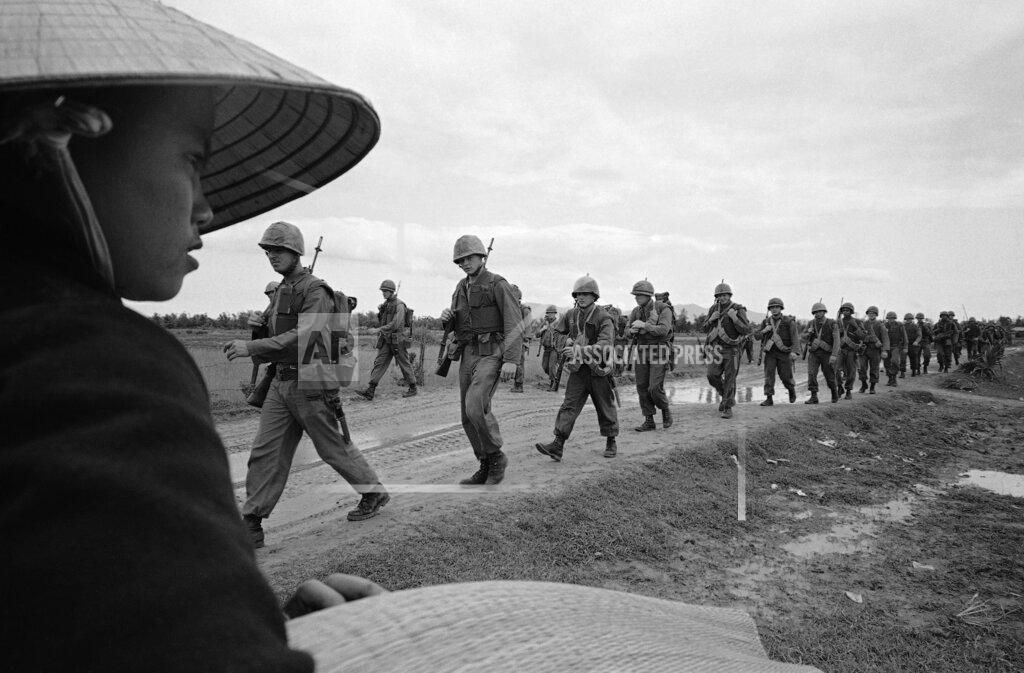
Operation ROLLING THUNDER was a sustained aerial bombardment campaign conducted by the U.S. Air Force, U.S. Navy, and Republic of Vietnam Air Force (RVNAF) against North Vietnam from March 2, 1965, until November 2, 1968, during the Vietnam War. The objectives of the operation were to boost the sagging morale of the Saigon regime in the Republic of Vietnam, persuade North Vietnam to cease its support for the communist insurgency in South Vietnam, to destroy North Vietnam’s transportation system, industrial base, and air defenses, and to halt the flow of men and materiel into South Vietnam. On March 15, 1965, the aircraft carrier USS Ranger (CVA-61) launched forty-two aircraft on a strike mission against the Phú Quý Ammunition Depot in North Vietnam. After leaving the target area, one aircraft, a Douglas A-1H, call sign Fortress 512, reported a rough running engine and smoke in the cockpit, possibly due to flak damage. The pilot, LTJG Charles F. Clydesdale, elected to ditch at sea sixty-three nautical miles from the Ranger. The aircraft was observed to make a wings-level, hard ditch into the water. The plane floated tail high for about thirty seconds before sinking in 288 feet of water; Clydesdale was not seen to leave the aircraft. An extensive search of the area was conducted by three Navy destroyers and a helicopter from the Ranger. They recovered the pilot’s helmet and pieces of the aircraft; however, no sightings of Clydesdale were made.
The President of the United States of America takes pride in presenting the Distinguished Flying Cross (Posthumously) to Lieutenant, Junior Grade Charles F. Clydesdale, United States Navy, for extraordinary achievement while participating in aerial flight as Pilot of an aircraft in Attack Squadron NINETY-FIVE (VA-95), operating from USS RANGER (CVA-61), on 15 March 1965. Participating in a strike against targets in North Vietnam, Lieutenant, Junior Grade Clydesdale brought his aircraft to minimum altitude and carried out a daring and accurate rocket attack in the face of intense anti-aircraft fire, inflicting extensive damage and destruction on North Vietnamese military installations. After rendezvousing with his flight and proceeding toward RANGER, he experienced engine trouble and elected to execute an open sea ditching. Despite his excellent ditching procedure, he was not observed to leave the aircraft.
Charles is memorialized at Courts of the Missing at the Honolulu Memorial. He is honored on the Wall at Panel 1E, line 96.
United States Air Force jets joined Navy bombers from the Seventh Fleet and flew deep into North Vietnam this afternoon to bomb an ammunition depot 100 miles south of Hanoi. More than 100 United States. jets and propeller aircraft struck at Phú Quý, more than 180 miles north of the 17th Parallel, which divides North and South Vietnam. No South Vietnamese Air Force planes took part in the attack. Twenty-four South Vietnamese Skyraiders, with American jet support, bombed an island naval base off the coast of North Vietnam yesterday.
Today’s target was the eighth since bombing raids began February 7. The director of operations for the Second Air Division, Col. Hal L. Price, described the ground fire from the Communist base as “light.” One of the propeller-driven A-1H Skyraiders was lost at sea about 60 miles from its carrier on the return flight. Military spokesmen in Saigon said they did not know whether a malfunction or enemy ground fire had caused the crash. North Vietnam said its anti-aircraft units had shot down five of the attacking planes and damaged “many others,” United Press International reported. Colonel Price said the depot was “an excellent target, our most remunerative target.” The colonel, from Orlando, Florida, said Phú Quý had been used as a base to supply the Việt Cộng in the South as well as the regular North Vietnamese army.
From the descriptions given by the pilots who flew the mission Colonel Price predicted that the final analysis would show that the raid had done more damage than any previous strike. He estimated that the depot, on the Con River 38 miles from the Laotian border, was 100 miles farther north than any previous target hit in the bombing series. The previous northernmost target was Quảng Khê, a Communist port that was bombed on March 2.
In line with a new Pentagon policy, the colonel would not give certain details of the raid today. He would not separate the number of planes that made the first flak suppression raids from the number that actually bombed the targets. He would not say how many tons of bombs had been dropped and he would not disclose from which land base in Southeast Asia the United States Air Force planes had flown. He said the Navy had flown propeller-driven A-1 planes and A-4. F-4B, and F-8 jets. The Air Force sent F-100 and F-105 jets. About two-thirds of the aircraft came from carriers of the Seventh Fleet and the rest from United States Air Force bases, according to Colonel Price. The pilots reported no sign of enemy aircraft during the two-hour mission, which began about 2 PM.
The United States attack on North Vietnam today was another attempt to increase the pressure by which Washington hopes to force Hanoi to end its support of the Communist insurgency in South Vietnam. It was meant to be the most potent and threatening in the series of raids that began February 7. The attacks are being intensified geographically by a choice of targets progressively closer to the North Vietnamese capital. The raids are designed to prove that North Vietnam will suffer increasingly serious punishment if it continues to support the Việt Cộng. They are meant to evoke some sign that Hanoi wishes to avoid that punishment and that it is “prepared to stop its aggression.”
Thus far, officials reiterated, there has been no such sign but the indications were that Washington would now give North Vietnam a few days’ respite for further diplomatic activity. By flying for the first time within the range of MIG fighter planes stationed near Hanoi, the United States also wished to demonstrate that it was prepared to take on the defending jets. Some of them were said to have been in the air but not near the attacking planes. Apparently confident that North Vietnam as well as its allies, the Soviet Union and Communist China, understand the purpose and meaning of the pressure, the Administration said nothing to explain today’s strikes against a nation with which it remains, nominally at peace. After a White House conference with President Johnson, military leaders described the attack as “successful,” but genuine success, in the Administration’s view, requires political as well as military results. At some stage in the pressure, officials have said, the raids may be extended from strictly military to industrial installations.
By selecting targets at will, the United States also hoped to demonstrate the insufficiency of North Vietnam’s defenses and to underscore the apparent inability or reluctance of either Moscow or Peking to give it effective assistance.The belief here is that some of these aspects of its position are beginning to be understood in Hanoi. But there has been no direct response to Washington’s invitation for an “indication” of a willingness to come to terms. Today’s raids were among several subjects discussed at a 90-minute White House conference this afternoon by President Johnson, Secretary of Defense Robert S. McNamara and the Joint Chiefs of Staff. They heard a report from General Harold K. Johnson, the Army Chief of Staff, who has just returned from Saigon.
General Harold Johnson, Army Chief of Staff, reports to President Johnson and Secretary McNamara on his recent visit to Vietnam. He admits that the recent air raids have not affected the course of the war and says he would like to assign an American division to hold coastal enclaves and defend the central highlands. General Johnson also advocates creating a four-division force of U.S. and SEATO troops to patrol the DMZ along the border separating North and South Vietnam and Laos.
South Vietnamese authorities called off today a plan to deport three leaders of a peace movement said to be Communist controlled. The plan was to drop them into North Vietnam by parachute. Earlier in the day, Brigadier General Nguyễn Chánh Thi, an army corps commander stationed near Đà Nẵng, had announced the plan for dropping the men into the North tonight. Later, the general said he had received a telephone call from Saigon telling him not to carry it out.
In the ground fighting, troops of a South Vietnamese armored personnel carrier killed at least 30 guerrillas in a clash 270 miles northeast of Saigon, United States officials said. There also were air strikes at the Việt Cộng in Hậu Nghĩa and Phú Yên Provinces.
In the rapidly developing campaign for control of the central highlands the Việt Cộng have gathered the largest striking force they have ever had in this strategically vital area of South Vietnam.
American bombing raids on North Vietnam can only lead to a further delay of any possible step toward negotiation of a peaceful settlement in Vietnam, authoritative Soviet sources said today.
Concern over the American bombing in North Vietnam is growing in Great Britain, and is not confined to the ruling Labour Party’s left wing. There is growing uncertainty over the American objective.
Queen Elizabeth II ended the ostracism of the Duchess of Windsor, the former Mrs. Wallis Warfield Simpson, 28 years after her uncle, formerly King Edward VIII, had abdicated the throne in order to marry the divorced American. The decision was occasioned by Edward’s illness and surgery, and the meeting took place at his bedside at The London Clinic. “When the 68-year-old duchess curtsied to the queen,” UPI would report, “it ended the bitterness in the royal family over the duke’s marriage…”
Frank Bossard, a member of Britain’s Secret Intelligence Service who had been selling information to the Soviet Union for four years about British military radar and guidance systems, was arrested by Special Branch agents at the Ivanhoe Hotel in Bloomsbury. A Soviet defector, code-named “Top Hat”, had alerted British intelligence of Bossard’s activities, and when he made reservations for the Ivanhoe on March 12, agents trailed him from the Ministry of Aviation to the hotel. When he emerged from his room after a little more than an hour, two officers searched him and found four classified file folders, photography equipment, and exposed rolls of 35 millimeter film. On May 10, he would be sentenced to 21 years in prison.
A diplomatic showdown between the Arab states and West Germany over the latter’s plans to recognize Israel is expected to produce a new “no Germany” policy by several countries. “They won’t recognize East Germany; they won’t recognize West Germany,” one Western diplomat said. “As far as diplomatic relations are concerned, there just won’t be any Germany at all.” If a decision early today by Arab foreign ministers to break with Bonn is carried out to the letter, it would leave several states — Jordan, Lebanon, Syria and Saudi Arabia — with no diplomatic relations with either East or West Germany.
West Germany directed its embassies in the Arab world to carry on as usual as optimism increased that as few as four Arab nations would break diplomatic relations with Bonn.
Gamal Abdel Nasser was re-elected to another term as President of the United Arab Republic (formerly Egypt) and, once again, without opposition in a yes or no vote. The government would report that 6,950,652 out of 6,951,196 voters approved Nasser and that only 65 voted against him. The other 479 ballots were declared void.
Communist China has issued its most direct and savage attack on the New Soviet leadership since the ouster of Nikita S. Khrushchev, calling the Kremlin “subservient” to the United States. A Peking newspaper accused the Soviet Government today of being subservient to the United States. The criticism was a new Chinese Communist attack on Moscow following the suppression of a student demonstration against the United States earlier this month and the alleged ill treatment of Chinese participants.
South Africa announced a tougher policy of strict racial segregation of the races in sporting events, going beyond the existing rule of separate sections for white and non-white (black and coloured) spectators. Under the new regulations, non-whites were barred from even attending events at venues in predominantly white districts, and whites could not venture into non-white events. Michiel De Wet Nel, the Minister of African Administration, and Pieter Botha, the Minister of Community Development announced the new policy. On average, 25 percent of the spectators at soccer games had been non-white.
The United Nations Security Council unanimously approved the admission of Gambia to membership in the United Nations.
With results virtually complete, it became clear Perónists had scored impressive gains in Argentina’s congressional elections. The Government-backed People’s Radical party took a lead early today in Argentina’s Congressional election, but the Perónist Popular Union was making a strong showing.
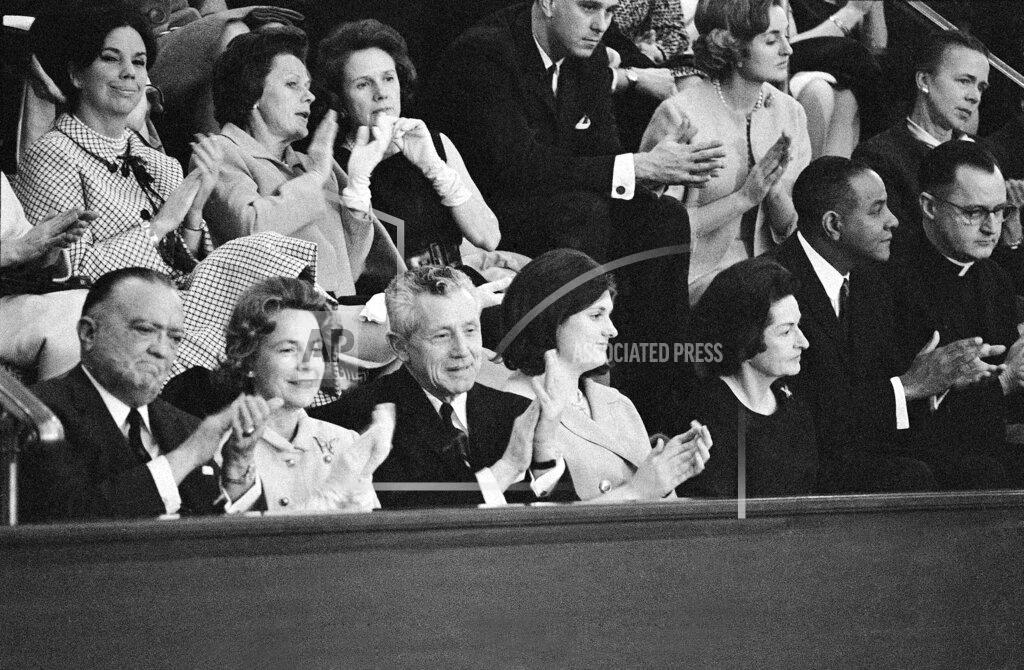
President Johnson spoke to a joint session of Congress and a nationwide television audience to call for federal legislation that would become the Voting Rights Act of 1965. The speech would be remembered for his repeated reference to an African-American song, “We Shall Overcome.” “Experience has clearly shown that the existing process of law cannot overcome systematic and ingenious discrimination,” Johnson said. “No law that we now have on the books — and I have helped to put three of them there — can ensure the right to vote when local officials are determined to deny it…. What happened in Selma is part of a far larger movement which reaches into every section and State of America. It is the effort of American Negroes to secure for themselves the full blessings of American life. Their cause must be our cause too. Because it is not just Negroes, but really it is all of us, who must overcome the crippling legacy of bigotry and injustice. And we shall overcome.” The bill would be introduced in the Senate on March 17, pass the House, with amendments, on August 3 by a 328–74 vote, and by 79–18 the next day in the Senate, and would be signed into law on August 6, 1965.
In his slow Southern accent, Mr. Johnson demanded immediate action on legislation designed to remove every barrier of discrimination against citizens trying to register and vote. He was interrupted 36 times by applause and two standing ovations. The President said he would send this legislation to Congress Wednesday. It is expected to receive overwhelming bipartisan support. Before a joint session of Congress and millions watching on television, Mr. Johnson deplored recent violence against Blacks in Selma, Alabama, where a voter registration struggle has been going on for six weeks, And he identified the cause of Blacks there and elsewhere with the spirit of the nation.
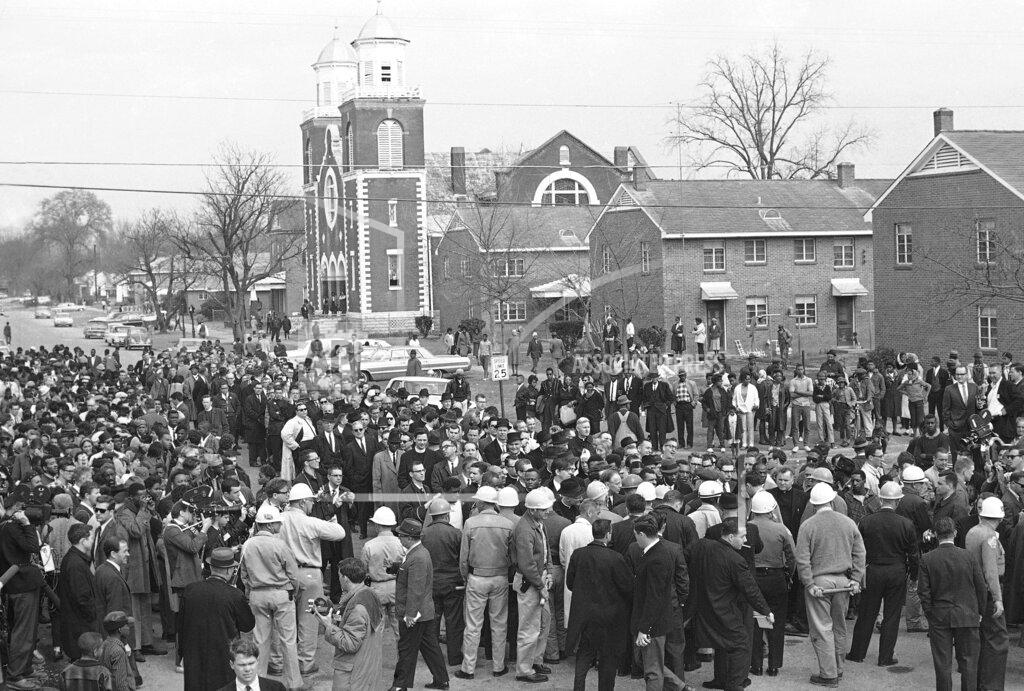
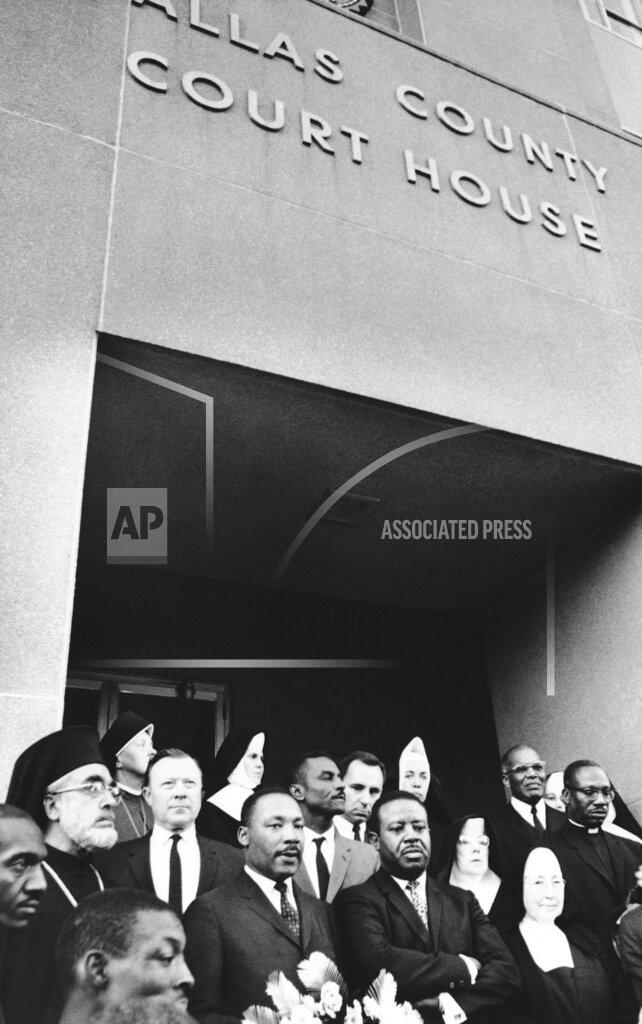
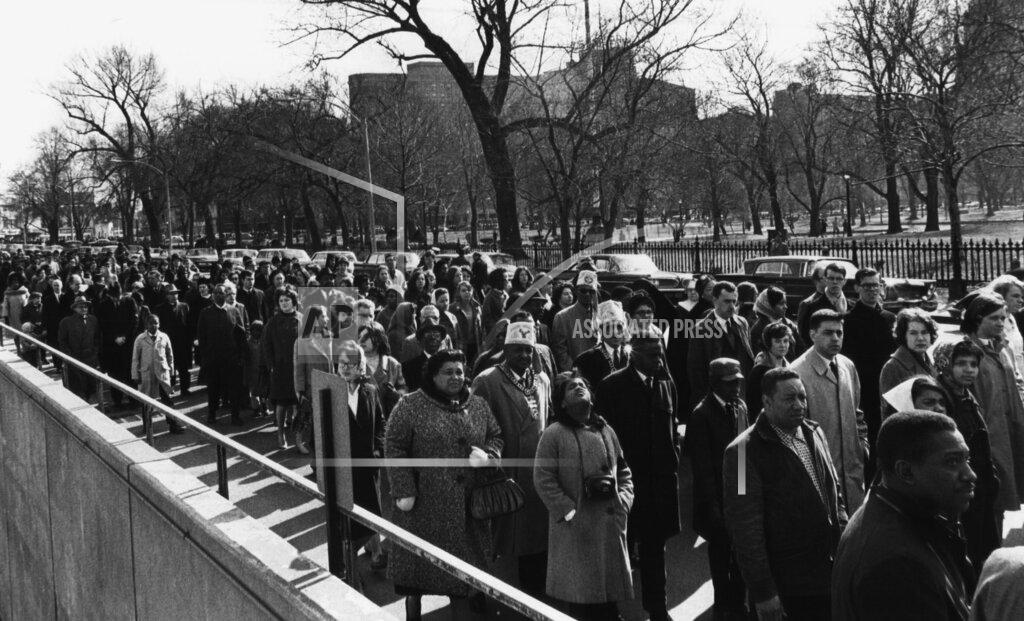
A Federal judge intervened and made it possible for more than 2,000 Black and white sympathizers to march through the streets of Selma today to pay homage to a white minister slain here last week. Federal District Judge Daniel H. Thomas of Mobile stepped in and worked out a compromise between law-enforcement officials and a group of marchers the officials had confined to a Black section of town since last Wednesday. By telephone through Sheriff James G. Clark Jr., Judge Thomas arranged for the demonstrators to hold their march under certain restrictions. They had to follow a prescribed route and march no more than three abreast.
The agreement was worked out with the assistance of representatives of the Federal Community Relations Service and Wilson Baker, Selma’s Commissioner of Public Safety. The march, from the Browns Chapel Methodist Church to the Dallas County Courthouse, eight blocks away, was the final part of a memorial service for the Rev. James J. Reeb, a Unitarian minister from Boston who was fatally beaten by white toughs on a Selma street corner last Tuesday night. Mr. Reeb died Thursday night at the University of Alabama Hospital in Birmingham.
The increase in the number of employed workers outside of agriculture continued strong in February, the Labor Department reported today. After allowance for normal seasonal changes, the rise in the number of jobholders amounted to 230,000. The increase was widespread through various sectors of the economy and included the manufacturing, mining, construction and both wholesale and retail trade areas. Only about one-fourth of the rise reflected the settlement in most ports last month of the East and Gulf Coasts dock strike, the department said.
The nation’s first firing of a two-man Gemini spacecraft, once scheduled for next Monday, was ordered postponed today to permit the firing of a Ranger photographic spacecraft to the moon.
President Johnson is in excellent health despite the rigors of dealing with the racial crisis and the war in Vietnam, his doctors reported after a thorough examination. President Johnson’s doctors have urged him to set aside regular days for relaxation and to follow faithfully a program of exercise.
The first TGI Fridays restaurant was founded, by businessman Alan Stillman, who purchased The Good Tavern, located at 63rd Street and First Avenue in New York City and named the chain for the expression “Thank God It’s Friday.”
Dow Jones Industrial Average: 899.85 (-0.48)
Born:
Svetlana Medvedeva, Russian economist, former Russian First Lady, wife of Dmitry Medvedev, in Kronstadt, Saint Petersburg, Russian SFSR, Soviet Union.
Marianne Morris, American golfer (Women’s PGA Championship, 3rd, 1995), in Middletown, Ohio.



 History Diaries