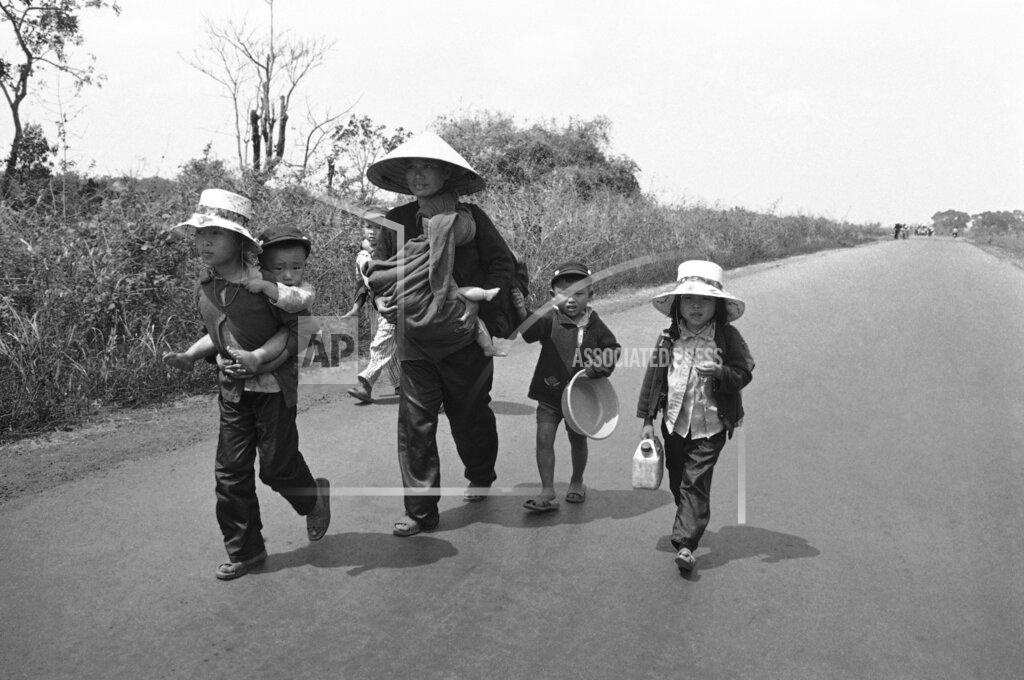
They are, sadly, unlikely to survive the flight from the highlands.

After the fall of Buôn Ma Thuột (Ban Me Thuot), South Vietnam’s President Thieu made the decision to abandon the northwestern half of the nation to the North Vietnamese invaders, withdrawing troops and ordering an evacuation, in hopes of consolidating a defense of the remaining provinces around Saigon, and possibly regrouping for a counterattack. “The strategy might have had a chance of success had it been made sooner,” an observer noted later, but “the plan to retake certain strategic points and commence an orderly withdrawal from the Central Highlands was made too late.” South Vietnam’s defense would collapse so rapidly that the entire nation would be in North Vietnamese control within six weeks. Meeting with his commanders, President Thiệu orders the withdrawal of ARVN forces from the Central Highlands and the northern provinces of South Vietnam to the coast. Five days later he orders Huế held at all costs.
North Vietnamese tanks and troops attacked outposts southeast of the key city of Tây Ninh today, stepping up the drive to isolate the province capital, 65 miles northwest of Saigon, the South Vietnamese command said today. As heavy fighting continued west of Saigon, in the northern provinces and the Central Highlands, the command announced that radio contact had been lost with an important outpost 25 miles northwest of the highlands provincial capital of Buôn Ma Thuột, most of which is reported to be in Communist hands. At a news conference this morning, Colonel Võ Đông Giang, a spokesman for the Việt Cộng’s Provisional Revolutionary Government, asserted that “the armed forces and people of Đắk Lắk (Darlac) Province have gained complete control of the provincial city of Buôn Ma Thuột.” The Saigon command said that radio contact had been lost with Ban Dôn, a lonely outpost near the Cambodian border only a few miles from the North Vietnamese road network along South Vietnam’s western boundary.
The command focused attention on the fighting around the Tây Ninh district town of Gò Dầu Hạ, which it said was struck by 17 rounds of artillery and four rockets yesterday. Fourteen tanks, the command said, attacked a militia outpost nine miles northwest of Gò Dầu Hạ. The outpost apparently withstood the attack according to the command, and one enemy tank was reported knocked out by artillery fire. Gò Dầu Hạ is about 20 miles south of Tây Ninh. Essentially, Tây Ninh’s strategic significance is its size, its proximity to Saigon and to the Cambodian border and its role as the headquarters of the Cao Đài religious sect, which has about two million followers.
Although the military situation around Tây Ninh was worsening, military analysts here were uncertain if the Communists would actually seek to overrun Tây Ninh or permanently cut off Route 22, an important supply route. The road now comes under fire by small guerrilla groups. Closing of the highway would virtually strangle Tây Ninh and force the South Vietnamese Air Force to airlift food and essen tial supplies to the city.
In either case — an attack on Tây Ninh or a permanent cutting off of supplies by highway — a Communist success psychological blow to President Nguyễn Văn Thiệu, whose military officers have been shaken by recent North Vietnamese successes. President Thiệu has come under strong criticism for the loss of Phước Long Province early in January. In recent days, North Vietnamese troops have seized the city of Buôn Ma Thuột, which is astride a strategic crossroads in the Central Highlands. There were reports that more than 21,000 refugees from Buôn Ma Thuột had fled to the town of Phước An, to the East. Reports from the area made it clear that the South Vietnamese were preparing a major assault to try to retake the city, which is now said to be quiet. Small units of government troops reportedly remained in the city but were out of radio contact with units to the East. “If there are any soldiers in there, they are hanging on by their fingernails’” a Western source said.
The Communist capture of Buôn Ma Thuột leaves only two major highlands towns, Pleiku and Kon Tum, in government hands. Reports from Pleiku said that the South Vietnamese were fertying troops from the city to points east of Buôn Ma Thuột for an eventual counterattack on the town. A further report from Pleiku said that major clashes were taking place around Buôn Ma Thuột’s airfield, and a knowledgeable Western official in Saigon said that “a determined effort” would be made to retake the city. The seriousness of the fighting in the Highlands was underlined by a disclosure that Air Vietnam had temporarily halted flights to Pleiku because of rocket attacks on the airfield there. An Air Vietnam airliner flying from Vientiane, the‐Laotian capital, crashed on Wednesday, possibly after having been struck by North Vietnamese antiaircraft fire. Among the 26 passengers was the Australian charge d’affaires in Hanoi, North Vietnam.
A source in Pleiku described the situation around Buôn Ma Thuột as “fluid” and said that there was some panic to leave Pleiku because of the stepped up North Vietnamese attacks. Air tickets from Pleiku to Saigon are being sold on the black market for about $70, nearly five times the regular cost, despite a suspension of commercial flights. There are reports of soldiers seeking to push their families aboard aircraft leaving Pleiku.
Ranger units trying to reopen Route 19 reportedly lost ground east of Lê Trung, a district town where a sizable North Vietnamese force is reported to be well entrenched. Route 21, which leads out of the highlands from Buôn Ma Thuột, also has been closed by Communist forces.
The Saigon Government denied accounts that Montagnard tribesmen, disaffected with the government, had cooperated or made some kind of “accommodation” with the North Vietnamese, who moved a large number of tanks into the town with relative ease. Their anger at the Saigon Government is largely a result of the ravages of the war, their dislocation and the encroachment of Vietnamese landlords on tribal lands.
Five columns of Government troops pushing from different directions toward the important Cambodian town of Tuol Leap failed to make substantial progress yesterday. The area is essential to the security of Phnom Penh’s airport. The airport, Pochentong, the last supply line to the isolated capital, reopened to traffic after being closed much of Thursday when a rocket fired by the Communist‐led insurgents blew up an ammunition dump next to the civilian terminal. An Air Cambodge jet from Saigon left with a full load of passengers for Bankok, the first international commercial flight since Monday.
Visitors returning from the besieged Mekong River town of Neak Luong reported even more intensified shelling in that last major Government stronghold on the river between Phnom Penh and the South Vietnamese border. As for Tuol Leap, which is about five miles from Pochentong, its area has been the launching point for the rockets and artillery shells that have been landing with increasing regularity on the airport. They frequently disrupt the American airlift that is the only source of supply since the insurgents cut off the Mekong. Military sources reported yesterday morning that rebel forces striking from Tuol Leap had cut government lines in the middle. East of this operation, on Route 5, about eight miles north of Phnom Penh, the rebels continued their pressure with more than a dozen attacks Thursday night.
A British Broadcasting Corporation television crew and a relief worker from Catholic Relief Services who returned from Neak Luong reported that more than 600 artillery shells and rockets struck the center of town from insurgent positions just across the Mekong. In a three‐hour period, they said, 25 civilians were killed and more than 80 wounded in the center of the town alone. The residents of the town, who have been undergoing nearly constant shelling for more than a month, have long since taken to a network of bunkers.
While the 3,000‐man Neak Luong garrison was reinforced earlier this week by 1,000 Government troops, the supply situation is reported to be worsening. The B.B.C. crew, which flew along the Mekong, in a helicopter, reported seeing a wooden barricade with mines stretching across the river above the town, which is 38 miles southeast of Phnom Penh. All supply efforts have been from the air.
Meanwhile, the Australian Embassy disclosed that all its remaining diplomatic personnel — the chargé d’affaires and five attachés — would be leaving on an Australian Air Force transport for Bangkok. It is the second embassy to close recently, the Israeli Ambassador having left last week. The embassies’ decisions to close and the general absence of any really good news from the Government side on the battlefield has not seemed to alter the mood in Phnom Penh appreciably. Thursday afternoon, while flames and smoke shot up from the ammunition dump at the airport, Cambodian cars paused — at a safe distance — to watch the noisy display.
President Ford tried today to work out a new plan for giving military aid to Cambodia in the face of warnings from Congressmen that approval for such assistance was virtually hopeless. The President made a new appeal for aid, saying through his press spokesman, Ron Nessen, that he hoped wiser Congressional heads would prevail. Mr. Nessen refused to discuss the possibility of a compromise between the legislators and Mr. Ford. He would not say if the President stood by the $222‐million aid figure he has sought and which has been rejected by both Houses of Congress. But Congressional sources said a compromise centered around demands by some key Congressmen that the President pledged to end United States involvement in Cambodia by June 30, a promise the Administration earlier refused to give.
The Laotian airline today idefinitely suspended its twice‐weekly flights between Vientiane and Saigon. An official announcement said the suspension had been ordered for technical reasons, but it was noted that the decision followed the crash of an Air Vietnam airliner, possibly after having been hit by Communist antiaircraft fire.
At a rally organized by the Communist party, thousands of Portuguese gathered in the rain in Lisbon to cheer a decision to nationalize the country’s banking system that had been decreed by the new leftist High Council of the Revolution. Premier Vasco dos Santos Goncalves said that it was “the first firm, irreversible step” to put the economy at the service of the people. The rally was called by the Communist party after the nationalization decision was announced early today by the newly formed leftist High Council of the Revolution. The Premier, who spoke in a television interview, described the decision as historic but warned of “hard days” and sacrifices ahead. He called on the people to remain alert to “reactionary maneuvers.”
The banking measure affects all banks except a few savings and agricultural institutions. A side effect of the nationalization was to put most of the press under state ownership, since the great majority of Portuguese newspapers had been in the hands of the banks. The Premier sought to assure businessmen that the Government did not intend to follow up the nationalization of the banks by nationalizing the whole economy. He said that it would now make certain that the banks would work for the development of the entire country instead of for the interests of a “privileged minority.”
The Ford Administration expressed concern today over the leftward swing in Portugal. L. Bruce Laingen, Deputy Assistant Secretary of State for European Affairs, said “unfortunate developments” had followed the Portuguese Government’s announcement Tuesday that it had smashed what it called an attempted coup by rightists. In testimony before the House Foreign Affairs subcommittee on international political and military affairs, Mr. Laingen said that there had been “a diminution of the moderate center” since Tuesday’s events. Other senior Administration officials, speaking privately, said that Portugal appeared to be on the verge of leftist dictatorship. The officials interviewed were in the State Department or the Defense Department.
One, who recently visited Portugal, said: “We are all very worried. The moderate leaders have been swept aside or are in custody. It plays beautifully into the hands of the leftists.” According to officials, the Administration’s main concern is that Portugal, as a leftist country, could no longer be treated as a viable partner in the North Atlantic Treaty Organization. One official said, however, that he doubted that Portugal’s leftist military rulers would, take the country out of the alliance.
Israel said that Egypt’s latest proposals for a new Sinai agreement were short of what was needed for an accord. An official said that he expected Israel would give Secretary of State Kissinger concrete views of her own to keep the negotiations going, and that he expected the government would recommend and get from the cabinet on Sunday a mandate authorizing more flexible negotiating terms. This would formally empower Premier Yitzhak Rabin’s negotiating team to begin discussing in specific detail with Mr. Kissinger the conditions it would demand for giving up the territory Egypt regards as a minimum for a new Sinai accord — the Mitla and Gidi passes and the Abu Rudeis oilfields. Less than half an hour atter Mr. Kissinger had briefed Mr. Rabin and his top aides, the Israeli official told reporters at the King David Hotel that the Egyptian ideas were still under study, but the initial reaction was that there was “a long way to go” before an agreement could be reached.
Egypt is considering the possibility of Egyptian-Israeli military commissions to meet in the United Nations buffer zone on the Sinai front, and has discussed this possibility with Secretary of State Kissinger, Foreign Minister Ismail Fahmy said tonight.
The Iranian Government has informed representatives of the Kurdish rebels in Iraq that the Kurds are welcome to cross into Iran to escape an Iraqi Army offensive, informants close to the rebels said tonight. No reports of further fighting in Iraqi Kurdistan reached Tehran today, but Baghdad radio, monitored in Beirut, said that combat was continuing. The Iraqi Government proclaimed a two‐week cease‐fire starting yesterday. As far as could be determined here tonight, no substantial numbers of Kurds have crossed into Iran since late last week, when the Iraqi armed forces began their offensive against the rebel enclave in notheastern Iraq adjoining the Iranian border. More than 100,000 Kurdish refugees — mostly women, children and old men — crossed into Iran last year and have been housed in camps provided by the Iranian Government.
Political and religious figures critical of the Government of President Park Chung Hee have appealed for an end to the conflict between the publisher of the nation’s largest daily, and reporters who have seized its premises. “The collapse of this newspaper will mean an end to the hope of democracy for Korea,” said Kim Yong Sam, leader of the opposition New Democratic party, on visiting the occupied Dong‐A Ilbo offices this morning. Mr. Kim’s statement was echoed by others who, with help from the Dong‐A Ilbo, have led a growing political offensive against the government, demanding that President Park ease his grip on the country. The paper, which has reported anti‐government statements and activities in South Korea, has come under increasing pressure in recent months, with businesses withdrawing their advertising reportedly under of ficial urging.
Fragmentary evidence suggests that a major reassessment of the Chinese wage structure is under way and that officials and managerial personnel may be facing reductions as they did during the Cultural Revolution, when Chairman Mao Tse‐tung himself was said to have taken an exemplary 20 percent cut.
The Canadian Government called several dozen influential citizens together here today to begin what it hopes will be a comprehensive national debate on Canada’s immigration policy.
Several hundred leftist, anti-government students shouted abuse and showered President Luis Echeverria Alvarez of Mexico with bottles and pieces of brick when he tried to address the opening of the academic year at the National University in Mexico City. He was the first Mexican president to enter the campus in more than eight years. He was grazed by the debris but not seriously hurt, an official spokesman said. The visit was intended to seal a new relationship that Mr. Echeverría had been building with the country’s students and intellectuals since he took office in 1970. It was also aimed at burying the memories of the 1968 student protest movement that was crushed by the army with the loss of about 300 lives. Mr. Echeverría was Minister of the Interior. While the Government’s liberalization of Mexico’s foreign policy and its relaxation of domestic political controls have won the President the conditional, support of many leftist Mr. Echeverría’s decision to enter the campus was evidently interpreted a challenge by extreme left‐wing groups.
The police today dispersed with tear gas students who have been protesting the murder of Josiah Mwangi Kariuki, a popular politician known throughout Kenya as “J.M.” In the National Assembly, member after member alleged that Mr. Kariuki was the victim of an internal political struggle. His bullet‐ridden body was found in bush country about 40 miles from here on March 3. There are allegations that Mr. Kariuki, was last seen alive being led from a hotel by men dressed in the uniform of the General Service Unit, Kenya’s security police. Parliament today voted to establish an investigating committee. Mr. Kariuki was an outspoken member of Parliament in this one‐party nation who had, it is believed, incurred the wrath of President Jomo Kenyatta, although the two had been friends in the days before and immediately after independence from Britain. In recent years, however, there has been an unofficial but none the less effective ban on Mr. Kariuki.
The Senate Finance Committee finished work on legislation that would reduce the taxes of individuals and corporations by $29.2 billion this year and by smaller amounts in future years. Most of the tax cut this year — $21.2 billion — would benefit individual taxpayers. The tax reduction that the committee approved contrasts with a cut of $16‐billion proposed by President Ford in January and with a reduction of $19.9‐billion approved by the House in late February. A tax cut of around $30‐billion has been advocated by a large number of economists, mainly liberals but also some conservatives, as the size that would be required to reverse the current sharp economic downturn. The Ford Administration has indicated a strong belief that a reduction of this size would be too large.
Reflecting the worsening recession, the nation’s industrial production declined in February for the fifth consecutive month, the Federal Reserve Board announced in Washington. Industrial output was down 3 percent last month, compared with a January decline of 3.6 percent, which was the sharpest drop for a single month since December, 1937. The Federal Reserve’s index of industrial production was 110.3 percent of the 1967 average, down from 113.7 percent in January.
Virtually all White House authorizations of foreign and domestic intelligence activities going back nearly three decades, over the terms of five presidents, have been requested of President Ford by the Senate Select Committee on Intelligence. Several members of the committee said they regard the request as the test of President Ford’s willingness to cooperate with the committee. The request, set out in an addendum to a letter delivered to the White House Wednesday, was made public today by the White House with the permission of Senator Frank Church, chairman of the committee.
The Idaho Democrat had made public the first item of the request, a call for the 39‐page report furnished to President Ford by William E. Colby, Director of Central Intelligence, at a news conference Wednesday. But the more sweeping items were not disclosed until today. In his letter accompanying the request, Senator Church said the items were needed “to fully determine the legal basis for the activities of the United States intelligence agencies.” He said the request had been made with the “unanimous approval of the committee.”
A Miami woman said today that she was recruited by the Internal Revenue Service in 1972 to take part in a widespread operation to gather information on the sex life and drinking habits of 30 prominent South Floridians, among them a state attorney involved in the Watergate investigation.
Fred Larue, a White House aide in the Nixon administration, was sentenced to six months in prison for his admitted role in the Watergate cover-up. He was a key prosecution witness in the cover-up trial and pleaded guilty in June, 1973, to a single count of conspiracy to obstruct justice, the first Watergate defendant to plead guilty. He was also the last of the eight Watergate defendants to be sentenced.
Jack Scott, university athlete, writer and educator, who has been sought across the United States in connection with the Patricia Hearst kidnapping case, told a reporter by telephone that his lawyer was discussing his situation with federal authorities.
David Hall, a 44-year-old former governor of Oklahoma, was convicted by a federal jury on four counts of bribery and extortion. W.W. Taylor, a Dallas mortgage broker, was also convicted. The government had alleged that Mr. Hall and Mr. Taylor had conspired to bribe the Oklahoma Secretary of State, John Rogers Jr., to approve an investment of $10 million in state retirement funds in one of Mr. Taylor’s companies. Hall, who had been indicted on January 13 while still in office, was convicted of racketeering, extortion and perjury, and sentenced to three years in federal prison. He would be released after 19 months.
The judge in the San Francisco “zebra” street killings case has warned attorneys that it will be a long trial and he hopes they “can learn to get along.” The trial was recessed for the weekend yesterday with attorneys’ tempers flaring and still no jury seated. A second panel of 100 prospective jurors is to be sworn in when the trial resumes Monday. Four Black Muslims are charged with three of the 12 random street killings that terrorized the city for more than five months last year. Attorneys and the Superior Court judge, Joseph Karesh, have rejected more than 90 prospective jurors since the trial started March 3.
A federal district judge ordered the government today to move quickly to enforce school desegregation requirements in 125 school districts in 16 Southern and Border states.
The American Motors Corporation announced today that it was recalling 13,676 of its new Pacer cars for a problem that could cause a fuel leak. A spokesman for the company said the recall was needed to inspect and make possible corrections to the fuel supply system. The spokesman said faulty systems could result in abrasion of a flexible hose that could ultimately lead to a fuel leak. Eight leaks have been found, six on engineering test cars, the spokesman said. No injuries or property damage have resulted.
Deep down, the squabble that began in the central Texas chalk hills last week is simple: The United States Army wants to annex 60,000 acres adjacent to Fort Hood for additional tank training grounds. The rancher‐owners of the lane want to stay put. Congress will have to decide who wins. But on the surface, it is much more complicated. It has become a war between elephants and ants, with the ants on the offensive. The elephants occupy Fort Hood — the largest armor post in the free world, they call it — with 217,551 acres, two combat divisions, and an air assault brigade, 45,000 soldiers, 2,142 tanks and other battle armor, 528 helicopters, spokesmen full of “no comments” on land plans, and officers who seem to be continually awaiting “guidance” from the Pentagon. The ants, some 200 land owners and hundreds more allies in the contested zone, have turned for guidance to higher authority. “Our heavenly Father, we come to you feeling like David as he approached Goliath,” their pastor began last night.
A Federal Trade Commission today ordered three West Coast travel agencies to stop promoting tours to the Philippines for miraculous cures through so-called psychic surgery.
Susan Hayward, the red-haired actress who won a 1958 Academy Award for her role in “I Want to Live,” died today at her home in Beverly Hills, Calif. She was 55 years old. Miss Hayward had been suffering from a brain tumor for two years. She died after having suffered a seizure, her physician said. The Brooklyn‐born actress appeared in more than 50 films and was one of the most sought‐after stars in Hollywood in the nineteen‐fifties.
Film adaptation of Neil Simon’s comedy “The Prisoner of Second Avenue”, starring Jack Lemmon and Anne Bancroft, premieres in NYC.
Dow Jones Industrial Average: 773.47 (+10.49, +1.37%)
Born:
Peppi Zellner, NFL defensive end (Dallas Cowboys, Washington Redskins, Arizona Cardinals), in Forsyth, Georgia.
Died:
Susan Hayward (stage name for Edythe Marrenner), 57, American film actress (“Young and Willing”), died of brain cancer. Hayward had won the 1958 Academy Award for Best Actress for her role in the film “I Want to Live!”.
Keeve M. “Kip” Siegel, 51, co-developer of the first small-scale thermonuclear fusion within a laboratory, died of a stroke suffered while testifying in Congress before the Joint Committee on Atomic Energy about his goal in developing a cheap source of energy through use of lasers to achieve fusion. The day before, Siegel was reading a prepared statement when he couldn’t say the words aloud, and slumped over after taking a sip from a glass of water.






 History Diaries