Mikhail S. Gorbachev, the new Soviet leader, has come to power pledging to rouse the Soviet economy from its stupor. That stupor, however, has resisted repeated assaults over the last 40 years, and Western diplomats here say they are skeptical that, for all his youth and apparent energy, Mr. Gorbachev will be capable or really prepared to take the radical steps required. The task is a daunting one, as any Western visitor to the Soviet Union quickly sees. Long lines form for consumer goods that would be scorned in Western shops. By American standards, the telephone service is rudimentary, banking is all but unknown, roads are few and poor, offices are ill equipped and officials inaccessible.
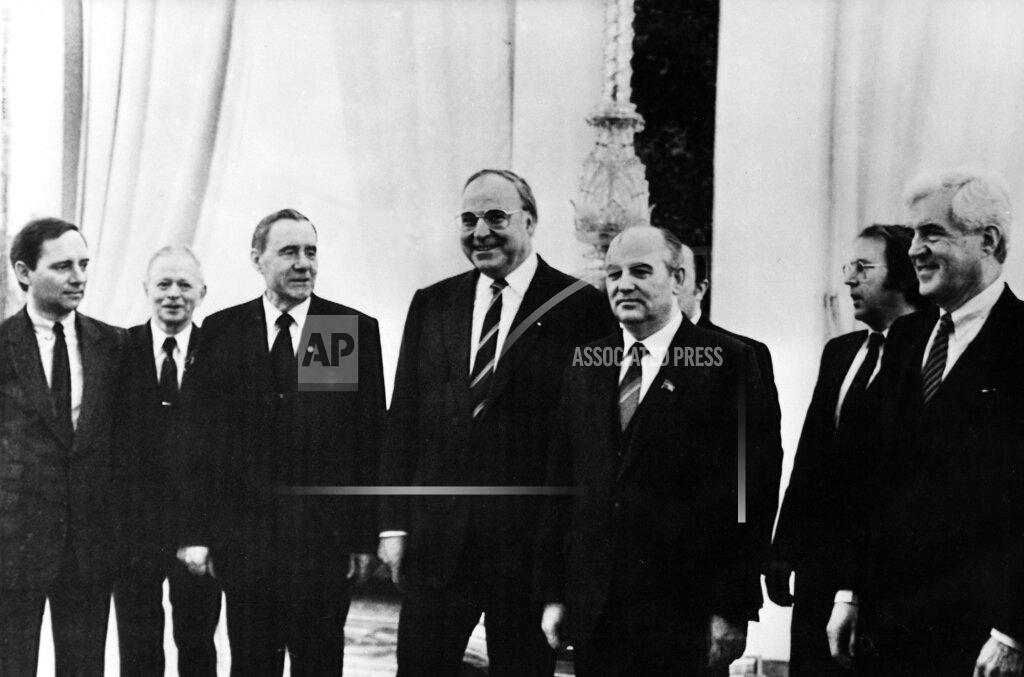
Mikhail S. Gorbachev plunged into his new role today, meeting a series of foreign leaders, sometimes at half-hour intervals, and impressing them with his knowledge and air of command. The day after his predecessor, Konstantin U. Chernenko, was buried, the new Soviet leader multiplied the meetings with world leaders he began Wednesday, talking with more than 20 of the visitors who came for the funeral. American-Soviet relations and the Geneva arms talks were at the top of the agenda in his discussions with Western leaders. In a meeting with a Chinese delegation, Mr. Gorbachev pressed to raise the level of contacts between the two Communist nations.
Prime Minister Brian Mulroney of Canada said, “Here is a man who is very much in control and very knowledgeable.” President François Mitterrand who was one of nine leaders who met Mr. Gorbachev on Tuesday, said, “This is a calm, relaxed man who appears to be willing to take on problems firmly.” Chancellor Helmut Kohl of West Germany said, “In a word, there is a man sitting there now as General Secretary, who knows it, and who expressed his opinions with a sovereignty and a notable mastery of material in the most differing areas.” Diplomats and other analysts here said they believe that foreign policy remains under the guidance of Foreign Minister Andrei A. Gromyko, who sat in on Mr. Gorbachev’s meetings today. No radical changes in direction can be expected, these analysts said.
President Reagan asserted today that the Soviet Union was in “a different frame of mind” about arms talks with the United States. But at the same time, the White House cautioned against expecting an early Soviet-American summit meeting. In one of his most positive assessments about the sincerity of Soviet intentions since he took office, Mr. Reagan told a group of magazine publishers that he believed the Soviet leaders were “really going to try and, with us, negotiate a reduction of armaments.” But as Mr. Reagan awaited a first-hand assessment of the new Soviet leader, Mikhail S. Gorbachev, from Secretary of State George P. Shultz on Friday, the White House sought to dampen speculation that the change of leadership, the resumption of arms talks, and the new hopeful mood would produce an early summit meeting.
Charges that a Soviet radar system violates the 1972 treaty limiting antiballistic missile systems are being questioned by American and British intelligence experts, according to Reagan Administration officials. Moscow has said that the radar, now being built in central Siberia, is for space-tracking and is allowable under the treaty.
The Belgian government, ending several months of hesitation, decided to begin the immediate deployment of the first of 48 U. S. cruise missiles as scheduled by the North Atlantic Treaty Organization, government sources in Brussels said. The Belgian Cabinet made the decision after several hours of debate, the sources said. They said 16 cruise missiles will be deployed within the next several weeks at an air base near the town of Florennes, 40 miles south of Brussels. The last of the remaining 32 missiles will be deployed by the end of 1987. The Netherlands, which has also hesitated about deploying cruise missiles, is due to make a final decision by November 1.
A 32-nation panel preparing for a major conference of the U.N. Commission on the Status of Women ended its meeting in disarray in Vienna after a dispute over the agenda. U.N. officials said it will now be hard for the conference to design a plan of action when it convenes in July to evaluate the U.N. Decade of Women. President Reagan’s daughter Maureen, leader of the U.S. delegation to the commission, charged that the Soviet Bloc, which wants to expand the agenda to include action against an “unjust world economic order,” is deliberately obstructing agreement. Soviet delegates could not be reached for comment.
The U.S. Embassy staff in Beirut has been temporarily reduced because of the worsening security situation, the Reagan Administration said. But Administration officials said Ambassador Reginald Bartholomew remained at his post and “the embassy is functioning, but with a limited staff.” Neither the White House nor the State Department would say how many personnel had been evacuated or how many remained. Nor would they say where the ones still in Lebanon were living.
Syria today warned Christian militiamen who are in revolt against President Amin Gemayel’s pro-Damascus policies that it would not tolerate the rebellion. At the same time, the rebels expanded their control over the main Christian areas of Lebanon. Samir Geagea, the pro-Israeli commander of the major fighting units in the Lebanese Forces, the nation’s largest Christian militia, seized control of major Christian communities north of Beirut in an overnight sweep Tuesday.
The Iran-Iraq war intensified as the United Nations Security Council struggled to find a way to restrain the combatants. New ground fighting was reported in strategic marshlands in southern Iraq, where the Iraqis said they managed to stop Iranian attempts to gain a foothold and isolate Basra Province from the rest of the country. Earlier, witnesses in Iraq were quoted as saying that Baghdad’s central bank had been devastated in a huge blast.
Iran said that it hit Baghdad with a missile, and witnesses in the center of the Iraqi capital said that a huge explosion severely damaged most of the 12-story main branch of the government-owned Rafidan Bank. Iraq denied that Baghdad was hit by a missile, saying that the bank was damaged by a bomb planted by Iranian agents. The two nations also carried out air raids on each other’s cities — the latest in a 10-day exchange of attacks on civilian targets.
Canada and the United States plan to install a new North American radar system to detect Soviet missile or bomber attacks over the Arctic Circle, the Canadian Defense Ministry announced. The $1.2-billion North Warning System, expected to be operational by the early 1990s, will replace the Distant Early Warning (DEW) system first set up in the 1950s. The agreement will be formally signed Monday in Quebec City when Canadian Prime Minister Brian Mulroney and President Reagan end a two-day meeting. Under the pact, the two countries will jointly finance a chain of 52 radar stations.
A top Mexican police officer held for questioning, reportedly about the kidnapping and murder of a United States drug agent, died in custody, the Government announced today. It said a second man had confessed to taking part in the abduction. “A member of the Jalisco judicial police, Gabriel Gonzalez Gonzalez, who was at the disposition of the Federal Judicial Police, died while being detained,” a statement by the Mexican Attorney General’s Office said. Official sources said Mr. Gonzalez had been detained in the kidnapping and murder of Enrique Camarena Salazar, a Drug Enforcement Administration agent. No reason was given for the officer’s death and the Attorney General’s office did not identify the man who it said had confessed to taking part in the kidnapping. An earlier statement reported that 13 people, including seven policemen, had been held for questioning in the abduction of Mr. Camarena.
Vice President George Bush rejected Grenada’s request to let 250 American soldiers stay on the island, but he said that the United States is committed to preserving Grenadan democracy. The troops, remnants of a force that invaded the Caribbean island in October, 1983, are scheduled to leave by June 12, and Bush said there are no plans to change the timetable. But on a visit to the island, he pledged that the United States “will not sit idly by and allow Grenada’s security to be threatened.”
A Haitian Government official today denounced an Amnesty International report of human rights abuses in Haiti as “complete lies.” The London-based organization’s report, which was released Wednesday, said that although abuses have fallen sharply in Haiti since 1977, the authorities still single out political opponents, journalists and trade unionists for arbitrary detention, torture and execution. The government official, Information Minister Jean-Marie Chanoine, said in an interview: “We have no political prisoners, and we have no selective repression.”
France said today that it was sending 60 paramilitary policemen to bolster security forces in Guadeloupe, where a bomb attack Wednesday killed one person and wounded 11, including four Americans. The bomb killed a woman in a restaurant in central Pointe-a-Pitre, the capital, the Guadeloupe authorities said. No group took responsibility for the blast. The restaurant is owned by an official of the rightist National Front of Guadeloupe, which has blamed separatist terrorists seeking independence from France for the recent violence.
Brazil’s armed forces step down Friday after 21 years in power, leaving the country’s new civilian Government with the unenviable task of imposing unpopular austerity measures in order to tackle an acute economic crisis. Late tonight, less than 12 hours before he was to receive the sash of office, the 75-year-old President-elect, Tancredo Neves, underwent emergency surgery for an acute intestinal inflamation, and doctors said the surgery was successful. With dozens of foreign delegations in town, congressional leaders said the inauguration would take place as planned, with the elected Vice President, Jose Sarney, temporarily occupying the presidency.
Mr. Neves’s unexpected operation — doctors said they had hoped to postpone surgery until after the inauguration – temporarily switched attention from the difficult legacy that he will inherit to the more immediate question of his health. But the incoming Government’s principal challenge lies in the continuing economic threat to Brazil’s stability. Mr. Neves, who was chosen by a 686-member Electoral College last January, has defined his challenge as “the very difficult task” of simultaneously fighting inflation and recovering traditional rates of economic growth.
The Argentine Senate approved the Beagle Channel treaty with Chile by a single vote, giving President Raul Alfonsin a major legislative victory. The treaty, earlier approved by Argentina’s Chamber of Deputies, divides sovereignty over the strategic waterway and its three islands at the southern tip of South America. Approval in the Senate, where Alfonsin’s Radical Civic Union is in a minority, was opposed by the Peronist party. Ratification by Chile is expected because the accord is endorsed by military President Augusto Pinochet.
Two senior South African Cabinet ministers flew to neighboring Mozambique today in an effort to rescue a faltering nonaggression pact that appears threatened by collapse just a year after it was signed. The agreement committed the two nations to withdraw support from each other’s internal adversaries. But since then, an insurgency against the Government of President Samora Machel has swelled in Mozambique, and the Marxist Government there has accused South Africa of failing to block insurgent supply lines across the two countries’ border.
G.O.P. senators up for re-election next year are being told that President Reagan’s involvement in their campaigns will be limited unless they support his programs, White House officials said. In what one official described as “hardball” political tactics, the White House decided in recent days to step up the pressure on the 22 Republican senators in the hope of cementing their support on pending votes. These include votes, which are expected to be close, on whether to continue building the MX missile and on the budget package, which involves cuts and freezes in numerous domestic programs. One White House official described the tactic as “a carrot and a stick thing.” He added, “Basically, what it means is that if the senator doesn’t support us on the MX and he wants a fundraiser in the next three or four months, he’s not going to get a fundraiser.”
President Reagan meets with Deputy Assistant and Director of Private Sector initiatives Frederick Ryan.
President Reagan meets with the 14 year old boy who held off a 220lb man who was attacking an 11 year old girl.
An omission of the Social Security cost-of-living increase next year was endorsed by the Senate majority leader, Bob Dole. Robert C. Byrd, the minority leader, said he would oppose the one-year freeze. The conflicting positions indicated the issue would generate a bitter fight in Congressional budget debates and perhaps in next year’s campaign for control of the Senate.
Attorney General Edwin Meese 3d said today that he did not favor imposing blanket economic sanctions on countries that produced or shipped narcotics, although he said he viewed the “objective” as “a good one.” In an interview shortly before being formally installed as Attorney General, Mr. Meese elaborated on a variety of topics. These were among them:
- He is not inclined to seek changes in antitrust laws and says enforcement decisions should be made so as to help American companies compete worldwide.
- He does not foresee changes in the department’s enforcement policies on civil rights, although he wants to improve communication with minority groups and civil rights leaders who have been critical of the Administration’s performance.
- He intends to press for measures to protect crime victims’ rights and to insure that the nation’s prison system is “adequate and humane.”
A former FBI agent pleaded guilty in Miami to charges of possessing and distributing more than 90 pounds of cocaine and receiving $850,000 in bribes and kickbacks while working in an undercover operation. The former agent, Dan Mitrione Jr., faces up to 45 years in prison.
An engineer pleaded guilty to espionage, confessing he had tried to pass Stealth bomber secrets to Soviet agents for $55,000 because he needed money. The aerospace engineer is Thomas P. Cavanagh.
Officials who disclose intelligence or military secrets without proper authorization can be prosecuted under laws barring espionage and theft of Government property, under a ruling by Federal District Judge Joseph H. Young in Baltimore.
The Senate Special Committee on Aging released a staff study concluding that Medicare could save up to $1.2 billion a year — and do no harm — by requiring patients to consult a second doctor before some surgery. Senator John Heinz (R-Pennsylvania), committee chairman, made public a memo showing that some high-ranking officials favor mandatory Medicare second opinions, which the Administration publicly opposes. The study said that requiring second opinions for nine common elective operations under Medicare could eliminate 17% to 35% of them. The study listed cardiac pacemaker installation, cataract surgery, gallbladder surgery, prostate surgery, knee surgery, hysterectomy, back surgery, hernia repair and hemorrhoidectomy.
U S. Surgeon General C. Everett Koop said that removing price supports for tobacco farmers would do little to discourage smoking in the United States. “If you pulled out price supports tomorrow, the tobacco farmer would have to grow more tobacco, which would reduce the cost for cigarette manufacturers. They’d make more profits for advertising,” said Koop, who testified in St. Paul, Minnesota, before a committee of the state Legislature.
The Mississippi Senate approved a $4,325 raise over three years for teachers, but a statewide strike is still planned for Monday, a union leader said. Jerry Caruthers, a spokesman for the 13,000-member Mississippi Association of Educators, said the strike is still on, but the plans could change if the raise is approved by the House, where it is scheduled for debate today. The Senate voted 41 to 11 to approve a $2,325 raise for teachers next year, backed up by $1,000 raises in each of the following two years.
A federal judge in Beckley, West Virginia, struck down the state’s six-month-old school prayer law as unconstitutional. U.S. District Judge Elizabeth Hallanan said the law violates the First Amendment because it “both advances and inhibits religion and fosters an excessive government entanglement with religion.” The law was overwhelmingly approved as a constitutional amendment by state voters in November.
Texas Attorney General Jim Mattox was acquitted in Austin of a commercial bribery charge resulting from allegations that he threatened a Houston law firm’s lucrative bond business. He thanked about 100 supporters later outside the courthouse. Mattox was accused of threatening to withhold his required approval of municipal bonds prepared by the Fulbright & Jaworski law firm unless one of its lawyers stopped trying to question his sister in an unrelated oil rights case.
Changes in airline schedules imposed last fall at six major airports have reduced daily flight delays from about 1,600 to fewer than 900, according to the Federal Aviation Administration. As a result, the agency has told the airlines it sees no need to renew the agreement as long as they adhere to its spirit.
A Federal district judge today barred the District of Columbia from promoting anyone in its Fire Department before April 1 while he considers charges that the department discriminates against whites. Judge Charles R. Richey also ordered consolidation of three lawsuits challenging the Fire Department’s hiring and promotion policies. The Reagan Administration filed suit Monday accusing the Fire Department’s affirmative action program of giving preference to minorities in promotions. Suits have also been filed by the union that represents firefighters and by three white firefighters who say they were among 14 whites passed over for promotions in favor of blacks. The affirmative action plan calls for quotas to increase minority representation in the department.
The “black English vernacular” of urban America, contrary to expectations, is becoming more different from standard English rather than more like it, according to a study by linguists at the University of Pennsylvania. Dr. William Labov, who directed the study, said the development reflected increasing racial segregation and isolation of urban black Americans.
A merger agreement between the International Typographical Union and the Graphic Communications International Union has collapsed, the labor groups said today, giving the teamsters’ union a new opportunity to move into the printing industry. The general board of the graphics union, meeting in Washington Wednesday, rejected the merger by a “decisive” vote, a union spokesman said. The merger had been designed to create a 250,000-member union of printing industry workers. Jackie Presser, president of the International Brotherhood of Teamsters, which had also sought a merger with the I.T.U., called today on the president of the typographical union to allow a vote on merger with the Teamsters.
A study has found little scientific evidence that hazardous waste sites have caused serious health problems for people living nearby, a group of scientists said. But the researchers, who said they found inadequate or non-existent data on many of the nation’s worst toxic waste sites, warned that their industry-sponsored study should not be interpreted as concluding that there are no risks. The report by Universities Associated for Research and Education in Pathology Inc. was released in Washington.
The Army defended the safety of its UH-60 Black Hawk helicopter today, despite a crash Wednesday that killed 12 soldiers, bringing total deaths associated with the aircraft to 34 in four years. “The Army is extremely well pleaseed with this helicopter,” said Maj. Donald Marple. “We have no indication to believe it’s not safe.” In the latest crash a Black Hawk flying in a routine exercise fell into woods at Fort Bragg and burned, killing four crewmen and eight paratroopers. The crash was the 22d since the Army began to use the helicopter to carry soldiers into combat.
Thunderstorms rumbled through Texas, flooding Houston streets with up to four inches of rain and clogging them with stalled cars. The storm washed out one Houston freeway underpass with six feet of water, forcing people who drove into it to swim out. Showers fell in Arkansas and Tennessee and rain mixed with snow fell from the Great Lakes and eastern Pennsylvania to New England. Dense morning fog was reported across southern Mississippi, southern Georgia and central Florida but skies were mostly clear from the middle and upper Mississippi Valley to the West Coast.
Michael Secrest (US) completes 24-hr ride of 516 miles, 427 yards.
Dow Jones Industrial Average: 1260.05 (-1.65)
Born:
Steven Hill, MLB pinch hitter, catcher, and first baseman (St. Louis Cardinals), in Houston, Texas.
Derek Peltier, NHL defenseman (Colorado Avalanche), in Plymouth, Minnesota.
Idaira, Spanish singer, in San Cristóbal de La Laguna, Spain.




 History Diaries