

A Bush-Gorbachev meeting in Moscow that lasted 85 minutes prompted the Vice President to say he believed “we can move forward with progress.” The official Soviet press agency Tass said that Mr. Gorbachev, the new Soviet leader, had affirmed his readiness “to work in practice” to improve relations with the United States. Mr. Bush said he had delivered a letter from President Reagan that American officials said contained an invitation to a meeting. The Vice President declined to discuss the content of the letter, but said: “I believe the President does feel that a meeting will be useful. I think he would be ready as soon as the Soviet leadership is ready.”
Funeral services are held for Konstantin Chernenko in Moscow. Chopin’s funeral march echoed across Red Square as Konstantin U. Chernenko was buried in the Kremlin. Once again, members of the ruling Politburo mounted the Lenin Mausoleum to part with one of their own in the now-familiar ceremony rich in pomp and Russian circumstance. Mr. Chernenko, who died Sunday at the age of 73, was interred in the row of graves where Yuri V. Andropov had been buried 13 months earlier and Leonid I. Brezhnev 15 months before that. This time, the mourners were led by the youngest man to take charge of the Kremlin since the early Soviet rule. Today, as he did on being selected Monday, Mikhail S. Gorbachev showed himself a man eager to move on.
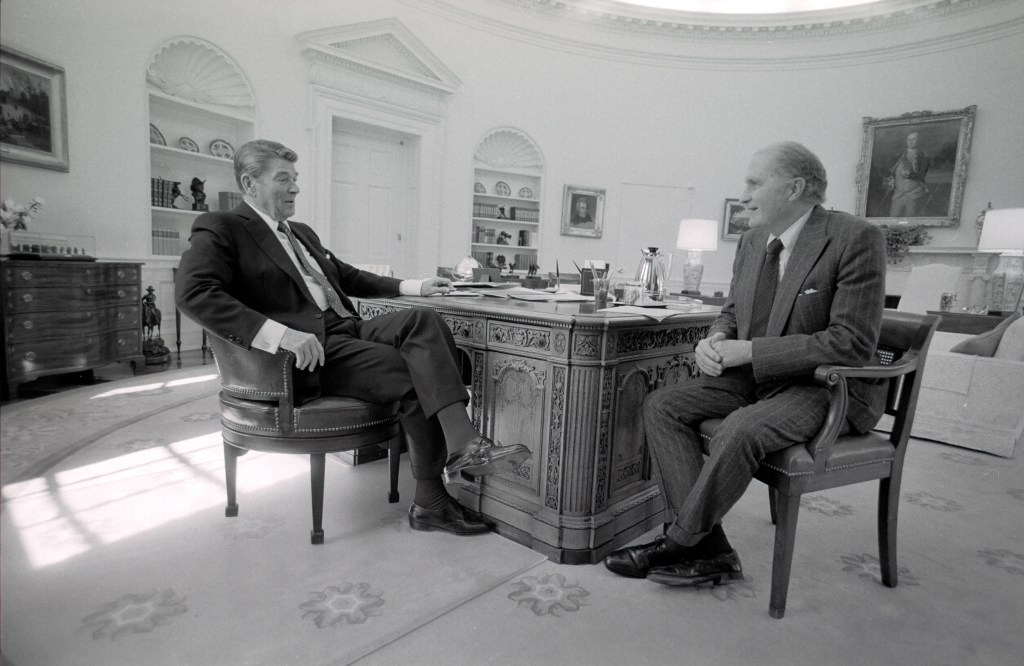
President Reagan meets with former Secretary of State Henry Kissinger to discuss U.S.-Soviet Union relations.
The President conveyed two views on Soviet-American relations to his senior aides early Monday. The first was that Mr. Reagan was reluctant to fly to Moscow for the funeral of Mr. Chernenko, partly because of the White House schedule and partly because the quick trip might be construed, according to an aide, as “grandstanding” and “gimmicky.” Mr. Reagan’s second opinion, an official said, was that he “wanted something other than a bland letter” to be presented to Mr. Gorbachev. “In the Monday morning meeting the strategy developed to send a personal letter to Gorbachev to cover our desire for an improvement in relations, our assessment of the progress made to date and an outreach in the form of an invitation to Gorbachev to come to Washington for a visit when he was ready,” one White House official said.
The number of muggings and robberies reported to London police hit a record high last year, and overall crime rose by 9%, Scotland Yard said. Muggings rose from the 7,200 reported in 1982 — the previous record total — to 7,900 last year, the metropolitan police force said in its annual crime report. The 13,600 robberies also represented an all-time high, Scotland Yard said. Murders, which fell from 618 in 1982 to 550 in 1983, rose again last year to 670.
Czechoslovak authorities arrested 48 members of the country’s human rights movement, Charter 77, after breaking up a clandestine film show in a Prague apartment, emigre sources said in Vienna. Thirty-seven of the people were released after questioning, but 11 remained in prison, the sources said. The arrests followed the release of Charter 77’s first-ever appeal for the withdrawal of all Soviet and American nuclear weapons and military units from Europe and the dissolution of power blocs on the Continent. Among the 11 still being held were Jiri Dienstbier and Eva Kanturkova, who speak for Charter 77, the emigres said. They said the raid occurred at the home of an artist, and that the group had gathered to watch films of events in the late 1960’s in Czechoslovakia. The police confiscated film, tapes, books, typewriters and documents, the emigres added.
Two leading members of the outlawed Red Army Faction were jailed for life today for their part in a campaign of terror that the far-leftist terrorist group carried out in West Germany in the late 1970’s. The Düsseldorf High Court sentenced Adelheid Schulz, 29 years old, to three concurrent life terms and Rolf Clemens Wagner, 40, to two terms of life imprisonment. Both were found guilty of taking part in the kidnapping and murder of a leading businessman, Hanns-Martin Schleyer, and the killing of his chauffeur and three bodyguards. Mr. Schleyer was abducted in Cologne in July 1977. After a three-month search his body was found in the trunk of an abandoned car in the French city of Mulhouse.
The Polish leader, General Wojciech Jaruzelski, met today in Moscow with Chancellor Helmut Kohl of West Germany, marking apparent new progress in a rapprochement between the two nations after nine months of severe diplomatic strain. The official Polish press agency, P.A.P., said the two men “exchanged views on the state of bilateral relations between the two countries and expressed an intention to improve them.
Israeli warplanes today bombed what officials here described as a Palestinian guerrilla base in Syrian-occupied eastern Lebanon. Prime Minister Shimon Peres, confirming the attack, said the camp was attacked because it had “a concentration of terrorists.” There were no immediate reports of casualties. Earlier, the Israeli military command announced that its planes attacked a base one mile west of Bar Elias, a town in the Bekaa region. The town is six miles west of the Syrian border and about seven miles north of Israel’s front line facing Syrian troops in the Bekaa area. The Israeli planes “bombed one base on which there was concrete information of a concentration of terrorists,” Mr. Peres said. “We don’t have to wait until the terrorists start toward us.”
Israeli Foreign Minister Yitzhak Shamir asked Canada to participate in the multinational peacekeeping force in the Sinai Peninsula. Shamir, beginning a six-day visit to Canada, made the request in a meeting with External Affairs Minister Joe Clark in Ottawa. Australia is due to withdraw its 100-person contingent from the 10-nation Sinai peacekeeping force in 1986, and Shamir cited Canada’s experience in similar peace forces in Cyprus and the Israeli-occupied Golan Heights. Israel, which captured the Sinai from Egypt in 1967, returned it in 1982.
Christian militia leaders rebelled against Lebanon’s President, a Maronite Catholic who is their ostensible leader. The uprising against President Amin Gemayel posed a new threat to the stability of the Government and added another element to the spiral of violent disintegration in the war-ravaged country. The rebel militias were reported today to have seized control of most of the Christian heartland around the port of Junieh and the mountains north of Beirut in an uprising against the 180-degree turn that Mr. Gemayel has made in shifting from an alliance with Israel to acceptance of Syrian predominance in Lebanon. The rebellion was led by Samir Geagea, one of the fiercest of the Christian partisans, and was said to have won the backing of Solanje Gemayel, the widow of the President’s late brother Bashir, who had led the Christian militias in the 10-year civil war, forged the alliance with Israel and was then elected President but assassinated before he could take office.
In Washington, State Department officials said the Administration was close to a decision on whether to withdraw the remaining United States Embassy personnel in Beirut or to reduce the already small staff to a caretaker status. They said the aircraft carrier Eisenhower, with its support ships, was now in the eastern Mediterranean and could be called on if necessary to support an evacuation of the 20 or so embassy personnel and other Americans and foreigners who want to leave. “The security situation is very bad,” one department official said. “There are threats against Americans and even in East Beirut it is getting dicey. We are looking at it constantly and it is getting to be decision time.”
Iran accused Iraq Wednesday of using chemical weapons as each side said it had inflicted heavy casualties on the other. The official Iranian press agency reported that an Iraqi plane fired three rockets into Teheran early today, while other Iraqi planes attacked the city of Tabriz, causing casualties. The reports, monitored here, indicated that some of the fiercest fighting of the 54-month-old Persian Gulf conflict was under way.
Sikh political leader Harchand Singh Longowal returned in triumph to the Golden Temple in Amritsar, Sikhism’s holiest shrine, after nine months in prison and accused India’s Prime Minister Rajiv Gandhi of plotting to “eliminate the Sikh religion.” Longowal, head of the Akali Dal Party, received a tumultuous reception at the temple complex, where an assault by the Indian army last June to quell armed Sikh separatists cost hundreds of lives. Longowal and seven other Sikh leaders jailed since the attack were freed by Gandhi this week as a conciliatory gesture.
The United States will supply new air-to-air missiles to Pakistan to improve its air defenses against incursions from neighboring Afghanistan, a senior U.S. official said. Michael H. Armacost, undersecretary of state for political affairs, told a press conference that the AIM-9 missiles are intended to be fitted on advanced U.S.-made F-16 jets, of which Pakistan has about 20. Pakistan has reported an increasing number of airspace and border violations by the Soviet-backed Afghan regime.
Japanese officials have expressed strong concern in the last few days that relations with the United States are deteriorating as a result of stubborn two-way trade problems. “The sentiment in the United States is like that before the outbreak of a war,” said Saburo Okita, head of a Government advisory committee on trade. Mr. Okita, a former Foreign Minister, met with American officials in Washington and came home this week warning that they had grown increasingly impatient with what they viewed as Japan’s reluctance to open its markets to imports.
China accused Vietnam of posing a “grave threat” to peace in Asia and demanded that Hanoi withdraw its troops from Cambodia, halt incursions into Thailand and cease hostilities along the Sino-Vietnamese frontier. In a letter to U.N. Secretary General Javier Perez de Cuellar, China’s U.N. representative Ling Qing also expressed strong support for Thailand and for the Cambodian guerrillas fighting Vietnamese occupation forces.
The Reagan Administration agreed, if Congress goes along, to pay for removing radioactive soil from Bikini atoll, site of 23 U.S. nuclear weapons tests until 1958, so the Pacific islanders can go home again for a second time. Lawyers for the Justice Department and the 1,200 islanders signed an agreement to dismiss the islanders’ lawsuit seeking to force a cleanup of the remaining radioactivity. A scientific committee estimated last November that a cleanup — essentially removing 11 inches of topsoil and replanting the island’s vegetation — would cost about $40 million.
A bomb exploded today outside a bar in the Caribbean town of Pointe-à-Pitre, Guadeloupe, killing one woman and wounding eight people, including four elderly American tourists, the police said. No one took responsibility for the attack. Marie Jose Aubery, daughter of the president of the island’s Chamber of Commerce, died of her injuries at a local hospital, sources said. The four injured Americans were hospitalized with severe burns, a police spokesman said. Officials identified them only as Obena Ray, Chester Ray, Marion Martz and Jeanny Martz. Hometowns were not immediately available.
Prison guards fired on Brazilian inmates brandishing makeshift knives, killing 11 of them in what officials called the bloodiest prison break in Sao Paulo history. Michel Temer, Sao Paulo state security secretary, said 15 convicts at the Sorocaba Prison, in the Sao Paulo suburbs, crawled through a tunnel dug under the main wall in an escape attempt. As they began scaling an outer fence, guards confronted them and opened fire, he said. Four reportedly escaped.
Alarmed by evidence that Colombian narcotics traffickers are expanding their activities into western Brazil, the Brazilian Government has begun its largest operation to date against major producers and smugglers of cocaine. So far this month, some 30 suspected traffickers have been detained in Sao Paulo and various sites near Brazil’s borders with Paraguay, Bolivia, Peru and Colombia, all countries involved in the cocaine trade. About 500 containers of ether, acetone or benzine, which are used by cocaine processing laboratories, have been seized, the police say. “There are various organized crime groups in Brazil,” said Paulo Gustavo de Magalhaes Pinto, head of the Federal Police Drug Enforcement Department, “but this one has been destroyed and we think it was the largest.”
The U.S. State Department, while acknowledging that several Latin American countries have made little if any progress toward reducing drug production, has decided it will not now advocate ending foreign aid to any drug producing countries. “The important word is ‘now,’ ” said Jon R. Thomas, assistant Secretary of State for International Narcotics Matters. He said today that the department may reassess its position in the months ahead.
The South African Government expressed regret today at the United States backing of a resolution by the United Nations Security Council that condemned this racially divided nation for the killing of black people and the detention of its opponents. The resolution, approved Tuesday, was prompted by the killing of 18 people at a squatter camp in clashes with the police last month, and the detention, in the same period, of 16 leading opponents of the white minority government. Foreign Minister Roelof F. Botha said in a statement that “we must not underestimate the possible consequences of the direction in which the Security Council is moving.” South African officials argued that by its support the United States had set a precedent that would be difficult to break in further Security Council resolutions on South Africa. “It is regrettable,” Mr. Botha said, “that Britain, the U.S. and other Western countries have allowed themselves to be drawn further into a corner to a point where it will become more difficult for them to resist the real objective of the militant majority in the U.N., which strives to bring about violence and revolution in South Africa.”
Senate budget makers approved, on a party-line vote, a deficit-reduction package that would sharply reduce military spending, eliminate for one year the cost-of-living increases for Social Security recipients and cut or eliminate many of the domestic programs targeted by President Reagan. The package, which includes no tax increases, would cut $55.1 billion from the deficit in 1986 and $296.7 billion over three years.
The Secretary of Defense and the senior adviser on arms control urged Congress today to approve continued production of the MX missile, both to encourage a new agreement on reducing nuclear weapons and also because such offensive power will be needed long after a proposed defense against missiles begins to take shape. Defense Secretary Caspar W. Weinberger and Paul H. Nitze, the Administration arms control adviser, appeared before a defense policy panel of the House Armed Services Committee to press for release of $1.5 billion, frozen last year, to procure 21 MX intercontinental missiles. The full Senate will vote on the issue next week and the House during the following week. On Wednesday, the House Appropriations Subcommittee on Defense voted 7 to 4 to approve releasing the funds.
President Reagan meets with Secretary of Commerce Malcolm Baldrige about his proposal of organizing a Department of International Trade and Industry.
A plan to halt airline subsidies for service to scores of small municipalities is opposed by civic and business leaders across the nation’s rural center. They say the Reagan Administration’s proposal to eliminate $50 million a year in the subsidies would further isolate them.
Some passengers and crew members probably would have survived the crash of a test aircraft in the California desert in December, even though the plane erupted into a fireball, the Federal Aviation Administration said. The experimental crash of the remote-controlled aircraft, which carried dummies, caught national attention when a fuel additive that was supposed to retard a post-crash fire seemed not to work, resulting in the plane’s being engulfed by a massive fireball.
Sexual transmission of AIDS between husbands and wives may be more common than previously believed, Army researchers report. But Dr. Robert R. Redfield of Walter Reed Army Institute of Research in Washington said research indicates that ordinary household contact is not likely to pass acquired immune deficiency syndrome to children. Sharing utensils and drinking glasses, kissing children goodnight and other interactions between family members did not result in children being infected, Redfield said.
A “mystery witness” will testify before a second grand jury that will consider further charges against Bernhard H. Goetz for shooting four youths on a New York subway, a prosecutor said. District Attorney Robert Morgenthau also said he had offered to protect and relocate the family of one of the wounded youths if he would testify before the panel, but the offer was refused. A grand jury in January refused to indict Goetz for attempted murder and charged him instead with illegally possessing a weapon. But a judge has given Morgenthau permission to resubmit the case to a second panel.
Stephen Peter Morin, convicted of killing three women in a five-week spree in Texas in 1981, was executed by lethal injection early Wednesday after lying on a gurney for 45 minutes while technicians at the Huntsville prison repeatedly pricked his arms and legs to find a vein undamaged by drug abuse. Morin, 37, a drifter from Rhode Island, had pleaded guilty to capital murder.
Protesters turned back a train and rocks were thrown at coal trucks today as supporters of the United Mine Workers tried to block shipments at subsidiaries of the strikebound A. T. Massey Coal Company, according to the police. Six demonstrators were arrested in two states. A spokesman for the Norfolk and Western Railway said union demonstrators blocked the tracks at the Sprouse Creek Processing Company here, keeping an empty train out of the plant. No injuries were reported. Four demonstrators were arrested at McCarr, Kentucky, after rocks were thrown at trucks hauling coal from the Big Bottom Coal Company, the state police said. Two other demonstrators were arrested here after a rock-throwing spree left windshields broken on several coal trucks, a police officer said. Sprouse Creek and Big Bottom Coal are subsidiaries of A. T. Massey, which has been struck by the United Mine Workers since it refused to sign the national agreement between the U.M.W. and the Bituminous Coal Operators Association in October. As the Big Bottom shipments began Wednesday morning, pickets began traveling the area “in cars, stopping and congregating at different locations,” with reports of 50 to 100 gathering at a time, according to the police.
The 13,000-member Mississippi Association of Educators called today for teachers to expand wildcat walkouts into a statewide strike next week to force the State Legislature to come up with “a reasonable” raise. Strikes over the past three weeks have put about 9,000 teachers on the picket lines and affected about 170,000 students. Most school districts are closed this week for spring break. The call for the walkout, which would start Monday, came as a legislative conference committee reported it had failed to reach a compromise on a teachers’ pay bill. Alice Harden, head of the teachers’ group, said, “What’s needed is to demonstrate our determination to realize the promises we have been made.” The average teacher’s salary in the state is $15,971. Teachers are seeking a $7,000 raise over two years.
A woman facing criminal charges for protesting peacefully outside the Soviet Embassy in Washington says she is a victim of “selective prosecution” because her case is being pursued while those against hundreds of protesters arrested outside the South African Embassy have been dropped. The woman, Vanna Om Strinko, a native of Cambodia living in Columbus, Ohio, argued in court papers that the charge against her should be thrown out because the government should not be able to discriminate between protesters for reasons of political expediency. The papers were filed Monday in her behalf by the Washington Legal Foundation, a conservative group. It publicized them today along with a subpoena asking Joseph E. diGenova, the United States Attorney here, to explain his reasons for the difference in treatment.
The defense rested today in the commercial bribery trial of Texas State Attorney General Jim Mattox after nine witnesses, including two clerics, a former Sunday school teacher and a Congressman, said he had a reputation for integrity. Juanita Dance, a 73-year-old Sunday school teacher at the East Grand Baptist Church in Dallas when Mr. Mattox was a teenager, said: “He is the epitome of everything fine and genuine and good. To me, Jim Mattox is all I’d ever want out of a young fellow.”
The Secret Service said that White House spokesman Larry Speakes was mistaken when he reported that two agents were among federal employees using diplomatic passports to buy luxury cars at a discount in West Germany. Secret Service spokesman Jack Taylor said the agents did not sign any agreement for the cars. He said one agent “might have shown some intent to purchase” an auto but dropped the idea later. On Monday, Speakes had said that two unidentified agents, four White House employees and three embassy employees overseas bought BMWs.
Aberdeen Proving Ground will be the site of an expanded program to test antidotes and devise medical therapies for soldiers who might one day be exposed to deadly gases in chemical warfare, Army officials say. The Army will seek bids April 1 from private contractors for construction and operation of a 100,000-square-foot laboratory complex on the base, officials said. Construction of the facility and its operation for the first five years should cost about $80 million, said an Army spokesman. The current laboratory can test and evaluate only four or five compounds a month, the spokesman said, adding, “We need to test 20 to 30 to 40 compounds a month.”
An Army UH-60 Black Hawk helicopter crashed and burned today at Fort Bragg, killing all 12 people on board. The helicopter, with a four-man crew and eight paratroopers on a routine exercise, plunged into a wooded area near a paratroop drop zone at the western edge of the base, officials said. “We can confirm there are 12 deceased service members,” said Maj. Thomas Hogan, a Fort Bragg spokesman. “There are no survivors. They were all in the helicopter when they died.” The crash was the second involving a Black Hawk, a new generation of air assault helicopters, in less than three weeks. The Black Hawk was introduced in 1984, replacing the UH-1 Huey of the Vietnam War. Officials began an investigation to determine the cause of the crash. A spokesman said the Army had 555 Black Hawks and the aircraft built by the Sikorsky Company of Stratford, Connecticut, had a good safety record.
Two major problems trouble the Army’s all-purpose replacement vehicle for the jeep, and a new round of intensive testing of the four-wheel carrier is to begin late this month, officials say. Hyman Baras, group director of Army acquisitions audit at the General Accounting Office, said last week that the replacement, called the High Mobility Multipurpose Wheeled Vehicle, was overweight and that a device to permit the vehicle to run for 30 miles after its tires went flat had destroyed the inside of the tires. The 8,000-pound vehicle is designed to carry an antitank missile, the Tube-Launched Optically Trapped Wire-Guided missile, or TOW.
Many women with breast cancer in its early stages can be treated just as well by small-scale surgery that does little to disfigure the breast rather than by removal of the breast, a major new study indicates. The researchers, who cautioned that the results were not conclusive, called the small-scale surgery appropriate to treating tumors an inch and a half or less in diameter.
An 1885 letter by Mark Twain details his offer to provide financial aid to one of the first black students at Yale Law School and contains language suggesting that Twain was vigorously opposed to racism. The recently authenticated letter, written in the year that “The Adventures of Huckleberry Finn” was published, is almost certain to become part of the long debate over whether the book or its author were racist.
Calvin Coolidge did not destroy all his private papers before his death, as many historians have believed. The 30th President’s son, John Coolidge, kept a dozen cartons of them in the attic of his home in Plymouth, Vermont. And although some of the papers have been nibbled by mice, John Coolidge has donated them to the public library in Northampton, where his father served as Mayor for a year and spent the last years of his life.
Rice University chose a theologian as its new president. He is George Erik Rupp, dean of the Harvard Divinity School, and he is the first nonscientist to lead Rice, which is widely regarded as the most academically select college in the Southwest.
Dow Jones Industrial Average: 1261.7 (-10.05)
Born:
Emile Hirsch, American actor (“Into the Wild”, “Speed Racer”), in Topanga, California.
Jo-Lonn Dunbar, NFL linebacker (New Orleans Saints, St. Louis Rams), in Syracuse, New York.
Died:
Robert “Bob” Shad [Abraham Shadrinsky], 65, American record producer and record label owner (Big Brother and the Holding Company).






 History Diaries