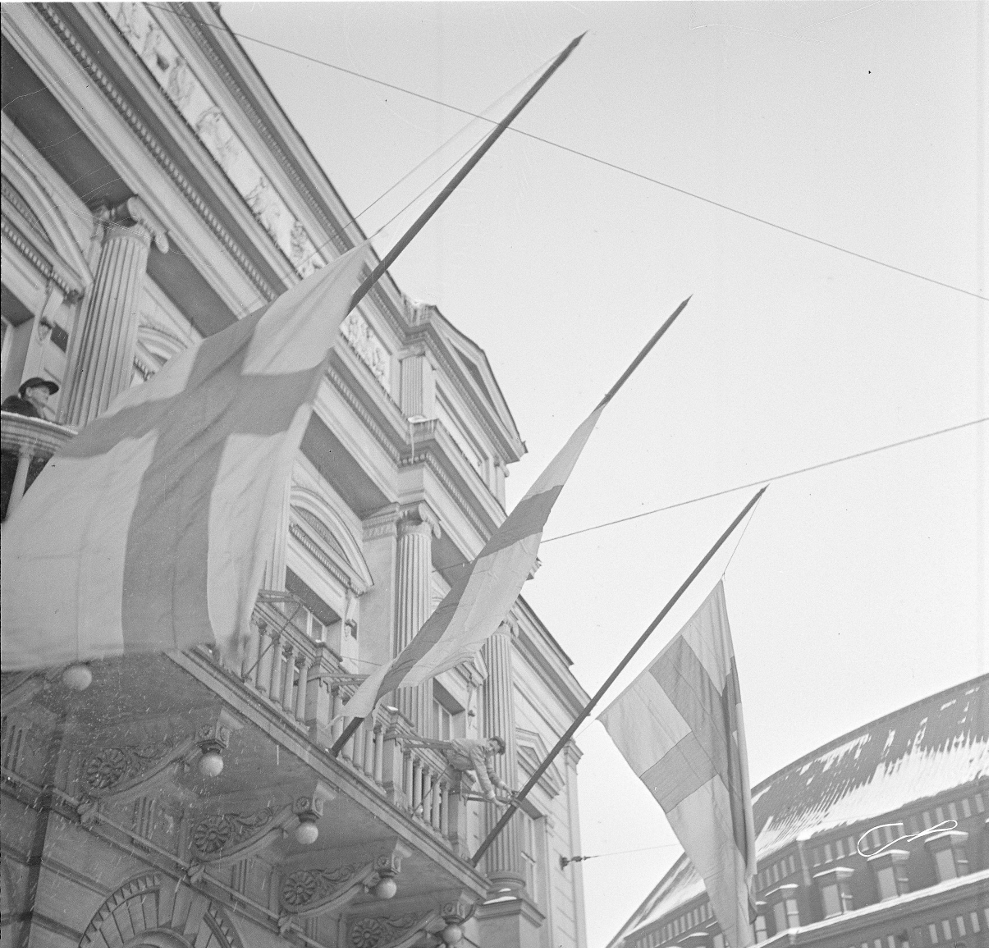

At 9 o’clock in the morning President Kyösti Kallio puts his signature to a paper giving full powers of negotiation to the Finnish delegation at the Moscow peace talks. Kallio says on signing: “This is the most awful document I have ever had to sign. May the hand wither which is forced to sign such a paper.”
There is a blizzard in the southern and central sectors of Finland that halts most operations. Soviet 7th Army continues assaulting Finnish positions at the edge of Viipuri. There is fierce fighting on the Isthmus to the northeast and south of Viipuri. 300 troops of the Finnish-American Legion reach the front at Viipuri.
The Red Army breaks through at Kollaa to a depth of approximately one kilometre. Combat Detachment Haini’s daily losses total around 100 men. On the days of fiercest fighting, the Soviets are losing over 2,000 men a day.
The Finns decide to abandon the defensive line along the River Kollaanjoki.
Around 50 Soviet tanks drive across the Vuoksi to the mainland, suffering losses under the Finnish artillery fire.
Colonel Hersalo’s 21st Division launches a counterattack in Vuosalmi.
The commander of III Army Corps, Major-General Talvela decides to pull back his troops in Vuosalmi on account of the ceasefire negotiations. However, in the evening his troops occupy the support line in the rear.
The troops defending Viipuri withdraw by midnight to new positions in Patterinmäki.
The weather keeps most planes grounded. Before things close down, a Soviet Polikarpov I-16 “Ishak” fighter (the Finns call it Siipiorava (“Flying Squirrel”)) wages a solitary battle against a lone Finnish anti-aircraft gunner located on a water tower at the city of Utti. The fighter makes numerous passes, obsessed with eliminating the gunner, but finally, the anti-aircraft gunner wins and shoots it down.
There is a serious rail accident south of Hämeenlinna between Turenki and Harviala when a military train carrying a transport company is involved in a collision with an express train. All the company’s 4 officers and around 30 men are killed, and another 40 are injured in the collision.
Sweden announces its readiness to begin talks with Finland on a possible defensive alliance between the two countries. Finnish Foreign Minister Väinö Tanner wanted the expression “urgently consider” to be included in the news report of the talks, but Sweden demanded removal of the word “urgently”.
The British embarked about 20,000 troops on transport ships at Rosyth, Scotland, to land in Norway, as the British finalize their plans for the invasion of Norway. Landings are to be made at Narvik and Trondheim in order to secure the rail line to Sweden and the large iron-ore fields. The ships did not depart as they were awaiting orders to begin the operation. The British War Cabinet debated operational plans, especially how to deal with Norwegian or Swedish armed opposition to the landings and subsequent troop movements through their countries. British Prime Minister Neville Chamberlain was against the whole operation, particularly armed conflict with the neutral Scandinavian countries. The British War Cabinet is uncertain about how to proceed. No agreement to a British military presence has been received from either Norway or Sweden, and such agreement would effectively violate their neutrality. Nobody knows what to expect, and how to handle armed opposition is up in the air. Prime Minister Chamberlain condemns the entire idea, but he is rapidly losing moral authority due to the deteriorating international situation that he helped create.
The Moscow Peace Treaty ending the Winter War was signed. The treaty is signed between Soviet Union and Finland in Moscow to become effective on 13 March, ending the Russo-Finnish War. At 0900 hours, Finnish President Kyösti Kallio authorized his delegates in Moscow full powers to negotiate peace terms. Soviet representatives had drafted a document dated today, ready for the Finnish delegation to sign. The document called for Finland to give up 35,000 square kilometers (16,173 square miles ) of territory to Russia, which constituted about 10% of the country, including the city of Viipuri (to be renamed Vyborg), Salla, the Karelian Isthmus, and Ladoga Karelia, housing about 12% of the entire Finnish population (450,000 people). Most of the Finns in the ceded territory were resettled in Finland. The Hanko Peninsula was also forced to be leased to the Soviets for 30 years for use as a military base. Kallio noted “This is the most awful document I have ever had to sign. May the hand wither which is forced to sign such a paper.” The delegations to the Moscow peace talks met twice in the Kremlin, but there were no changes in the Soviet Union’s terms. The second meeting began at 10 p.m. and continued on beyond midnight.
The Finnish desire to win back territory lost to Soviet encroachment (city of Viipuri / Vyborg and areas along Finland’s eastern borders) will push them closer toward the Axis.
Sumner Welles met Winston Churchill. In Welles’ account of the meeting he wrote that “Mr. Churchill was sitting in front of the fire, smoking a 24-inch cigar, and drinking a whiskey and soda. It was quite obvious that he had consumed a good many whiskeys before I arrived.” For almost two hours Welles listened to Churchill deliver “a cascade of oratory, brilliant and always effective, interlarded with considerable wit.”
An appeal to the American people to understand that Britain and France cannot weaken their blockade against Germany, coupled with a pledge to avoid “unnecessary inconvenience and loss to neutral countries,” was made today by Charles Rist of France and Frank Ashton-Gwatkin of Britain.
Oliver Stanley, British Secretary of State for War, in introducing army estimates, told the House of Commons today that the British Expeditionary Force had been doubled during the past five months. He said there were now approximately 316,000 British soldiers in France.
The French prime minister, Daladier, informs the Chamber of Deputies that an Anglo-French expeditionary force is ready to embark for Finland on receipt of a formal Finnish appeal for assistance.
Adolf Hitler met with Colin Ross, whom Hitler considered to be his top adviser on the United States. Ross told Hitler that the United States, run by Jews, had imperialist tendencies in terms of foreign policy. Ross also advised Hitler that Franklin Roosevelt, who had come to power around the same time as Hitler, was jealous of Hitler’s greater success thus was plotting with the Western Allies to defeat Germany.
The termination of the Russo-Finnish conflict and the consequent restoration of peace in the north is interpreted in official quarters in Berlin tonight as a victory for German diplomacy.
German Foreign Minister Ribbentrop continued his meeting with Mussolini in Italy, setting up a conference between Hitler and Mussolini, to be held some time on or after 19 March 1940.
A transport of 1,000 German Jews was forced to march through cold weather toward the Lublin Ghetto. 72 German Jews died of exposure.
Shipment of food parcels into Germany from the Netherlands on orders from the United States has almost completely ceased as a result of the restrictions put into effect by the Netherlands Government on March 1, it was reported by local concerns engaged in the “mail-order” business of forwarding food packages to Germany.
British General Wavell, the commander in the Middle East, sets out to South Africa for consultations with Jan Smuts.
British Home Fleet returns to Scapa Flow in the Orkney Islands from Rosyth and Loch Ewe after the completion of a substantial improvement of the anti-aircraft and anti-submarine defenses at the base.
Luftwaffe He-115 torpedo bombers make unsuccessful attacks on shipping along British coast.
The British cargo ship Gardenia struck a mine and sank in the North Sea off Cromer, Norfolk (53°04′N 1°33′E). All 33 crew were rescued by the Royal Navy armed trawler HMT Viviana.
The French barquentine Rose Effeuilée struck a mine in the North Sea (51°25′N 1°45′E) and sank. All crew were rescued.
Destroyer HMS Wren was damaged in a collision with steamer Lacklan (8670grt) 16 miles 180° off the Lizard. The stern of the destroyer was damaged. The steamer proceeded to Falmouth. Wren was repaired at Plymouth, completing on 13 April.
A British warship today landed in Capetown, South Africa, with 46 German prisoners – the crew of the scuttled steamer Wakama, which was scuttled off the Brazilian coast on February 12th. She also landed 16 British sailors from the Ajax, the Achilles, and the Exeter, who had been wounded in the battle of the River Plate. They were brought here for convalescence from Port Stanley, in the Falkland Islands, as there are better facilities for treatment here. The German prisoners were cheerful and obviously pleased with their treatment on board the warship. They had been given the greatest freedom, and even allowed to help the warship’s crew at their work. They were freely supplied with cigarettes and received the same rations as the warship’s crew. It was their captain, Captain Eschact, who, when he learned that the German reports alleged his crew had been fired on in their lifeboats, sent a special message to the Woermann Line, denying the reports and saying that the whole crew had been rescued by a British warship.
Convoy TM.25 departed the Tyne, escorted by the 19th Anti-submarine Group and supported by destroyer HMS Javelin.
Convoy FN.119 departed Southend escorted by destroyer HMS Jervis and HMS Whitley, sloop HMS Egret, and arrived in the Tyne on the 14th.
Convoy OB.108 departs Liverpool.
Convoy HG.22 of thirty nine ships departed Gibraltar escorted by destroyers HMS Watchman and HMS Vortigern from 12 to 19 March. Watchman and Vortigern were detached to Devonport and Portsmouth, respectively, for leave. Destroyers HMS Vanquisher, HMS Witch, and HMS Acasta escorted the convoy in Home Waters from 19 to 21 March. The convoy arrived at Liverpool on the 22nd.
The War at Sea, Tuesday, 12 March 1940 (naval-history.net)
Light cruiser MANCHESTER arrived at Scapa Flow after Northern Patrol.
Destroyers HARDY (D.2), FIREDRAKE, HOSTILE, and TARTAR escorted heavy cruisers BERWICK, NORFOLK and YORK of the 1st Cruiser Squadron on a full caliber shoot west of the Orkneys. After the shoot, the cruisers proceeded to Rosyth. The destroyers INTREPID and GRIFFIN proceeded 1931 to search for a submarine reported by aircraft at 1900 east of South Ronaldsay in 58 49N, 02 20W. Destroyers HARDY, FIREDRAKE, HOSTILE, ILEX, and TARTAR were ordered at 2000 to join. At 2130, HARDY and FIREDRAKE attacked a submarine contact and at 2140, TARTAR attacked a submarine contact east of Copinsay in 58 53.5N, 02 15W.All the attacks were unsuccessful. The contact was later assessed as probably a wreck. HARDY, HOSTILE, and TARTAR arrived at Scapa Flow after the hunt on the 13th. FIREDRAKE was detailed to patrol on a line south of Canntlick Head to Sandwick Bay, South Ronaldshay.
Destroyers ESKIMO, PUNJABI, and MASHONA departed Scapa Flow at 0030 for the Clyde for escort duties, and arrived late on the 12th.
Convoy TM.25 departed the Tyne, escorted by the 19th Anti-submarine Group and supported by destroyer JAVELIN.
Convoy FN.119 departed Southend escorted by destroyer JERVIS and WHITLEY, and sloop EGRET, and arrived in the Tyne on the 14th.
Destroyer WREN was damaged in a collision with steamer LACKLAN (8670grt) 16 miles 180° off the Lizard. The stern of the destroyer was damaged. The steamer proceeded to Falmouth. WREN was repaired at Plymouth completing on 13 April.
Destroyer WOLSEY was slightly damaged when she grounded alongside an oiler in the Firth of Forth.
Anti-submarine trawlers LE TIGER (516grt) and COVENTRY CITY (546grt) attacked a submarine contact off Aberdeen in 57-13N, 1-56W.
The 1st, 7th and 12th Destroyer Flotillas and the I’s of the 20th Flotilla were placed under the control of the Commander in Chief, Home Fleet.
Destroyer BRILLIANT completed boiler cleaning and degaussing alongside depot ship SANDHURST at Dover. Destroyer BOADICEA went alongside SANDHURST for similar work.
Destroyers ILEX, GRIFFIN, and INTREPID were submarine hunting in Moray Firth after a report by a British aircraft. INTREPID was joined on the 13th by destroyers FOXHOUND and IVANHOE.
FOXHOUND and IVANHOE had escorted steamers DEVON CITY (4928grt) and SPANKER (1875grt) from Methil departing at 1200/12th and arriving at Scapa Flow on the 13th.
Submarines NARWHAL and SWORDFISH departed Scapa Flow for Rosyth and Blyth, respectively. Anti-submarine whaler BUTTERMERE (560grt), escorting the submarines in Moray Firth in 58-16.5N, 2-22.2W made attacks on a submarine contact. The contact was probably a buoy laid by minesweeper NIGER after her submarine attack on 21 February. NARWHAL arrived at Rosyth on the 13th. SWORDFISH continued on to Blyth where she arrived later on the 13th.
Destroyers WOLSEY and BRAZEN and cable ship ROYAL SCOT arrived at Rosyth after completing the work of repairing the cables.
Destroyer VENETIA, escorting convoy OB.106, attacked a submarine contact west of Ushant in 48 10N, 09 14W at 1910. Sloop ROCHESTER was in company and reported an underwater explosion at 1940.
Submarine PORPOISE departed Portsmouth for Rosyth, and on the 13th, left Southend in convoy FN.120 for the passage north.
Submarine URSULA departed Blyth for patrol, and on the 14th, was ordered to the vicinity of Gotenburg to attack German destroyers reported operating in the area.
Submarines TRITON, TRUANT, and SEAL departed Rosyth on patrol.
Lt P.G. Philcox RNVR and Able Seaman D. Lewis were killed when their Proctor of 758 Squadron crashed near Worthy Down.
Steamers MACGREGOR LAIRD (4015grt) and LOMBARDY (3379grt) arrived at the Clyde from the south, leaving there on the 16th to return to Newport.
French fishing vessel ROSE EFFEUILEE (35grt) was lost on a mine laid by German minelaying Ship 11 in the North Sea in 51.25N, 01.45E; the entire crew was rescued.
A peace treaty between the USSR and Finland was announced and signed on the 13th. British operation STRATFORD, and Plan R 3, the proposed landing of troops at Narvik and Trondheim on the 20th to be followed shortly by landings at Stavanger and Bergen to relieve Finnish troops, was cancelled. The ships of the operation were released on the 15th. Heavy cruisers of the 1st Cruiser Squadron returned to Northern Patrol duties. Light cruisers GALATEA and AURORA with destroyers of the 6th Destroyer Flotilla departed the Clyde to return to Scapa Flow.
Convoy HG.22 of thirty-nine ships departed Gibraltar escorted by destroyers WATCHMAN and VORTIGERN from 12 to 19 March. WATCHMAN and VORTIGERN were detached to Devonport and Portsmouth, respectively, for leave. Destroyers VANQUISHER, WITCH, and ACASTA escorted the convoy in Home Waters from 19 to 21 March. The convoy arrived at Liverpool on the 22nd.
Destroyer WRESTLER arrived at Gibraltar after repairs at Malta.
French large destroyers MILAN and ÉPERVIER collided during preparations for the Finland operations. MILAN was repaired at Cherbourg completing on 4 April and ÉPERVIER at Brest, completing on 12 April.
The U.S. presidential primaries began in New Hampshire. In this year’s first primary election in the United States, the Democratic organization of New Hampshire elected today a full set of Roosevelt-pledged delegates to the Democratic National Convention and thereby made an official start in the movement to draft the President to run for a third term. The margin of victory, however, was not sufficiently large to be particularly encouraging to the President’s supporters. Incomplete returns indicated that the winning Roosevelt candidates for delegates. at large would not defeat the two candidates pledged to Postmaster General James A. Farley by much more than two to one.
Sizable votes for the delegates pledged to Vice President John N. Garner and to two unpledged candidates indicated that there was a strong anti-third term sentiment among the State’s Democrats. With the party organization making every effort to get every Democrat to the polls and with a considerable number of those on relief or on WPA projects voting for the Roosevelt ticket, the strength shown by the unorganized opposition was considerable.
Under the New Hampshire law, Roosevelt-pledged delegates must vote for him in the convention. until released personally by him. In returns from the Republican primary, Senator H. Styles Bridges, candidate for the nomination for President, led the field of eight candidates for four places as Delegates-at-Large, with his colleague, Senator Charles W. Tobey, second. The remaining two places apparently went to former Senator George H. Moses and former Governor Huntley N. Spaulding, who led Governor Francis P. Murphy with approximately half the returns tabulated.
The defeat of Governor Murphy, which was almost surely indicated, was a double victory for Senator Bridges. The Governor, an aspirant for the Vice Presidential nomination, has been lukewarm to the Bridges Presidential candidacy and his defeat for delegate at large would be likely to curb any plans he might have to run for the Senate in 1942, when Senator Bridges, if his present aims fail, will be up for re-election.
Only one Republican candidate for delegate at large was pledged. He was J. Howard Gile of Nashua, who was pledged to District Attorney Thomas E. Dewey of New York over the protest of Mr. Dewey. Mr. Gile was getting about a fifth as many votes as Senator Bridges.
President Roosevelt still has not made a firm statement about whether he will pursue a third term.
In Washington today, President Roosevelt again remained away from his desk, due to a cold, and cancelled his regular Tuesday press conference. He conferred in his private study with Governor Cone of Florida and Senator Pepper and with Senator Donahey.
The Senate approved and returned to the House the $92,769,021 First Deficiency Bill, considered amendments to the Hatch act, received from the Commerce Committee a recommendation for wire-tapping inquiry and recessed at 5:23 PM until noon tomorrow. The Commerce Committee also approved the Tobey resolution putting the Senate on record as opposed to certain census questions.
The House passed the $854,000,000 Naval Expansion Bill and adjourned at 4:49 PM until noon tomorrow.
The House passed and sent to the Senate today the Vinson bill authorizing an expenditure over the next few years of $654,902,270 to add to the navy 167,000 tons of fighting craft, or about twenty-one ships, as well as twenty-two auxiliary vessels and 1.011 additional planes. The roll-call was 303 to 37. The bill as originally submitted to Congress with Administration approval called for an expenditure of $1,300,000,000 in the next five fiscal years. The House Naval Affairs Committee was largely responsible for halving the amount. Passage was accomplished in less than five hours when little opposition to the measure developed. Representative Vinson of Georgia, chairman of the Naval Affairs Committee, urged the 10 percent increase in the navy to let Europe know that “we can speak the language of force” if necessary.
An amendment was offered by Representative Fish of New York to eliminate three aircraft carriers. It was shouted down after Mr. Vinson and others said that the Navy Intelligence Division had informed them that Japan had eleven aircraft carriers and was building two more. Mr. Fish contended that the carriers were not necessary to strict defense of our shores. Another amendment was proposed by Representative Schafer of Wisconsin, who sought to prevent the sale to foreign nations of any types of planes authorized in the bill. It was defeated overwhelmingly after Representative Taber of New York said that the language of the amendment would prohibit American manufacturers from selling any combatant planes abroad.
Quickly agreed to, however, was an amendment by Representative Cole of New York fixing at 4,500 the maximum number of planes which the navy may have. The Navy Department originally had asked for 6,000 planes but had consented to the lower figure — as a minimum, however. The bill also provides that, if necessary to carry out the program, shipbuilding docks may be built at the Portsmouth, Philadelphia and Norfolk navy yards.
Although facing an inconclusive future, the Hatch bill to curb political activities by Federal-aid State Jobholders hurdled its first direct ballot test in the Senate today. An outright attempt to vitiate its effect was voted down, 47 to 34, the vote being on an amendment by Senator Johnson of Colorado declaring that the restrictions should not be effective except in States having similar legislation. The vote showed that the coalition of Democrats and Republicans arrayed on the Hatch side from the first was holding its lines. Those backing the Johnson proposal were all Democrats except Senator Lundeen, Farmer-Labor. Partly as a result of this vote and to some degree on the basis of cloakroom surveys, the majority leadership was reported to feel that prospects for the bill appeared to be brighter, particularly as there was no visible evidence today of a desire by the minority to provoke an actual filibuster.
It was notable that while Senator Barkley, the majority leader, failed again in efforts to obtain an agreement to limit debate and expedite a final vote, objections to this action were voiced by individuals who acted for private reasons rather than by the group, including Senators Minton, Lucas and Pepper, which has marshaled the opposition to the measure. Senators Miller and Bilbo objected when Senator Barkley asked unanimous consent for a final vote tomorrow. Their objections were grounded, it appeared, principally on a fear that limitation of debate would open the door for introduction of the Anti-Lynching Bill as an amendment to the Hatch bill.
The House Census Committee approved a Congressional reapportionment bill today which would exclude the counting of alien residents in the determination of the number of House members from each State.
Still suffering from a slight head cold, President Roosevelt remained away from his desk in the executive office again today, but kept a full appointment schedule and dispatched the usual amount of office routine from his study on the second floor of the mansion. He canceled his regular press conference. Rear Admiral Ross T. McIntire, White House physician, advised Mr. Roosevelt “as a precautionary measure” against going to his office.
An analysis of more than eighty-seven surveys conducted by the Institute of Public Opinion since 1936 on the question of a possible third term indicates that President Roosevelt “would have a hard time being elected at the present time” should he run to succeed himself, it was announced yesterday by Dr. George Gallup, director of the organization. “While 64 percent of voters polled by the institute approve of Roosevelt as President at this point in his second term, only 47 percent are for a third term in a study completed this week,” the analysis said. “This compares with 46 percent last month.”
Elliott Roosevelt, second son of the President, called today for a “thorough housecleaning” of the National Labor Relations Board and amendment of the Wagner act to give business rights equal to those of labor.
A political tempest of the first magnitude which has already manifested itself in growing differences within the Administration appeared to be brewing here tonight over the sale of United States military planes to the Allies. Prompted by a statement by the War Department that the new Curtiss P-40 pursuit ship, powered with the Allison liquid-cooled engine, had been released for foreign sale and by reports that Allied purchasing commissions in this country expected to be able to procure even later models which have not yet been delivered to our own forces, a House subcommittee planned to discuss the question of foreign plane purchases tomorrow morning. The decision followed several weeks of hearings before another Congressional committee on the Army Appropriation Bill. It is understood that the effect of foreign orders on our own plane procurement program received considerable attention and that some of the testimony of War Department officials tended to indicate that the problems of plane procurement for our own forces had been made more complex by foreign orders.
USAAF General Henry “Hap” Arnold received a warning from Franklin Roosevelt for having voiced complaints against policies set forth by Roosevelt’s cabinet.
Two additional shipments of American Red Cross relief supplies valued at more than $100,000 are being rushed to Poland to meet urgent needs of suffering Poles, Norman H. Davis, chairman of the Red Cross, announeed today.
Shreveport, Louisiana cleared the debris late tonight left by a seventy-milean-hour wind that killed ten persons, injured scores and damaged 500 homes in five residential sections.
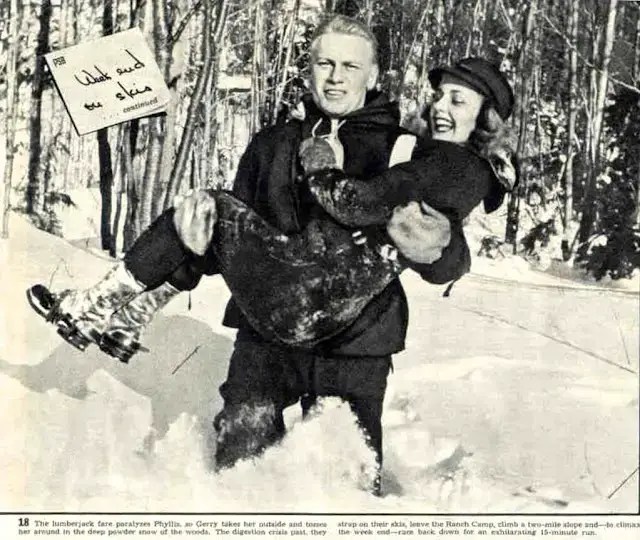
Look Magazine has a six-page feature on a Yale Law School student who also was a partner in a New York modeling agency (he was a model himself) and an assistant coach on the Yale football team. The male model was Gerald Ford. He became the 38th President of the United States in 1974 upon the resignation of Richard Nixon.
The screw steamer Poling Brothers No.2, formerly the Civil War USS Little Ada, foundered in ice off Captain Island, Long Island Sound, New York; no lives lost.
On the eve of a meeting of the political council of the Wang Ching-wei faction of the Kuomintang [Nationalist party] in Nanking, Mr. Wang tonight again appealed to the Chinese people to accept peace with Japan in accordance with a program he said would be best for China. Mr. Wang’s manifesto “regrets that now is not the time” to reveal a plan he has negotiated for readjustment of Chinese-Japanese relations, but he asked the nation to accept his assurance that the plan would guarantee China’s independence and that, as conditions improved, Japanese troops would be withdrawn, except from specified areas, where they would be needed to combat communism. The manifesto concludes with an appeal to Chiang Kai-shek’s government to “divest its mind of prejudice and immediately cease hostilities; upon this depends the salvation of the nation.”
Battle of South Kwangsi: Chinese 46th Army opens attack toward Nanning from the east.
A Chinese customs cruiser and a Portuguese patrol vessel fought off Portuguese Macao yesterday. A Chinese woman official was killed, four Chinese customs officers were seriously wounded and four others were arrested by the Portuguese. According to reports from Macao the customs cruiser approached Portuguese waters to search junks. for smuggled wolfram ore. When alleged smugglers fired on the cruiser the Portuguese vessel mistook it for a pirate craft and opened fire. The Chinese authorities are expected to protest to Portugal.
“Japan will render whole-hearted assistance toward the formation of the new government [in China] and is prepared speedily to extend recognition following its establishment.” This statement constitutes virtually the only definite pledge in Premier Mitsumasa Yonai’s answer to Wang Ching-wei’s statement, as handed out by the Foreign Office at noon today. The remainder of the statement depicts Japan’s ideals and aims in the customary vague phraseology. Japan’s purpose, the statement says, is “that the nations concerned shall cultivate relations of mutual aid and good fellowship, stand guard against the menace of communism so as to ensure peace in East Asia and practice the principle of ministering to each other’s needs by creating a reciprocal economic system.”
“That Japan will respect China’s independence and freedom,” it continues, “has been made clear in successive statements issued by Japan and will be proved in fact when the present disturbances subside.” Admiral Yonai did not announce Japan’s peace terms. These will be embodied in a treaty negotiated with the Wang government after it has established itself as a working entity. What Japan expects can be best described by repetition of the substance of a conversation this correspondent had with an official who knows the government’s views. He emphasized the importance of the new government’s role. He said its establishment would create a changed situation and Chungking would fade from the picture and become a mere backwoods regime.
Dow Jones Industrial Average: 148.37 (+0.22)
Born:
Al Jarreau, jazz singer (“Breaking Away”; “We’re In This Love Together”; “Moonlighting”), in Milwaukee, Wisconsin (d. 2017).
M.A. Numminen, Finnish avant-garde singer-songwriter and author, born in Somero, Finland.
Naval Construction:
The Royal Navy Shakespeare-class minesweeping trawler HMS Horatio (T 153) is laid down by Cook, Welton & Gemmill (Beverley, U.K.); completed by Holmes.
The Kriegsmarine (German Navy) Type VIIB U-boat U-99 is launched by F. Krupp Germaniawerft AG, Kiel (werk 593).
The Royal Navy auxiliary (coastal) anti-aircraft ship HMS Emperor of India (4.237) is commissioned. Her first commanding officer is T/Lieutenant Charles Clifford Matthews Pawley, RNR. (Paddle steamer originally built as Princess Royal in 1906; requisitioned by the Admiralty in September 1939.)



 History Diaries