Authoritative sources said today that recommendations by American officials in Saigon would probably lead to the stationing of a United States Army division in South Vietnam for defensive security. The sources explained that the assignment of a division. was one of a number of manpower plans under consideration and that so far no action had been taken to carry it out. But they predicted that insistent needs for greater troop reserves would make a prompt and favorable decision likely. They said that the use of Army troops rather than marines was likely because Washington was hesitant to tie up a large percentage of the Marine Corps on static duty.
General Harold K. Johnson, the Army Chief of Staff, left Saigon tonight to report to President Johnson on the military situation, particularly on the need for added manpower. With support troops such as administrative personnel, medical corpsmen, and Army aviation units, the size of a division would approach 20,000 men. The two battalions of United States. Marines that landed Monday to protect the jet airfield at Da nang brought the number of American troops in Vietnam above 27,000.
General Johnson closed his eight-day tour with a statement at Saigon Airport. He did not answer questions. “I will go back with a better understanding.” the general told a group that included Ambassador Maxwell D. Taylor and General William C. Westmoreland, commander of United States forces in Vietnam. “I think we will be more responsive at the Department of the Army level than perhaps we have been before.” Few military men in Saigon voice enthusiasm about a further commitment of large numbers of American troops. They suggest, however, that until the South Vietnamese can strengthen and increase their own forces, there is no other way to guarantee the security of vital American installations. Misgivings about the use of more United States soldiers have been analyzed during General Johnson’s visit.
Officials say they are aware of a danger of swamping the country with a predominantly white army and have weighed the propaganda fuel that such a move would give to the Việt Cộng. They say the troops would probably become engaged in military operations although their initial assignment would be limited to providing border security around certain bases. When these drawbacks and others had been explored, officials still maintained that the situation required emergency measures. The Biên Hòa and Tân Sơn Nhứt Air Bases, in Saigon, are two of the chief installations where greater guard forces would be stationed, the sources said. Ambassador Taylor, who was Chairman of the Joint Chiefs of Staff before he accepted the diplomatic assignment to South Vietnam, has repeatedly called for a ratio of at least 10 to 1 of government regular and paramilitary forces against the Communists.
The Vietnamese armed forces are reported to have 240,000 men. Regional forces, popular forces, irregular guards and other paramilitary units, such as the Combat Youth, are supposed to bring to 550,000 the total of Vietnamese Government forces. The Communist regular forces and guerrillas have been estimated at 110,000. If these figures are accurate, the ratio has been only half of what Mr. Taylor and other authorities on guerrilla warfare consider to be essential. A somewhat more hopeful view has been expressed by General Westmoreland. Although he, too, would prefer the 10-to-1 ratio, General Westmoreland is known to believe that helicopters, widely available for the first time in a guerrilla war, make it possible for the government to survive and even score successes with a ratio far less favorable.
The Government of Premier Phan Huy Quát today proclaimed a program of action foreseeing a general expansion of the war in Vietnam. Addressing all Vietnamese, North and South, it called for peace through victory. North Vietnamese are to be urged to participate, a tacit call for a revolt against President Hồ Chí Minh. The Hanoi radio said 12 United States and South Vietnamese planes from Đà Nẵng strafed the North Vietnamese border village of Chalo yesterday. Without mentioning casualties or damage, it said a protest had been filed with the International Control Commission.
In Washington, a Defense Department spokesman said he was unaware of action by United States planes in any new attack on North Vietnam. Four United States B-57’s and six Vietnamese Skyraiders flew missions that authorities said were directed against Việt Cộng forces in South Vietnam. The B-57’s struck at guerrilla concentrations about 180 miles south of Đà Nẵng in Phú Yên Province.
United States marines who reached Đà Nẵng last Monday clashed with Communist guerrillas for the first time last night, a marine spokesman said today. There were no Marine casualties. A Việt Cộng band attacked a marine unit entrenched on a hill about five miles west of Đà Nẵng, a key air base. The guerrillas got to within 350 yards of the marines’ positions before they were detected on a radar device. The marines fired flares and a small band of guerrillas was spotted. The guerrillas withdrew after the marines opened up with machine guns and heavy artillery.
Communist China declared in a statement today that the dispatch of United States ground forces to South Vietnam had “further blocked the way to a political settlement of the Vietnam question.” Peking charged that the arrival of the United States marine brigade in South Vietnam meant that the United States had “entered upon the path of war of the Korean type, willy-nilly.” It added that the Chinese were “not afraid” of the United States bombing China. The statement, dated yesterday, was made public as an official pronouncement by Hsinhua, the Chinese Communist press agency.
Analysts in Hong Kong said that it added no new threats of intervention to what Peking has already said. It appeared mainly to be concerned with emphasizing the view that the United States, by sending in the Marines, had closed the door to negotiations. “The United States will not succeed in its attempt to obtain the right to hang on in Vietnam by sending reinforcements to South Vietnam and extending its aggression in Vietnam,” the statement said. “If it has any desire for a political settlement it should withdraw its troops, every soldier who has been sent in must get out and not a single one will be allowed to remain.”
Communist China charged yesterday that Canadian members of the International Control Commission for Vietnam were serving United States interests and defaming North Vietnam.
Secretary of State Dean Rusk informed France today that the United States was cool toward any French-Soviet move for an international conference on Southeast Asia at this time.
The Soviet Government accused Communist China tonight of conducting an “extensive slander campaign” over methods used by the Soviet police in curbing a riot at the United States Embassy eight days ago. The Soviet accusation was expressed in an unusually strong note sent to the Chinese Embassy by the Soviet Foreign Ministry. The text of the note was made public by Tass, the Soviet press agency. It was the strongest statement addressed to the Chinese Communist leadership by the new Soviet leaders since they took over from Premier Nikita S. Khrushchev five and a half months ago.
A Chinese note last weekend accused the Soviet Union of police brutality against 2,000 Asian students who marched on the United States Embassy on March 4. The Chinese protest demanded that the Soviet authorities “admit their errors” and “apologize to the students.” It also requested that the police officers who had “committed violence” be “severely punished.” The Soviet reply rejected the Chinese charges as “completely groundless” and described the Chinese note as “an intolerable attack.” It said the Chinese students in the riot had used “iron rods, stones and sharp objects” to strike “unarmed Soviet policemen.” More than 30 policemen and soldiers were badly injured and four of them received serious wounds, the note declared. It accused the rioters of “premeditated provocation” directed against Soviet authorities as well as against a foreign embassy. Moscow requested the Chinese Embassy to take measures to prevent similar actions by Chinese citizens in the Soviet Union in the future.
The note warned that any similar violation of public order would be “resolutely cut short” and that the offenders would be taken to court under Soviet law. The Soviet note told the Chinese that Moscow did not intend to take lessons from anyone on “how to fight imperialIsm.” “As is well known,” the note said, the Soviet Union is taking “practical measures” to give added security and protection to North Vietnam. The Soviet Government and the Soviet people emphatically condemn “American aggression” and the “barbaric bombing” of North Vietnamese territory, it went on. It added that the Soviet Government and people “understood the feelings” of the Asian demonstrators who marched on the embassy.
The stakes have risen sharply for President Gamal Abdel Nasser in his showdown with West Germany now that President Habib Bourguiba of Tunisia has exposed a breach in the Arabs’ ranks on the German question. Not only are Mr. Nasser’s relations with Bonn and the West as a whole on the line, but Mr. Bourguiba’s statement is viewed here as representing a challenge to Mr. Nasser’s leadership of the Arab world, which has been carefully cultivated by Cairo for the last 15 months. Two nights ago Mr. Nasser dramatically announced that envoys of all 13 Arab states had unanimously agreed to a political and economic break with Bonn and that he would go a step further and recognize East Germany if Bonn established formal relations with Israel.
Mr. Bourguiba’s response — refusing to go along with the boycott of Bonn and criticizing Mr. Nasser’s handling of the current crisis — coming less than 24 hours later, caused a shock. With the Arab foreign ministers due to meet in Cairo Sunday for a final decision, the test for Mr. Nasser will be: How many Arab states he can persuade to go along with him, at least as far as breaking with Bonn is concerned, and how many Arab “moderates” will join Mr. Bourguiba and be unwilling to do more than recall their ambassadors from Bonn to signify their displeasure?
For President Nasser there was a disquieting note last night when King Hassan II of Morocco, here on a state visit, did not mention the German question in his speech at a dinner even though Mr. Nasser praised him for canceling his plan for a trip to Bonn. Today Mr. Nasser missed prayers and an embassy reception given for him by King Hassan though both events were on the published schedule.
A group of West German aircraft experts have told the Egyptian press they wanted to continue working here in spite of a possible break in diplomatic relations between Bonn and Cairo. But others have privately informed Western friends they will leave. Politically, the fate of President Gamal Abdel Nasser’s German experts is the major unanswered question left by the Egyptian President’s warning that if Bonn recognizes Israel he would recognize East Germany, seize German schools here and sequestrate other German assets. Because of West Germany’s extensive role in the Egyptian economy during recent years, a complete political and economic rupture with Bonn would also have a significant effect on the United Arab Republic’s development plans — at least over the short run. West Germans are “in here far deeper” than any other Western country, an independent Western economist remarked recently. A number of important projects now partly completed would presumably have to be dropped if relations are broken.
Authoritative sources denied today reports from Bonn that Israel had conditioned the question of diplomatic relations with West Germany on a German guarantee of her frontiers. “The report is not correct.” one official declared. “Who asked them to guarantee our frontiers, and how the hell would they do it?” asked another. The request, according to informants in Bonn, came from the Israeli Government. Rejecting it, a spokesman for the West German Government said, “There has never been any question of a security guarantee.” A feeling was expressed in informed quarters in Jerusalem that the reports from Bonn had been planted by “some circles” in the West German Foreign Ministry that were opposed to closer ties between the two countries.
Israeli Foreign Minister Golda Meir said today she expected that the Cabinet would decide Sunday on a West German request for diplomatic relations with Israel.
An increasing danger of new fighting in Cyprus was reported to the United Nations Security Council today by the Secretary General, U Thant. The Government of Cyprus has received both light and heavy equipment, he said, brought in without notice to the United Nations, in violation of an agreement. Both the warring Greek and Turkish Cypriot communities are better armed and a renewal of fighting is “likely to be more severe than before,” Mr. Thant reported. His report recommended extension of the United Nations peacekeeping force for another three months from March 26. But he expressed the feeling that its influence might diminish with rising tension and what he called “frustration and uncertainty” among the Cypriots.
The mercenary force that was expected to march against rebel positions in the northeastern Congo is not moving, according to military sources in Leopoldville, because it is shot of boots.
The West German Bundesrat, or upper house of Parliament, moved today to force judges and state prosecutors who had served Nazi courts to resign.
Premier Fidel Castro’s regime defended today this year’s glittering Havana carnival celebration against charges that they were extravagant and wasteful.
The third Test of New Zealand’s 1964–65 cricket tour of India opened at the Brabourne Stadium, Bombay.
His face flushed, Wilson Baker sprang from his white Chrysler today, took out his pocket knife and cut a single strand of rope that had been stretched across Sylvan Street since yesterday morning. Two hundred surprised Blacks, ministers and nuns stopped singing an improvised song called “The Berlin Wall” and broke into cheers. Then they chanted, “Freedom, we’ve got freedom.” But the exultation was short-lived. The city’s weary Director of Public Safety had simply eliminated a symbol. “Please do not move out.” Mr. Baker said. “You are not going to march.” The civil rights demonstrators, who have been in the street since Wednesday night, cut the rope into small pieces for souvenirs and made up new words to “Berlin Wall.” sung to the tune of “The Battle of Jericho.”
“The invisible wall… is a Berlin wall… in Selma, Alabama,” they sang. “The troopers’ cars… are a Berlin Wall… in Selma, Alabama.” This incident, which occurred. spontaneously at 2:50 PM, was indicative of the continuing struggle in Selma between the authorities and Blacks and religious leaders who continued to pour in here from across the nation. The demonstration originally started as a march on the Dallas County Courthouse here, but the police quickly halted it. Later, Mr. Baker put up the rope. The courthouse has become the symbol of barriers to Black voting in the Alabama Black Belt, a region of rich soil and large Black population. where the Rev. Dr. Martin Luther King Jr. has been leading a voter registration drive. LeRoy Collins, head of the Federal Community Relations service, who is President Johnson’s representative in Selma, came close early today to working out an agreement that would have lifted the police blockade on Sylvan Street.
In his mediation effort, the former Florida Governor worked through Mr. Baker and leaders of the Southern Christian Leadership Conference, which Dr. King heads. Under the compromise, the demonstrators would have gone to the courthouse in small groups today and would have held a prayer service for the Rev. James J. Reeb, the Boston minister who died last night of injuries suffered at the hands of a white gang Tuesday night. But Mayor Joseph T. Smitherman, who has been aligned with the state authorities in curbing racial demonstrations, assembled the City Council and received a unanimous vote to continue the city’s ban against marches of any kind. When the slender, 35-year-old Mayor arrived on the street scene in an oversized raincoat, shortly before noon, the demonstrators were huddled under umbrellas and large sheets of plastic, facing the rope and 25 cars of troopers.
“No marches or demonstrations will be permitted in Selma as long as the present threat of violence to our citizens exists,” Mr. Smitherman said. “If you people want to hold a memorial service, you are free to go back into the church, which would seem to be more appropriate.” The march started at the Browns Chapel Methodist Church. Mr. Baker had no comment on why the agreement had fallen through, Mayor Smitherman said he had never been consulted about the compromise.
A mass rally, of religious leaders erupted in shouts of fury and accusation in Washington, D.C. today over what they regard as President Johnson’s failure to act on the racial crisis in Selma, Alabama. Their anger was voiced after a delegation of 16 clergymen returned from a two-hour talk with the President to give a report that was obviously not satisfactory. Thousands of churchmen and lay leaders from throughout the nation had gathered at a Washington church earlier today to urge protection for Blacks who wanted to vote. Hundreds were still there late in the day to hear the delegation’s report on Mr. Johnson’s views and plans. The delegation was told by the President that 700 troops had been alerted for use but it did not pass on this information.
One clergyman who went to the White House but not to the church meeting afterward said Mr. Johnson’s remark had been made almost casually as part of a much longer statement and that “the President went on to something else.” “You don’t quote the President,” he said, “and I think a lot of the others must have felt the same way.” Some yelled after hearing the report that the President had given them a “snow job” — that he had not yet taken a stand or spoken honestly to the nation or the clergy about what he intended to do as “leader of all of us.” The religious delegation told of the “anguish” of Mr. Johnson over police brutality in Alabama and the “infinite concern” the President evinced in “bringing about a solution of this terrible racial dilemma” throughout the South.
A Black minister from Minneapolis sprang toward the altar of the Lutheran Church of the Reformation on Capitol Hill, where today’s mass rallies were held. “We didn’t come 1,500 miles to be jeered at,” he shouted at the group who had returned from the White House. “What are we going to tell our people?! We didn’t spend money to come here for nothing. I think you have been pleased with the prestige of being appointed to a committee to talk to the President. Of those 16 people who went to the White House, only two were Negroes — whose fight is this?” The outrage and frustration expressed by those who had waited all day for the report was in contrast to the quiet militancy of the morning’s meeting.
Seven hundred Federal troops have been alerted since the early morning hours of Tuesday, on President Johnson’s order, for possible duty in Selma, Alabama. Mr. Johnson alerted the troops for quick settlement of violence he feared might arise from any failure of the highly tentative understanding that had been worked out to prevent a collision between Alab state troopers and civil rights marchers headed by the Rev. Dr. Martin Luther King Jr. But the delicate understanding did not fail, violence was averted, and the troops remain on the alert for possible new outbreaks.
There was no indication of what units were involved, or where they were located. There are no sizable Army bases near Selma but it would take only hours for the Army to draw troops from Fort Stewart and Fort Benning in Georgia or from Camp Polk in Louisiana. In connection with his alert, the President signed none of the documents that would be needed before the troops could be swung into any action. He merely issued the routine orders that would place such troops on a stand-by basis for deployment the moment the necessary documents would be signed. There are certain complex legal requirements the President must meet through appropriate documentation before federal troops can be employed in a situation like Selma.
Meanwhile there was the prospect of an immediate confrontation between the President and Alabama’s Governor George C. Wallace. The Governor tonight asked the President by wire for a meeting to discuss the civil rights crisis in his state. The President replied, even before he had received the actual Wallace message, that he would be willing to meet with him “at any time” on matters of “mutual interest and concern.”
There was no date or time specified either in the Governor’s request or the President’s reply, but Mr. Johnson’s statement that, “I will be available in my office at any time that is convenient to you” made it appear the meeting was imminent, perhaps even tomorrow. Mr. Johnson told a visiting group of ministers today that he had alerted the troops. At the same time, he made clear to them that he would not actually use federal forces in Alabama without sufficient legal cause or send voting rights legislation to Congress without proper preparation.
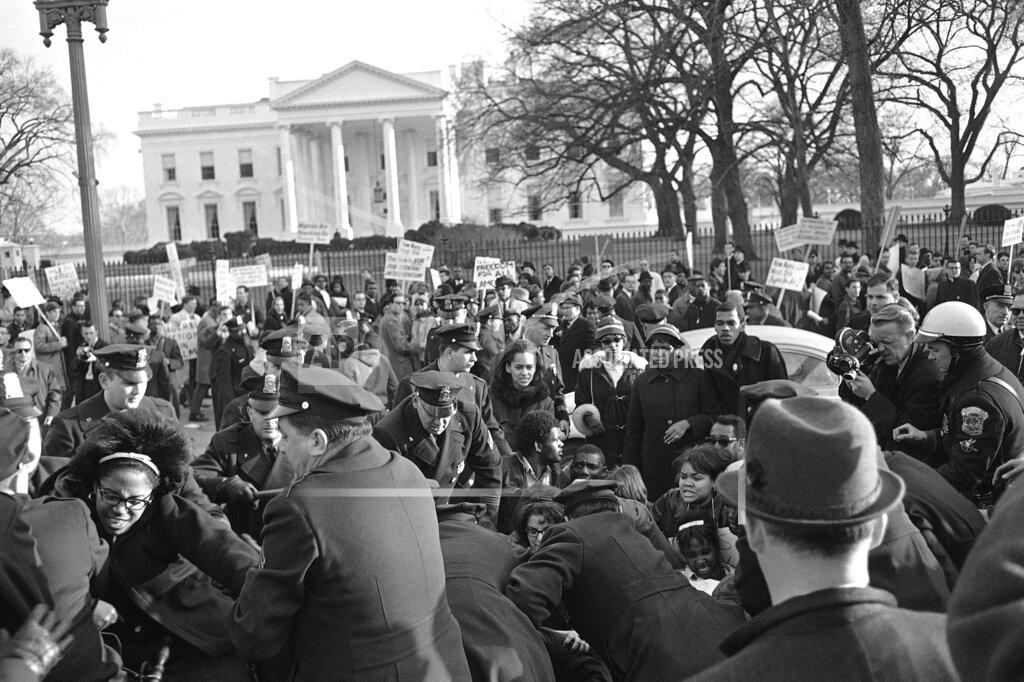
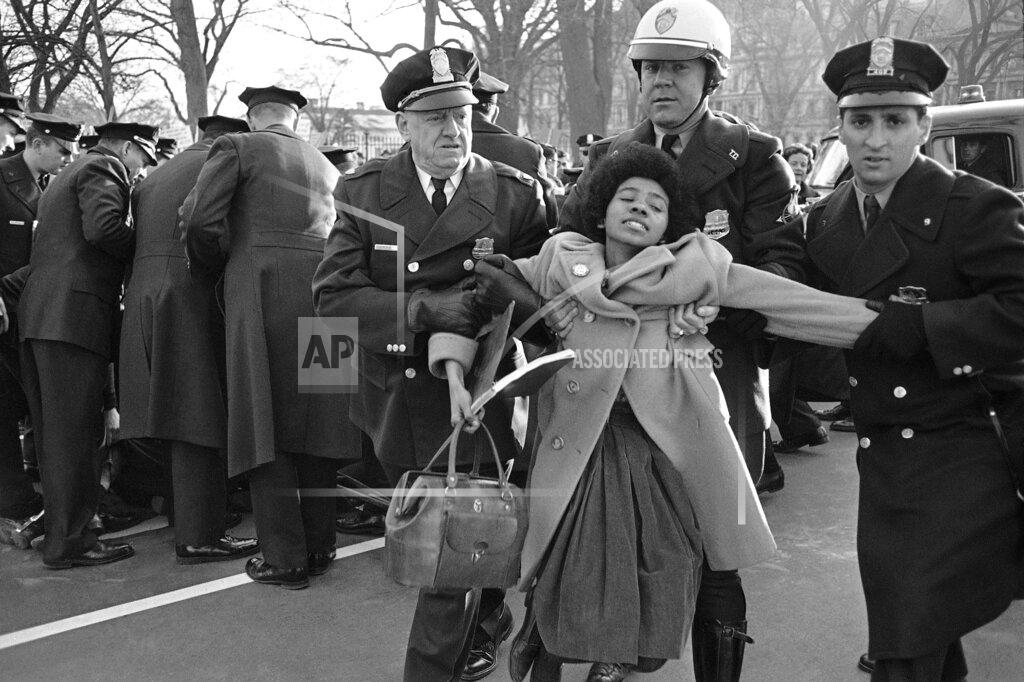
While he conferred with the ministers, hundreds of pickets marched along Pennsylvania Avenue in front of the White House. They chanted “Freedom, now,” sang “We Shall Overcome” and displayed posters such as one that read “Go All The Way, LBJ.” Late in the afternoon, some of the demonstrators lay down in the broad avenue, briefly bringing rush-hour traffic to a screaming halt. Four white women also sat down across a White House exit roadway. The four women and about two dozen demonstrators who had blocked Pennsylvania Avenue were hauled away by the police, but not without a hard struggle.
Public protests over the treatment of Negro and white integrationists in Selma, Alabama, continued across North America yesterday. There were sit-in demonstrations at the base of the Liberty Bell in Philadelphia and on the steps of the United States consulate in Toronto. Protests were held in Chicago, Pittsburgh, St. Louis, Los Angeles, and a number of smaller cities and towns across the United States.
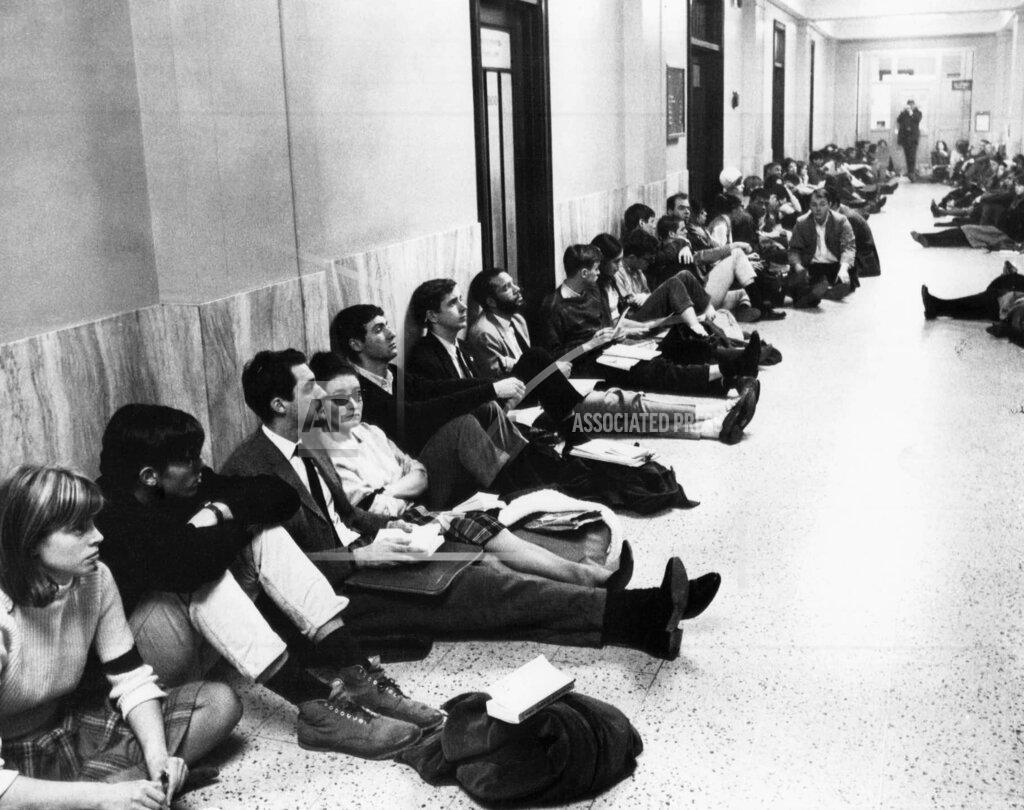
Twenty-five youthful civil rights demonstrators, including two coeds and a Black, staged a sit-in today at the base of the Liberty Bell in Philadelphia’s Independence Hall to dramatize their demand for Federal intervention in Selma.
Senate leaders and the Justice Department reached agreement tonight on a bipartisan bill to hasten and make effective the right of Blacks to register and vote. Mike Mansfield of Montana, the Senate Democratic leader, and Everett McKinley Dirksen of Illinois, the minority leader, said they hoped to be able to introduce the bill before many days, probably by the middle of next week. The two leaders met with Attorney General Nicholas DeB. Katzenbach for half an hour late this afternoon. Later, the three men sat down for nearly two hours more with their legal aides. When they emerged the two Senate leaders said that agreement had been reached on the general content of the bill, and all that remained was for their assistants, working with the Justice Department, to do the drafting.
Bipartisan teams of Congressmen will start fanning out around the country next week to take a “hard look” at the nation’s antipoverty programs.
The first American attempt to put two men into orbit in one spacecraft may take place March 22, the National Aeronautics and Space Administration said today. It will be the first manned orbital flight in the Gemini spacecraft, a forerunner and to some extent a training craft for the three-man Apollo that is to carry astronauts to the moon. The Gemini launching from Cape Kennedy, Florida, would be the first manned space flight for the United States in almost two years. Major L. Gordon Cooper Jr. of the Air Force circled the earth 22 times on May 15, and 16, 1963, in the last flight of the Mercury series. Since then the Soviet Union. has remained ahead of the United States in manned flight. Last Columbus Day, a Russian pilot, an engineer, and a physician made a one-day flight in a Voskhod (Sunrise) spaceship.
The two chief members of an Air Force Academy cheating ring made a profit of about $900 in selling examinations to other cadets, the Air Force has told Congress.
A bill to abolish capital punishment won final approval today in the West Virigina Legislature. The governor has said he will sign the bill.
A reporter for the Chicago Daily News, Margery McElheny, broke the story that former Governor of West Virginia William C. Marland had been working for the last two and a half years as a taxicab driver in Chicago. Marland, who had served as a state governor ten years earlier, from 1953 to 1957, told reporters at a press conference the next day that he was a recovering alcoholic, and that after being fired from a job as legal counsel for a coal company, he had been working since August 1962 for the Flash Cab Company. Marland, who had been chauffeured while governor, said that he had been driving passengers in an effort “to compose my character, which had fallen apart” as he rehabilitated himself. Marland would receive job offers after his story was told nationwide, including in his own appearance on The Jack Paar Show on March 26, but would soon be diagnosed with pancreatic cancer, and would die on November 26.
A longshoreman named Teddy Deegan was found murdered in Chelsea, Massachusetts. It would be noted later that the murder “would not even qualify as a footnote in Boston mob annals except for one crucial outcome; four men were wrongly imprisoned for decades for his murder, and the case became a cause célèbre and a lesson in the miscarriage of justice.” In 1967, Joe Barboza would confess to the murder, but would also accuse Joe Salvati, Peter J. Limone, Louis Greco, and Henry Tameleo of being his accomplices. The four men would be sentenced to life in prison, where Tameleo and Greco would die of old age; Salvati and Limone would spend 30 years behind bars before an enterprising investigative reporter, Dan Rea, would find the evidence that led to their release in 1997.
“Wooly Bully” single released by Sam the Sham and the Pharaohs
Dow Jones Industrial Average: 900.33 (+3.82)
Born:
Steve Finley, MLB outfielder (World Series Champions-Diamondbacks, 2001; MLB All-Star 1997, 2000; Baltimore Orioles, Houston Astros, San Diego Padres, Arizona Diamondbacks, Los Angeles Dodgers, Los Angeles Angels, San Francisco Giants, Colorado Rockies), in Union City, Tennessee.
Shawn Gilbert, MLB pinch runner, outfielder, and pinch hitter (New York Mets, St. Louis Cardinals, Los Angeles Dodgers), in Camden, New Jersey.
Randy Dixon, NFL guard (Indianapolis Colts), in Clewiston, Florida.
Jon Carter, NFL defensive tackle (Dallas Cowboys), in Los Angeles, California.
Fran Harris, WNBA guard (WNBA Champions-Comets, 1997; Houston Comets, Utah Starzz) and broadcaster (ESPN), in Dallas, Texas.
Steve Levy, American sports journalist (ESPN: Monday Night Football, NHL), in New York, New York.
Coleen Nolan, English-Irish singer, television personality, and author; in Blackpool, Lancashire, England, United Kingdom.




Hart was a terrific power hitter who struggled to stay healthy, with alcohol, and with his very shaky defense. But with Willie Mays, Willie McCovey, and Orlando Cepeda, the heart of the Giants’ batting order in the mid-1960s was formidable.
 History Diaries