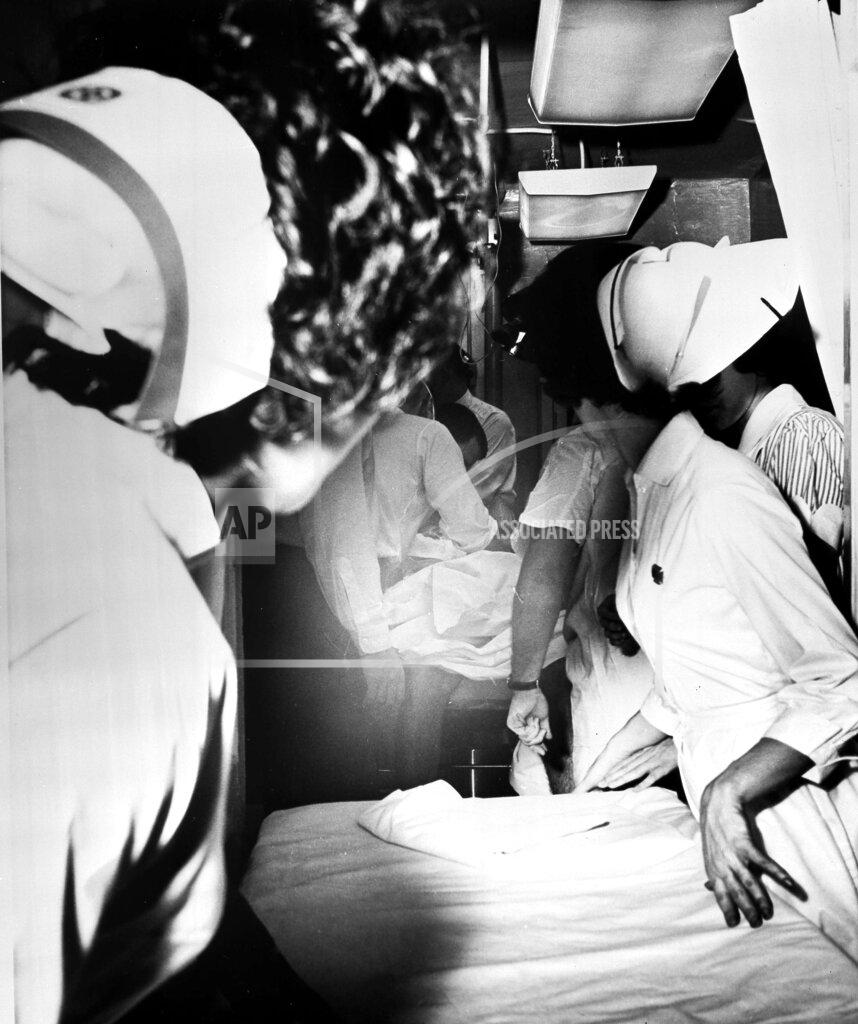
Rev. Reeb would die of his injuries. His attackers were acquitted by an all-white jury.
“All right, spread out around the forward edge, get down and keep your weapons ready,” Staff Sgt. Johnny Thomson said. United States Marines had arrived on Hill 327 overlooking Đà Nẵng Air Base. Through the haze in the distance lay the Hồ Chí Minh trail, the supply route of the Việt Cộng insurgents. The presence of marines on the grassy hilltop completed the first step in American efforts to protect the strategic base, from which fighters go to North Vietnam. Members of I Company moved through the swirling mist this morning up the 1,060-foot hill as Marine engineers began preparing an old secondary road to the top. The platoon headed by Sergeant Thompson, who is from Houston, Texas, was in the lead.
Twenty Marines, each carrying a pack and flak jacket weighing a total of 65 pounds, renamed the hill “the hungry i” after the San Francisco nightclub. As soon as the marines dig in and the road to the peak is opened, Hawk anti-aircraft missiles will be moved from the Đà Nẵng airfield to the top of the hill. A marine Hawk missile unit has been helping guard the Đà Nẵng base since February. To the north, on the slightly lower crest of Hill 268, K Company was digging in to protect another Hawk battery. The arrival Monday of the First Battalion of the Third Marine Regiment and the Third Battalion of the Ninth Regiment marked the first commitment of American ground combat troops to the tight against the Việt Cộng insurgency. Most Americans here serve as advisers to the South Vietnamese armed forces. The marines were sent here to prevent, if possible, Việt Cộng attacks such as that at Pleiku, where guerrillas successfully raided an American military compound and inflicted heavy casualties.
Their role is supposed to be strictly defensive, but as part of this defense they will patrol the perimeters of the two hills and the area around the air base. At the moment the beautiful valley below the hungry is free of Communist guerrillas and is patrolled by South Vietnamese Army forces and militia. Squads from I Company made their first patrols last night with Vietnamese rangers. We ran into nothing” First Lieutenant Don Hering, of Danville, Kentucky, said. “The Vietnamese seemed to know their business, all right. But we were a little shook up when they started lighting cigarettes and listening to jazz on their transistors while we were patrolling.” The First Battalion of the Third Marines has been assigned to positions around the airfield itself. This morning it began digging in. Marine artillery, brought in by the landing teams, was in position at one corner of the field. Although the artillery Is basically for defense, it can be called on to support South Vietnamese action, an informed military source said. Captain H. J. Morgan of Colorado Springs, Colorado, commander of A Company, looked around this morning and said with satisfaction: “If we can get settled here it would take an army to throw us off.”
A Marine Corps brigade of about 6,000 men was moving from Hawaii to Okinawa to replace the 3,500 marines who were sent to South Vietnam last weekend, the Associated Press said. The first units of the 6,000-man Marine Corps force began boarding ships at Pearl Harbor late today.
Revived religious friction brought arson and gunfire today to Danang, the site of a strategic air base newly reinforced by 3.500 United States Marines, Buddhist youths burned the homes of four Roman Catholics in reprisal for the fatal stabbing of a Buddhist soldier by a Roman Catholic soldier in a card game Sunday. South Vietnamese rangers fired into the air to break up a crowd of Buddhist demonstrators shouting anti-Catholic slogans. They arrested 16 persons, No Americans were involved. Ill feeling between Vietnamese Buddhists and Catholics is of long standing in the area.
President Johnson took his three senior foreign-policy advisers to a nearby mountain retreat today for an afternoon and evening discussion believed to have been dominated by the Vietnam crisis. The White House did not explain the unusual conference at Camp David, in Maryland, except to say that “no specific issue” was being resolved. Other sources said it was fair to assume that Vietnam was the major topic and that the participants wished to explore it in relaxed conversation. With the President were Secretary of State Dean Rusk, Defense Secretary Robert S. McNamara and Mr. Johnson’s special assistant for national security affairs, McGeorge Bundy.
They flew by helicopter from the White House lawn at 3:10 PM and arrived about half an hour later at Camp David, the Presidential retreat established in World War II in the Catoctin Mountains by Franklin D. Roosevelt under the name Shangri-La. On arrival, the Presidential party drove about a mile to a new Job Corps camp in Catoctin Mountain Park. Trailed by Mr. McNamara and Mr. Rusk, the President wandered around the camp, inspecting classrooms and barracks and talking to the youths. “A lot depends on how you fellows make out,” the President told one group of corpsmen in a first-aid class. “If you make a good job of it, the Congress will go along and make a lot of training available to other fellows.” The President has asked Congress this year to double the antipoverty fund to a total of $1.5 billion during the coming fiscal year.
After an hour’s inspection, the party returned to Camp David and settled down in the main cabin of the heavily guarded, rustic compound. The President and his advisers dined in the main lodge at Camp David, then returned to Washington by helicopter this evening. Details of their talk were not disclosed. Also in the party were three White House aides, Bill D. Moyers, Jack Valenti and Marvin Watson. It was not made known which of them, if any, participated in the talks. The four principals have met regularly each week, usually on Tuesday or Wednesday, over luncheon at the White House. Apparently they decided at yesterday’s conference to seek seclusion for a longer session. Although the same group meets even more often in larger conferences of the National Security Council, it is generally looked upon as the inner core of decision makers on major foreign-policy questions.
Officials and observers here speculated that the President and his advisers probably wanted to assess the United States position one month after the start of bombing raids against North Vietnam and to look ahead to the decisions they will face in the near future. Their purpose has been to force attention upon their belief that North Vietnam’s aggression against the South is at the root of the crisis. They have wanted to warn North Vietnam and its Communist allies in Peking and Moscow that even greater military pressure and resistance will follow unless the infiltration of men and supplies into South Vietnam is ended.
The Secretary General, U Thant, emphasized today that he would go ahead with his attempt to and the fighting in South Vietnam despite the United States’ statement that it could not accept his proposal for a seven-power conference.
The Republican Coordinating Committee attacks Democratic Party members who raise ‘disruptive voices of appeasement’ and expresses support for the Johnson administration’s policies in Vietnam.
Five persons, including one American civilian, were killed when an Air America helicopter crashed Friday 12 miles from the Laotian royal capital of Luang Prabang, according to informed sources. The American was identified as Charles David of Jacksonville, Florida. The other dead were a Thai and three Laotians. The sources said engine trouble had caused the crash. Air America is a private company under charter to the United States aid mission.
Laotian Government forces using guerrilla tactics are retaking the initiative in the northeast Laotian province of Sam Neua, according to Laotian military sources. They cited a successful government ambush yesterday in which 10 pro-Communist Pathet Lao soldiers were killed.
President Gamal Abdel Nasser warned tonight that the United Arab Republic would recognize East Germany if West Germany established formal relations with Israel. In a speech at Shibin el Kom, 50 miles north of Cairo, President Nasser also threatened to seize West German property and schools in the United Arab Republic and to sequester funds in this country. “Then we should like to see how West Germany is going to punish us.” President Nasser said tauntingly. “We would like to see who is going to pull the other’s ear.”
In a sharp attack on West Germany at the end of a droning, hour-long speech, he also advocated an Arab boycott of West Germany. “I would like to address a word to all Arabs,” he said. “Thirty percent of West Germany’s trade is with Arab countries. If we boycott West Germany economically, we shall deprive her of 30 percent of her trade.” A West German spokesman asserted that trade with Arab states accounted for only 3 percent of West Germany’s exports and 1.8 percent of the country’s total foreign trade. The spokesman said West German property here was “very limited.”
West Germany’s special envoy left Jerusalem today carrying assurances that Israel will establish diplomatic relations with West Germany.
The West German Government took into account the possibility of a diplomatic break with Arab countries when it made its offer to exchange ambassadors with Israel, informed sources said tonight.
American and British officials are becoming increasingly concerned that the Soviet Union is not interested in returning to the disarmament talks in Geneva. A month has passed since William C. Foster, director of the United States Arms Control and Disarmament Agency, suggested to Semyon K. Tsarapkin, the Soviet disarmament representative that the talks, recessed last September, should be resumed around April 1. There has been no reply. Western officials speculate that the Soviet Union is caught in a policy dilemma. On the one hand, they say, Moscow wants to continue the policy of peaceful coexistence with the West. But at the same time the Soviet Union is under political and ideological pressure to enter into the power struggle in Southeast Asia.
The MacDonald House bombing, Indonesia’s only successful attack on the Malay peninsula during the Konfrontasi war over Java, killed three people and injured 33 others in Singapore. The two young Indonesian Marine Corps operatives who had carried out the attack, Harun Said and Osman Mohamed Ali, would be executed by hanging in 1968.
Several hundred Indonesian Navy officers have refused to report for duty at the naval center of Surabaya in an attempt to force the dismissal of the Navy commander, Rear Admiral E. Martadinata. They accuse him of mismanagement and corruption, which they claim has led to most of the fleet being laid up due to poor mantenance and a lack of spare parts.
In France, the cabinet of President Charles de Gaulle approved a bill to remove many of the restrictions placed on married women, in what Information Minister Alain Peyrefitte described as “a veritable emancipation of the wife.” The new bill, drafted by Justice Minister Jean Foyer, was expected to be passed by the French parliament. At the time, married women were not allowed to take a job, open a bank account, or spend their own earnings without their husband’s consent.
Robert Komer, President Johnson’s adviser on the Middle East, met with Israel’s Prime Minister Levi Eshkol in Tel Aviv, seeking to get the Israelis to agree to bring their nuclear program under the jurisdiction of the International Atomic Energy Agency. However, the only concession that Eshkol would agree to in the “Memorandum of Understanding” signed between the two nations was a reaffirmation that “Israel will not be the first to introduce nuclear weapons into the Arab-Israeli area.”
E.M.S. Namboodiripad, leader of the pro-Peking Communists in India’s Kerala state said today that “agitation” had been started to force the release of 29 Communists elected last Thursday to the state legislature.
The United Kingdom and Norway signed an agreement on the maritime boundary between the two nations in the North Sea. Rather than the former line based on the Norwegian trench, the British and Norwegian governments agreed that the median line of points equidistant from both mainland coasts would serve as the boundary.
British Prime Minister Harold Wilson will pay another visit to the United States next month. It was announced today at 10 Downing Street, his official residence, that he would speak to the Economic Club of New York, a distinguished private group. He is expected to use the occasion to have a second official talk with President Johnson. No exact date was given, but Mr. Wilson is expected to make the trip shortly after publication of the budget early in April.
A meeting between Queen Elizabeth II and the Duchess of Windsor will take place within the next few days at the bedside of the Duke of Windsor. The Duchess has never been received openly by her husband’s family. This may not be the first time the Queen will have met the Duchess, but it will probably be their first meeting during the Queen’s 13-year reign. Since the Duke, then King Edward VIII, abdicated the throne in December, 1936, to marry Wallis Warfield Simpson, there has been an unofficial ban on the Duchess, a divorcee, by the royal family.
The West German Parliament, challenged by a member to acknowledge that “we all share the guilt,” registered overwhelming support today for the principle of unlimited prosecution of Nazis accused as murderers.
The first drawings were held under Australia’s new birthday lottery system of conscription. At the Department of Labor and National Service in Melbourne, Representative Dan Mackinnon drew marbles from a barrel as part of the “birthday ballot” until there were sufficient eligible men to meet the quota of 4,200 draftees. The results were kept secret, with a policy that “Although pressmen will be able to watch and photograph the drawing of the first marble they will not be allowed to see or photograph the number on it.” Young men whose birthdays were selected were “balloted out” and would be notified within four weeks.
The engagement was announced between Princess Margriet of the Netherlands and Pieter van Vollenhoven, who would become the first commoner and the first Dutchman to marry into the Dutch royal family.
Goldie, a London Zoo golden eagle, was recaptured 12 days after her escape. Goldie was recaptured by London Zoo officials today as he was enjoying a breakfast of rabbit that had been laid out as a lure.
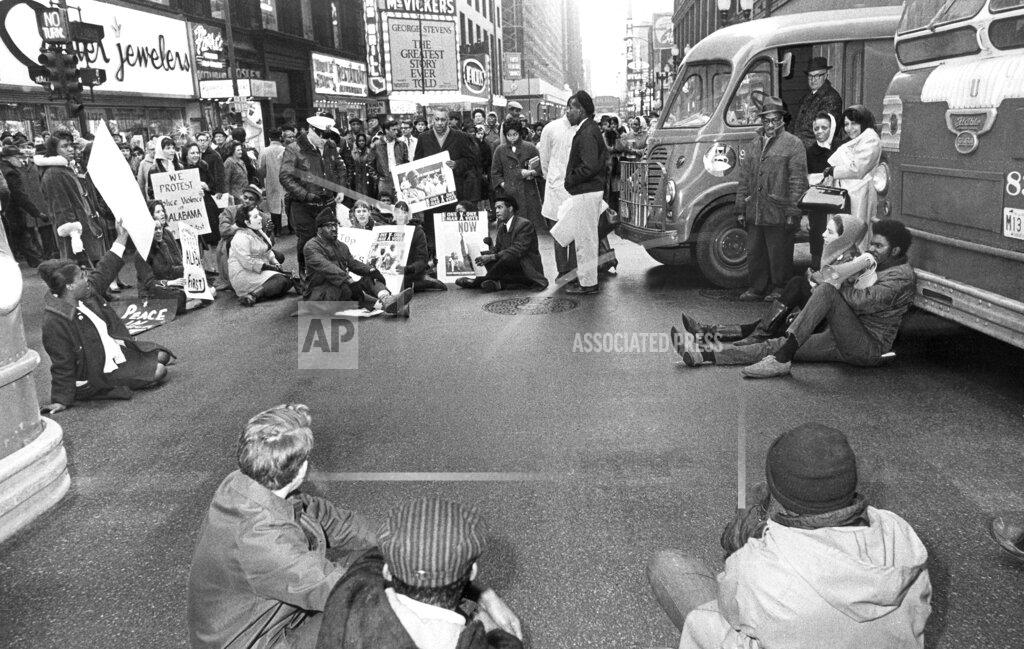
About 300 civil rights demonstrators sang, prayed and slept in a street tonight after the police halted their third attempt of the day to march on the Dallas County Courthouse. The first march of the day, led by six smiling nuns from St. Louis, had been halted by Mayor Joseph T. Smitherman and scores of policemen. The police also stopped the second march, attempted by a group of youngsters. “We’re going to stay here all night until the state troopers move aside and let us through,” the Rev. Ralph D. Abernathy said after the marchers were halted in their third attempt. He is an assistant to the Rev. Dr. Martin Luther King Jr., who has been heading the Black voter registration drive here.
The street sleep-in was the latest demonstration in the eight-week-old campaign. Frequent violence and arrests of more than 3,500 persons have brought nationwide repercussions. In the first march, 500 demonstrators walked for half a block before they were stopped by the Mayor, state troopers and local policemen. That demonstration was held shortly after noon. For the rest of the daylight hours, Blacks and ministers from throughout the nation played a war of nerves game with scores of state policemen by staging attempted marches and informal walks through the streets of Selma, a city bristling with racial tension.
Shortly after dark, most of the participants met back at the Browns Chapel Methodist Church and planned a night march. Dr. King stayed in seclusion in the rear of the church but gave the plan his blessing. Then he left for Montgomery, where he will appear as a witness tomorrow in a Federal Court hearing on a request by civil rights leaders for an injunction that would permit a mass march on the state capital from Selma. Demonstrators poured into the street and were again stopped about half a block from the church. Then they settled down for the night. Hundreds of others watched from the sidewalks.
There was a brief flurry of excitement a short while later when the police reported they had heard of a threat to bomb the church. They cleared the building of all remaining occupants and 14 troopers marched through. They found no sign of a bomb. When they emerged from the front door, the demonstrators in the street sang “We Love, Everybody.” One of the troopers snapped his fingers in rhythm with the song, the first time during the long day there had been any relaxation of the grimness that marked the confrontations.
Late tonight about 200 youngsters were stretched out on inflated plastic mattresses in the street. Scores of white ministers, who were part of the demonstration, milled among them. In the first demonstration, the marchers were permitted to take turns speaking in the middle of the street. For more than an hour, they lectured the authorities on what they considered the mistreatment of Blacks in Alabama. Then they prayed and turned back to the Browns Chapel Methodist Church, where the march had formed.
Five minutes later 200 Black, children and teen-agers tried to march from another church. After a few tense moments, they yielded to the gentle prodding of the state troopers’ nightsticks and the persuasion of their leaders, and withdrew. Finally, about 200 youths and adults succeeded in their goal of marching on the Dallas County Courthouse despite Mayor Smitherman’s new ban against demonstrations of any kind. They broke up into small groups, white and black together, and walked hand-in-hand around the building as a ring of state troopers stood guard and white onlookers cursed and jeered. The city remained tense. LeRoy Collins, head of the Federal Community Relations Service, arrived here tonight by jet at the direction of President Johnson.
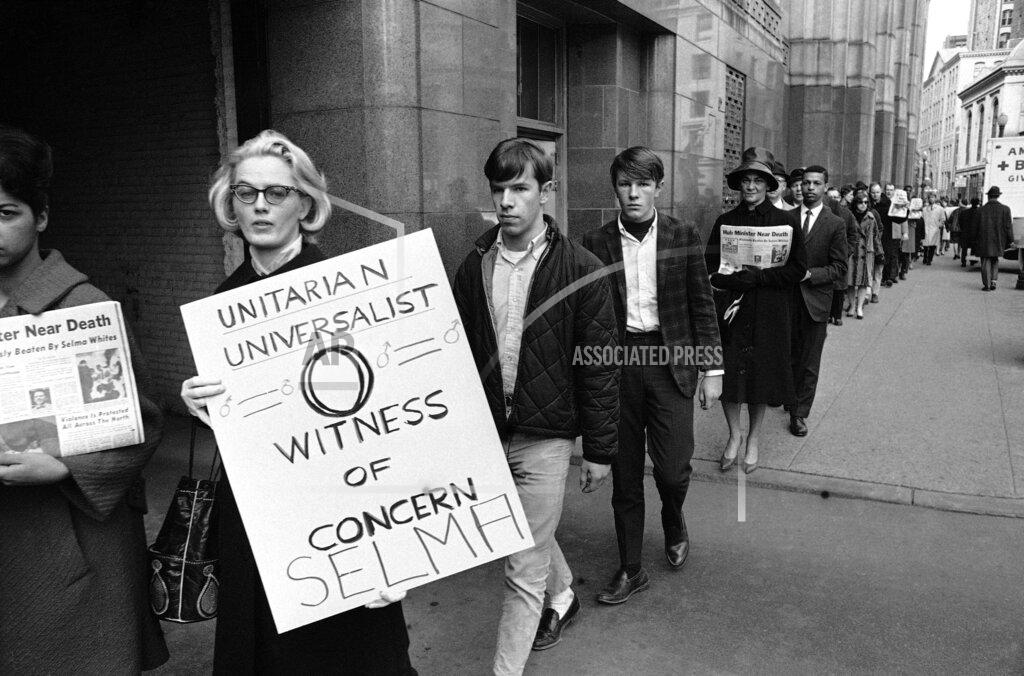
Three white men were arrested in Selma today on charges of assaulting a white Unitarian minister from Boston last night. The minister, the Rev. James J. Reeb, who came South to help Alabama Blacks win voting rights, remained in critical condition today as a result of the beating. He was attacked in Selma last night by a group of white men and then taken to University Hospital in Birmingham.
The arrests were announced by Wilson Baker, Public Safety Director of Selma. He said a fourth man was being sought. Mr. Baker said the three taken into custody were William Stanley Hoggle, 36 years old; R. B. Kelly, 30, and Elmer Cook, 41, all of Selma. They were charged with assault with intent to murder. Mr. Baker said they were being held in the Selma city jail. He said the warrant for the fourth man, whom he would not name, also charged assault with intent to murder. The suspects will be charged with murder if Mr. Reeb dies, Mr. Baker said. Mr. Baker said the three men in custody were associates in the used car business. He declined to say whether they had made statements either admitting or denying the attack, nor would he give any other details of the investigation.
A spokesman at the hospital in Birmingham said today that the condition of Mr. Reeb, a 38-year-old father of four, had worsened. “His prognosis is poor,” the spokesman said. “Twice this morning his heart stopped,” the hospital said. “Both times he was restored immediately.”
In Montgomery, Alabama more than 500 Black students and a handful of white ministers held a peaceful sitdown demonstration in front of the Alabama Capitol. They were protesting the action of state troopers last Sunday in breaking up a civil rights march in Selma.
There were more protests across the country and beyond today, in sympathy with the Selma marchers. Demonstrations were held in Los Angeles, San Francisco, Buffalo, and Toronto, Canada. There are plans now for daily protests at the White House.
The Justice Department asked today for a sweeping Federal court order to prevent Alabama officials from interfering with peaceful demonstrations on behalf of Black rights. In a complaint filed in Montgomery, Alabama, the department accused Governor George C. Wallace, Albert J. Lingo, director of the Alabama Department of Public Safety, and Sheriff James G. Clark Jr. of Dallas County of “preventing and discouraging Blacks from exercising their full rights of citizenship.” Specifically, the department asked for an order preventing the officials from “summarily punishing, by striking, beating, tear-gassing, or other means,” any person for his participation in a demonstration on behalf of the rights of Blacks. The complaint, filed under a section of the Civil Rights Act of 1964 that lets the department intervene in court cases it considers of general public importance, asked:
- That the three officials and their agents be enjoined by the court from intimidating, threatening or coercing anyone for the purpose of interfering with his right to register to vote.
- That they be prevented from interfering with “lawful, peaceable demonstrations in behalf of the rights of Blacks by attempting forcibly to disperse the demonstrators or seeking to impose unreasonable conditions on the demonstrators.”
- That they be ordered to provide ordinary police protection for those attempting to exercise the right to vote or demonstrate lawfully on behalf of Black rights.
The issues could be decided tomorrow at a hearing in Federal District Court in Montgomery before Judge Frank M. Johnson Jr., who imposed a temporary restraining order yesterday on demonstrators that the Rev. Dr. Martin Luther King Jr. was leading on a second attempt to march from Selma, Alabama, to Montgomery.
Two doctors serving with the Medical Committee for Human Rights said today that they had been taken to the Dallas County Courthouse by state troopers and ordered not to give first aid to persons hurt in racial demonstrations. The physicians were Dr. Richard Hausknecht of New York and Dr. Jack Gieger, a professor at Harvard University. The committee helped set up first-aid units yesterday and had several vehicles ready for use as ambulances. First-aid corpsmen wore armbands. Several churches designated their basements as first-aid shelters.
Senator Robert F. Kennedy, Democrat of New York, urged federal court action today to stop the “wanton abuse of police power bordering on hooliganism” that has occurred in Alabama. Mr. Kennedy, who was faced with many civil rights crises. while he was Attorney General, said that he hoped the courts: would lift the order prohibiting protest marches after determining the rights of both sides. “The events of the last few weeks in Selma are a sad setback to those — in Alabama and in the nation — who are attempting to solve difficult problems in the spirit of intelligence, goodwill, and adherence to law,” Senator Kennedy said.
Opposing party leaders in the Senate agreed today that they did not like the complexity of Administration proposals to enforce voting rights. This raised the prospect that a bipartisan bill would displace the draft that President Johnson expects to send to Congress early next week. Senator Mike Mansfield of Montana said he had directed his staff to draw up a voting rights bill that he would review tomorrow with the minority leader, Senator Everett McKinley Dirksen of Illinois. He said both would confer with Attorney General Nicholas de B. Katzenbach tomorrow. Both Senators have seen the closely guarded Administration draft and they dissent from its length and complexity. Senator Mansfield said today this draft “so far has been a bit too long, with too many whereases.”
Representative Wilbur D. Mills predicted today broad public support for an enlarged version of the Administration’s program of medical care for the aged. The Arkansas Democrat, chairman of the House Ways and Means Committee, said he believed the revised bill would be accepted as “a satisfactory, proper, and correct way of dealing with this particular problem.” It was clear from his remarks, in a speech to supporters of health care for the aged during a luncheon at the Capitol, that he would use his own great influence in Congress to win passage of the measure.
According to a survey conducted by the U.S. Department of Defense, only 15 percent of the 201,000 enlisted men serving in drill units of the Army Reserve forces would join the National Guard if their units were liquidated in accordance with a proposal by Secretary of Defense Robert S. McNamara.
The Pentagon said today that early in the investigation of the Air Force Academy cheating scandal a number of cadets were taken from the school grounds to protect them against possible assault by other cadets.
Clark Kerr’s decision to resign as president of the University of California was ascribed by knowledgeable sources today to continued interference with administrative details by individual members of the Board of Regents.
President Johnson asked Congress today for Federal aid to stimulate and encourage drama, dance, painting, music, literature, history and other cultural activities in the United States.
The House approved 402 to 0 today a bill to end the illegal traffic in goof balls and pep pills — a traffic described by President Johnson as a factor in the “trend toward lawlessness.”
The Ohio Supreme Court upheld city ordinances against racial discrimination in selling and renting houses and in making home loans today.
“The Odd Couple,” a play by Neil Simon, debuted on Broadway at the Plymouth Theatre, with Walter Matthau as “Oscar Madison” and Art Carney as “Felix Ungar.” Simon would say later that he based the characters on a situation involving his meticulously tidy older brother, writer Danny Simon, who had had to share an apartment with a disheveled theatrical agent and friend, Roy Gerber, following a divorce. The characters of Oscar and Felix would be reimagined in many versions over the next half-century, including two films (with Matthau and Jack Lemmon); a 1970s television show (Jack Klugman and Tony Randall); and, more recently, a 2015 TV sitcom with Matthew Perry and Thomas Lennon.
“I’ve Got a Tiger By the Tail” album by Buck Owens is released (Billboard Album of the Year, 1965)
Dow Jones Industrial Average: 892.39 (-1.68)
Born:
Rod Woodson, NFL cornerback and free safety (Hall of Fame, inducted 2009; NFL Champions, Super Bowl 35-Ravens, 2000; Pro Bowl, 1989-1994, 1996, 1999-2002; Pittsburgh Steelers, San Francisco 49ers, Baltimore Ravens, Oakland Raiders), in Fort Wayne, Indiana.
Ken Brown, NFL wide receiver (Cincinnati Bengals), in Monroe, Louisiana.
Pete Williams, NBA power forward (Denver Nuggets), in Harbor City, California.
Pepsi Tate [Huw Smith], Welsh glam-rock bassist (Tigertailz), born in Cardiff, Wales (d. 2007).
Died:
José “El Piloto” Castro Veiga, 50, Galician guerrilla and terrorist, was executed in Spain.
Daisy Lampkin, 81, African-American suffragette and civil rights activist.





 History Diaries