
Silver Star
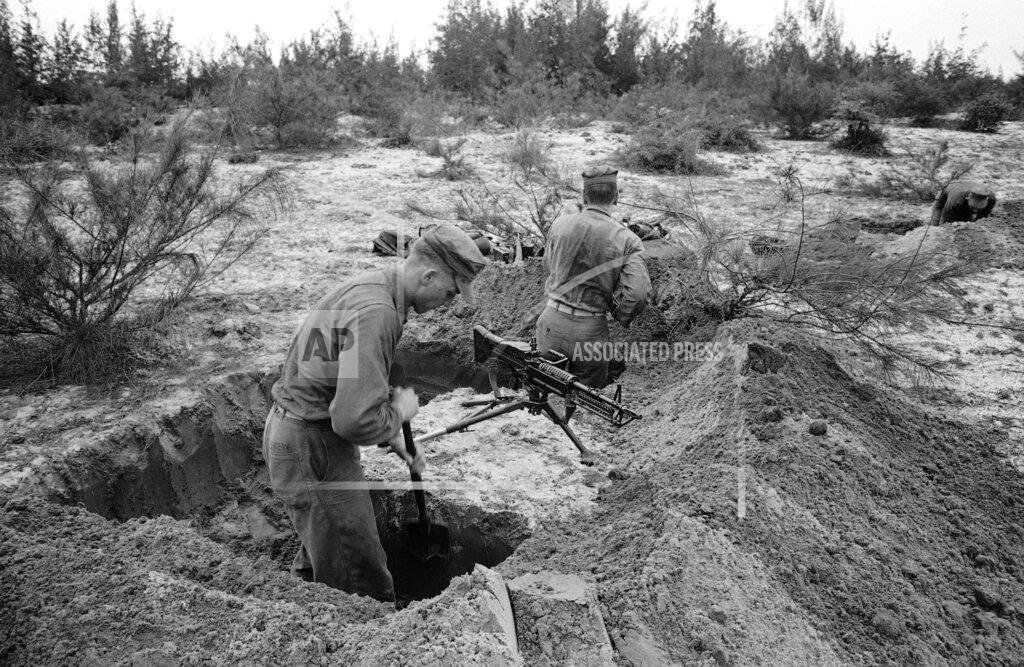
The President of the United States of America takes pride in presenting the Silver Star (Posthumously) to First Lieutenant Dempsey H. Williams, III (MCSN: 0-82159), United States Marine Corps, for conspicuous gallantry and intrepidity while serving with the Marine Advisory Unit of the Naval Advisory Group, United States Military Assistance Command, Vietnam on 9 March 1965. First Lieutenant Williams was an Assistant Task Force Advisor to Task Force A of the Vietnamese Marine Brigade in the hostile area of Hoài Ân Village, Bình Định Province, when the Marines were ordered to attack the Việt Cộng besieging the town. Plans were made to closely coordinate the strikes of attack aircraft with the advance of ground troops. To be in a better position to observe and coordinate the attack he joined the leading elements of the group. He reached the head of the column as they crossed a bamboo bridge under heavy fire and helped steady the forward Vietnamese troops as in the air strikes were conducted on enemy positions barely twenty-five meters in front of their positions. Although the Vietnamese troops could not understand his shouts as he gave the signal for the assault, they rallied to his example and overran the forward enemy positions. When his unit became pinned down from reinforcing enemy fire, he searched for a smoke grenade to mark their positions for the friendly aircraft but a burst of hostile automatic weapons fire hit him and he died shortly afterwards. Through his knowledge of air-ground coordination techniques, and his shining personal example, he contributed substantially to the relief of the village of Hoài Ân from Việt Cộng attack. His cool courage and gallant actions were in keeping with the highest traditions of the United States Naval Service. He gallantly gave his life in the cause of freedom.
Dempsey is buried at Arlington National Cemetery. He is honored on the Wall at Panel 1E, line 95.

In South Vietnam, government forces achieved a major victory yesterday in the repulse of a Việt Cộng assault on a Special Forces camp 270 miles northeast of Saigon. The Communist attackers left at least 100 dead around the Kannack (K’Nak) camp. The Việt Cộng were believed to have carried off 200 other dead and wounded. The Government forces collected 65 weapons dropped by the Việt Cộng, including a 57-mm recoilless rifle and six 75-mm rocket launchers. Government casualties at the camp totaled 33 militiamen killed and 37 wounded. Among the wounded were three of the nine-man United States Special Forces team stationed at Kannack. A Vietnamese military commander said flagging morale had led the Việt Cộng to undertake the desperate attack on the camp.
Brigadier General Nguyễn Hữu Có, the commander of the II Corps, said the attackers were from the units that were bombed by United States jet aircraft February 24. That bombing, on the day the United States disclosed the use of American jets in South Vietnam, broke up a large Việt Cộng concentration near An Khê in Bình Định Province. General Có said in a statement today that the defeated Communist guerrillas had marhaled their entire force of two battalions — 900 to 1,400 men in the area — to “obtain definite success in order to regain their lost prestige and also to keep up their troops’ morale.” His interpretation was supported by the diary taken from the body of the North Vietnamese lieutenant who led the assault.
Telling of the 61-day march that began in North Vietnam on November 22 and took him into the South Vietnamese highlands, the lieutenant wrote: “My life is very hard. There is not enough to eat and all the time the planes bomb me.” The senior American adviser, in the area. Colonel Theodore C. Mataxis of Kingston, Maryland, said that the attacking Communist troops had thrown themselves on the small camp in suicidal assaults.
According to The Associated Press, one United States Marine was killed and one was wounded today in a clash with the Việt Cộng in Hoài Ân, Bình Định Province.
The Marines continue to land around Đà Nẵng. Among today’s arrivals is the first U.S. Armor — an M48A3 tank of the 3rd Marine Tank Battalion; it will be followed in a few days by more tanks, including those with flame-throwing capabiity. There is scattered firing from Việt Cộng hidden onshore, but no Marines are hit. The Marines are at once assigned to protect the base, both from the immediate perimeter and from the high ground along a ridge to the west.
By dusk tonight almost the entire marine brigade around Đà Nẵng was deployed around the critical United States air base. Earlier in the day a full-strength detachment of marines moved out of Đà Nẵng to take up positions on a three-peaked hill about five miles from the base. The hill, 1,200 feet at its highest point, overlooks the territory surrounding the airstrip. Brigadier General Frederick J. Karch, commander of the Ninth Expeditionary Brigade, declined to say how far from the air base the marine defense perimeter would extend.
President Johnson authorizes the use of napalm by U.S. planes bombing targets in North Vietnam. President Johnson authorized the use of a newer, more flammable version of napalm B for the anti-personnel bombs dropped by American bombers in Vietnam.
General William C. Westmoreland, commander of United States forces in South Vietnam, has insisted in a report that American fighting men there “are getting adequate equipment.”
The U.S. State Department formally rejects U Thant’s proposal of 24 February that the United States join with other major powers in negotiating a solution to the war, on the ground that the government cannot support any such plan until North Vietnam ceases its ‘aggression.’ The United States has told Ui Thant, the Secretary General of the United Nations, that it cannot accept his or any other. invitation to a conference on Vietnam until North Vietnam indicates a readiness to halt its “aggression.” The rejection of Mr. Thant’s proposal for a seven-nation “preliminary” discussion was disclosed today by the State Department. It was accompanied by a word of thanks for his efforts and expressions of hope that diplomatic channels would be held open for a peaceful solution. After issuing its statement replying to Mr. Thant, the State Department hastily altered some of the language it used to describe Washington’s condition for negotiations. But in either form, the statement marked no change in the Administration’s positions.
In fact, officials here are beginning to suspect that the Soviet Union, Communist China, and North Vietnam, like Washington, are temporarily frozen in their diplomatic positions. If such a freeze persists, the Administration will soon face another major decision about how much additional military pressure on North Vietnam it wishes to risk. By raiding a few military installations in North Vietnam in the last month, the United States has tried to warn the Hanoi Government that it faces continuing and intensified punishment unless it halts the! infiltration of men and arms into South Vietnam.
“To end this war we must get political stability and find a government that has popular support, whether the Americans like it or not,” the young man said. He was Vinh Khả, leader of the Student Union in Huế, and he had come to discuss what ought to be done in South Vietnam. A thin nervous man of the rather advanced student age of 27. Mr. Vinh Khả heads an organization that claims a membership of 3,000 among Huế’s large restless population of university and high school students. The students are closely aligned with the Buddhists in Vietnam.
Prime Minister Harold Wilson told the House of Commons he thinks the United States would pull its troops out of South Vietnam if the Communists in the north halted their “aggression.”
Evidence collected in Vietnam indicates that both North and South Vietnamese Communists have become aware that talk of proposed peace negotiations could undermine the spirit of the Việt Cộng.
Pressures mounted among Arab states today for concerted and sharp retaliation against West Germany for its decision to seek diplomatic relations with Israel. In a speech tonight, President Gamal Abdel Nasser hailed the Kuwaiti National Assembly for favoring an immediate break with West Germany, establishment of relations with East Germany and a pan-Arab boycott of West Germany. While he was speaking, representatives of 13 Arab countries held their second urgent session of the day to reach a unified strategy against West Germany.
It was announced after the first meeting that the Arab League delegates had unanimously adopted resolutions and were referring them to the 13 Arab Governments. The communiqué said the Arab foreign ministers would meet here Sunday to ratify the resolutions, which were not described. President Nasser, apparently encouraged by the progress, said at a rally at Menya, 150 miles south of here, that on the basis of what he knew, the Arabs would win “this political showdown” with Israel and West Germany. He did not elaborate.
Premier Levi Eshkol will make a statement on Israeli-West German relations next Tuesday in the Knesset (Parliament).
The Soviet-sponsored conference of 19 Communist parties that met here last week failed to produce any plan of action that might prevent further fragmentation of the international Communist movement. A final communiqué published early today made it clear, Western specialists said, that the Soviet leaders had failed in yet another effort to meet the challenge of the Chinese Communists and to restore the Kremlin’s position as the leader of world Communism. The communiqué indicated that even the pro-Soviet parties were unable to agree on a meaningful joint course.
The Soviet Union and 18 other Communist parties urged a meeting at some unspecified date of all 81 of the world’s Red groupings to end the Moscow-Peking ideological dispute.
Secretary of State Dean Rusk, launching the case for the administration’s $3.38 billion foreign aid request in the Senate, predicted further massive assistance for South Vietnam and a probable cutoff of aid to Indonesia. Rusk told Congress today that “it would be dangerous for our security and tragic for the future of the world” if the United States discontinued or substantially reduced its foreign-aid program.
Intermittent shooting between Israeli and Syrian frontier forces just north of the Sea of Galilee continued today for the third successive day. Israeli settlers of Almagor, a border farm settlement situated where the Jordan River empties into the northern end of the Sea of Galilee, have been plowing a field near the river. The small plot seems to lie clearly in Israeli territory, but until recently Syrian farmers had crossed over the Jordan to use it despite Israeli complaints. Neither the Syrians nor the Israelis have admitted to any casualties.
The State Department said today that its approval in principle of surplus food shipments to royalist-held territory in Yemen did not signify any change in the United States’ diplomatic recognition of the republican Government in that Arab country.
Prime Minister Harold Wilson of Britain ended today a four-day visit to West Germany that was friendly but without much concrete achievement.
Britain and West Germany ended two days of talks with indications that Bonn will spend more in Britain to offset the money drain of maintaining the British Army of the Rhine.
Leaders of all parties joined today in a move to take the racial issue out of British politics. Prime Minister Harold Wilson announced a series of moves to lessen tension that has arisen over “colored immigrants,” as they are called in Britain. Most of them are from India, Pakistan and the West Indies. Mr. Wilson appointed a special coordinator of efforts to integrate the immigrants into communities. He promised legislation against racial discrimination, and he appointed a mission to review immigration controls with Commonwealth countries.
The police in Montevideo, Uruguay said today that an Israeli Government employe was involved in the slaying here of Herbert Albert Cukurs, a Latvian-born former Nazi wanted for alleged war crimes.
President Humberto Castello Branco appealed to the Brazilian people to support his fight against crippling inflation.
Indian Prime Minister Lal Bahadur Shastri will visit Moscow as well as Washington this spring in an effort to improve his own stature and that of his country as the principal spokesman for the nonaligned nations.
Conservative parties in the politically upset Indian state of Kerala have begun to rally their forces to meet the threat of the pro-Peking Communists, who elected 40 candidates, the largest single party bloc, to the State Legislature last Thursday.
The Western Allies have asserted their sovereign rights in West Berlin and their ultimate responsibility for the city’s security in talks with Mayor Willy Brandt and other officials over the case of a local security officer.
British and South African police detectives in Durban, South Africa, recovered 20 gold bars, valued at $280,000, that had been missing from the ocean liner Capetown Castle for more than a month. The bars, shipped by the South African government and entrusted to the Bank of England, had been reported missing on February 5 when the ship had docked at Southampton. The value was based on the international price of gold at the time of 35 dollars per troy ounce and the weight (400 oz t or 12.4 kg) of each bar. Fifty years later, in March 2015, the price of gold was $1,226.14 per ounce, a gold bar would be worth $490,456 and twenty bars would be worth more than 9.8 million dollars.
The Organization of African Unity has postponed further discussion of the Congo problem.
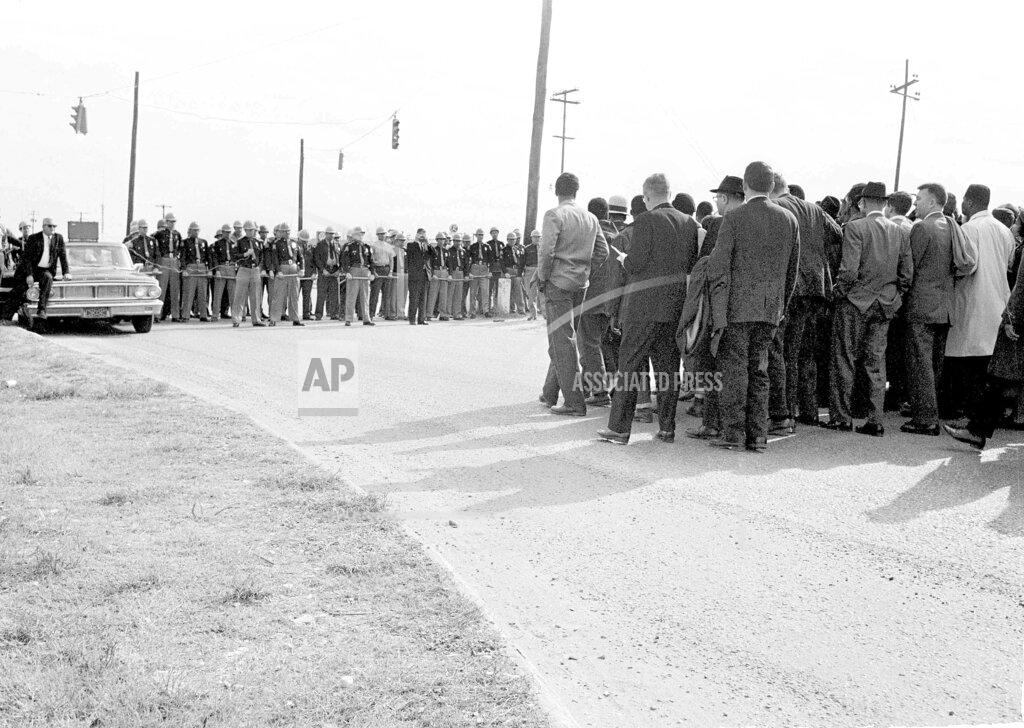
In their second attempt to march from Selma to Montgomery, Alabama, under the leadership of Martin Luther King Jr., civil rights activists were stopped by state police at the bridge that had been the scene of violence two days earlier. Obeying a court restraining order, the group halted, and King asked State Police Major John Cloud (who said “This march is not conducive to the safety of those using the highways”) whether he objected to a prayer being led by religious leaders who were present. “You can have your prayer, and then return to the church,” Cloud said. After being led in prayer by Ralph Abernathy, King led the group back and vowed to march again.
To prevent another outbreak of violence, the SCLC had attempted to gain a court order that would prohibit the police from interfering. Instead of issuing the court order, U.S. District Court Judge Frank Minis Johnson issued a restraining order, prohibiting the march from taking place until he could hold additional hearings later in the week. Based on past experience, some in SCLC were confident that Judge Johnson would eventually lift the restraining order. They did not want to alienate one of the few southern judges who had displayed sympathy to their cause by violating his injunction. In addition, they did not yet have sufficient infrastructure in place to support the long march, one for which the marchers were ill-equipped. They knew that violating a court order could result in punishment for contempt, even if the order is later reversed. But some movement activists, both local and from around the country, were determined to march on Tuesday to protest both the “Bloody Sunday” violence and the systematic denial of black voting rights in Alabama. Both Hosea Williams and James Forman argued that the march must proceed and by the early morning of the march date, and after much debate, Dr. King had decided to lead people to Montgomery.
Assistant Attorney General John Doar and former Florida governor LeRoy Collins, representing President Lyndon Johnson, went to Selma to meet with King and others at Richie Jean Jackson’s house and privately urged King to postpone the march. The SCLC president told them that his conscience demanded that he proceed, and that many movement supporters, especially in SNCC, would go ahead with the march even if he told them it should be called off. Collins suggested to King that he make a symbolic witness at the bridge, then turn around and lead the marchers back to Selma. King told them that he would try to enact the plan provided that Collins could ensure that law enforcement would not attack them. Collins obtained this guarantee from Sheriff Clark and Al Lingo in exchange for a guarantee that King would follow a precise route drawn up by Clark.
On the morning of March 9, a day that would become known as “Turnaround Tuesday”, Collins handed Dr. King the secretly agreed route. King led about 2,500 marchers out on the Edmund Pettus Bridge and held a short prayer session before turning them around, thereby obeying the court order preventing them from making the full march, and following the agreement made by Collins, Lingo, and Clark. He did not venture across the border into the unincorporated area of the county, even though the police unexpectedly stood aside to let them enter. As only SCLC leaders had been told in advance of the plan, many marchers felt confusion and consternation, including those who had traveled long distances to participate and oppose police brutality. King asked them to remain in Selma for another march to take place after the injunction was lifted.
This evening, three white Unitarian Universalist ministers in Selma for the march were attacked on the street and beaten with clubs by four KKK members.. The worst injured was Reverend James Reeb from Boston. Fearing that Selma’s public hospital would refuse to treat Reeb, activists took him to Birmingham’s University Hospital, two hours away. Three men were arrested by Selma city police for the armed assault, released on bail, and immediately re-arrested by the FBI for charges of violating Reeb’s civil rights. Reeb died on Thursday, March 11 at University Hospital, with his wife by his side. Three men were tried for Reeb’s murder but were acquitted by an all-white jury. His murder remains officially unsolved. Neither Jimmie Lee Jackson’s murderer, nor Reverend Reeb’s, were ever prosecuted by the federal government.
Thousands of Blacks and whites demonstrated in major cities yesterday to show their sympathy with Blacks whose voter registration march in Selma, Alabama, was broken up by the Alabama police Sunday. Governor Romney and Mayor Jerome P. Cavanagh led thousands of persons today in a 10-block march through downtown Detroit to protest events in Selma, Alabama. Marches in support of the Blacks in Selma were also held in New York City, Chicago, Los Angeles, Berkeley, California, Hartford, Connecticut, Syracuse, New York, Springfield, Ohio, Beloit, Wisconsin, and Boston.
President Johnson condemned police brutality in Selma, Alabama, and urged both sides in the racial crisis to maintain respect for law and order.
The Administration wants to avoid, if it is at all possible, sending Federal troops or a large force of Federal marshals, to Selma, Alabama. Attorney General Nicholas’ deB, Katzenbach discussed today the gravity of sending troops into the situation and said: “I would hope and pray that it wouldn’t be necessary.” The Administration has been under increasing pressure by local civil rights groups to send troops or a large group of marshals to Selma.
Civil rights demonstrators who ignored pleas of federal officers and some of their own leaders were forcibly ejected from the Federal Building where they were protesting the Selma, Alabama violence.
Roy Jefferson, Black football star, led a group of civil rights advocates to the world headquarters of the Mormon Church today to protest what they called racial injustice in Utah.
Two days of student demonstrations against alleged racial discrimination at the University of Kansas ended tonight when Chancellor W. Clarke Wescoe yielded to demands to reinstate 110 students suspended yesterday. One of the protesters in Lawrence is star halfback Gale Sayers.
House Republicans accused the administration of dragging its feet in sending its long-promised voting rights bill to Congress.
A program to invigorate the lagging economy of Appalachia became law today in the sunny Rose Garden of the White House. “The dole is dead, the pork barrel is gone,” President Johnson said as he prepared to sign into law the first of his Great Society legislation this year. The $1.1 billion measure cleared Congress last week. The Federal-state program of economic aid will move into action immediately. About 78 percent of the funds will be used to build highways and access roads. The groundwork has been laid. A staff is being assembled. By late spring or early summer, the program will be going full speed. Congress has not yet appropriated the $1.1 billion. Last year, however, Congress appropriated $800,000 to administer the program once it became law.
Legislation to guide the states in setting up Congressional districts under the one-man, one-vote rule was cleared today for House action that is expected in about a week.
The Senate confirmed today President Johnson’s nomination of Thomas C. Mann to be Under Secretary of State for Economic Affairs.
The United States launched OSCAR 3, the third in the Orbiting Satellite Carrying Amateur Radio series, and the first to have a transponder to allow amateur radio operators to communicate with each other. Over the next two weeks, “more than 100 amateurs in 16 countries” were able to talk to each other until the satellite’s batteries ceased working.
Dow Jones Industrial Average: 894.07 (-2.77)
Born:
Benito Santiago, Puerto Rican MLB catcher (All-Star, 1989-1992, 2002; San Diego Padres, Florida Marlins, Cincinnati Reds, Philadelphia Phillies, Toronto Blue Jays, Chicago Cubs, San Francisco Giants, Kansas City Royals, Pittsburgh Pirates), in Ponce, Puerto Rico.
Brian Bosworth, NCAA and NFL linebacker (College Football Hall of Fame, inducted 2015; National Championship 1985 University of Oklahoma; NFL: Seattle Seahawks), in Oklahoma City, Oklahoma.
Died:
Kazys Boruta, 60, Soviet Lithuanian poet.




 History Diaries