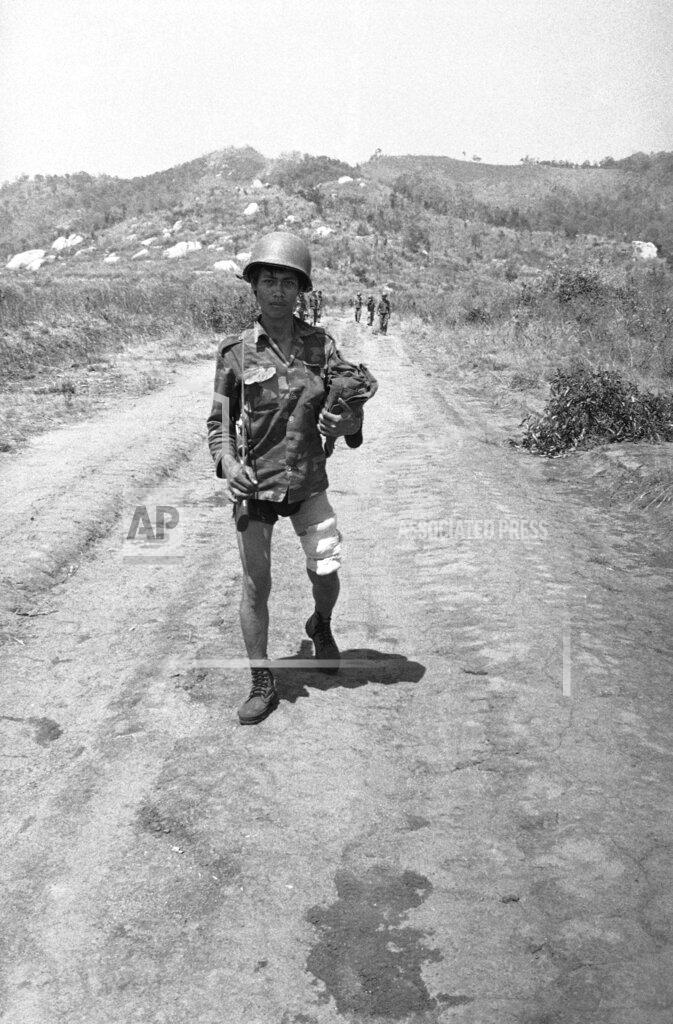


North Vietnamese troops began attacks around the placid Central Highlands provincial capital of Buôn Ma Thuột (Ban Me Thuot) in South Vietnam, the Saigon command said. The principal targets were two airfields, an ammunition dump and other positions. The southern part of the city was being surrounded as well. The North Vietnamese troops were reported to have opened a new front in the Central Highlands yesterday by attacking Đức Lập, 31 miles southwest of Buôn Ma Thuột. Đức Lập, a lonely outpost on Route 14, stands astride the North Vietnamese forces’ independent road network extending down the western spine of South Vietnam. Buôn Ma Thuột, where a number of French planters live, had not been touched by war since the Communists’ 1968 Lunar New Year offensive. It is situated at an important crossroads in the Central Highlands. Route 21 from the city leads to the coast while Route 14 leads down to the isolated province of Quảng Đức. If the Communists could take Buôn Ma Thuột, which is believed to be defended by 1,000 to 2,000 men, they would seal off Quảng Đức Province.
The command could provide few details on the fighting around Buôn Ma Thuột or the size of the attacking force, which is believed to be drawn from the North Vietnamese 320th Division. Yesterday Major General Phạm Văn Phú, the Government’s commander in the Highlands, ordered a top priority “red alert” for Buôn Ma Thuột and ordered troops to occupy all high buildings in the provincial capital. While the attacks were unfolding around Buôn Ma Thuột, extremely heavy fighting was reported at Đức Lập. North Vietnamese gunners, from the F‐10 Division, the command said, fired 10,000 rounds into the vicinity of Đức Lập, which blocks the southward extension of the Communists’ Truong Son highway system in South Vietnam. The road system detours into Cambodia north of Đức Lập. The military command said that an entire North Vietnamese regiment had attacked the town as well as three outlying base, camps southwest of Đức Lập, which itself is believed to be lightly defended. Đức Lập has housed a sizable force of government tanks and armored personnel carriers. The command asserted that Government air strikes and the defenders’ own response to the attack had killed 165 Communist troops and knocked out 26 antiaircraft weapons.
The North Vietnamese campaign in the Central Highlands, which began last Tuesday, was developing with surprising swiftness. While the fighting raged in Đắk Lắk (Dar Lac) Province, an independent report from the field said that about 2,000 Government rangers from the Highlands and two regiments from the 22d Division, or about 4,000 men, from the coast were pushing along Route 19. The highway, which links Pleiku and the coast, is critical to the defense of the Highlands. It has been cut in several places. Government tanks, armored personnel carriers and troops were seen moving east of the district capital, Lê Trung. Communist gunners on a nearby mountain shelled bridges the column had crossed to cut off its retreat.
The rangers are trying to dislodge North Vietnamese troops of the 95th Regiment of the Yellow Star Division from Camp 94, which was captured five days ago. The camp lies in the Plei Bông Valley, 22 miles east of Pleiku, where a Communist‐built road almost crosses Route 19. At the other end of the road, three miles west of Bình Khê, other troops from the Yellow Star Division have also cut Route 19. On both highway fronts the Saigon command reported heavy fighting. The advancing South Vietnamese troops around Bình Khê were said to have killed 139 Communist soldiers while seven of their own men were killed and 35 wounded. At one spot government forces were attacked by ground troops after coming under intensive heavy weapons fire, the command said. The town of Bình Khê was reported to have been struck by rockets.
The Highlands command reported 52 North Vietnamese troops killed in the Plei Bông Valley area. Two of the Government’s armored personnel carriers were known to have been knocked out and two others damaged. Military sources in the Highlands said North Vietnamese tanks had been sighted in the Plei Bông Valley. Ranger jeeps were seen moving TOW wire-guided anti-tank missiles to the Plei Bông front. Western sources said that nine bridges and culverts had been knocked out on Route 19. None has been repaired so far because of the heavy fighting. In addition, two bridges have been destroyed on Route 21, the other usable road leading out of the Highlands.
Foreign military experts in Phnom Penh believe they are watching the final phase of a military victory for the Communist-led troops that have surrounded the city. The final stage may be over quickly or it might last several months or even possibly into next year. A great deal will depend on whether the Ford administration succeeds in keeping the faltering Phnom Penh government alive for a while longer with a new infusion of military aid. But despite the short-term survival possibilities, the military situation offers nothing except pessimism about the ultimate outcome.
Some of the rockets fall harmlessly in empty fields, but others land in crowded streets and markets an on average they kill a dozen or more people every day, keeping the capital very much on edge and often sleepless because of nighttime explosions. In the rest of the country, many provincial capitals are also under siege, and almost all are isolated and cut off from Phnom Penh except by air. Heavy casualties have shrunk Government military units to half strength or less. With the exception of a few units, the troops are badly led and badly looked after. Hardly a single foot sldier has a complete uniform. Most of the troops lack even boots, so they fight in sandals or go barefoot. They earn the equivalent of $12.50 a month, which has to support, on average, a family of five. Hundreds of millions of dollars in American military aid have been poured into Cambodia every year, but this army has become one of the most patched and tattered and disheartened fighting bands in the world.
The insurgent side is believed to have suffered casualties just as severe as the government’s, or worse, because the government has the advantage of heavier weapons and an air force that can bomb. Yet the insurgents appear to be more disciplined, and perhaps more ruthlessly led, for they have not crumbled or retreated in the face of superior firepower, as the Americans had hoped they would. Only rarely does on Insurgent soldier surrender. Almost the only prisoners the government forces ever capture are wounded men who cannot move from where they have fallen. Numerically the two sides present vivid contrasts. The government lists and, pays, with American aid, more than 220,000 men under arms, but no more than 70,000 of them, if that many, are actual combat soldiers. The total insurgent strength is estimated by Western analysts at a maximum of 60,000, and almost all are combat soldiers. When this offensive began 10 weeks ago, about 30,000 of the insurgents, were believed arrayed around Phnom Penh, which was being defended by tens of thousands of desk soldiers but only about 25,000 combat troops, who outgun their enemy with the help of armored personnel carriers, planes, artillery and other heavy weapons.
The Cambodian high command and the Americans contend that so far in the offensive the insurgents have suffered over 15,000 casualties around Phnom Penh, which seems high, and the government side half that, which seems low. American officials also say that both sides have built their ranks back up to the original strength, mostly with poorly trained and second‐rate troops. Along the Mekong River, the only other major battlefront, which runs about 60 miles from Phnom Penh southeast to the Vietnamese border, the Americans believe the insurgents have 12,000 men, which may be a high figure, and the government side only 5,000. The rest of the troops on both sides are deployed in and around provincial capitals throughout the country. Until recently, the Americans had been calling the war a stalemate citing the fact that the insurgents had been unable to seize the big prize, Phnom Penh But the insurgents are moving closer and closer to the prize. “If they get some more money from the Congress,” one Western military expert said of the government forces, “they may be able to stagger on a little longer. But we all know it’s only putting off the evil day.”
Military analysts here foresee the possible loss of some outlying provincial capitals the situation continues to deteriorate and the government continues to draw off troops from those isolated towns for the defense of the capital. The insurgents, using mostly their weaker territorial troops, have steadily increased their pressure against provincial capitals such as Prey Veng, Takeo and Kampot, and it is possible that one or two of these could fall in the coming weeks. In addition, the key town of Neak Luong, the government’s last major post on the Mekong, 38 miles southeast of Phnom Penh, is under increasingly heavy siege, with intense enemy shelling most days. Its loss would seal the river. As these government defenses gradually weaken and pieces fall away, the capital city, despite the nearness of the fighting, tries hard to maintain its languid prewar face. This afternoon the pool at the Hotel Le Phnom was thronged with French and other foreigners pretending for a few hours that the war was somewhere else. Among the Sunday swimmers and sunbathers were doctors and nurses who spend 18‐hour work days in the overcrowded hospitals here, trying to help some of the hundreds maimed by the war every day.
Among Cambodians, there is a sense of decay and hopelessness, but no feeling of urgency. Nattily dressed young draft evaders from moneyed families stroll in the parks with their women friends, and high government officials are still holding fancy parties in their villas. But every day rockets whistle down and explode in some of the most populous quarters of the city Bodies in pools of blood are now as common in Phnom Penh as dented fenders in the streets of New York. The American Embassy still desperately tries to bolster the Government of Marshal Lon Nol. At the moment some apparently cosmetic Cabinet changes are in the works and some corrupt and incompetent military commanders are being replaced. The Americans would like this to be called a major shake‐up, but it is little more than an effort to create an impression of reform where actually there is none. On February 26, President Ford said that if Congress did not vote the $222‐million in additional military aid he has asked for Cambodia, the Lon Nol forces would run out of ammunition “in less than a month” and “be forced to surrender to the insurgents.” Few knowledgeable observers here believe the ammunition stocks will run out that soon. Yet foreign military experts in Phnom Penh believe that no matter how much aid the American send, the problem is one of Cambodian will and leadership and fighting manpower, all of which the government lacks.
So far the bombardment by 107‐mm Chinese rockets, which are inaccurate, and by much more accurate artillery shells from a captured Americanmade 105‐mm howitzer, has not shut down the airport, which is situated five miles west of Phnom Penh. But if the insurgents can push perhaps two miles closer, using a few artillery pieces and perhaps some heavy mortars, and can protect their weapons from attack — and also if they have forward observers, to direct the fire — it is generally thought that they could start scoring direct hits on planes and thus close the airport. In that event, supplies could still be dropped by parachute, but this would be an extremely difficult operation, and if the situation deteriorates that badly for the government, collapse will probably not be far off. All roads out of the capital have been cut. And this year, in the offensive they began on January 1, the Cambodian insurgents finally blocked Phnom Penh’s main supply line, the Mekong River, by seeding it with mines and emplacing heavy guns on its banks. Many military analysts here believe the river is irrevocably blockaded.
Now the insurgents are firing artillery and rockets at Pochentong Airport, the capital’s last link to the outside world. Passenger flights out of Phnom Penh are becoming fewer and fewer. The large‐scale American airlift has also been disrupted, though not yet halted, by the shelling. On the ground, the capital’s most crucial defense perimeter — roughly an arc that swings from north of the city to the northwest and then around to the southwest — seems to be gradually deteriorating. This arc represents the enemy’s main push against the capital, and at some points, such as at Prek Phnou to the north, enemy forces are attacking only eight miles from the center of Phnom Penh. There is a different kind of threat — from rockets — on the other side of the capital, to the east and northeast, across the wide Mekong River. Insurgent units have seized areas just opposite the capital on the east bank and on a peninsula that juts into the river there. While a surface assault is almost impossible because of the river, these positions, no more than three miles away, allow the insurgents to carry on blind rocketing of the capital every day. Government efforts, including bombing, have failed to dislodge these units.
Senator Hubert Humphrey said in a television interview that “additional military aid will merely prolong the agony” in Cambodia. He charged that the administration had no program for Cambodia after June 30, the cutoff date for its proposed additional military aid to the Phnom Penh government. He said “private reports from the Embassy and from the intelligence service tell us that the odds are dead set against the continuity or the saving of the Lon Nol government or even of any kind of military stalemate.”
The Senator charged that the Ford Administration had “no program” for Cambodia after June 30. “They simply say give us money until June 30.” He continued: “Why, then, do we prolong the agony? I’ll tell you why, I think. Because we want to be able to say, well at least we tried.” Mr. Humphrey also accused the Administration of not trying hard enough to bring about a negotiated settlement. Asked what there was to negotiate except the surrender of the Phnom Penh Government, given the Communists’ reluctance to negotiate, he responded that President Lon Nol should step down, and that an interim government should be formed “to bring about an orderly transfer of power.”
It was learned that high White House officials called Mr. Humphrey before the television show, seeking to head off strong statements by the Senator. But on the program Mr. Humphrey not only said he would vote against the extra military aid but also predicated that his Senate Foreign Relations Committee subcommittee on foreign aid would vote no funds except for food or other humanitarian assistance. The Senator also threw cold water on a compromise deal being advanced privately by the Administration under which Mr. Humphreys subcommittee would reject the $222‐million request but approve a formula allowing the Cambodians to receive about $125‐million from available American military stocks. “There was a time that it looked that that might have some salability,” Mr. Humphrey said. “But let me tell you, I think we have to make a hard decision.” He said that decision was for the “American Government to say, no more military assistance, and try to arrange for a cease‐fire, try to arrange for a transfer of power.”
Administration officials would not comment today on a report yesterday in The New York Times that quoted sources in the United States Embassy in Phnom Penh as having said that Secretary of State Kissinger had rebuffed proposals by the United States Ambassador in Cambodia that contact be made with Cambodian Communist leaders. On the interpretation of official telegrams from Cambodia, the officials said that they stood by previous Administration testimony to Congress that the supplemental military aid would give the Phnom Penh. Government a reasonable hope of surviving until June, with the hope that thereafter a military stalemate could lead to negotiations. In a related development today, 37 House Democrats, all but one of them freshmen, have sent a letter to President Ford saying that they will not vote for his military aid request for either Cambodia or South Vietnam. According to Representative Thomas Harkin, Democrat of Iowa and one of the signers of the letter, the Congressmen have asked President Ford to let statesmanship prevail over dollars.
Soviet trade union chief Alexander Shelepin should be persuaded not to visit Britain, a Labor Party member of Parliament said. Addressing a party meeting at Hartlepool, Ted Leadbitter said, “He is not regarded as a welcome visitor. This ex-boss of the KGB (secret police) is looked upon as a brutal, unfeeling man who is responsible for having so many workers serving long sentences in prison.” Shelepin has been invited by the British Trades Union Congress but no date has been fixed for the visit.
A fire-bomb attack was launched on the fleet of the fishing village of Greencastle in the Republic of Ireland and a militant Protestant organization of Northern Ireland, the Ulster Defense Association, claimed responsibility, saying the fishing fleet had been gun-running for the Irish Republican Army. Two boats were gutted in the attack and police found unexploded fire bombs on all but one of the 18 other vessels in the harbor.
The Christian Democrats increased their majority in the Rhineland-Palatinate province, conforming to a national trend away from the ruling Social Democrats led by German Chancellor Helmut Schmidt. Computer projections by television networks based on early returns said that the Christian Democrats had won about 53.4%, the Social Democrats about 38.9% and the Free Democrats about 5.8% of the popular vote.
The Popular Democratic Party accused its Communist partners in Portugal’s coalition government of being involved in weekend violence that wrecked a PDP rally in the port city of Setúbal. Julio Castro Caldes, a PDP leader, said Communist Party militants were identified and photographed among leftist demonstrators who attacked the rally. Although a deep split has set the Socialists and the center-left PDP against the Communists within the coalition, this was the first time one party had accused another of a major act of violence.
His bristle moustache now snow white, Vyacheslav M. Molotov, marked his 85th birthday in retirement in Moscow. He is one of four old Bolsheviks left who survived the civil war of the 1920s, the Stalin purges of the 1930s, World War II, and the rise and fall of Nikita S. Khrushchev. Born in a small town in Vyatka province, he was baptized Vyacheslav Mikhailovitch Scriabin (his uncle was the celebrated composer Alexander Scriabin) and later changed his name to Molotov (hammer). Stalin’s ironhanded top lieutenant and former foreign minister now passes his time with walks in the park, trips to the library and visits with his sons and grandchildren.
Secretary of State Kissinger announced today that he would interrupt his Egyptian‐Israeli diplomacy tomorrow to fly from Israel to Ankara for unexpected talks with key Turkish leaders on the Cyprus situation. Just two days ago, reporters accompanying Mr. Kissinger were told that Turkish authorities had refused to receive him in the Turkish capital, in apparent pique over the suspension by Congress last month of American military aid because of the Turkish intervention on Cyprus. But yesterday afternoon while in Aswan, Egypt, Mr. Kissinger was notified that the Turks had agreed to meet with him on Monday and Tuesday in Ankara. The purpose of Mr. Kissinger’s mission to Ankara will be to persuade the Turks to go along with American efforts to reconvene talks between Greek and Turkish Cypriot leaders on solving the crisis. At the moment, the American efforts are directed at moving the discussions from Nicosia, where they have collapsed, to New York, under a United Nations umbrella.
Secretary of State Kissinger arrived in Jerusalem today and presented Egypt’s latest proposals on a new Sinai agreement to Israel’s leaders, but he apparently failed during a stopover in Damascus to persuade President Hafez al-Assad of Syria to drop his opposition to Egyptian-Israeli negotiations. Soon after arriving at Tel Aviv’s airport, Mr. Kissinger was driven to Jerusalem and conferred with Premier Yitzhak Rabin, Foreign Minister Yigal Allon and Defense Minister Shimon Peres. While in Jerusalem, Mr. Kissinger expects to receive Israeli proposals that he can bring back to President Anwar Sadat of Egypt. The Israelis were described by diplomats here as being generally optimistic that a second‐stage accord on Sinai would be worked out, following up the agreement reached in January, 1974, providing for an Israeli pullback from the Suez Canal area. But many Israelis are skeptical about the value of an accord that will probably call on Israel to make significant territorial concessions in return for intangible pledges and steps to reduce the likelihood of another war.
Reports from Middle East sources received in Paris said that Iraq had opened an offensive against rebellious Kurds. The attack began Friday morning along Iraq’s northern front, the sources said, and started soon after Iraq and Iran announced a settlement of their border differences last week in Algeria. The Kurdish rebellion in the mountains of Iraq will collapse by next summer, an Iraqi Kurdish cabinet minister predicted in Beirut. Rural Affairs Minister Hashem Agrawi told the Beirut weekly Ad-Diyar that he was prepared to lay a bet that Kurdish rebel leader Mulla Mustapha alBarzani would be flushed from his last hideouts in the north by next summer.
A Soviet commentator, A. Kantov, said that Peking was to blame for its dissatisfaction with U.S. policy toward China and Taiwan. He said it was the Chinese themselves who had decided on bettering relations with the United States. Because the Chinese do not want to complicate their relations with Washington, they will. not act on their promises to liberate Taiwan, he said. Kantov said Peking leaders still cherish the hope of making an undercover deal with Taiwan under which Chaing Kai-shek would fill the post of head of Taiwan province for life.
Senator Gary Hart (D-Colorado) said he would try to block funds to help the Marianas — a group of islands north of Guam — achieve commonwealth status as a territory of the United States. He said the United States only wants the islands for military bases. The Marianas are part of the Trust Territory of the Pacific, which is administered by the United States.
Ethiopia’s ruling military council said it intends to stay in power until a sufficiently large number of Ethiopians are politically ready for civilian rule. The 120-man council said it was paving the way for a handover of power to the masses but does not wish to turn power over to civilians at present. The council came to power after deposing Emperor Haile Selassie last September 12.
As civil war continued between Eritrean secessionists and Ethiopia, the army of Ethiopia massacred 208 civilians in the city of Agordat, located in Eritrea’s lands.
President Valery Giscard d’Estaing said, last night that he looked forward to the emergence of a new grouping of African countries—including former French, Belgian and Portuguese colonies — within a year or two. Mr. Giscard d’Estaing spoke at a news conference at the conclusion of the top‐level meeting of 14 French‐speaking African countries here, before flying back to Paris early this morning. Some French‐speaking countries, notably Madagascar, Chad, Cameroon and the Congo Republic, did not come, but former Belgian as well as former French colonies were represented.
Work has started on the Alaskan oil pipeline, the largest private construction project in the history of the United States. If work progresses on schedule, 30 months from now the first yield of crude oil from the rich Prudhoe Bay field will begin flowing at four miles an hour from the frozen Arctic tundra 789 miles south to the ice-free Alaskan port of Valdez.
Replying to mounting conservative criticism of President Ford and his policies, White House chief of staff Donald Rumsfeld warned against moves to narrow the base of the Republican Party. “The purpose of a political party is to earn the right to govern, and that means you have to get a majority of the votes, you have to reach out and add. Politics is addition, not subtraction.” He spoke in response to conservative Republicans, led by former California Governor Ronald Reagan, who criticized Mr. Ford at a party meeting in Washington last week for his proposed $53 billion budget deficit and other anti-recession steps that the conservatives consider violations of party principles.
Adam Walkinsky and Peter Edelman, former assistants to Robert F. Kennedy when he was Attorney General and a Senator, said that Mr. Kennedy told them in 1967 that agents of the Central Intelligence Agency had contracted with the Mafia in an aborted plot to assassinate Premier Fidel Castro of Cuba before the aborted Bay of Pigs invasion in 1961. They said in interviews that Mr. Kennedy privately told them that he had played an active role in stopping the assassination attempt. Their statements provided the most specific allegations to date of a link between the C.I.A. and the Mafia and assassination attempts on Mr. Castro.
New York City policemen have voted overwhelmingly to work five days a year without pay to save the jobs of 535 rookies, the Patrolmen’s Benevolent Association says. Mayor Abraham D. Beame had threatened to make the job cuts to help close a $430 million gap in his $11.1 billion budget, but he said the police plan would allow the rookies to stay on the job. The policemen approved the plan by a vote of 14,135 to 5,366 after the association’s president, Kenneth McFeeley, had campaigned extensively to overcome initial opposition. Meanwhile, Housing Authority policemen voted for a similar plan to work five days without pay in order to save the jobs of 45 of their colleagues, also threatened by city budget cuts.
Integration of Boston schools has cost so much that they may run out of money and have to close early this spring, the Boston School Committee chairman. John J. McDonough, said. Unless they get money from other sources, the schools will use up their budget by May 1. The budget for the year ending June 30 is $125 million. McDonough said that so far the committee had spent $8 million on integration and that it would have to spend about $9 million more, by the end of the school year. If the system runs out of money, 7,000 employees will not be paid, McDonough said. “When that happens, they may choose not to work and we will be forced to close the schools.”
Eldridge Cleaver, down-and-out and living in Paris, wants to come home to California, “where people have the room to be human,” Newsweek magazine reported. Cleaver, former head of the Black Panther Party who has been in exile for six years in Cuba, Algeria, and Paris, has mellowed. But at 39, with gray in his hair, he still is pro-Palestine, although not so rabidly anti-Israel. And the “back to Africa” movement for American blacks wouldn’t work. “I felt as distant from the Africans as I did from the Asians.” He noted also, “The Russians would really prefer that the U.S. cease to exist. I came to the conclusion that they were capable of launching a surprise attack.” The author of “Soul on Ice” is willing to return and stand trial on an assault charge growing out of an Oakland, California, shootout, the magazine said, but only if he can stay out of jail until the end of the trial. But his lawyer, Charles Garry, told Newsweek, “It doesn’t look good.”
Symbionese Liberation Army member Russell Little, one of two men charged with the 1973 murder of former Oakland Schools Superintendent Marcus Foster, will appear today in Sacramento Superior Court, where his attorney will request court permission to withdraw from the case. The attorney, John Bain, will base his request on a conflict of interest after he witnessed an alleged escape attempt by Little and co-defendant Joseph Remiro from Alameda County Jail last week. Bain, a Contra Costa County deputy public defender, testified before the Alameda County grand jury which indicted the pair on charges of attempted escape and assault. They have been in the Alameda jail since their arrest in January, 1974. The trial, which was moved to Sacramento last December, is expected to begin March 31.
Betty Ford suffering from a severe flare-up of a chronic osteo-arthritic condition in her neck and back, was treated at the White House today by a rheumatology specialist.
Having enough time for recreation is more important to most Americans than making money. That is how 55% of a cross section of the U.S. public responded in a study on leisure completed at Ohio State University in Columbus. People indicated they were not bored with their leisure activities and consequently wanted more time to pursue them. One of the investigators said it was estimated that Americans annually spent between $80 billion and $150 billion in leisure activities. He said that although the answers had been received in mid-1973, before the current economic situation, the study’s findings remained valid.
Disturbed by reports that some Florida condominium developers have engaged in unethical and illegal sales practices, a number of local builders have formed a policing association that they hope will spread statewide through the troubled industry.
A storm spreading freezing rain, lightning, sleet, and heavy snow moved rapidly through the Southern Plains, the Mississippi Valley, Kansas, and Iowa. The Weather Service posted a winter storm warning for most of Indiana and northern and central Ohio also. A tornado watch was in effect for much of southern Oklahoma, northern Texas, and a small part of Arkansas. Winds gusted up to 60 mph at Dallas and Ft. Worth and up to 55 mph at El Paso and Houston. Five persons were injured when wind blew a large highway sign onto their car in Houston. Elsewhere, it was fair throughout the East, although a forecast of gale force winds threatened the New England coast.
The Golden Hinde II arrived in San Francisco Bay, re-enacting the voyage of Sir Francis Drake, which sailed in the bay in 1579. The journey had started on September 24 from Plymouth, England.
Musical rock opera “The Lieutenant” opens at the Lyceum Theatre, NYC; runs for 9 performances.
With Rod Laver continuing his amazing mastery over Arthur Ashe today, Australia was able to continue its notso-amazing dominance over the United States in tennis by taking its fifth Aetna World Cup in six years, 4 matches to 3. Laver demolished Ashe, 6-2, 7-6, for his 19th victory in 21 meetings.
Born:
Adonal Foyle, Vincentian-American NBA center (Golden State Warriors, Orlando Magic, Memphis Grizzlies), in Canouan, St. Vincent and the Grenadines.
Bob Hallen, NFL guard and center (Atlanta Falcons, San Diego Chargers), in Mentor, Ohio.
Rob Sasser, MLB pinch hitter (Texas Rangers), in Philadelphia, Pennsylvania.
Roy Makaay, Dutch footballer known as “Das Phantom”; in Wijchen, Netherlands.
Jane Antonia Cornish, British composer of contemporary classical music (Seascapes), and film scores (“Five Children And It”), in London, England, United Kingdom.
Died:
Shirley Ross [Bernice Maude Gaunt], 62, American actress (“Cafe Society”, “Prison Farm”, “Waikiki Wedding”), of cancer.
Warren K. Lewis, 72, American chemistry professor known as “the father of chemical engineering.”






 History Diaries