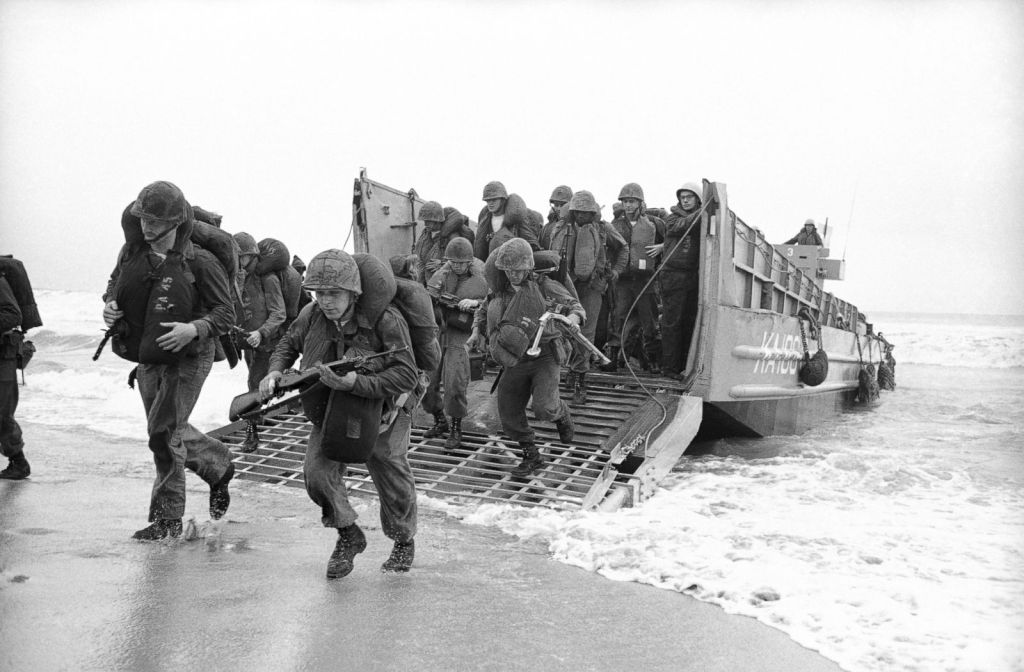

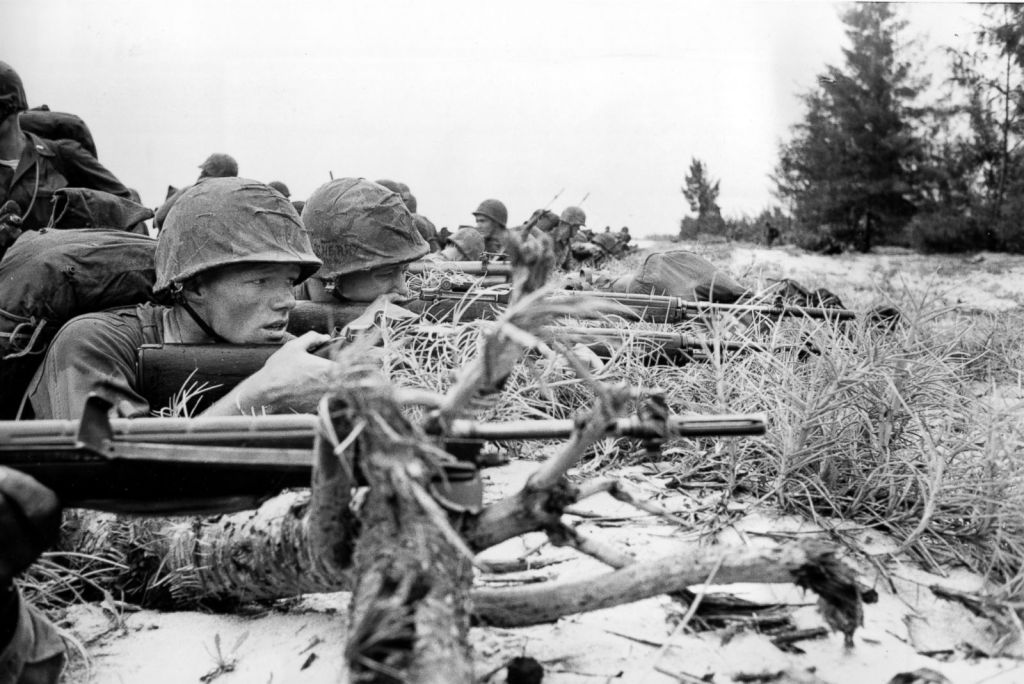
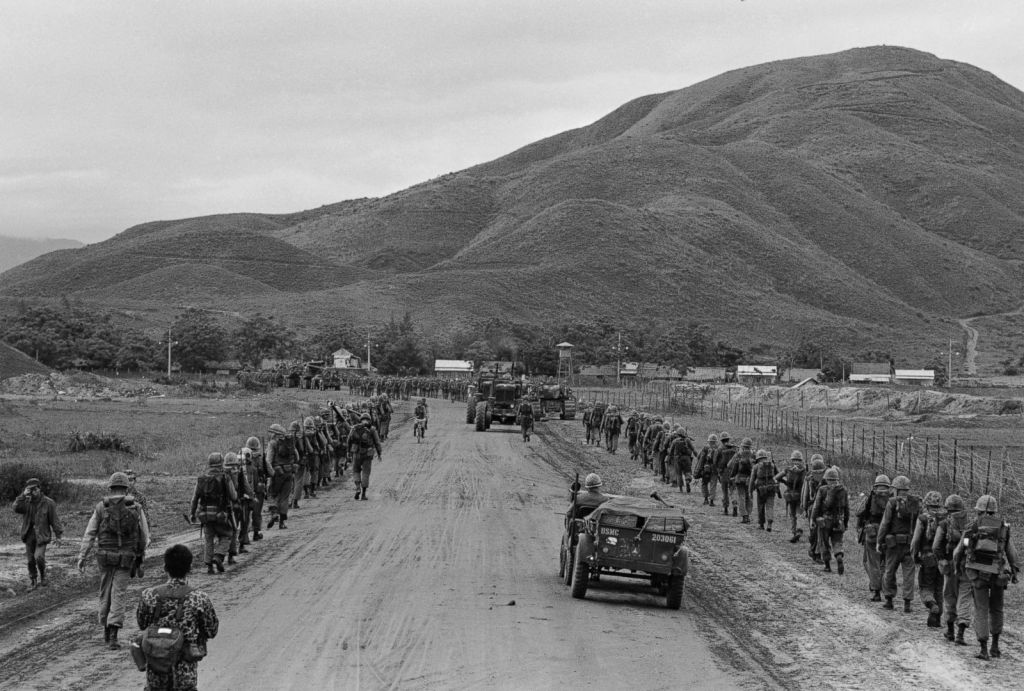
At 9:02 AM local time, the first American military combat troops arrived in South Vietnam as 1,400 members of the United States Marines in combat gear came ashore at Đà Nẵng Bay. The men of the 9th Marine Expeditionary Brigade were the first of 3,500 troops from the 3rd Marine Regiment of the 3rd Marine Division. Although there were 23,000 American military personnel in South Vietnam already, the deployment represented “the first body of Americans to go to the embattled southeast Asian nation as a fighting military unit.” The USS Henrico, USS Union and USS Vancouver, carrying the 9th Marine Expeditionary Brigade under Brigadier General Frederick J Karch, relocated from Okinawa, take up station some 4,000 yards off Red Beach Two, north of Đà Nẵng. First ashore is Battalion Landing Team 3/9, which arrives on the beach at 0918 hours. Wearing full battle gear and carrying M-16s, the Marines are met by sightseers, ARVN officers, Vietnamese girls with leis, and four American soldiers with a large sign: ‘Welcome Gallant Marines.’ (General Westmoreland is reportedly ‘appalled.’) Within two hours, BLT 1/3 begins landing at Đà Nẵng Air Base.
Việt Cộng guerrillas attacked a Special Forces camp today in Bình Định Province, north of Saigon, with mortars, recoilless rifles and small arms. Three Americans serving with Vietnamese units were reported wounded, none seriously. On Saturday night, guerrillas. overran a South Vietnamese Government platoon three miles from the end of an airstrip at Đà Nẵng, the base that is to be secured by United States marines. Two of the defenders were killed and two others are missing. Việt Cộng casualties, if any. were unknown.
The Johnson Administration is considering sending American-manned naval craft to help protect the South Vietnamese coast against increasing Communist infiltration by sea. Another step being discussed within the Administration is assigning additional attack carriers to the Seventh Fleet to increase American air power in Southeast Asia. As was indicated by the landing of two marine battalions at Đà Nẵng, the United States is in the process of increasing its direct military support of South Vietnam beyond the advisory role of the past.
In recent weeks it has begun supplying air power for bombing strikes at Communist targets in South and North Vietnam. With the assignment of the marines, it has started providing ground forces to help defend crucial military installations. The next likely step would be a contribution of naval power to help patrol the long and vulnerable South Vietnamese coastline. A commitment of naval power is being prompted by the growing indications that North Vietnam is using the sea to an increasing degree for smuggling men and, more particularly, weapons into South Vietnam.
North Vietnam and Communist China today protested the assignment of United States Marines to South Vietnam. The Hanoi Government lodged a “strong” protest with the International Control Commission. China’s denunciation. was made in a broadcast by the Peking radio. The Chinese called the landing “another step of the Johnson Administration to widen the war of aggression gradually and by stages.” In another broadcast monitored here, the Hanoi radio said that the United States marine landing was “an ever heavier menace to peace and security in this part of the world” and that “the United States Government must bear full responsibility for all consequences.”
A clash between Buddhist and Catholic groups was reported to have occurred late last night at the northern edge of Saigon. It was the first violence between the two religious groups since last fall. Reliable informants said that fighting broke out, some shots were fired and two grenades were thrown. One person was said to have been seriously wounded and six others slightly wounded by grenade blasts. An unknown number of others were said to have been hurt by sticks and rocks.
The incident was reported to have occurred where the Government had taken over a plot of land and was building about 20 small houses for Roman Catholic refugees of recent floods as part of a resettlement program. In a move for religious amity, representatives of four South Vietnamese religious groups appeared yesterday at a rally called by the Rev. Koang Quỳnh, militant Roman Catholic leader. In addition to the Catholics, there were speakers from Buddhist, Cao Đài and Hòa Hảo organizations. They urged friendship among religious groups and denounced Communism.
The United Nations Secretary General, U Thant, has sent messages to some of the principal powers involved in the situation in Vietnam recommending a seven-power conference as a step toward ending the war there. It is understood that he envisages the conference as a preliminary to a more formal and enlarged meeting.
Reliable sources said today that Mr. Thant had proposed that the United States, the Soviet Union, Britain, France, Communist China, North Vietnam and South Vietnam take) part in the conference if informal preliminary discussions indicate there is a possibility of an agreement. These seven powers, along with Laos and Cambodia, attended the 1954 conference in Geneva that produced the armistice agreements that ended the Indochina war with the partition of Vietnam at the 17th Parallel.
Mr. Thant sent his proposal to six of the suggested participants, omitting Communist China. No formal replies have been received, but it is assumed here that the United States, which is insisting that it must strengthen its position before negotiations begin, is reluctant to agree at this stage even to talks on the possibility of a conference. North Vietnam, it was indicated, is showing a less “positive” attitude than it did last fall to Mr. Thant’s attempt to arrange secret informal discussions between Hanoi and Washington. However, President de Gaulle previously advocated reconvening the Geneva conference and it was believed that France would favor Mr. Thant’s suggestion. The Soviet Union and Britain hold key roles because their foreign ministers, as co-chairmen of the 1954 conference, would have the responsibility of reconvening it.
Mr. Thant disclosed at a news conference February 24 that he had made “concrete” proposals and suggestions to the United States and to other powers principally involved in the Vietnam question. He did not name the others. However, it was supposed at the time that he had confined himself to suggesting “dialogues” in advance of a formal conference. According to information obtained today, Mr. Thant’s messages suggesting the sevenpower conference called also for such pre-conference discussions. The fact that some time before February 24 the Secretary General took the initiative and approached six of the seven participants himself became known today.
The United States mission in Saigon is preparing an intensified program to win support from the Vietnamese people for the war against the Communists.
Soviet news and propaganda media struck a relatively mild note today in their criticism of the landing of United States Marines in South Vietnam.
The International Control Commission for Vietnam has urged Britain and the Soviet Union to issue “an immediate appeal” for measures to “stem the deteriorating situation” in the divided Southeast Asian country.
The political arm of the Việt Cộng insurgents flatly rejected today a negotiated settlement in South Vietnam while American forces remain there. Nguyễn Minh Phương, deputy chief of the South Vietnamese National Liberation Front permanent mission here. said at a news conference: “So long as there is one single shadow of U.S. imperialism in Vietnam, the Vietnamese people will hold tight to their weapons and fight to the end for their aims.”
President Gamal Abdel Nasser sharply attacked West Germany tonight but sidestepped an immediate showdown with Bonn over its declaration yesterday that it was seeking diplomatic relations with Israel. The United Arab Republic’s President said Bonn’s policy was a question for all Arab states and would be taken up at a meeting of personal representatives of 13 Arab chiefs of state here tomorrow. “I hope we shall emerge with a unified plan for action,” Mr. Nasser said at a political rally at Assuit, a city 200 miles south of Cairo.
But, he asserted, “if we fail to reach such an action, then we on our own will take a decisive stand against West Germany backed by the Arab countries that support our policy.” At a minimum, this was considered a reference to Iraq, Algeria, and Yemen, which have sided most consistently with Mr. Nasser on the German issue and other problems.
“I’ll not please West Germany by saying anything today and allow her to separate the Arabs,” Mr. Nasser said, implying potential differences among the Arab states on the question of dealing with Bonn. In an effort to rally other Arab leaders, President Nasser recalled the decision of the first Arab summit conference of January, 1964, “calling for reviewing relations if West Germany should recognize Israel.” He declared that Arab unity was vital for liberation of Palestine and he scoffed at Western arguments for a balance of power between Israel and the Arab states. “If they buy 200 tanks and we buy 200 tanks, this is not the way,” he explained. “We must accomplish what they cannot do. We can mobilize five million. They cannot mobilize five million.”
Even before Mr. Nasser’s speech, Western diplomats here were concerned over rising tensions between Israel and the Arabs in the dispute over the waters of the Jordan River. There has been serious concern over the possibility that the Middle East arms race will be stepped up. Mr. Nasser avoided a direct call for action against Israel, but he told a cheering crowd tonight that “to liberate Palestine Arab armies must be united, Arab endeavor must be united. If the Arabs are defeated again, Arabs will never rise again.”
Buoyed by solid domestic support of the offer to seek full diplomatic relations with Israel, West German Chancellor Erhard was described as fully prepared for the United Arab Republic to grant diplomatic recognition to Communist East Germany in response to Bonn’s announcement on Israel.
Israeli and Syrian troops clashed three times today north of the Sea of Galilee, where three other exchanges have been reported in recent days, an Israeli Army spokesman said. Tanks and automatic weapons were used by the Israelis to silence Syrian fire directed from gun and mortar positions, the spokesman said. He said the Syrians had fired into Israeli territory. There were no Israeli casualties, he said.
In Damascus, a Syrian Spokesman reported a 90-minute tank fire and gun battle, the fourth in six days, raged across the armistice line between Israel and Syria today. Syria complained to the United Nations truce observers that it was a case of “premeditated aggression.”
Nine passengers on board Aeroflot Flight 513 were the only survivors when the plane crashed shortly after takeoff from Kuybyshev (now Samara) on a flight toward Rostov. Thirty other people, including the entire nine-member crew, were killed when the Tu-124 jet dropped from a height of about 150 feet (46 m).
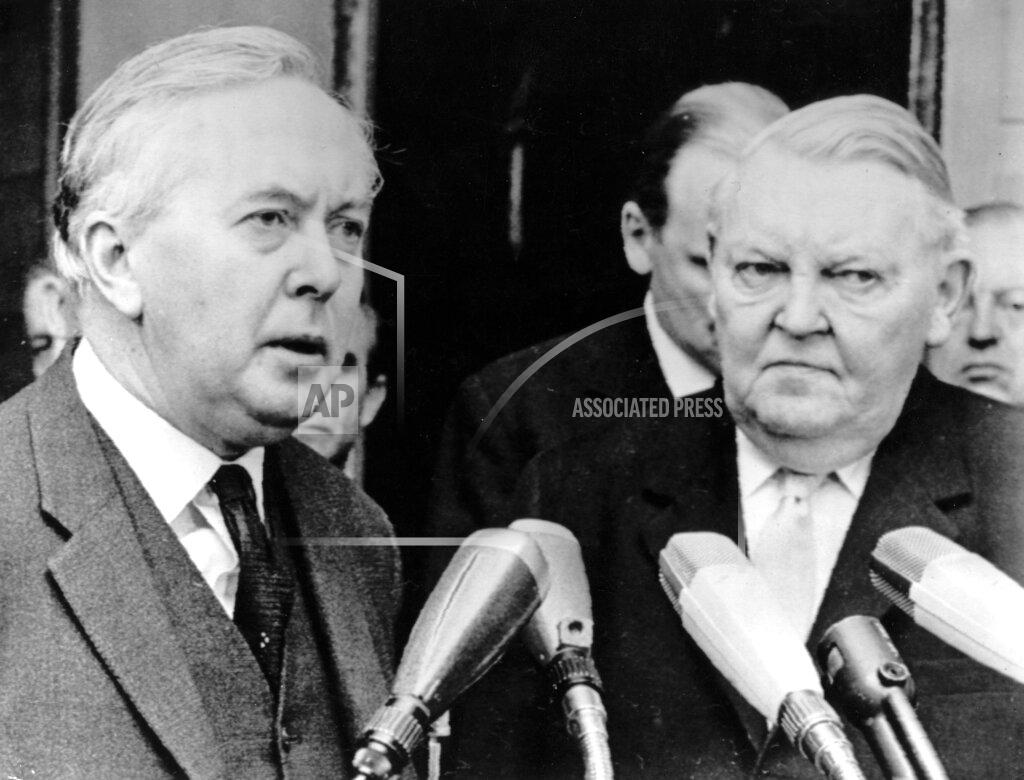
West Germany offered today to increase its guaranteed sterling expenditures substantially to help offset the hard-currency costs of the British Army of the Rhine.
Britain’s participation in talks on European political unity was urged today by her new Ambassador to France, Sir Patrick Reilly.
The State Department altered the framework of United States diplomatic recognition of the republican Government of Yemen by opening the door today to the shipment of food to royalist forces there.
International Red Cross sources reported today that they had word, still unconfirmed, that a missing Danish cameraman and an Indian were executed a month ago by Congolese rebels.
Leaders of the Christian Democratic party in Chile were jubilant today over their sweeping election victory, which exceeded their most optimistic estimates. Balloting gave the party 82 of the 147 seats in the Chamber of Deputies, an 8-vote majority.
The U.S. State Department expressed regret to the Soviet Embassy today for yesterday’s splattering of the embassy building with a black liquid and said compensation would be paid.
British jet fighters today warned off a Soviet jet bomber that was shadowing a six- nation allied naval force maneuvering in the North Atlantic, British naval sources said. According to the sources, the Soviet plane was a twin-jet long-range bomber of the type known under the North Atlantic Treaty Organization code name of Badger.
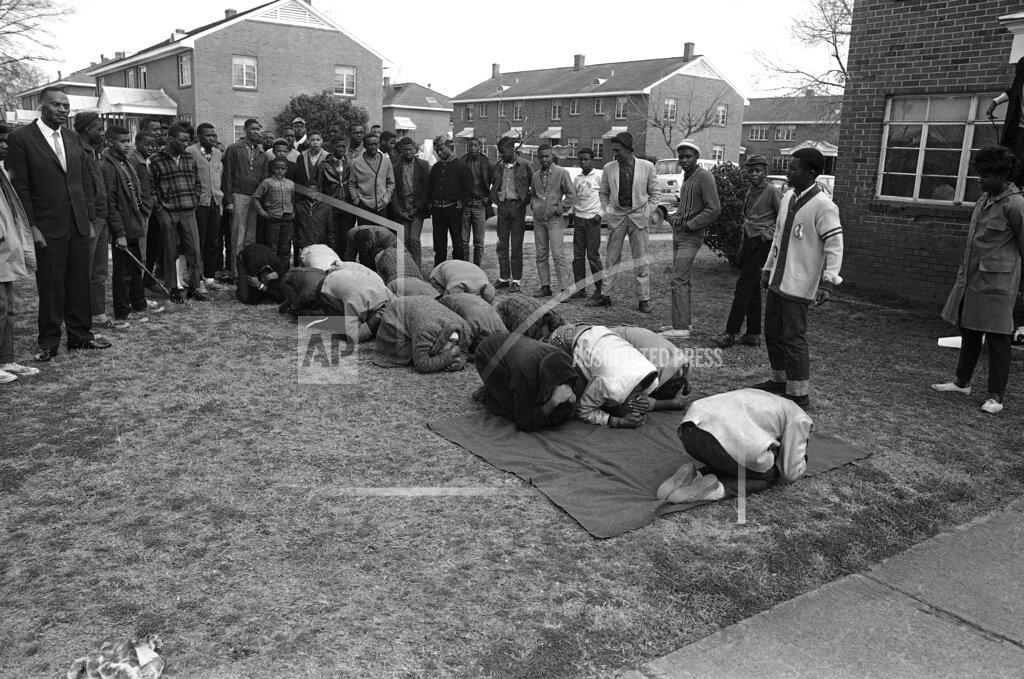
The Rev. Dr. Martin Luther King Jr. returned to Selma tonight to lead a second attempt to protest for Black voting rights with a march to the state capital. The march is set for tomorrow, and Selma was tense today in expectation of the protest. Seventeen Blacks still lay in hospital beds tonight with injuries suffered yesterday when the state police and Dallas County officers suppressed the first march to Montgomery before it had passed the city limits of Selma. Sixty-seven others were injured, most of them suffering from the effects of tear gas. They were treated and released.
Hundreds of representatives of religious, medical and civil rights groups and other concerned persons were on their way to Alabama last night to walk with the Rev. Dr. Martin Luther King Jr. from Selma to Montgomery. Friends of the Black movement from several other states headed for Selma today to take part in the new march. They were aroused by Governor George C. Wallace’s sending in tear-gas bombs, night sticks, whips and horses to turn back the march yesterday. Among those on their way to Selma were Bishop John Wesley Lord of the Methodist Church, Msgr. George L. Gingras of the Roman Catholic Archdiocese of Washington, Rabbi Richard G. Hirsch of the Union of American Hebrew Congregations, James Farmer, national director of the Congress of Racial Equality, the Rev. Dr. David R. Hunter, deputy general secretary of the National Council of Churches, and 10 executives of the council, including the Rev. Dr. Robert W. Spike, executive director of the council’s race commission. About 60 of these friends, most of them white ministers, representing the National Council of Churches, arrived tonight and joined the Blacks at a mass meeting in Browns Chapel Methodist Church. Several telegrams were read from wellwishers across the country. More than 700 persons jammed the church to hear plans for the march, which is scheduled for 1 PM tomorrow.
Aware of this influx, the Governor massed more than 100 highway patrol cars at Montgomery, to be ready to back up a force of troopers already in Selma. Highway patrolmen stopped all cars driving between Montgomery and Selma tonight, asking the drivers where they had come from and where they were going. Governor Wallace presided over a three-hour private meeting in his office tonight. Among those present was Maj. General Alfred Harrison, the State Adjutant General and head of the Alabama National Guard. There was a rumor tonight that the Governor was considering calling out the Guard. A spokesman was asked about that and he answered: “No decision has been taken yet.” Others at the meeting included Sheriff James G. Clark Jr.. Mayor Joe Smitherman and Circuit Judge James J. Hare, all of Selma, and members of the Governor’s staff.
As the tension built up, a Federal judge at Montgomery indicated that he was ready to intervene, perhaps to order one or both sides to back down. The judge, Frank M. Johnson Jr., received a petition from two Black lawyers late this afternoon asking him to overturn the Governor’s ban on the 50-mile march. He heard the petition in private and instructed his secretary to draft an order, but did not disclose its contents. He is not expected to sign the order and make it public until early tomorrow. Judge Johnson has been known to enjoin both sides in disputes such as this.
Governor George C. Wallace denied today that Alabama state troopers and sheriff’s deputies had used unnecessary force in routing Black marchers at Selma yesterday. Governor Wallace said in an interview it was probable that the police billy club and tear gas assault on the vanguard of more than 500 Black marchers had saved the lives of some of them by turning them back to Selma. He said the police could not have protected the marchers from angry whites on the 50-mile march to Montgomery to petition for voting rights for Blacks. He indicated that there would be no change in police tactics should the marchers try again tomorrow, as planned. In Selma, Mr. Wallace said, “not nearly as many were hurt as were hurt in” similar occurrences in other states, including those in the North.”
While the Governor praised the police for “enforcing the law,” he appeared, nevertheless, to be somewhat on the defensive. He pointed to a photograph on the front page of a Birmingham newspaper, and observed: “There’s a picture of a policeman raising his club, but what doesn’t show is that there is a Black there grabbing that policeman’s arm.” “Up North,” he continued, “you people club the Blacks when they disobey the law this way and it doesn’t get on the front page, but down here it’s a big story.” He said he was referring to incidents last summer between Black demonstrators and the police at the New York World’s Fair and in Rochester, New York. Walking to his office from the state house cafeteria, where he had just finished lunch, Mr. Wallace was stopped in the corridor of the capitol by several well-wishers. “Well,” he said to one, “we have had a little trouble” in Selma.
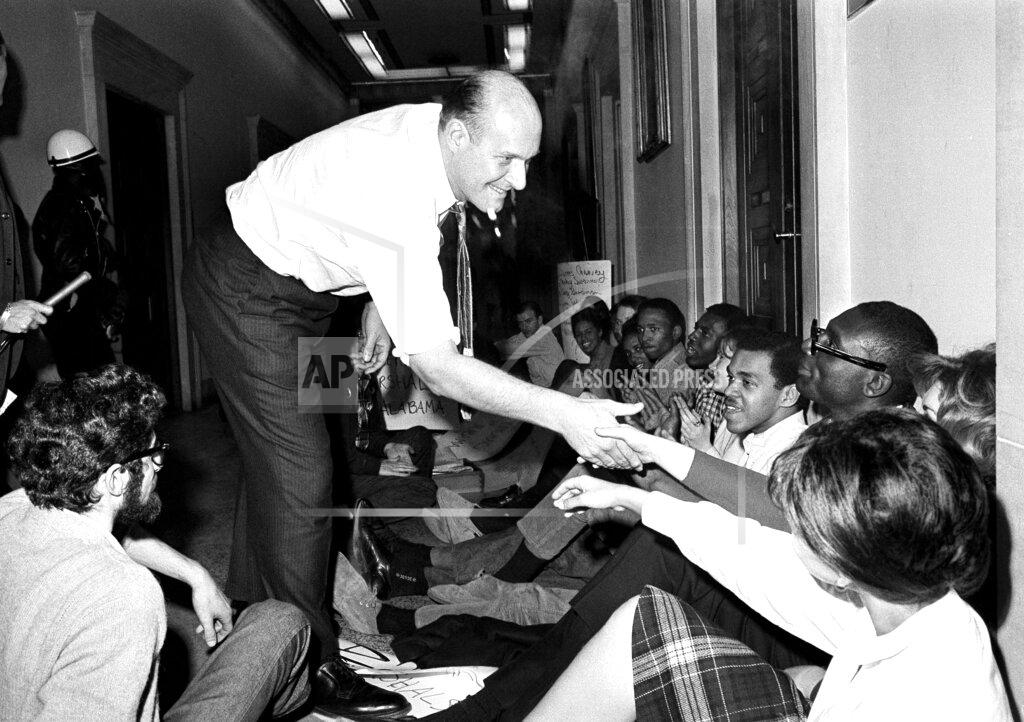
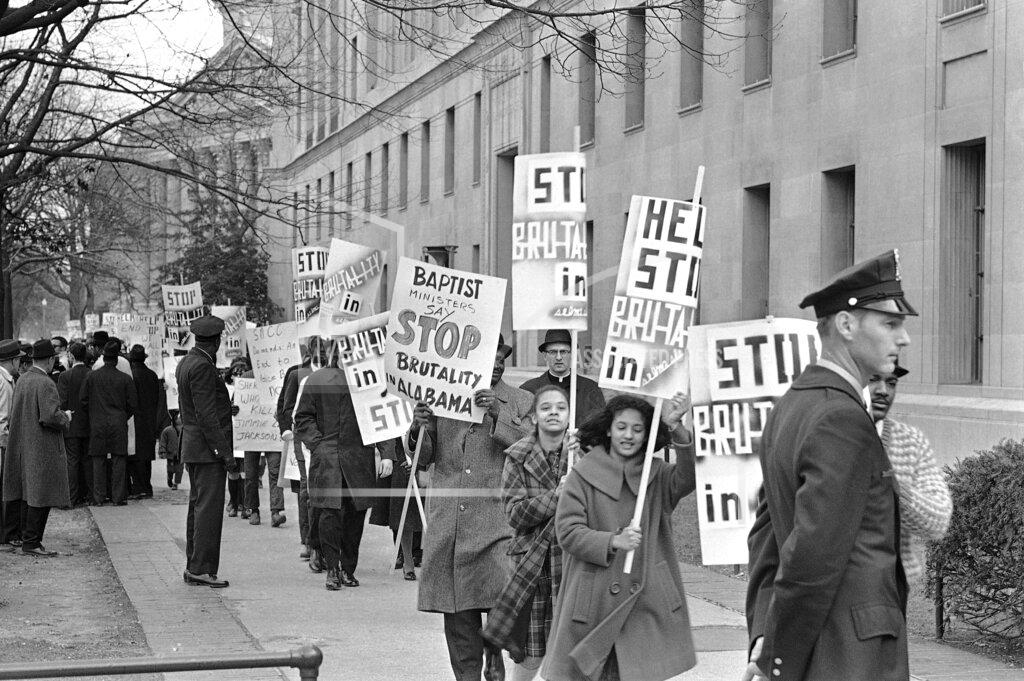
Congressional pressure for a new voting rights law mounted today as members of both parties expressed anger and disgust at Alabama’s violent repression of the Black marchers in Selma, Alabama. Yesterday’s rout, in which tear gas, whips and clubs were used on the demonstrators, was described by legislators as “sickening.” “savage” and “disgraceful.” Democrats and Republicans also complained that President Johnson’s promised bill to eliminate the remaining barriers to Black voting rights had not yet been sent to Congress. Washington deliberations on the problem were interrupted today by several demonstrations. These lasted through the day and finally ended after 9 PM, when about 20 white and Black youths were forcibly ejected from the fifth-floor corridor beside the office of Attorney General Nicholas deB. Katzenbach.
This took place after the Attorney General had come into the corridor and asked the demonstrators to leave. He said he would be appreciative if they left for the night. Their reply was that they would if he agreed to send United States marshals to Selma to protect tomorrow’s marchers. The Attorney General replied: “I have responsibilities to fulfill and decisions to make. They will not be influenced one way or another because you are going to sit here all night.” With that he returned to his office after shaking hands with some of the demonstrators.
An hour and 15 minutes later the chief United States marshal, James P. McShane, stepped into the corridor among the demonstrators, who had seated themselves and started to sing. He urged them to leave, saying: “You’ve had your chance to talk. This is a public building and it closes at 6 PM. We’ve made a decision that you must leave and now you must decide how.” A few of the group rose and left voluntarily, but the majority were dragged to elevators and out of the building by District of Columbia policemen and building guards summoned by Mr. McShane. Once out of the building they rose and dispersed quietly. While being dragged out they stretched out in a rigid posture or locked their arms under their knees. Two or three struggled briefly, but stopped once they were in the elevator. The ejection took about half an hour. None was charged with any offense.
The National Association for the Advancement of Colored People sent a telegram from New York to President Johnson asking that federal troops be sent to Selma to prevent “bloody assaults against Negro citizens.” The association’s executive director, Roy Wilkins, said that unless the federal government acted. “There’s going to be resistance with weapons, protection of ourselves with weapons.”
The U.S. Supreme Court’s ruling in United States v. Seeger expanded the allowable grounds for conscientious objection to being drafted. The Supreme Court held unanimously today that the provision in the draft law exempting religious objectors from combat training and service should be interpreted broadly. The law exempts from the draft persons who by reason of religious training and belief are conscientiously opposed to any participation in war. It also defines religious training and belief as “an individual’s belief in a relation to a supreme being involving duties superior to those arising from any human relation, but [not including] essentially political, sociological or philosophical views or a merely personal moral code.”
The Court also invalidated, in Louisiana v. United States, the “interpretation test” clause of the Louisiana state constitution, which provided that a voter had to interpret a random section of either the state or federal constitution “to the satisfaction of the registrar.” As Justice Hugo Black noted in the unanimous opinion, less than one percent of African-Americans were registered to vote between 1921 and 1944, and the only 15% were registered at the time the suit was filed. “This is not a test, but a trap,” Black wrote, “sufficient to stop even the most brilliant man on his way to the voting booth… The cherished right of people in a country like ours to vote cannot be obliterated by… the passing whim or impulse of a voting registrar.”
The Supreme Court held today that exclusion of Blacks from a jury that convicted a Black of rape was not, in itself, enough to show the general, purposeful exclusion necessary to upset the conviction. The court held, 6 to 3, that the defendant in the case had not proved that the prosecution had excluded all Blacks from juries in Talladega County, Alabama, because of their race. It affirmed the conviction of Robert Swain, a Black, convicted of raping a white girl. He has been sentenced to death. In an opinion by Justice Byron R. White, the Court’s opinion said that although a Black is not entitled to a jury containing members of his race, a state’s purposeful or deliberate exclusion of Blacks on account of race from service as jurors is unconstitutional. It cited a long line of cases in favor of this. But, the Court said, purposeful exclusion may not be assumed or merely asserted.
President Johnson proposed today a long-range attack on the rising crime rate that includes a study in depth of its causes. “We must arrest and reverse the trend toward lawlessness,” Mr. Johnson said in a special message to Congress. He called crime a national problem that he would attack in these ways:
- Increased Federal law enforcement efforts.
- Assistance to local law enforcement efforts.
- A comprehensive, penetrating analysis of the origins and nature of crime in modern America.
The President said that every individual had a role in these efforts. “The people,” he said, “will get observance of the law and enforcement of the law if they want it, insist on it, and participate in it.”
Two Democratic Senators asked Congress today to preserve the natural beauty of some of the nation’s rivers and to protect them from dam construction.
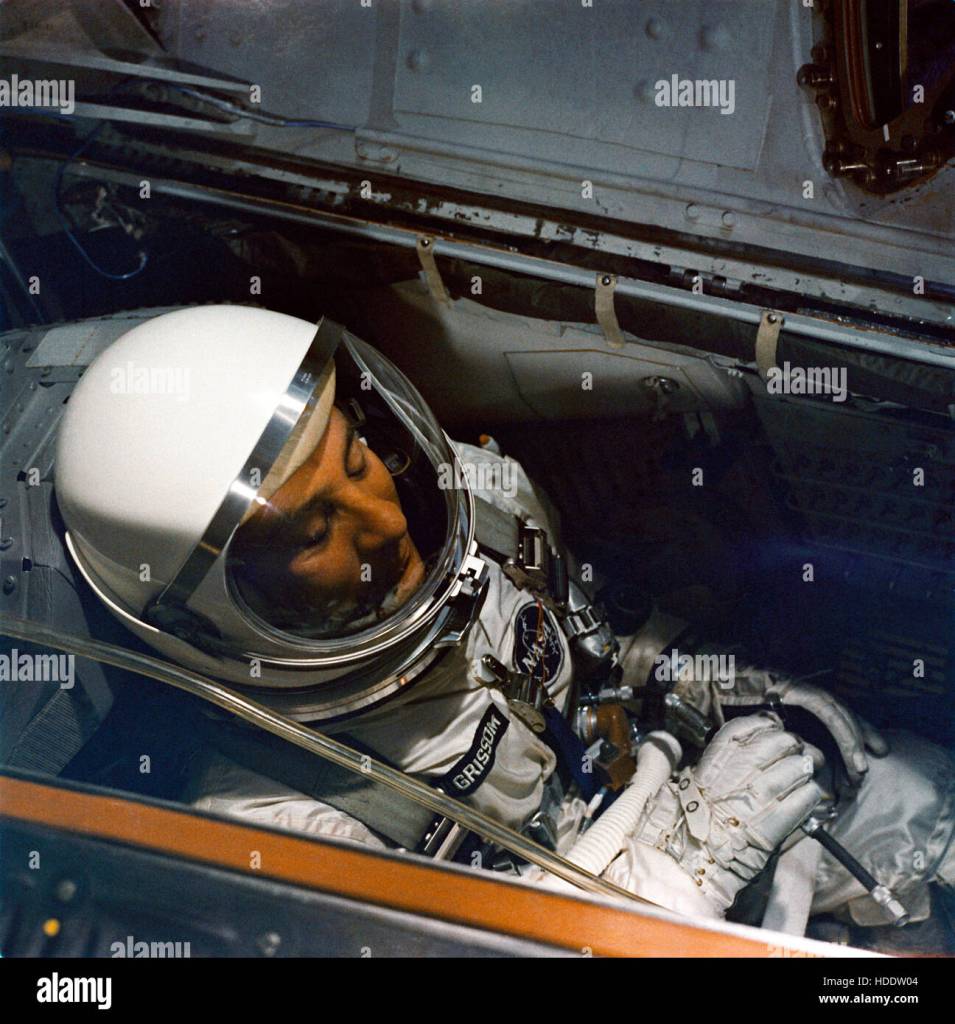
Major Virgil I. Grissom and Lieutenant Commander John W. Young conducted a countdown rehearsal today for America’s first two-man space flight, the upcoming Gemini 3 mission.
Emile Zuckerkandl and Linus Pauling published their groundbreaking paper, “Molecules as Documents of Evolutionary History”, in the Journal of Theoretical Biology, applying their 1962 theory of the “molecular clock” to a proof “that genes can be used to determine when different organisms evolutionarily diverge”, by comparing molecules of different species to estimate when divergence took place.
Dow Jones Industrial Average: 896.84 (+0.86)
Born:
Kenny Smith, NBA point guard (NBA Champions-Rockets, 1994, 1995; Sacramento Kings, Atlanta Hawks, Houston Rockets, Detroit Pistons, Orlando Magic, Denver Nuggets), in Queens, New York, New York.
Stacy Harvey, NFL linebacker (Kansas City Chiefs), in Pasadena, California (d. 2019, of heart failure).
Kenny Gamble, NFL running back (Kansas City Chiefs), in Holyoke, Massachusetts.
Derrick Thomas, NFL running back (Tampa Bay Buccaneers), in Paducah, Kentucky.
Mike Rowe, Canadian NHL defenseman (Pittsburgh Penguins), in Kingston, Ontario, Canada.
Thierry Jacob, French boxer (WBC super bantamweight champion 1992), in Calais, France (d. 2024).
Claudia Webbe, British Labour Party politician; in Leicester, England, United Kingdom.
Died:
Esther Howard, 72, American actress (“Meet the Mayor”, “Detour”), of a heart attack.
Tadd Dameron, 48, American jazz pianist, composer (“If You Could See Me Now”; “Lady Bird”), arranger (Count Basie, Jimmie Lunceford, Dizzy Gillespie, Billy Eckstine) and bandleader, of cancer.

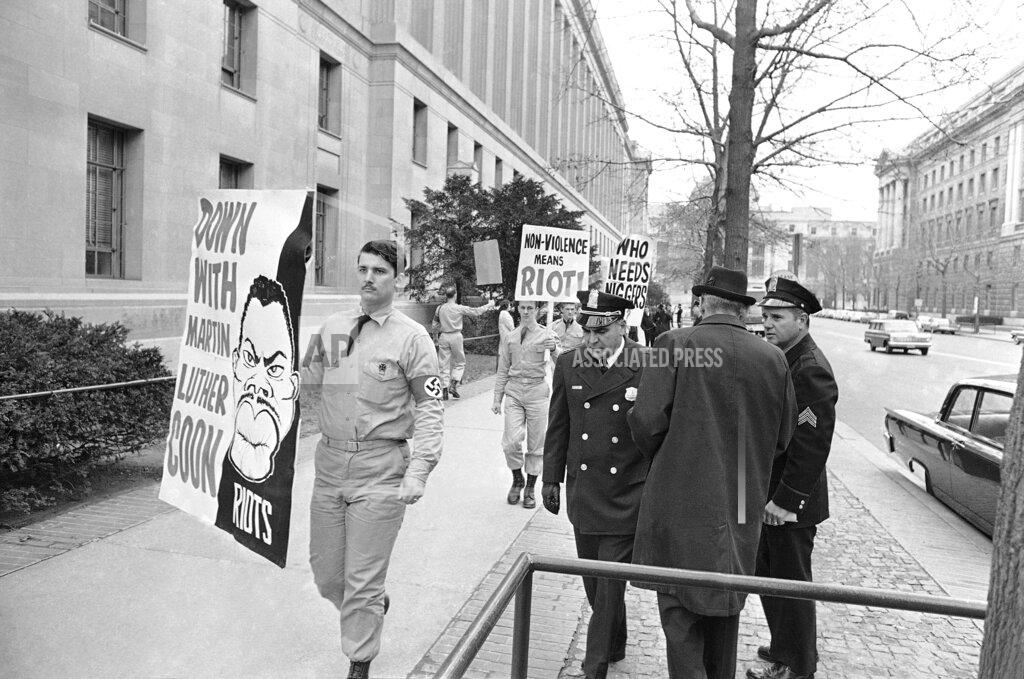
Goddamned Nazi idiots.

 History Diaries