
General Secretary Konstantin Chernenko is conspicuously missing…
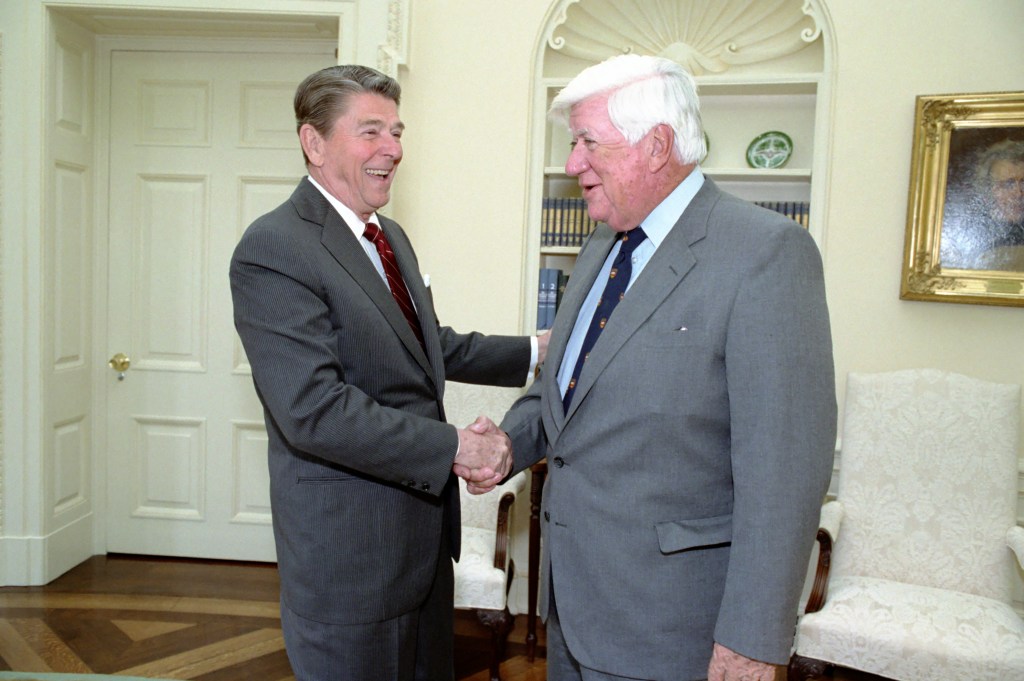
President Reagan meets with Member of the Soviet Politburo, Union of the Soviet Socialist Republics, Vladimir Vasil’yevich Shcherbitskiy to discuss U.S. and Soviet Union relations. President Reagan and a Soviet leader agreed that the Soviet people would not start a war against the United States. But Mr. Reagan told the visiting official, Vladimir V. Shcherbitsky, that “unfortunately, the people in the Soviet Union don’t have much to say about what their government does.” The comment, as related by Larry Speakes, the White House spokesman, came during what was described as an hourlong “lively give-and-take” between Mr. Reagan and Vladimir V. Shcherbitsky, the Soviet visitor. Mr. Shcherbitsky, who heads a delegation of legislators, is the Communist leader of the Ukraine, the Soviet Union’s second most important republic, after Russia. He told reporters on leaving the White House that he had spent most of the time “trying to prove” to the President that it “is not worthwhile” to continue the research program into the proposed space-defense system popularly known as “Star Wars.”
A group of five key senators and representatives has agreed on a broad strategy linking the future of President Reagan’s nuclear weapons program to signs of “good faith” by American negotiators at the arms control talks in Geneva. One measure of this, one legislator said, would be a willingness to give some ground on President Reagan’s “Star Wars” defense plan. The agreement by the five lawmakers, including the chairman of the House Armed Services Committee, Les Aspin, Democrat of Wisconsin, and Senator Sam Nunn, Democrat of Georgia and senior Democrat on the Senate Armed Services Committee, includes a decision to support production of 21 MX missiles in a series of votes this month. Critics and supporters have said that the support of Mr. Nunn and Mr. Aspin would virtually assure passage of the MX measure, which the President has deemed critical to success in Geneva. But the lawmakers also agreed, at a meeting Wednesday in Mr. Nunn’s office, to press later this year for slowing the production rate of the MX, and possibly cutting back the planned deployment of 100 of the missiles. The exact numbers would depend on the lawmakers’ reading of the situation in Geneva.
House Majority Leader Jim Wright (D-Texas) said he will head a small delegation of congressional observers at next week’s opening of the U.S.-Soviet arms talks in Geneva — ending a bitter quarrel with the White House. Wright said he agreed to lead a six- to eight-member House delegation after receiving two conciliatory telephone calls from President Reagan. Earlier in the week, House leaders announced that they would not go to Geneva after unnamed White House sources were quoted as complaining about the size of the original delegation, which was to include up to 40 people.
The Soviet Union’s ruling Politburo approved instructions for the Soviet negotiators at the nuclear arms control talks with the United States opening Tuesday in Geneva, Tass reported. “The Soviet side will act energetically and constructively, proceeding from the principle of equality and equal security,” the news agency said in its report on the Politburo’s regular weekly meeting. Soviet President Konstantin U. Chernenko usually chairs such meetings, but Tass did not mention him. Save for two brief TV appearances, Chernenko has been out of sight, apparently ill, since December 27.
The plan for a space defense system against missiles appears to be gaining strong momentum, even as members of Congress and experts outside the Government ask whether President Reagan’s proposal is hurling the nation onto a new strategic weapons course before the future implications can be fully evaluated. Critics fear that the President’s search for a defense that would render nuclear weapons “impotent and obsolete” will fail and yet is already driving the world’s military competition in new directions. Although the Soviet Union is believed to be substantially behind in the technology needed to put effective weapons in space, its leaders have said privately that they will have to accelerate their own research in this area. The Russians have said publicly that they will expand their production of offensive weapons in response to President Reagan’s plan. Experts on strategy disagree sharply on whether the world will become safer or more dangerous as this new missile- defense research program goes forward.
A European space-based defense plan should be begun and France should lead the effort, according to a French general. The program would be separate from the United States’s missile defense plan. The call appears to reflect what a French official described as a “European current of opinion” moving away from the skepticism shown about the feasibility of the American program. The general’s remarks were contained in a front-page article published this week by Le Monde. The general used the pseudonyn Hoplites to sign the article, but its authenticity was verified by officials of the French Foreign Ministry and Defense Ministry.
Lech Walesa, the founder of Solidarity, and three colleagues received summonses today to report to the Gdansk prosecutor for questioning on charges of inciting public unrest and organizing illegal protests. Mr. Walesa, reached by telephone at his Gdansk apartment, said, “I am summoned for Saturday at 9 AM as a suspect for committing a crime under Article 282A of the penal code.” The article sets a maximum three-year prison sentence for those convicted of inciting public unrest and organizing illegal protest actions. Mr. Walesa said summonses had also been delivered to two close aides, Jacek Merkel and Bogdan Olszewski, and to Janusz Palubicki, a leader of the outlawed labor group from Poznan.
Two guerrillas of the Irish Republican Army who were convicted of killing three people in a wave of London bombings in 1981 were each sentenced to five life terms in prison. Judge Anthony McCowan in Old Bailey criminal court said Paul Kavanagh and Thomas Quigley, both 29, “showed not a spark of compassion” for their victims — two civilians and a British bomb disposal expert. Authorities said Kavanagh also led an IRA squad that bombed Harrod’s department store, killing six, on December 17, 1983.
The chief of the Basque region’s police force was killed in a bomb explosion today as he started his car at a roadside cafe in Vitoria, Spain. Basque separatists were blamed. The police chief, Lieutenant Colonel Juan Carlos Diaz Arkotxa, 52 years old, died at Santiago Apostol hospital in the Basque capital of Vitoria 30 minutes after the bomb tore apart his automobile at 9:25 AM. Officials said militants apparently planted the bomb under the car while Mr. Diaz was having breakfast at the cafe a miles outside Vitoria and 100 yards from the Police Academy. The bomb exploded when Mr. Diaz put his keys in the ignition and tried to start the car, the police said. He was rushed to the hospital but could not be saved.
An Israeli soldier was killed today in an exchange of fire with Lebanese Army troops, the military command here said. A communique said the soldier belonged to a force that had pursued suspected guerrillas and had been attacked by a Lebanese Army force stationed in Kuthariyat as- Siyad, a villlage more than a mile inside territory restored to Lebanon February 16.
Jeane J. Kirkpatrick told the United Nations Security Council today that the United States had received information about three threats against Americans in Lebanon if the United States vetoed a Lebanese draft resolution now before the Council. Dr. Kirkpatrick, the chief United States delegate here, called on the Council to make sure that it is functioning free from intimidation.
Iraq and Iran reported artillery attacks on six border communities today and pledged further widening of their four-and-a-half-year-old war, in whose latest phase civilians have become the targets. Iran’s press agency, monitored in Nicosia, Cyprus, said Iraqi artillery and missile fire struck Dizful, Abadan and Khurramshahr, killing at least 14 people and wounding 123. It said the shells fell in civilian areas, damaging a hospital, schools and homes. Iraq reported Iranian shelling at Basra, and in the towns of Mandali and Tweilah. It said there were “a large number” of casualties at Basra, but gave no figures. The southern border city of about a million people is the only major Iraqi border city within range of Iranian artillery. The raids violated a ban on attacks on civilian areas arranged last June by the United Nations Secretary General, Javier Perez de Cuellar. Iran told the United Nations after its first shelling of Basra on Tuesday that Iraq broke the agreement with air raids on two cities the previous day.
The Thai Army said today that it had driven Vietnamese troops from a line of hills inside the border, repelling the largest single intrusion into Thai territory in the six years since the Vietnamese invaded neighboring Cambodia. The Thais, moving behind air strikes, ousted the Vietnamese from positions they had taken for a planned attack on the last major Cambodian rebel base, Thai military officers reported. Thailand put long stretches of its border with Cambodia on full alert. The army sent reinforcements to the area of the three-day battle. Between 800 and 1,000 Vietnamese soldiers pushed into the hills about two miles across the frontier in an attempt to gain the high ground in Thailand and encircle the Tatum camp, which is perched on a cliff just inside Cambodia and surrounded by land mines.
The trial of Philippine armed forces chief General Fabian C. Ver and 25 others on murder charges in the killing of opposition leader Benigno S. Aquino Jr., was postponed for the fifth time in a week because four key prosecution witnesses cannot be found. At least two of the witnesses told a fact-finding board last year they feared for their lives.
The Senate unanimously ratified a new Pacific salmon-fishing treaty with Canada and enacted legislation to implement it. The pact, the first comprehensive one in more than 15 years, regulates the production and harvest of the migrating fish and is designed to encourage conservation. Congress rushed the measure through so that President Reagan can take it to Canada for his March 17-18 meeting with Prime Minister Brian Mulroney.
The United States Ambassador said today that “beating and asphyxiation” caused the deaths of a United States drug agent and a Mexican pilot whose bodies were discovered Wednesday. Ambassador John Gavin said the bodies were positively identified today as those of Enrique Camarena Salazar, an agent of the Drug Enforcement Administration, and Adolfo Zavala Avelar, a Mexican pilot who sometimes flew missions with him. The two men had been missing since being abducted in Guadalajara February 7. Their bodies, wrapped in plastic bags, were found on a ranch 70 miles southeast of Guadalajara.
The British Governor of Turks and Caicos, the windswept protectorate of 37 little islands north of the Caribbean called today for the resignation of the elected head of government, who has been accused of involvement in a conspiracy to smuggle drugs into the United States. The elected official, Chief Minister Norman Saunders, was arrested in a hotel room near the Miami International Airport earlier this week after accepting a $20,000 payment from United States undercover agents, according to United States officials. Mr. Saunders, who is 41 years old, is being held in Miami in $2 million bond. Two other members of his government are also being held in $1 million bond each. Bond for a Canadian associate has been set at $5 million.
Nicaragua today refused to permit Arturo Cruz, the principal civilian oppositon leader, to enter the country on the grounds that he had aligned himself with rebel forces. Officials at the Nicaraguan Embassy here said Mr. Cruz was about to board a Panamanian airliner bound for Managua in San Jose, Costa Rica today when airline officials refused to permit him aboard. According to the embassy officials, the airline crew was advised by the Nicaraguan Government that Mr. Cruz would not be allowed to disembark in Managua.
The Nicaraguan Democratic Force, the largest of the United States-backed rebel groups seeking the overthrow of the Managua Government, called today for additional investigations into allegations that its members had committed abuses against unarmed civilians in Nicaragua. Two reports issued this week asserted that Nicaraguan rebels had committed extensive human rights abuses, including the rape, kidnapping, torture, mutilation and murder of numerous unarmed civilians. Testifying before a Senate Appropriations subcommittee today, Secretary of State George P. Shultz said he was skeptical about the reports, adding that their “scope and nature” were at variance with the United States Government’s information.
Nicaragua’s bid for a loan from the Inter-American Development Bank was stalled by the Reagan Administration. In an unusually blunt letter, Secretary of State George P. Shultz warned the international bank that it risks losing its financial support from the United States if the $60-million loan is approved. Bank officials said the leftist regime’s loan application was scheduled for consideration this week but was delayed after Shultz’s warning.
The chief spokesman for the Salvadoran Army was shot and killed at a fashionable sports club today by gunmen who draped a rebel banner over his body, witnesses said. The witnesses said three men dressed in tennis gear strolled into the exclusive Club Deportivo, pulled automatic weapons and opened fire on the official, Lieutenant Colonel Ricardo Aristides Cienfuegos, as he was resting on a bench after a tennis match.
A drought is crippling Mali, a poor, landlocked West African country. In one village where, long ago, there was a great well, men have been digging with shovels and hands to create a vast hole and have struck a small pool of water. A deep cavity interrupts the wind-scoured landscape of sand dunes and scattered brush outside the ancient town of Timbuktu. Men from the nearby village of Bouquiat have been digging here with shovels and hands every day for many sunrises, they say, and their sweat and sinew have thus far created a hole 56 feet deep and 115 feet wide. In the valley of the looming man-made cliffs, they have struck a small pool of water. “In a faraway time,” a leader of the village explains, there was a great well here, providing for the needs of the surrounding population. Surely, the village reasoned, there must be water here now.
At least 56 supporters of the Zimbabwean opposition leader Joshua Nkomo have been abducted and probably killed by squads operating at night and in unmarked cars in the troubled province of Matabeleland, church officials and opposition figures said this week. The officials and others who spoke here in the provincial capital said that it was possible that scores of people in addition to the 56 had been kidnapped and killed since mid-January. One diplomat compared the style of the disappearances to the activities of “Latin American hit squads working from hit lists of victims.” However, diplomats noted that the number of abductions and presumed killings appeared to be lower than in previous years. In 1983 and 1984, unofficial estimates of the death toll among civilians ran as high as 2,000 after the army conducted sweeps through the province, supposedly to quell an insurgency.
A bipartisan coalition of House and Senate critics of South Africa’s racial policies introduced legislation that would prohibit new U.S. investment in South Africa and ban imports of the country’s gold Krugerrands. The bill would prohibit new U.S. bank loans to South Africa and new investments by U.S. firms there except for projects designed to foster radical desegregation. It would also ban the sale of American-made computers. The measure would not halt reinvestment of profits or the raising of capital within South Africa.
David A. Stockman, the budget director, today defended a Reagan Administration order that Federal agencies ignore some sections of the Deficit Reduction Act of 1984. Both Democratic and Republican leaders in Congress have strongly opposed the order and this week supported a suit in Federal District Court challenging it. The struggle centers on sections of the act, signed by President Reagan last summer, that were aimed at increasing competitive bidding for Government contracts. To promote that aim, Congress authorized the General Accounting Office to review whether contracts were properly awarded.
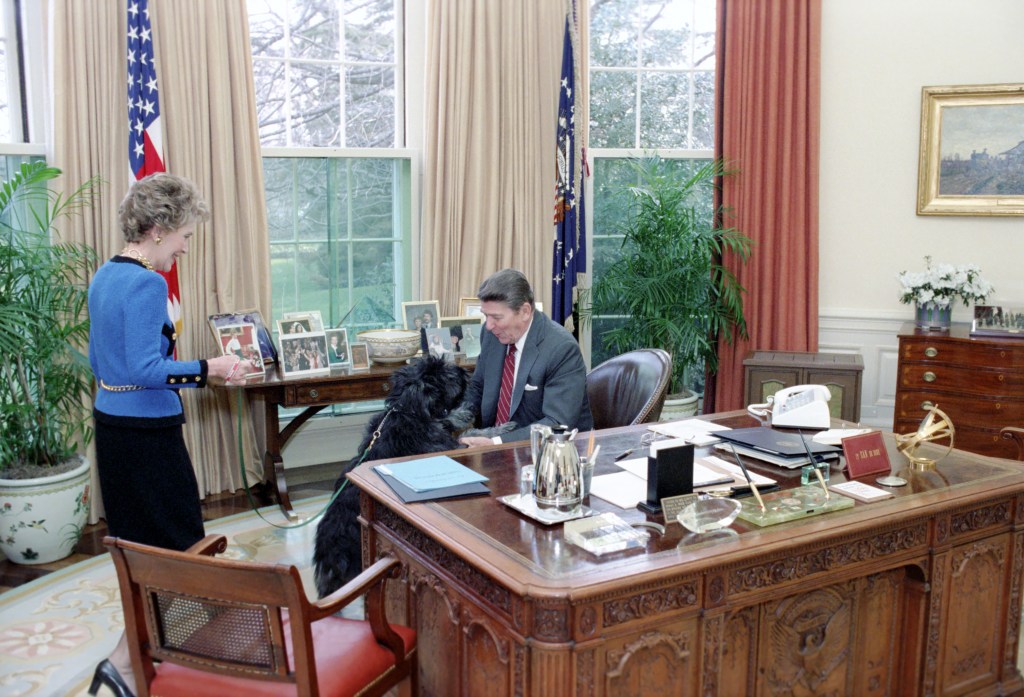
President Reagan attends a Cabinet Council meeting to discuss the sale of excess government properties.
Federal subsidies for Amtrak and mass transit were approved by the Senate Budget Committee. The Republican-controlled committee also voted to include in the next budget most of the student loan programs earmarked by President Reagan to be ended. This evening the committee deadlocked on Social Security as it defeated a proposal to eliminate the cost-of-living increase for one year and also defeated, on two votes, a proposal to leave the cost-of-living increase intact. A third proposal to limit the cost-of-living increase to the needy was also defeated. “We have to vote again but not this week,” said Senator Pete V. Domenici, Republican of New Mexico, chairman of the committee, The committee worked until after 10 P.M. and then recessed until Tuesday, when it is expected to resume work on the budget package.
A high-ranking panel of federal judges said that it will ask Congress to shield the pocketbooks of state judges who violate someone’s civil rights. The panel also heard about new efforts to gain a large pay raise for federal judges-one that would hike federal trial judges’ yearly salaries from $76,000 to $121,000. U.S. Judicial Conference spokesman Joseph Spaniol disclosed the developments after the policy-making panel for the federal courts concluded two days of closed-door meetings in Washington. The 26-member conference is headed by Chief Justice Warren E. Burger.
The Education Department has halted 61 discrimination investigations against colleges and school districts in the year since the U.S. Supreme Court curtailed its powers to enforce civil rights laws, a congresswoman said. Rep. Claudine Schneider (R-Rhode Island), releasing a list of the suspended cases to two House committees, said, “almost certainly, these 61 suspended complaints represent only the tip of the iceberg.” The House Education and Labor Committee and the Judiciary subcommittee on civil rights conducted the joint hearing on legislation to restore the enforcement powers.
The E.P.A. is under court order to regulate air pollution from trucks and buses by next week, but the Office of Management and Budget is seeking to weaken the agency’s proposed enforcement rules. The environmental agency has drafted rules that would require heavy trucks and buses to install traps for emissions of solid particles from diesel and gasoline engines made after 1994. The proposed rules would also require reductions of nitrogen emissions by heavy- and light-duty trucks and buses. The budget office wants the agency to drop or further delay the requirement for the installation of emission traps, E.P.A. officials said today, adding that the budget office contended that the technology for such controls had not been sufficiently developed.
More than 2,500 civil rights backers gathered at the steps of the Alabama State Capitol to renew an appeal for justice for blacks. The rally before the white dome of the Capitol marked the end of a four- day re-enactment of the 1965 march, in which Dr. King led more than 4,000 demonstrators on the 50-mile trek from Selma east to Montgomery to seek black voting rights in the South. But as a measure of the changes that have occurred since 1965, leaders of today’s march, including the Rev. Jesse Jackson and Coretta Scott King, Dr. King’s widow, had only praise today for Gov. George C. Wallace, a man they once villified, after a private hour-long meeting this afternoon. “George Wallace is a man whose attitude has changed, whose behavior has changed,” Mr. Jackson said after the meeting. “I only wish that Ronald Reagan had the kind of sensitivity now being expressed by George Wallace.”
The government approved a second screening test for AIDS contamination in blood donations, licensing a New Jersey firm to produce the test for blood banks, plasma centers and laboratories. The Food and Drug Administration approved the license for ElectroNucleonics Inc., of Fairfield, New Jersey, and said that the firm was prepared to begin shipping some 150,000 test kits immediately from a facility in Columbia, Maryland. Three other firms have license applications pending.
An Arizona patient was given his third new heart in 46 hours, the latest one a human organ to replace an experimental mechanical device. Last night, the patient, Thomas Creighton, a 33-year-old auto mechanic, showed slight improvement, but he was in extremely critical condition, struggling to overcome the complications of the extensive surgery. Whether to act against the surgeons who implanted the unapproved artificial heart in the Arizona patient has not been decided, a federal government spokesman said.
Union Carbide Corp. has started preliminary construction work needed to reopen its methyl isocyanate unit in Institute, West Virginia, which has been closed since more than 2,000 persons died in a Bhopal, India, accident December 3, company spokesman Thad Epps said. Epps said that the company will spend $5 million to $10 million for facilities to convert methyl isocyanate, a pesticide ingredient, to a safer state.
Georgia will appeal a court ruling that voids a construction contract for the parkway leading to former President Jimmy Carter’s planned presidential library in Atlanta, a Georgia transportation commissioner said. Dan Lee, Carter’s chief of staff, said that it would be “almost impossible” to continue the library project without the parkway. Carter Presidential Library Inc. would have to build the road if the state doesn’t build it, he said. Opponents of the road contend that its construction would spoil the neighborhoods and parks through which it would run.
Moves to cut Medicare’s hospital costs have generated an unexpected sharp increase in out-of-pocket costs for elderly beneficiaries, according to Federal health officials. Legislators and lobbyists for the elderly were caught unawares by the increases, which were caused by a change in the Government’s system of figuring hospital reimbursements. President Reagan has asked Congress to cut $19 billion from the Medicare budget over three years. Without reductions, the Medicare budget, now running at $66 billion a year, is projected at $70 billion in the fiscal year beginning October 1. Of that, $48 billion would go for hospital care.
A doctor today was allowed on the campus of the tiny Christian Science college struck by an outbreak of measles to examine four children suspected of having measles and to observe nearly 30 students in isolation. The measles outbreak at Principia College, 30 miles north of St. Louis, is linked to two deaths and is suspected in a third.
Five Mexican nationals were found shot along a rural road near New Braunfels, Texas, and one of them, who also had been stabbed in the throat, bled to death, authorities said. The four other victims, ranging in age from 16 to 21, were taken to hospitals in San Antonio, where they underwent surgery, officials said. Captain Jack Dean of the Texas Rangers said that details of the case were sketchy. “Maybe a ‘coyote’ (alien smuggler) dropped them out there. But we don’t know right now.”
A Federal court jury took 20 minutes today to convict a former United States Attorney on charges of improperly telling a friend about a grand jury indictment. J. William Petro, the former United States Attorney for the Northern District of Ohio, faces up to six months in prison and a $1,000 fine.
The General Motors Corporation will recall 290,000 Cadillacs to fix potentially defective pollution control equipment, the third recall by the company in five months for the same problem, the Environmental Protection Agency says.
On Wednesday, as frantic negotiations were under way between the owners of United Press International and the troubled news agency’s principal creditor, some U.P.I. staff members began clearing out their desks amid reports of bouncing payroll checks and fears of imminent bankruptcy. But yesterday, after the announcement of an agreement that will allow operations to continue and could stabilize U.P.I.’s financial status, payroll funds were freed and morale soared. “There were a lot of people who felt like cornered rats,” said Paul Westpheling, business editor for the U.P.I. Radio Network in Washington, “but we feel like a back door has opened up.” Douglas F. Ruhe and William E. Geissler, who own about 90 percent of U.P.I. stock, have agreed to make the bulk of it available to the company’s vendors in exchange for forgiving outstanding debts estimated at about $12 million. That does not include about $5 million to $7 million in notes from the Foothill Financial Corporation, a Los Angeles-based lender.
Volunteers piled sandbags along the rising Illinois River but authorities said that there was little they could do to save the Illinois towns of Rome and Liverpool, where flood waters reached the rooftops of houses. Water spilling from the river threatened the region with its worst flooding in history. The towns were “lost to any flood-fighting efforts,” Greg Durham, spokesman for the Emergency Services and Disaster Agency, said. “The towns are completely evacuated.” The river stood at 28.4 feet — still shy of the record 28.8 set in 1943. It was expected to crest at 29.5 feet by Saturday.
IBM-PC DOS Version 3.1 (update) is released.
Dow Jones Industrial Average: 1271.53 (-8.84)
Born:
Andre Fluellen, NFL defensive tackle (Detroit Lions, Miami Dolphins), in Cartersville, Georgia.
Sidney Spencer, WNBA guard (Los Angeles Sparks, New York Liberty, Phoenix Mercury), in Hoover, Alabama.
Thomas Erak, American progressive rock guitarist (The Fall of Troy; Just Like Vinyl), in Seattle, Washington.
Gerwyn Price, Welsh darts player (PDC World C’ship, 2021; Grand Slam of Darts, 2018, 2019; World Grand Prix, 2020), bon in Cardiff, Wales, United Kingdom.
Died:
Robert W. Woodruff, 95, American CEO (Coca-Cola) and philanthropist.
Victor W. Farris, 75, American inventor (paper milk carton).
George Schick, 76, Czech conductor (Chicago Symphony, 1950-56; Metropolitan Opera, 1958-69), and educator.









 History Diaries