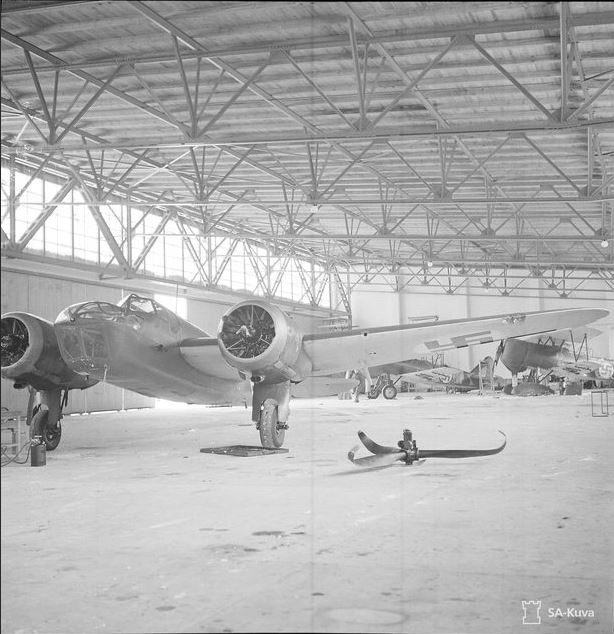
Soviet 7th Army continues attacking toward Viipuri. Fighting between Finnish and Soviet forces continues south, east, and west of Viipuri, Finland.
Soviet 28th Corps expands beachhead across frozen Viipuri Bay.
In Ladoga Karelia, the Soviet 11th Division launches a tank-supported offensive against the Finnish-controlled islands in the Pitkäranta sector at 9 o’clock in the morning. The offensive is preceded by a fierce three-hour artillery bombardment during which approximately 10,000 enemy shells rain down on the Finnish positions. In this way the Russians manage to break through the Pitkäranta section of the blockade encircling the great Kitelä ‘motti’. The Finnish counterattack in Vilaniemi is unsuccessful. Russians also come ashore in Karjaniemi and Niskapohja. In the Sintolanniemi sector on the Isthmus the Russians cross the Vuoksi on a 2 km front. Paimio, Petäjä, Maksima and other islands on the eastern shore of Lake Ladoga are under heavy enemy shelling. 50 men from the municipality of Rantasalmi are killed.
In one of the worst air raids of the war Soviet bombers swooped down on a little town in Southern Finland. They bombed the hospital five times. As the result of a direct hit by a bomb on an air raid shelter 25 women and children were killed and about 100 wounded. The total casualties in the town are estimated at 50 killed and 200 wounded. The Finns report that three hospitals were bombed by Russian airmen yesterday, 14 patients being killed and seven wounded. The roofs were clearly marked with a red cross.
Foreign Minister Väinö Tanner asked Great Britain and France for an extension of the deadline for requesting military assistance. Finland was given until the March 12, 1940 to make a formal request.
The Soviet Union announced its readiness to open talks with Finland in Moscow, but would not agree to a ceasefire until the talks were actually underway.
The Finnish Government met twice to consider the composition of the Finnish delegation for the Moscow peace talks.
In the evening, the Finnish delegation under the leadership of Prime Minister Risto Ryti left for Moscow via Stockholm. The other members of the delegation were J.K. Paasikivi, Rudolf Walden and Väinö Voionmaa. Mannerheim, seeing it is useless to continue the once-sided struggle against the Soviet Union, has accepted that there must be talks. The delegation arrives the following day.
Newly created Soviet 15th Army breaks through Finnish positions to relieve encircled 168th Rifle Division north of Lake Ladoga.
Simo Häyhä was finally hit by an explosive round in an anti-sniper campaign run by the Soviets, putting him into an 11-day coma.
British MPs protested the Land Transfers Regulations in Palestine, but a motion of censure brought against the government was defeated. The Chamberlain government survived a censure motion over Palestine policy. However, discontent over the conduct of the war is growing. In the face of the bitterest opposition from Labor benches that has developed since the start of the war, Malcolm MacDonald, Colonial Secretary, today told the House of Commons that if the government had not restricted the sale of land to Jews in Palestine, trouble would have again broken out and might have spread throughout the Arab world, and to India.
Based on a compromise of the original plan, modifications to the German invasion plan of the west were approved by Hitler.
The German Army communique today reported the first large-scale contact between German and British troops on the Western Front, the result of which was claimed to be sixteen British prisoners and twenty dead.
France and Italy conclude a trade agreement providing for an increase in the volume of trade between the two countries.
Two more Italian ships were interned by the British, carrying German coal. Today’s seizures were the Liana and Rapido, both rated as colliers.
Britain carried out promptly and to the limit tonight her threat to seize German coal found on Italian ships. Despite loud protests from Premier Mussolini the Enemy Exports Committee, sitting in the paneled Library of London University, ordered that 80,000 tons of German coal in eight Italian ships at the contraband control base at the Downs should be unloaded immediately and held in prize until the end of the war. At the same time it was announced that six more Italian ships. were taken into the Downs late tonight and it is almost certain that their cargoes will be unloaded in the same way.
This has been a day of waiting and tension over the Italian coal dispute with Great Britain, but the fact that the British are now confiscating the cargoes of the seized colliers naturally has served to aggravate the situation still further.
Hungarian Foreign Minister Count Stephen Csáky drew approval from the House of Deputies in Budapest today when, in answer to a question from a Nazi Deputy, he called Czecho-Slovakia a “patchwork” and said that it was against the interests of Europe that that country be restored.
King Carol of Rumania will open a session of Parliament today with an appeal to his people to prepare for great sacrifices for the defense of their frontiers, it was learned on high authority.
German aircraft bomb and machinegun two lightships.
British experts examine the captured RDF (radar) system of the Graf Spee.
Rumania agrees to provide oil to Germany in exchange for captured Polish weapons
Two Norfolk lighthouses and two convoys are bombed & machine-gunned by German aircraft. Little damage caused.
The Royal Navy heavy cruiser HMS Berwick (65), commanded by Captain Irving M. Palmer, intercepted the 3,425 ton German freighter Uruguay northeast of Iceland (67°52′N 16°08′W). Before the Uruguay could be captured she was scuttled by her own crew. Just as the boarding action by the British began, Uruguay’s crew set the ship on fire. Berwick sank Uruguay with gunfire after withdrawing the boarding party and bringing the German crew on board.
Latvian steamer Latvis (1318grt) was seized in the Baltic by German warships, and renamed Edith Faulbaums for German use.
Destroyer HMS Venomous was in a collision with tug HMS Swarthy at 0321 in Portsmouth Harbour, was under repair at Portsmouth until 29 April, and departed on 2 May.
Dutch submarines O 9, O 10, and O 11 departed from Den Helder Naval Base. Before they left the harbor, O 11 collided with the armored tug BV 3; 3 men were killed as they were trapped in O 11 while she sank. O 11 was refloated on 10 March. While under repair Germany invaded the Netherlands and the boat was scuttled to prevent her capture. The Germans raised the boat and ordered its repair. However it was not repaired in time to help the war effort. While still under repair the boat was scuttled again in order to block the entrance of Den Helder harbor. On 10 December 1947 the wreck was raised and sold for scrapping.
Convoy TM.20 escorted by the 19th Anti-submarine Group and destroyer HMS Vivien departed the Tyne for Methil.
Convoy FN.114 departed Southend escorted by sloops HMS Black Swan, HMS Grimsby and destroyer HMS Woolston, and arrived in the Tyne on the 8th.
Convoy FS.114 departed the Tyne, escorted by sloops HMS Londonderry and HMS Fleetwood, and arrived at Southend on the 8th.
The War at Sea, Wednesday, 6 March 1940 (naval-history.net)
German steamer URUGUAY (5846grt), which had departed Pernambuco on 11 February, was sighted by trawler ST WISTAN (564grt) northwest of Iceland. This enabled heavy cruiser BERWICK on Northern Patrol to intercept her. Rather than be captured, URUGUAY scuttled herself in 67 52N, 16 08W; BERWICK rescued 14 officers and 40 men.
Light cruiser DRAGON departed Portland for duty with the 3rd Cruiser Squadron in the Mediterranean Fleet. She departed Gibraltar on the 10th, arrived at Malta on the 12th for refitting, and reached Alexandria on 3 April.
Armed merchant cruiser ASTURIAS departed the Clyde for Belfast for overhaul and refit.
Armed merchant cruiser CARINTHIA departed the Clyde for Northern Patrol.
Destroyer VENOMOUS was in a collision with tug SWARTHY at 0321 in Portsmouth Harbour, was under repair at Portsmouth until 29 April, and departed on 2 May.
Destroyer JUNO arrived at Rosyth from convoy duty with defects, and departed on the 9th for repairs at Hull.
Destroyer HOTSPUR departed Sheerness for the Clyde, arriving on the 8th.
Destroyer GALLANT arrived at Invergordon from patrol.
Destroyer FURY departed the Clyde at 1600 for Milford Haven to discharge fuel prior to arriving at Newport for refitting. At 2334/6th, she attacked a submarine contact southwest of Chicken Rock, I.O.M., in 53 47N, 5 09W, which was later assessed as probably a wreck. On the 7th, she attacked another submarine contact in 53-48N, 5-06W, also a wreck, and reached Milford Haven on the 9th.
Minesweepers BRAMBLE, BRITOMART, HAZARD, SPEEDY, and HEBE departed Greenock for Scapa Flow.
Sloops KINGFISHER and FOXGLOVE were searching for a submarine SSE of Portland Bill. FOXGLOVE attacked a contact in 50-10N, 2-12W, and destroyer ANTHONY relieved KINGFISHER in the hunt.
Destroyer WOLSEY and cable ship ROYAL SCOT arrived back at Rosyth after cable mending all day.
Convoy TM.20 escorted by the 19th Anti-submarine Group and destroyer VIVIEN departed the Tyne for Methil.
Convoy FN.114 departed Southend escorted by sloops BLACK SWAN and GRIMSBY and destroyer WOOLSTON, and arrived in the Tyne on the 8th.
Convoy FS.114 departed the Tyne, escorted by sloops LONDONDERRY and FLEETWOOD, and arrived at Southend on the 8th.
Destroyer GURKHA attacked a submarine contact ENE of Sumburgh Head in 60 00N, 00 00W, which was later evaluated as non-submarine.
Anti-submarine trawler NORTHERN WAVE (655grt) attacked a submarine contact north of Kinnaird Head in 57-51N, 2-03W.
Shadowing submarine UNITY reported German supply ship ALTMARK departing Jossing Fjord escorted by two Norwegian destroyers, and was later ordered to take up a position ten miles north of Hantsholm. Polish submarine ORP ORZEL was in a patrol area off Hantsholm, and both submarines were to intercept ALTMARK if she left Norwegian territorial waters. On the 7th, UNITY sighted three darkened destroyers two miles west of Hantsholm, but could not attack.
Submarine STERLET arrived at Lowestoft from patrol for reballasting.
Aircraft of German X Air Corps (He111’s of KG26 or Ju88’s of KG30) attacked tanker SHELBRIT 2 (695grt) off Girdle Ness, steamer ROYSTON (2722grt) 10 miles north of Hartlepool, steamer JACOBUS (1262grt) 10 miles south of the Tyne, and convoy TM.20. No casualties were sustained.
Dutch submarine HrMs (HNMS) O 11 at Den Helder was sunk in an accidental collision with Dutch dockyard tug BV 3 (AMSTERDAM). She was raised on the 10th, but was still under repair when Holland fell in May.
Latvian steamer LATVIS (1318grt) was seized in the Baltic by German warships, and renamed EDITH FAULBAUMS for German use.
French battleship PROVENCE, heavy cruiser DUQUESNE, and British aircraft carrier HERMES with destroyers DECOY and DEFENDER patrolled off the African coast between 10W and 20W from the 6th to 16th. On the 14th, Portuguese steamer GANDIA (4333grt) was stopped and a German citizen removed, and on the 15th, Portuguese steamer MOUZINHO (8374grt) was also stopped and another German citizen removed.
Light cruiser DANAE departed Hong Kong on patrol.
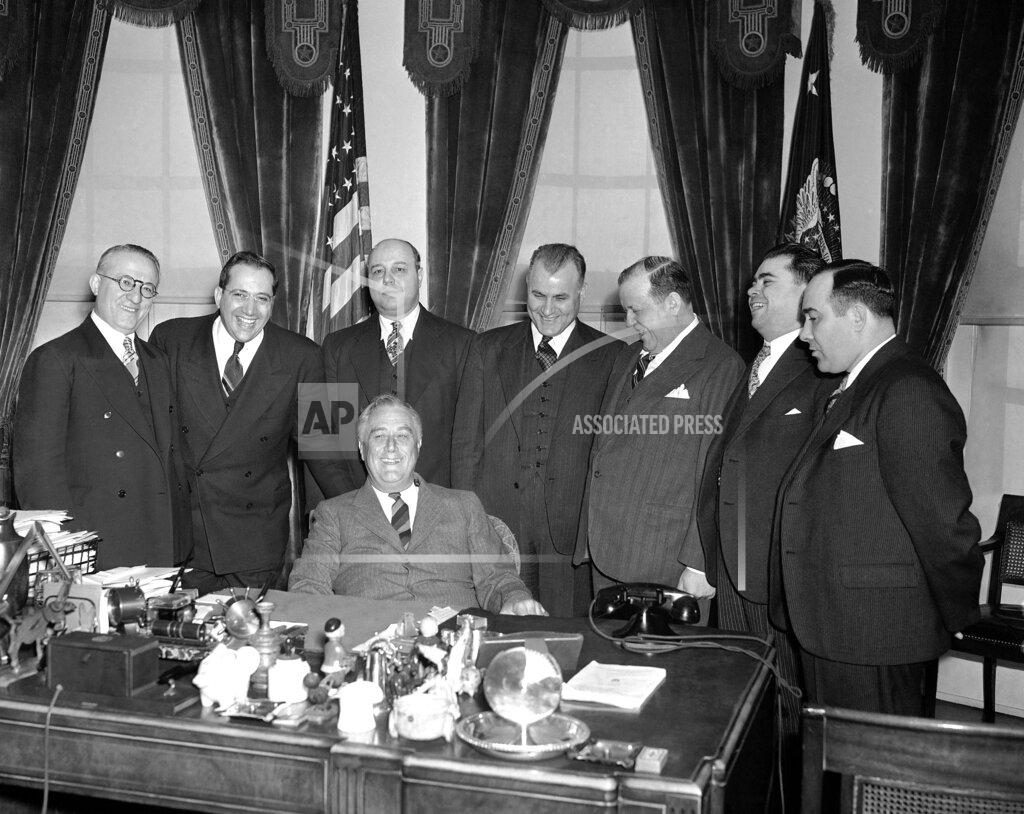
President Roosevelt conferred with Representative Howard W. Smith, chairman of the committee investigating the National Labor Relations Board, with Mayor Maury Maverick of San Antonio, and received the supreme lodge of the Order of Ahepa.
The Senate considered amendments to the Hatch Act, defeating the Miller amendment to repeal the ban against political activity by federal workers, and recessed at 3:27 PM until noon tomorrow. The Finance Committee concluded hearings on the proposed extension of the trade agreements program.
The House passed a bill for the construction of a railroad in Alaska and adjourned at 3:55 PM until noon tomorrow.
A Senate coalition today beat down by only three votes a fight supported by a majority of the Democratic members to strip from the “clean politics” law existing prohibitions against political activity by Federal jobholders beneath the rank of policy-making officials. Forty-four members, representing all political divisions, defeated an amendment introduced by Senator Miller, Democrat, of Arkansas. One Republican, Senator Gurney of South Dakota joined the forty Democrats who voted for the amendment.
The result was taken as an indication of ultimate victory for a pending bill, written by Senator Hatch, to extend the existing restriction on Federal employees to State workers paid in whole or in part through grants of Federal funds. After the close vote on the Miller amendment the Senate took up another controversial amendment by Senator Danaher, Republican, of Connecticut, which resulted in open charges that the chair, occupied by Senator Schwartz, Democrat, of Wyoming, had miscounted votes on a division.
The Hatch act, adopted last year, consists basically of two major sections. The first of these penalizes coercion of Federal employees or solicitation of political contributions from them. The other forbids political activity by jobholders other than the exercise of their right to vote. In each case members of Congress, the Cabinet and policy-making officials are exempted. Senator Miller’s amendment proposed the elimination from the existing Hatch act of Section 9, dealing with political activity by Federal jobholders. Under Senate rules, Mr. Miller could redraft the amendment and offer it to the pending bill, but occasions upon which such procedure has been attempted have been rare.
When the ballot was taken, twenty-two Democrats, nineteen Republicans, one Progressive, one Independent and one Farmer-Laborite cast their votes against the Miller amendment, in a manner that demonstrated the weakness of Democratic party lines where this issue is concerned. Ultra conservative Southerners joined with outright New Dealers in supporting the Miller amendment, while Senator Holt, most consistent “rebel” among the Democrats, voted against it.
Conspicuous in three hours of oratory that preceded the vote was a plea for defeat of the Miller amendment by Senator Barkley, who was instrumental in killing a first effort to enact the “clean politics” law in 1938 but who today accepted it wholeheartedly, since State employees would be put on the same basis with federal ones, and told the Senate that he spoke despite efforts by Democrats to dissuade him. “Some of my colleagues have asked me not to speak my convictions,” he said in debate. “When the time comes that I must stifle my convictions, I will call a conference of the Democratic members and tender my resignation as majority leader.”
Amendments to the National Labor Relations Act designed to curb the Labor Board were completed today by the Smith committee and will be reported to the House at noon tomorrow.
President Roosevelt’s economic advisers now feel that the economic stage is set for a new, but gradual, upturn of business.
The issue of the third term will be stressed in the campaign for the election of Garner delegates to the Democratic National Convention in the ten Congressional districts in New York State in which there are primary contests, it was said yesterday at Garner headquarters in New York City.
The new British liner Queen Elizabeth was nearing New York harbor last night after running the German submarine blockade in the most spectacular and dangerous maiden voyage in maritime history. She was off Nantucket at 6 PM and was expected to dock at 9:30 o’clock tomorrow morning.
In spite of the sharp total rise in U.S. exports, a comparatively limited number of American industries are booming because of it. Foreign demand for agricultural exports, including tobacco, is dropping toward the point of non-existence. And foreign buying of automobiles and trucks, as necessary as these are to war, has shrunk materially. The belligerents are able to produce their own machines of transport, without spending their carefully hoarded gold for American products. The biggest increase for any export commodity is shown by aluminum, which is up 823 percent. Aluminum is becoming a vital commodity for construction of planes and other instruments of war. Aircraft exports have risen close to 200 per cent and chemicals and leather have both shown advances of 60 percent or more.
The Remington Arms Company was indicted by a Federal grand jury today for alleged violation of the neutrality act in the shipment of 27,500 rounds of ammunition to Mexico. Indicted with the company were two Mexican citizens now jailed at Laredo, Texas Lt. Col. Francisco De Valle Arispe and Gregorio Prieto, a retired army major who said he was in the employ of the National Revolutionary party of Mexico. George John, assistant to the U. S. District Attorney, said the Government alleged “conspiracy to violate, and violation of, the neutrality act of 1939 by unlawfully exporting, and attempting to export, ammunition to Mexico without obtaining a permit from the Secretary of State.” The exported arms, he said, were 17,750 rounds of Remington 32-callber ammunition and 9.750 rounds of Remington police service ammunition.
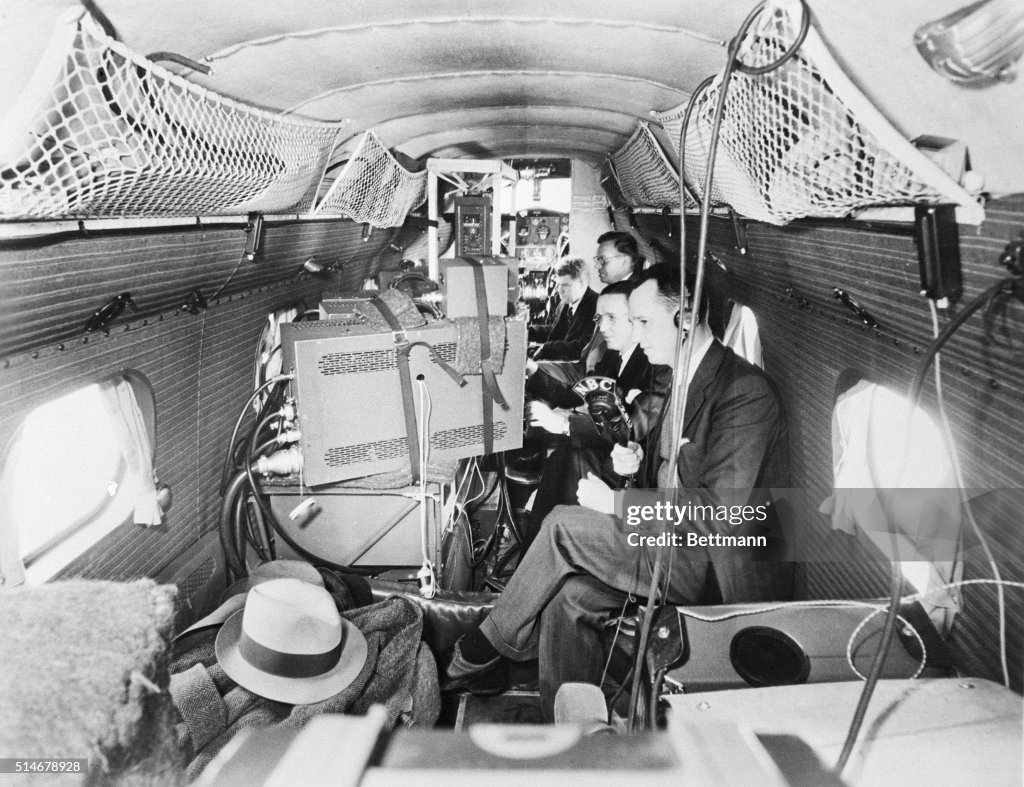
The first telecast is made from an airplane, over New York City. Radio and aviation joined yesterday afternoon to take the television audience on a forty-five-minute sightseeing tour of New York.
Detective Comics #38 was published (cover date April), featuring the first appearance of Batman’s sidekick, Robin.
Joe Medwick, leader of the nation’s holdout division, flew home from training camp today, a disgruntled, dissatisfied ball-player, but certain the St. Louis Cardinals would not let his $200,000 talents remain idle.
Hank Greenberg, erstwhile first baseman, made his debut as a Tiger outfielder today in an intra-squad game. He looked better at the plate, with a triple and a single, than in the outfield, where he was charged with an error.
A new Japanese punitive expedition in South China has advanced close to the Portuguese colony of Macao, which is filled with 20,000 frightened Chinese refugees, according to dispatches today. The Japanese force was said to number about 400 men who were landed in rubber boats after Japanese destroyers had shelled Chinese positions near Heungchau, in the Macao area. The Japanese, advancing in two columns, cut the motor highway from Shekki to Macao and dislodged several small groups of Chinese soldiers, who set fire to villages before retreating.
The Japanese action was believed to be designed only to scatter Chinese guerrilla bands that have been operating in the Shekki-Macao district and it was said that no permanent Japanese occupation of Shekki, an important town in the Macao-Hong Kong trade, was expected. It also was revealed that the Japanese had started an extensive “mopping-up campaign” on Hainan Island designed to crush an estimated 10,000 Chinese guerrillas who have been sniping at Japanese outposts. Both army and navy units were participating in the campaign, which was described as preliminary to “large-scale industrial and economic development” of the island, which lies off French Indo-China and commands the sea route from Singapore and Manila to Hong Kong and Shanghai.
Chinese militiamen and armed civilians were reported in Chinese quarters today to be stoutly resisting the advance of a strong Japanese force that landed this morning on the south bank of the Pearl River, fifty miles south of Canton and only twenty miles north of the Portuguese colony of Macao. Landing under the protecting fire of destroyers anchored in the Pearl River, the Japanese naval and military forces met determined Chinese resistance after they had pushed beyond the protecting range of their naval guns. The fighting was increasing in intensity. The objective of the new Japanese drive has not been disclosed. At the same time Japanese planes swooped in to break up any attempts by Chinese forces to concentrate for reinforcement of their positions above Macao.
The new vigorous Japanese offensive in the Heungshan district of Kwangtung Province has a threefold objective: further to embarrass Britain’s Hong Kong trade with China by way of Portuguese Macao, to cut the supply road between Macao and Shekki, Heungshan’s capital, and to establish a striking point for advances. against the flourishing counties in the West River delta. After the Japanese landed at Heungchau they began their drive toward the highway, along which 20,000 persons had already fled to Macao from Shekki.
The Japanese drive is expected to succeed despite the resistance of isolated groups of Chinese irregulars, who were surprised by the use of cavalry by the invaders. The Japanese occupied Choimei, near the Macao-Shekki highway, and forced prisoners to remove grain and other foodstuffs from mills. The attack is expected to leave the district ravaged because the Japanese are leaving a trail of burned villages and sacked granaries.
General Juzo Nishio, supreme Japanese commander in China, arrived in Canton today after concluding his first tour of the South China fronts. On the heels of his recent visit to Hainan Island comes the news of the launching of a large-scale offensive there against Chinese guerrillas. It is believed here that the Japanese are trying, by operations on Hainan, to influence the present French-Japanese trade talks by thus suggesting the permanent Japanese occupancy of the island.
A Japanese offensive designed to complete the conquest of Hainan Island was launched March 4, with planes supporting columns driving into the interior from the northern, southern and western coasts, Japanese dispatches reported today.
In answering a question in the House yesterday War Minister General Shunroku Hata said that if foreign powers aggressively obstructed Japan’s military operations in China the Japanese authorities there might not reopen the Yangtze River. Yakichiro Suma, Foreign Office spokesman, at a conference today explained that, while it was possible that individual ships offending in the manner suggested might be penalized, General Hata’s words did not mean that all shipping would suffer or that only the powers recognizing the new regime would be permitted to benefit by the opening.
Mr. Suma repeated that the date for the reopening depended on the military situation and that preparations were being pushed forward. He again denied that, though the reopening was first promised in Admiral Kichisaburo Nomura’s talks with Ambassador Joseph C. Grew, it was intended as a bargaining point with the United States. Until the matter was raised in the press conference today, officials had attached little importance to General Hata’s impromptu answer to a hypothetical question. The Foreign Office asserts that General Hata meant just what he said, namely, that an aggressive obstruction of Japan’s military operations might cause the river to be closed. Such opposition is not expected and is considered extremely unlikely.
The authorities assert that the reopening will have no political strings attached and will take place some time this month. It is added that, although Admiral Nomura was the first to reveal the decision to reopen the river, both army and navy in China and the government in Tokyo had previously agreed to the reopening, which is a definite part of Japan’s policy for smoothing out her foreign relations as China’s new government comes into existence. Officials cannot explain why the river is still closed almost three months after Admiral Nomura’s promise was made, but they assert that the promise holds good, though it is for the forces in China to say when the preparations will be complete.
The Commonwealth Government in Australia has decided to recruit another division for service abroad as well as further troops necessary to compose an army corps.
Dow Jones Industrial Average: 147.97 (+1.08)
Born:
Willie Stargell, MLB outfielder (Baseball Hall of Fame, inducted 1988; World Series Champions, 1971, 1979; All-Star, 1964, 1965, 1966, 1971, 1972, 1973, 1978Pittsburgh Pirates), in Earlsboro, Oklahoma (d. 2001).
Joanna Miles, American actress (“Cross Creek”, “Delta County USA”), in Nice, France.
Naval Construction:
The U.S. Navy destroyer tender USS Hamul (AD-20), lead ship of her class of 2, is laid down by the Federal Shipbuilding & Drydock Co. (Kearny, New Jersey, U.S.A.).
The Marine Nationale (French Navy) Richelieu-class battleship Jean Bart is launched by At.&Ch de St Nazaire-Penhoet (St. Nazaire, France).
The U.S. Navy Patoka-class oiler USS Tippecanoe (AO-21) is commissioned. Her first commanding officer is Commander Hugh Wilson Olds, USN.
 History Diaries