
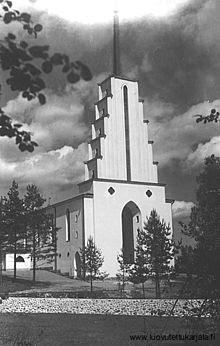
There is continued heavy fighting as Soviet 7th Army pushes ever closer to Viipuri. Soviet and Finnish troops continued to fight near the city, particularly near the Vuoksi River near Äyräpää church.
Finnish forces defeat Soviet forces attacking from the east and west of Viipuri. The Soviet forces attacking from the west are attempting to cross the ice on Viipuri Bay.
On the Isthmus, a Soviet assault launched at 6 o’clock in the morning leads by nightfall to the capture of a bridgehead near Äyräpää church. Around noon Russian troops supported by tanks once again come ashore at Vilajoki and Häränpäänniemi on Viipurinlahti bay. What little air power Finland has is concentrated to resist the enemy offensive across Viipurinlahti Bay.
The Soviets continue attacking across the Gulf of Viipuri. Their hold there is tenuous because should the ice melt before they consolidate the bridgehead with an overland advance, they would be stranded on the far shore of the Gulf with no hope of rescue. Soviet troops, meanwhile, try to scoot across the ice quickly around noon, but Finnish artillery and planes attack them relentlessly and cause heavy casualties.
Elsewhere along the front, the Finns dig in and prevent any further major advances. The Finns still hold the greater part of Viipuri despite Soviet inroads. The Soviets are focusing attacks to the east of the city, trying to bypass it on both sides.
The Taipale sector is quiet.
Detachment Alfthan unsuccessfully attempts to take Lavajärvi village. The enemy threatens Kotka and Virolahti.
A new combat detachment, Detachment Aarnio, is being formed to fight along the section of the front between Mustalampi and Lavajärvi with the task of cutting the enemy’s supply lines.
In the Ladoga Karelia area the 69th Infantry Regiment was still holding its ground in Kollaa in the face of the massive Red Army offensive. Artillery shelling and patrol activities nevertheless continue.
In the far north, Soviet forces withdraw in the Petsamo sector. Under the current peace offer (which, while expired, remains the only one outstanding), Petsamo would be handed back to the Finns anyway.
President Kyösti Kallio congratulates Commander-in-Chief Mannerheim on the destruction of a Russian tank brigade.
Soviet military command in Leningrad denies bombing Finnish towns and villages and accuses the Finns of provocation.
A League of Nations mission arrives in Helsinki to investigate Finnish allegations of Soviet methods of warfare that are illegal. The deadline for Finland to appeal to the Allies for military assistance expires tomorrow.
A crash between a goods train carrying children and an express train at Iittala, near Hämeenlinna, claims 31 lives; 11 of the dead are children.
The Soviet Union, which had denied bombing Pajala on 21 February, formally and belatedly apologizes for the incident. It is very rare for the USSR to ever apologize, so this indicates their interest in maintaining good relations with Sweden and thereby avoiding a larger Scandinavian war.
Today is Finnish day at the Holmenkollen games in Oslo. In a speech at Holmenkollen, the Finnish speedskater Clas Thunberg says: “My people hope that here in Norway you will realise that Finland’s cause is also your cause. The Finns dying at the front are giving their lives to protect all of us in the Nordic countries.” Thunberg’s speech is followed by a rendering of the Finnish national anthem.
U.S. Undersecretary of State Sumner Welles departed Berlin, Germany. Undersecretary Welles arrived in Lausanne, Switzerland from Berlin this afternoon after his conferences with Chancellor Adolf Hitler and other German leaders and will spend the next two days in the Swiss resort preparing his notes before entraining for Paris Wednesday evening to see French Premier and Foreign Minister Edouard Daladier.
The Under-Secretary, who is touring Europe on a fact-finding expedition for President Roosevelt, plans to remain in the French capital for three days and then will fly to London for three days for conversations with King George, Prime Minister Neville Chamberlain, Foreign Secretary Viscount Halifax and other British leaders. After his London conferences the Under-Secretary will fly back to Paris for a day and then will go to Rome for a second meeting with Italian Premier Benito Mussolini. He will sail for home on March 18 on the Italian liner Conte di Savola.
The Italian note of protest on the coal blockade, which was handed to the British yesterday and published today, has turned out to be so strong that a crisis is threatening to develop. Moreover, Italian colliers have put out to sea from Rotterdam in defiance of British orders, thus directly challenging the Allied blockade. Here in Rome the full gravity of the situation is emphasized and it is generally admitted that if this does not prove a turning point in the economic warfare being waged it will at least prove one of the major developments of the conflict.
In London it was said that the British Government had no intention of accepting the Italian protest. Reports were also denied that Britain intended to relax her embargo order to allow Italian ships now loading German coal at Amsterdam to pass unmolested through the Allied contraband control.
The British Treasury announces that £1,000,000 was raised in saving certificates and defense Bonds during the three days ending 1 March 1940.
The Home Office announced that women would not be asked to work more than 60 hours a week in British factories, and youth under 16 would not be required to work more than 48. In World War I, women were frequently working as many as 70 hours a week.
French military dispatches reported fresh divisions were entering the German lines amid mounting activity today on the western front. German Army reinforcements of “several” new divisions trained during the winter were said to be arriving behind the active front while aerial feints back and forth across it intensified over the weekend, stressing the belligerents’ anxious watch of each other for a hint of springtime tactics. Other German units were reported moving into the region facing Switzerland.
The Chief Executive Officer of the American firm General Motors James Mooney, holder of the German Grand Cross of the German Eagle medal for his services to Germany, met with Adolf Hitler in an attempt to dissuade Hitler from escalating the war.
The National Council of Palestine Jews, meeting in plenary session, adopted unanimously today a resolution declaring that, while anxious to cooperate with the Allies, it could not accept new British regulations restricting the sale of land by Arabs to Jews.
The German Navy began holding submarines in port for Weserubung, the invasion of Norway, and cancelled all other naval operations.
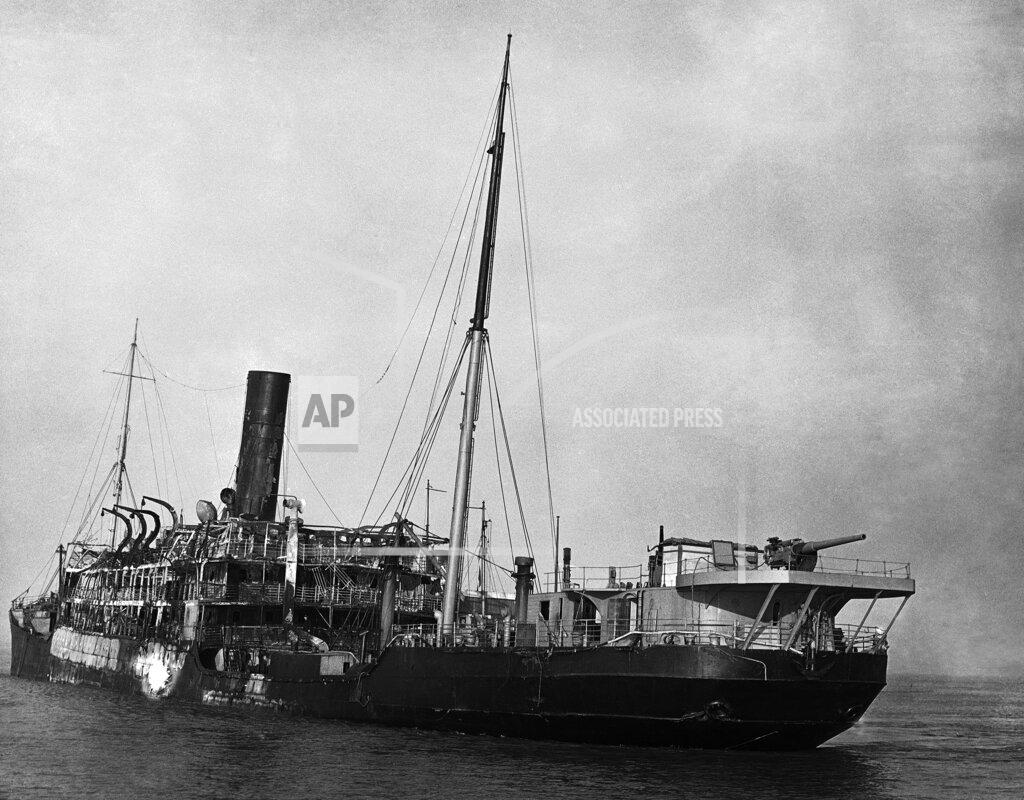
Shortly after midnight the French steam merchant S.N.A. 1 collided with the British steam merchant Thurston approximately 60 miles south of Milford Haven in the Irish Sea and sank. 31 crew members were rescued by the Thurston. The 2,679-ton S.N.A. 1 was heading for Rouen, France.
At 5.23 a.m. the same day the Thurston was torpedoed and sunk by the U-29, commanded by Kapitänleutnant Otto Schuhart, in the Bristol Channel 32 nautical miles (59 km) off Trevose Head (50°23′N 5°49′W). Of the ship’s complement, 34 died and three survivors were picked up by the British steam merchant Moyle. Only one of the 31 French sailors survived the second sinking. The 3,072-ton Thurston was carrying manganese ore and was bound for Cumberland, England.
Dispersed from Convoy HX.19, the British motor merchant Pacific Reliance was also torpedoed and sunk by the U-29, commanded by Kapitänleutnant Otto Schuhart, off Land’s End near the English Channel (50°23′N 5°49′W), at 1239 hours. Of the ship’s complement, all 53 survived and were picked up by the British merchant Macville. The 6,717 ton Pacific Reliance was carrying general cargo and aircraft parts and was bound for London, England.
U-29 also fired another torpedo at the same time at the steam merchant San Florentino. The ship was reported sunk to B-Dienst, but in fact the torpedo had exploded prematurely and the ship was not damaged.
At 2030, tanker Charles T. Meyer (10,516grt) of convoy HX.20A, escorted by sloop HMS Fowey, struck a floating mine 15 miles south of Dungeness, in 50-21N, 0-18E. Fowey continued on with the convoy. To assist the damaged tanker, destroyers HMS Brilliant was ordered from Dover, HMS Boadicea from her patrol, and HMS Keith from Dover when ready. Tug Lady Brassey and French torpedo boats and trawlers proceeded to the area. HMS Boadicea located the damaged tanker at 0400 the next morning. At 0500, HMS Brilliant joined and soon after HMS Keith arrived. At 0600, HMS Boadicea took the tanker in tow escorted by HMS Brilliant and HMS Keith. Tugs Lady Brassey from Dover and Foremost from Newhaven arrived at 0959 and took over the tow. HMS Brilliant returned to her patrol at 0700, but HMS Keith remained as an anti-submarine screen. Tug Calshot departed Southampton at 1100 and Admiralty Salvage Vessel Recovery Of Leith departed Dover. HMS Keith was released when the tow reached Sandown Bay, I.O.W. All units involved arrived safely at Castle Point, Cowes, at 0105 on March 6th.
U.S. freighter Exeter, detained at Gibraltar by British authorities since 1 March, is released, but not before 155 sacks of mail for Germany are removed, as are 95 sacks for Italy and 59 for Switzerland. Some 140 sacks previously removed from other neutral ships, however, are brought on board and the ship is permitted to sail.
Convoy ON.17A of six British, sixteen Norwegian, eight Swedish, eight Finnish, three Estonian and one Panamanian ship departed Methil escorted by destroyers HMS Jervis, HMS Juno, HMS Jupiter, HMS Janus and HMS Jaguar. One steamer was detached before the convoy crossed the North Sea. The convoy was joined by 17 ships from Kirkwall. These are included in the sailing breakdown from Methil. Anti-aircraft cruiser HMS Calcutta departed Sullom Voe on the 5th for anti-aircraft protection. Destroyer HMS Jervis made an attack at 0905 on the 7th on a submarine contact northeast of the Shetlands at 61 15N, 1 20E. The convoy arrived safely at Bergen on the 8th, while HMS Calcutta arrived back at Sullom Voe on the 9th.
Convoy FN.111 departed Southend, escorted by destroyers HMS Vega, HMS Grenade and sloop HMS Stork, and arrived in the Tyne on the 6th.
Convoy FS.112 departed the Tyne, escorted by sloop HMS Flamingo and destroyer HMS Wallace, and arrived at Southend on the 6th. Convoy FS.113 was cancelled.
Convoy MT.23 departed Methil, and arrived in the Tyne the next day.
Convoy HG.21 of 34 ships departed Gibraltar escorted by destroyers HMS Velox, HMS Vidette and HMS Active, the latter detaching on the 6th. HMS Velox, which had joined from convoy HG.20F, and HMS Vidette were detached on the 11th to Portsmouth and Devonport, respectively. Destroyer HMS Vimy escorted the convoy from the 4th to 10th. Destroyer HMS Winchelsea joined from the 11th to 13th in Home Waters for the Liverpool section. Merchant ships not going to Liverpool were escorted by destroyer HMS Windsor which was with the convoy from the 11th to 13th. The convoy arrived at Liverpool on the 13th.
The War at Sea, Monday, 4 March 1940 (naval-history.net)
Light cruisers PENELOPE and AURORA arrived at Rosyth after covering convoys ON.15 and HN.15.
Light cruiser SOUTHAMPTON arrived at Scapa Flow after Northern Patrol.
Armed merchant cruiser PATROCLUS departed Liverpool on Northern Patrol.
Armed merchant cruiser MALOJA arrived in the Clyde from Liverpool.
Destroyers INTREPID, GALLANT, and IVANHOE arrived at Aberdeen to patrol. INTREPID left to investigate a submarine reported at 0530 six miles NE of Aberdeen, and destroyers JUPITER and JUNO of convoy ON.17A were detached to assist. Trawler BEN CHOURN (197grt) reported an explosion in this area. It was first thought that convoy ON.17 was under attack. It was later ascertained that the submarine was the British NARWHAL, proceeding to Scapa Flow, and that the explosion was a depth charge fired by destroyer NUBIAN.
Submarine TRIAD carried out special trials off Inchkeith.
Destroyer VESPER departed Greenock escorting submarine TETRARCH to Portsmouth, where they arrived on the 6th. TETRARCH carried out equipment repairs, and then sailed on 13 April for a war patrol.
Anti-submarine trawler NEIL MACKAY went ashore at Scapa Flow during a storm, but was later refloated.
At 2030, tanker CHARLES T. MEYER (10,516grt) of convoy HX.20 A, escorted by sloop FOWEY, struck a floating mine 15 miles south of Dungeness, in 50-21N, 0-18E. FOWEY continued on with the convoy. To assist the damaged tanker, destroyers BRILLIANT was ordered from Dover, BOADICEA from her patrol, and KEITH from Dover when ready. Tug LADY BRASSEY and French torpedo boats and trawlers proceeded to the area. BOADICEA located the damaged tanker at 0400. At 0500, BRILLIANT joined and soon after KEITH arrived. At 0600, BOADICEA took the tanker in tow escorted by BRILLIANT and KEITH. Tugs LADY BRASSEY from Dover and FOREMOST from Newhaven arrived at 0959 and took over the tow. BRILLIANT returned to her patrol at 0700, but KEITH remained as an anti-submarine screen. Tug CALSHOT departed Southampton at 1100 and Admiralty Salvage Vessel RECOVERY OF LEITH departed Dover. KEITH was released when the tow reached Sandown Bay, I.O.W. All units involved arrived safely at Castle Point, Cowes, at 0105/6th.
Convoy ON.17 A of six British, sixteen Norwegian, eight Swedish, eight Finnish, three Estonian and one Panamanian ship departed Methil escorted by destroyers JERVIS, JUNO, JUPITER, JANUS, and JAGUAR. One steamer was detached before the convoy crossed the North Sea. The convoy was joined by 17 ships from Kirkwall. These are included in the sailing breakdown from Methil. Anti-aircraft cruiser CALCUTTA departed Sullom Voe on the 5th for anti-aircraft protection. Destroyer JERVIS made an attack at 0905/7th on a submarine contact northeast of the Shetlands in 61 15N, 1 20E. The convoy arrived safely at Bergen on the 8th, while CALCUTTA arrived back at Sullom Voe on the 9th.
Convoy FN.111 departed Southend, escorted by destroyers VEGA and GRENADE and sloop STORK, and arrived in the Tyne on the 6th.
Convoy FS.112 departed the Tyne, escorted by sloop FLAMINGO and destroyer WALLACE, and arrived at Southend on the 6th. Convoy FS.113 was cancelled.
Convoy MT.23 departed Methil, and arrived in the Tyne the next day.
Sloop LEITH, escorting convoy HG.20, attacked a submarine contact west of Scilly Isle in 49 57N, 08 15W. Destroyer VENETIA, also of HG.20, joined her in the hunt.
U-29 sank steamers THURSTON (3072grt) 32 miles west of Trevose Head in 50-23N, 5-49W and PACIFIC RELIANCE (6717grt) in 50 23N, 05 49W. THURSTON had been involved in a collision with French collier S N A 1 (2679grt) which sank, and had just rescued the French survivors when she herself was sunk. Thirty-four crew were lost on THURSTON, while one survivor each from SNA 1 and THURSTON was picked up by steamer MOYLE (1761grt). All 53 crew of PACIFIC RELIANCE were rescued by steamer MACVILLE (666grt) and tanker SAN FLORENTINO (12,842grt). U-29 also attacked SAN FLORENTINO but torpedo failures allowed her to escape.
Steamer AUCKLAND STAR (13,212grt) reported she had sighted a submarine (U-28) in 49 26N, 07 27W. Sloop LEITH nearby, escorting convoy HG.20 was detached to investigate. On the morning of the 5th, destroyers WILD SWAN and VENETIA were ordered into the area to assist. Later, on the 5th, another report of a submarine, led to destroyers WHIRLWIND, VOLUNTEER, and VETERAN being ordered into the area.
The German Navy began holding submarines in port for WESERUBUNG, the invasion of Norway, and cancelled all other naval operations.
Convoy HG.21 of 34 ships departed Gibraltar escorted by destroyers VELOX, VIDETTE, and ACTIVE, the latter detaching on the 6th. VELOX, which had joined from convoy HG.20F, and VIDETTE were detached on the 11th to Portsmouth and Devonport, respectively. Destroyer VIMY escorted the convoy from the 4th to 10th, when she detached to convoy HG.21 (?). Destroyer WINCHELSEA joined from the 11th to 13th in Home Waters for the Liverpool section. Merchant ships not going to Liverpool were escorted by destroyer WINDSOR which was with the convoy from the 11th to 13th. The convoy arrived at Liverpool on the 13th.
Heavy cruiser CORNWALL departed Freetown on patrol.
Heavy cruiser CUMBERLAND departed Freetown.
Light cruiser DUNEDIN departed Kingston on patrol.
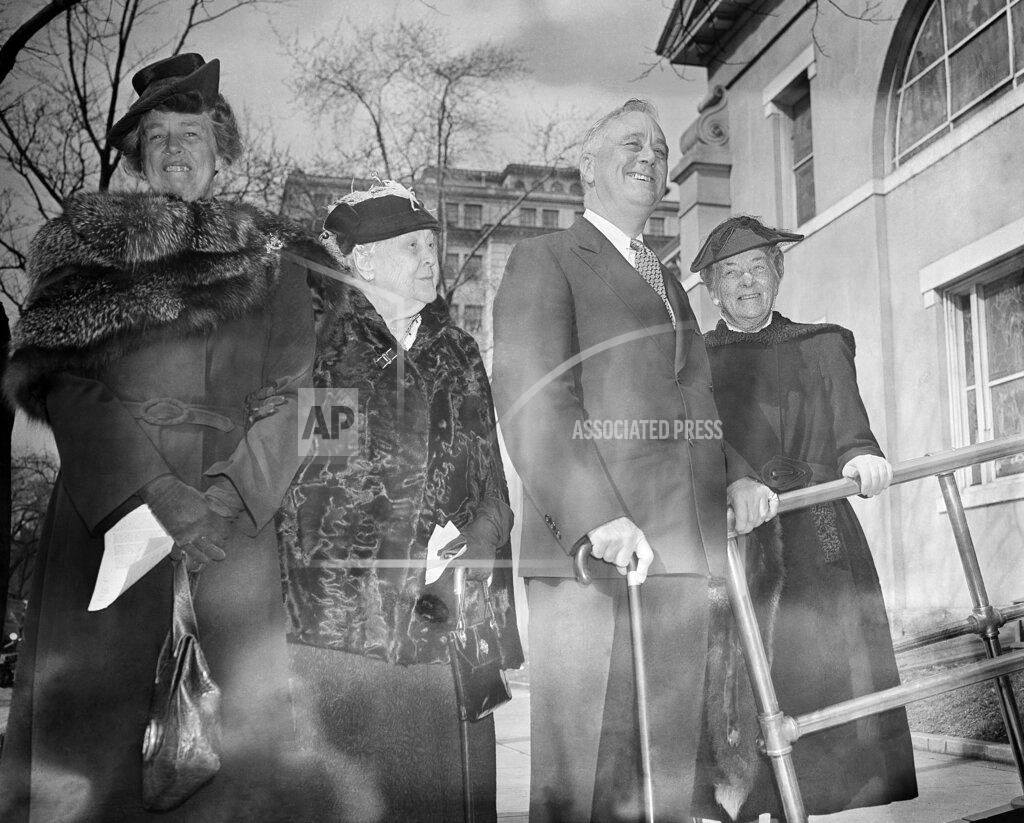
President Roosevelt observed the seventh anniversary of his inauguration today in Washington by attending services at St. John’s Church this morning and the annual Cabinet dinner in his honor tonight. He conferred with Secretary Hull, Secretary Morgenthau and other executives of fiscal agencies, and signed a bill extending for four years the period under which farms may file petitions under Section 75 of the Bankruptcy Act.
With third-term speculation at a new high and Democratic and Republican orators in heated debate over the accomplishments and failures of the New Deal, President Roosevelt quietly marked the seventh anniversary of his accession to office today by attending Divine service with members of his immediate and official families. Accompanied by his wife and mother and White House aides, the President went early in the day across Jackson Square to historic St. John’s Episcopal Church, as he has done on each March 4 since his first inauguration. There, with members of his Cabinet and several agency chiefs, he joined in a prayer that America be spared the cruelties of war and that bitterness and misunderstanding might be ended in this country.
Tonight the President and Mrs. Roosevelt were guests at the dinner given for them each year by the Cabinet on the anniversary of his inauguration. It was a day in which third-term speculation figured prominently in private discussions in virtually all official circles, but for those who had expected a statement from Mr. Roosevelt on his political plans for 1940, it was one of disappointment.
Ignoring the political implications of the occasion, the President said nothing and Stephen T. Early, White House secretary, would neither confirm or deny a published report quoting Mr. Roosevelt as having told a Southern Democrat that he would not run for a third term unless the nation were confronted by a grave emergency growing out of the European war. After his regular morning conference with the Chief Executive, Mr. Early described the report as the “free exercise of the prerogatives that go with a free press,” adding that it was similar to news stories on the subject published in the past.
With the Episcopal prayer for those in authority, the simple forty minute service included a prayer for peace. Flanked by his wife and 86-year-old mother, the President listened attentively to the lesson from the fourth chapter of the Book of Micah: “And they shall beat their swords into plowshares and their spears into pruning hooks; nation shall not lift up a sword against nation; neither shall they learn war any more.”
The Senate heard Senator Barkley praise the New Deal Administration and Senator Austin criticize it; received the Thomas bill to redistribute the gold stocks through the Export-Import Bank, the Pepper bill to establish a permanent industrial loan corporation, and bills to establish the Farm Credit Administration as an independent agency and to make the Federal Land Bank System self-supporting, and adjourned at 4:25 PM until noon tomorrow. A commerce subcommittee voted to recommend that the Tobey resolution to eliminate certain questions from the census be reported to the Senate.
The House received the $119,071,187 Interior Department Appropriation Bill, the Randolph bill for acquisition of British islands in the Caribbean in payment of war debts, heard a eulogy of Representative Royal C. Johnson, and adjourned at 3:28 PM until noon tomorrow.
A crusade for a new liberalism “that will free the country from the domination of ‘Big Government’” was demanded today by Wendell Willkie, president of the Commonwealth and Southern Power Corporation, speaking before a convocation of students of the University of Toledo, the Rotary Club and the Toledo Civic Forum. After the World War business men forgot their real mission, he said, and in becoming jugglers of finance paved the way for the campaign of 1932 to “free us from manipulation.”
Today conditions had been transposed, declared the foe of the New Deal, who has been mentioned as a possible candidate for President. “Money power has been taken from Wall Street and put on Pennsylvania Avenue,” he said. “Bureaus control our economic life. The buccaneers of Washington with their broad powers answerable to the Executive of the government have taken control.” He asserted that if governmental control.could be taken off the nation’s money markets there was enough idle capital ready to be loosed by business to remove eight or ten million persons from the unemployed lists.
Holding that the practice of medicine falls within the purview of the Sherman Anti-Trust Act, the United States Circuit Court of Appeals for the District of Columbia ruled valid today an indictment found here against the American Medical Association and two local affiliated medical societies for conspiracy to restrain trade. The unanimous decision reversed the local Federal District Court, which had sustained a demurrer to the conspiracy indictment.
Many children of school age on the Navajo reservation are too far from schools to attend them, Congress learned today. The Bureau of Indian Affairs told a house interior appropriations sub-committee that it had asked the budget for money to build several new day schools on the reservation, but had been turned down.
A possible recall of the Byrd Antarctic expedition a year or two ahead of its tentatively scheduled return was threatened today by refusal of the House Appropriations Committee to recommend $250,000 for the expedition’s expense during the 1941 fiscal year.
Eleanor Roosevelt gave an address to the Chicago Civil Liberties Committee.
A storm that may compare with the hurricane of September, 1938, in property destruction from ice and wind, today raged along the eastern seaboard. Driving, freezing rain whipped by a 40-mile northeast wind covered sections of New York, New Jersey, Pennsylvania and the New England States with ice, and early property damage reports indicated the greatest loss since the hurricane. The full force of the storm was not felt in New York City except Queens and the Bronx.
A new film “Canada at War” in the March of Time series, prepared by the motion picture staff of Time, Inc., of New York, was banned today in Ontario by Premier Mitchell Hepburn in his capacity as chairman of the appeal board of the Ontario Board of Censors.
The Canadian sailing ship Douglas & Robert ran aground at Arnold’s Point, Little Harbour, Labrador and was wrecked.
Although secret parleys have been going on in both Tokyo and Berlin for a closer Japanese-German rapprochement, it is learned here that these have broken down because Germany has refused to diminish her very substantial technical and other aids that are being given to the Chungking government, often through Soviet agencies. German assistance to Generalissimo Chiang Kai-shek and the Chinese Government is apparently not inspired, mainly, by friendship for China, but is largely motivated by the desire to undermine British influence in this portion of Asia. Since Japan is not only openly warring to overthrow General Chiang, but also aspires to succeed to the British position in China, the rift between Tokyo and Berlin is perceptibly widening.
Reopening of the Yangtze River, the great central China waterway controlled by the Japanese Army and Navy, will be delayed until such time as the great powers — Britain, France, the United States and Italy — have given a clear indication of their attitude toward the proposed new Nanking Government. If it is apparent that any or all these powers are working actively to prevent the success of the proposed Nanking regime of Wang Ching-wei the river will remain closed. The Japanese still appear to consider control of the river, the most important commercial artery in China, a major bargaining point.
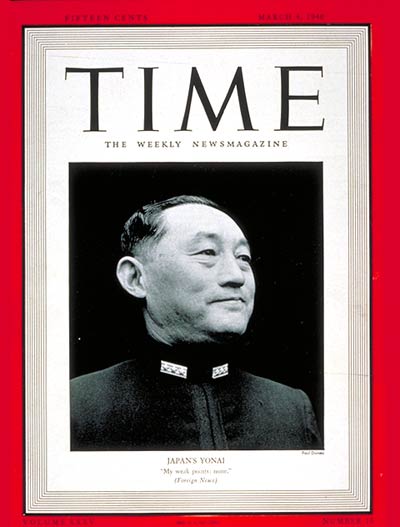
War Minister General Shunroku Hata indicated that despite previous Foreign Office promises to reopen the Yangtze River to foreign trade the Japanese Army was not yet ready to declare the stream open. “The army will not reopen the Yangtze if third nations aggressively obstruct Japanese military operations and the maintenance of peace and order,” he said. “When the army is ready, sooner or later, the Yangtze will be reopened.” The War Minister said that the promise to reopen the stream was made to the United States, was unilateral and did not obligate Japan.
Japanese War Minister General Shunroku Hata declared before the Diet (parliament) today that the Salvation Army must be placed under “proper regulations” for prevention of “espionage.” Hata said military authorities had started watching the religious organization’s activities. “Aside from questions of its dependency on Britain, or its religious beliefs,” he declared, “I believe that the Salvation Army must be placed under proper regulations in order to prevent espionage.”
Dow Jones Industrial Average: 146.43 (+0.1)
Born:
Kas Garas, Lithuanian-American actor (Hamlyn – “Strange Report”), in Kaunas, Lithuania.
Tom Neumann, AFL halfback (Boston Patriots), in Menomonie, Wisconsin.
Died:
Hamlin Garland, 79, American writer.
Naval Construction:
The Kriegsmarine (German Navy) Type VIIC U-boat U-351 is laid down by Flensburger Schiffsbau-Ges, Flensburg (werk 470).
The Royal Canadian Navy Flower-class corvette HMCS Orillia (K 119) is laid down by Collingwood Shipyards Ltd. (Collingwood, Ontario, Canada).
The Royal Canadian Navy auxiliary minesweeper (ex-fishing vessel) HMCS Joan W II (FY 34) is commissioned. Her first commander is Skipper/Coxswain James H. Auchteronie, RCNR.





 History Diaries