
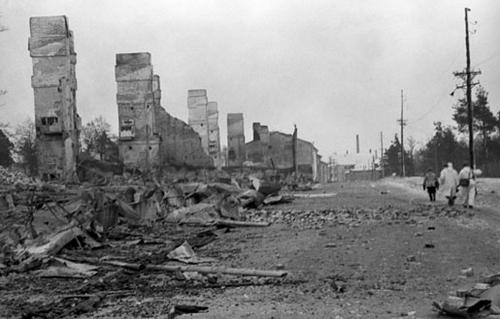
The Soviet forces begin major attacks on the new Finnish defense line under the direction of General Timoshenko. Three Soviet divisions launch a massive general offensive. Pressure is exerted against all points but is strongest at the north and south ends. Vuosalmi in the north is attacked by Soviet 13th Army forces while the reserve corps of Soviet 7th Army is advancing over the sea ice toward the west side of Viipuri Bay. Soviets reach the southern suburbs of Viipuri. Meanwhile, Finnish fighters foil an attempted raid on Helsinki.
Soviet 7th Army continues attacking toward Viipuri.
Soviet 13th Army is attacking in the Taipale sector.
Despite the Red Army’s massive numerical superiority, the fighting became bogged down in trench warfare with very heavy casualties on both sides and the Finnish defenses holding firm. The fiercest fighting was on the Karelian Isthmus at Käremäenlahti to the south of Viipuri and in the Lyykylä sector east of the city where the Finns were forced to withdraw from the frontline strongholds.
Soviet troops enter the southern suburbs of Viipuri at Sainio, 5 miles south of the city along the coast, and Heinjoki River, 17 miles east of the town. They continue swarming west. Fires break out in Viipuri, which is being abandoned and destroyed.
Soviet troops attempted to establish a beachhead west of the Finnish city of Viipuri across the frozen Viipuri Bay, while pressure was asserted on the city from its south and east. An attempt was orchestrated on 29 February 1940 without success; likewise, this newly dispatched unit failed to establish a beachhead.
The Red Army advances towards the islands of Tuppuransaari and Teikarsaari were supported by a massive artillery bombardment. A Finnish counterattack around midday was unsuccessful and Tuppuransaari ran out of ammunition. Both islands were lost to the Soviets. The Red Army also managed to reach land on the western shore of Viipurinlahti Bay. Finnish Major General Wallenius cannot dislodge them and is said to be drinking heavily.
In Ladoga Karelia, the Soviet artillery in Kollaa began an intensive bombardment at 6.30 AM, followed by an assault with two divisions across the entire breadth of the Finnish positions north of Lake Ladoga in the Kollaa sector. Finnish reconnaissance planes have in the past couple of days observed firing stations for approximately 50 enemy artillery batteries in the centre of the Kollaa front. During the course of the day the enemy artillery in Kollaa fires about 30,000 rounds, against less than 1,000 on the Finnish side. Despite the enemy’s massive numerical superiority, the fighting becomes bogged down in trench warfare with very heavy casualties on both sides. The Soviet artillery at times reaches a rate of 200 rounds a minute. Despite the extremely difficult conditions and the pounding it has taken from the air due to the Soviet Union’s aerial superiority, the Finnish defence nevertheless holds firm.
The Russians also launch assaults with artillery and tank support on the River Aittojoki. The Russian assaults are repulsed.
In the north, the Finns defending the Kuusijoki line in Kuhmo were unable to withstand the Soviet assault. The assault was preceded by an artillery bombardment of around 3,000 rounds.
In Salla, nine members of a company of Swedish volunteers are killed when the company is surrounded by the Russians. The enemy loses 200 of its own men.
In Ladoga Karelia, a Soviet ski battalion is wiped out between Mustalampi and Lavajärvi.
Tampere is bombed by over a hundred Soviet aircraft, including some fighters.
Over 70 buildings are destroyed by Soviet bombers in Lahti.
Soviet bombers again try to bomb Helsinki, but Finnish fighters drive them off.
Hungarians volunteering to fight in the Winter War arrived in Finland after three weeks of travel. They immediately began training with the Finnish Army but would not complete training before the end of Winter War. After traveling 3 weeks by train officially classified as “tourists going to ski-camp”, the Hungarian Volunteer Detached Battalion arrived in Finland at a training center in Lapua. They would learn winter warfare and how to ski. However, the Soviet/Finnish peace treaty would be signed before they saw action.
The office of the Canadian Prime Minister announced that there were no legal obstacles for Canadian volunteers participating in the war in Finland. The first batch of volunteers boarded a ship in Ottawa which was bound for Finland.
Finland’s Foreign Minister Väinö Tanner explained to the Parliamentary Foreign Affairs Committee why the Government has postponed acceptance of the Soviet Union’s peace terms. Sweden’s Foreign Minister Christian Günther delayed passing on Finland’s answer to Moscow.
The United Kingdom and France once again requested Sweden and Norway to allow passage of Allied troops through their borders in order to aid Finland, should Finland formally requested such aid from the Allies. A formal request is sent to Sweden and Norway to allow Allied troops to be sent to Finland through the Scandinavian countries. (Units are intended to begin arriving by March 20th. Daladier has plans for a force of 50,000 French “volunteers” and 150 aircraft. The British force is planned to reach a level of 100,000 men eventually.)
Norway and Sweden still refuse permission.
French Army intelligence reveals German preparations for an attack on Scandinavia.
U.S. Undersecretary of State Sumner Welles meets with Adolf Hitler in Berlin to offer American mediation. Welles went to the Chancellory and met Hitler, who claimed to want peace but insisted that Britain was determined to destroy Germany. Welles’ impression of Hitler was that he appeared to be calm and in excellent health and that “while his eyes were tired, they were clear.” Hitler argues the Nazi German case for a “new place in the sun” during the 94-minute session.
Some support is to be found in this evening’s French communique for the view that if a German offensive comes it will be between Luxembourg and the Rhine, with a simultaneous demonstration along the river as far as Switzerland.
The British-Italian coal dispute took a turn for the worse today when it was announced that, “following the measures adopted by Great Britain against Italian traffic, especially in regard to coal, a note of protest is being drawn up which the Italian Government will send tomorrow to the British Government.”
Great Britain’s fears that Rumania would provide additional oil for the Nazi war machine were reported to be calmed tonight after a new diplomatic exchange.
In a speech at Cardiff, Wales, yesterday Dr. Edvard Beneš, former President of Czecho-Slovakia, said the German people could not be dissociated from the actions of their government. He said it was necessary mercilessly to destroy the whole Nazi ideology, its regime and its military machine. “For the present war and for all the horrors of nazism Germany is responsible as a State and the Germans as a nation,” he said. “I myself proudly acknowledge that for everything which was done in Czecho-Slovakia in the past twenty years the government was responsible, and for this government the whole of the Czecho-Slovak State and nation was responsible. I do not mean a policy of vengeance and destruction should be. carried out, but it would be folly to believe we are fighting only against Hitlerism and Nazism.”
Yet another warning that peace would not be cheaply bought was sounded tonight by Sir John Simon, Chancellor of the Exchequer, in a radio address. He urged the people of Britain to prepare for a long hard fight against a strong, ruthless foe.
Cambridge won an unofficial Boat Race at Henley-on-Thames.
The police imposed curfew regulations at Tel Aviv tonight after breaking up widespread anti-British demonstrations in which Jewish participants and officers were injured. The demonstrations were against British restrictions on the sale of Arab lands to Jews. Angered Jews erected barricades In the streets and hurled missiles at the police. In Haifa the demonstrators stoned a police station and damaged a district officer’s automobile. In Jerusalem the protestants threw stones at policemen who dispersed their processions.
RAF, Luftwaffe, and French fighters engaged in dogfights over France.
A high-flying RAF Spitefire photographs the entire Ruhr industrial region in one sortie. In addition, RAF bombers drop leaflets and parachute flares over Berlin.
Two Belgian army planes were shot down over their homeland in a clash with a German bomber which the government quickly protested to Berlin as “a grave violation of Belgian neutrality and an act of aggression.” One Belgian pilot was killed and another was wounded in the clash.
The Royal Navy light cruiser HMS Dunedin, commanded by Captain C E. Lambe, intercepted the German steam merchant Heidelberg west of the Windward Passage, 60 miles west of Aruba in the Caribbean Sea. Before the 6,530 ton Heidelberg could be captured she was scuttled by her own crew. The HMS Dunedin picked up 25 of the Heidelberg’s crew who would be detained in a British internment camp in Jamaica
The Royal Navy heavy cruiser HMS Berwick, commanded by Captain Irving M. Palmer, intercepted the German steam merchant Wolfsburg, which was disguised as Norwegian ship Aust, north of Iceland (67°20′N 22°50′W). Before the 6,201 Wolfsburg could be captured she was scuttled by her own crew. The HMS Berwick picked up all 54 of the Wolfsburg‘s crew.
A Heinkel He-111H of the Luftwaffe’s KG26 bombed the British cargo liner Domala, carrying mainly British Indian subjects repatriated from Germany, off the Isle of Wight and machine-gunned survivors who were trying to escape by lifeboat. 108 died and 183 survived in the incident. The Dutch ship Jong Willem rescued 48 of the survivors and was also attacked. The Domala was towed to the Solent and beached. She was requisitioned by the Ministry of War Transport, converted to a cargo ship and entered service as Empire Attendant.
The Dutch coaster Elzienna was bombed and sunk in the North Sea 5 nautical miles (9.3 km) off Coquet Island, Northumberland, United Kingdom by Heinkel He 111 aircraft of KG26, Luftwaffe with the loss of two of her five crew.
The Danish fishing trawler Vilhelmine was sunk in the North Sea by Heinkel He 111 aircraft of Kampfgeschwader 26, Luftwaffe. All four crewmen died.
The British cargo ship Albano struck a mine and sank in the North Sea 4 nautical miles (7.4 km) east of Hartlepool, County Durham. Nine crew were killed. Survivors were rescued by HMT Stella Carino and HMS Wallace.
The Royal Navy rescue tug HMS Fairplay II ran aground at Redcar, Yorkshire and was wrecked. All nineteen crew were rescued.
At 0715, Swedish motor merchant Lagaholm was ordered to stop by the German U-boat U-32, commanded by Oberleutnant zur See Hans Jenisch, and was shelled at 0810 hours with 40 rounds from the submarine’s deck gun, after the crew had abandoned ship in the lifeboats. The ship caught fire and sank later at 59°42N, 05°35W. All 27 crew were rescued by the Norwegian motor merchant Belpamela, which had also been attacked unsuccessfully by torpedo. The Lagaholm and Belpamela had been ordered to Kirkwall by the British armed boarding vessels HMS Northern Sky (4.41) (Lt J.E. Bromley, RNR) and HMS Northern Princess (4.06) (Lt J.N. Hulse, RNR) for contraband inspection. U-32 had first attacked Belpamela with three torpedoes at 01.12, 02.12 and 04.56 hours, but all detonated prematurely. The commander experimented with the torpedo settings between the shots, but gave up after the third attack and decided to stop the other ship with gunfire. The Lagaholm was carrying 4,700 tons of general cargo, including 100 tons of aluminium ingots, 62 tons of copper, 53 tons of brass, engines and chemicals and mail to Gothenburg to Malmö, Sweden.
At 2159, German U-boat U-17, commanded by Kapitänleutnant Udo Behrens, fired a torpedo at a ship reported as a fully loaded tanker of estimated 9,000 tons from a distance of 1200 meters in the North Sea off Zeebrugge, West Flanders, Belgium (51°36′N 2°54′E). The ship was hit in the bow and sank within five minutes. This must have been the Dutch motor merchant Rijnstroom (Master L. Verhoef), which was later reported missing. All twelve of her crew perished. Only a capsized lifeboat, some lifebuoys, deckplanks and part of the cargo were later found adrift. A Dutch ship also picked up an empty raft. The Rijnstroom was carrying general cargo to Amsterdam, Netherlands.
At 0800 hours, the newly completed British (Cunard) ocean liner Queen Elizabeth left the Clyde, United Kingdom escorted by the Royal Navy destroyers HMS Mohawk, HMS Punjabi, HMS Fortune, and HMS Foxhound. It was reported that the Queen Elizabeth was going to Southampton, England but in reality she was bound for New York City, New York. Later that day, when she was due to arrive at Southampton, the city was bombed by the Luftwaffe. Queen Elizabeth zigzagged across the Atlantic to elude German U-boats and took six days to reach New York at an average speed of 26 knots. There she found herself moored alongside both Queen Mary and the French Line’s Normandie, the only time the world’s three largest ocean liners were ever berthed together.
U.S. passenger liner SS Manhattan is detained at Gibraltar by British authorities, but is released the same day. Some 80 of 200 items of cargo, however, are detained subject to guarantees as to their destinations.
Convoy OA.102 departs Southend.
Convoy OB.102 departs Liverpool.
Convoy HX.24 departs Halifax for Liverpool.
The War at Sea, Saturday, 2 March 1940 (naval-history.net)
Destroyers KELLY and SIKH arrived at Greenock from Scapa Flow.
Destroyer KHARTOUM arrived at Greenock from Scapa Flow.
Battleship VALIANT, battlecruiser HOOD (Whitworth), and destroyers KELLY (D.5), SIKH and KANDAHAR departed Greenock at 1600, and destroyers FAULKNOR (D.8), FORESTER, Fand AME departed the Clyde to patrol and cover the progress of the ON/HN convoys at sea. At 1133/3rd off North Minch, FORESTER made a submarine contact in 58-27N, 5-46W and attacked it without result. FORESTER and FAME made further attacks at 1240, 1320, 1423, 1500 in the same area. FORESTER remained at the contact for 24 hours before rejoining the Whitworth force. At 2138/3rd, northwest of Foula Island in 61-06N, 03-58W, KELLY made a submarine contact, also attacking it without result. In a freshening gale, contact was lost and KELLY rejoined the Whitworth force.
Battlecruiser REPULSE destroyers HARDY, HOSTILE, and VIMY departed Portsmouth for the Clyde. The ships arrived during the afternoon of 3 March and VIMY immediately returned to Plymouth, via Liverpool.
Liner QUEEN ELIZABETH (83,673grt) departed the Clyde at 0800 escorted by destroyers MOHAWK, PUNJABI, FORTUNE, and FOXHOUND. As she was getting underway, MOHAWK was damaged in collision with steamer GARTBRATTAN (1811grt) off Greenock. However, this did not prevent her from joining the escort. Destroyer TARTAR was just arriving from Greenock in the Clyde for boiler cleaning when she received orders to join the outbound “convoy” – the lone QUEEN ELIZABETH. TARTAR relieved MOHAWK, which returned to the Clyde, TARTAR’s commanding officer becoming the senior officer of the escort. The destroyers escorted the liner to 200 miles northwest of Rathlin Island before being detached. FOXHOUND and FORTUNE proceeded to Belfast to escort dummy aircraft carrier HERMES (decoy ship MAMARI) on the 3rd. All three left there on the 4th and arrived in the Clyde on the 5th. TARTAR and PUNJABI arrived back at the Clyde on the 4th. MOHAWK entered the Ailsa Shipyard at Troon on the 5th and was repairing until 19 March. QUEEN ELIZABETH arrived safely at New York on the 7th completing her maiden voyage.
Light cruiser MANCHESTER departed Scapa Flow on Northern Patrol duties.
Armed merchant cruiser CARINTHIA arrived in the Clyde from Northern Patrol.
Light cruiser ENTERPRISE arrived at Portsmouth from Halifax convoy escort duty to refit completing on 11 April.
Destroyers FURY and KINGSTON proceeded to patrol off Pladda Island in case a U-boat sighted in 55-48N, 6-45W at 1300 was en route to mine the Clyde. The patrol was terminated at 1000/3rd.
Light cruiser GALATEA departed Portsmouth to join the Home Fleet at Scapa Flow, and arrived on the 4th.
Convoy OA.102 departed Southend, and escorted by destroyer CAMPBELL, which accompanied the convoy on 3 and 4 March. On the 5th, the convoy dispersed.
Convoy OB.102 departed Liverpool escorted by destroyers WALPOLE and VANOC, until they detached on the 5th to HX.22. The convoy dispersed on the 6th.
Convoy FN.109 departed Southend, escorted by destroyers VALOROUS and JERVIS and sloop HASTINGS, and arrived in the Tyne on the 4th.
Convoy FS.110 departed the Tyne escorted by destroyers WHITLEY and BOREAS and sloop EGRET. Minelayer PRINCESS VICTORIA travelled in the convoy, which arrived at Southend on the 4th.
German steamer WOLFSBURG (6201grt) had departed Pernambuco on 5 February. Disguised as Norwegian AUST, she scuttled herself north of Iceland in 67 20N, 22 50W when intercepted by heavy cruiser BERWICK on Northern Patrol. BERWICK picked up the German crew of 11 officers and 43 men and sank the steamer with gunfire.
Cable ship ROYAL SCOT with destroyers BRAZEN and WOLSEY was involved in mending cables in Largo Bay.
Submarine TRIAD undocked at Rosyth.
Destroyer BEAGLE went alongside destroyer depot ship SANDHURST in the Submarine Basin at Dover for boiler cleaning and degaussing, returning to service on the 7th.
Destroyer KEITH arrived at Dover from Sheerness after repairs.
After a report of a German submarine off the Dutch coast, two French destroyers departed Dunkirk that evening to sweep up the Belgian and Dutch coast during the night.
U-17 sank Dutch steamer RIJNSTROOM (695grt) in 51 36N, 02 54E.
U-32 sank Swedish steamer LAGAHOLM (2818grt) in 59 34N, 05 10W, 80 miles west of Kirkwall; one crewman was lost. Armed boarding vessels NORTHERN SKY and NORTHERN PRINCESS were sent to investigate. The 27 survivors were rescued by Norwegian steamer BELPAMELA (3215grt), fourteen were landed at Kirkwall on the 4th, and the remainder at North Ronaldsay. U-32 also attacked BELPAMELA, but torpedo malfunctions allowed her to escape undamaged. LAGAHOLM and BELPAMELA were both en route for contraband inspection at Kirkwall.
Steamer ALBANO (1176grt) was sunk on a mine 7.6 miles 128.5° from Coquet Light, midway between Blyth and North Sunderland; nine crew were lost. The survivors were picked up by escort vessel WALLACE and armed patrol trawler STELLA CARINO (440grt).
Dutch steamer ELZIENA (176grt) was bombed and sunk by He111’s of German KG26 (X Air Corps) five miles east of Coquet Island; two crew were killed. The survivors were picked up. (Sources show the rescue ship as Danish ZINE or Dutch SINE, but neither appear in LLOYDS).
At 0500, steamer DOMALA (8441grt) was bombed and set on fire by He111’s of German KG26 (X Air Corps) 24 miles east of St Catherine’s Point, I.O.W, between St Catherine’s Point and the Owers. Dutch steamer JONGE WILLEM (1632grt) assisted and was machine gunned and bombed, also by He111’s of German KG26. Four to five bombs were dropped, but no damage was done. At 1245, destroyers VISCOUNT, which was en route to pick up convoy OA.102, VENOMOUS and tug STALWART were standing by. Destroyer ANTHONY arrived from Portsmouth shortly after to assist in driving off further air attacks. Soon destroyer ACHATES, tug REVUE and anti-submarine trawler KINGSTON AGATE (464grt) arrived. VISCOUNT picked up 120 survivors, but sustained some damage to her hull while alongside. JONGE WILLEM picked up 51 crew and three dead from lifeboats and took them to Newhaven.
Convoy BC.27 of steamers BALTRAFFIC, BARON GRAHAM, BOTHNIA, BRITISH COAST, and MARSLEW (Commodore) departed Loire escorted by destroyer VIVACIOUS, and arrived safely in the Bristol Channel on the 4th.
Convoy HN.16 six British, eighteen Norwegian, two Finnish and two Danish ships departed Bergen escorted by destroyers ESCAPADE, ENCOUNTER, ELECTRA, and ESCORT. When the convoy split into sections, destroyers INGLEFIELD and IMOGEN took over the seven ships of the west coast section. Convoy HN.16 and ELECTRA, ESCAPADE, ENCOUNTER, ESCORT, and ECLIPSE arrived safely at Methil on the 5th. INGLEFIELD and IMOGEN arrived in the Clyde at 0630/6th after dispersing the west bound section of HN.16 at Cape Wrath.
Rescue tug FAIRPLAY II (282grt, Temporary Lt H L Forster RNR) was wrecked on the Yorkshire coast.
Convoy HX.24 departed Halifax at 0800 escorted by Canadian destroyers HMCS SAGUENAY, HMCS SKEENA, and HMCS ST LAURENT, the latter returning to Halifax after dark. SAGUENAY and SKEENA turned over the convoy to battleship REVENGE on the 3rd, and they arrived back at Halifax mid-morning on the 4th. REVENGE detached on the 11th. Destroyers VERSATILE, WAKEFUL, WALPOLE, and WOLVERINE escorted the convoy from the 14th to 17th, when it arrived at Liverpool.
Light cruiser DUNEDIN intercepted German merchant ship HEIDELBERG (6530grt) 60 miles WSW of the Windward Passage in the Caribbean. She had departed Aruba the day before with German steamer TROJA, which had also scuttled herself to avoid capture.
President Roosevelt returned to the capital tonight to tackle domestic and international problems after a Central American cruise during which he inspected the defenses of the Panama Canal.
President Roosevelt warned Congress today it would have to assume full responsibility for delaying military and commercial improvement of the Panama Canal by construction of a third set of locks. He charged the House Appropriations Committee with trying to camouflage the issue by saying the army was not ready to go ahead with the undertaking. The President returned to the capital this evening from an inspection of Canal fortifications. In a press conference on his special train en route to Washington today he let it be known that the American republics were in complete agreement on the joint defense of the strategic waterway in event of this country’s involvement in war. However, there was no thought of acquiring sovereignty over adjacent territory in peacetime as a precaution, he said.
The President spoke of Canal defense problems as he traveled toward Washington from Pensacola, Florida, where yesterday he ended his fifteen-day vacation cruise aboard the USS Tuscaloosa. The Presidential party arrived at the capital in time for the President to have dinner at the White House, and to examine a number of legislative enactments that had accumulated during his absence. At the station Mr. Roosevelt was met by Secretary Hull and Louis Johnson, assistant secretary of war.
On reaching the White House the President’s first official act was to sign the bill increasing the lending authority of the Export-Import Bank by $100,000,000, under the terms of which Jesse H. Jones, Federal Loan Administrator, yesterday allocated $20,000,000 to Finland, $15,000,000 to Sweden and $10,000,000 to Norway as “economic assistance” to the three Northern States. A brief White House announcement shortly after his arrival said the measure signed by the President provided for loans to Finland specifically but made no mention of the other Scandinavian countries included in Mr. Jones’s announcement. It added that the President had previously informed Washington of his approval of the measure by navy wireless while he was aboard the Tuscaloosa.
On his return trip through the Canal, Mr. Roosevelt paused during his tour of inspection long enough to urge that facilities for its defense be doubled. This, the House appropriations group answered by cutting $16,000,000 from his budget estimates for improvements to the waterway during the next fiscal year. Among items rejected by the committee was a proposed immediate cash outlay of $15,000,000 for preliminary work and necessary equipment for the third set of locks. It also struck out provision for a $99,300,000 contract authorization for the same project, contending that a third set of locks would make the canal no less vulnerable to attack than at present and that detailed plans for its construction had yet to be completed by army engineers.
Criticizing President Roosevelt’s foreign policy, Senator Robert A. Taft charged that Roosevelt has “leanings toward the belief” that this country should enter the European war. Senator Robert A. Taft said that President Roosevelt had not “whole-heartedly” accepted the manifest desire of the American people to stay out of war except in self-defense. If the United States joined the war under New Deal leadership, he predicted, it would mean dictatorship here, with complete socialization of property, and the permanent end of private enterprise and local self-government.
Senator Taft criticized the President for failure to say anything about maintaining neutrality in his message to Congress last month, and for implying at the same time that this country had the right or the duty to interfere because of the nature of the government of some of the belligerents. Expressing the hope that foreign policy would not be an issue in the campaign, Mr. Taft warned that the Republicans would make it one if the President reverted to the position of his Chicago “quarantine” speech in 1937. That speech, he went on, meant risking war through the application of economic sanction and embargoes against some nations and loans and munitions for others. He cast doubt on the President’s desire to continue his present neutrality policy by saying: “The Republican party is a peace party; the Democratic party may or may not be a peace party.” Any alternative is preferable to the horrors of modern war, he added, except in case of physical attack or loss of freedom.
The Senator opposed Congressional enactment of an embargo against Japan, unless the President and Secretary of State recommend it, as risking war in the Pacific, and urged that the Japanese problem be not made a campaign issue. Although he opposed foreign loans in general, he favored the loan to Finland, and expressed himself in favor of the sale of arms to that country and contributions for that purpose, as a special case. He said “We certainly owe something to the Finnish people” in view of their payment of their debts to the United States, “alone among the European nations” to have done so, as against the “complete default” of the Russians.
Although, it is not as strong as it was in 1936, the Democratic party is still the “majority. party” of the nation, according to a survey conducted by the American Institute of Public Opinion, of which Dr. George Gallup is director. 55% of respondents still favor the Democrats over the Republicans.
A nine-year-old girl was killed and at least 11 persons were injured today when a tornado ripped an eight-mile path through an industrial and residential section in the northern part of Evansville, Indiana. Tornadoes swept into the lower Ohio and Mississippi River Valleys today, killing at least eleven, causing widespread property damage, and disrupting communications.
District Attorney Thomas E. Dewey expressed gratification yesterday at the conviction of Louis (Lepke) Buchalter, who, with co-defendants Max Silverman and the latter’s son Harold, was found guilty in the Court of General Sessions of extortion in the trucking and baking business. Lepke faces a mandatory life sentence.
Great Britain’s curb on Jewish land purchases in Palestine, announced Wednesday by Malcolm MacDonald, British Colonial Secretary, and described in a White Paper, was deplored by rabbis of New York in sermons yesterday.
Naval members on the Joint Army-Navy Board recommended a strong increase in both Army and Navy air strength in the Philippines. Strong then directed his War Plans Division to conduct a study, which found that a proper defense of the islands would require a 12-fold increase in air power (from 37 aircraft to 441), a doubling of the U.S. and Philippine Scout forces assigned, and $22 million in new construction, mainly for airfields.
The character of ‘Elmer Fudd’ first appeared in the Warner Bros. animated short “Elmer’s Candid Camera.”
The first televised intercollegiate track meet is seen in NYC on W2XBS; NYU wins the meet presented live from Madison Square Garden.
Beaten by a nose in both the 1937 and 1938 Santa Anita Handicaps, Seabiscuit finally wins the Big ‘Cap in his final race; retires the leading money-winning horse in the world.
Thousands of European fugitives and millions of fugitive dollars rescued by them from the wreck of their enterprises abroad are finding a safe haven in Canada in the greatest industrial immigration this Dominion has ever known.
Mohandas K. Gandhi undertook today to explain and interpret the resolution adopted by the Indian National Congress working committee yesterday, setting complete independence as India’s goal.
The Australian Chief of the General Staff General Squires passes away.
Dow Jones Industrial Average: 146.33 (+0.1)
Born:
Tony Croatto [Hermes Martinis], Italian-Puerto Rican folk song singer and composer (Los TNT; Haciendo Punto en Otro Son), and television presenter, born in Udine, Italy (d. 2005).
Died:
Matt Kilroy, 73, American baseball pitcher (MLB single-season record 513 strikeouts 1886; MLB no-hitter 1886; Baltimore Orioles).
Naval Construction:
The Royal Navy Dance-class ASW trawler HMS Sword Dance (T 132) is laid down by Henry Robb Ltd. (Leith, U.K.); completed by Whites M.E.
The Royal Canadian Navy Flower-class corvette HMCS Collingwood (K 180) is laid down by the Collingwood Shipyards Ltd. (Collingwood, Ontario, Canada).
The Kriegsmarine (German Navy) Type IXB U-boat U-123 is launched by AG Weser, Bremen (werk 955).
The U.S. Navy Sims-class destroyer USS O’Brien (DD-415) is commissioned. Her first commander is Lieutenant Commander Carl Frederick Espe, USN.



Following her commissioning, O’Brien operated along the Eastern Seaboard of the United States. She was moved to the Pacific in early 1942. After operating out of Pearl Harbor and patrolling the Hawaiian atoll, French Frigate Shoals, O’Brien called at Midway Island in the latter part of March, escorting the seaplane tender Curtiss there to evacuate civilians. The two warships returned to Pearl Harbor on 3 April. After an increase and improvement of her antiaircraft batteries, she embarked passengers for transportation to the Naval Air Station at Palmyra Atoll, and then steamed out on 18 April with the destroyers Flusser and Mugford. The destroyer then joined convoys from San Diego and San Francisco to escort them to American Samoa, arriving at Pago Pago on 28 April.
O’Brien was retained at Pago Pago for local escort work. On 26 May, she supported the occupation of Wallis Island, previously taken over by the Free French, and then she joined the auxiliary vessel Procyon on 19 June for the return voyage to Pearl Harbor. Operating out of Pearl Harbor, the ship performed escort duty and acted as patrol and plane guard. She got underway on 17 August with Task Force 17 (TF 17) to reinforce the South Pacific Force, screening the tanker Guadalupe.
Lost 19 October 1942.
USS O’Brien (Cdr. Thomas Burrowes) was torpedoed by the Japanese submarine I-15 on 15 September 1942 northwest of Espiritu Santo in position 12º25’S, 164°08’E. O’Brien reached Espititu Santo under her own power the following day where the American seaplane tender USS Curtiss made temporary repairs. O’Brien sailed on 21 September for Noumea, New Caledonia to receive further repairs by USS Argonne. O’Brien departed on 10 October 1942 bound for San Francisco for permanent repairs. O’Brien called at Suva, Fiji Islands from 13 to 16 October. The rate of leakage of seawater into O’Brien continued to increase, and on 18 October it was necessary for O’Brien to head for the nearest anchorage. Large amounts of topside weights were jettisoned, and preparations were made for abandoning the ship, but her captain still thought that she could be taken intact to Pago Pago. However, at about 0600 on 19 October, her bottom suddenly split open considerably, and her forward and after hull portions began to work independently. At 0630, all hands except for a small salvage crew abandoned, but half an hour later O’Brien was abandoned entirely. Just before 0800 she descended beneath the waves, and after steaming nearly 3,000 nautical miles (5,600 km) since she had been torpedoed. All members of her crew were saved. She sank some 50 nautical miles north-northwest of Tutuila, Samoa in position 13°30’S, 171°18’W.
USS O’Brien earned one battle star during World War II.
 History Diaries