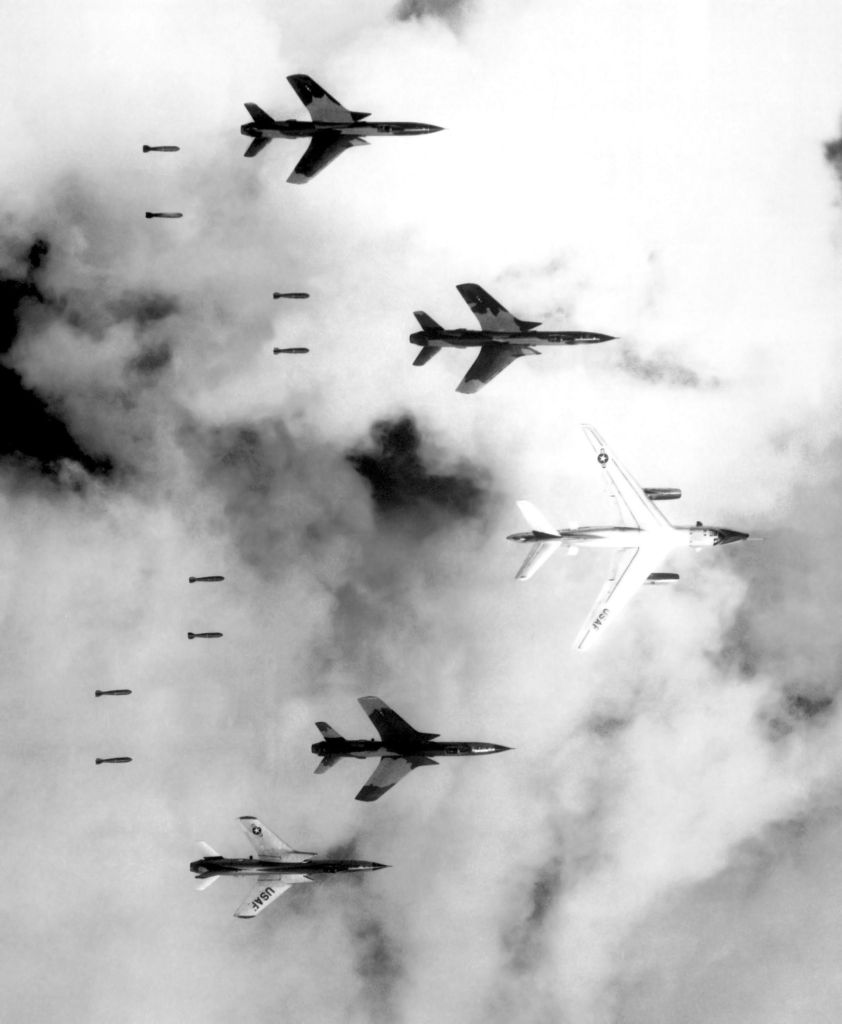

Operation ROLLING THUNDER, the daily bombing of North Vietnam by the United States, began as the 8th and the 13th Bomber Squadrons set off from the Biên Hòa Airfield with eight B-57 Canberra bombers and the protection of F-100 Super Sabres. Over 100 U.S. Air Force jet bombers strike an ammunition depot at Xom Băng, 10 miles inside North Vietnam, while 60 South Vietnam Air Force propeller planes bomb the Quảng Khê naval base, 65 miles north of the 17th parallel. This is the first raid on North Vietnam that is not justified as retaliation for Communist assaults on U.S. installations or personnel. (Six U.S. planes are downed, but only one U.S. pilot is missing.) This raid begins Operation ROLLING THUNDER (rescheduled from 20 February). President Johnson has not yet approved any extended series of bombing raids. For the next two weeks, Johnson will consider the conflicting proposals of various military and civilian leaders. The official position is that this raid does not represent a change in U.S. policy, but it does imply the possibility of additional raids until North Vietnam ends its support of the Việt Cộng.
The missions today were carried out by the largest number of planes yet used in one day against targets in North Vietnam. In the single strike of February 11 the number involved was also given as more than 160, but United States Air Force officials said today’s total was greater. The pilots of the downed planes, one of whom was a Vietnamese, were picked up by United States Navy aircraft. The attacks followed by a day a declaration by Premier Phan Huy Quát that there could be no peace until the Communists end the war they have provoked and stop their infiltration.” The Premier spoke out as talk of peace through negotiations was increasing in Saigon. The strikes also followed an unrelated disclosure earlier in the day that three United States jets accidentally bombed South Vietnamese Government forces last Sunday, killing four soldiers and wounding 15.
The first raid did serious damage, but at the cost of three F-105 and two F-100 fighters, and the capture of the one surviving pilot of the five; a historian would later note, “America was shocked that its large, high-tech, expensive air force, in combat for the first time since the Korean War, had been humbled by a third world country, a communist one at that.” The operation would have 700,000 sorties until its halt on October 31, 1968, without bringing any visible end to the Vietnam War. “ROLLING THUNDER’s ultimate failure came as a result of an inappropriate strategy that dictated a conventional air war against North Vietnam to affect what was basically an unconventional war in South Vietnam.”
By the end of Operation ROLLING THUNDER, U.S. aircraft had flown 153,784 sorties against North Vietnam, with the Navy and Marine Corps adding another 152,399 attacks. Towards the end of the campaign, the U.S. Department of Defense announced that 864,000 tons of American bombs had been dropped on North Vietnam during the operation.
However, in general, Operation ROLLING THUNDER succeeded most in exposing key problems in US military strategy. Perhaps of greatest importance was American underappreciation of the People’s Army of Vietnam (PAVN) defences throughout North Vietnam. According to author and former national security correspondent Stephen Budiansky in his book Code Warriors (2016), “…captured documents showed that the North Vietnamese had at least thirty to forty-five minutes’ warning of 80 to 90 per cent of Rolling Thunder missions.” The North Vietnamese signals intelligence staff of 5,000 “proved as adept at exploiting traffic analysis as the NSA was. Every U.S. bombing mission was preceded by an upsurge of traffic involving logistics, ordnance loading, weather flights, and aerial refuelling tankers, and even if none of the content of the signals was readable, the pattern was a dead giveaway.” Additionally, “nearly all radio communications of the U.S. air operations used unencrypted tactical voice.”
An American Army major declared that “war is a dirty job,” as he watched South Vietnamese troops remove women and children from a village and then burn it to the ground as part of a scorched earth policy against the Việt Cộng.
Soviet commentators assailed U.S.-South Vietnamese air raids on Communist North Vietnam as the work of “barbarous pirates.”
Prime Minister Lal Bahadur Shastri said in Parliament today that he was awaiting a “final reply” from both the United States and the Soviet Union to his proposal for a Geneva-type conference on Vietnam.
Communist aggression in South Vietnam is part of a plan to dominate the whole world, Lieutenant General Nguyễn Khánh, former commander-in-chief of the South Vietnamese armed forces, warned on his arrival in New York.
The United States announced today that it would donate $60 million to the United Nations Special Fund and Expanded Technical Assistance Program. Three months ago, when negotiations were under way to try to solve the knotty financial and political problems of the world organization, Washington delayed its usual pledge to the programs to exert pressure on the Soviet Union, France, and other countries to pay assessments. Negotiations failed to resolve the dispute over the legality of the assessments and over the application of Article 19, which states that any nation two years in arrears “shall have no vote” in the General Assembly. The interlocked questions have been placed before a special committee of 33 under the chairmanship of Alex Quaison-Sackey, President of the Assembly.
The European community passed a major milestone tonight when the council of ministers agreed to merge the executive bodies of the Common Market, Euratom, and the Coal and Steel Community. The fusion of the three administrative groups has been two years in the making. Most observers here regarded tonight’s action as conclusive proof that the economic integration of the six member nations is inevitable. The Common Market, in another action, jolted the European Free Trade Association by agreeing to begin treaty negotiations with Austria, an EFTA member.
Communist delegations from 19 countries including the Soviet Union: met in the strictest secrecy today for the second day of the Soviet-sponsored consultative conference. The meeting was held in a suburban villa outside Moscow frequently used for conferences. The 47 delegates as well as the three observers representing the American Communist party were reported to have. been enjoined by their Soviet hosts from passing any information on the meeting to outsiders. Soviet newspapers and other mass communications media have not mentioned the meeting since they announced the arrival of the delegations. The decision of the Americans to participate only as observers was believed to be a result of the legal action recently renewed by the United States Government against the party for having failed to register as a Communist-action organization.
Diplomatic sources reported Israel is seeking direct supply of U.S. military equipment to replace the arms which Germany has refused to deliver.
U.A.R. President Gamal Abdel Nasser has indicated that if West Germany reneges on any of its economic aid commitments to the United Arab Republic, Egypt will stop repayment of nearly $200 million in debts to Bonn. He also warned that his government would have to seek new arms to compensate for weapons that West Germany has supplied to Israel, especially the 200 tanks included in Bonn’s shipments. The Egyptian President also said Cairo had drawn up economic plans for 1965 on the assumption “that the American deals are expected to be stopped.” The current American aid agreement with Egypt runs out June 30, and further surplus food shipments would require Congressional approval for a new agreement.
Soviet Premier Alexei N. Kosygin’s first visit to the Berlin Wall and his tour of the divided city went largely unnoticed in the Communist East German satellite. Premier Aleksei N. Kosygin of the Soviet Union inspected the Berlin wall today. He peered through heavy snow into the Western sector at two prominent landmarks, the Brandenberg Gate and Checkpoint Charlie.
Invading Indonesian guerrillas ambushed a Malaysian security force Sunday, killing eight and wounding five in a fierce jungle battle, officials reported today. The losses represented the heaviest toll ever suffered by Malaysian forces in clashes with Indonesians. The Indonesians escaped uninjured in the battle. which took place in deep jungles about 40 miles northeast of Singapore. Officials said the report of the fighting was delayed because of the poor communications in the rugged area.
The United States raised the possibility today of further curtailing its aid to Indonesia in retaliation for Indonesian moves against American property.
The British House of Commons, in a non-party vote, today rejected a move to put stricter limits on British Commonwealth immigration into Britain.
A threat of a strike by Britain’s family doctors receded today when the Government agreed to distribute a recommended $15.4 million increase without any strings attached.
The West German Government conceded today that unknown Nazi criminals might still be occupying “important posts” in West Germany.
Prime Minister Lester B. Pearson offered a detailed plan today for terminating Canada’s last legislative link with Britain.
Canadian drug lord and mobster Lucien Rivard escaped from the Bourdeaux Jail in Montreal, where he had been held for ten months while fighting extradition to the United States to face charges of drug trafficking. At about 6:20 p.m., Rivard and a fellow inmate, Andre Durocher, asked one of the guards for permission to get a hose “so they could flood the jail’s hockey rink.” After a guard escorted them to the storage room, Durocher pointed a gun (which was actually a carved piece of wood covered with black shoe polish) at the guard, tied him and two maintenance workers up with wire, overpowered another guard and took his shotgun, scaled the 20-foot (6.1 m) high wall around the jail with a ladder, used the hose to slide to the ground, hijacked a car that was stopped at a traffic light, and made their escape. The incident would lead to a scandal in which the members of the cabinet of Prime Minister Lester Pearson were accused of complicity in the escape, and which would ultimately lead to the resignation of Canada’s Minister of Justice, Guy Favreau. Rivard would be recaptured on July 16 at a cottage 15 miles (24 km) southwest of the jail.
An avalanche in the Austrian Alps killed 14 college students from Sweden. The students were passengers on a bus that was taking them to the ski resort at Obertauern, and were on the Radstadt Tauern road. They died after falling rocks swept the vehicle down into a valley 150 feet (46 m) below.
The Johnson Administration’s $1.3 billion school-aid bill emerged from the House Education and Labor Committee today, but faced possible delay and renewed Republican assaults before House passage. The committee vote was 23 to 8. All of the panel’s Democrats and two of its 10 Republicans, Ogden R. Reid of Westchester and Alphonzo Bell of California, supported the measure. Despite prospects of time-consuming maneuvers in the Rules Committee, Administration leaders expressed confidence that the high-priority bill would reach the House floor by the end of this month. The outlook for House passage was regarded as good. In the Senate, committee hearings have been completed but no action has been taken on a companion measure pending there.
The Senate Rules Committee made public today a report by the Department of Justice that found no substantiation of allegations made by Don B. Reynolds in secret testimony involving President Johnson and several Senators. Mr. Reynolds, who runs an insurance agency in nearby Silver Spring, Maryland, was a friend and one-time business associate of Robert G. Baker, former Secretary of the Senate Democratic majority. Mr. Baker resigned the post rather than submit to questioning about his financial dealings. Mr. Reynolds has figured prominently in the Rules Committee investigation of Mr. Baker. The report made public today was the result of an investigation by the Federal Bureau of Investigation of allegations made by Mr. Reynolds in secret testimony before the committee on December 1, 1964. The FBI investigation was undertaken at the request of the committee.
President Johnson proposed today a system of direct rent subsidies to some “moderate” income families as part of a broad program to improve the nation’s cities. Government sources said the rent supplements would encourage the construction of 500,000 dwellings meant primarily for persons earning between $4,000 and $6,500 a year. As he had promised in his State of the Union Message, Mr. Johnson also proposed the creation of a Cabinet department of housing and urban development.
In a rare display of solidarity, House Democrats easily defeated the major Republican challenge to President Johnson’s $1.1 billion program designed to aid the depressed Appalachia region.
The Justice Department filed notice in Jackson, Mississippi today that it would appeal to the Supreme Court the dismissal of the major charges against 17 men accused in the deaths of three civil rights workers.
In Camden, Alabama, Mayor Reg Albritton, a service station operator, strapped on a walkie-talkie Tuesday and directed several units of auxiliary policemen in stopping the only protest march ever attempted by Blacks in Wilcox County. Several whites cursed the Blacks, but there were no incidents and no arrests. With Dr. Martin Luther King in Washington to make a speech, the demonstrations here were in the hands of John Lewis, chairman of the Student Non-Violent Co-ordinating Committee (SNCC). Only 50 Blacks, mostly women and elderly people, tried the march, which began about two blocks from the courthouse. Mayor Albritton’s helmeted policemen, armed with clubs, blocked the Blacks after only a few steps and they dispersed.
About three hours later, Lewis and another Black walked to the courthouse and stood outside on the walkway where they eventually were joined by about 30 Blacks. In Wilcox County the sight of Lewis infuriates local whites, some of whom call him “that little n****r with the mustache and monkey suit.” He was wearing a dark business suit, blue dress shirt and tie, with a lapel button reading: SNCCOne Man, One Vote.” There are no registered Black voters in Wilcox County, where whites are outnumbered 3 to 1.
Roy Wilkins, the Black leader, saw President Johnson today and said he had got personal assurance that Mr. Johnson believed no American should be denied the right to vote.
Senator Robert F. Kennedy, Democrat of New York, was accused today of trying to promote, while he was Attorney General, a magazine exposé of James R. Hoffa. The attempt was said to have occurred while Hoffa, the Teamsters Union president, was in legal trouble with the federal government. Kennedy promptly denied the charge.
In the U.S. city of Philadelphia, four men were driving past the Fidelity Philadelphia Trust Company bank when they spotted a bag that had been accidentally dropped by a Brink’s armored car, and picked up what turned out to be $40,000 in cash (worth more than $300,000 fifty years later). They were arrested four days later after one of the group used some of his newfound wealth to buy a 1963 Cadillac automobile.
The U.S. space program suffered a setback when a $12,000,000 Atlas-Centaur rocket exploded during an attempted uncrewed launch. The rocket “rose about three feet from its pad, lost power from two of its three engines, crashed back to the ground and erupted into a brilliant orange ball of fire.”
A tumor the size of a large walnut taken from the brain of Albert Cardinal Meyer, Roman Catholic Archbishop of Chicago, was analyzed today as malignant.
Montcalm Community College founded in Sidney, Michigan.
“The Sound of Music,” starring Julie Andrews and Christopher Plummer in 20th Century Fox’s film adaptation of the Rodgers & Hammerstein musical, premiered at the Rivoli Theater in New York City. It would be released in Los Angeles on March 10, and elsewhere in the U.S. on the Wednesdays that followed. “Sneak” previews had also been held on January 15 at the Mann Theatre in Minneapolis, Minnesota, and in Tulsa, Oklahoma the next day.
Dow Jones Industrial Average: 901.91 (+2.15)
Born:
Ron Gant, MLB outfielder (MLB All Star 1992, 1995; Atlanta Braves, Cincinnati Reds, St. Louis Cardinals, Philadelphia Phillies, Anaheim Angels, Colorado Rockies, Oakland A’s, San Diego Padres) and broadcaster (WAGA-TV, co-host ‘Good Day Atlanta’, born in Victoria, Texas.
John Garrett, NFL wide receiver (Cincinnati Bengals), in Danville, Pennsylvania.
Lembit Öpik, British politician (Liberal Democrats), born in Bangor, County Down, Northern Ireland, United Kingdom.





 History Diaries