
A fact-finding delegation of eight members of Congress left for home after a heated, theatrical encounter with representatives of North Vietnam and the Viet Cong’s Provisional Revolutionary Government. The delegation visited South Vietnam and Cambodia at President Ford’s request to determine if Saigon and Phnom Penh required additional military aid. Most members of the group professed to have not quite made up their minds on the administration’s request for $222 million, but several said that the group had at least reached a rough consensus that it was imperative for Secretary of State Kissinger to involve the United States again in a search for negotiated settlements of the Vietnamese and Cambodian wars. Senator Dewey F. Bartlett, Republican of Oklahoma, said at Tân Sơn Nhứt Air Base just before the party left for Washington: “It would be my guess that we would want Secretary Kissinger to play a very big, role, to play it right away, with Russia and China, in an effort to encourage them to use their influence on the North Vietnamese to reduce the level of war and to reduce military support to the North Vietnamese as we would reduce it to the South Vietnamese.”
This morning, seven of the eight Congress members met with North Vietnamese and Việt Cộng officers, who are lodged at Tân Sơn Nhứt on moribund negotiating teams, to discuss the emotionally charged question of American personnel missing in action in Indochina. Representative John P. Murtha Democrat of Pennsylvania, who was twice wounded as a marine colonel here, absented himself from the unusual meeting, a colleague said, because he feared his lingering “hatred” for the Vietnamese Communists might flare. As it was, several members, formal and stony‐faced before a crush of television cameras, accused the Communists of lying, indulging in propaganda and being insincere about the search for the 929 Americans listed as missing in action in Indochina and 1,163 more whose remains have not been recovered. “We have a term in Oklahoma that covers your answer,” Senator Bartlett told Lieutenant Colonel Nguyễn Đức Bảo of the North Vietnamese delegation after listening to a long lecture on American “sabotage” of the Paris peace agreements. “And it’s hogwash.” Senator Bartlett dramatically removed a silver M.I.A. bracelet from his left wrist; it bore the name of an Air Force captain, Clifford Fieszel of Tulsa, Oklahoma, who was shot down over Hải Phòng on September 30, 1968. Mr. Bartlett passed it down to the colonel.
“His wife wants to know where he is or where his remains are,” the Republican told the North Vietnamese officer, who sat at the opposite end of a long table. “I go back to Oklahoma in two weeks. Now what am I going to tell Mrs. Fieszel?” The stocky colonel, unruffled behind his tinted glasses, did not give a direct answer through his young interpreter, but returned to his history of the two‐year war since the Paris accords. The Communists insist that the search for the M.I.A.’s cannot go forward until the agreements are “scrupulously and strictly implemented.” “Is it reasonable,” the colonel asked at one point, “that when the United States is bringing weapons, ammunition and war materials to South Vietnam to kill the Vietnamese it is demanding to seek information about the missing in action?” But later, the colonel said he would forward the name of Captain Fieszel — and those of any other American “martyrs” that were furnished — to Hanoi. “Whenever information is available, we shall notify you,” he said.
State Department officials said today that despite the apparent willingness of President Lon Nol to step aside if he was a barrier to a peaceful settlement in Cambodia, they doubted that it would occur so long as the Cambodian insurgents refuse to negotiate. With the Lon Nol Government in desperate straits, and American officials warning that it will fall in a matter of weeks if $222‐million additional in military aid is not approved by Congress, the officials said they saw no likelihood that the insurgents would change their “no‐negotiation” policy. As long as the Insurgents refuse to negotiate, American officials said they saw no reason for Marshal Lon Nol to step down, or for the United States to seek his resignation. Yesterday, in a meeting in Phnom Penh with members of a Congressional fact‐finding mission, Marshal Lon Nol, who spoke in Khmer, was quoted as having said he would do “whatever is possible and necessary so that peace and the welfare of my people can be achieved.”
The United States Ambassador, John Gunther Dean, was said to have interpreted this remark as meaning that President Lon Nol “will step aside if he is a barrier or stands in the way of a peaceful settlement.” “I think Lon Nol is sincere about quitting if that was all that blocked a peace,” one State Department official said. “The trouble is, the other side does not seem to want a peace settlement, only a military victory.” The official was reflecting the widespread view among American specialists that the diplomatic situation in Cambodia seems frozen as it has been for the five years of the Cambodian war, with the insurgents showing no interest in negotiations while the military situation seems to favor them. Another official cited the latest proclamation of the insurgent forces as indicative of their hard‐line refusal to negotiate with the Phnom Penh Government.
A communiqué issued by the insurgents’ radio Wednesday referred to a “national congress” held last Monday and Tuesday in “the liberated zone” of Cambodia, under the chairmanship of Khieu Samphan, the acting premier and defense minister of the insurgent forces in Cambodia. In that document, the insurgent movement, which calls itself the National United Front of Cambodia, said that Marshal Lon Nol and six other leaders of the coup that deposed Prince Norodam Sihanouk as Chief of State in March, 1970, must be executed. The six others are Sisowath Sink Matak, a member of the ruling executive council and distant relative of Prince Sihanouk; Son Ngoc Thanh, once a close colleague of Prince Sihanouk, now living in Saigon and in poor health; Cheng Heng, who was Chief of State before Marshal Lon Nol; In Tam, a former Premier; Long Boret, the current Premier, and Lieutenant General Sosthene Fernandez, the armed forces chief of staff.
Compromise in the Cambodian situation “is and will be absolutely unacceptable,” Prince Sihanouk said in an interview published yesterday by Newsweek. Prince Sihanouk said in the telephone interview that the United National Liberation Front did not plan a direct offensive against Phnom Penh. He added: “For the moment we are concentrating on (1) reinforcing our hold on the Mekong, (2) eliminating one by one the outposts of Lon Nol’s army, and (3) drawing out of the capital the largest possible number of the enemy army’s combat units in order to chop them to pieces. “Phnom Penh will fall, inevitably, one day or another, like a ripe and rotten fruit.”
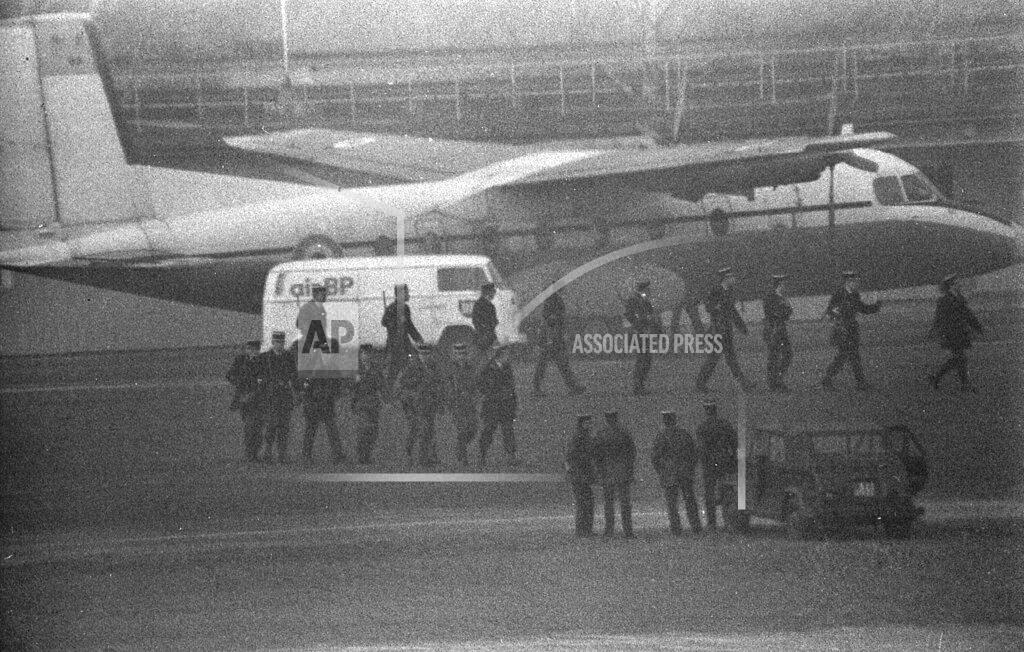
The kidnapping ordeal of Peter Lorenz, a West Berlin party leader, moved toward a climax on election night. West Berlin and West German authorities flew four convicted anarchists and a hostage to Frankfurt as the kidnappers demanded. Two anarchist prisoners whose release was demanded by the radical June 2 Movement had at first refused to agree to be exchanged for Mr. Lorenz, but one of these, Gabriele Kroecher-Thidemann, was reported en route from a prison in Essen to the airport.
Swiss voters turned down a proposed constitutional amendment that would have given their government greater control over the economy. A measure that would have authorized the government to take whatever measures necessary to correct unwelcome economic trends received 52.8% of the popular vote in a nationwide referendum but failed to obtain approval from a majority of cantons or states. Both are required for constitutional changes. The cantons were deadlocked 11 to 11.
Moscow military district court has sentenced a dentist, N. A. Lukin, to be shot for collaborating with German forces during World War II, the newspaper Selskaya Zhizn reported. Lukin is reported to have taken a direct part in torturing and shooting Soviet patriots in Kalinin province and in Byelorussia after his capture by Germans in 1941. After the war, he is said to have used false documents to get into a Kiev medical institute, later becoming a dentist in the Ukraine.
A 22-year-old Roman Catholic was shot and seriously wounded in Belfast, apparently in a feud between rival factions of the Irish Republican Army. The victim had been drinking with friends at a Belfast bar when a hooded gunman burst in and fired several shots, police said. A spokes-man for the Irish Republican Army’s Official wing identified the gunman as a member of a newly formed splinter group, the Irish Republican Socialist Party.
Pope Paul VI, speaking during a Mass in St. Peter’s Basilica to about 25,000 of the Roman Catholic youth movement New Generation, said that young people who thought they were freeing themselves by rejecting their families became slaves of a collective rebellion.
The World Bank and its richer member nations, including the oil-producing nations, are moving toward the first major international aid program for the world’s poorer countries that would not depend on United States participation.
An unidentified British doctor who accompanied British Prime Minister Harold Wilson to Moscow last month believes that Communist Party chief Leonid L. Brezhnev recently underwent radiation treatment, Newsweek magazine reported. Across two hours of observation, the doctor noticed a slight discoloration on Brezhnev’s chin that the Russian kept rubbing. The magazine said the comment again fueled speculation that Brezhnev had been treated for cancer.
Israel’s Defense Minister, Shimon Peres, suggested that Israel would return the Abu Rudeis oilfields and two strategic mountain passes in Sinai to Egypt only if President Anwar Sadat gave an open and direct pledge of an end to belligerence. The Egyptian leader had said recently that he would not make such a commitment directly to Israel but might do so to Secretary of State Kissinger. In an interview at his office tonight, Mr. Peres, a member with Premier Yitzhak Rabin and Foreign Minister Yigal Allon of Israel’s negotiating team, declined to say what precise form an Egyptian pledge would have to take. He said: “I would not like to go into this right now. It’s too early would simply say that it must be an agreement done at noon, in broad light, and between the two parties concerned.”
Israeli troops bodily evicted 60 young Jews from a hill in occupied Jordan where they had tried to make their home. The settlers claimed a God-given right to live in the Judean desert east of Jerusalem, and their action rekindled the debate in Israel over the future of the Jordanian West Bank, of which the desert is a part. But Prime Minister Yitzhak Rabin reiterated his ban on such unauthorized settlements and ordered the troops to forcibly remove the settlers.
Foreign Minister Abdelaziz Bouteflika of Algeria formally opened the ministerial conference of the Organization of Petroleum Exporting Countries here today with an appeal for united action to counter the “Western crusade” against the group of 13 countries. Mr. Bouteflika, elected chairman of the conference in the Palace or Nations here, in his opening speech also assailed “threats of premeditated military aggression aimed at causing disruption and backsliding in the ranks of OPEC.” Food supply, he said, is being used by the industrialized countries to put pressure on developing nations. This was generally taken as being directed at the United States, a major exporter of food. He suggested that OPEC formulate a plan for third‐world countries, including an increased share of world markets, proper remuneration for oil sales measured against other commodities, and free access to modern technology.
The Arab boycott conference warned the West German automaker Volkswagen today that it had three months in which to end its dealings with Israel or be blacklisted by Arab countries.
Lebanese Premier Rashid al-Solh announced tonight that calm had returned to the southern Lebanese port of Saida after two days of fighting between troops and gunmen in which five soldiers were killed and 10 wounded and an unknown number of civilians injured.
Shah Mohammad Reza Pahlavi of Iran declared the kingdom to be a one-party state, with the new “Rastakhiz (Resurgence) Party” to be led by Prime Minister Amir-Abbas Hoveyda. The Shah called on all Iranians “who believe in the royal regime, the Iranian Constitution and the Iranian revolotion” to join the new party. The Shah also called for 49 percent of the shares in all privately owned factories to be sold to their workers and for the public to buy the shares if the workers did not. He announced that 99 percent of the shares of all government‐owned factories, with the exception of key industries such as oil, steel mills, copper and transport, are to be sold to their workers and to the public, with 1 percent of the shares to be held by the government with full management rights. The Shah said that to improve living standards a minimum monthly wage of $184 would go into effect throughout Iran.
The new United States Ambassador to India, William B. Saxbe, arrived in New Delhi tonight after a delay of a week. Mr. Saxbe told newsmen at the airport that he had stayed a week in Bangkok, Thailand, for personal reasons.” The former Attorney General was originally scheduled to arrive here last Saturday and present his credentials to the Indian Government last Monday. Reports from Washington had said that he had been asked to stay in Bangkok until criticism over the American decision to resume arms deliveries to Pakistan subsided. The decision was announced Monday.
An official identified with China’s more radical wing, led by Chiang Ching, wife of Mao Tse-tung, has warned of new bourgeois elements who “openly break the law while cunning bourgeois elements of long standing direct them from behind the scenes.”
Pronouncing himself “overwhelmed” by the heavy vote in his favor in the referendum he staged last week, President Ferdinand E. Marcos has promised a “return to the discipline of the early days of martial law.”
Senator Edward M. Kennedy (D-Massachusetts) said he would introduce legislation to remove prohibitions against U.S. trade with Cuba and against U.S. citizens’ travel to Cuba. He added, however, that his proposal would leave in effect prohibitions against foreign aid and most-favored-nation treatment for Cuba, but would remove prohibitions against third countries trading with Cuba. Secretary of State Henry A. Kissinger earlier had signaled an easing of U.S.-Cuban tensions.
John Patrick Egan, honorary U.S. consul in Cordoba, Argentina, was buried in a short, simple ceremony less than 48 hours after he was slain by leftist Montonero guerrillas. The funeral was led by the dead man’s Bolivian-born wife Cyrila and attended by General Raul Lacabanne, Cordoba’s military leader. The U.S. Embassy was represented by the deputy chief of mission, Joseph Montllor.
Many thousands of Ethiopians today celebrated the victory of the nation over an Italian army 79 years ago and vowed to achieve a similar triumph over secessionist guerrillas in Eritrea Province. Several hundred performers dressed like 19th‐century Ethiopian noblemen, soldiers and patriots depicted in a series of street pageants and parades the victory of Adowa, in northern Ethiopia, in 1896. Thousands of spectators left the sidelines to follow bands through downtown Addis Ababa. Huge groups trotted in the streets and shouted in Amharic: “Ethiopa will not be sold to the Arabs” and “Eritrea and Ethiopia are one — Ethiopia or death.” No soldiers took part in the demonstrations and no members of the ruling military junta joined city officials in Menelik II Square. The square is named for the Emperor who raised an army of more than 100,000 soldiers from the feudal states of Ethiopia and routed a better armed Italian force of about 20,000 at Adowa. The victory kept this nation from becoming an Italian colony.
Central African Republic President Jean-Bédel Bokassa, in power since 1965, declared himself President-for-life. A year later, he would declare himself to be an Emperor.
A bomb planted at a bus terminal in Nairobi, Kenya, killed 27 people and injured almost 100. A bomb explosion ripped open a crowded bus parked in the center of Nairobi last night, killing at least 27 people and injuring 90 in an apparently motiveless act of terrorism.
Democrats on the House Ways and Means Committee formally issued proposals for a national energy program, and administration officials indicated privately that the plan offered a better basis for compromise with the White House than the program offered last week by a study group of congressional Democrats. The committee’s plan includes a graduated tax on gasoline and import quotas.
From mid‐December until mid‐January, Oklahoma’s Secretary of State, John Rogers, was virtually a walking radio station for the Federal Bureau of Investigation. He had two tape recorders and a broadcasting unit strapped on him as he wandered around the Capitol trying to get the man who was Governor, David Hall, to say something incriminating about bribery. The government says that Mr. Hall did. Mr. Hall says that he did not. This week, the former Governor, who has been a special target of Federal prosecutors for several years, went on trial on charges of extortion and of conspiring to bribe Mr. Rogers. Mr. Hall was under investigation by either state or federal grand juries for most of his term. He went into office amid charges of irregular campaign financing, and for the next four years the pressure never eased.
A group of 28 conservative Republican leaders served notice on President Ford today that their support “cannot be taken for granted” and that neither he nor anyone else has a lock on the Republican Presidential nomination in 1976.
Already at work on a platform for the 1976 Democratic National Convention, a dozen or so party officials from around the country gathered in Atlantae this weekend to explore the crime issue and to take testimony from the experts.
Almost three months after the nation’s chief health official submitted his resignation, the Ford Administration still has not named his replacement.
As unemployment has increased, enrollment in the government’s food stamp program has increased by two million, pushing the national enrollment to 17.9 million people as of January 31. Meanwhile, reports issued by government agencies and a congressional group were critical of the program. The Senate Select Committee on Nutrition and Human Needs estimated that only 38 percent of persons eligible for food stamps were receiving them, and that about 20 million eligible persons were not on the rolls.
Declining beef prices caused by an increased number of cattle going to market helped consumers save money on grocery bills during February, an Associated Press market-basket survey showed. The overall bill went down in nine cities, declining an average of 2.4%. It went up in four cities, with an average increase of 2.3%. The latest average market-basket total was about 0.9% less than at the start of February. Although some individual items are cheaper than they were a year or even two years ago, the overall bill has risen an average of 16% in the year ended March 1 and jumped 34% over the two years of the survey period.
The reported number of gonorrhea cases was at a record high in 1973-74, up 8% from the preceding year, the American Social Health Association said. It said the 8% increase rate was lower than those of the two previous reporting periods, suggesting some success in efforts to control the disease. The agency reported also that for the first time in six years the number of cases of primary and secondary syphilis had declined. There were 874,161 cases of gonorrhea reported in the fiscal year that ended June 30, 1974, and 24,728 cases of syphilis. Syphilis was down 1.4%.from 1972-73. The actual — not just reported — incidence of venereal disease is unknown because many cases of gonorrhea are not detected and many that are treated are not reported.
Cancer victim Heidi Biggs died en route to her home in Belleville, Illinois, from a Hawaiian “dream vacation” — her last wish. The frail child, 14, who was heavily drugged when she left Honolulu for St. Louis, lost consciousness during the flight and died in an ambulance taking her to her home. Heidi had been confined to her Honolulu hotel room the last week of her two-week vacation when her condition suddenly worsened. But she lived the first week to the fullest, enjoying every minute. Canadian businessman Russell J. Penny, who started a fund to make the trip possible, said, “We gave her her wish. It was her last request and we honored it.”
New York Governor Hugh L. Carey announced that the state and 11 major banks had reached a limited agreement that would allow the insolvent Urban Development Corp. to continue its construction program, at least for the time being. But aides said the banks still had not agreed to back up the new agency created last week to finance UDC construction on a long-term basis. Carey will ask the Legislature today for a $110 million appropriation that will be passed on to the UDC to continue construction of 16,000 housing units and other projects under way around the state.
An index of help-wanted advertising indicates that the nation’s unemployment will increase “to 9% or above” before leveling off. The January jobless figure was 8.2%. A monthly study by the Conference Board showed that in January ads in 52 major newspapers posted a sixth consecutive big drop, down 8% from a month earlier. Help-wanted advertising usually begins to decline a few months ahead of a rise in unemployment, and recovers sooner, the firm said. A spokesman said the latest results suggested that the jobless rate had “at least one more large monthly increase ahead before it begins to level off.”
Senator James Abourezk (D-South Dakota) said he would propose a $1 billion, four-year program for research and development of solar energy-combined with elimination of federal funding for nuclear breeder reactors. Abourezk issued an advance summary of remarks he plans to deliver today to a Senate Interior subcommittee hearing on the $347 million budget request for the Energy Research and Development Administration, successor to the Atomic Energy Commission. Under his plan, Abourezk said, Congress would appropriate $50 million for solar energy research in the current fiscal year and more each year until funding is up to $325.8 million in the 1979 budget.
President Ford’s proposed energy program would increase utility rates throughout the nation by 20%, the National Association of Regulatory Utility Commissioners said in a statement issued after a meeting of their executive committee. This increase, they said, “is far in excess of any reasonable increase, needed to maintain a viable industry.” The organization called Mr. Ford’s proposals a “usurpation of power” that would reduce the state commissions’ flexibility and ability to set rates.
The U.S. Department of Agriculture said its sewage doesn’t smell-and offered two years of research to prove it. Department officials in Washington, D.C., said their scientists, working in conjunction with environmental experts on a local level, have developed a method of combating repugnant odors that often accompany sewage treatment. A department news release said the “aeration” procedure reduces offensive odors by eliminating the organisms in raw sewage that produce them. The key to the operation, the release said, is ventilation that raises the temperature of a compost heap from 135 degrees to as high as 180 degrees, thus destroying bacteria and viruses.
Joe Frazier stopped a weary and bleeding Jimmy Ellis in the ninth round today in his bid to gain a fight for Muhammad Ali’s world heavyweight boxing title.
Born:
Lee Sun-kyun. South Korean actor (“Parasite”, “Pasta”; “Paju”), in Seoul, South Korea (d. 2023).
Died:
J. M. Kariuki, Kenyan politician, was kidnapped from the Nairobi Hilton Hotel by bodyguards of Kariuki’s political opponent, Kenyan President Jomo Kenyatta and murdered. His body was found three days later in a valley of the Ngong Hills.






 History Diaries