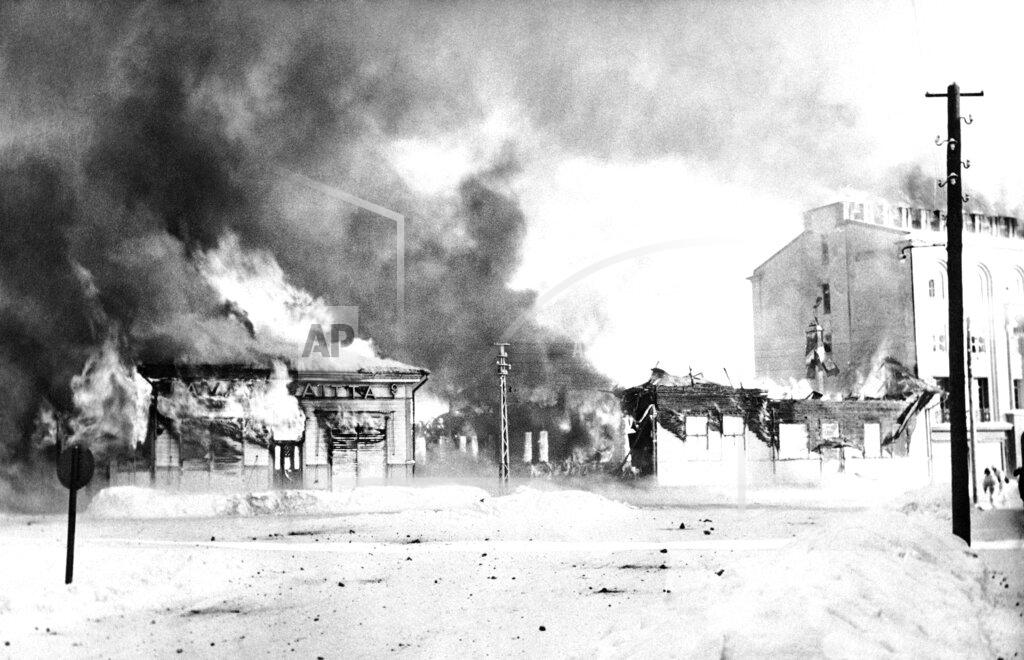
The Soviet 7th Army continues attacking toward Viipuri. The Red Army attacked along the Heinjoki-Lyykylä road and to the south of Viipuri. The Soviets were now only 4 miles from Viipuri and the vanguard of the Russian tanks broke through to Ukonmäki near the main road from Viipuri to Tali. As the Russians approached Viipuri, the city was a largely deserted, bomb-shattered ghost port. Soviet tanks break out past Viipuri and now are on much easier tank country. Essentially, the city is surrounded and the defense fragmented. Soviet 7th Army is heading west.
The Soviet force on the Isthmus follows closely behind the Finnish troops withdrawing to the backline positions and carries out a number of assaults on the delaying positions. Soviet tanks dragging sled personnel carriers overtake the Finnish troops withdrawing to the delaying positions to the west of Perojoki. The Soviets are also attacking along the Heinjoki-Lyykylä road and to the south of Viipuri.
In Vuosalmi, a Soviet detachment of approximately battalion strength attacking the church hill at Äyräpää is beaten back by the defending Finnish troops.
In Taipale, the command dugout in the Terenttilä sector receives a direct hit; 2 officers and 11 men are killed and a further 6 soldiers are seriously wounded.
In northern Finland, Lieutenant-Colonel Magnus Dyrssen is killed by enemy shelling. Dyrssen was commander of the Swedish volunteer battalion, Stridsgruppen SFK, which had just taken over responsibility for the front in Salla.
The fighting in Viipurinlahti bay leads to the establishment of a Coastal Group. Marshal Mannerheim transfers a Jaeger (elite light infantry) Major-General, Kurt M. Wallenius, from Lapland to a new coastal command protecting Viipuri from the seaward side. Wallenius is famous for his saying, “”We don’t let them rest, we don’t let them sleep,” and is something of a national hero. Since everything is frozen, there is no natural boundary on that side of the city. He panicked at the sight of the defenses and went off to get drunk.
Wallenius is no fool, having managed the extremely successful strategic defense of Salla and Petsamo. However, he knows an impossible situation when he sees it, and he protests the assignment because the Soviets already have crossed the frozen gulf and there is nothing that he can do. His troops, used to fighting in woods and tundra, are completely out of their element. They fail to dislodge the Soviets.
There are fierce dogfights over Viipuri, as the Finnish Air Force is making a stand there. The Finns send their own bombers to attack Soviet lines of communication, attacking railway junctions and troop trains.
Finland delays its response to the peace terms put forward by the Soviet Union. The Finns are ready to capitulate to the Soviet terms, but the British and French are aghast. Finland knows what it is up against and demands 100 bombers and 50,000 troops to stay in the fight.
The USSR’s February 23 peace offer expires; Finns hold out for more Allied offers of assistance. Finnish ambassadors in London and Paris ask for 100 bombers and 50,000 troops. Illustrating the discord among the Allies, the French promise these assets while Britain realistically notes that these are not available.
The French announce they are ready to send 50,000 troops and aircraft to Finland if they receive an official request for help before the 5th of March.
As bitter as the Soviet offer was, the Finns should have taken it.
Foreign Minister Tanner gives an interview to the Swedish newspaper Dagens Nyheter. In his interview, Tanner underlines the urgent need for foreign aid, while also stressing Finland’s willingness to seek peace through dialogue.
Finland’s civil defence chief, Lieutenant-General Sihvo urges the general public to avoid going into the towns if at all possible.
In Sweden, a collection of gold rings has raised 1,500 rings.
On the Western Front, the “phony war” continues with a few artillery exchanges and a little patrol action.
U.S. Undersecretary of State Sumner Welles arrived in Berlin, Germany on a peace mission, and met with German Foreign Minister Joachim von Ribbentrop on the first day of his visit, to offer American mediation. In Germany, the second stop of Welles’ fact-finding mission, he met with von Ribbentrop and listened to him speak almost non-stop for two hours. Welles came away thinking that Ribbentrop had a “completely closed mind” that was “also a very stupid mind.”
This is a quite common reaction to Ribbentrop from foreign diplomats. Ribbentrop has an overbearing attitude with them, often ranting and raving about how Germany will crush all opposition and basically giving listeners ultimatums on what they must do.
Hitler issues the final formal war directive for the German invasion of Norway and Denmark. Hitler has a ground commander, von Falkenhorst, and a naval commander, Admiral Raeder, for Operation Weserubung. He gives the final directive for the invasion, No. 10a, “Case “Weser Exercise” against Denmark and Norway.”
Germany issued a sharp warning again to neutral nations today that acceptance of the British contraband control would be regarded by the German Government as “not in accordance with their neutrality or sovereignty.”
The Libyan 1st and 2nd Divisions were formed by the Italian Army.
London halts exports of German coal to Italy by sea.
The British Government informed the Cunard Line they would be requisitioning the Queen Mary ocean liner for war duty.
Women in Britain are urged to wear light clothes in order to save darker dyes for forces uniforms.
According to BBC audience research, about two-thirds of the adult population tunes in to Lord Haw-Haw’s broadcasts from Hamburg. One person in six is a regular listener to his propaganda. Some 16 million listeners hear the BBC nine o’clock news every night and about 6 million of them them switch straight over to Lord Haw-Haw afterwards.
All Spitfires are converted this month to use 100 octane fuel. This added an additional 300hp to the power of the Merlin II engine. The availability of high quality avgas from American refineries will give a boost to the British Spitfires just when England needs them most.
The British Air Ministry reluctantly places an order for 50 de Havilland twin engine medium bomber aircraft, to be built largely out of wood to preserve strategic materials for other, higher priority projects. In a display of remarkable foresight, de Havilland constructed the airplane almost entirely out of balsa and plywood in case strategic metals became scarce. The Air Ministry originally wanted nothing to do with the aircraft, and rejected it as unsuitable because of its wooden construction. Subsequent pressures of war had forced them to reconsider. The order was soon postponed while the Allied armies replaced the material lost on the beaches at Dunkirk. Eventually, in November a prototype flies and startles the RAF with its tremendous performance. Air Ministry officials who had been so skeptical were amazed to see the aircraft performing climbing rolls on one engine, and dashing across the sky at speeds expected of fighters. The aircraft that no one wanted goes on to become one of the great aircraft of World War II: the de Havilland DH 98 Mosquito. A total of 7,781 Mosquitos, of many different variants, are eventually built.
Also this month, AI Mk. III interception radar is installed in some Blenheim night fighters.
The French government offers to purchase “heavy water” from Norway. Heavy water, of course, is useful only for research purposes and atomic bomb construction.
There is stricter food rationing in France. Allowances of alcohol and gasoline are reduced.
The Hungarians form three field armies: the Hungarian First Army, the Hungarian Second Army, and the Hungarian Third Army. With the exception of the independent “Fast Moving Army Corps” (Gyorshadtest), the field armies are initially relegated to defensive and occupation duties within the regained Hungarian territories. Gusztáv Jány was named the commanding officer of Hungarian 2nd Army.
Two hundred thousand men answered Rumania’s call to the colors today, raising her army to 1,600,000 against a possible broadening of the European war in the Spring.
General Wavell begins a major planning conference with officers from the Indian Army.
David Ben Gurion, chairman of the executive committee of the Jewish Agency in Palestine, today appealed to the United States to intervene on behalf of the Jews in Palestine against new British regulations. In an interview, Mr. Ben Gurion declared that under the 1924 British-American convention Britain agreed not to make any changes in the Palestine mandate affecting American interests without first consulting the United States. “I consider that over 8,000 American citizens presently residing in Palestine — mostly landowners — are affected by these restrictions,” he said.
The British conduct reconnaissance all the way to Berlin, with the focus being Kiel, Lubeck and the Heligoland Bight.
The Luftwaffe makes raids off the Yorkshire coast, bombing and strafing Latvian steamer Katvaldis, 1388-ton Norwegian freighter Brott and British fishing trawler Courage.
Sailing with Convoy FS.109, the 1583 ton Norwegian steamer Brott was machine gunned and bombed by German aircraft off Whitby in the North Sea and the crew abandoned ship. The destroyer HMS Juno, escort vessel HMS Vega and sloop HMS Stork were escorting the convoy and one of the escorts picked up a lifeboat from the Brott.
The Norwegian steamer Vestfoss was bombed and sunk by Heinkel He-111s of the German X Air Corps (KG26) about 10 miles east of Copinsay, Orkney Islands in the northern Atlantic Ocean. After an unsuccessful attempt to tow the Vestfoss, the British steamer Star of Liberty took off the entire crew of 19 safely. The 1,388 ton Vestfoss was carrying coal.
At 0315, the Italian steam merchant Mirella was hit in the bow by one torpedo from U-20, commanded by Kapitänleutnant Harro von Klot-Heydenfeldt, in the North Sea off the coast of Suffolk, United Kingdom (52°42′N 2°02′E) but did not sink. The U-boat waited submerged during the daytime, returned to the abandoned ship in the evening and sank her at 2114 hours by a coup de grâce. The wreck was later dispersed. Of the ship’s complement, 1 died and 29 survived and were rescued by HMT Cape Argona and HMS Wallace. The 5,340 ton Mirella was carrying coal and was bound for Leghorn, Italy.
The German cargo ship Troja was intercepted by HMS Despatch off Aruba, Netherlands Antilles and was scuttled by her crew to avoid capture.
The U.S. passenger ship New Yorker was destroyed by fire whilst laid up at Marlboro, New York.
U.S. freighter Exeter is detained at Gibraltar by British authorities (see 4 March).
Convoy HG.21F departs Gibraltar for Liverpool.
Convoy SL.22F departs Freetown for Liverpool.
Convoy OG.20 forms at sea for Gibraltar.
The War at Sea, Friday, 1 March 1940 (naval-history.net)
Heavy cruiser YORK departed Scapa Flow on Northern Patrol.
Heavy cruiser NORFOLK was on the WR station off North Cape to intercept German shipping.
The flag of Cruiser Squadron 2 transferred to depot ship FORTH.
Destroyers FAULKNOR, FAME, FURY, FORESTER, and MOHAWK arrived back in the Clyde after escorting battleship MALAYA and armed merchant cruiser ASCANIA.
Destroyer JAGUAR departed the Humber for Rosyth. On the 2nd, she was attacked by German aircraft off Longstones, but was able to drive the attack off without damage to herself, and arrived at Rosyth on the 2nd.
After delivering Fleet Tenders A and B (decoy ships PAKEHA and WAIMANA) to Scapa Flow on the 1st, destroyer TARTAR departed Scapa Flow again that day.
Destroyer KANDAHAR arrived at the Clyde.
Destroyers FORTUNE and PUNJABI, returning to the Clyde after full calibre firings, investigated a submarine reported seven miles 254° from Ailsa Craig. Steamer CLAN MACNAUGHTON (6088grt) had reported sighting a periscope.
Destroyer WILD SWAN, escorting convoy OA.100G, lost Probationary Midshipman R. R. Tett RNR overboard.
Submarine THISTLE departed Rosyth and performed exercises in the Firth of Forth.
The Northern Patrol from 1 to 14 March sighted 52 eastbound merchant ships and sent into Kirkwall twelve for inspection. Four German merchant ships were encountered and all four scuttled themselves to avoid capture. Armed merchant cruisers ASTURIAS and SCOTSTOUN arrived at the Clyde from Northern Patrol. Armed merchant cruisers WOLFE and DERBYSHIRE departed the Clyde on Northern Patrol. Air escort from Aldergrove was supplied for DERBYSHIRE.
Sloop GRIMSBY was in a collision with Italian steamer EDERA (5254grt) while berthing in the Tyne, but sustained no damage.
Anti-submarine trawler ASTON VILLA (546grt) was damaged in a collision with RFA PETRONEL at Aberdeen.
Norwegian steamer VESTFOSS (1388grt) was bombed and sunk by aircraft of German KG26 (X Air Corps) twelve miles east by south of Copinsay, Orkney Islands. After an unsuccessful attempt to tow VESTFOSS, British steamer STAR OF LIBERTY (205grt) took off the 19 crew. Tug ST MELLONS had been dispatched, but was recalled. Part of the crew from VESTFOSS arrived at Oslo on the 6th. (Note: German X Air Corps flew He111’s of KG26, Ju88’s of KG30, and two reconnaissance squadrons flying He59’s or Do17’s.)
Norwegian steamer BROTT (1583grt) in convoy FS.109 was machine gunned and bombed by German aircraft off Whitby, and the crew abandoned ship. The steamer waited in Bridlington Bay for tugs. Destroyer JUNO, escort vessel VEGA and sloop STORK were escorting the convoy, one of the escorts picking up a lifeboat from BROTT.
Convoy MT.21 departed Methil for the Tyne. In convoy MT.20, Latvian steamers ELIZABETE (2039grt) was damaged by German bombers five miles east by south of Hartlepool Light Vessel and KATVALDIS (3208grt) off Scarborough, in 54-20N, 00-20W. KATVALDIS was struck by two bombs, one of which did not explode. The convoy arrived in the Tyne on the 2nd.
Steamer DOMALA (8450grt) ran aground three cables east of Goodwin Knoll Buoy. Downs Guard Vessel GOODWIN, minesweeping trawler CALVI and a tug from Ramsgate stood by until she refloated herself without assistance at 1600.
Convoy OG.20 was formed from two convoys – (1) OA.100G, which departed Southend on 28 February, escorted by sloop BIDEFORD from 28 February to 2 March and destroyer WILD SWAN from 29 February to 3 March, and (2) OB.100G, which departed Liverpool escorted by sloop LEITH from 1 to 3 March and destroyer VENETIA from 1 to 2 March, with 31 ships. Both Liverpool escorts were detached to convoy HG.20. French destroyer TIGRE and escort vessel VIKINGS joined the convoy from 2 to 7 March. Destroyer ACTIVE joined on the 6th, and the convoy arrived at Gibraltar on the 7th.
U-20 sank Italian steamer MIRELLA (5340grt) in 52 24N, 02 02E; one crewman was lost. The survivors were rescued by destroyer WALLACE and anti-submarine trawler CAPE ARGONA (494grt). Patrol sloops SHEARWATER and MALLARD were patrolling nearby and were joined by sloops WIDGEON and SHELDRAKE to search for the submarine.
Convoy HG.21F departed Gibraltar with 36 ships. French destroyer CHACAL and auxiliary patrol vessel CAPITAINE ARMANDE escorted from 1 to 6 and 7 March, respectively. Destroyers WHIRLWIND from convoy OG.21F and WITCH escorted the convoy from 7 to 10 March, when it arrived at Liverpool.
Destroyer BULLDOG and Australian destroyer HMAS WATERHEN arrived at Gibraltar.
Heavy cruiser SUSSEX departed Colombo 1 March to return to Home Waters. She reached Malta on the 10th, departed on the 12th, passed Gibraltar on the 14th, and arrived at Liverpool on the 17th. There she began a refit that continued until 18 May when she joined the 1st Cruiser Squadron operating with the Home Fleet.
Steamer SOUTHGATE (4862grt) reported being under attack by a U-boat 150 miles northeast of San Juan in 19 58N, 64 00W. American destroyers of the 31st Destroyer Squadron, USS MACLEISH (DD-220, Flagship Commander Destroyer Squadron 31, Captain W.W. Bradley) and USS SATTERLEE (DD-190) and USS MASON (DD-191) of the 68th Destroyer Division were dispatched to assist. However, the submarine was not located and SOUTHGATE was not damaged. U.S. Coast Guard cutter USCGC UNALGA also searched in the area for the reported submarine. The U-boat, in reality, was one of the four French submarines based on Martinique.
During the night of 29 February/1 March, light cruiser DESPATCH off Aruba in the Caribbean intercepted German steamer TROJA (2390grt) shortly after the German ship had put to sea. Rather than be captured, TROJA scuttled herself.
Gunboats APHIS and LADYBIRD left Singapore escorted by light cruiser DAUNTLESS for Penang where they arrived on the 2nd. They departed on the 3rd, and arrived at the Nicobar Islands for refuelling. There, DAUNTLESS was relieved by Australian light cruiser HMAS HOBART which took them to Colombo. DAUNTLESS arrived back at Penang on the 8th. The gunboats departed Colombo on the 11th without an escort, and proceeded to Bombay, joined an RFA tanker and proceeded with her to Masirah. At Masirah, they refueled from the tanker and carried on to Aden, arriving on the 27th, followed by calls at Port Sudan, Suez, Port Said. They arrived at Alexandria on 4 April.
Convoy SLF.22 departed Freetown escorted by armed merchant cruiser MOOLTAN until 12 March. On the 11th convoy SL.22 merged with convoy SLF.22. On the 12th, sloops BRIDGEWATER, ROCHESTER and destroyers AMAZON and VENETIA relieved the armed merchant cruiser. The convoys arrived on the 15th.
French heavy cruiser SUFFREN arrived at Singapore for docking, and was undocked on the 7th.
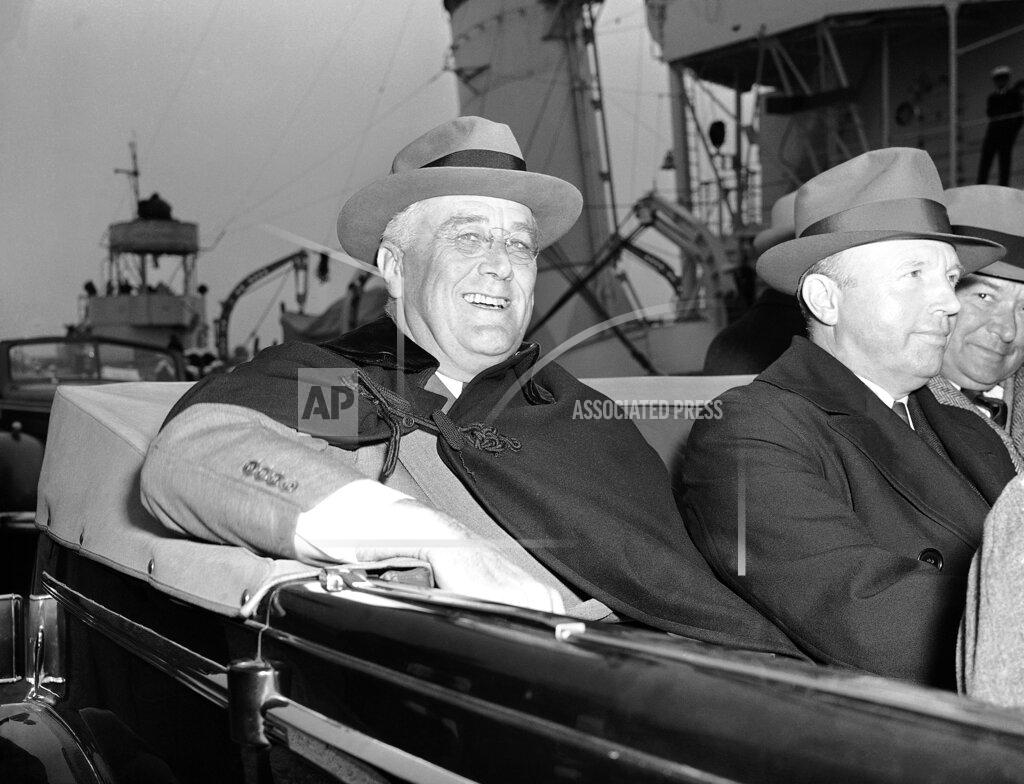
President Roosevelt completed a 4,000-mile cruise today when he disembarked from the U.S. Navy destroyer USS Lang at the naval air station at Pensacola, Florida, on his way back to Washington. The fifteen-day vacation cruise that took him over 4,000 miles of open sea and included an intensive inspection of Panama Canal defenses was ended by President Roosevelt today in a “pea soup” fog that hung over the naval base at Pensacola, Florida, and delayed his debarkation by several hours. Deeply tanned and apparently in good spirits, the President stood at the rail of the destroyer Lang when it came alongside the naval air station dock late in the afternoon.
Occasionally he smiled and waved a greeting to acquaintances among the yard staff lined up on shore to greet him, but for the most part, he wore the same serious expression with which he left the Gulf port two weeks ago. Aboard the cruiser USS Tuscaloosa, he had been fog-bound in the channel about a mile and a half off shore from 8:30 AM. When it became evident late in the afternoon that the fog was not lifting, the President gave the word and the Lang, with only the ship’s bell of the Tuscaloosa to guide it, came abreast and took Mr. Roosevelt aboard, and delivered him safely ashore. The Lang was one of the escort ships on the cruise.
Today in Washington, the Senate was in recess. Its Commerce subcommittee concluded hearings on census questions, and its Monopoly Committee continued its study of insurance companies.
The House passed the amended Stream Pollution Bill, received recommendations for legislation from the Maritime Labor Board, and adjourned at 4:56 PM until noon Monday.
The Export-Import Bank made allocations of credits to Finland, Sweden and Norway.
A prediction that millions of American women will choose jail rather than answer intimate questions in the forthcoming census was given to a senate subcommittee by Catherine Curtis of New York, national director of Women Investors in America, Inc. “I recommend that congress postpone further appropriations for national defense and put through an emergency measure to enlarge jail accommodations to house the millions who will go there rather than disclose their wages or income, matrimonial adventures, or whether they use their bathroom alone or share it with someone else,” she said.
Six Democratic Senators joined today in an open revolt against efforts by Secretary of Agriculture Wallace to revamp the government’s farm credit facilities.
After deliberating thirteen hours and thirty-nine minutes, a jury in General Sessions found Louis (Lepke) Buchalter, Max Silverman and the latter’s son, Harold, guilty of extortion in the bakery and trucking racket at 1:24 AM today.
Attorney General Jackson absolved today the Federal Bureau of Investigation of misconduct or unwarranted exercise of authority in its arrest of sixteen persons at Detroit on charges of recruiting for the Spanish Loyalist Army.
McDonnell Aircraft Corporation responds to an Army Air Corps request for a proposal for fighter construction. The McDonnell Model I is not selected, but the USAAC encourages McDonnell to substantially rework the design. Eventually, it will emerge after several iterations as the groundbreaking XP-67 Moonbat, one of the more futuristic designs of the war. The Moonbat will be plagued with engine overheating issues and will never be quite successful, but the wartime contracts keep the tiny new company afloat, and after the war McDonnell will produce a succession of successful designs, such as the FH Phantom, the F2H Banshee, and the iconic F-4 Phantom II.
The novel “Native Son” by Richard Wright was published in the United States.
The adventure film “Strange Cargo” starring Joan Crawford and Clark Gable (in his next role after “Gone with the Wind”) was released.
A federal judge rules in favor of Grace Comiskey, who became owner of the Chicago White Sox after the death of her husband John Louis Comiskey in 1939, helping her keep control of the team. The widow needed to go to court because the First National Bank of Chicago, the trustee of the estate, wanted to sell the team because there was no specific instruction in her spouse’s will that she should take control of the franchise.
Growing temper in the Indian Congress party was voiced today in a strongly worded resolution dissociating the party from the war and holding out the threat of a civil disobedience campaign as the next step toward complete Indian independence.
Battle of South Kwangsi: Japanese 22nd Army preparing defensive positions around Nanning while Chinese forces assemble for new attacks.
The government in Chungking makes a new effort to evacuate over 100,000 non-essential people from the overcrowded city.
The International Settlement of Shanghai has won little in today’s agreement with the Japanese permitting Settlement police to return to a small part of the Settlement area north of Soochow Creek. This long-awaited agreement, while a step in the right direction, deals only with police matters and does not touch on franchises, taxation, licensing and other vital questions. The Japanese military retains complete control over all Yangtzepoo, will continue to maintain armed sentries and barbed wire barricades at all Soochow Creek bridges and will bar Settlement police from an area two blocks deep along the north bank of Soochow Creek.
The agreement permits Settlement police to return only to the portion of Hongkew where a new police division has been created, including Kiangwan Road as far as the municipal swimming pool and Scott Road as far as the international rifle range. But even within this area the Japanese Navy will maintain sentries. The agreement also permits the Japanese authorities to name the commander of the newly created police division. The Japanese still refuse to permit Settlement street cars to operate north of Soochow Creek and bar buses holding Settlement franchises. In this northern area a Japanese-owned bus line and a Japanese-owned taxicab company have been operating without franchises and without Settlement licenses.
Takao Saito, who early this month criticized the nation’s China policy, has agreed, under pressure, to resign the Parliamentary seat he has held nearly a lifetime as atonement for his speech, but he demands permission to make a valedictory address in which he will defend his patriotic motives.
Dow Jones Industrial Average: 146.23 (-0.31)
Born:
Larry Brown, MLB shortstop, second baseman, and third baseman (Cleveland Indians, Oakland A’s, Baltimore Orioles, Texas Rangers), min Shinnston, West Virginia (d. 2024).
Ralph Towner, American jazz-rock fusion and world music guitarist (Oregon; Paul Winter Consort), in Chehalis, Washington.
Robert Grossman, American illustrator, in Brooklyn, New York, New York (d. 2018).
Nuala O’Faolain, journalist and writer, in Clontarf, Dublin, Ireland (d. 2008).
Died:
Josef Swickard, 73, German actor (“The Wizard of Oz”; “Lost City”; “A Tale of Two Cities”).
Sherman H. Dudley, 67–70?, African-American vaudeville performer.
A. H. [Anton Hansen] Tammsaare, 62, Estonian writer (“Truth and Justice”).
Naval Construction:
The Royal Navy Bar-class boom defense vessel HMS Barrymore (Z 73) is laid down by W. Simons & Co. Ltd. (Renfrew, Scotland).
The Kriegsmarine (German Navy) Type XB U-boat U-118 is laid down by F. Krupp Germaniawerft AG, Kiel (werk 617).
The Royal Australian Naval Bathurst-class minesweeper-corvette HMAS Lismore (J 145) is laid down by Morts Dock (Sydney, New South Wales, Australia).
The Royal Navy Hunt-class (Type II) escort destroyer HMS Chiddingfold (L 31) is laid down by the Scotts Shipbuilding & Engineering Co. (Greenock, Scotland).
The U.S. Navy Sirius-class cargo ship USS Spica (AK-16) is commissioned. Her first commanding officer is Commander Edwin Dowling Gibb, USN.
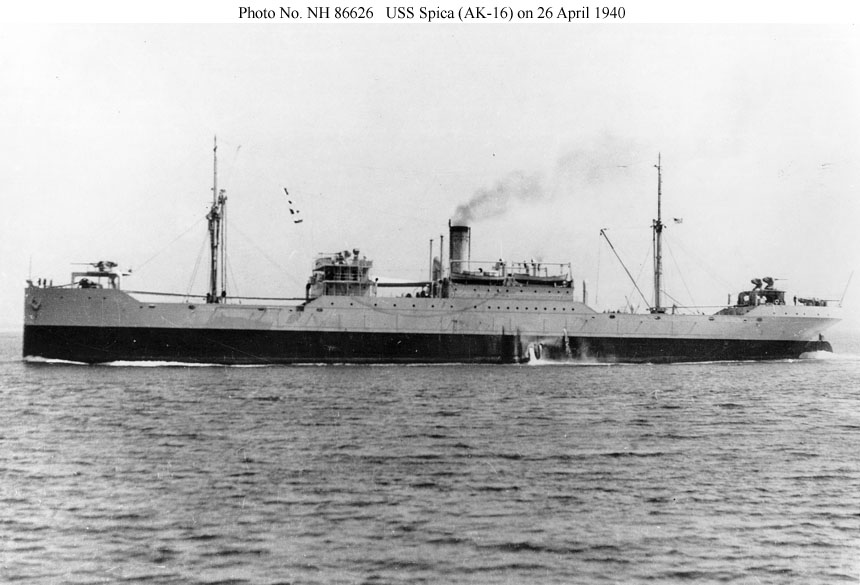
By mid-1940, Spica was assigned to the 13th Naval District; and, until late 1943, she sailed Alaskan waters carrying supplies to American outposts on the Alaskan coast and in the Aleutian Islands. During this period, she participated in the campaign to reoccupy Attu. She spent most of her war in Alaskan and Aleutian waters.
Spica was awarded one battle star during World War II.
 History Diaries