
The Supreme Commander of the North Atlantic Treaty Organization told Congress today that NATO military forces continued to be heavily overmatched by the Warsaw Pact and would be forced to surrender or resort to nuclear weapons within days of a Soviet attack. The officer, General Bernard W. Rogers, said the NATO conventional forces would quickly be overrun because of shortages of munitions, a lack of bomb-proof shelters for aircraft and because the United States does not have the airplanes to get reinforcements to Europe in time. General Rogers also said he believed the European allies were paying an “equitable share” to build up NATO forces, and he urged Congress not to pressure the Europeans for more military spending by threatening to cut American troops there. The general’s remarks, in testimony to the Senate Armed Services Committee, came as some members of Congress are bracing for a re-examination of NATO’s military operations.
Senator Sam Nunn, Democrat of Georgia, who last year led a drive to begin cutting American troops as a pressure tactic on the Europeans, said NATO must do more to beef up conventional weapons to get the allies away from a nuclear hair-trigger. Senator Carl Levin, Democrat of Michigan, said there was also a widespread feeling that the allies should relieve the United States of some of the costs associated with defending Europe. Senator Levin quoted from a January study by the Congressional Budget Office that said the United States was paying $819 per person on the military, while West Germany and Norway were spending less than half that amount and Japan was spending $93. General Rogers said such studies distorted the cost-sharing by counting American forces held in reserve at home. “The allies are bearing a fairly equitable share of the common burden,” the general said. He added, “If we’re going to convince the Western Europeans to do more, you can’t do it by threatening to withdraw our troops.”
The general said NATO was gradually building up its installations, improving its stockpiles of ammunition and switching to a new fighting strategy that emphasizes attacking Warsaw Pact forces deep behind their front lines. But he said the alliance continued to suffer from several “war stoppers,” deficiencies that would quickly force the alliance to give in or use nuclear weapons. These were among the deficiencies he said NATO forces were facing:
- Shortages of munitions and other supplies. Although the United States has set a goal of having 30 days of ammunition stashed in Europe, he said, most of the European nations fall far short of that, and the American forces also are short in some things, including air-to-air missiles and some artillery shells.
- A lack of bomb-proof hangars for the airplanes that would be rushed to Europe in the first 10 days of battle. NATO nations have recently agreed to spend more on these shelters, but General Rogers said they would not be complete until the 1990’s.
- Too few aircraft to move in reinforcements. Asked by Senator Levin if the United States could meet its current battle plan, which calls for moving 10 divisions to Europe in 10 days, General Rogers said, “We do not have the capability, no.”
- Outdated chemical weapons that would not deter the Soviet Union from launching a chemical attack. Instead, he said, allied troops would have to clamber about in hot, cumbersome anti-chemical suits that would hamper their ability to fight.
The Reagan Administration seems determined to press on with the testing and development of a weapon to destroy satellites, despite warnings that the military value of the weapon may be minor. A bipartisan group of 100 members of Congress wrote President Reagan this week to urge him not to resume testing of an American antisatellite weapon and to seek a treaty that would limit such technology. Many scientists are also critical of the program. The critics say a race to build such weapons may threaten stability in future crises because satellites permit both the United States and the Soviet Union to follow what the other side is doing. They say the Administration’s position could close the door to a treaty limiting such weapons.
Representatives of Western countries and the oil- producing nations reached agreement today on the outlines of a plan designed to save the United Nations agency that helps farmers in the third world. The agency, the International Fund for Agricultural Development, had been threatened with bankruptcy because of a decision by the Organization of Petroleum Exporting Countries to cut its contributions, and the United States’ angry reaction. The proposed agreement, which still requires formal approval by the United States, would accept a lower OPEC contribution to a smaller budget. The battle over the organization took on particular importance in light of famines that have taken hold in large parts of Africa, and because of the recent American withdrawal from the United Nations Educational, Scientific and Cultural Organization.
Cypriot President Spyros Kyprianou tonight rejected a challenge issued by Parliament last Friday that he resign and call new presidential elections. But he failed to offer an expected formula for ending the crisis. The two leading parties, the Communists and the conservative Democratic Rally, combined last week to censure Mr. Kyprianou for his rejection of a draft agreement presented in January by the United Nations Secretary General, Javier Perez de Cuellar, at a meeting between the leaders of the Greek and Turkish populations of this divided island. In a television and radio address Thursday night, Mr. Kyprianou advanced only one proposal: he invited the leaders of the opposition parties to meet separately with him to explore possible ways out of what Cypriot and diplomatic specialists say they believe to be an impending paralysis of Government.
The Spanish Parliament has overwhelmingly cleared Prime Minister Felipe Gonzalez of charges that he illegally received money from a West German industrial conglomerate. By a vote of 263 to 7, the legislators ended the case late Thursday night by approving a parliamentary investigating commission’s report exonerating Mr. Gonzalez.
The challenger for the world chess championship, Gary Kasparov, said today that procedures for planning a September rematch with the champion, Anatoly Karpov, were inadequate. In an interview made public by the Soviet press agency Tass, Mr. Kasparov said a planned meeting in August of the International Chess Federation to set the rules and the site of the new championship would be too late. He said this should be done no later than May. At a stormy news conference on February 15, the president of the federation, Florencio Campomanes of the Philippines, annulled the championship match that the two Soviet grandmasters had been playing for more than five months.
President Reagan meets with a group of Arab-American leaders to discuss the situation in the Middle East.
The President of Bangladesh, H.M. Ershad, reimposed martial law with full force today, banning all political activity, closing universities and ordering a curfew for the capital. He also announced that there would be a referendum on his policies on March 21 instead of the elections planned for April 6. A seven-party alliance said Thursday that it would block any move to hold a referendum that bypassed a parliamentary election. It said a referendum would be an effort to continue military rule in a different form.
Japan can ship more cars to the U.S. President Reagan, on the unanimous advice of his Cabinet, said he had decided not to ask Tokyo to extend four-year-old export quotas that expire March 31. he President, citing the “wisdom of maintaining free and fair trade for the benefit of the world’s consumers,” said that he had decided not to ask Tokyo to extend the export quotas, which expire on March 31. In a statement released by the White House, Mr. Reagan urged Japan to reciprocate by opening its markets to American goods and pledged to “continue to actively support further liberalization of the global trading system.”
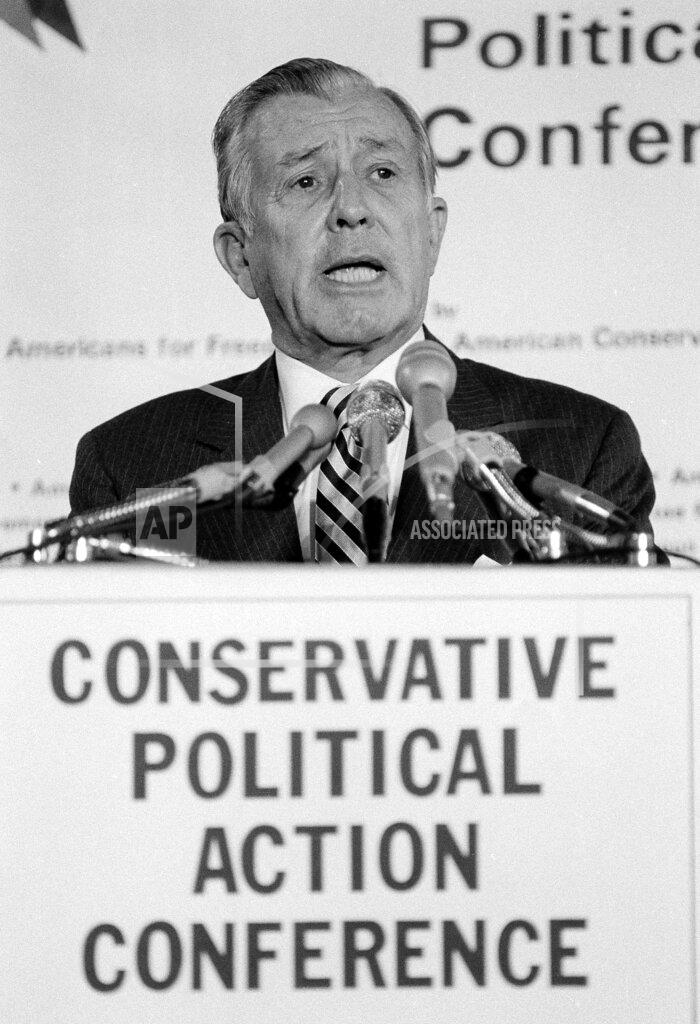
Nicaragua’s anti-Sandinista rebels were the “moral equal of our Founding Fathers,” President Reagan said in speech at the annual conference of the Conservative Political Action Conference in Washington. Mr. Reagan renewed his demand for Congressional approval of $14 million in aid for the rebels. Mr. Reagan also strongly appealed for support of the proposed research program on a space-based defense system against nuclear weapons and said conservative ideology was now the mainstream of American public thought. Speaking about Nicaragua, Mr. Reagan called the rebel forces “our brothers” and “freedom fighters.”
Political killings and human rights violations increased significantly in Guatemala last year, according to figures provided by the American Embassy here. Nonetheless, the embassy has cited an improving political climate in arguing that “overall human rights conditions” have improved in Guatemala, an assessment that is shared by the leaders of most political parties here. Political debate has increased and presidential elections have been scheduled. According to the embassy’s latest human rights report, covering 1984, there were 950 politically motivated disappearances and killings of civilians here last year. Of that total, 425 were disappearances and 525 were killings.
Uruguay’s democracy was restored with the inauguration of Julio Maria Sanguinetti as President. His election ended 12 years of military rule. The inauguration also underscored the trend toward democracy throughout Latin America. Uruguay is the eighth country in the region to pass from military to civilian government since 1979.
The Sahara has encroached steadily on Mauritania, covering almost all the land that had been a buffer between the desert and the African jungles. The encroaching desert and a 15- year drought has made Mauritania’s 1.7 million people reliant on food aid until well into the next century, according to relief officials.
The State Department said today that a gravesite found in Zimbabwe might contain the bodies of two Americans, two Britons and two Australians kidnapped in July 1982. The Americans were Brett Baldwin of Walnut Creek, California, who was 23 years old when he was abducted, and Kevin Ellis, 24, of Bellevue, Washington. “Our embassy in Harare has confirmed that a gravesite was discovered and that there is a possibility that it contains the remains of the kidnapped tourists,” a department spokesman, Edward P. Djerejian, said.
The Reagan Administration issued a policy statement on South Africa today that sought to balance the Administration’s concern about the recent arrest of opposition leaders with continued backing for President P. W. Botha’s program of change. The State Department statement insisted that changes in South Africa to alter the apartheid system of racial separation are genuine. The policy of “constructive engagement,” as the Administration describes its efforts to bring about racial change in South Africa through diplomatic persuasion rather than confrontation, is meeting with what the Administration regards as growing opposition in this country. In recent weeks, there have been daily pickets near the South African Embassy and numerous calls in Congress for legislation imposing economic sanctions on South Africa.
A key Government economic index jumped 1.7 percent in January, the biggest increase in 19 months, the Commerce Department reported. Economists said the advance, somewhat larger than expected, indicated the economy was moving smartly ahead — probably at a pace exceeding the 4.2 percent average growth for the third year of postwar recoveries that lasted that long. In 1984, the economy grew by 6.9 percent after allowing for inflation. “It’s one more sign that 1985 will be a good year,” Marc M. Goloven, an economist for the Manufacturers Hanover Trust Company, said of the latest report. “Last fall’s fears of a growth recession have been virtually buried.”
The President and the First Lady attend the 12th Annual Conservative Political Action Conference Reception and Dinner.
Former transporters of illegal aliens have been working as undercover informers for the federal government at a church in Tucson, Arizona, which offered sanctuary to aliens smuggled from Central America. Their part in the inquiry has led religious leaders to question whether the separation between church and state has been violated. To those at Tucson’s Southside Presbyterian Church, Jesus Cruz was a kindly, deferential old man who seemed delighted to help with the work of moving Central Americans into this country and sheltering them from arrest as illegal aliens. But court records and farm union officials say that Mr. Cruz, a chubby, baldish man with playful eyes and “a nose like an eagle,” was a transporter of illegal aliens until the federal government turned him into an undercover informer. The records name Mr. Cruz and Salomon Delgado, who had a similar background, as the men who taped 100 hours of conversations about the work of the movement for sanctuary for aliens.
Federal approval for a test to screen donated blood for a suspected antibody of acquired immune deficiency syndrome, or AIDS, is expected to be announced today in Washington, Federal health officials said last night. Officials hope the test will help prevent contamination of the nation’s blood supply. Thus far, at least 177 of the 8,500 people diagnosed as having AIDS contracted the deadly disorder from blood transfusions or blood products. Margaret M. Heckler, Secretary of Health and Human Services, was scheduled to approve the blood test a week ago for licensing by the Federal Food and Drug Administration. Approval was postponed, Mrs. Heckler said then, to give the test’s manufacturers additional weeks to provide more data from clinical trials.
A lawyer for Troy Canty, one of the four young men shot by Bernhard H. Goetz, said he would allow his client to testify without immunity if the state reopened its case against Mr. Goetz before a new grand jury. “I want his story out, and I think his testimony comes under the heading of new information,” said the lawyer, Howard R. Meyer, who represents 19-year-old Canty of the Bronx. “Justice should be done in this case. A grand jury should hear someone from the other side.” Mr. Canty, who has recovered from his gunshot wound, was the first person to approach Mr. Goetz on a subway train last December 22, first “asking how he was doing” and then asking him for $5, according to a report by the police in New Hampshire.
The planned launching of the space shuttle Challenger next week has been scrubbed because of problems with two $100 million satellites, space officials announced tonight. Senator Jake Garn, Republican of Utah, had been scheduled to be a passenger on the spaceship. The National Aeronautics and Space Administration said it would combine some features of the mission with those of another flight that had been scheduled for March 22. The combined mission, which will require outfitting the shuttle Discovery for a Canadian communications satellite that was to have flown on next week’s journey, may not get off the ground until April. Officials could not say whether Senator Garn would be on that flight, but if precedent is followed, he would.
The “nuclear winter” theory advanced by scientists in 1983 has been accepted as potentially possible by the Pentagon. The 1983 theory held that detonation of nuclear bombs could generate enough smoke and dust to blot out the sun and cause severe climatic cooling. The Pentagon, in a report on “the Potential Effects of Nuclear War on the Climate,” accepted the basic conclusions of the scientists. “Even with widely ranging and unpredictable weather, the destructiveness for human survival of the less severe climatic effects might be of a scale similar to the other horrors associated with nuclear war,” said the report, “The Potential Effects of Nuclear War on the Climate.” As part of the military programs bill for this fiscal year, Congress ordered Secretary of Defense Caspar W. Weinberger to submit by today a detailed review and evaluation of the nuclear winter theory, including discussion of its strategic policy implications. The report was delivered to Congressional offices this evening.
[Ed: The nuclear winter theory has faced increasing skepticism in later years. The effect is now generally thought to be more of “nuclear autumn.”]
Mississippi Governor Bill Allain, again rejecting legislative plans for pay increases for teachers, said today that their expanding wildcat strikes were a “breach of contract” and warned that school districts could lose state aid if the actions persisted. Meanwhile, the teachers, the lowest- paid in the country, extended their protest into six more Mississippi districts. The walkouts left 80,000 of the state’s 465,000 students without their regular instructors. There were signs that thousands more would join the wildcat strikers Monday when a 10-day restraining order expired. State officials said they would not ask that it be extended. “I think there are going to be widespread walkouts all over the state,” said Olon Ray, superintendent of the 6,500-student Biloxi district where teachers tentatively plan to strike Tuesday.
A federal district judge today denied a request by Dr. Jeffrey MacDonald for a new trial in the February 1970 slayings of his pregnant wife and two young daughters. Judge Franklin Dupree, in rejecting the bid, said that purported confessions by others were “a factual charade” and said a second jury “would again reach the inescapable conclusion that he was responsible for these horrible crimes.” Dr. MacDonald, a former member of the Army Special Forces, has maintained that four drug-crazed intruders killed his family and attacked him. His attorneys said in a January hearing that he deserved a new trial because two “repugnant” women admitted the killings. But Assistant United States Attorney Brian Murtagh contended that the “bizarre” confessions were beyond belief. Dr. MacDonald is serving three life sentences after being convicted in 1979 of murdering his wife, Colette, and daughters, Kimberly and Kristen, at their Fort Bragg apartment.
The Bank of America sued six employees today, charging them with “gross negligence” for their involvement in a mortgage-backed securities scandal that has led to huge losses and embarrassment for the bank. Five of the six employees have been dismissed and the sixth was demoted, the bank said. All six were based in the Los Angeles area. The suit filed in state court provides the bank’s answer to the question of whether its employees defrauded it or were merely sloppy. “We simply do not have any basis to believe or suspect fraud or criminal acts by any of our employees,” said Winslow Christian, director of litigation for the bank. The bank is also suing the National Mortgage Equity Corporation and the West-Pac Corporation, charging them with violating Federal securities laws and of defrauding investors. A prominent Chicago law firm is also a defendant in this suit.
Doctors who gave Murray P. Haydon an artificial heart said today that they had considered sending him back to the operating room because of bleeding inside his chest but rejected the idea. Mr. Haydon’s bleeding problem “could be fully resolved in the next 24 to 48 hours” without the need for surgery, Dr. William C. DeVries, the surgeon in charge of the artificial heart project at Humana Hospital Audubon, said in a medical bulletin. The decision was based on improvements in routine blood tests measuring Mr. Haydon’s red cell count and in X-rays of his chest. An X-ray this afternoon “indicated a decreased amount” of blood in his chest cavity, Dr. DeVries said in a medical bulletin.
A Texas teenager who was the third person in the world to undergo a simultaneous heart-and-liver transplant died this morning when her new heart failed while she was undergoing a second transplant operation, doctors said. The girl, Mary Cheatham, a 17-year- old senior from Fort Worth, went into the operating room Thursday evening to receive a second heart and liver after the first set of donor organs proved too large for her body. She died shortly after 3:30 AM, said Karen Lewis, administrative assistant at Presbyterian-University Hospital. “Both the heart and liver had been implanted but the heart didn’t function,” said Dr. John Armitage, chief cardiac resident at the hospital, who aided in the surgery. “It wasn’t a question of the body’s rejecting the new organs. The heart simply wasn’t strong enough.”
Pan American World Airways said yesterday that it planned to operate about half its international flights as some pilots crossed picket lines and the company mobilized supervisors to replace striking workers. After the Transport Workers Union walked out Wednesday night, the airline estimated that it might be able to operate only 30 of its 213 scheduled daily international flights. Yesterday, however, officials said they were trying to run about 100 flights. Some union leaders doubted that the carrier could achieve that level of service and were encouraged that other unions were honoring the picket lines of the Transport Workers Union, which represents more than 5,000 baggage handlers, flight dispatchers and food service workers. John Krimsky, the airline’s senior vice president of marketing, said in a statement that Pan Am’s aim “is to minimize passenger inconvenience by providing air service where alternative airline capacity is not available or limited.”
Federal agents seized an estimated 15 tons of marijuana from a leaky Panamanian cargo ship Thursday, detained six crew members and searched for a British captain and first mate who fled, the Coast Guard said. The 180-foot cargo ship, Fatuk, limped into port last Friday with multiple problems, including a serious leak, said Lance Jones, a Coast Guard spokesman at the Boston station. Customs Service agents and Coast Guard officers searched the ship’s hold Thursday and found the marijuana under 100 tons of frozen shark meat, Mr. Jones said.
An Alaska Railroad freight train killed 24 moose in a single night this week. “It was a terrible night,” said the railroad’s general manager, Frank Turpin. Arnold Polanchek, assistant general manager of the state-owned line, which runs 525 miles between Seward and Fairbanks, added: “Normally, you hit one or two a trip. I’ve been here 14 years and I can’t remember anything like it.” The moose, killed Wednesday between Anchorage and Fairbanks, died one by one as they walked along the ploughed track rather than in snow up to 18 inches deep, said Capt. Wayne Fleek, a state Fish and Wildlife officer. Fourteen died on the northbound trip and 10 on the way back, Mr. Polanchek said. The train, equipped with a steel cowcatcher, was not damaged, he said. “There’s a natural trough that moose will get into and just don’t want to get out of,” said Mr. Polanchek. The train, normally traveling at 40 miles an hour, cannot stop in time to avoid hitting the animals, he said.
American singer Liza Minnelli enters Betty Ford Center in Rancho Mirage, California for substance abuse rehabilitation.
Milwaukee businessman Herb Kohl purchases the NBA’s Milwaukee Bucks for $18 million.
Stock prices surged to new highs on a wave of institutional buying yesterday. The Dow Jones industrial average closed at a record 1,299.36, up 15.35 points, after being as high as 1,306.76 at midafternoon. The previous record was 1,297.92, set on February 13, when the Dow climbed 21.31 points. Since then, it has hovered around 1,280.
Dow Jones Industrial Average: 1299.36 (+15.35)
Born:
Anthony Toribio, NFL defensive tackle (Green Bay Packers, Kansas City Chiefs), in Miami, Florida.
Died:
Eugene List, American concert pianist and teacher (Eastman School of Music).









 History Diaries