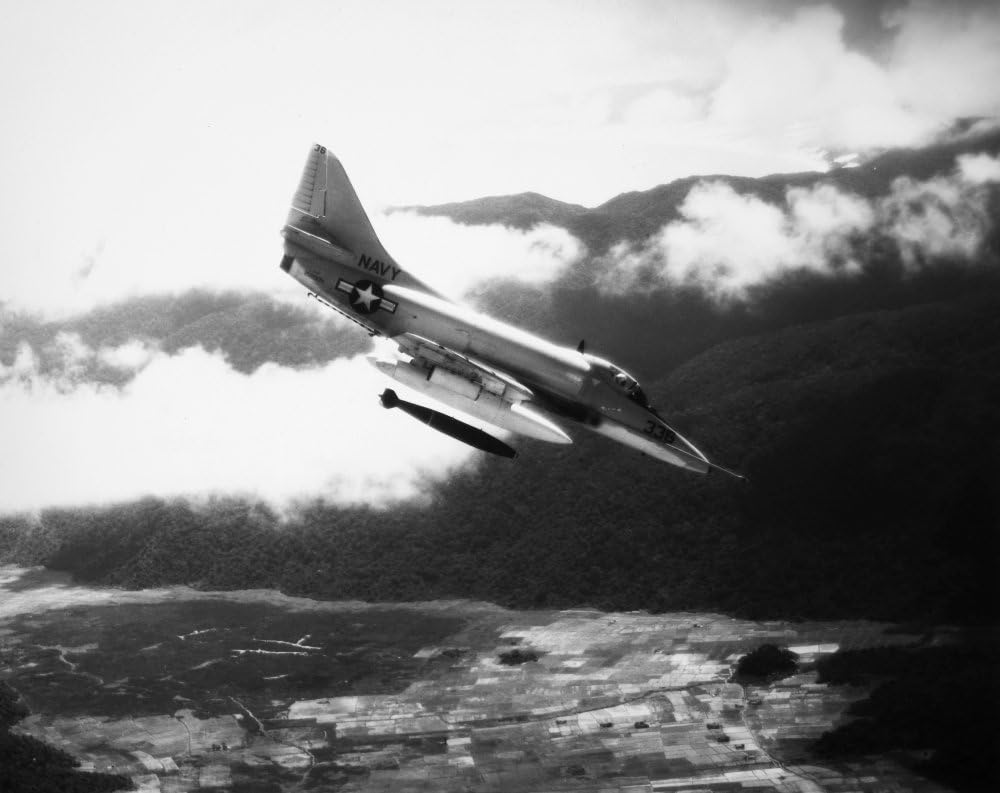
U.S. aircraft made their first attack on the Mụ Giạ Pass, the major supply route for the Việt Cộng into South Vietnam, as Skyraider planes and Skyhawk jet bombers from the USS Coral Sea made a massive strike.
Fighting erupted last night on the perimeter of the United States Army base at Camp Holloway, scene of the Việt Cộng raid that killed eight Americans this month. The new action was a 30-minute clash between a government patrol and Việt Cộng guerrillas. No American casualties were reported. Government mortar fire forced the guerrilla band to withdraw.
In a jungle area 50 miles East of Saigon, more than 100 United States helicopters continued to search for Việt Cộng guerrillas. The region was blasted yesterday by 60 United States jet bombers and more than 1,000 Vietnamese soldiers were airlifted into the area. They were still unable to turn up a trace of the Việt Cộng or even a suspected terrorist.
Việt Cộng forces have captured three districts in the northern part of South Vietnam, the Peking radio reported today. In a broadcast monitored here. Peking quoted the South Vietnam Liberation Press Agency, a Việt Cộng organ. It said, South Vietnamese troops had been forced out of the An Lão and Vĩnh Thạnh districts in Bình Định Province, and the Trà My district of Quảng Nam Province.
The United States and South Vietnam announced that sustained bombing of North Vietnam, Operation ROLLING THUNDER, would begin during the coming week. The highest American and South Vietnamese officials in Saigon say they are “virtually certain” that President Johnson has decided to open a continuing, limited air war against North Vietnam to bring about a negotiated settlement of the Vietnam problem on honorable terms. They say the air war would be unrelated to specific provocation. Their virtual certainty on a Presidential decision is based in part on instructions from Washington in the middle of February to prepare for the first air strike of the new series. This was to be a joint American and South Vietnamese attack. It was postponed during the abortive coup d’état of February 19, and new orders are now awaited daily.
In Washington, Johnson Administration sources said the United States was stepping up air surveillance of the Vietnamese coast to curtail seaborne aid from the North to the Việt Cộng.
In discussing the President’s plans, United States and South Vietnamese officials say their certainty is “virtual” rather than absolute because earlier Presidential avoidance of a decision has distorted and perhaps rendered inoperative key elements of the original “peace through pressure” plan. The latest version of this plan, officials say, was submitted to the President in December. Earlier last year, the project was known as the McNamara-Bundy plan, after the Secretary of Defense and McGeorge Bundy, special assistant to President Johnson. A later variant was drafted by John T. McNaughton, Assistant Secretary of Defense for International Security Affairs.
No decision was made on these proposals during the long Presidential campaign despite deterioration of the political and military situation in South Vietnam. But as soon as the election was over, two of the State Department’s young experts on Asian affairs were known to have prepared a new draft. This, for the first time, won unanimous agreement among agencies both in Washington and in Saigon.
The December plan proposed that North Vietnam be given indications that there could be a better route to economic viability, to the rice of South Vietnam and to independence from China than the reunification of Vietnam by force. This alternative to aggression-including trade with the West, increased diplomatic recognition, possible food-for-peace aid, and international-development assistance — was to be made even more attractive by the opening of a low-intensity air war against North Vietnam.
The aim was not to bomb North Vietnam into submission, a high official said, but “to do something we could stop doing to them, in return for equivalent concessions.” The idea was to reply to Hanoi’s continuing surreptitious, undeclared ground war against South Vietnam not with tit-for-tat blows set off only when Americans were injured but with a continuing. surreptitious undeclared war against North Vietnam. Already this was under way in Laos. The attacks would be neither announced nor officially admitted. The raids, two or three a week, were to start near the 17th Parallel, North Vietnam’s border with South Vietnam. They were to be restricted initially to a few planes — a 24-plane raid is by far the biggest yet employed in Laos —and were to strike at the southern third of North Vietnam, below the 19th Parallel. The participating South Vietnamese propeller-driven Skyraider fighter-bombers would thus remain beyond the range of Hanoi-based MIG interceptors.
More important, it was said. the 19th-parallel limit would support assurances to Moscow, and to Peking that the raids were aimed neither at China; nor at the destruction of the Hanoi Government. This small, semi-clandestine type of offensive was favored because of major disadvantages of large-scale, publicized raids. Some of these had been demonstrated by the 64-plane retaliation for the Tonkin Gulf strike in August. Large-scale, publicly announced raids, it was felt, might provoke Chinese intervention. They would put the Soviet Union on the spot, forcing gestures of solidarity with Hanoi and possibly Peking. They would make it more difficult for North Vietnamese leaders to back down without a loss of prestige. They would, moreover, place Washington under pressure from its allies and American opinion to enter prematurely into talks — “the wrong conference with the wrong people at the wrong time,” in the words of an official in Saigon.
Officials maintain that all but the first of these disadvantages have been brought upon Washington by the three February strikes, which involved as many as 160 planes. It was only after the February 11 raid that the December plan, in the President’s bottom drawer for two months, was pulled out. American commanders in Saigon were instructed to prepare for a continuing aerial offensive, but publicly and with announcements. Ambassador Maxwell D. Taylor argued for silence, but was overruled by the argument that clandestine raids would be politically unpopular in the United States.
[Ed: very nice. And how do you feel about the POW issue, Lyndon?]
As a result of the American announcement, North Vietnam’s leaders ordered the evacuation of children and elderly residents from Hanoi and other major cities.
Premier Aleksei N. Kosygin of the Soviet Union tonight labeled the United States white paper on Vietnam a “black book” of evil deeds that would unite all Asia against the United States.
Prince Norodom Sihanouk, the chief of state of Cambodia, proposed today the formation of a League of Indochinese States — Cambodia, Laos, and North and South Vietnam.
United States and South Vietnamese officials were attempting today to moderate a peace movement begun by the Buddhist clergy this morning.
Senator Russell B. Long warned yesterday that if the United States withdrew from South Vietnam “there will be no place to stop until we reach our own borders.” The United States must be prepared to fight Communist China and Russia if necessary to win the guerrilla war in South Vietnam, Senate majority whip Long (D-Louisiana) declared.
Russia and China will stand by and allow North Vietnam to be bombed as long as they feel the war in South Vietnam can be won, a British authority on counter-insurgency has suggested.
Communist China charged today that the Soviet Union had deepened the split in the international Communist movement. In the strongest attack on the Kremlin since the fall of Nikita S. Khrushchev last October, Peking asserted that the present Moscow leadership was guilty of hypocrisy and anti-Chinese agitation. Hsinhua, the Government press agency, said in a commentary that Mao Tse-tung, chairman of the Chinese Communist party, had been abused in the book “The International Revolutionary Movement of the Working Class,” which was recently put on sale in Moscow. The chief editor is Boris N. Ponomarev, a Secretary of the Central Committee. He is in charge of relations with parties within the Communist bloc. The commentary said: “The fact that the editors of the book go to great pains to advocate Khrushchev’s revisionism is additional proof that Khrushchev’s downfall merely means a change of signboard and that what is on sale in the shop remains the old wares of Khrushchev revisionism.”
The United Arab Republic has closed the Gaza Strip on the Israel border to visitors and has mobilized several thousand reserve troops. The Government of the U.A.R. has called up several thousand army reservists in the last six weeks, well qualified Egyptian and foreign sources reported today. These sources said most of the reservists and veterans had apparently been called back to duty in connection with Egyptian operations in Yemen, where the United Arab Republic is now estimated to have 50,000 troops. But some sources did not rule out the possibility that some reservists might have been involved in recently reported maneuvers by Egyptian troops in the Gaza Strip region bordering Israel.
Meanwhile, Walter Ulbricht, the East German head of state, who is visiting the U.A.R., offered to add $22 million in long-term industrial credits to Cairo to the $78 million worth of credits agreed upon earlier this month. Mr. Ulbricht also invited President Gamal Abdel Nasser to visit East Germany. The East German leader and President Nasser met for two hours this evening.
The United States Ambassador protested to the Indonesian Government today after about 500 students invaded the grounds of his residence in an anti-American demonstration. American officials here viewed the hour-long demonstration as the forerunner of more anti United States incidents following the Government’s takeover last week of the management of American rubber plantations. While the singing, chanting students milled about the grounds of the residence, a group of about 30 demonstrators who had been allowed into the house to see Ambassador Howard P. Jones posted anti-American placards in the hallway. The police eventually dispersed the demonstrators, most of them young Muslim students. The students said they were demonstrating over the assassination of Malcolm X. They described him as “a Muslim murdered by Americans.” The American black nationalist leader was shot to death at a rally of his followers in New York February 21.
The Administration was reported today to be studying carefully its responses to the latest series of anti-American moves by Indonesia.
The Malaysian Government accused Indonesia today of having plotted with extremist political leaders in Malaysia to stage and armed coup d’état. The Malaysian government issued a white paper, accusing Indonesia of plotting with extremist political leaders to stage an armed revolt.
Serious, if not permanent, damage has been done to U.S. relations with the United Nations by a series of events climaxed last week by the controversy over a Vietnam peace conference proposal.
Swiss voters agreed today to retain for at least a year the Government’s emergency restraints on economic activity as a weapon against inflation.
The Administration faces crucial action this week on two Great Society programs — economic aid to Appalachia and the $1.25 billion school-aid bill. The $1.1 billion Appalachia bill, already approved by the Senate, goes to the House floor tomorrow for what is expected to be at least two days of long and bitter debate. It would become the first of President Johnson’s major domestic programs enacted into law this year. The Administration will also attempt to win clearance of another Great Society measure, the school-aid bill, from an unexpectedly balky House Education and Labor Committee.
The White House had pressed for approval of the bill yesterday, but six restive Democrats joined with the committee’s 10 Republicans and forced adjournment by a vote of 16 to 15. The Republicans and some Democrats were said to be unhappy over the pressure to move the bill out of committee without adequate consideration. The committee also ignored White House recommendations by revising the bill’s formula for the distribution of $1 billion in aid to poverty-impacted schools. The revision, designed to channel more funds into the big cities, would add $63 million to the cost of the bill. Representative Adam Clayton Powell (D-New York), chairman of the committee, said today that the bill would be cleared on Tuesday.
The United States Commission on Civil Rights found widespread discrimination today against Southern Black farmers in the administration of government farm programs, ranging from education to land conservation. As a result, the commission said: “Few of the economic problems now burdening the rural South can be solved until basic changes are made in the Federal programs designed to bring about solutions. These changes must include the elimination of the segregated structuring of services, the removal of racial limitations on opportunity, and the inclusion in the decision-making process of broad sections of the population previously denied participation.” It concluded: “Until these long-deferred changes are made, the South will continue to place a brake upon its own progress and that of the nation.”
The report placed most of the blame for discrimination on various Agriculture Department agencies that operate largely on the state and local level. However, these programs are directed from Washington, and in recent years officials here have taken only a few steps to end segregated facilities. The commission recommended that President Johnson “direct the Secretary of Agriculture to end the discriminatory practices in the administration of the department’s programs.” Further, it called upon the Secretary to “continue efforts to impress upon the administrators and field staffs of every agency the necessity of abandoning practices of segregation, unequal treatment, and exclusion, which have barred Negro farmers and rural residents from the services and benefits of these programs.”
Vice President Humphrey has placed more than half of his net assets in trust to avoid any conflict of interest. Vice President Hubert H. Humphrey has placed his private holdings, amounting to about $90,000, in trust to avoid any possible conflict of interest with his governmental duties.
James T. Aubrey was fired from his job as President of the CBS Television Network. An announcement by CBS, Inc. President Frank Stanton praised Aubrey’s “outstanding accomplishments” and said that Aubrey had resigned, but gave no explanation for the dismissal; press reports noted that “it was understood in the industry that the resignation had not been voluntary.”
Elijah Muhammad, standing behind a barrier of bodyguards, assured the closing session of the Black Muslim convention in Chicago that the outbreak of violence among Blacks has not made him shaky.
Dr. Martin Luther King Jr. offered to serve as a mediator in the dispute between the Black Muslims and followers of the late Malcolm X.
A Black minister in Lowndes County, Alabama, said a band of armed white men forced the deacons of his church to fire him because of his involvement in the civil rights struggle.
The United Steelworkers of America struck the American Can Company and the Continental Company today. The strike, affecting 36,000 union members, began at 12:01 AM, after the breakdown of negotiations dating back to last October.
Officials of the Longshoremen’s Union rejected an urgent appeal from the government to load grain ships for India.
Senator Robert F. Kennedy declared last night that “we have to see that the next generation of Puerto Ricans in New York City is not a lost generation.”
An 8-year-old boy was killed and eight other people injured when a stock car, driven by NASCAR champion Richard Petty, flew off a drag strip and into a crowd of spectators. The accident, which happened at the Southeastern International Dragway in Dallas, Georgia, happened when a tie rod broke on Petty’s Plymouth Barracuda dragster while he was moving at 130 miles per hour (210 km/h). Most of the fans were able to get out of the way, but Wayne Dye of Austell died when the car struck him.
Born:
Mikko Mäkelä, Finnish National Team and NHL right wing, left wing, and centre (Olympics, 7th, 1992; bronze medal, 1994; New York Islanders, Los Angeles Kings, Buffalo Sabres, Boston Bruins), in Tampere, Finland.
Duane Ferrell, NBA small forward (Atlanta Hawks, Indiana Pacers, Golden State Warriors), in Baltimore, Maryland.
David Caldwell, NFL nose tackle (Green Bay Packers), in Bay City, Texas.
Colum McCann, Irish novelist (“Let the Great World Spin”), in Dublin, Ireland.
Markus Stenz, German conductor (Netherlands Radio Philharmonic, 2012-19), in Bad Neuenahr-Ahrweiler, West Germany.
Died:
Adolf Schärf, 74, President of Austria since 1957. Chancellor Josef Klaus became the Acting President. New presidential elections would take place and Franz Jonas would be sworn in on June 9.




 History Diaries