
Three former makers of military policy told Congress today that the Soviet Union would probably increase its arsenal of offensive nuclear weapons if the United States attempted to build a huge space-based defense against nuclear attack. The three were Harold Brown and James R. Schlesinger, former Secretaries of Defense, and a retired lieutenant general of the Air Force, Brent W. Scowcroft, who is also a former White House national security adviser. They also endorsed continued production of the MX intercontinental missile, saying it had intrinsic military value and would be useful in reaching an agreement with the Soviet Union to reduce arms. Testifying before the House Armed Services Committee’s new panel on defense policy, the three former officials said the Administration should offer to give up or curtail the MX program in return for significant Soviet reductions in long-range nuclear weapons.
Konstantin U. Chernenko was shown on television today for the second time in five days in a carefully staged appearance in which he looked exhausted, unsteady on his feet and short of breath. In contrast to his brief and almost wordless appearance last Sunday, he was shown today reading a short exhortation to workers to “carry out the tasks set for us.” The 73-year-old Soviet leader, who has been reported ill, had dropped from sight for 59 days and had missed several expected public appearances, before appearing on television Sunday as he cast his ballot in a regional election.
Foreign Minister Andrei A. Gromyko of the Soviet Union arrived in Madrid today for a two-day official visit during which he is expected to encourage Spain to oppose American plans to develop a space- based missile defense system. Mr. Gromyko, who arrived from Italy, is also expected to press Spain to withdraw from the North Atlantic Treaty Organization. Spain joined NATO in 1982, but Prime Minister Felipe Gonzalez has frozen military integration into the alliance and has called a national referendum on whether to remain a member for early next year. The Gromyko visit comes at a time when Spain’s Socialist Government is irritated with the United States.
Nine Ulster police officers were killed and 30 people were reported hurt when guerrillas of the Irish Republican Army lobbed three mortar shells into a police base cafeteria in the border town of Newry. A few hours later, in Pomeroy, 35 miles northwest of here, a bomb exploded outside a Roman Catholic church as a foot patrol passed, killing a soldier of the locally recruited Ulster Defense Regiment and seriously wounding two others, a police spokesman said. The police blamed guerrillas of the Irish Republican Army, although no one immediately took responsibility.
The Polish Government, making it clear that it had not backed down over price increases, said today that it would impose food price rises before the end of June in three stages, but did not indicate their scope. The Government agreed not to impose across-the-board increases in March in response to union pressure. The country’s biggest daily, Zycie Warszawy, said some people wrongly read the government’s decision “as a complete abandonment of price rises.” It added, “There should be no illusions in this respect.”
A former Libyan ambassador to Austria was shot and critically wounded as he left his home in Vienna, police said. Ezzeddin Ghadamsi, 45, was hit by five bullets before he could open a front garden gate, they said. He later underwent surgery at Wilhelminen Hospital. Police questioned witnesses who reported seeing an automobile drive by at the time of the shooting, but no suspect was in custody. Ghadamsi, ambassador from 1971 to 1980, was described as an opponent of Libyan leader Muammar Qaddafi.
Readiness to return to the peace process in the Middle East in any way the Arabs and Israelis think appropriate was expressed by the Reagan Administration. This was the Administration’s most explicit statement to date on its willingness to play a more active negotiating role since diplomatic activity began to pick up in the Middle East in recent days. But Administration officials cautioned that they still had many questions about the feasibility of undertaking a new initiative at this time, given the apparent dissension in Arab ranks, and particularly the strong possibility that the Palestine Liberation Organization will not support the idea of direct negotiations with Israel endorsed in recent days by Egypt and Israel. A spokesman for the Palestine Liberation Organization in Tunis criticized Egypt’s call for direct peace talks between Israel and a Jordanian-Palestinian delegation. He said an international peace conference with P.L.O. participation was the “proper framework” for making peace.
Two senior Israeli Government officials from the Likud bloc criticized the Egyptian peace initiative today.
Lebanon urged the Security Council today to condemn Israel for “inhuman military operations” in southern Lebanon. But the United States delegate raised the possibility of an American veto if a resolution was put forward for a vote. Lebanon’s chief delegate, Rachid Fakhoury, asked the 15-member Security Council to adopt a resolution calling for an immediate halt to Israel’s crackdown on villages in southern Lebanon, for Israel to respect the Geneva Conventions, which are intended to protect the residents of occupied territories, and for Israel’s rapid, complete withdrawal from Lebanon.
A report prepared by the United Nations Human Rights Commission says that since Soviet troops swept into Afghanistan five years ago, “gross violations of human rights” have occurred there. The violations, according to the report, include routine torture, the massacre of civilians, the forced evacuation of rural areas and the incarceration without trial of tens of thousands of political prisoners. The report was welcomed by Western delegates who said it was the first major instance in which the commission has fully turned its attention to rights violations by the Soviet Union. The report was prepared by Felix Ermacora of Austria for the annual meeting of the Human Rights Commission, which is now taking place here. It describes a situation of extraordinary dislocation and destruction arising from the conflict between Afghan guerrillas and what it describes as “foreign troops,” meaning Soviet forces.
The second step in President Zia ul-Haq’s plan to transfer power from military rule to elected civilian government took place as voters chose legislative assemblies in Pakistan’s four provinces. Election commission sources said the turnout was heavy, but final results were not immediately known. More than 3,850 candidates had planned to contest 483 seats. Police reported scattered incidences of violence during the polling, including the slaying of one candidate in Dadu, in the southern Sind province.
Fire engulfed a crowded squatters’ area in Manila on the eve of Fire Prevention Month, leaving about 2,000 families homeless in the biggest blaze in the Philippine capital since 1978. Police said six people were injured and a 2-year-old boy was missing and feared dead. Witnesses said about six blocks in the Paco area were engulfed by flames. The cause of the fire was not immediately known. Police said it was the worst blaze since one in 1978 in a slum area of the Tondo district.
New Zealand’s Prime Minister said today that the United States wants to drive him from office because of his antinuclear policy and is using tactics “akin to the very totalitarianism we’re supposed to be fighting against.” The Prime Minister, David Lange, whose Labor Government has been in office seven months, was reacting at a news conference to what he called a “whole range of countermeasures” by the United States, “including a failure to exercise in land, sea and air and a cutoff in intelligence sources.’ Lange said U.S. pressure against his anti-nuclear policy is aimed at replacing his government. Speaking during a visit to London, he said the United States “generally is seen” to be trying to have “the situation in New Zealand changed to a point where a government is elected that will welcome nuclear weapons into New Zealand.” He added, “The leader of the opposition has already declared his commitment to snuggling up to the bomb.” New Zealand has barred nuclear-powered or nuclear-armed vessels from its ports.
Ernst Zundel, a German-born commercial artist and anti-Semitic pamphleteer, was convicted today in Toronto of “publishing false news” in a tract declaring that accounts of the Nazi crimes against Jews are a fabrication. The verdict from a District Court jury of 10 men and 2 women ended an eight-week trial in which Mr. Zundel’s assertions that there were no gas chambers at Auschwitz and that Hitler had no intention of inflicting genocide on Jews captured front-page attention across Canada. The case produced mixed reactions from Canadian Jews. Some felt the prosecution just lent prominence to Mr. Zundel’s views. Misgivings were also expressed by civil libertarians and advocates of freedom of the press. Judge Hugh Locke set March 25 for sentencing and freed Mr. Zundel on bail of $1,000. Mr. Zundel, who was convicted on one of the two counts against him, faces a maximum of one year in prison. Mr. Zundel, 46 years old, is a West German citizen and has lived in Canada for more than 25 years as a landed immigrant.
The Pentagon’s Inspector General will open a second investigation into the actions of Vice Admiral Joseph Metcalf, who received a letter of caution after trying to bring captured weapons back from Grenada, a Defense Department spokesman said today.
Nicaragua’s latest peace overtures were labeled by the White House as a “change without substance.” But Secretary of State George P. Shultz appeared to leave the door open for a meeting with President Daniel Ortega Saavedra. But Secretary of State George P. Shultz, on his way to Latin America, later appeared to leave the door open to a meeting with the Sandinista leader. Adding a third note to the somewhat disjointed Administration response, Vice President Bush renewed President Reagan’s call for money to support the rebels seeking the overthrow of the Nicaraguan Government. He said Mr. Ortega’s proposals came because the Administration’s policy was working.
Nicaragua plans to free a student whose arrest led to a dispute with Costa Rica and caused the cancellation of regional peace talks, a Foreign Ministry official said today. The student, Jose Manuel Urbina Lara, will be turned over to officials of the Contadora group, who are seeking a regional peace settlement, said Nora Astorga, the Nicaraguan Deputy Minister of Foreign Affairs. Miss Astorga gave no details, but said President Daniel Ortega Saavedra made the decision before he went to Uruguay for the inauguration of Julio Maria Sanguinetti, the newly elected President. Costa Rica says the Nicaraguan police violated the neutrality of its embassy in Managua when they arrested Mr. Urbina Lara, 23 years old, there on December 24. Nicaragua said Mr. Urbina Lara was evading the military draft and was not on the embassy’s grounds. Costa Rica, El Salvador and Honduras boycotted a meeting of the Contadora group, which includes Mexico, Venezuela, Colombia and Panama, on February 14-15 because of the incident.
The U.S. State Department said today that it had told Roberto d’Aubuisson, a candidate for El Salvador’s National Assembly, that the United States would prefer he not visit this country before the election. A department official said a request by Mr. d’ Aubuisson for a visa was still being processed, but that the Salvadoran had been told “it is our expectation and our clear preference” that none of the major political figures in the March 31 election visit the United States before the election. Mr. d’Aubuisson was said to be planning to attend a dinner in Washington this weekend.
A top South African Communist who was once a leader of the military wing of the African National Congress was released from prison after serving more than 20 years of a life sentence for sabotage. Dennis Goldberg, now 51, was the first of the jailed leaders of the group to accept President Pieter W. Botha’s offer of amnesty on condition that he renounce violence as a means of political struggle. He was convicted in 1964, along with Nelson Mandela and other leaders of the black nationalist, anti-apartheid group. Government sources said Goldberg plans to move to Tel Aviv.
“Scandalous” policies on aliens being pressed by the Reagan Administration were denounced by more than 200 Roman Catholic, Protestant and Jewish leaders. They pleaded for a halt in the deportation of Salvadoran and Guatemalan aliens and the jailing of American religious workers who try to shelter them.
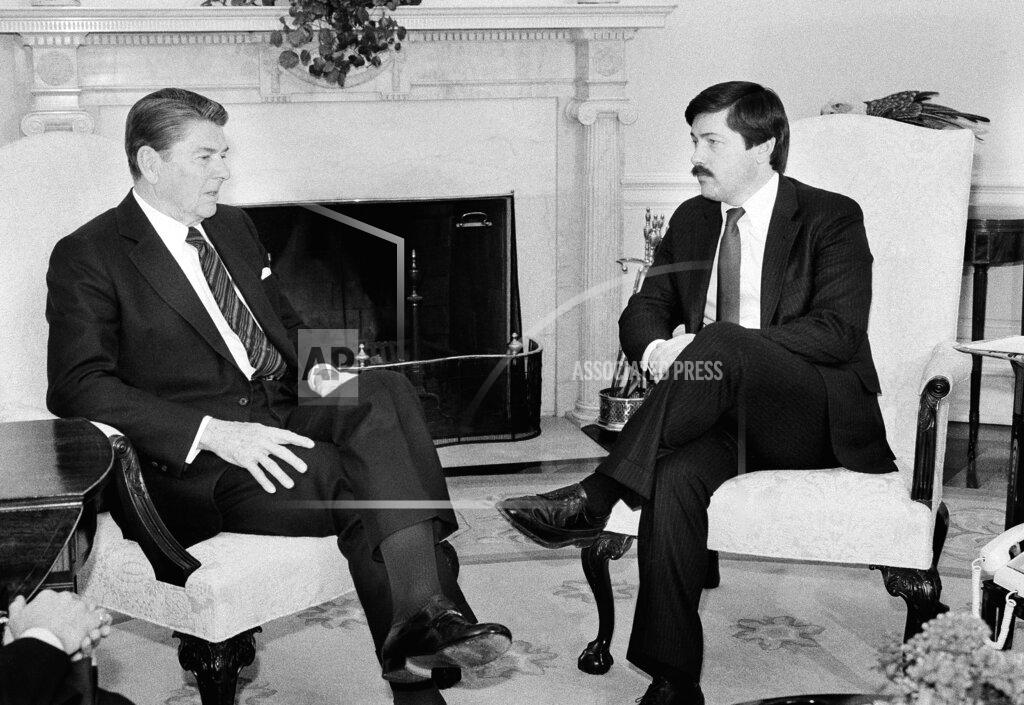
President Reagan addresses the National Association of Independent Schools.
President Reagan meets with independent oil producers to discuss how they will be effected by the proposed provisions in the Treasury Departments tax plan.
David A. Stockman defended President Reagan’s proposal to abolish the Small Business Administration before a hostile Senate committee. But the presentation by Mr. Stockman, the Federal budget director, began shakily when backers of the agency on the committee played a White House videotape in which Mr. Reagan warmly praised the agency.
Legislation to release $7.2 billion in Interstate highway money to the states was approved today by the House, 392 to 4, and was sent to the Senate. Representative James J. Howard, the New Jersey Democrat who heads the Public Works and Transportation Committee, said the measure drafted by his panel was “nonnegotiable.” It passed the House one day after it cleared the committee and five days after the Senate passed a rival plan to send the funds to state highway officials.
In defiance of Democratic leaders, a group of Democratic officeholders, including 10 governors, 14 senators and 17 representatives, from the South and West announced the formation of an independent council to help shape party policy and rules. At a news conference on Capitol Hill, the organizers said that many elected Democrats view the national party as a political liability in their regions and have expressed support for their initiative.
Louisiana’s Governor was indicted on conspiracy charges by a Federal grand jury investigating assertions of corruption in his administration. The indictment of Governor Edwin W. Edwards arises from his involvement with a hospital consulting company that won special treatment from his administration. The Governor has acknowledged receiving nearly $2 million from the company, the Health Services Development Corporation. He explained that this represented legal fees paid to him while still in private life before 1983, when he was elected to his current term. He also was Governor from 1972 to 1980.
Action on speedy loans to farmers was pressed by the House Rules Committee. The panel recommended that the House accept the Senate’s emergency farm credit bill in full, a maneuver that would prevent Senate opponents from eliminating parts of the measure opposed by President Reagan.
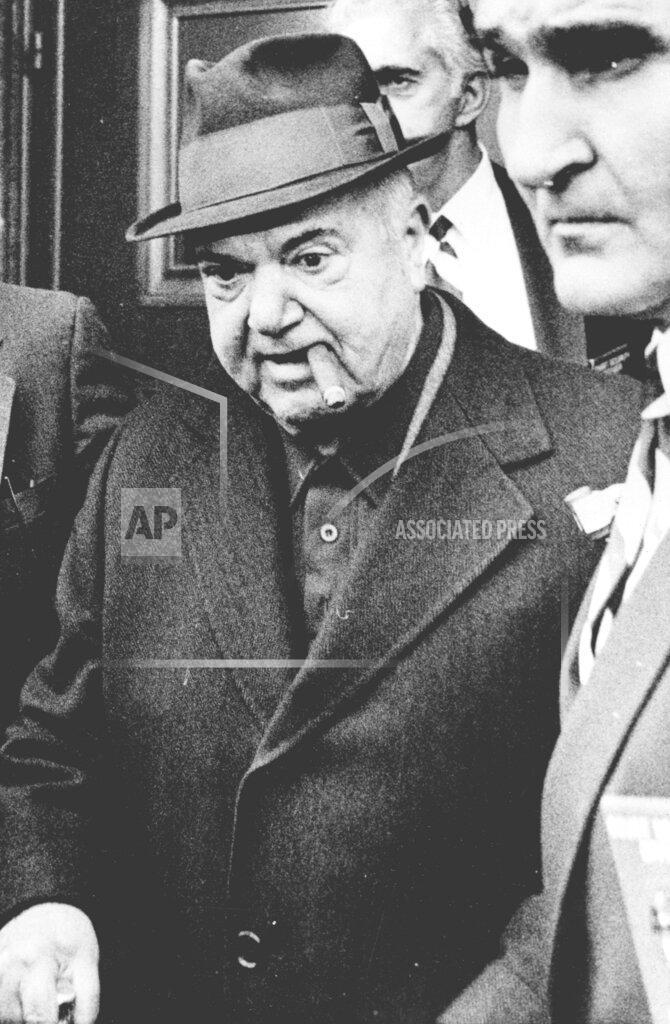
Eight reputed mobsters indicted as members of the Mafia’s ruling “commission” pleaded not guilty in federal court in Manhattan. Reputed Bonanno family crime boss Philip Rastelli, 67, collapsed into a chair as the arraignment ended and was taken to a hospital for observation. He later was returned to jail. The 15-count racketeering indictment names five of the defendants as the godfathers of New York’s five powerful Mafia families: the Gambino. Bonanno. Genovese. Lucchese and Colombo crime brotherhoods.
The case of New York subway gunman Bernhard H. Goetz could be resubmitted to a grand jury following revelations that he calmly plotted his line of fire and shot twice at one of four victims, officials said. “We have been considering” resubmitting the case, said. Mary de Bourbon, a spokeswoman for District Attorney Robert Morgenthau. Goetz was indicted only on weapons possession charges by a grand jury. The revelations about Goetz’s actions during the December 22 shootings included statements he gave to New Hampshire police several days after the incident. In January, a grand jury indicted Mr. Goetz only for illegal weapons possession, although prosecutors had said there were legal grounds for charges of attempted murder. That grand jury’s term has since expired. “We have been considering re- presenting from the day the indictment was voted,” Mr. Morgenthau said yesterday in a telephone interview. “But just because a prosecutor is not happy over a grand jury action is not a basis for re-presenting. We’re not interested in tilting at windmills. I’ve got to have a substantial basis for doing it.”
The Transport Workers Union struck Pan American World Airways yesterday, shutting down most of the line’s operations. Four other unions honored the picket lines, disrupting travel plans for thousands of people who had intended to fly on Pan Am, which serves 89 cities around the world. The airline was able to operate only 100 of 380 scheduled flights that normally serve 39,000 passengers a day. Jeffrey Kriendler, the vice president of public affairs for Pan Am, said the carrier expected to operate only 30 flights tomorrow, none of them in the United States.
The Department of Health and Human Services is quietly circulating a proposal that could result in the closing of more than half of the nation’s 1,340 Social Security field offices, Rep. Edward R. Roybal (D-California) said. The field offices represent the first line of contact for most Social Security recipients and are the places where they apply for benefits or arrange for changes. But Social Security Administration spokesman James Brown said that the proposal is just part of a plan to look at Social Security’s “overall service to the public.”
Louis Farrakhan, leader of the Nation of Islam, said that he has no doubt that Libyan leader Muammar Qaddafi was sincere in offering to help arm and train black Americans for an armed uprising against the U.S. government. Qaddafi addressed the group’s convention in Chicago via satellite last weekend. But while “we are pleased that Brother Qaddafi and the Libyan people see the struggle of blacks and Indians in America as a just struggle,” Farrakhan told a Washington news conference, “I cannot accept the carnal weapons of this world.”
A federal court of appeals in New York ruled that Hana Koecher, the wife of accused Czech intelligence agent Karl Koecher, cannot be held in jail for refusing to testify against her husband. But the judges gave prosecutors time to appeal before Hana Koecher, 40, is released. Her husband, 50, is being held without bail in New York on charges that he was a communist spy who penetrated the CIA during the 1970s.
Selma, Alabama, has changed mightily in some ways since the bloody Sunday 20 years ago when civil rights marchers were beaten back from a planned 50- mile march to Montgomery with tear gas, clubs and bullwhips. But, as civil rights activists plan to converge on Selma to commemorate the 1965 march, black leaders say there is still a long way to go.
Karyn Reddick knows the stories of that bloody Sunday, 20 years ago, when 600 civil rights marchers were turned back from the Edmund Pettus Bridge by tear gas and bullwhips and mounted sheriff’s deputies wielding clubs. One cannot grow up in Selma and not know. But like the rest of her classmates at Selma High School, black and white, she has a difficult time understanding how it ever happened. “Kids today, they’re used to the way things are,” said Miss Reddick, a black teen-ager. “Try as you can, you can’t believe that white people once treated black people that way. It seems like something that happened long, long ago.” On Sunday, hundreds of longtime civil rights activists will return to Selma to commemorate the anniversary of that 1965 confrontation, a moment that was seared onto the nation’s conscience and helped lead, later that year, to the passage of the Voting Rights Act that changed the region’s political and social landscape.
Governor Bill Allain heard angry shouts from 75 teachers and students in the Capitol today as teachers in five more Mississippi counties and two cities joined a growing wildcat strike for a pay increase. Governor Allain told the group gathered outside his office that he planned to “do what I think is best for all the people of Mississippi” in providing more money for teachers. But his remarks drew angry cries from strikers dissatisfied with their status as the nation’s lowest-paid teachers.
A proposed equal rights amendment to the State Constitution won overwhelming approval in the Vermont House today, setting the stage for a referendum on the proposal next year. If the proposal is approved in November 1986, Vermont would join 17 other states that have such measures. “Equal rights are due to women and men not because of their sex but because they are people,” said Representative Betty Nuovo, chairman of the House Judiciary Committee. “If there were but one case of discrimination in the state, this amendment would be needed.” The House vote was 124 to 24. Mrs. Nuovo’s committee voted out the proposal, 10 to 1, earlier this week; the Senate passed it last month. Constitutional changes must be passed by both chambers in two consecutive biennial sessions. Last year the House and Senate passed the equal rights measure. Mrs. Nuovo disputed arguments that the measure would open up Vermont to Medicaid financing for abortions, homosexual marriages, female priests and one-sex bathrooms.
Jackie M. Fourthman, who had been ordered by a Florida judge not to have children for 15 years after her son died of abuse, has been sentenced to three years in prison for giving birth to a child outside the state. Miss Fourthman, who is 22 years old, was sentenced Wednesday by Judge Wayne L. Cobb in the Pasco Circuit Court. Assistant Public Defender William Eble told the judge that Miss Fourthman, fearing she would go to jail, had allowed an aunt to adopt the baby. The judge said leaving the state to give birth was enough cause for a jail term. Miss Fourthman had been free on 15 years probation after pleading guilty in March 1982 to murder and child abuse charges. Her son, Jeremy. was 6 months old when he died in June 1981 of an infection complicated by malnutrition and deyhdration. Judge Cobb sentenced Miss Fourthman and James Burchell, then her husband, to the 15-year probation term. Miss Fourthman gave birth to a boy in July 1983 in Phoenix and was apprehended after applying to Aid to Families with Dependent Children for money.
The executive board of the International Olympic Committee voted yesterday to allow professional tennis, ice hockey and soccer players under the age of 23 to compete in the 1988 Winter and Summer Games. In announcing the decision by the nine-member board following four days of meetings in Calgary, Alberta, the site of the 1988 Winter Games, I.O.C. President Juan Antonio Samaranch said the rule was experimental, “This decision is only for 1988,” he said. “After 1988 we will see, The Olympic movement must go with the times.” If the decision is ratified at the I.O.C.’s annual meeting in East Berlin in June, as it is expected to be, it would theoretically clear the way for such young National Hockey League stars as Mario Lemieux, the Canadian-born Pittsburgh Penguin rookie and Pat LaFontaine, the Islanders’ American-born rookie, to compete at the 1988 Winter Games.
The Pittsburgh Pirates signed 35-year-old Rick Reuschel as a free agent for $200,000. He had pitched well earlier in his career, but Reuschel was coming off of a 5.17 ERA in 92.1 innings with the Chicago Cubs in 1984. He missed all of 1982 with rotator cuff surgery and struggled through the 1983 season, spending most of the year in the minors. He will spend the first two months of the 1985 season in the minors, but after being called up in May, Reuschel turned things back around with the Pirates, going 14-8, 2.27 in 194 innings for a team that lost 104 games. he will be named the National League’s Comeback Player of the Year by the Sporting News. He made another 89 starts for the Pirates before being traded late in the 1987 season to the San Francisco Giants.
Dow Jones Industrial Average: 1284.01 (+2.98)
Born:
Fefe Dobson, Canadian pop-rock singer-songwriter (“Bye Bye Boyfriend”), in Scarborough, Ontario, Canada.
Jelena Janković, Serbian tennis player, in Belgrade, Serbia, Yugoslavia.
Died:
Charita Bauer, 62, American actress (“The Guiding Light”, “Aldrich Family”), following a long illness.
David Byron [Garrick], 38, British vocalist and songwriter (Uriah Heep), of alcohol-related complications.



 History Diaries