
The Finnish troops have held the intermediary defensive positions on the Isthmus for 12 days.
It is a bleak day for Finland. The Red Army continues its general offensive towards Viipuri with the intention of crushing the withering Finnish resistance in a pincer movement including an assault across frozen Viipuri Bay to encircle the city. Towards evening General Mannerheim orders the Finnish army to evacuate the second defensive line. At 7 PM, commander of the Finnish Army of the Isthmus, Lieutenant-General Erik Heinrichs orders withdrawal from defensive positions in the V-line. An orderly retreat towards Viipuri begins. Finnish units are withdrawing to the T Line, their final prepared positions in the Karelian Isthmus.
The Finns begin delaying action to cover withdrawal to the backline defences. Despite the critical situation in the intermediary positions as a result of the enemy breakthrough, the Finnish troops manage to pace their withdrawal successfully. The Soviet force follows behind relatively slowly.
Soviet forces launched a pincer movement aimed at the city of Viipuri. The Soviets attack the islands in the Bight of Viipuri. This is part of a broader pincer move against Viipuri, the true prize on the Isthmus of Karelia.
They also launch attacks at Taipale.
Following the realignment of the front on the western part of the Isthmus, the Finnish 2nd Division is ordered to withdraw to the eastern side of the Vuoksi and defend the Sintolanniemi-Vuosalmi line. The 2nd Division fighting in Vuosalmi ends its assessment of its present situation: “Today we’re okay, tomorrow we’ll be really struggling, and the day after tomorrow the 2nd Division will no longer exist unless we get full assistance from III Army Corps.” The 2nd Division is placed under III Army Corps and begins a delaying action in the Vuosalmi sector.
In the face of an assault by a much larger enemy force, the outnumbered Finns are forced in the evening to withdraw to the west bank of the River Nautsijoki.
In the far north, enemy air raids on the Finnish positions at Heteoja in Petsamo continue throughout the day.
300 child evacuees arrive in Stockholm from Finland. 3,000 more are expected to arrive soon.
Pope Pius XII donates a signed and sealed prayer on behalf of Finland to the Pro Finlandia auction of books organized by the Bukowski auction house in Stockholm.
Helsinki’s Swedish Theatre visits Oslo and receives public acclaim for its performance of J.J. Wecksell’s play “Daniel Hjort.” After the performance the company are presented with flowers and Director Nyman presents his Finnish colleague with a laurel wreath. The Norwegian Royal Family and many members of the Government attend the performance, which ends with the singing of the Finnish and Norwegian national anthems.
British volunteers leave to join the Finnish forces today. Many of the volunteers from other countries such as England, while good-hearted and motivated, are young, naive and unsuitable for combat in the harsh conditions of the Finnish forests.
A half-hearted U.S. House of Representatives deferred final action late Tuesday on a bill to permit an additional 20-million-dollar loan to Finland.
Finland’s Foreign Minister Väinö Tanner is in Stockholm for talks with Swedish Prime Minister P.A. Hansson.
Tanner proposes a defensive alliance to halt the Soviet advance. The Swedish Government sticks to its previous position: it will not intervene to help Finland. Norway and Sweden refused to allow British and French troops to cross through their territory to aid Finland. The Finnish government begs for assistance from its Scandinavian allies, but Norway and Sweden reaffirm their neutrality in fear of Soviet reprisals.
Tanner also meets the Soviet Union’s ambassador in Stockholm, Madame Alexandra Kollontai. The Soviet Union refuses to relax its peace terms.
Artillery fire of increased intensity was reported to be shaking houses of the frontier villages of neutral Luxembourg today while heavy German troop movements were sighted across the Moselle River on the Western Front. Unusually heavy road and rail traffic was visible across the river. A steady stream of cavalry, cyclists, infantry, ammunition and food columns has been noticeable since Saturday. The Obermosel Zeitung said barracks had sprung up overnight halfway between Nennig and Besch, in the Rhineland region. Observers could not say whether the German troops moving southward were manoeuvring or reinforcing troops in the Saar section. Witnesses said they had seen an officer they believed to be Field Marshal Hermann Göring among a group of German officials standing on a bridge near Echternach over the Sauer River Saturday.
The first detachment of American ambulance volunteers has reached the army zone in France and soon will be operating in field conditions.
Undersecretary of State Sumner Welles left Rome at 12:05 this morning in a cheerful frame of mind, owing to the results of his conversations with Premier Mussolini and Count Ciano, the Italian Foreign Minister, which he described as “very helpful.”
Italy and Great Britain are having a serious dispute over their trade relations, it was disclosed in the Italian press today.
Liberty of political discusison will be permitted in the French press from tonight, Premier Edouard Daladier announced at the close of the debate on the censorship, propaganda and information services that has occupied four sittings of the Chamber of Deputies.
In a unique ceremony this morning, Myron C. Taylor established himself as the personal ambassador of President Roosevelt to the Pope.
Shipments of tin and rubber from the United States to Russia in the last few months have increased but exports of petroleum appear to have decreased, according to a statement to the House of Commons today by Ronald H. Cross, Minister of Economic Warfare.
The Ehrenpokal der Luftwaffe (Honor Goblet of the Luftwaffe) was established by Hermann Göring.
Rumania, occupying an increasingly uneasy position between conflicting German and Allied claims for her rich oil stores, was reported authoritatively tonight to be considering a royal decree for “emergency mobilization” of the nation’s industry.
At a meeting of the Soviet Defense Committee, the decision is taken — after much design work — to produce new tanks for the Red Army: A-30 (wheel-track, 30 mm armor, 76.2 mm gun) and A-32 (purely caterpillar construction). Experience in Finland has shown the value of tracked tanks. Stalin and Voroshilov attend.
Spanish artist Joan Miró’s Seated Woman II (Femme assise II) is finalized.
The Turkish Cabinet coordination committee has decided to recall Turkish ships from abroad, it was learned today. The committee decided that hereafter no ships flying the Turkish flag would go to foreign waters.
First Lord of the Admiralty Winston Churchill claims half of the German U-boat strength has been destroyed. In actuality, relatively few U-boats have been sunk so far and the U-boat fleet is growing, but there is no way for the public to know this.
Luftwaffe reconnaissance bombers are intercepted by RAF fighters over British coast. The RAF shoots down two Heinkel He 111 bombers, one over the Firth of Forth and one over the Northumberland Coast.
The RAF sends reconnaissance flights over the Heligoland and German north sea coasts and down along the western German frontier. Bombers drop propaganda leaflets over Berlin.
The French collier PLM 25 in Convoy FS.106 struck a mine and was damaged in the North Sea (53°19′N 1°12′E). She was taken in tow by the Royal Navy Black Swan-class sloop HMS Flamingo but struck another mine and sank with the loss of four of the 43 crew. The survivors were rescued by the Shakespeare-class destroyer HMS Wallace (L 64).
The British trawler Ben Attow struck a mine and sank in the North Sea off the coast of Fife with the loss of all nine crew. She was sunk either by a mine or a Heinkel He 111 aircraft of Kampfgeschwader 26, Luftwaffe.
The Estonian coaster Orion foundered in the North Sea east of the Shetland Islands, United Kingdom. All sixteen crew were rescued by the British fishing trawler Avonside.
The Swedish cargo ship Storfors collided with the Royal Navy destroyer HMS Jackal (F 22) in the North Sea, 12.8 nautical miles (23.7 km) off the Longstone Lighthouse, Northumberland, United Kingdom and sank. All 14 crew were rescued by HMS Jackal.
U.S. freighter Sundance is detained at Gibraltar by British authorities.
Convoy OA.99 departs Southend.
Convoy SL.22 departs Freetown for Liverpool.
Convoy OG.20F forms at sea for Gibraltar.
The War at Sea, Tuesday, 27 February 1940 (naval-history.net)
Battleship MALAYA, and armed merchant cruiser ASCANIA departed Greenock with gold for Halifax, and left the Clyde escorted by destroyers FAULKNOR, FAME, FORESTER, FURY, and MOHAWK.
Destroyer JACKAL sank Swedish steamer STORFOS (545grt) in an accidental collision 12.8 miles 126° from Longstone Light. JACKAL picked up the crew and escorted by destroyer JANUS, proceeded to the Tyne for repairs requiring three weeks. The steamer was determined to be at fault for the collision.
Sloop BLACK SWAN departed Portland for Rosyth.
Armed merchant cruiser CORFU departed the Clyde on Northern Patrol.
Armed merchant cruiser ASCANIA departed the Clyde.
While liner ORION (23,456grt) was docking at London, she was in collision with destroyer GRENADE, which had just completed refit. GRENADE’s sailing was postponed while the damage was assessed and she repaired at Harwich, completing on 3 April.
Destroyer KINGSTON reported her petrol compartment was leaking and she was only capable of sixteen knots.
Convoy OA.99 departed Southend escorted by destroyers WINDSOR and WOLVERINE, and dispersed on 1 March.
A TM convoy departed the Tyne for Methil escorted by the 3rd Anti-Submarine Group and destroyer JACKAL.
Convoy FN.104 departed Southend, escorted by destroyers WESTMINSTER and WOLSEY and sloops BLACK SWAN and LONDONDERRY, and arrived in the Tyne on the 29th. Convoy FN.105 was cancelled.
Convoy FS.107 departed the Tyne, escorted by destroyer VALOROUS, sloop HASTINGS, and also destroyer JERVIS, joined FS.108 on the 29th and both arrived at Southend on 1 March.
Convoy MT.19 departed Methil, escorted by destroyer VALOROUS and sloop HASTINGS, and arrived in the Tyne later that day.
Trawler BEN ATTOW (156grt) was reportedly sunk by a mine seven miles east, one half mile south of May Island. Seekrieg lists her as bombed and sunk by He111’s of German KG26 (X Air Corps). As He111’s were carrying torpedoes during anti-shipping missions, a torpedo hit might have been mistaken for a mine explosion.
Tanker BRITISH GOVERNOR (6840grt) was bombed and damaged by He111’s of German KG26 (X Air Corps) off the east coast, and then escorted into port by destroyer JANUS.
Anti-submarine trawler LE TIGER (516grt) attacked a submarine contact off Fife Ness near North Carr Light Vessel in 56-19N, 2-32W, and was later relieved by sloop PELICAN.
Anti-submarine trawler RUBY (420grt) attacked a submarine contact in Liverpool Bay in 53-30N, 3-46W.
Italian steamer MIRA (3165grt) was bombed and damaged by He111’s of German KG26 (X Air Corps) two miles northeast of St Abb’s Head.
Norwegian steamer ANNFIN (729grt) reported ramming a submarine of unknown nationality outside Norwegian waters in the North Sea.
Convoy OA.98GF departed Southend escorted by destroyer WREN on the 24th, which was then relieved by sloop SANDWICH on the 26th, and OB.98GF departed Liverpool, also on the 24th escorted by destroyers VANOC and WHIRLWIND. The two merged on the 27th as OG.20F, escorts:
27th: Sloops SCARBOROUGH and WELLINGTON joined.
VANOC and WHIRLWIND detached to HG.20.
1st: Destroyer VORTIGERN joined.
2nd: VORTIGERN detached.
The convoy arrived at Gibraltar on 4 March with SCARBOROUGH and WELLINGTON.
The two sloops temporarily joined the 13th Destroyer Flotilla to allow destroyers VELOX and VIDETTE to sail for the UK.
The Senate was in recess today in Washington. Its Finance Committee heard Secretary Wallace and Henry F. Grady urge extension of the reciprocal trade treaty program, and the Commerce Committee delayed action on the Rivers and Harbors Bill, pending conferences with President Roosevelt.
The House debated the bill to increase the capital of the Export-Import Bank, heard Representative Cox assail the National Labor Relations Board and adjourned at 4:50 PM until 11 AM tomorrow.
A Roosevelt request for 15 million dollars to start a new set of bomb proof locks to enlarge the Panama canal was turned down by the House Appropriations Committee on the ground that Congress was being asked to commit itself to a “vast and costly” under taking before detailed plans are available. Using brisk language, the committee instructed the army to get its blueprints ready first. The House Appropriations Committee today refused to recommend that Congress commit itself to the immediate construction of a third set of locks for the Panama Canal, advocated by President Roosevelt as an urgent defense need. Instead, it instructed the War Department to prepare plans and specifications with the promise that the project would receive consideration later. In reporting to the House recommendations on the War Department measure asking $203,472,567 for non-military functions, the committee allowed $850,000 for preparing plans and specifications for a new set of locks. This was a reduction of $14,500,000 from the amount requested by the President to start the work. The committee also turned down the Budget Bureau’s request for contractual authority of $99,300,000 for the new locks. The foregoing reductions made up most of the savings of $16,609,683 that the committee hewed from the Budget Bureau’s requests for $220,082,250.
The committee’s comment on the proposal for the new locks read in part: “The committee believes this project is being pushed too rapidly. The proposition is to commit the government to a vast and costly undertaking two years in advance of the time when detailed plans and specifications will be ready for accomplishing the structural features. In the absence of such plans and specifications the ultimate cost must largely be conjectural. The project is urged at this time as a defense measure, but a project that cannot be completed for six years has questionable standing as an urgent defense measure. Moreover, we are now engaged in building protective works around existing canal facilities at an estimated cost of $39,570,000. If this work does not give the sought protection, an auxiliary waterway closely paralleling the present one and similarly protected would be of doubtful value. Both would be equally vulnerable.”
The committee struck from budget estimates $1,000,000 for dredging the canal at Wake Island in the Pacific. It thus followed the lead of both branches of Congress in twice refusing, in this and the preceding session, to sanction expenditures for harbor improvements at Guam. The committee approved practically as submitted budget estimates of $70,000,000 for general flood control projects and of $30,000,000 for the Mississippi River Valley. For rivers and harbors improvements the committee recommended $66,721,510, a reduction of $2,051,540 in budget estimates. This was accounted for by cutting out the Wake Island project and reducing maintenance funds.
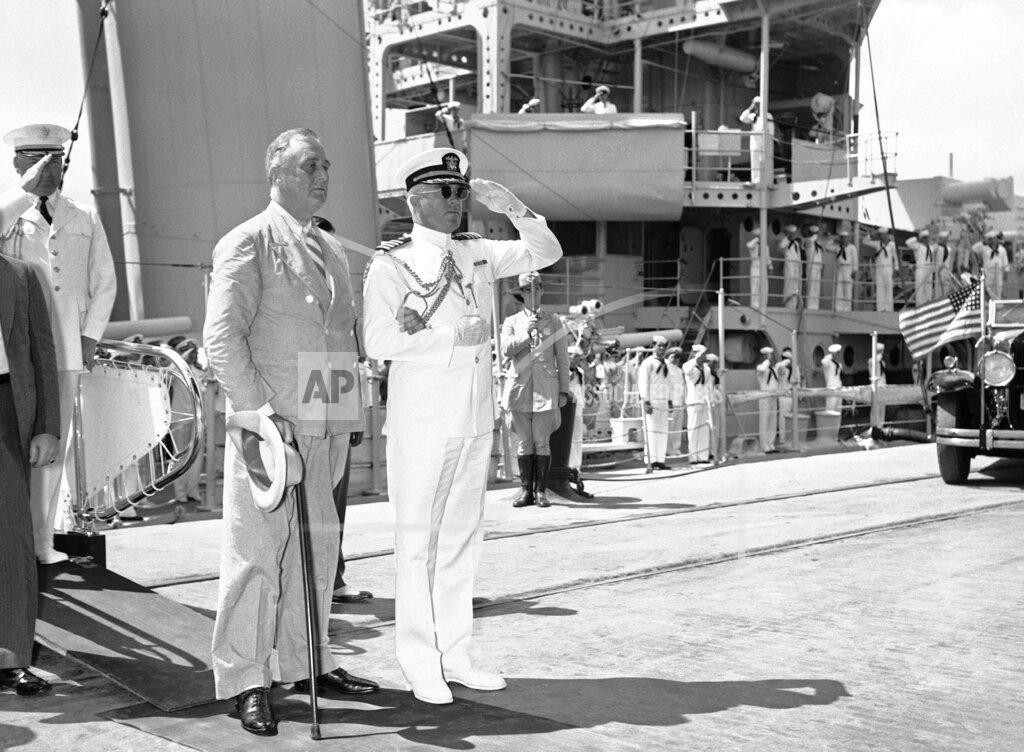
President Roosevelt said today that doubling the present number of planes and guns defending the Panama Canal was necessary for the long range defense of the vital link between the Atlantic and Pacific. Such a long range program contemplates defense operations extending, if necessary, throughout Central America and as far south as Ecuador, Colombia and Venezuela, he told reporters at a press conference aboard the cruiser USS Tuscaloosa after he had completed a thorough inspection of canal defenses and had started the homeward voyage to the United States. More planes and guns were needed, Mr. Roosevelt said, to allow a better opportunity to discover any attacking force either from the air or by sea-at a much longer distance from the canal than ever had been provided heretofore.
The possibility of economic reprisals against Great Britain, France and Argentina for alleged discrimination against American commerce was brought into the hearings before the Senate Finance Committee today on the resolution to extend the Trade Agreements Act for three years. Secretary Wallace and Assistant Secretary of State Grady, while they gave the impression that there was little or no immediacy in the situation, conceded that problems along that line are under consideration. Senators La Follette and Vandenberg contended that since the outbreak of the war in Europe discriminatory arrangements have been made by Great Britain and France against which trade agreements of the Roosevelt-Hull variety offer little defense. The two witnesses held that the Trade Agreements Act gave the government ample weapons to protect American interests. The Assistant Secretary of State was not prepared to concede that discrimination exists, although Mr. Vandenberg pressed him repeatedly on this point.
Republicans of President Roosevelt’s home state gleefully railroaded through the legislature a Democrat’s resolution requesting Congress to forbid a third term for any President. Assembly action completed a coup begun last night when Democratic senate leaders were caught sleeping and permitted the resolution to pass without protest on a voice vote.
The Dies Committee to Investigate Un-American Activities stated today that public hearings would continue. Inquiries will be started soon into alleged Communist and Nazi activities in the motion-picture industry and into allegations that Mexico may be the base for operations by these groups in the United States, it was said. The committee, which has been in executive session for two days, reported that it had abandoned the proposal of its chairman, Representative Martin Dies of Texas, to conduct private hearings in order to avoid charges that its disclosures might be of a political nature designed to affect the outcome of this year’s elections.
Waterways, turned to torrents by cloudbursts and melting snow, drove as many as 3,000 persons from their homes in a score or more northern California cities. Almost nine inches of rain fell in 24 hours at several points. The storm, in its third day, left river conditions critical. More rain was in prospect, and flood conditions equaling the ravages of December, 1937, were predicted by the weather bureau. In the rich Sacramento valley “the situation appears to be grave,” a weather forecaster said. “I would advise vigilance in patrolling of the levees.” In the town of Napa, 35 miles north of San Francisco, some 500 persons were rescued from flooded homes by boats. Damages from the storm will exceed a million dollars.
Based upon research of former NACA engineer, Charles H. Zimmerman, Navy initiated development of the Flying Flapjack with award of contract to Vought-Sikorsky for design of the V-173. It featured an unorthodox “all-wing” design consisting of a flat, somewhat disk-shaped body (hence its name) serving as the lifting surface. The unconventional design promised high speed with low takeoff speed. A larger, follow-on design was built for the U.S. Navy as the XF5U. Both twin-engine designs had a complicated gearbox system to allow either of its engines to turn both propellers. This proved too ambitious for the era. Both aircraft were delayed by problems with the gearbox, particularly extreme vibration. In 1947, with these problems not wholly resolved and jet aircraft beginning to appear in numbers, the Navy lost interest. The design had such a low stall speed – estimated at around 20 knots – that it could almost be seen as a VTOL aircraft on board ship. The applicability to even the smallest escort carriers, had it succeeded, is obvious. The design was also incredibly strong and would have been difficult to shoot down; indeed, a wrecking ball was required to scrap the prototype XF5U.
Contracts for the construction of $20,000,000 worth of attack bombers for Great Britain have been placed with the Douglas Aircraft Company, President Donald W. Douglas said today.
Martin Kamen and Sam Ruben discovered Carbon-14 at the University of California, Berkeley.
Japanese Army headquarters today declared that their forces in central Kwangsi Province had routed three Chinese divisions that for some weeks had been attempting to weaken the Japanese hold on Nanning, key point of Japanese military activity in South China. Japanese reports from Nanning said that the Chinese fleeing northeast of the city had abandoned 1,000 dead, and that the Japanese had captured forty prisoners and twenty-three machine-guns.
Dow Jones Industrial Average: 146.17 (-0.27)
Born:
Howard Hesseman, American actor (‘Johnny Fever’ – “WKRP in Cincinnati”), in Lebanon, Oregon (d. 2022).
Bill Hunter, Australian actor (‘Major Barton’ – “Gallipoli”), in Ballarat, Victoria, Australia (d. 2011).
Dame Barbara Kelly, Scottish civic activist & former CEO (Crichton Foundation, Scottish Consumer Council), in Dumfries and Galloway, United Kingdom.
Smokey Gaines, ABA shooting guard (Kentucky Colonels) and NCAA head coach (San Diego State University), in Detroit, Michigan (d. 2020).
Died:
Peter Behrens, 71, German architect and designer.
Naval Construction:
The Royal Navy Bangor-class (Reciprocating engined) minesweeper HMS Romney (J 77) is laid down by Lobnitz & Co. Ltd. (Renfrew, Scotland).





 History Diaries