
The U.S. Department of State issued a white paper to the press, Aggression From the North: The Record of North Viet-Nam’s Campaign to Conquer South Viet-Nam, as part of the U.S. government’s effort to justify the escalation of the role of the United States in the Vietnam War. As a CIA employee and National Security Council staff member would note later, the paper “proved to be a dismal disappointment… the only hard information we had about North Vietnamese participation and supplies and so forth came from information that was much too highly classified to include, and the only information that was of sufficiently low classification was pretty thin gruel.”
Among other things, the paper asserted that “In Vietnam a Communist government has set out deliberately to conquer a sovereign people in a neighboring state… North Vietnam’s commitment to seize control of the South is no less total than was the commitment of the regime in North Korea in 1950… the planners in Hanoi have tried desperately to conceal their hand. They have failed and their aggression is as real as that of an invading army.” Citing ‘massive evidence’ including testimony of North Vietnamese who had defected or been captured in South Vietnam, this so-called White Paper claims that nearly 20,000 Việt Cộng military and technical personnel have entered South Vietnam through the ‘infiltration pipeline’ from the North and that they remain under military command from Hanoi.
In the war against the Việt Cộng today, 137 United States and South Vietnamese helicopters assaulted a jungle area 50 miles east of Saigon but encountered no guerrillas. The largest helicopter operation of the South Vietnamese war was staged this morning 50 miles east of Saigon. But although the attack was large, there was no contact with the Việt Cộng guerrillas. The only casualty was a helicopter forced down by mechanical failure. It was later recovered. A United States military spokesman refused to disclose details of the operation, saying only that it was continuing. Of 137 helicopters used this morning, 127 were American and the others were operated by South Vietnamese forces. The largest previous helicopter strike was on November 18, when 115 helicopters were used. On that operation two Communist guerrillas were captured.
Before the new operation began, a heavily wooded area near the helicopter landing zone was hit by American twin-jet bombers. They were accompanied by smaller, propeller-driven Skyraiders of the South Vietnamese Air Force. Fifty sorties were flown by the American bombers. They had struck near the same area yesterday. Afterward, pilots reported that large sections of the forest were burning. In another American air action yesterday, eight F-100 Supersaber fighter planes attacked a suspected guerrilla command post 20 miles east of Pleiku. It was a Communist attack on Pleiku this month that led to the first American and Vietnamese air strikes on North Vietnam.
The use of American bombers and fighters on missions in South Vietnam began last week and was disclosed Wednesday. This was the eighth consecutive day that American planes had hit the area of Phước Tuy Province. According to a military source, Việt Cộng guerrillas were believed to be using the heavily wooded area to marshal supplies for another operation on the scale of the regiment-size attack at Bình Giã at the end of December. It was hoped that heavy bombing would force them to move into the open.
South Vietnamese fighter-bombers tonight attacked and sank a camouflaged vessel believed carrying arms and ammunition to Việt Cộng guerrillas. United States military sources here said the ship was sighted off Kiến Hòa Province, about 45 miles southwest of Saigon, reportedly ignored warnings to halt and was attacked by Skyraider fighter-bombers. Pilots said the vessel was aflame and sinking when they turned for their home base. They said they could see on the decks about 30 crewmen dressed in the black, pajama-like clothes favored by the Việt Cộng. The ship had apparently been heading for the maze of inland waterways and swamps in southwest Vietnam controlled by the Việt Cộng. The United States Air Force has ordered photo-reconnaissance missions over the shallow waters.
The leaders of South Vietnam’s Buddhists are planning to begin a “peace movement” tomorrow with the ultimate aim of forcing all foreign military units out of North and South Vietnam. The movement is to be dedicated at a Buddhist-sponsored meeting to select members of a central committee. Thích Quảng Liên, a Buddhist monk who received a master’s degree from Yale University under a United States Government grant, has been chosen to lead the drive. The committee is to include representatives of student groups, professions and other religions to give it a semblance of popular support. Its central demand will be that “the United States Army must withdraw from the South, as well as the Chinese and Russian advisers and soldiers from the North. The Buddhists then plan to call for a “reconciliation committee to negotiate with the leaders of North and South Vietnam to reunify the nation. The proposal does not specify a form of government for the reunited Vietnam.
In conversations this week. Thích Quảng Liên left no doubt that the antiwar campaign would also include demands that Maxwell D. Taylor be replaced as United States Ambassador. Mr. Taylor is a retired general. To achieve their aims, Thích Quảng Liên said, the Buddhists will “do all we can, including demonstrations if necessary.” While calling upon American troops to withdraw, the Buddhist leader said he welcomed economic aid and American training for the Vietnamese armed forces. Thích Quảng Liên is commissioner general for cultural affairs in the Buddhist Secular Institute. He distributed English translations of an “appeal” and a “manifesto” to be discussed by the meeting’s 40 delegates.
The delegates, who call themselves the Struggle Movement for the Preservation of Peace and the People’s Happiness, are expected to approve the drafts with few changes. It calls for “the Governments of Hanoi and Saigon to cease immediately their dirty war, so as to save the lives of millions of the innocent people who every day are killed on the battlefield.” The manifesto also states, “The Vietnamese people do not wish their nation to become one of the Sino-Russian satellites or a colony of the Western imperialists” Although Thích Quảng Liên Is not among the most prominent Buddhist leaders, his proposals are reported to have been endorsed by both Thích Tâm Châu and Thích Trí Quang, the best-known “political” monks. Under Dr. Phan Huy Quát the Premier, Saigon’s Cabinet has been meeting for two days to agree on an official policy towards neutralist trends in Saigon.
Prince Norodom Sihanouk told Communists and neutralists today that they must offer guarantees to the West if there is to be a genuine neutralization of South Vietnam and Laos. He said that, in order to persuade the West to withdraw military forces, the Eastern camp must do the same. The Cambodian chief of state contended that a “fear of being tricked” was causing public opinion in the United States, Britain, Australia, and France to hesitate in pressing Washington to enter into an Indochina peace conference. The Prince expressed his views in a speech originally prepared for the opening of an anti-American “conference of Indochinese people.”
[Of course, the Communists insist they must be allowed to take over South Vietnam no matter what, so this will go nowhere.]
Communist China said today that reports from Washington indicate that the United States “is busy inventing excuses and preparing the public for new aggression” against North Vietnam.
Adlai E. Stevenson, chief United States delegate, conferred for two hours today with the Secretary General, U Thant, on the Vietnam crisis. The United States also delivered its white paper on the situation to all 11 members of the Security Council to emphasize the urgency of the situation. A United States spokesman said the talks between Mr. Stevenson and Mr. Thant had been devoted almost entirely to Vietnam. He gave no further details.
The executive council of the American Federation of Labor and Congress of Industrial Organizations supported President Johnson today in the use of “energetic retaliatory measures” to deter and halt Communist aggression in South Vietnam.
Without warning, all 47 West German military personnel in Tanzania withdrew from the African nation and flew home, after West Germany’s cabinet decided to terminate military aid to the African nation in retaliation for Tanzania’s opening of diplomatic relations with East Germany. “The effect of this forceful display was instantly undermined, however, by a brilliant gesture” by Tanzanian President Julius Nyerere, a historian would write later, who “proclaimed that since the Federal Republic was so insistent on abusing its military aid for political ends, his country would forgo all forms of West German aid… Nyerere’s announcement resonated as an example of principled resistance to foreign manipulation.” Since the West German decision was made at the same time as the visit of East German leader Walter Ulbricht to Egypt, the unintended consequence would be that Egypt and other nations in Africa and the Middle East would forge closer ties to West Germany’s eastern enemy.
The Government of the United Arab Republic disclosed today the arrest of four West Germans soon after it had announced the discovery of an alleged spy ring including German nationals.
The Johnson Administration is being drawn deeper into the accelerating arms race in the Middle East by requests for arms from Jordan and Saudi Arabia. Jordan, diplomatic sources disclosed, has requested a gift of tanks and other military equipment from the United States. Saudi Arabia has expressed an interest in purchasing some supersonic fighter-bomber planes. The arms requests are posing a policy dilemma for the Johnson Administration of how to maintain the friendship of the two Arab nations and still not contribute to the arms race in the Middle East. Thus far the Administration has not decided how to resolve the dilemma, although strong political and economic pressures appear to be pushing it in the direction of approving both requests.
A Communist-backed economic conference of Africans and Asians ended a week of debates in Algiers today with a flurry of resolutions denouncing “imperialist” Western aid. Attending the conference, sponsored by the African-Asian Solidarity Council, were 40 delegations, including some from Communist China, India, Japan and the Soviet Union. Delegates came from a dozen “liberation” movements, mostly in Africa south of the Sahara, but also from the Middle East and the British island of Mauritius. Twenty-seven other delegations, although invited, did not show up. Delegations from most of the French-speaking African countries were among those notably absent. To the surprise of Western observers, there were few echoes of the ideological quarrel between Moscow and Peking at the session. The Soviet Union and Communist China have been competing for influence in the left-wing Solidarity Council.
The new Soviet leadership will begin playing host Monday at a party which it wishes Nikita S. Khrushchev had never arranged. The gathering is a meeting of Communist Parties from other nations. The Soviet party leadership painted a dark picture today of increased East-West tensions as a background for the conference of Communist parties that is scheduled to open in Moscow on Monday. China and the countries which support her in the Sino-Soviet schism are not expected to send delegations.
The Council of Ministers of the Organization of African Unity, in the first real working session of its meeting in Nairobi, Kenya, appeared to be deadlocked from the start. The impasse was said to be on the issue of the Congo and word from Premler Moïse Tshombe that he expected to attend the meeting to present his case personally. Jean Nguzo, the Congolese delegate at the talks, told delegates today that Mr. Tshombe was “likely” to come toward the end of the conference. If and when Mr. Tshombe arrives in Nairobi, he will be faced with a discussion of Uganda’s complaint against him and the United States. Uganda has protested against “bombings” by American-supplied Congolese aircraft on the Ugandan border villages of Goli and Paidha on February 13 and on Nyapea last Monday. Mr. Tshombe has lodged two protests. One is against Algeria, the United Arab Republic and the Sudan for supplying weapons to Congolese rebels. The other is against the former French Congo for allegedly allowing rebels to make their base there.
The United Nations announced today the composition of a 33-nation committee to seek a way out of the impasse over peacekeeping operations and assessments to cover their cost.
A U.S. Embassy spokesman said Indonesia has decided to close down all U.S. Information Service libraries in the country. A United States Embassy spokesman said the decision was communicated to Ambassador Howard P. Jones by President Sukarno last night at the Bogor Presidential Palace, 40 miles south of Jakarta. Mr. Jones had dinner with President Sukarno there. Mr. Sukarno emphasized that the closing would be “temporary” and the libraries would be returned to the United States’ control “when the situation warrants.” United States Information Service operations are now limited to Jakarta. Libraries in Surabaya, in East Java, and Medan, in northwestern Sumatra, have been attacked by crowds demonstrating against United States activity in Vietnam and have been closed.
Premier Aleksei N. Kosygin endured blizzardlike weather and what appeared to be studied official coolness today to make good his first appearance in East Germany as head of the Soviet Government.
Queen Juliana of the Netherlands began consultations with her political advisers tonight in an effort to form a new Government. Premier Victor G.M. Marijnen submitted his resignation this morning.
In Paris, Paul Gérin-Lajoie, the Minister of Education for the French-speaking Canadian province of Quebec, signed an agreement on educational cooperation with the government of France. After Gérin-Lajoie returned to Canada, Quebec’s Premier, Jean Lesage, presented the agreement “as a major advance in Quebec’s quest for an international role.” Paul Martin, Canada’s Minister of External Affairs, would warn France’s ambassador that “only Canada had the authority to speak for Canadians on the international stage”, and that the Canadian government, not the Quebec provincial government, had the sole power to sign agreements with foreign nations.
A Soviet fishing official today described as “an absolutely groundless concoction” reports that a Soviet vessel tried to seize an American fishing trawler in distress on February 18 in the Atlantic off Montauk Point, the eastern tip of Long Island.
France performs an underground nuclear test at Ecker, Algeria.
The Antonov An-22, nicknamed Antaeus and the largest turboprop airplane ever built, flew for the first time. The Soviet cargo plane could carry a payload of 85,000 tonnes (84,000 long tons; 94,000 short tons), had room for 290 passengers, and could reach speeds of up to 460 miles per hour (740 km/h).
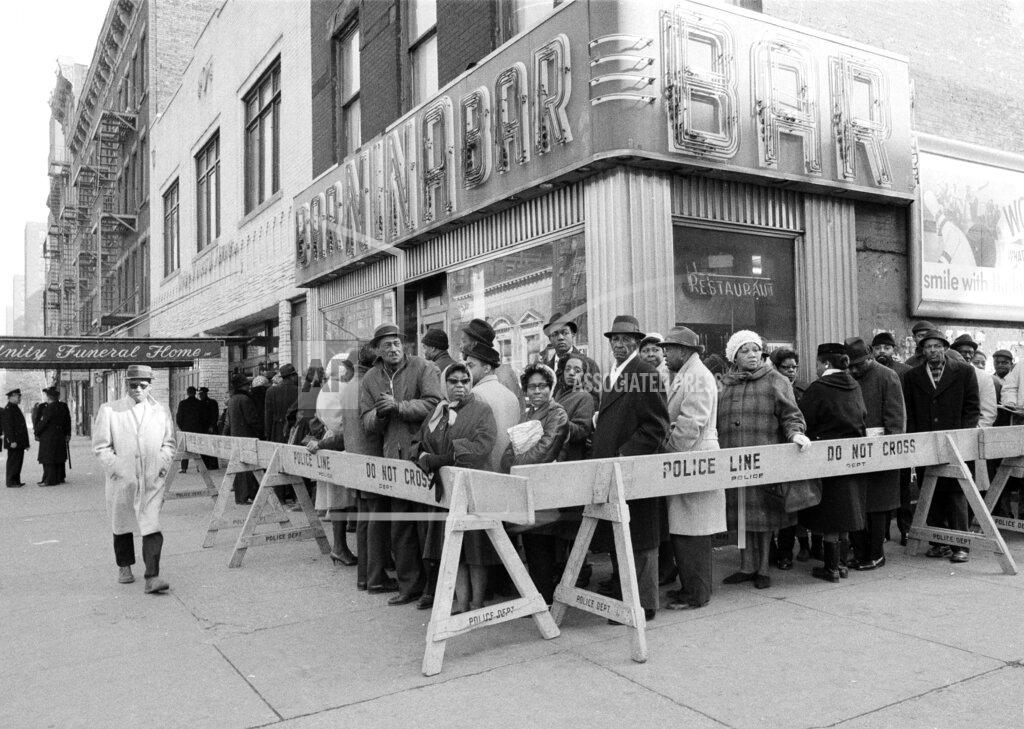
Malcolm X, a black nationalist who had told Blacks they must meet violence with violence, went to his grave yesterday eulogized as a man who died believing in the brotherhood of man. Several thousand people jammed the sidewalks in the bitter cold and about 600 packed the Christian church where the Muslim services were held. Hundreds of policemen stood guard during the services. There had been instances and threats of violence after Malcolm was murdered last Sunday, but there was no violence at the services in New York’s Harlem or at the graveside in Hartsdale. Ossie Davis, the Black actor and playwright, who delivered the eulogy, said, “Malcolm was our manhood, our living black manhood. In honoring him we honor the best in ourselves.” The funeral service took place at Faith Temple, Church of God in Christ, an old motion picture theater at 147th Street and Amsterdam Avenue.
Mourners and the curious lined the sidewalks on both sides of Amsterdam Avenue behind police barricades to watch as the procession of friends and relatives moved into the church. Hundreds more pressed against the window panes of the red brick and wooden tenements across the street, or stood shivering on their fire-escapes. The police were all over-on the street corners on Amsterdam Avenue, which had been blocked off for traffic from 145th to 149th Street, and on the roofs. The service was scheduled to start at 9:30 AM, but lines began forming on the east side of Amsterdam Avenue three hours earlier as many tried to assure themselves seats inside. One, John Davis, a 46-year-old laborer wearing a leopard skin pillbox hat, said of Malcolm X: “I knew him as a wonderful man, a great man, a prince of peace, a nobleman. I just want to be here.”
Jimmie Lee Jackson will be given a hero’s burial next week. Plans are being made for the Rev. Dr. Martin Luther King Jr. to speak at his funeral. The leaders of the Black voting drive in Alabama are arranging a series of special services. Mr. Jackson’s final service will be called a freedom funeral. He will be buried in blue denim overalls, a blue denim jumper, white shirt and necktie — the uniform of the Southern Christian Leadership Conference headed by Dr. King. Mr. Jackson, a 26-year-old Black man, died yesterday of complications resulting from wounds inflicted February 18 when state troopers broke up a civil rights night march at Marion, 30 miles northwest of Selma. He was shot in the stomach and clubbed on the head and body.
Marion and Selma, the two towns that have seen most of the activity since the S.C.L.C. and the Student Nonviolent Coordinating Committee began the Alabama drive six weeks ago, were quiet today. Workers were rounding up Blacks to go to the courthouses of several Black Belt counties Monday to demonstrate their desire to register to vote. Dr. King is to return Monday after a speaking and fund-raising tour in California. He left Selma Wednesday shortly after 100 Black youngsters attempted a protest march just before nightfall. Wilson Baker, Selma’s Commissioner of Public Safety, stopped that march after three and a half blocks and persuaded the youngsters to return to their meeting place.
House Republican leader Gerald R. Ford threw his support behind a drive to enact more stringent federal voting laws this year
The Rev. Claude C. Brown, Selma, Alabama, long an advocate of negotiation between the races in that strife-torn community, now believes that only demonstrations achieve concrete results.
Rep. Adam Clayton Powell (D-New York), who doubles as a Harlem preacher, shows many faces to his House colleagues, who regard him with mixed emotions.
The Administration’s $1.25 billion school aid bill encountered unexpected delay in committee today, and efforts to clear it for House action were abandoned until next week. The failure of the House Education and Labor Committee to approve the measure was a minor rebuff to the White House, which had been pressing for final committee action at the special meeting today. Before adjourning until Tuesday, the committee disregarded White House recommendations in another respect by revising the bill’s formula for distribution of $1 billion in Federal aid to public elementary, and secondary schools. The amendment, approved by voice vote, had the effect of adding $63 million to the program’s cost over its five-year span.
The distribution formula, as originally written, based Federal grants to school districts on the number of school-age children from families with annual incomes of less than $2,000. For each such child, a district would receive federal funds equal to half of the state’s average cost of providing primary and secondary education for a pupil. Representatives of big cities, with large concentrations of families on public relief, complained that 227,000 impoverished children would not be counted under the original formula because their family income exceeded the $2,000 limit.
Congressional opponents of the Supreme Court’s historic legislative reapportionment ruling start their make-or-break push this week to overturn the court decision with an amendment to the U.S. Constitution.
The U.S. Chamber of Commerce recommended a $5.7-billion slash in the $112.3 billion of new spending authority it said Congress is being asked to approve this sesssion.
Organized labor’s top leaders warned today of a possible slowdown in the nation’s economy later this year. They called for steps in both the private and government sectors to counter such a trend.
Hugh Martin and Timothy Gray’s musical “High Spirits”, based on Noel Coward’s “Blithe Spirit”, closes at Alvin Theater, NYC, after 375 performances.
The 1965 Bandy World Championship was won by the Soviet Union. The Soviets had effectively clinched the championship with the defeat of Norway, 4–0, on February 24.
Born:
Van Waiters, NFL linebacker (Cleveland Browns, Minnesota Vikings), in Coral Gables, Florida.
David Treadwell, NFL kicker (Pro Bowl, 1989; Denver Broncos, New York Giants), in Columbia, South Carolina.
Noah Emmerich, American actor (“The Walking Dead”, “The Americans”), in New York, New York.
Maggie Siu [Mei-Kei Siu], Hong Kong actress (“Eye in the Sky”), in British Hong Kong.
Frank Peter Zimmermann, German violinist, in Duisburg, West Germany.





 History Diaries