
Defense Secretary James Schlesinger believes that Cambodia will fall whether or not Congress approves emergency aid. Secretary of State Kissinger reasons that with American aid the Phnom Penh government’s chances for survival waver between zero and 50-50. Both believe Cambodia’s collapse would be a setback but not a disaster for American foreign policy as long as aid has not been halted, leaving the United States open to blame. On Vietnam, however, both are reliably known to feel that the fate of the Saigon regime is still vital to the interests of the United States. These are known to be the views expressed in private by these two officials. President Ford’s views are not similarly known in any detail. But he is said to be deeply committed to continuing aid to Cambodia and South Vietnam.
Publicly, the three men continue to be optimistic about the prospects of Philom Penh’s survival if Congress approves $222‐million in emergency aid that has been requested and fearful that other nations will regard Washington as unreliable if Cambodia is denied aid and then falls. Today, for example, Mr. Schlesinger told a House committee that the probability is “extremely high” that Cambodia could survive, with the supplemental aid. Why their sentiments reportedly expressed privately, contradict their public statements appears to be open to interpretation. Senator Hubert H. Humphrey, Democrat of Minnesota, suggested today that the Administration was trying to shift the “blame” to Congress for certain failure in Cambodia.
Others maintained that the two senior secretaries were not being cynical but were sincerely trying to cushion the adverse consequences of Cambodia’s’ fall on American foreign policy In their view, Congressional approval of the $222‐million is essential to this cushioning process. For they are said to be convinced that Cambodia’s fall must be clearly seen as stemming from the deficiencies of the Phnom Penh regime rather than from Washington’s defaulting on aid obligations. And, of course, as they have said publicly, there is always the slight possibility that the aid could work to sustain the Government of President Lon Nol and to bring about negotiations.
South Vietnam is another matter entirely. Both secretaries are reliably known to feel that the fate of the Saigon regime is still vital to the United States and are trying to make subtle public distinctions between American interests in South Vietnam and Cambodia. Yesterday, for example, Mr. Kissinger was asked about the consequences of losing South Vietnam and Cambodia: As an official later pointed out, Mr. Kissinger answered that if South Vietnam fell, this would have “the most serious consequences.” He said nothing about Cambodia. These two officials, however have different points of view on the advisability of President Ford’s recent proposal for ending aid to South Vietnam in three years. Mr. Kissinger is willing to go along With it as politically necessary, and Mr. Schlesinger wants either to go on indefinitely or to pull up stakes” right now.
Meanwhile, Administration officials disclosed that experts are filling in the details of Mr. Ford’s three‐year proposal, on aid for Saigon, and that the total figure now under consideration for military and economic aid is, monk than $6‐billion. Of perhaps greater importance, it is understood that the President will present the final package to Congress on a take-it-or-leave-it basis. As reliably explained, the figure will represent the Administration’s best judgment of what will be adequate for Saigon’s survival, and the President will accept nothing less.
Discussions within the Ford Administration — no one described them as serious disputes — revolve around three issues there any chance that the phnom Penh regime will survive? What would be the effects of a fall? How is the future aid program for South Vietnam to be continued, given Congressional opposition? There is no disagreement within the Administration that the Phnom Penh regime will be defeated in a matter of weeks to a few months without a massive American resupply of ammunition. On the chances of Cambodia’s survival even if the aid is provided, the two secretaries react with various shades of pessimism. Mr. Schlesinger is said to believe that the fall of the Phnom Penh Government is in the cards almost no matter what the United States does. Mr. Kissinger’s views are variously described as somewhere between the total conviction that Cambodia is gone with nothing to be done about it and, according to one source, that it has a 50‐50 chance. The most optimistic private assessment of Mr. Kissinger’s opinion. is that with the ammunition, Cambodia has a good chance of getting through the coming rainy season.
Neither man is said to have made any flat predictions on how long the Phnom Penh Government would endure with the aid; but the speculation is that it could be another year. The belief of the two secretaries that Cambodia must eventually fall is based on their judgment of the incompetence of President Lon Nol’s leadership and the absence of a viable alternative. Therefore, the main issue for them is not whether Phnom Penh will fall, but how. Both secretaries are known to argue that if Cambodia falls despite the best American efforts, the foreign‐policy consequences will be bearable. If, however, she falls as a direct consequence of an American aid cutoff, Mr. Kissinger believes the effects in other capitals would be injurious over the long run while Mr. Schlesinger thinks more in terms of a serious setback.
Both remain convinced, as they have stated publicly, that the value of the American word around the globe is still tied to aiding die Saigon regime. They further contend that the arguments now being made in Congress for the termination of aid were not seriously advanced at the time the Paris accords were signed in 1973. Mr. Kissinger, however, made plain yesterday that he was prepared to accept a three‐year phase‐out of aid to Saigon as “the best that may be attainable” given Congressional views. Mr. Echlesinger, on the other hand, is described as feeling that this approach is disingenuous, and that if Washington is prepared to let Saigon fall in 1977, why not in 1976 or even 1975? The Defense Secretary is said to feel that the three‐year phase‐out would solve the current political problem in Washington, but would leave an even greater moral problem at a later point.
The Senate Majority Leader, Mike Mansfield, said today that he was “sick and tired of pictures of Indochinese men, women and children being slaughtered by American guns with American ammunition in countries in which we have no vital interests and which are not tied to our security or our welfare.” Asked about the consequences of President Lon Nol’s losing, he said, “It would force the Cambodians to face up to their own future with no help or hindrance from us, and that’s the way it should be and that’s the way it’s going to be.”
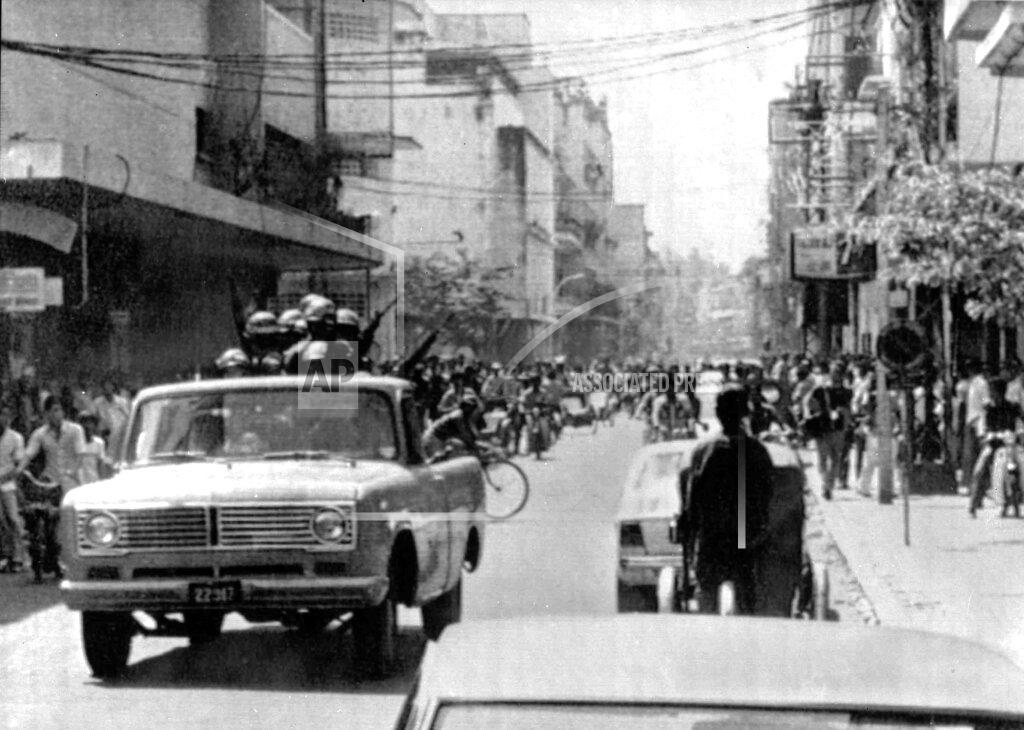
The United States Ambassador, John Gunther Dean, today joined the Administration’s appeal for more aid for the troubled Cambodian Government. The mood of the populace in Phnom Penh seemed to be growing nastier over deteriorating conditions here and the failure of Marshal Lon Nol’s Government to do anything about them. Students are beginning to roam the street, in threatening groups, in protest against scaring food prices and government corruption and, in particular, in antagonism against ethnic Chinese shopkeepers, a minority that plays a large role in Cambodian commerce and is often made the scapegoat in difficult timeshare.
So far, there has been no major violence in Phnom Penh, though the windows of a few Chinese shops have been broken and a few Chinese youths have been beaten up on the street. But many Cambodians think these incidents could be a harbinger of much greater chaos and disintegration. Acting out of fear, almost every Chinese owner of a shop or restaurant in this city of more than two million has kept his premises shuttered and locked since yesterday afternoon. The trouble here was touched off by the destructive food riots that occurred late last week in Battambang, a northwestern provincial capital. That town, Cambodia’s second largest, is still in unrest. It was against this background that Ambassador Dean went before the foreign press corps today to predict that without additional American aid the Cambodian Army’s supplies “will be used up in a few weeks.”
The United States began a vast airlift of rice today from Saigon to besieged Phnom Penh. Two civilian companies, World Airways of Oakland, California, and Airlift International of Miami, began shuttling the 135 miles between the South Vietnamese and Cambodian capitals. Their long‐range DC‐8 jets during the next 30 days will haul about 18,000 tons of rice allocated under the United States economic aid program to feed residents of Phnom Penh. The South Vietnamese Government approved American use of Saigon’s Tân Sơn Nhứt Air Base as the staging point, a United States Embassy spokesman said. North Vietnam assailed the United States for using South Vietnam as a base and said the Ford Administration could never save Cambodia from collapse.
Prince Norodom Sihanouk said in Peking today that nothing would prevent the Cambodian insurgents from winning a “final and total” victory, even if the United States Congress granted additional credits to the regime of Marshal Lon Nol. Approval of these credits can in no way alter the determination of the United National Front of Cambodia and the Royal Government of National Union of Cambodia, which he heads, and their armed forces “never to negotiate with the Phnom Perth traitors,” the Prince said. Prince Sihanouk, who was ousted as Cambodia’s chief of state in 1970, made his comments in a statement distributed to foreign correspondents here. The real reason behind the United States’ persistance in backing the “dying” regime in. Phonm Penh is that ”willy-nilly, it will have to leave South Vietnam and Laos after its inevitable defeat in Cambodia,” Prince Sihanouk said. “Then, it will no doubt lose Thailand, Taiwan, South Korea and the Philippines,” he said. The “domino theory” will also prove true in other areas, including the Middle East and Latin America, he asserted.
[Ed: Sihanouk you fucking bastard, don’t forget the part where your Khmer Rouge buddies murder two million people. I hope they buried you with a stick and lots of marshmallows.]
Senate Democratic and Republican leaders introduced a bill today to lift the military aid embargo against Turkey in an effort to prevent a worsening of Turkish‐American relations and spur Cyprus negotiations. Under strong Administration pressure, the key leaders mitted a measure that will taken up tomorrow by the Senate Appropriations Committee to give President Ford the right to resume the military aid Turkey that was suspended February 5. Since the aid was suspended, Turkey has threatened to sever military ties with the United States and has accused Washington of acting in bad faith. The ban on military aid was imposed as the result of the Cyprus crisis and of the view the majority in Congress that Turkey had violated American law in using American military equipment in its military actions in Cyprus.
Greek military authorities arrested more officers suspected of participating in an aborted coup, sources close to the army reported. The plot reportedly included assassinating Premier Konstantine Karamanlis. Arrests of officers loyal to the deposed military dictatorship which ruled for seven years have been placed at 70, although the government has released names of only 37. Meanwhile, it was reported that the supreme defense council will meet shortly to purge pro-junta elements from the armed forces.
Cruel and oppressive religious persecution is taking place in the Soviet Union, contrary to some reports, Senator James L. Buckley (Cons.-R-New York) said. Buckley, who recently visited Russia, described the persecution as “in many ways far more cruel and more oppressive than even the persecutions under Stalin.” His comments came, he said, in response to statements issued in the United States by 18 Russian churchmen who defended religious life in their homeland.
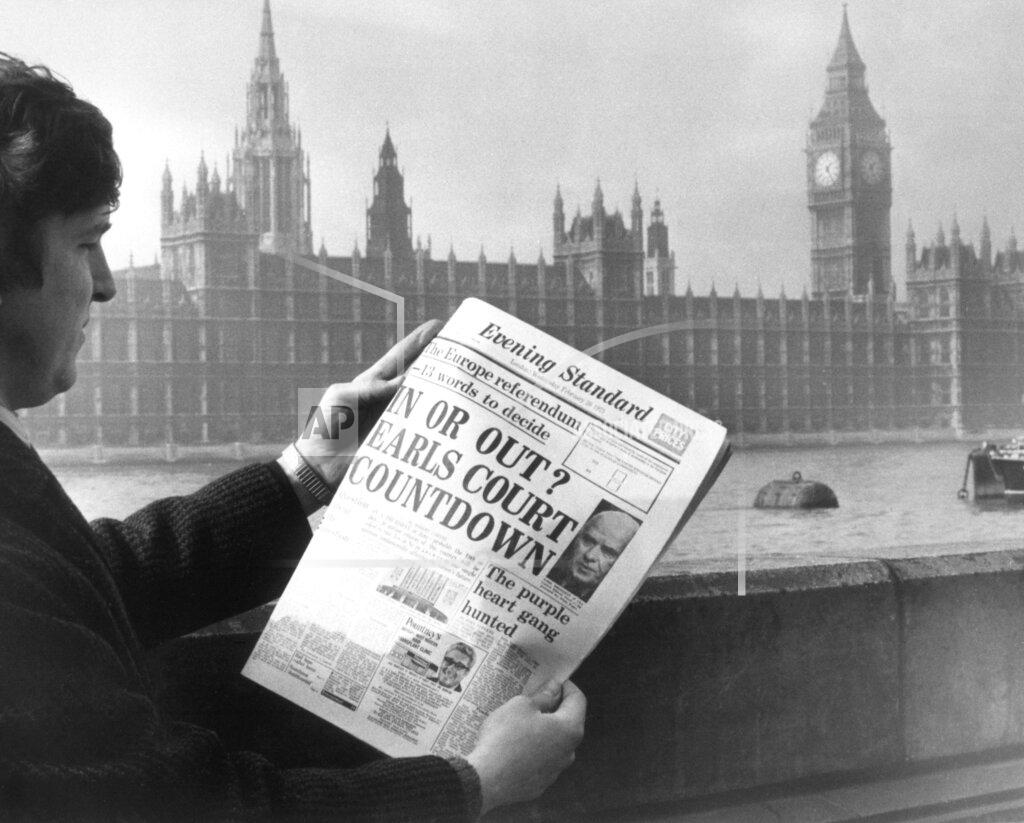
The British Government published its proposals today for condudting a referendum on whether Britain should remain in the Common Market. It will be the first national referendum in British history. As, such, with argument over its constitutional propriety mixing with high feelings over the question to be decided, it is likely to become one of the most inflamed political issues of recent years. The proposals, presented to news conference by Edward Short, Lord President of the Council, deal only with the mechanics of the referendum, to be held possibly in June. In such an affair, however, even the mechanics are bitterly controversial. Within hours there was strong criticism by antimarket groups who believe the arrangements will put them at a disadvantage.
Britain’s Parliament voted to give Queen Elizabeth a $908,000 annual pay raise, but only after the royal family came in for sharp attacks by critics of the monarchy. After a three-hour special debate, the House of Commons rejected by a vote of 427 to 90 a motion to scrap the proposed wage increase. A threatened revolt failed to materialize among left-wing members of Prime Minister Harold Wilson’s Labor Party who opposed the raise.
The leader of Italy’s ruling Christian Democratic Party, Amintore Fanfani, has fired all the leaders of the party’s youth wing after a stormy debate in which some youthful delegates said he was suffering from arteriosclerosis — hardening of the arteries. The showdown came four months before nationwide regional elections in which 18-year-olds are expected to be able to vote for the first time.
The official start of campaigning for April’s elections for a constituent assembly has been postponed from next Monday until March 20, the Portuguese Council of State announced tonight.
President Ford, in a news conference in Hollywood, Florida, spoke out against Arab attempts to discriminate against financial “institutions or individuals on religious or ethnic grounds” and said that “such discrimination is totally contrary to American tradition and repugnant to American principles.” He made these remarks in his opening statement and did not mention the boycott as such. He said any allegation of discrimination would be fully investigated and appropriate action taken under the laws of the United States.
Egyptian officials, who are proclaiming confidence that Secretary of State Kissinger will succeed in getting Israel to withdraw from the Sinai passes and oilfields, are at the same time continuing tough bargaining in Cairo with the American ambassador. The official Egyptian optimism is based largely on the belief that the United States has decided to induce Israeli concessions with new economic and military assistance.
President Hafez al‐Assad of Syria said today that there could be no peace in the Middle East unless Israel gave up all of the Golan Heights and all of Sinai and restored the rights of the Palestinians. Speaking at a student rally in Damascus, he said that neither Cairo nor Damascus could determine the fate of peace in the area. “Only the Palestinians can because their rights constitute the foundations of peace,” he said. The speech, which was broadcast live by the Damascus radio, received loud applause. It was one of Mr. Assad’s toughest speeches in the last year, and Arabs here said it reflected the present mood in Syria. The Syrian Government is continuing a diplomatic campaign in the Arab world in what is described as an endeavor to head off any separate agreenient between Israel and Egypt in Sinai under the auspices of Secretary of State Kissinger.
Prime Minister Indira Gandhi said today that the United States decision to lift the embargo on arms supplies to Pakistan amounted to “the reopening of old wounds” on the Asian subcontinent. Mrs. Gandhi, speaking to the crowded upper house of Parliament, said: “The decision of the United States to resume arming Pakistan shows that the policy‐makers of that great country continue to subscribe to the fallacy of equating Pakistan and India. It is a policy which has caused tension in the subcontinent. The United States dezision amounts to reopening of the old wounds and it hinders the process of healing and normalization.” The State Department announced on Monday that the United States would resume the sale of arms to India and Pakistan, ending a 10‐year embargo against the two nations. India, which receives a steady flow of arms from the Soviet Union, has strongly opposed any lifting of the ban.
Although he is the only candidate in the field, President Ferdinand E. Marcos of the Philippines is waging a high‐powered campaign to win himself a big vote of confidence tomorrow in a referendum that his critics are denouncing as a farce. For the first time since he assumed dictatorial powers in 1972 under a proclamation of martial law, he has been addressing mass rallies and barnstorming in the provinces, contending that the world, in general, and the Philippines, in particular, are going through period of crisis that makes his brand of one‐man rule the only safe choice for the country. Sometimes he refers to the troubled world economy, sometimes to the rebellion of Muslim secessionists in the southern Philippines to make his case that the country cannot afford to return to a more open political system.
Runaway British legislator John Stonehouse is mentally ill and has been told that he would be given three days to leave Australia if he loses British parliamentary immunity, Immigration Minister Clyde Cameron told the House of Representatives. Cameron said the Health Department had given Stonehouse a psychiatric examination and concluded that he had suffered a mental breakdown.
Harry W. Shlaudeman, Deputy Assistant Secretary of State for Inter‐American Affairs, said today that the United States did not subvert the Chilean Government of Salvador Allende Gossens in 1973. Mr. Shlaudeman, who was deputy chief in the American Embassy in Santiago during the Allende administration, appeared at a Senate Foreign Relations Committe hearing into his nomination as Ambassador to Venezuela. While conceding that he knew or Central Intelligence Agency operations in Chile during the Allende Administration, Mr. Shlaudeman stated repeatedly and firmly that they were directed solely at assisting opposition political elements. “I do not believe there was any attempt to subvert or overthrow the Chilean Government,” Mr. Shlaudeman said in response to a question by the committee chairman, Senator John J. Sparkman, Democrat of Alabama. He also denied that the United States was involved in the coup that overthrew President Allende in September, 1973.
Heavily armed guerrillas kidnapped the honorary American consul from his home in Cordoba, Argentina, a private news agency reported. John Patrick Egan, 65, retired American diplomat, was seized by persons identified as members of the Montoneros, a leftist Perónist guerrilla group. The incident comes a year after the kidnapping in Cordoba of U.S. Consul Alfredo A. Laun III, by the People’s Revolutionary Army. Laun was wounded but released within 24 hours when the guerrillas saw he needed emergency medical care.
The congressional black caucus formally asked President Ford to withdraw the nomination of Nathaniel Davis as assistant secretary of state for African affairs. In a letter, Rep. Charles Rangel (D-New York), caucus chairman, said the nomination demonstrated an insensitivity toward developing African nations concerned over subversion by the major powers. Noting that Davis was ambassador to Chile during the ouster of President Salvador Allende, the letter said, “One might easily assume that Mr. Davis may have been involved with the unfortunate United States complicity in the overthrow.” The organization of African Unity also has protested the nomination, which is before the Senate Foreign Relations Committee.
Heavy rocket and machine-gun fire broke out for an hour last night between secessionist rebels and government troops camped at the fairgrounds in Asmara, capital of Eritrea province. It was the first major fighting in or near the city since Sunday, when government jets bombed suspected rebel positions just outside Asmara. Residents said that Asmara was quiet early today.
President Ford told newsmen in Florida that at the rate Congress is moving on a tax cut to stimulate the economy, the measure may not reach his desk until June. He said the only further step he could take to reduce unemployment would be to agree to a larger tax cut than he proposed January 15. He said that when the Democrats in Congress had agreed on a conservation plan for energy he would be glad to negotiate a compromise with them.
A new compromise on the filibuster rule in the Senate was proposed by Mike Mansfield, the Democratic leader, and Russell Long, Democrat of Louisiana. They suggested that the vote of 60 percent of the total membership should be sufficient to cut off debate. That would mean, assuming there were no vacancies, that it would take 60 votes to invoke closure. The present rule requires two-thirds of those present and voting.
Attorney General Edward H. Levi will tell a Congressional subcommittee tomorrow that J. Edgar Hoover, the late direcfor of the Federal Bureau of Investigation, maintained personal files containing derogatory information on members of Congress, a Justice Department spokesman said tonight. Mr. Levi, who took over as head of the Justice Department earlier this month, has uncovered some new details of Mr. Hoover’s practice, long‐rumored but never officially confirmed, of maintaining a set of personal files relating to the private lives of members of Congress, a department source said.
The Administration opposed any change in the 25th Amendment, under which President Ford was elevated to the Vice Presidency, but suggested that Congress set a time limit of 60 days for itself for confirming future vice presidential appointees. Assistant Attorney General Antonin Scalia, testifying before the Senate constitutional amendments subcommittee, also opposed a proposal that a special election be called any time another appointed Vice President succeeds to the Presidency with more than a year left in the term, as Mr. Ford did. In other testimony, historian Arthur M. Schlesinger Jr. suggested simply abolishing the office of Vice Presidency, which he called both “superfluous and mischievous.
The Senate Select Committee on Inelligence will ask Vice President Rockefeller for “all records, transcripts and materials” that will be gathered by the White House commission investigating the Central Inteligence Agency, the committee chairman said today.
Representative Wilbur D. Mills, the former chairman of the House Ways and Means Committee, has entered a Florida institution in an attempt to cure his alcoholism, a spokesman for his office said today. Mr. Mills, an Arkansas Democrat, is expected to stay for six to eight weeks at the Palm Beach Institute. From December 3 until yesterday, Mr. Mills had been at the Bethesda Naval Hospital. He had entered that institution for rest after announcing that he was an alcoholic and after a series of public incidents involving a striptease dancer.
The special unemployment fund that bolsters jobless benefits for laid-off salaried workers at Chrysler Corp. will be depleted in mid-March, the United Auto Workers announced in Detroit. The union also confirmed earlier reports that the Supplemental Unemployment Benefit fund for hourly workers would be exhausted by late March or early April. A union official said the fund balance for white-collar Chrysler workers dropped from $4.4 million on February 1 to $1.7 million on February 23. He said about half of the 10,000 union-represented white-collar workers were currently laid off. Chrysler has a total of 39,000 salaried workers and more than half are now out of a job.
The Secretary of State of Oklahoma, John Rogers, testified today that a $25,000 bribe offer from former Governor David Hall prompted him to do undercover work for the Federal Bureau of Investigation in a bribery-extortion case against Governor Hall.
A Kentucky agriculture official said the killing of about a half-million birds at Ft. Campbell in the past week would not eliminate the threat of disease. And a humane society representative said the deaths were not humane. The Army has sprayed 11 acres of bird-filled pine trees with a detergent and then doused them with water to strip the birds of natural oil and leave them to freeze to death The birds have helped to spread a human lung ailment, histoplasmosis, have damaged crops and were a menace to aviation. But the bird droppings on the soil could harbor the germs for up to 12 years, says Dr. Wade Katel, a diagnostician for the Kentucky Agriculture Department.
F. A. O. Schwarz III, a New York trial lawyer, was named chief counsel of the Senate Select Committee on Intelligence Activities. Schwarz, 39, will be aided in organizing a staff by Burke Marshall, deputy dean of the Yale law school, whom the committee has appointed as consultant, according to Senator Frank Church (D-Idaho). Schwarz, a partner of Cravath, Swaine & Moore, was a magna cum laude graduate of Harvard law school in 1960.
Citing plutonium as a potential source of homemade nuclear bombs, Wisconsin Representative Les Aspin (D) has introduced legislation that would prohibit the commercial use of the material pending a major new scientific assessment of its risk.
The Roman Catholic Archdiocese of Philadelphia is severing relations July 1 with the Girl Scouts organization in a dispute over moral questions of abortion and birth control. The Rev. Francis X. Schmidt, director of the department of youth activities of the archdiocese, said yesterday that Philadelphia was the first archdiocese in the nation to sever ties with the Girl Scouts. The 8,000 girls will be asked to switch to the Camp Fire Girls, which an archdiocese spokesman described as more God‐conscious. There are about 29,000 Girl Scouts in the area. Father Schmidt said that the Girl Scouts had failed to show “adequate concern or desire” for the beliefs of Roman Catholics.
The United States Railway Association, a government agency set up to reorganize the bankrupt railroads of the Northeast, announced its preliminary plan. It would strip away unprofitable freight routes and invest more than $7 billion in public and private funds in rehabilitation. The largest corporate restructuring in the nation’s history would include establishing a Consolidated Rail Corporation from bankrupt lines, except for some that would be taken over by two solvent lines, Norfolk & Western and the Chessie System. Conrail and the two other systems would compete. But Norfolk & Western said the plan needed continuing government financial support. The Senate interrupted a filibuster to pass emergency aid for the Penn Central, Erie Lackawanna and other lines.
The first underground nuclear test in the United States this year was delayed until tomorrow because of adverse wind conditions at the test site at Yucca Flat, Nevada. The weapons test originally was scheduled for Wednesday morning but experts decided to cancel the detonation after several delays during the day and begin the countdown again this morning. Authorities said the blast may be felt outside the boundaries of the test site and could sway high-rise buildings in Las Vegas, about 90 miles away.
Water fowl cholera has wiped out an estimated 1,000 swans in the Sacramento-San Joaquin Delta since Christmas — the worst epidemic in 10 years. A state wildlife pathologist said 4,600 other fowl also have died in the delta during the last two months. “Once it gets widespread, there isn’t much you can do about it,” said Dr. Merton Rosen of the state Department of Fish and Game. The disease can kill poultry but is not harmful to humans.
About 6,000 gallons of oil leaked from a disabled barge in Lake Michigan before the barge was beached and its remaining cargo was pumped into another ship. The damaged 260-foot vessel was carrying about 272,000 gallons of fuel oil from Chicago to Milwaukee when it broke down near Milwaukee.
An attorney for Jackie Gleason’s estranged second wife sought a court order in Ft. Lauderdale, Florida, to prevent Gleason from cutting off her golf club charge account while the divorce action is pending. Miami attorney Ellis Rubin charged that Gleason had kicked Beverly McKittrick Gleason out of their home and deprived “her of the funds for the necessities of life.” The divorce action is in limbo at the moment, pending a suit by a newspaper to unseal the court records. Rubin said that since December 1, 1974, Gleason, “worth conservatively about $3.5 million, has contributed exactly $200 to his estranged wife, who has no independent income of her own.” Gleason also has cut off all her other charge accounts, the lawyer said.
First televised kidney transplant (on NBC’s “Today Show”).
Harry Chapin’s musical revue “The Night That Made America Famous” opens at Barrymore Theatre, NYC; runs for 75 performances.
Gerald Ford became the first incumbent U.S. President to play in a PGA golf tournament, as an amateur in a pro-am event, the Jackie Gleason-Inverrary Classic. A crowd of 41,720 (largest for a single day on a PGA Tour event) watched as the President shot 100 on 18 holes, in partnership with Jack Nicklaus, Jackie Gleason, Bob Hope and New York businessman Elliot Kahn.
Dow Jones Industrial Average: 728.10 (+8.92, +1.24%)
Born:
Mark DeRosa, MLB third baseman, second baseman, and outfielder (Atlanta Braves, Texas Rangers, Chicago Cubs, Cleveland Indians, St. Louis Cardinals, San Francisco Giants, Washington Nationals, Toronto Blue Jays), in Passaic, New Jersey.
P.J. Axelsson, Swedish National Team and NHL left wing (Olympics, 5th, 2002, gold medal, 2006; NHL: Boston Bruins), in Kungalv, Sweden.
Mike Wilson, Canadian NHL defenseman (Buffalo Sabres, Florida Panthers, Pittsburgh Penguins, New York Rangers), in Brampton, Ontario, Canada.
Sam Cowart, NFL linebacker (Pro Bowl, 2000; Buffalo Bills, New York Jets, Minnesota Vikings), in Jacksonville, Florida.
Chris Jackson, NFL wide receiver (Tennessee Titans, Green Bay Packers), in Bristol, Pennsylvania.
Jerry Jensen, NFL linebacker (Carolina Panthers), in Downey, California.

 History Diaries