
Karelian Isthmus: the enemy offensive on the intermediary positions in the Taipale sector and the Central Isthmus is halted by Finnish counterattacks.
The Finns report that they knocked out 25 Soviet tanks over the weekend on the Karelian Isthmus, as well as 17 north of Lake Ladoga.
There was some fighting in the Salla area. Otherwise, the front is reasonably quiet as both sides recuperate from the recent battles and also deal with the nasty winter weather.
The two sides are locked in what military types call an “embrace” all along the front. The Finns may be in trouble in places, but so are many trapped Soviet forces in others. Elements of the Soviet 54th Rifle Division which have been holding out in the Kuhmo sector are eliminated by Finnish attacks. In the center of the line, though, the Soviets retain the initiative and the overwhelming preponderance of force.
In the north, an enemy company pursuing the Finnish troops which carried out yesterday’s surprise attack at Kuusivaara in Salla is destroyed in an ambush.
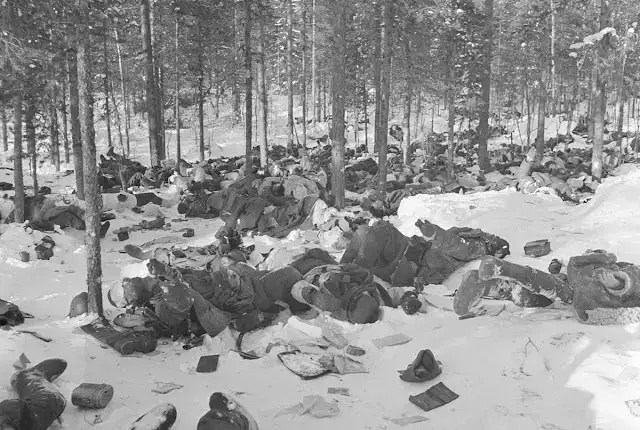
In Kuhmo, Reuhkavaara ‘motti’ is finally cleared out by midday. Elements of 54th Rifle Division of Soviet 9th Army destroyed in a pocket in the Kuhmo sector.
Finnish II Corps is responsible for the area around Lake Näykkijärvi, just to the southeast of Viipuri. It is one of the most sensitive areas on the entire V-line. Its commander, General Harald Öhquist, issues orders which are passed along to front line units at 22:15: the 23rd Division, which has been recently reinforced with armor units, is to attack. Four infantry units, two artillery battalions and the 4th Tank Company set out by truck to Heponotko and travel through the night to a spot near a town called Honkaniemi.
A Finnish infantry division is deployed in Vuosalmi. III Army Corps’ focus of operations is shifted to Vuosalmi.
The Scandinavian foreign ministers reaffirm their countries’ neutrality. Scandinavian foreign ministers declare their countries’ neutrality and emphasize their commitment to peace.
Finnish Council of State reviews diplomatic situation and dwindling options. The Finns continue considering the Soviet peace offer, which expires on 1 March 1940.
Continuing their tactics of attacking French outposts, presumably for the purpose of seizing prisoners or pushing forward their own positions, the Germans today attempted one such raid in a district between the Rhine and the Vosges. They first bombarded the outpost position with trench mortars, but that preparation did not suffice. According to the French evening communiqué, the raid “was at once repulsed and with losses.” The morning communiqué said: “There is nothing to report.”
French and Germans sniped at each other from casements along the Rhine yesterday and today while fog banks rolled across the front, reducing land and aerial activities, military dispatches said. Despite bad weather, the dispatches added, the Germans attempted two flights deep into France, one east and the other north. French chasers intercepted the Nazi planes, chasing them away.
Norway proposes international arbitration over the Altmark Incident if Great Britain wishes to continue its diplomatic protest.
Adolf Hitler addresses his old guard in the Munich beer hall where he launched his putsch in 1920.
Under Secretary of State Sumner Welles arrives in Naples and then Rome to begin his fact-finding/peace mission for President Roosevelt.
A Moscow newspaper charges that the visit of Sumner Welles to Europe was part of an American plan to prolong the war, for purposes of profit, “to the last drop of English, French, and German blood.”
Authoritative sources said today that both Turkey and Russia had withdrawn troops from their frontier in the Caucasus to avoid friction.
The first squadron of the Royal Canadian Air Force arrived in Britain. The first Royal Canadian Air Force unit arrived in the United Kingdom as No. 110 Army Co-operation (Auxiliary) Squadron of the RCAF arrived in Britain.
The Type IIC German U-boat U-63, commanded by Oberleutnant zur See Günther Lorentz, was sunk in the North Sea south of the Shetland Islands (58°35′N 1°05′W) by depth charges and torpedoes from the destroyers HMS Escort (H 66), HMS Inglefield (D 02), HMS Imogen (D 44) and the submarine HMS Narwhal (N 45). The Royal Navy submarine HMS Narwhal, escorting convoy HN.14 from Bergen, Norway to Methil, Scotland, spotted German submarine U-63 on the surface at 0755 hours, which dove to avoid a torpedo attack. Destroyers Escapade, Escort, Inglefield, and Imogen attacked the submarine with depth charges for nearly 2 hours, finally forcing her to surface at 0950 hours. U-63 was scuttled 100 miles east of Wick, Scotland. Of the ship’s complement, one died and 24 survived. The survivors were rescued by HMS Inglefield and HMS Imogen. The German prisoners of war were landed at Leith, Scotland on 27 Feb 1940; they would remain in Britain until the end of the war. During its career under Oberleutnant zur See Lorentz the U-63 sank 1 merchant ship for a total of 3,840 tons.
The British cargo ship Castlemoor from Convoy HX.20 was last seen in the Atlantic Ocean 800 nautical miles (1,500 km) west of Ouessant, France. No further trace, presumed foundered with the loss of all 42 crew.
Convoy HG.20 departs Gibraltar for Liverpool.
The U.S. freighter West Camargo was stopped by an unidentified French cruiser off the north coast of Venezuela. The French made no attempt to board the West Camargo but only requested information “where from, where bound, and what cargo” before allowing the merchantman to proceed after a 20 minute delay.
The U.S. freighter Exochorda was detained for several hours at Gibraltar by British authorities, but was allowed to proceed.
The War at Sea, Sunday, 25 February 1940 (naval-history.net)
Heavy cruiser BERWICK departed Scapa Flow for Greenock.
Vice Admiral CS 1 hoisted his flag on heavy cruiser DEVONSHIRE at sunset.
Light cruisers EDINBURGH and ARETHUSA arrived at Rosyth.
Destroyers KASHMIR with a defective asdic installation and KANDAHAR arrived at Scapa Flow.
Destroyer KHARTOUM sustained weather damage to her hull and was capable of only twelve knots.
Destroyer VESPER reported her anti-submarine dome leaking, and returned to Plymouth for repairs.
Destroyer FORESTER departed the Clyde on the 23rd and rendezvoused the same day with destroyer MOHAWK which was escorting tanker IMPERIAL TRANSPORT (8022grt. They met light cruiser ORION (carrying the ashes of the Governor General of Canada) and liner DUCHESS OF BEDFORD (20,123grt, carrying the first Squadron of RCAF to England) in the Western Approaches and arrived at Liverpool on the 25th.
Sloop WESTON departed Rosyth for Tees to refit, and arrived on the 26th.
Midshipman T W R Wagner RNVR was killed when his Roc of 759 Squadron crashed near Botley, Hants on a training exercise.
Convoy OA.95G departed Southend on the 20th and OB.95G Liverpool on the 21st, with thirty-four ships, and merged as OG.19 on the 25th. No escorts are listed for either convoy at this stage, but when it arrived at Gibraltar on the 29th, it was accompanied by destroyer DOUGLAS, French destroyer CHACAL and French patrol vessel CAPITAINE ARMANDE, which joined on the 23rd, and armed boarding vessel ROSAURA.
Convoy FS.105 departed the Tyne, escorted by destroyer WOOLSTON and sloop GRIMSBY, and arrived at Southend on the 27th.
Convoy TM.14 departed the Tyne escorted by anti-submarine trawlers and destroyer JANUS.
Sloop FOWEY, escorting a outward bound convoy, attacked a submarine contact off Wolf Rock in 49-43N, 5-38W.
Anti-submarine yacht RHODORA (709grt), on patrol off Helwick Light Vessel, was ordered to search for a U-boat sighted off Caldy Island, and attacked a contact south of Caldy Island in 51-29N, 4-39W.
Steamer CASTLEMOOR (6574grt) in convoy HX.20 foundered in the Atlantic with the loss of forty-two crew.
Convoy HG.20 departed Gibraltar with 39 ships on the 25th, escorts:
25th: Destroyer WISHART joined.
Sloops ABERDEEN and DEPTFORD joined.
27th: WISHART detached.
3rd: Destroyer WILD SWAN joined.
Destroyer VENETIA joined from convoy OG.20
ABERDEEN detached.
4th: Sloop LEITH joined from convoy OG.20.
WILD SWAN detached.
6th: DEPTFORD detached
The convoy arrived Liverpool on 6 March with VENETIA and LEITH.
U.S. President Franklin Roosevelt’s failure to withdraw his name from the Illinois preferential primary scheduled for April 9 was accepted generally in Washington today as practically a green light for the movement to draft him for the Democratic Presidential nomination at the forthcoming national convention Chicago. Under the Illinois law as interpreted here, the President had until midnight last night to withdraw, if the avowed intention of the Kelly-Nash machine in Chicago and the down-State organization of Governor Henry Horner to swing the Illinois delegation for him were. distasteful. The fact that he had never publicly assented to his name being filed did not alter substantially this view. The immediate result of the situation thus created was that Mr. Roosevelt and Vice President Garner will be pitted against each other for the preference of Illinois Democrats. There were broader implications, however, which representatives of practically all Democratic factions at the capital read alike into the President’s silence.
Backers of the draft movement could scarcely conceal their elation. In the long-continuing absence of any definite word from the President one way or the other, they had looked to the midnight deadline to furnish a sign, and they said tonight that they had observed that sign, for all practical purposes, in the lack of action by Mr. Roosevelt. The New Dealers had approached the zero hour last night with increasing misgivings because of reports, growing more persistent as the week-end neared, that the President might take the occasion to express his reluctance to accept a third-term nomination. All day yesterday they kept one ear tuned to Springfield, Illinois, where notice of withdrawal supposedly would have to be filed, and the other to the Panama Canal Zone, where the President was reported to be returning after a fishing trip at sea.
Because the President did not raise his hand against their openly avowed purposes, the Roosevelt drafters proposed to proceed vigorously with their plans. These call for starting the Roosevelt snowball rolling in New Hampshire next month; “knocking Garner off” in the Wisconsin primary on April 2; finishing the kill of the Texan in the Illinois party election on April 9, and spiking any chances for a Western drive for Senator Burton. K. Wheeler in the California and Oregon primaries early in May. They entertained no question of complete success in this scheme. They were prepared, moreover, to reject or pick holes in any advance statement the President might conceivably make hereafter on the third-term question. In the first place they did not believe he would attempt anything like a conclusive statement after the Illinois deadline. They based this on many assumptions, among them Mr. Roosevelt’s likely reluctance to do anything to modify his national leadership while Sumner Welles, Undersecretary of State, is taking an inventory of peace possibilities in Europe.
With additional signs pointing to an adjournment between May 15 and June 1, Congress this week faces a full program designed to clear further the House’s calendar and break the log jam of appropriation measures in the Senate. The House is expected to dispose of two appropriation bills, leaving only four regular supply bills for consideration. The program is so well ahead of past years that leaders are considering three-day recesses until the Senate catches up.
The House economy advocates, holding tightly their own lines, are watching the course of several appropriation bills in the Senate Appropriations Committee, and they are wondering whether the Senate farm bloc can hold back the Agriculture Supply Bill until the army and navy bills are out of the way and whether the defense measures will be slashed to provide the farm benefits denied by the House. The House has sent to the Senate, ahead of normal schedule, most of the regular appropriation measures. These have been trimmed by more than $200,000,000, and the six to come are expected to effect savings sufficient to avert levying of new taxes or raising the debt limit at this session.
The Senate has been known to take its time about making up its mind, but it can act swiftly when it decides to. The present legislative jam in Senate committees does not yet threaten delay in adjournment, but some members of the House remember when the Senate has waited until everybody was ready to go home and then sent over appropriation bills greatly increased. Just as House conferees on the Relief Bill “rose up on their hind legs” last year and in effect told the Senate it would accept generally the House bill or not get one, so now the House economy leaders are believed in for a “staying” test to see whether that can hold their lines in the face of pressure from Senate blocs.
Senators Russell of Georgia and Byrnes of South Carolina, who are steering the agriculture bill, have expressed a desire to wait and see what the army and navy bills would contain, with a view to reducing them and giving the difference to the farmers. The House has yet to act upon the army bill. The last of the appropriation bills on its schedule is that for the Work Projects Administrations, an annual battleground in Congress.
Pan American Airways announced yesterday that its transatlantic Clipper flying boats would omit the Bermuda stop after March 15 in their flights from the United States to Lisbon, Portugal. The operating company said better weather conditions and the fact that mid-Atlantic weather reports were now being received from United States Coast Guard vessels assigned to special duty would permit the omission of the Bermuda stop. In Washington it was pointed out, moreover, that by dropping Bermuda as a port of call the Clippers would be able to carry American mail to Europe without having it subjected, as it has been since January 18, to British seizure and censorship at Bermuda. Only a few days. ago The Associated Press reported that the first mail seizure from a Pan American Clipper at Bermuda, on January 18, was made by force of arms. As a result of the new policy, American mail will be able to reach Germany without any Allied interference. Pan American connects at Lisbon, it was explained, with the Italian Ala Littoria airline, which flies between Lisbon and Rome.
The first hockey game televised in North America was broadcast on W2XBS from Madison Square Garden between the New York Rangers and Montreal Canadiens. The Rangers won, 6–2.
Foreign military observers believe Japan intends to maintain a permanent chokehold upon China’s seacoast and main ports because extensive land fortifications are being rapidly constructed in the Shanghai and Tsingtao areas. These fortifications are not intended to protect these vital seaports from attacks from the sea but are designed to hold off land assaults. This is taken to indicate the Japanese Army envisions withdrawal from the interior in one or two years, leaving Wang Chingwei’s government to its own fate, with its own Chinese army to hold off Generalissimo Chiang Kai-shek’s forces. The fortifications are also regarded as a precautionary measure in case Mr. Wang’s regime ever adopts an anti-Japanese program.
The work thus far indicates the Japanese Army intends to abandon Nanking and Hankow but attempt a permanent hold on the Yangtze delta for, besides the concrete defense lines around Shanghai, strong lines are being built from Hangchow Bay, linking Hangchow, Soochow and Chinklang on the Yangtze.
The Tsingtao defense measures are further advanced than those in the Yangtze delta, taking advantage of the mountainous terrain that virtually encircles Kiaochow Bay for twenty-five to forty miles. The proposed peace agreement between Wang Ching-wei and Japan specifies that Tsingtao, Shanghai, Amoy and Hainan Island must become “special administrative areas,” not subject to the authority of the Wang regime nor of the provincial governors. It was not disclosed here whether Amoy and Hainan Island also were being fortified.
The Central China Daily News, organ of former Premier Wang Ching-wei, who will head the new Japanese-sponsored Government of China to be proclaimed in Nanking, said in an editorial today that if the United States and Britain continued to assist the Chinese Nationalist Government headed by Generalissimo Chiang Kai-shek the Wang government will take over foreign concessions in China. The “new China” that Mr. Wang will head, prefers, if necessary, to be an enemy of Britain and the United States rather than to be a mere “British protectorate,” the newspaper said.
Recently Japan presented her peace terms to China. Observers in Hong Kong said that these were planned simply to tighten Japan’s grip on China and promised virtually nothing. Now the influential Chinese daily, Ta Kung Pao, outlines the Chinese peace requirements. China demands:
- China’s territorial sovereignty to be intact, including the return to China of Manchuria, Dairen and Port Arthur.
- Abolition of all unequal treaties between the two countries, removing Japan’s right to establish concessions and factories in China.
- Foreign capital investment for China’s rehabilitation to be welcomed, Japan having equal rights with other nations and all present Japanese investments in China to be reorganized in accordance with Chinese laws.
- Conclusion of a commercial treaty with Japan.
- Settlement of the Korea and Formosa question on the principle of racial self-determination.
- China to fight with Japan for fair treatment of their peoples in the family of nations.
Born:
Ron Santo, MLB third baseman (Hall of Fame, inducted 2012; MLB All Star, 1963–1966, 1968, 1969, 1971, 1972, 1973; Chicago Cubs, Chicago White Sox), in Seattle, Washington (d. 2010).
Danny Cater, MLB first baseman, outfioelder, and third baseman (Philadelphia Phillies, Chicago White Sox, Kansas City-Oakland A’s, New York Yankees, Boston Red Sox, St. Louis Cardinals), in Austin, Texas.
Billy Packer, American college basketball broadcaster (Raycom Sports, NBC, CBS), in Wellsville, New York (d. 2023).
Jud Taylor, American actor (‘Dr. Gerson’ – “Dr. Kildare” TV series), and director (“Tail Gunner Joe”), in New York, New York (d. 2008)
Naval Construction:
The Royal Navy Flower-class corvette HMS Windflower (K 155) is laid down by the Davie Shipbuilding and Repairing Co. Ltd. (Lauzon, Quebec, Canada). Transferred to the Royal Canadian Navy in 1941.
The Вое́нно-морско́й флот СССР (ВМФ) (Soviet Navy) “M” (Malyutka)-class (3rd group, Type XII) submarine M-31 is launched by Krasnoye Sormovo (Gorkiy, U.S.S.R) / Yard 112.




Tuberculosis is incurable and still a huge killer in 1940. Antibiotics will change that soon after the war.
 History Diaries