
Both President Ford and Secretary of State Kissinger said the Cambodian government would fall to Communist-led insurgents unless Congress approved a $222 million supplemental aid request. Mr. Ford made his appeal in a letter to Carl Albert, Speaker of the House of Representatives. Mr. Kissinger said at a news conference that if the aid was not voted in a few weeks, Cambodia would run out of ammunition though it clearly “wishes to defend itself.” In separate remarks, both marked by an urgent tone, Mr. Ford and Mr. Kissinger intensified what has become a desperate Administration effort to persuade a reluctant Congress to come to Cambodia’s support. “An independent Cambodia cannot survive unless the Congress acts very soon to provide supplemental military and economic assistance,” Mr. Ford said in a letter to Carl Albert, Speaker of the House. “If additional military assistance is withheld or delayed, the government forces will be forced, within weeks, to surrender to the insurgents.”
Mr. Kissinger, referring to an “immediate emergency” in Phnom Penh, said at a news conference that “if a supplemental is not voted within the next few weeks, it is certain that Cambodia must fall because it will run ‘out of ammunition.” Speaking in slow, deliberate manner, Mr. Kissinger said: “Therefore, the decision before us is whether the United States will withhold ammunition from a country which has been associated with us and which, clearly, wishes to defend itself. This is a serious responsibility to take.” Mr. Ford, after listing Cambodia’s urgent military and economic needs, said, “This is moral question that must be faced squarely. Are we to deliberately abandon a small country in the midst of its life and death struggle? Is the United States, which so far has consistently stood by its friends through the most difficult of times, now to condemn, in effect, a small Asian nation totally dependent upon us?”
“We cannot escape this responsibility,” Mr. Ford continued. “Our national security and the integrity of our alliances depend upon our reputation as a reliable partner. Countries around the world who depend on us for support — as well as their foes — will judge our performance.” Mr. Kissinger covered a wide range of issues at his news conference. But the main focus of attention was on the Administration’s effort to convince Congress that American credibility demanded a continuation of aid. “I know it is fashionable to sneer at the words ‘domino theory’,” Mr. Kissinger said. “I think this is a very grave matter on which serious people have had a divided opinion. And we’ve been torn apart by the Vietnam war long enough. But I do not believe we can escape this problem by assuming the responsibility of condemning those who have dealt with us to a centain destruction.”
The “domino theory” was so named as a result of a comment by Dwight D. Eisenhower that if one country in Southeast Asia fell to Communists, others would fall like dominoes. Mr. Kissinger, in his remarks today, sought to draw a distinction between Cambodia, for which the Administration is seeking $222‐million in supplemental aid, and South Vietnam, for which it is asking $300‐million in further appropriations this fiscal year. He said that Saigon did not face the kind of short‐term emergency that Cambodia did, and he seemed to say that South Vietnam was in a better position to save itself than was Cambodia. On long‐term aid to South Vietnam, Mr. Kissinger was asked about Mr. Ford’s suggestion that a cutoff of three years might be set, provided the aid was very large in those three years. A figure of $3‐billion to $6‐billion has been suggested.
Cambodian Government forces have abandoned the former national capital of Oudong after fierce fighting, giving Communist‐led insurgents virtual control of corridor within eight miles of besieged Phnom Penh. Tonight’s Cambodian announcement of the fall of Oudong — for the second time in less than a year — came at the end of a day in which the insurgents launched one of their heaviest rocket attacks on Phnom Penh itself, killing at least one civilian and injuring several others. The high command said that about 700 defenders retreated yesterday about four miles from Oudong, which is about 25 miles north of the capital.
The United States Embassy announced today that a 30‐day American airlift of rice and kerosene for the civilian population of Phnom Penh would begin Thursday from Saigon’s Tân Sơn Nhứt Air Base. An embassy spokesman said that two Pentagon‐hired charter airlines that had been hauling ammunition into Phnom Penh’s Pochentong airport from the American base at U Taphao in Thailand would eventually make about 15 flights a day from here to the isolated Cambodian capital. The two airlines, Airlift International and World Airways, will fly in 545 tons of rice and 250 cubic meters of kerosene day on “stretched” DC‐8’s according to John F. Hogan, the embassy spokesman. The American Government has been using “civilian” contractors for the airlift rather than the Air Force, which, if employed, might antagonize opinion at home and give the impression of deepening American involvement in the Cambodian war.
The airlift into Phnom Penh — from Thailand, and now from South Vietnam as well — has become the capital’s only source or replenishment since Communist‐led insurgents seized much of the 60‐mile stretch of the Mekong River that runs from Phnom Penh to the South Vietnamese border. The Mekong route had provided Phnom Penh with 80 per cent of its outside needs. But since the insurgent offensive began at the beginning of the year, convoys working up the river have been badly shot up and damaged by mines. Mr. Hogan said the American Government had provided the rice to Cambodia under Public Law 480 — the so‐called “Food for Peace” program. He said 40,000 tons of rice were stored in South Vietnam intended for Mekong convoys going to Phnom Penh. The kerosene, he said, was paid for under the current American aid program to Cambodia and stored here in warehouses owned by Telekhmer, the Cambodian national oil company.
Cambodian children orphaned or separated from their parents by battle are dying of hunger in the capital, Phnom Penh. Five years of war, with resulting shortages and high prices, have produced serious malnutrition among children in this once-bountiful country. But hospitals are already crowded with war wounded and few children are admitted. Unofficial estimates say that dozens are dying daily.
Daniel P. Moynihan, former American Ambassador to India, said today that the United States should drop its defensive attitude toward the new United Nations majority of third‐world countries. “It is time for the Unites States to go into the United Nations and every other international forum and start raising hell,” he said in an interview. Mr. Moynihan, who has returned to Harvard University after two years in India, said he was opposed to a United States withdrawal from the United Nations and insisted that it should be able to work with the countries of Asia, Africa and Latin America that make up the third world.
But the United States, he asserted, should do so by behaving like the opposition party in any parliament criticizing, attacking the majority, hammering away at its weak points, and displaying a new spirit of initiative and leadership. Mr. Moynihan said that human‐rights issues had been politicized by Communist and third‐world countries and suggested there was something “profoundly wrong” in the fact, that the United States was alone in voting last week against a resolution by the Human Rights Commission censuring Israel for alleged mistreatment of Arab war victims.
The North Atlantic Treaty Organization is considering military aid to Turkey, now cut off from US. aid, NATO Secretary General Joseph Luns said in Washington. He said NATO would take up the matter in two weeks if Congress did not lift the U.S. ban. He declined to go into detail.
Gunmen killed two men and wounded two other persons in separate shootings in Belfast during a visit to the city by Britain’s secretary for Northern Ireland, Merlyn Rees. He was on a meet-the-troops tour in the Falls Road area about 200 yards away when one of the men shot. Rees said later that the province was still nowhere near peace after more ‘than five years of violence and religious strife.
Thirty-seven Greek officers, including six generals, were arrested during the last two days and charged with plotting against the Government, an official announcement said tonight.
Dissident Yugoslav writer Mihajlo Mihajlov denied charges that he had published anti-Yugoslav propaganda and collaborated with hostile emigre groups. Mihajlov, 40, who has already served 3½ years in prison for his anti-Soviet views and criticisms of one party-rule in Yugoslavia, went on trial in Novi Sad, accused of publishing four articles in the Frankfurt-based Russian emigre magazine Posev, and collaborating with about 10 other emigre publications.
An official Moscow newspaper cited statistics today to show that applications for emigration to Israel were declining, strongly suggesting that relatively few Soviet Jews still want to emigrate.
Spain’s labor minister, Licinio de la Fuente, has resigned in a disagreement with other cabinet members over workers’ right to strike, reliable sources said. He reportedly quit in the midst of mounting labor unrest caused by inflation. The sources said he disagreed with cabinet colleagues that employers should be allowed to dismiss striking workers.
The Constitutional Court of West Germany in a controversial 6 to 2 decision struck down as unconstitutional a law allowing abortions on request in the first three months of pregnancy. The court held that the law, enacted last June but not put into effect, violated the right to life for everyone. It said, however, that abortions could be performed in the first three months in cases of rape, danger to the mother’s health, a possibility of deformity and when the birth could cause “grave hardship.”
The regulations for the economic boycott of Israel by Arab countries fill 100 double-spaced pages and cover such diverse matters as border smuggling, oil tankers and motion pictures.
Yemen today became the first Arab country to sentence a hijacker to death. The state security court in Sana, the Yemeni capital, issued the verdict against All Ben Ali al Awadi, a Yemeni in his early 30’s who hijacked a Yemeni DC‐3 Sunday. The Sana radio said the sentence had been referred to Col. Ibrahim al‐Hamidi, the head of state, for approval. If the sentence is approved, the hijacker will be decapitated. Under Yemeni tradition, the head is mounted on the main gate of Sana for 24 hours before it is buried with the body.
Marshal Andrei A. Grechko, the Soviet Defense Minister, met with Prime Minister Indira Gandhi and Foreign Minister Y.B. Chavan today.
Sheik Mohammed Abdullah, the Lion of Kashmir, was sworn in as chief minister of India’s northern Kashmir state after 22 years in political exile. There were celebrations by the Moslem majority throughout the state capital of Jammu as Abdullah was sworn in, but there were also demonstrations by Hindus opposed to his reinstatement. Several of the Hindus were arrested.
Two men armed with grenades grabbed a rifle from a passenger and a pistol from an air marshal and hijacked a Philippine Airlines passenger plane with 28 people aboard. They surrendered in Manila in the mistaken belief that President Ferdinand E. Marcos had given in to their demands, which included a full pardon for the hijacking as well as past crimes. Both men, Emilio Abarca Jr. and Cesar Malay, were held. The plane was on a flight from Pagadian City to Zamboanga. Marcos ended the hijacking of the Philippine Airlines flight by telling hijacker Abarra that “he would be pardoned for whatever crimes he committed.” Abarca and his accomplice, Cesar Meland (who was not pardoned), then released their 15 hostages and surrendered to authorities. Afterward, Major General Fidel Ramos said that Abarca’s pardon included all crimes except for the hijacking itself.
Chile’s outlawed Revolutionary Left Movement rejected a call by four of its imprisoned leaders to give up the armed struggle against the ruling junta and said it had condemned the four to death. In a communique distributed to news media in Santiago, the movement said it would not lay down its arms and branded the four as traitors and collaborators of the military authorities. The four had said in a television interview that fighting the military was a “sterile struggle.”
Rep. Charles C. Diggs Jr. (D-Michigan), who recently returned from a study mission in Africa, accused the Ford Administration of arrogance in insisting on the nomination of Nathaniel Davis as assistant secretary of state for African affairs. Diggs said the formal expression of concern over the nomination issued last week by the Organization of African Unity would render Davis ineffective and would risk further damage to U.S. relations with African nations.
The House Democratic Caucus, defying most of its leaders, initiated a move to make Congress confront the issue of repeal of the 22 percent oil depletion allowance. It voted 152 to 99 for a resolution expected to require a floor vote on attacking repeal of the depletion allowance to the antirecession tax cut bill. But the caucus action also demanded a vote on an amendment that would limit the effect of the change by letting “independent” producers of not more than 3,000 barrels a day to keep the depletion allowance permanently.
The Supreme Court held that school officials who discipline pupils unfairly and become defendants in civil rights suits cannot claim ignorance of the pupils’ basic constitutional rights. Dividing 5 to 4, it ruled that a school board member is liable for damages if he knew or if he reasonably should have known that his action would violate the student’s rights. The dissenters said this “harsh standard” would destroy most of the immunity from civil suits that lay administrators and board members ordinarily enjoy for good-faith actions.
The Senate Select Committee on Intelligence favors the use of carefully selected grants of immunity from criminal prosecution to encourage candid testimony from Government agents in the panel’s investigation, a survey of the membership has disclosed.
In the first test of the new Congress on cutting federal spending, the House voted to reduce expenditures the $929.4 million President Ford had by $222.5 million. It was far short of recommended. The bill now goes to the Senate. The bulk of the reductions — $183.2 million — came in defense spending. The bill was a result of the Budget Control Act of 1974, which requires approval of Congress of the President’s plans to cut congressionally ordered spending. Mr. Ford has proposed another $1.1 billion in cuts which neither chamber has yet considered.
President Ford is reported to be ready to name Pittsburgh industrialist W. Frederick Rockwell Jr. as secretary of commerce. Rockwell, 61, board chairman of the giant Rockwell International Corp, with products ranging from military and civilian aircraft and missiles to nuclear reactors, rocket engines, truck axles and taxi meters, would succeed Frederick B. Dent. Dent would become the President’s chief trade negotiator with the rank of ambassador.
Mayor Richard Daley of Chicago, last of the big-city Democratic bosses, defeated three opponents in the party primary in his bid for an unprecedented sixth four-year term. He was leading his closest rival by more than 2 to 1.
The Anti-Defamation League of B’nai B’rith accused two federal agencies — the Overseas Private Investment Corporation and the Army Corp of Engineers — and six private companies of discriminating against Jews in violation of civil rights laws. It said they were acting either under orders from Arab lands or in hope of getting business in those countries.
The United States is running out of opium-derived drugs — principally codeine — for medical needs, said the American Medical Association. “Medical practitioners may soon be faced with a shortage or unavailability of a drug that has long been a mainstay in relieving pain and controlling coughs,” said Dr. William Barclay, AMA deputy executive vice president. The association has called a conference of high federal and medical officials to meet in Washington to examine the problem. The shortage has been caused partly by the ban Turkey imposed on growing opium poppies. That ban has ended but the first crop will not be ready until next fall.
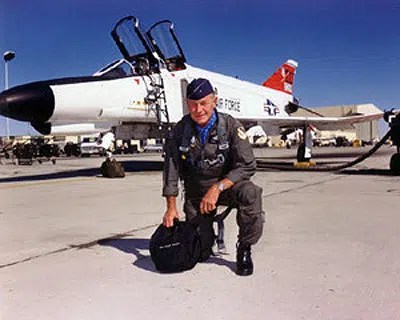
At Edwards Air Force Base, California, Brigadier General Charles Elwood (“Chuck”) Yeager, United States Air Force, made his final flight as an active duty Air Force pilot, flying a McDonnell Douglas F-4E Phantom II 65-0713.
An Air Force F-111 fighter that crashed into a private plane over Utah the night of Nov. 12, 1974, apparently mistook the small plane for a military refueling tanker, the National Transportation Safety Board said. The pilot of the private plane, a turbo-prop Aero Commander 6-T, was killed. The two crewmen aboard the F-111 ejected safely.
An underground nuclear test with a yield of up to 200,000 tons of TNT will be conducted at the Nevada test site today, the Energy Research and Development Administration said. The ERDA said the weapons-related test may cause a “slight earth tremor” particularly noticeable in high-rise buildings in Las Vegas 90 miles to the south and warned managers of the buildings to have employees out of precarious positions when the test is conducted at 8:30 am. The test, code-named “Topgallant,” will be conducted at the bottom of 2,380-foot shaft at Yucca Flat.
An Ocean Mining Administration to prepare for the day when man taps the mineral riches on the ocean floor-has been created by Interior Secretary Rogers C. B. Morton. The new organization will be headed by Leigh S. Ratiner and will begin with a staff of three. Morton said the new organization would deal with problems involved in mining the ocean floor in international waters for such metals as nickel, copper and cobalt.
The FDA ordered ingredient listing for all cosmetics and warning labels on feminine vaginal sprays. Parts of the action have been vigorously opposed by the cosmetics industry. The consumer movement and the National Organization for Women have endorsed the new rules. The order requires the listing of cosmetic ingredients in order of predominance but flavors and fragrances are exempted as trade secrets. Vaginal sprays must carry the warning “CAUTION-For external use only… Discontinue use immediately if rash, irritation or discomfort develop. Manufacturers also are prohibited from suggesting the products have any hygienic or medical value.
A blizzard lashed upper Michigan and piled up heavy snows that all but paralyzed traffic. Along the storm’s path from Missouri to the northern Great Lakes high winds and drifting snow closed highways and cut visibility in parts of lowa, Illinois, Wisconsin, and Minnesota. Many schools were closed. Light snow and freezing rain spread eastward from the main snowstorm all the way to Maine, coating streets and highways with glaze. Elsewhere, floodwaters from heavy rains closed some Indiana and Ohio roads Oklahoma and Texas also suffered extensive flooding.
Elijah Muhammad, spiritual leader of the nation’s Black Muslims, died in Chicago today of congestive heart failure. He was 77.
The Baltimore Orioles trade first baseman Boog Powell and pitcher Don Hood to the Cleveland Indians for catcher Dave Duncan and a minor league outfielder.
Shunning any type of special treatment that might befit the wealthiest Yankee, Jim (Catfish) Hunter was the first player to arrive at the ball park and the first player dressed on the New York Yankees’ first day of spring training today.
Dow Jones Industrial Average: 719.18 (-17.76, -2.41%)
Born:
Chelsea Handler, American comedian and actress (“Chelsea Lately”), in Livingstone, New Jersey.
Naga Munchetty, English TV presenter and journalist (“BBC Breakfast”), in London, England, United Kingdom.
Damon Gibson, NFL wide receiver (Cincinnati Bengals, Jacksonville Jaguars), in Houston, Texas.
Jason McEndoo, NFL center (Seattle Seahawks), in San Diego, California.
Died:
Elijah Muhammad, 77, African-American Nation of Islam leader. Born Elijah Poole, he had spread the “Black Muslim” movement founded by W. D. Fard. He was succeeded by his son, Warith Deen Mohammed, who would renounce the teaching that white people were “devils”, and would move to bring the Nation of Islam closer to other Muslim communities in the United States, changing the name of the organization to the American Muslim Mission. Louis Farrakhan, who had been viewed as a potential successor to Elijah Muhammad, would break with Warith Mohammed and name his group the Nation of Islam. Warith Deen Mohammed.




[Ed: “He’s a clown with no chance” — and indeed, Ali would win, but not so easily as everyone thought. And along the way, a young actor named Sylvester Stallone gets an idea for a movie…]
 History Diaries