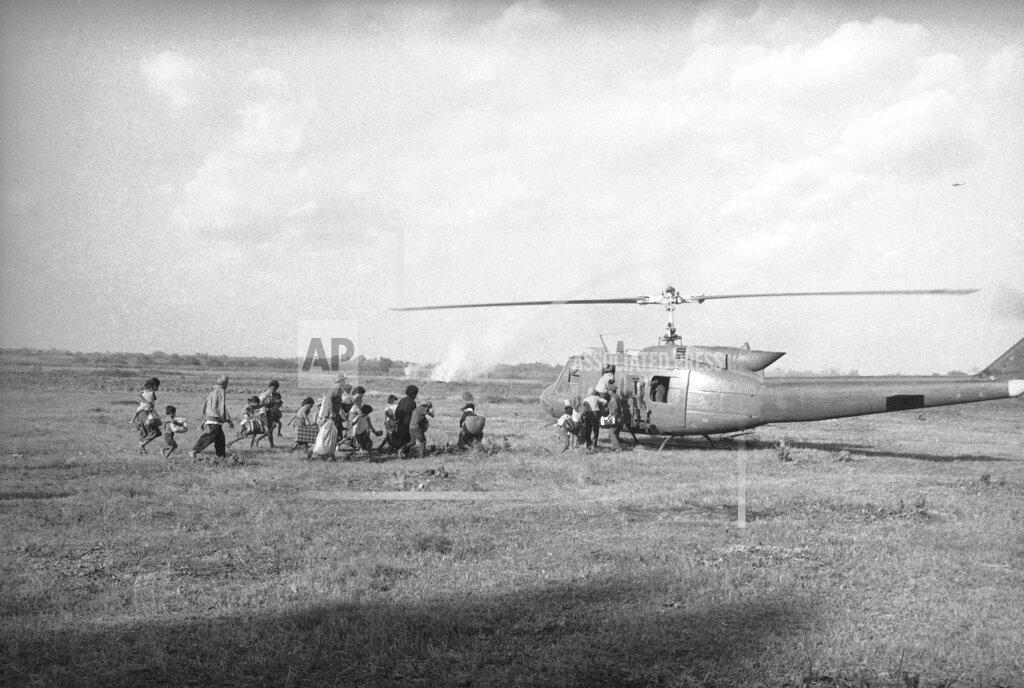
Rebel Cambodian gunners firing captured American howitzers forced the Catholic Relief Services’ Refugee Relief Agency, a U.S. volunteer agency, to evacuate its 19-man helicopter relief team from the naval base town of Neak Luong — the first such pullout of Cambodia’s war. The Air America helicopter that lifted the team out of the besiged town, 38 miles southeast of Phnom Penh was hit by fragments of a shell that landed nearby as it was taking off, but no one was wounded. Insurgent forces also reportedly massacred about 1,000 refugees in the northwestern part of the country. Rebel gunners fired 27 rockets into the Phnom Penh area, wounding nine persons. Rebels’ fire also killed a Cambodian general and provincial governor.
Members of the relief team said, on their return to Phnom Penh, that 105‐mm artillery shells were landing all around their hospital and the main market, in the southern part of the town. They said the shelling had increased significantly in the last 24 hours, particularly from the 105‐mm howitzers, which until now had fired only an occasional round into the town. Most of the previous shelling had been from mortars and rockets. In addition to the tightening of the insurgent siege of Neak Luong, there were these other developments:
- The operation to try to break the insurgent blockade of the Mekong River continued to unravel. One of the last two government beachheads on the lower Mekong, south of Neak Luong, was reported to be in “critical” condition, with the few hundred troops there clinging to the position only tenuously.
- An unconfirmed report said that an attempt by Government naval craft to probe the blockade, trying to find an opening for a possible supply convoy from South Vietnam, ended in disaster yesterday. Two navy patrol boats and a bigger gunboat were sunk by mines, the report said. No convoys have been able to travel up the river to Phnom Penh for nearly month. Many ships have been sunk. The Mekong, blocked by mines and by heavy guns emplaced on the river banks, was formerly the country’s main supply line, bringing in 80 per cent or more of Phnom Penh’s vital supplies of Americanprovided food, fuel and anununition.
- Reliable but unofficial reports indicated unrest in Cambodia’s Navy over what some sailors consider suicidal missions on the Mekong. Ten sailors who reportedly refused to go down the river were said to have been charged with mutinous conduct and put into a military jail here. A number of other sailors have deserted after receiving orders for service on the Mekong.
- The government lost radio contact with the last small units that had been holding out on the edges of Maung Russei, a rice depot town 150 miles northwest of Phnom Penh that fell to the Communist‐led insurgents a week ago. The relief columns that had been pushing from the north and south failed to reach the outpost in time, and still have not linked up.
“I haven’t heard any good news for so long,” said one United States Embassy official today, that if somebody brings me some I’ll probably go into shock.” The news did indeed remain negative on almost every front, with the focus on Neak Luong, where relief officials believe thousands could starve if adequate food supplies do not reach them soon. The United States Embassy was reported to be working urgently on plans to get rice to the town, possibly by parachute drops from American planes. Food is now being dropped by Cambodian Air Force planes, but only enough for the military garrison. There is almost none for the civilian refugees huddled in the town. On a large island in the middle of the Mekong, off the northern edge of town, Government troops abandoned their last position today in chaos, with the survivors jumping into the water and swimming to shore.
In Phnom Penh, despite the Mekong blockade, basic stocks of vital supplies are still large enough to last a month or more, and there is no immediate threat of any major enemy ground assault. An American airlift from Thailand is supplying the capital with ammunition and other military needs, bringing in 900 tons or more day. Since this is at least twice the Government’s daily expenditure of ammunition, it indicates that the Americans are building up a stockpile for the months ahead. American officials will not provide detailed figures, but the evidence of military supplies on hand would seem to contradict the Americans’ prediction that ammunition will run out by late March unless Congress provides suppiemental military aid.
In a Senate subcommittee hearing on a supplemental military aid request for Cambodia, the Assistant Secretary of State, Philip Habib, announced that the United States would begin a food airlift today to Phnom Penh, the besieged capital. Habib, Assistant Secretary of State, made the announcement to a Senate subcommittee on foreign assistance that was holding a hearing on the Administration’s request for $222‐million in supplemental military aid for Cambodia. He said rice stored in South Vietnam would be flown to Phnom Penh at a cost of $180,000 each day. The airlift would provide 17,500 tons of rice in 30 days compared with a normal consumption of 26,000 tons a month.
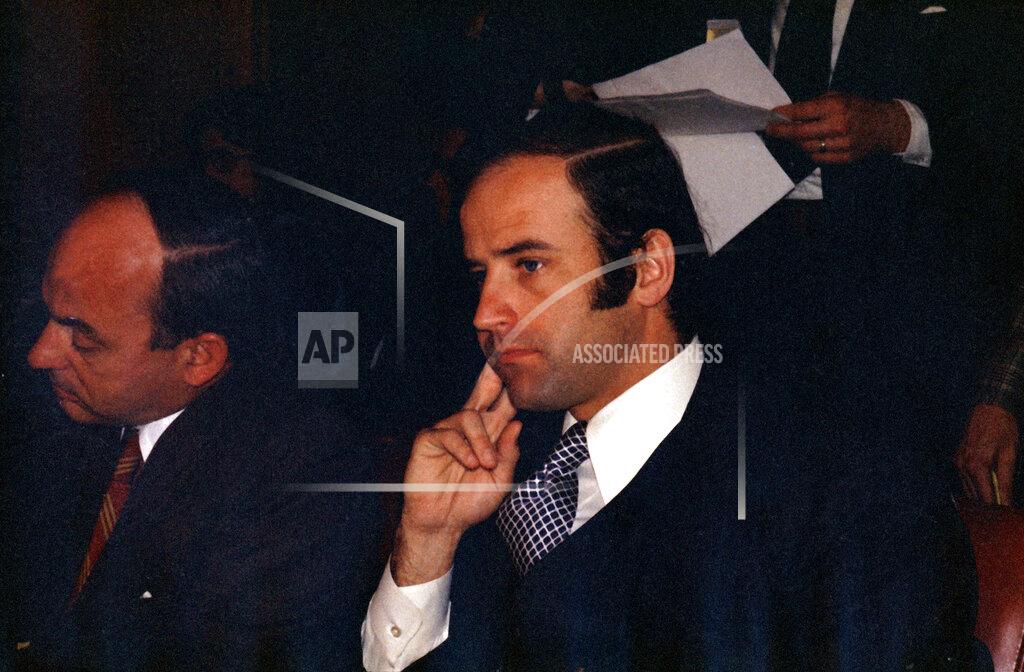
Mr. Habib said that the cost of a week’s airlift of food would be about the same as that of one day’s airlift of ammunition. A State Department source said later that funds for the airlift would be taken out of economic aid funds that had previously been obligated but not yet expended. Mr. Habib declined to give assurances to the subcommittee that the Phnom Penh Government would survive even if Congress approved the supplemental aid. The basic issues of the aid request were raised and disputed by the only two members who were present—Hubert H. Humphrey, Minnesota Democrat, and Clifford P. Case, New Jersey Republican. Mr. Humphrey asked, “Isn’t there a time to say ‘This is a loser,’” and end all military aid to Cambodia. Mr. Habib responded that this was a decision for the Phnom Penh Government to make. “For us to make it for them is not necessarily the way we led them to believe it would occur,” Mr. Habib added.
Mr. Habib painted a desperate picture of the military and economic situation in Phnom Penh, whose line of supply along the Mekong River has been cut off by insurgents. He said that Washington had used up the $452‐million in aid approved by the Congress. “If no additional authority is provided, ammunition will begin to run out in about a month and food by June, perhaps earlier if we run out of funds for transportation, which has now become very expensive because of necessary airlifts,” Mr. Habib said. He added that the United States was prepared to send $73‐million in food aid in addition to the $222‐million if Congress approved. Senators Humphrey and Case indicated they were prepared to stop all forms of military aid and provide only food aid. Mr. Habib told Mr. Humphrey, “There is no point in talking about food aid without talking about munitions also.” Without both, Mr. Habib said, the Phnom Penh Government could not be expected to survive “more than a month or two.”
Two Republican members of the United States Congress arrived in Saigon today at the behest of President Ford who wants them to see for themselves whether the Saigon Government needs the $300‐million in supplementary aid he has requested. Senator Dewey F. Bartlett of Oklahoma and Representative Paul N. McCloskey Jr. of California both said that they had landed with open minds. However, Senator Bartlett noted that Mr. McCloskey had been considered “as perhaps a dove and I as a hawk.” They expect also to visit Phnom Penh, Cambodia, and hope to be back in Washington Sunday night.
Tom Wicker, journalist asshole of the New York Times, opines:
“Why doesn’t Secretary of Defense James R. Schlesinger go on television and try to sell the Brooklyn Bridge? That would be easier and far more honest than trying to sell the shabby proposition that if Cambodia goes Communist, it will be both a disaster for the United States and the fault of the Democratic Congress.
“Mr. Schlesinger said on ABC’s “Issues and Answers” that if Congress did not provide $222 million requested by the Ford Administration for military aid to the Lou Nol Government, Cambodia would “absolutely” fall to the Communists.
“Maybe so, although scaretalk out of the Pentagon is cheaper than the dollar. What Mr. Schlesinger did not say, although he knows it perfectly well, is that if Congress does put up the $222‐ million, Mr. Schlesinger and the Administration will be back next year for more, probably much more, since a hundred times $222 million will not bring an anti‐Communist victory in Cambodia, anymore than such sums brought an anti‐Communist victory in South Vietnam.
“There is a great deal more that Mr. Schlesinger did not say, although he probably knows most of that, too. He did not say, for the most egregious example, that the real disaster is that of the gentle and unwarlike Cambodian people, whose country and civilization are being savagely blown apart by a war that the Ford Administration, like the Nixon Administration before it, seems to see only as an instrument of policy. But those are—or were— real Cambodians bleeding and dying and watching their homes and children destroyed.
(…)
“But even if the Schlesinger‐Rockefeller scare tactics don’t work, the military‐aid struggle discloses a sad and rather ominous state of mind at the top of the Ford Administration—an unwillingness to admit error, a dogmatic anti‐Communism, an affinity for military force, a mindless persistence in outmoded or discredited slogans, an inverted sense of priority a myopic perception of domestic political reality, and an utter callousness to the human consequences of lofty policy decisions.
“Thus, Indochina policy still seems to be controlled by the single, overriding policy concern that has controlled it at least since the Kennedy Administration —the high‐level belief that no American Government can afford to let a country it has undertaken to assist go Communist, for fear of the political reaction of the American people. To prevent that dread reaction, billions of dollars, 50,000 American lives, and untold numbers of Vietnamese and Cambodians have been sacrificed. To stave off that feared accounting, the credibility of the Presidency and the integrity of the Government have been repeatedly breached.
“If there ever was any validity to that fear of an outraged and vengeful public, it was when a huge American army was committed to battle and the national honor was loudly proclaimed at stake. No such army is now engaged, and so little American honor can be found amid the wreckage and corpses of Indochina that to invoke it now mocks history and the dead.”
[Ed: I hope the souls of the two million soon to die in the Communist Killing Fields, get to help with Mr. Wicker’s eternal torment in Hell. Sorry/ Not Sorry.]
The British government of Northern Ireland announced in Belfast that 80 suspected guerrillas will be released in the coming weeks as a response to the cease-fire called by the Irish Republican Army. Merlyn Rees, British minister for Northern Ireland, said he would eventually free all people detained without trial if there was a genuine and sustained cessation of violence, but that the releases would be halted if the violence continued.
Moscow police broke up a Jewish demonstration for freer emigration in front of the Lenin Library. The demonstration by seven Jews had hardly begun when police rushed in, ripped down banners and hustled six of the Jews inside the building for questioning. At the same time, 80 Soviet Jews told Western newsmen that postal authorities refused to transmit a message from them to Israel celebrating the Jewish Purim holiday.
The Turkish Cypriots’ decision to proclaim a separate state on Cyprus took official form today with the swearing in here of a 50‐member constituent assembly. Rauf Denktaş, the president of the state, presided. The assembly’s members, who were either appointed by Mr. Denktaş or elected by professional and trade organizations, include the 15 Turkish Cypriots who represented their community in the now defunct Cyprus Legislative Assembly. One of the appointed members is Fazil Kutchuk, who served as Vice President and leader of the community until Mr. Denktaş came to power.
Glafkos Clerides, the Greek Cypriot leader, conferred today with Secretary of State Kissinger on ways of getting talks with Turkish representatives on the Cyprus issue started again. The United States remains actively involved as a go‐between for all the parties to the Cyprus dispute, a high Administration official remarked after the noon discussion. He said that Mr. Kissinger and his Cyprus specialist, Joseph J. Sisco, Under Secretary for Political Affairs, had urged Mr. Clerides to do nothing at the current United Nations Security Council meetings on the Cyprus issue that would prejudice future Greek‐Turkish negotiations.
The Greek government announced that it had placed its troops on alert in the Athens region after thwarting “conspiratorial movements” by followers of the military government that collapsed last July. It was reported later that 28 officers had been arrested.
The Baden-Wuerttemberg state government in West Germany called a temporary halt to construction of a nuclear power plant near Wyhl after 2,000 protesters occupied the site. A spokesman said work will stop until the end of March to allow time for a legal ruling on objections to the project. The plant’s critics say it would pollute local vineyards.
Oil ministers of the Organization of Petroleum Exporting Countries gathered in Vienna for a meeting in which they will consider production cutbacks due to lower consumption in the West and ways to cope with the declining value of the dollar. A new price increase was seen as a slight possibility. Three pricing proposals were expected to be considered when the meeting convenes today.
The Israeli Government presented to the Knesset (Parliament) today a $9.38‐billion budget, with 40 percent earmarked for defense, and announced a series of new taxes to help pay for it. Confronted with a huge defcit in its budget estimates for the fiscal year beginning April 1, the Government decided on a new 7½ percent payroll tax, an increase in purchase taxes on goods and services, a higher excise tax on cigarettes and 20 percent rise in domestic postal, telephone and telegraph rates. Despite the new taxes, the budget included a deficit calculated at $250‐million.
The armed forces of the Persian Gulf sheikdom of Abu Dhabi will acquire in the next few weeks two C‐130 transport aircraft, their first major pieces of United Statesmade military equipment, qualified informants reported today. Abu Dhabi has already sent airmen to the United States for training in manning the planes. The sale of the aircraft, a kind that was used during the Vietnam war, is a further step in the increasing United States military role in the Persian Gulf area, the source of much of the world’s oil supply. Within the last few months, Washington has sold antitank missiles and land mines to Oman and more than $250‐million in air defense missiles, warplanes and military transport vehicles to Kuwait.
India assailed the United States today for lifting its 10‐year arms embargo against Pakistan. The Pakistanis welcomed the move, which was announced by the State Department this afternoon. In formally disclosing the end of the embargo, the State Department spokesman Robert Anderson said that the United States did not intend to upset the strategic balance in the subcontinent, to stimulate the arms race, or to disrupt moves for reconciliation between India and Pakistan. “We presently enjoy very good relations with both India and Pakistan and we see no reason why this should not continue to be the case,” Mr. Anderson said.
Sheik Mohammed Abdullah will be reinstated tomorrow as head of the Kashmir state government in India, 22 years after he was dismissed from the post. Sheik Abdullah, who has been detained by India for a total of 14 years since 1953, had been suspected of wanting to separate Kashmir, a predominantly Muslim state, from the rest of India. Prime Minister Indira Gandhi said in Parliament today that the settlement between her government and Sheik Abdullah “is an entirely domestic matter.”
The coronation of Birendra Bir Bikram Shah Deva, who had been King of Nepal since the death of his father on January 31, 1972, took place in Kathmandu at exactly 8:37 AM local time, a moment that had been pre-determined by the royal astrologers. The elaborate ceremony was attended by 50,000 people, including representatives from 58 nations.
Hundreds of thousands of cheering Mexicans gave Britain’s Queen Elizabeth and Prince Philip one of the biggest welcomes ever accorded a state visitor as they drove through sunny streets in Mexico City in a minibus to start a six-day tour. They were accompanied by President Luis Echeverria and his wife. Queen Elizabeth is the first British monarch ever to visit Mexico.
The Central American Common Market appeared on the way to a breakup as a ministerial meeting in Guatemala failed to agree on the lifting of restrictions on trade between members of the market themselves. The restrictions include quotas on imported products that compete with locally-produced products. The members of the trade group are Costa Rica, El Salvador, Guatemala, Honduras and Nicaragua.
Joel Siqueira Jr., a young man who hijacked a Brazilian jetliner to Brasilia and reportedly was fatally shot by police when they stormed the plane, is alive and well and is being questioned, the Aeronautics Ministry said. Asked for details, the spokesman said he did not know whether the hijacker’s “light wounds” were from bullets.
Secretary of State Henry A. Kissinger voiced dismay to the Organization of African Unity for condemning the selection of Nathaniel Davis as assistant secretary of state for African affairs. In a letter to the secretary-general of the OAU, Kissinger said the naming of an official for a post in the US. Administration is a “function of American sovereignty… a purely internal, domestic concern.”
The villages hugging the road junction north of the Eritrean capital of Asmara were quiet today, almost a year since the effective reign of Emperor Haile Selassie came to an end in riots, mutinies, strikes and the resignation of the Cabinet. The villages have been the scene of some of the heaviest fighting in a three‐week war between the military Government now in power in Addis Ababa and secessionists in Eritrea Province. Yesterday Government forces used jet fighter‐bombers, artillery and assault troops there in an attempt to dislodge guerrillas of the Eritrean Liberation Front.
It was disclosed by Representative Tip O’Neill, the House majority leader, that the House Democrats’ Task Force on Energy and the Economy was recommending a three-year increase of 16 cents a gallon in the federal gasoline tax and a quota, or ceiling, on oil imports that would gradually decline. Substantial differences between House and Senate Democrats were indicated, and an administration official said that the views of the House Democrats were more compatible with President Ford’s.
With strong backing from Vice President Rockefeller, Senate reformers appeared to gain the upper hand in the battle to modify the Senate’s filibuster rule, but the fight was far from over when the Senate recessed. Senator James Allen, Alabama Democrat, used traditional parliamentary tactics and some novel ones to prevent a direct vote on whether the Senate should permit a three-fifths vote of the Senate, instead of the present two-thirds, to cut off a filibuster.
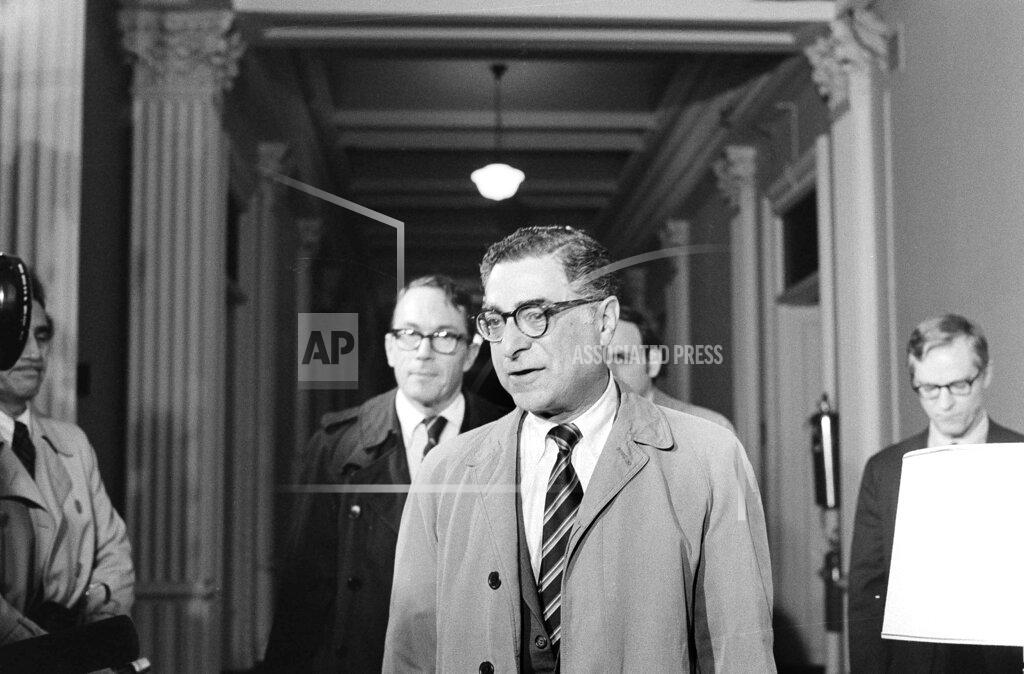
The Rockefeller commission tightened its secrecy procedures today as it took testimony from the former head of clandestine operations for the Central Intelligence Agency and from two officials still with the agency. Thomas H. Karamassines, who directed the agency’s clandestine operations from 1967 to 1973, testified for three and half hours, then left by a side door in an apparent effort to avoid reporters. A spokesman for the commission refused to disclose the names of the two other witnesses, saying that they were still employed by the C.I.A. and that identification might impair their effectiveness. With the exception of William E. Colby, the director of Central Intelligence, the two were the first active agency officials to appear before the commission.
A Navajo Indian member of the New Mexico House of Representatives said today that he did not want John D. Ehrlichman coming here to “do penance” for his conviction in the Watergate scandals. Mr. Ehrlichman, the former White House aide who was sentenced last week to two and one‐half to eight years on his Watergate convictions, announced through his lawyer Saturday that he planned to do “personal penance” by living with and doing legal work for Indians in New Mexico’s northern Pueblos.
Final ratification of the Equal Rights Amendment, outlawing any law that discriminates on the basis of sex, may not come until 1976, if then. The amendment has been rejected by legislative chambers in Oklahoma, Arizona, Nevada, Georgia and Utah. It was defeated by a House committee in Indiana and buried by committee action in Virginia and Louisiana. Only North Dakota has approved the amendment this year — the year that proponents predicted it would become part of the Constitution. Four more Legislatures must approve the measure to make the necessary 38 states for ratification. It will die if it is not ratified by 1979.
The bribery and extortion trial of former Governor David Hall of Oklahoma and a Texas man began in federal court today with the selection of a jury of seven men and five women.
Two cases of a lung disease have been diagnosed in Milan, Tennessee, one of the cities where the government plans a massive bird kill. “Histoplas mosis is common anywhere there is a lot of birds and we’ve got a lot of birds around here,” said Dr. P. D. Jones. Doctors said the two cases were detected in patients hospitalized for other ailments. The disease, which has symptoms like a cold or flu and can be fatal, is spread by bird droppings. Officials of Milan Army Ammunition Plant are awaiting the right conditions in which to carry out an attempt to kill some of the millions of starlings and grackles wintering on the reservation. The plan calls for spraying with a detergent just prior to rain and if the temperature goes to freezing the birds die of exposure.
The Justice Department announced it had ended its investigation of the 1972 shooting deaths of two black students at the predominantly black Southern University campus in Baton Rouge, Louisiana, without indictments. Assistant Attorney General J. Stanley Pottinger, head of the Civil Rights Division, said there wasn’t “sufficient evidence… to determine whether any specific individual had violated the federal criminal civil rights statutes.” The November 16, 1972, shooting occurred after sheriff’s deputies and state police ordered a crowd of demonstrating students to leave the building and its environs and began firing tear gas.
Chairman Charles E. Goodell of the Presidential Clemency Board said he recommended to President Ford that the clemency program, due to expire Saturday, be extended for another month. It originally was due to expire February 1 but Mr. Ford extended it until February 28. Goodell said more than 8,000 of the 120,000 eligible men have signed up with the board and I expect that by the end of this week” there will be 10,000.”
Alice Mitchell Rivlin was sworn in as the first director of the new Congressional Budget Office and held a news conference in which she declined to answer the first question — What do you think of President Ford’s budget? This is really a nonpartisan office,” said the economist, 43. “It is designed to give the legislators a firmer grip on income and outgo and a stronger voice in setting national priorities. We are not here to make policy but to give Congress budget analysis and lay out possible alternatives,” Mrs. Rivlin said. “My personal views are irrelevant.”
The American Bar Association called on states to legally redefine rape victims in terms of persons instead of women. An accompanying report said homosexual and bisexual rapes were believed to be increasing and prison rapes were commonplace. The change in definition was recommended by the association of 190,000 lawyers — mostly men — at a conference in Chicago. Members also called for the establishment of rape treatment and study centers to help both victims and offenders. A report said there appeared to be an emerging class of rapists who were not particular about whom they raped — men or women or both, “and male victims are usually more reluctant than women to press charges,” the report said.
A general decline in interest rates, evident for many months to business lenders, finally appears to be reaching the consumer who has to borrow. Interest paid for car loans, one-family home mortgages and stock purchases are among the consumer rates that have declined this year. Eliot Vestner, New York State Superintendent of Banks, said “our statistics show that rates are coming down, but some rates are corning down much more slowly than others.”
A long-awaited federal plan to revitalize six bankrupt railroads serving the Northeast and Midwest calls for the initial abandonment of 6,200 miles of money-losing freight routes and the incorporation of 15,000 miles of remaining routes into a system beginning next year. It also proposes the formation of two other competing freight systems fashioned from still-flourishing lines, and the rerouting of rail freight between Boston and Washington to clear the tracks for high-speed passenger trains.
Consumers Union filed suit today to counter what it called irresponsible Government action In allowing potentially unsafe levels of lead in paints destined for household use and children’s toys. The action is directed at the Consumer Product Safety Commission, the agency that administers legislation involving lead paints. Last December, the commission released a finding, based on a limited number of “questionable” scientific tests, that set the allowable lead content in paint at a higher level than that deemed safe by Congress, the Consumers Union suit said. The suit filed in United States District Court in Washington and a petition filed with the safety commission objected to the finding that a 0.5 per cent lead content in paint is safe.
Authority to ban pleasure driving at least one day per week could be given to states under legislation introduced by Senator Lawton Chiles (D-Florida). He said the plan, which would cut back on the “superfluous use of gasoline,” would be less disruptive to the economy than gas rationing or higher import fees on foreign oil. Under the program, which would be up to individual states, stickers would be issued to all cars identifying the day they could not be driven. Chiles’ bill also would mandate gasoline efficiency of at least 20 miles per gallon on new cars by 1980.
The release of $9 billion in federal funds for construction of sewage treatment plants has been authorized by President Ford, the Environmental Protection Agency said. The total includes $5 billion ordered released by the Supreme Court on February 18 in a ruling that denied the Administration could legally withhold the congressionally appropriated money from the states. Ford previously had released $4 billion. EPA Administrator Russell Train said the funds would create 180,000 jobs in the construction industry and at least twice that number in related fields.
A 300-foot oil barge ran aground in Lake Michigan off the Milwaukee breakwater, spilling some of its half-million-gallon cargo. Coast Guard officials said emergency crews were being called in to contain the spill from polluting nearby beaches. It was not immediately known how much oil had been spilled. The barge was carrying about 16,000 barrels of crude oil.
Henry Ford 2d, the head of the Ford Motor Company, was held in jail for about four hours on a charge of drunken driving late Saturday night after he and a woman companion were stopped by the police on a street in a suburb of Santa Barbara, the California Highway Patrol said today.
The St, Louis Cardinals, who missed a championship by 1½ games last year, began their pursuit of another in the rain today. But for Bob Gibson, who holds more records than any pitcher still in the business of baseball, it was the beginning of the end, “traumatic, but with no regrets.” This is to be his last season on the mound.
Dow Jones Industrial Average: 736.94 (-12.83, -1.71%)
Born:
Ashley MacIsaac, Canadian fiddler (“Sleepy Maggie”), in Creignish, Inverness County, Nova Scotia, Canada.
Wilmont Perry, NFL running back (New Orleans Saints), in Louisberg, North Carolina.
Daryl Carter, NFL linebacker (Chicago Bears), in Milwaukee, Wisconsin.
Died:
Nikolai Bulganin, 79, Premier of the Soviet Union from 1955 to 1958. After being deposed as Chairman of the Council of Ministers by the Communist Party Politburo in 1958, and replaced by First Secretary Nikita Khrushchev, Bulganin lived in the rest of his life in Moscow, on a government pension, and was ignored by the Soviet press. His death was announced in a single paragraph in the government newspaper Izvestia, and no observation was made by the party or the government of his funeral. Time magazine summed up Bulganin’s condemnation to obscurity with the article title “Death of an Un-Person.”






 History Diaries