
Some of President Johnson’s closest advisers have urged him to break the Administration’s two-week silence on policy on Vietnam, but without success. Mr. Johnson’s hesitation is explained differently by different sources here, but it appears to be related to a wider debate about how far to expand the war into North Vietnam. Reporters are being encouraged in many quarters to believe that United States policy now sanctions attacks on North Vietnam even without further specific provocation, but no official will assume responsibility for saying so. What is described as recent evidence of direct North Vietnamese control of the Việt Cộng guerrillas in South Vietnam — which would be justification for further air attacks — is not being made public without the “highest” clearance.
The Administration has made only three brief statements since it approved three attacks against North Vietnamese military depots two weeks ago, following major rebel assaults on American troops in South Vietnam. In two White House statements, the air raids were described first as retaliation and then as a response to rebel “outrages” against Americans and South Vietnamese. Mr. Johnson himself added a brief comment last Wednesday and that is now said to have sanctioned further attacks, regardless of the scale of rebel activity. But his actual words did not commit him to an expansion of the war. He said: “Our continuing actions will be those which are justified and those that are made necessary by the continuing aggression of others. These actions will be measured and fitting and adequate. Our stamina and the stamina of the American people are equal to the task.”
The President was asked to discuss Vietnam in an address in Lexington, Kentucky, yesterday, but he refused. The arguments for and against the Administration’s silence have been summarized by officials. The arguments for speaking out are that North Vietnam’s control over the guerrillas in the South should be demonstrated to the world; that delay dissipates the political value of this month’s air strikes and makes them appear to be merely retaliatory for attacks on Americans; that various Communist governments as well as the Western allies and American people are confused, or even misled, by silence and speculation here, and that the rebels and their supporters in fact and in appearance retain the “initiative.”
The arguments for silence are that the ambiguity of United States policy may give the Communists pause without further commitment, as in the 1958 crisis over Quemoy and Matsu, two islands off the coast of China, that a nuclear power should not unnecessarily commit itself to military actions it has not yet decided to undertake; that delay will permit the Communist nations to plan their moves with greater care and presumably caution, that a policy statement would have to envision a settlement, talk of which is regarded here as premature and even risky. The Administration fears that even vague references to negotiations would further undermine anti-Communist forces in South Vietnam, would discourage North Vietnam and Communist China from developing more palatable proposals for the West and encourage them to expect an early American withdrawal. The failure of any premature move toward negotiations, some officials add, would lead to disastrous military conflict.
Confirmation came that the United States wants a door kept open for possible negotiations on the Vietnamese crisis, without relinquishing the American option to strike again at North Vietnam.
Senator Thomas Dodd (D-Connecticut), in a 2½-hour speech, charges that to advocate negotiating with the Vietnamese Communists “is akin to asking Churchill to negotiate with the Germans at the time of Dunkirk.”
Senator Robert F. Kennedy today firmly opposed suggestions that the United States pull its forces out of South Vietnam. Mr. Kennedy said the United States had made a commitment to help Vietnam.
President Anastas I. Mikoyan said today that “peace-loving countries” were firmly determined to halt the expansion of the conflict in Vietnam, the Soviet press agency Tass reported.
The Soviet Union declared today its support for President de Gaulle’s call for a negotiated settlement of the war in South Vietnam. Ambassador Sergei A. Vinogradov had a 20-minute talk with General de Gaulle at Elysée Palace. The Soviet envoy had asked for the meeting. During the talk the Ambassador handed the French President a memorandum stating the Soviet Government’s views. This emphasized the gravity of the situation, especially “the United States bombing of North Vietnam,” and expressed “the concern that this situation inspired” in Moscow. The statement, made known by Soviet sources, is powerful support for General de Gaulle’s campaign for a negotiated settlement through the reconvening of the Geneva conference on Indochina. The Soviet Ambassador stated that his Government would agree to recalling this conference, which met originally in 1954.
South Vietnamese Lieutenant General Nguyễn Khánh, the deposed strongman, will soon go to the United Nations to present evidence that North Vietnam is directing the war in the South, Major General Nguyễn Văn Thiệu said tonight. General Thiệu, the Vice Premier and Defense Minister, said General Khánh’s appearance would be his first task in his new role as “roving ambassador” for South Vietnam. The removal of General Khánh as commander in chief led one Buddhist leader to call tonight upon Vietnam’s Buddhists to give energetic support to the Armed Forces Council and the civilian Government of Premier Phan Huy Quát, which the military council created. Thích Tâm Châu, addressing a crowd of 10,000, also said that the Vietnam war could be ended if the Vietnamese who preferred Communism were to go North and those who preferred freedom were to be permitted to come South.
General Khánh, who served as Premier through much of 1964, was relieved as commander in chief of the armed forces last Sunday night by his colleagues on the Armed Forces Council. His assignment as roving ambassador was announced today by the chief of state, Dr. Phan Khắc Sửu, after consultations with Vietnamese and American military and political leaders. Speaking at a reception at the home of Premier Quát tonight, General Thiệu said that General Khánh was preparing for his appearance in New York. He said the Khánh speech at the United Nations would be centered on a large cache of arms sent by boat from North Vietnam to Vũng Rô Bay in South Vietnam for use by the Việt Cộng guerrillas. The arms, which included a million rounds of ammunition, and several thousand weapons, were discovered last week. It was the first evidence to confirm suspicions in South Vietnam that supplies were being sent by sea from Hanoi to the Communist insurgents.
The Armed Forces Council is impatient to have General Khánh appear at the United Nations before the impact of the arms discovery fades. But the general is insisting on taking several days in Saigon to prepare for his extended travels. General Khánh is apparently accepting his removal from power and his overseas assignment. Dr. Quát said he had spoken to him by telephone and “found him quite happy about his new job.” General Thiệu added: “He’s taking it like a man.” General Khánh has asked, however, that he be permitted to return to the United States at the end of a tour of foreign capitals — either as ambassador or as the permanent observer to the United Nations.
The government of Syria executed two men convicted of spying for the United States. Farhan Atassi, a naturalized American citizen, was hanged in public at Al Marja Square in Damascus, and Syrian Army Colonel Abdel Moeen Hakimi was shot by a firing squad. Syria had accused both men of working for Walter Snowdon, the second secretary of the U.S. Embassy. Snowdon had been expelled from the country six days earlier.
Walter Ulbricht, East Germany’s President, arrives tomorrow to fulfill an invitation that many Western diplomats are convinced resulted from pressure on President Gamal Abdel Nasser by the new Soviet leadership. Communist East German flags were hoisted over Cairo as that center of the Arab world prepared to give East German Communist Party chief Water Ulbricht a full-dress welcome.
President Sukarno declared today that Indonesia could no longer afford freedom of the press. He ordered the banning of anti-Communist newspapers. The President also charged that the United States Central Intelligence Agency was behind the now dissolved anti-Communist organization known as the Body for the Promotion of Sukarnoism. “I have secret information that reveals that the C.I.A. was using the Body for the Promotion of Sukarnoism to kill Sukarnoism and Sukarno,” he said. “That’s why I banned it.”
The White Houe announced today that President Chung Hee Park of South Korea would visit Washington May 17. But the White House would not talk about President Johnson’s own travel plans.
President Johnson is sending W. Averill Harriman to Israel in an apparent effort to smooth things with the government of Premier Levi Eshkol, embittered because West Germany cut off arms deliveries
A legal representative of the West German Government arrived in Washington over the weekend to re-examine American records on Nazi war crimes.
The Soviet Union sent 14 spy-in-the-sky camera satellites over the United States last year in a pattern that provided relatively continuous reconnaissance of U.S. territory.
The Labor government pledged British nuclear forces to reassure friendly non-nuclear nations like India living in “the new shadow” of Red China’s atomic power.
Britain offered today to make a permanent commitment of logistical support for as many as six infantry battalions in a United Nations peace-keeping force.
In Rhodesia, Arthur Bottomley, Britain’s Secretary of State for Commonwealth Relations, was greeted by African chiefs in red and purple robes at Dombashawa near Salisbury today when he tried to find out how traditional rulers felt on the independence issue. He was left in no doubt that the chiefs, who are subsidized by the white-controlled Government, want independence under the present regime without interference by African nationalists.
A “three-language formula” has been worked out as a solution to India’s bitter split on the question of a national official language.
The remains of Irish nationalist Roger Casement, who had been executed by British authorities on August 3, 1916, after participating in the Easter Rising, were reburied in a state funeral in Glasnevin, Ireland. Casement’s body had been buried in the Pentonville Prison in Great Britain after his hanging.
Premier Moise Tshombe’s new political party, the Congolese National Convention, ended its first conference today with the announcement that it represented the fusion of 49 of the Congo’s 223 parties.
A bill to add $750 million in United States contributions to funds for multilateral loans to Latin America came under attack in the Senate today and all voting was put off until tomorrow.
The special border passes of all foreigners living in Spain and commuting to work in Gibraltar will be revoked March 7, a Spanish Government spokesman said today.
Lowell D. Skinner, who spent 10 years in Communist China as an Army turncoat after the Korean War, has been spared a prison sentence by committal to a mental institution.
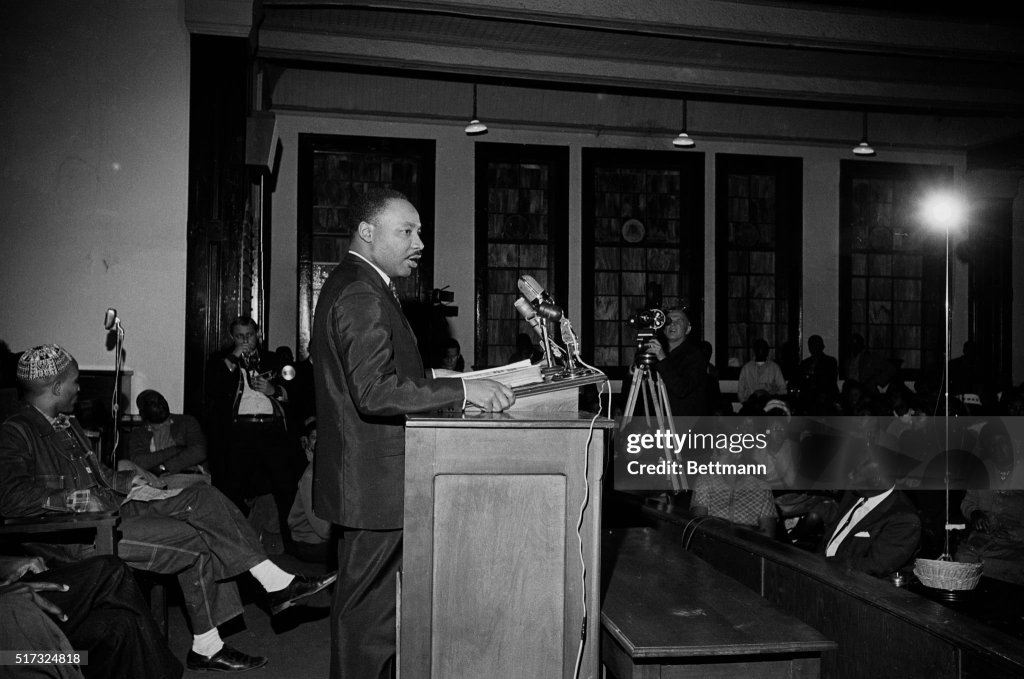
Thirty-one Republican leaders prodded President Johnson today to act with greater speed in sending to Congress his promised bill to eliminate remaining barriers to Black voting rights. The group, made up of five Governors, four Senators, and 22 Representatives, said in a statement: “How long will Congress and the American people be asked to wait while this Administration studies and restudies Dr. King’s request for new Federal legislation? The need is apparent. The time is now.” For the last several weeks, the Rev. Dr. Martin Luther King Jr. has been leading a drive to register Black voters in Selma, Alabama. During the demonstrations, almost 3,400 persons have been arrested. One Republican said the television broadcasts and news accounts of Sheriff James G. Clark Jr.’s treatment of Blacks seeking to register in Selma had been an element in the decision to issue the statement.
He noted that four-fifths of the Republicans in both House and Senate had voted for the civil rights bill last year, and said: “We felt we had to reconfirm that the Republican party has a commitment to see that the act is carried out.” It seemed to some observers here that the Republicans also were seeking to embarrass the Administration and garner some credit with Northern Black leaders who have been calling on the President to act. Several times during the last four weeks, President Johnson and the White House press secretary have said that legislation to secure voting rights would be presented to Congress and they indicated that it would go up soon.
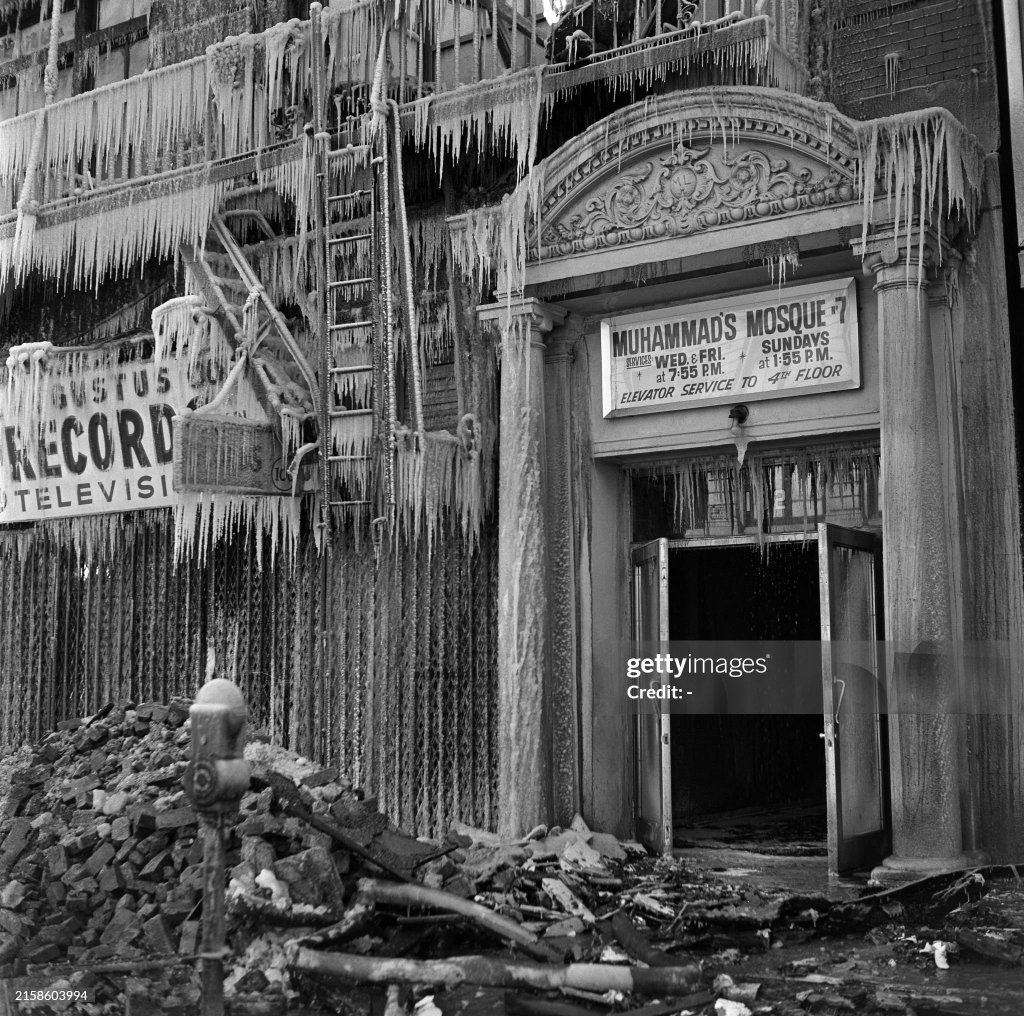
Two mosques of the Nation of Islam, one in Harlem in New York City, and the other in San Francisco, were firebombed, in an apparent retaliation for the assassination two days earlier of Malcolm X. Six FDNY firemen were injured when the front of the Harlem mosque collapsed. A day of tension in heavily policed Harlem followed a fire and explosion which wrecked a Black Muslim headquarters mosque. The fire apparently was in reprisal for the killing of rival Black leader Malcolm X.
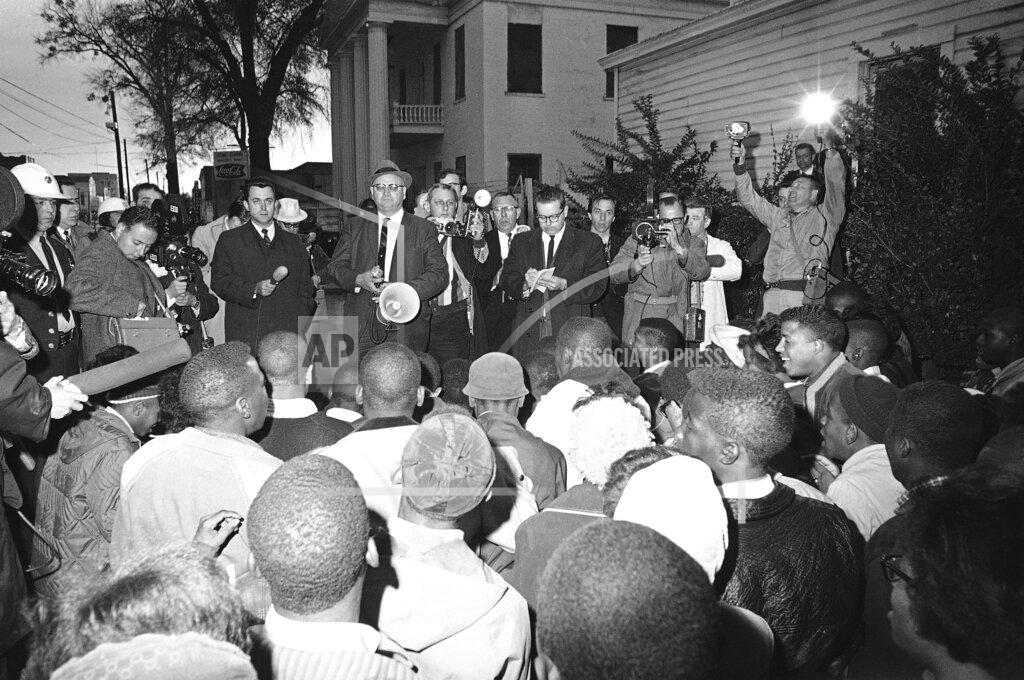
Captain Wilson Baker, Selma, Alabama’s Commissioner of Public Safety, persuaded 100 Black youngsters marching on the courthouse to turn back just before nightfall today, thus avoiding the potential dangers of a night march in the Deep South.
Demonstrations after dark were banned last week by Governor George C. Wallace after 11 persons were injured in Marion, 30 miles to the northwest, during a march that was broken up by state troopers wielding clubs. Today’s march, in contrast, was halted by persuasion. Captain Baker spoke a few words, after confronting the demonstrators three and a half blocks from their starting point, and they turned back without a murmur. Captain Baker, who maintained an attitude of firmness and diplomacy despite the tension around him, tried unsuccessfully to stop the march before it began.
He met the marchers, nearly all of them children and teenagers, as they came out of the Browns Chapel Methodist Church and headed for the Dallas County Courthouse eight blocks away. The Rev. Dr. Martin Luther King Jr., their leader, was in conference elsewhere at the time. “Now listen,” Captain Baker called to the marchers over a public address system, “a march at this time of evening is a dangerous thing… To do this will be unlawful,” he said. “I am asking you not to do this thing.” A voice from the crowd of Blacks called out: “What about it being unlawful to vote?” The demonstrators whooped and cheered and started down Alabama Avenue toward the courthouse. Captain Baker called after them, “It’s only in the interest of your safety. I cannot permit you to march on the courthouse.” At the courthouse Sheriff James G. Clark Jr. and a force of deputies were waiting. Blacks have come up against the nightsticks and cattle prods of these men often since they began a voting rights drive here last month.
Also on hand were 75 state troopers under the command of Colonel Al Lingo. It was they who clubbed the marchers in Marion last week.Both Colonel Lingo and Sheriff Clark had issued sharply worded warnings that today’s march would be broken up if it reached the courthouse. But Captain Baker conferred with them later and persuaded them to move in only if necessary. A few white bystanders, plainly expecting more action than Captain Baker permitted, waited in small groups along the street as the Black youngsters marched past. After the crowd had gone three and a half blocks, Captain Baker picked up a bullhorn, stepped out in front of the column and called for attention.
The Blacks stopped, perhaps expecting to be arrested. They knelt in front of Captain Baker and sang “We Shall Overcome,” a favorite song of the civil rights movement. Then they prayed. As Captain Baker stood looking down on them, a cigar in one hand and a bullhorn in the other, a voice came from a small group of white men at the curb: “Why doesn’t he do something?” Captain Baker gave no sign that he had heard. At the end of the prayer he raised his bullhorn and said, “All right now, go peacefully back to your church.”
The youngsters turned and walked away, slowly and quietly at first, then picking up speed and bursting into song. Exuberantly and without irony, they sang “Ain’t Gonna Let Nobody Turn Me ‘Round.” As they returned the way they had come, a group of 15 broke away, ducked into a side street and started running. Two or three policemen, spotting them, took off in pursuit, waving their clubs. “Let them alone,” Captain Baker called out over his bullhorn. One of his lieutenants yelled a sharp order and the policemen gave up the chase and came back.
As the rest of the marchers reached Browns Chapel, the sun was setting in a big patch of orange behind what Blacks call “the Project,” a cluster of red brick public housing apartments surrounding the church. In another 15 minutes it was dark. The Blacks’ rationale in holding night marches is to provoke the racist element in white communities to show its worst. As a result, Blacks have often been attacked. Both whites and Blacks acknowledge that the risk of violence is heightened considerably after nightfall.
The Justice Department and Dr. Martin Luther King Jr. flatly contradicted each other over who said what about an alleged plot to kill Dr. King.
Militant teenage Blacks in New York, angered by a refusal of support for the boycott of public schools, staged a noisy sit-in yesterday at the office of Roy Wilkins, executive director of the National Association for the Advancement of Colored People.
Growing concern is expressed in both the Capitol and the White House over the health of Senator Everett M. Dirksen, Senate minority leader.
The Senate Rules Committee received today written replies from Walter W. Jenkins to a list of questions it had submitted to the former White House aide in lieu of a personal appearance before the committee.
Critics of the Arms Control and Disarmament Agency called today for its abolition or a sharp cut in its spending.
Senator Robert F. Kennedy said today he would soon join other Senators in suggesting legislation to control narcotics imports and to help protect victims of illegal narcotics traffic.
Treasure hunters armed with dynamite and visions of fantastic riches probed deeply into a legend-shrouded pile of rocks near Salado, Texas. They expect to find a room containing diamonds, coins, gold and silver.
Postmaster General John A. Gronouski refused to hand the Senate investigators a list of persons whose mail is being scrutinized by postal inspectors. A Senate investigating subcommittee demanded today that the Post Office Department produce the names of about 24,000 persons whose mail was put under special surveillance in the last two years.
Labor’s top leaders warned today against what they called a last-ditch effort by the American Medical Association to block passage in Congress of hospital care for the aged under Social Security.
The first naturally occurring neutrino was detected by a team of physicists, led by Frederick Reines of Case Western Reserve University in a project with the University of the Witwatersrand in South Africa, using a liquid scintillator at an underground laboratory within the Proprietary Gold Mine near Johannesburg. In accepting the Nobel Prize for Physics thirty years later, Reines explains that “natural” in this case meant “it did not arise from a man-made nuclear reactor”, and that the team recorded 167 total events.
MGM Studios announced that it would begin filming of Stanley Kubrick’s science fiction movie, “Journey Beyond the Stars,” in Cinerama. Three years later, the film, retitled “2001: A Space Odyssey,” would be released to theaters under a different wide-screen format, Super Panavision 70.
The Beatles began filming of their movie “Help!” on New Providence island in the Bahamas.
Dow Jones Industrial Average: 891.96 (+6.35)
Born:
Michael Dell, American billionaire entrepreneur and computer manufacturer (Dell Technologies, founded in 1984); in Houston, Texas.
Helena Suková, Czech tennis player (14 Grand Slam doubles & mixed doubles titles), in Prague, Czechoslovakia
Kristin Davis, American actress (“Melrose Place”; “Sex and the City”) and producer; in Boulder, Colorado.
Robert “Bob” Ferguson, American politician (Democratic Party) and Attorney General of Washington, in Seattle, Washington.
Sylvie Guillem, French ballet dancer (Royal Ballet, 1989-2015); in Paris, France.
Died:
Stan Laurel, 74, American film comedian and half of the duo of Laurel and Hardy; of a heart attack.



 History Diaries