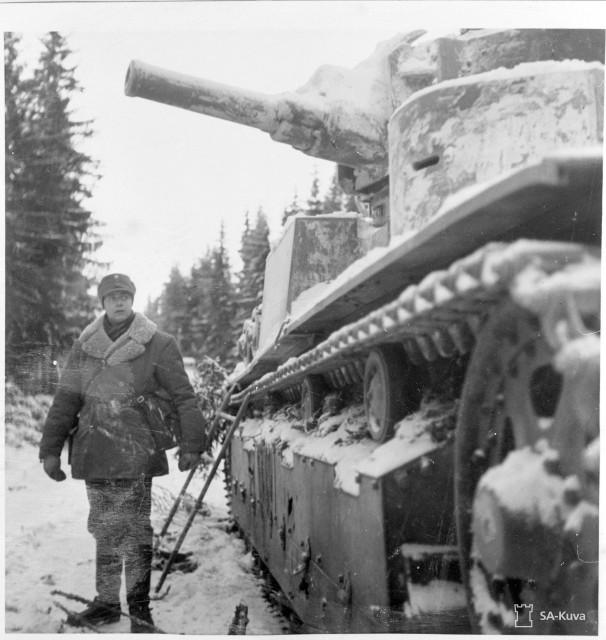
Soviet forces continue attacking into the Finnish secondary V Line. On the Isthmus the enemy assaults on the intermediary defensive positions are successfully repulsed.
The staff of II Army Corps reports it has run out of 37 mm anti-tank shells. Fresh supplies arrive during the night.
The extremely cold winter has made the Gulf of Finland excellent terrain for mounting an assault on the Finnish coast, the severe frost making the ice thick enough to drive a lorry over. The Soviets occupied islands in the Gulf of Finland. The Soviet 43rd Division attacks with trucks and tanks across the ice and captures Lasisaari and Koivisto islands. The islands are lost to the enemy. Before abandoning them, the Finnish garrison destroys the guns and fortifications and then withdraws under cover of a snowstorm across Viipurinlahti bay to Säkkijärvi. The road to Viipuri is now however open to the Red Army.
In Kuhmo, Finnish dugouts are destroyed by direct laying fire from heavy field guns.
In Ladoga Karelia, the Soviet 204th Reconnaissance Parachute Brigade is sighted on the front on the coast of Lake Ladoga.
Meanwhile, the 34th Moscow Tank Brigade, encircled near Kitelae, on the Ladoga front, eats the last of its packhorses and must now survive on starvation rations and biscuits and rusks dropped from Soviet aircraft.
The constant Soviet bombing on the home front is hampering work in factories and other workplaces. The Finnish Government decides that the working day may be extended by up to two hours to take account of the time lost due to air raids. It also issues pay guidelines for such a contingency.
Members of the public are urged to buy 1939 government bonds.
Sweden is afraid that giving military aid to Finland would end up dragging it into a major war. The Swedish Government’s policy on Finland is approved by the first chamber of the Swedish Parliament. The chamber nevertheless urges the Swedish people to give whatever voluntary aid they can to Finland.
The Commander in Chief of the Swedish Northern Army Corps today received orders to strengthen air defense units and to fire on sight at all Russian planes appearing over Swedish territory. This was the aftermath of yesterday’s bombing of the Swedish frontier town of Pajala.
There has been an increase in the number of volunteers from the United Kingdom since the British Government announced that men aged 27 or over are free to serve in Finland.
The Allies were urged tonight by Britain’s recently dismissed war secretary to make war on Russia at once, both to aid Finland and as a strategic move to shorten the Allied-German conflict. Leslie Hore-Belisha, whose aggressive personality caused cabinet friction before he was dropped, urged Britain and France to support Finland by “sea, air and land” in a speech to his constituents at Devonport. In his first public address since he was removed from the cabinet, Hore-Belisha declared that the Finns’ continued resistance indicated that the might of Russia rests on insecure foundations,” and added: “The risk of helping Finland may be great, but the risk of not helping her may be greater, for this gallant country is fighting not for herself alone; she is holding the pass for civilization.”
Both on land and in the air the increasing rhythm of the war was notable today. Enemy airplanes pushed far inland on reconnaissance, flying high, and then drew some gunfire from the widespread French defense system. Over the front lines there were constant patrols from both sides and one skirmish which ended in the withdrawal of a German pilot. This morning’s communiqué announced that the enemy had tried a surprise attack which had been repulsed and that a French patrol had brought back two non-commissioned officers as prisoners.
This evening the communiqué recorded: “Artillery action on both sides, notably west of the Saar and east of Blies sectors. Increased activity of both air forces between the Moselle and Rhine Rivers and also in Alsace. No less than three skirmishes took place during yesterday and last night with German raiding parties, one east of the Moselle, another immediately east of the Saar where the French captured an unusual amount of enemy material after driving the raiders back, and the third in the Blies sector.”
Heavy artillery fire, directed by French and German planes, began rolling along the Western Front today, while patrol detachments engaged in hand-to-hand fights in No Man’s Land. Brilliant sunshine shook off the Winter sluggishness all along the front, sending both armies into a burst of new activity — hottest since Winter set in.
German artillery lined French positions and batteries under heavy fire east of the Moselle on the Western Front today, an official German D.N.B. news agency report said. D.N.B. said that French anti-aircraft guns fired frequently at the German planes as they roared over Eastern France but that they were unable to halt the Nazi patrollers.
The Polish Air Force becomes an independent military service. The Polish Air Force was previously a subordinate branch of the Polish Army. Commander-in-Chief of the Polish government-in-exile, General Władysław Sikorski, signed the historic order to create the Polish Air Force as an independent military service. General Sikorski said in his announcement that “… My ambition is to create this year a Polish Air Force numerically at least equal and technically superior to that with which the Polish Armed Forces entered the fight in the autumn of last year.”
12 people were injured in the West End of London by Irish Republican Army bomb explosions. This was the last important event in the S-Plan campaign.
The British Foreign Office, in a long and closely reasoned note to Washington, rejected today the United States protest against British seizure of German exports.
German Army (Heer) Field Marshal Georg von Küchler ordered his subordinates to stop all forms of criticism toward Nazi racial policies. On the outbreak of the Second World War, Küchler was given command of the 3rd Army. During the invasion of Poland Küchler’s troops captured Danzig. Although a committed supporter of the Nazi Party, Küchler upset the Schutzstaffel (SS) by punishing soldiers who committed atrocities against civilians. In 1940 he became far more supportive of Nazi racial policy and today ordered a halt to any criticism of “ethnic struggle being carried out in the General Government, for instance of the Polish minorities, of the Jews and of the Church matters”. His order explained that the “Final ethnic solution” required unique and harsh measures. After the end of the war he was tried by a military court and on 27 October 1948 was sentenced to twenty years’ imprisonment for his treatment of partisans in the Soviet Union. However, he served only eight years before being released in 1953 due to illness and old age.
Berlin had a sudden thaw today after two months of cold and snow such as the city has not seen for decades.
Rumania, showing increasing concern over the possibility of war in the Spring, today increased her armed forces and published a sweeping decree banning the export of a long list of raw materials and manufactured goods “necessary for the national defense.”
Nuri al-Sa’id agrees to return as Prime Minister of Iraq.
Luftwaffe reconnaissance bombers are intercepted by RAF fighters over British coast. Squadron Leader Douglas Farquhar of No.602 Squadron took the first British gun-camera film of the war, while attacking and destroying a Heinkel He-111 over Coldingham in Berwickshire.
Six German type 34 destroyers, Friedrich Eckholdt (flying the flag of Fregattenkapitan Berger, commander of Destroyer Flotilla 1), Richard Beitzen, Theodor Riedel, Leberecht Maass, Max Schultz & Erich Koellner sailed from Schilling Roads into the North Sea during Operation Wikinger, which attempted to attack British fishing boats that had been reporting the movement of German warships. While transiting a German minefield, the force sighted, and was sighted by a German aircraft. He-111 aircraft of the German Luftwaffe, never been notified of the Kriegsmarine operation, misidentified the destroyers and attacked them. About a half-hour later the aircraft (a He-111 from 4/KG26) returned & dropped two 100 KG bombs, one of which struck Z1 Leberecht Maas amidships, apparently knocking out her boilers. Eckholdt went to give her assistance. Then, while standing by, the ships came under attack again, with two more bombs being dropped. Either one hit or the ship simultaneously drifted on a mine, but regardless, Leberecht Maas exploded, broke in half, and sank. There were 60 survivors rescued from the cold water. Some minutes later, the furthest destroyer away from the scene of the Leberecht Maas demise, Z3 Max Schultz exploded and sank. There was a submarine alarm, an aerial alarm, and she was in the minefield. There were no survivors, and no one apparently saw exactly what happened to her. However, at a subsequent inquiry, it was determined that the Luftwaffe aircraft had claimed hits on both destroyers. There was no British submarine in the area, but it had been mined by British destroyers two weeks before. However, regardless of what actually sank them, the Luftwaffe got the dubious credit. The sinking was most probably caused by the detonation of a mine.
The whole thing could have been avoided with a little communication between the Kriegsmarine and the Luftwaffe. In Germany, however, everyone guards their own private fiefdoms zealously.
British North Sea trawlers are again attacked by Luftwaffe aircraft. Little damage is done to the trawlers, as the bombers are driven off by the trawlers’ machine guns, and two are shot down by fighters.
At 0107 hours, in the Atlantic Ocean 92 nautical miles (170 km) south-southwest of Rockall (58° 45’N, 2° 24’W), the German submarine U-23, commanded by Kapitänleutnant Otto Kretschmer, again torpedoed the damaged and drifting British steamer Loch Maddy (formerly of convoy HX.19) which had been torpedoed by U-57 and abandoned by its crew on the previous day. Tthe drifting Loch Maddy was hit on port side amidships by one G7e torpedo from U-23 as coup de grâce about 12 miles southeast of Copinsay and broke in two. The bow section slowly sank vertically, but the stern section remained afloat on the cargo of timber, was later taken in tow by the tug HMS St. Mellons (W 81) (Lt H. King) and beached in the Inganess Bay, Orkney Islands. The cargo of aircraft, timber and wheat was salved and the vessel declared a total loss.
At 0020 hours, the German submarine U-50, commanded by Kapitänleutnant Max-Hermann Bauer, torpedoed and sank the British tanker British Endeavour in convoy OGF.19, 125 miles west of Vigo, Spain (42°11′N 11°35′W), killing five of her crew. 32 men were rescued by British steamer Bodnant, which landed them on the Portuguese island of Madeira at Funchal on February 26. The 4,580-ton British Endeavour had been carrying ballast on her journey from Glasgow to Abadan, Iran.
The U.S. freighter Sahale, detained by British authorities at Gibraltar the previous day, was released.
Convoy HG.20F departs Gibraltar for Liverpool.
Convoy SL.21F departs Freetown for Liverpool.
Convoy HX.22 departs Halifax for Liverpool.
The War at Sea, Thursday, 22 February 1940 (naval-history.net)
Heavy cruiser DEVONSHIRE departed the Clyde for Rosyth where she arrived on the 23rd.
Armed merchant cruiser CICILIA departed the Clyde on Northern Patrol.
Armed merchant cruiser ASTURIAS boarded Danish steamer JONNA (1517grt) and sent her to Kirkwall for inspection.
Destroyer DIANA arrived at Rosyth from Scapa Flow for repairs.
Destroyers IMPERIAL and DELIGHT arrived at Rosyth after submarine hunting.
Destroyers BOREAS and BRAZEN departed Rosyth for the Humber.
Motor torpedo boats MTB.22, MTB.24 and MTB.25 were searching for a submarine off Whitby.
Destroyers ICARUS and IMPULSIVE were transferred from the 3rd to the 20th Destroyer Flotilla.
Minelayer TEVIOTBANK departed Rosyth escorted by destroyers BOREAS and BRAZEN on minelaying operation PA 1 in the North Sea.
Destroyer GREYHOUND at anchor off Outer Dowsing was damaged when Swedish steamer REX (1013grt) hit her. Her stem was bent, and she repaired at Hull, completing on 20 March.
The 23rd Anti-Submarine Group departed Methil with an MT convoy covered by sloop LONDONDERRY and destroyers WESTMINSTER and JERVIS. The cover force transferred to convoy FS.103 on the 23rd.
Blockship CARRON (1017grt) departed the Tyne for Rosyth escorted by destroyer JAVELIN. She reached Scapa Flow and was sunk there on 3 March.
While escorting battleship RODNEY and battlecruiser HOOD, destroyer FOXHOUND attacked a submarine contact ENE of Muckle Flugga in 61-11.5N, 3-32W.
Destroyer FORESTER, escorting tug BUCCANEER in the Firth of Clyde in 55‑20. 75N, 04‑57.25W, attacked a contact, which further investigation showed to be the wreck of U-33 sunk earlier.
Destroyer ACASTA, escorting a homebound convoy, attacked a submarine contact west of Scilly Isle in 50‑00N, 10‑00W.
Destroyers WALPOLE and MACKAY, escorting a homebound convoy, attacked a contact SSW of the Scilly Isles in 49‑28N, 06‑48W. This was later determined to be the wreck of steamer VACLITE lost on 30 January.
Anti-submarine trawler LORD ESSENDEN (464grt) attacked a contact at 0840 in the Firth of Clyde, two miles 075° from Little Cumbrae in 55-41N, 4-58W.
Convoy HN.14 departed Bergen escorted by destroyers ESCAPADE, ECLIPSE, ESCORT, and ELECTRA and submarine NARWHAL, but 22 of the original 37 ships returned to Bergen. (See also the 24th following).
U-50 sank tanker BRITISH ENDEAVOUR (4520grt) from convoy OG.19F NW of Cape Finisterre in 42‑11N, 11‑35W. The tanker broke in two and five crew were lost. Steamer BODNANT (5342grt) rescued the 33 survivors. Destroyers HEARTY and ARDENT were sweeping in the area but neither ship made a radio report and the destroyers were unaware of the submarine’s presence.
German destroyers LEBERECHT MAAS, MAX SCHULTZ, ERICH KOELLNER, RICHARD BEITZEN, THEODOR RIEDEL, and FRIEDRICH ECKHOLDT departed Wilhelmshaven early on the 22nd on Exercise WILKINGER, an anti-shipping sweep in the area of Dogger Bank. That evening at 1900, northwest of Borkum Island, the destroyers were attacked by the Luftwaffe – He111’s of IV/KG26 of the X Air Corps, which were not informed of the destroyers’ movements. Some sources cite II/KG26. LEBERECHT MAAS was struck by three bombs, ran onto a British mine and sank, while MAX SCHULTZ evaded the bombing but also ran onto a British mine and sank. Five hundred and seventy eight crew from both ships were lost including the entire crew of SCHULTZ. There were 60 survivors from MAAS with KOELLNER picking up 24, ECKHOLDT 19 and BEITZEN 17. Heavy fog during the 23rd made further rescue efforts unsuccessful. German auxiliary patrol boat Vp.809 (trawler KONSUL DUBBERS, 408grt) searched through the afternoon. The minefield, hitherto undiscovered, had been laid by units of the British 20th Destroyer Flotilla on the 9th/10th January.
Convoy HX.22 departed Halifax at 1000 escorted by Canadian destroyers HMCS RESTIGOUCHE and HMCS SKEENA, which detached on the 23rd. Ocean escort was battleship ROYAL SOVEREIGN, left on 2 March. Destroyers VANOC, VETERAN, WALPOLE, and WREN escorted the convoy from 6 to 9 March, when it arrived at Liverpool.
Convoy HG.20F departed Gibraltar with 30 ships on the 22nd, escorts:
22nd — Destroyer VELOX, French destroyer PANTHÈRE, and French auxiliary patrol vessel MERCEDITA joined.
28th — Destroyers WHIRLWIND and VANOC joined from convoy OG.20F.
Sloop SANDWICH joined.
PANTHÈRE and MERCEDITA detached.
WHIRLWIND and VANOC detached later in the day.
3rd — VELOX detached to convoy HG.21.
The convoy arrived with SANDWICH at Liverpool on 3 March.
Light cruiser CERES, which had sailed from Plymouth, arrived at Gibraltar on the 19th and left the same day, now reached Malta.
Convoy SLF.21 departed Freetown escorted by armed merchant cruiser BULOLO until 4 March. Destroyer VANSITTART joined the same day and escorted the convoy until its arrival on the 7th.
French destroyer SIMOUN, escorting AUSTRAL and transport GOLO passed Gibraltar. GOLO had departed Toulon on the 17th and Algiers on the 20th. AUSTRAL had also left Toulon on the 17th and joined at Algiers. On the 22nd, the three ships departed as convoy 2F and were joined en route by destroyer FORBIN. They arrived at Brest on the 27th in preparation for allied operations in Finland.
French convoy 69.KF departed Casablanca with seven steamers, escorted by large destroyers MILAN, EPERVIER, and VERDUN, and arrived at Brest on the 26th. The destroyers also joined the allied preparations for Finland operations.
Australian light cruiser HMAS HOBART arrived at Colombo, where she drydocked from the 25th to 29th.
In Washington today, the U.S. Senate heard Senator Burke read Washington’s Farewell Address, Senator Wiley oppose enlargement of the capital of the Export-Import Bank, several Senators denounce British seizure of United States mail at Bermuda and adjourned at 1:26 PM until noon on Monday. The Education and Labor Committee approved the nomination of James J. McEntee to be director of the Civilian Conservation Corps.
The House of Representatives heard Representative Crowther read Washington’s Farewell Address, received the Marcantonio bill for a work relief and unemployment assistance program and adjourned at 12:52 PM until 11 AM tomorrow. The Labor Committee heard Kenneth Crawford, president of the American Newspaper Guild, on proposed amendments to the National Labor Relations Act.
The national capital solemnly commemorated George Washington’s Birthday anniversary today with wreath-laying ceremonies, speeches and parades.
Senator McCarran of Nevada joined today the ranks of Democrats seeking a third-term declaration by President Roosevelt. Mr. McCarran, who has opposed the Administration on several issues, issued a statement in which he said that the President “should clear the political atmosphere for the benefit of the party that gave him office.”
President Roosevelt has not yet decided whether he will run for a third term, according to inference made from remarks made by his eldest son, James, in an address in Philadelphia tonight.
Despite a statement by new Supreme Court Justice Murphy that he is very happy on the bench, there are persistent reports that he that he has been seeking the vice presidential nomination on the democratic ticket.
United States Undersecretary of State Sumner Welles, on his way to Europe to study conditions in the belligerent and other capitals, will have a conference with Führer Adolf Hitler when he arrives, it was disclosed today.
Considerable resentment was voiced today in Congressional circles concerning British methods of enforcing censorship over the American mail at Bermuda, as a result of publication of reports that this action was with a display of armed force.
A federal graft hunter who broke the Louisiana scandals which brought ballot disaster to the Huey Long political regime said tonight he would soon open an investigation of similar corruption in another State. O. John Rogge, assistant attorney general, disclosed this much tonight but would not say where the Federal lightning would strike next. He also outlined a plan through which the Justice Department will seek uniformity in federal investigation and jurisprudence.
Ernest T. Weir, chairman of the board of the National Steel Company and president of the Iron and Steel Institute, has been appointed chairman of the Republican National Finance Committee.
William L. Hutcheson, general president of the A.F.L. Carpenters Union, and 49 other defendants were indicted today on two counts of a conspiracy to restrain and monopolize interstate commerce in violation of the anti-trust act.
An attack upon the New York Transit Commission for approving the proposed demolition of sections of the Ninth and Second Avenue elevated lines as an action in complete disregard of the convenience of residents of the Bronx was made yesterday by George F. Mand, president of the Bronx Chamber of Commerce. He intimated that an attempt might be made to take the issue to the courts. Characterizing the action of the commission as “astounding,” Mr. Mand charged that razing the elevated would lead to crowding on other already overtaxed transit lines.
The British Pavilion will continue to operate at the New York World’s Fair this year, it was announced in the House of Commons today by R.S. Hudson, Secretary for Overseas Trade.
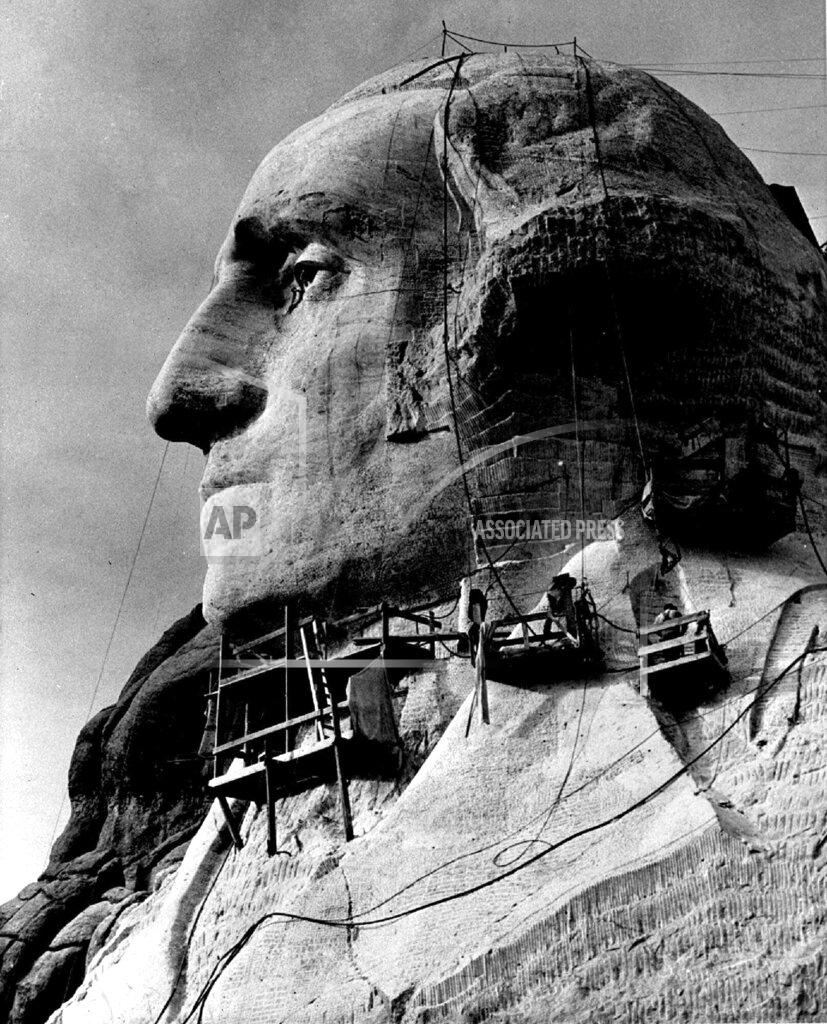
The head of George Washington at the Mount Rushmore National Memorial was undergoing its final buffing today under the direction of Gutzon Borglum.
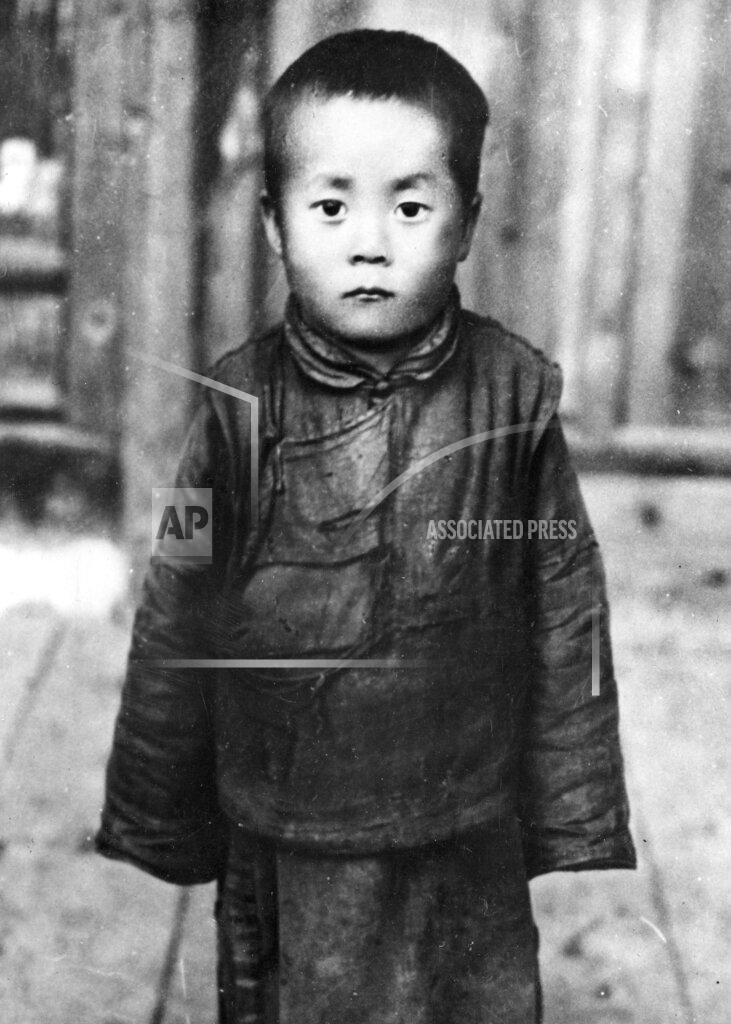
The enthronement occurs in Lhasa, Tibet today of the 14th (and current) Dalai Lama, 4-year-old Jampel Ngawang Lobsang Yishey Tenzin Gyatso (Tender Glory, Mighty in Speech, Excellent Intellect, Absolute Wisdom, Holding to the Doctrine and Ocean-Wide), born Lhamo Dondrub.
Collapse of a Japanese puppet army of Chi-nese soldiers, landed on the Fukien coast to fight Generalissimo Chiang Kai-shek’s forces, was reported today by Chinese dispatches. The commander of the puppet army, General Huang Tai-wei, these sources declared, was put aboard a Japanese warship as a prisoner following mutinies among his troops. A thousand soldiers with 900 rifles, three trench mortars, a dozen machine guns and other equipment were said to have gone over to the Chinese.
The Chinese Government’s Central News Agency also reported that four of six Japanese warships on the Yangtze at Kiukiang had been shelled by the Chinese. In South China, a battle was reported by the Chinese military spokesman to be in progress twelve miles north of Nanning, where the Japanese are in strong positions. A Japanese Army division withdrew to the coast from this front starting last Thursday and sailed to Canton. Foreign observers said they believed the withdrawal indicated that the Japanese were confident that the danger of a Chinese recapture of Nanning had been removed definitely.
The military spokesman in Chungking said in his weekly review of the war situation today that the Japanese had removed 10,000 wounded from Nanning during the week and that altogether they had suffered 20,000 casualties in the operations in the Nanning area in recent weeks.
Born:
Chet Walker, NBA small forward (Hall of Fame, inducted 2012; NBA Championship-76ers, 1967; NBA All-Star, 1964, 1966, 1967, 1970, 1971, 1973, 1974; Syracuse Nationals-Philadelphia 76ers, Chicago Bulls), in Bethlehem, Mississippi (d. 2024).
Larry Eisenhauer, AFL defensive end (AFL All-Star, 1962, 1963, 1964, 1966; Boston Patriots), in Hicksville, New York (d. 2020).
Mike Lind, NFL fullback (San Francisco 49ers, Pittsburgh Steelers), in Chicago, Illinois (d. 2002, of cancer).
Johnson Mlambo, South African leader (Pan-African Congress), born in Johannesburg, South Africa.
Judy Cornwell, English actress (“Keeping Up Appearances”), in Hammersmith, London, England, United Kingdom.
Billy Name, photographer, filmmaker and lighting designer, in Poughkeepsie, New York (d. 2016).
Died:
Hans von Gronau, 89, Prussian World War I general.
Naval Construction:
The Royal Navy Flower-class corvette HMS Erica (K 50) is laid down by Harland & Wolff Ltd. (Belfast, Northern Ireland).
The Royal Navy Hunt-class (Type I) escort destroyer HMS Cattistock (L 35) is launched by Yarrow Shipbuilders Ltd. (Scotstoun, Scotland).





 History Diaries