
Military spending in the Soviet Union, although slightly increased in the last two years, generally has leveled off since 1976, according to a CIA report to Congress. From 1965 to 1976, the growth in Soviet defense spending averaged about 4% to 5% a year, but after 1976 the rate of increase dropped to about 2% a year, the CIA said in a report last November to the Joint Economic Committee of Congress. The CIA report, made public by Senator William Proxmire (D-Wisconsin), seemed to contradict Defense Secretary Caspar W. Weinberger, who has testified that the Soviet military buildup has proceeded unabated since the 1970s.
State Department officials said today that two days of talks in Vienna between the United States and the Soviet Union on the Middle East had produced no agreements, except a continued desire to see the Iran-Iraq war settled. President Reagan, in his news conference, minimized the importance of the talks. “We simply felt that it was time to exchange views with one another,” he said, adding that the talks did not signal a new United States interest in inviting the Soviet Union to play a role in negotiating peace in the Middle East. “We don’t favor that,” the President said. “We don’t believe there should be that many hands in the pot.”
The Soviet Union and the International Atomic Energy Agency signed an agreement today permitting inspection of some Soviet civilian nuclear plants, but apparently not of advanced types. An agency source said only a small number of Soviet reactors would be covered, but the accord was seen as a major step in extending the governing body’s authority. China is still outside the agency’s control. The agreement was signed at agency headquarters by the agency director general, Hans Blix of Sweden, and Andronik M. Petrosyants, chairman of the Soviet Union’s State Committee on the Utilization of Atomic Energy. The Russians are to submit a list of plants for peaceful nuclear purposes from which the agency inspectors may choose a certain number.
British Prime Minister Margaret Thatcher said today that she was disappointed by New Zealand’s decision that prevented United States ships carrying nuclear weapons from entering its harbors. Reflecting support for the Reagan Administration in a diplomatic showdown with the Commonwealth nation, she said at a news conference that she would join the United States in refusing to indicate if ships entering New Zealand ports carried nuclear weapons. “All of our ships are seconded to NATO,” she said. “At any moment’s notice they might be instructed to take up NATO positions and therefore they must carry whatever is appropriate to their NATO task.
Mineworkers’ union delegates from all over Britain decided to continue their 50-week old coal strike, rejecting a government plan to close unprofitable pits and cut jobs. Delegates meeting in London backed a refusal by leaders of the National Union of Mineworkers to accept a “final compromise plan” put forward by the National Coal Board. The board remained adamant that the union has to accept the closure of uneconomic pits as a precondition for talks to end the strike.
Two hooded gunmen shot and killed a Northern Ireland policeman just moments after he delivered a busload of children to a tiny Armagh country school. The outlawed Irish Republican Army claimed responsibility. Sgt. Frank Murphy, who was driving the bus for a friend, had just dropped off children at the school in Armagh, 45 miles west of Belfast, when his vehicle was ambushed, police said.
Israeli forces were reported to have besieged at least three villages in southern Lebanon today, rounding up dozens of male residents for interrogation. The Israeli operation, which was said to have involved armored columns and large numbers of troops, was apparently part of an announced drive against the growing Shiite Muslim rebellion against the Israeli occupation of the region. Israel’s Foreign Minister, Yitzhak Shamir, has said Israel would take all measures, “even the most severe,” to protect its soldiers. Israel withdrew from the area around Sidon, north of Tyre, on Saturday in the first part of a planned three- stage pullback. But Shiite attacks have continued in the area still occupied, and three Israeli soldiers, including a colonel and a major, have been slain in ambushes so far this week.
Prime Minister Shimon Peres of Israel said today that his Government would reconsider its objections to United Nations mediation in the Middle East if the Soviet Union and China eased their hostility toward Israel. He told Israeli reporters who accompanied him on his visit here that he had asked Nicolae Ceaușescu, the Rumanian leader, to urge the Soviet Union and China to establish diplomatic relations with Israel.
Kuwaiti voters ousted two prominent Moslem fundamentalists and elected a bloc of leftists in balloting for the only elected Parliament among the Persian Gulf nations, according to the election results announced today. Some Western diplomats and Kuwaiti journalists said the results of Wednesday’s balloting, in which more than half the 40 incumbent candidates were defeated, reflected widespread discontent with the government’s economic and social programs. They said the new Parliament would probably be less willing to support government policies. Interior Ministry officials said 85 percent of the 56,818 eligible voters took part in the election.
A report by a three-member United Nations study group has concluded that both Iran and Iraq regularly mistreat each other’s prisoners of war in violation of the Geneva Conventions. The report calls for both sides to release as many prisoners as possible. The 82-page report, made public today by Secretary General Javier Perez de Cuellar, grew out of trips to P.O.W. camps in Iran and Iraq, which have been at war for four and a half years. It is estimated that there are 50,000 Iraqi P.O.W.’s in Iran and that more than 9,000 Iranians are being held in Iraq.
The Pakistani Government announced today that hundreds of people had been arrested this week for activities that it said could disrupt national elections next week. Officials said also that more than a dozen top political opponents of Gen. Mohammad Zia ul-Haq, the President, had been confined to their localities. Many were said to be under house arrest as a “pre-emptive” step to insure that the elections for a new National Assembly and provincial legislatures take place quietly. General Zia, discussing the wave of arrests after it began earlier this week, said that those seized or confined would be released when the elections were completed. The vote is to take place Monday and Thursday.
The State Department said today that South Korea had formally expressed regret that force was used against Americans accompanying the opposition leader Kim Dae Jung back to Seoul this month. The department said it now considered the matter closed. Edward P. Djerejian, a department spokesman, said the South Koreans, in their response to an American Embassy protest two weeks ago, said the South Korean Foreign Ministry “has formally expressed regret over this unfortunate incident and said it should never happen again.” At the time, some Americans, including two Congressmen, said they were roughed up by Korean security forces when they disembarked from their plane with Mr. Kim. The American Embassy protested to South Korea over the treatment of the Americans and the failure to follow a plan under which Mr. Kim was to have been taken to his home, to be followed by three of the Americans traveling with him. The Americans were to have been been met by American Embassy personnel, who were barred from doing so.
A team of U.S. experts will travel to China early next week to inspect what the Chinese say are the remains of an American pilot missing since World War II, a spokesman for the U.S. Pacific Command said. Lt. Col. Richard E. Stevenson said the Peking government notified the United States in the last month that the remains of an American pilot had been found and could be turned over to U.S. officials. He said he did not know where the remains were. An estimated 78,000 Americans, both military and civilians, remain unaccounted for from the war.
Diplomatic tensions between Mexico and the United States have risen sharply this week. The immediate cause was a move by the Reagan Administration to begin close inspection of automobiles at the Mexico-United States border. United States officials said the tough new inspections, which began last Saturday, were intended to uncover evidence in the case of Enrique Camarena Salazar, a Drug Enforcement Administration agent who was kidnapped by armed men from a street in Guadalajara on February 7. But Mexican officials say they view the move as a heavy-handed attempt by the United States to put pressure on the Mexican Government to solve the case, in which the Mexicans insist they are already making their best effort.
El Salvador will soon receive four helicopter gunships from the United States for Vietnam-style airborne assaults on leftist rebels, State Department officials said. The Hughes 500 helicopters, equipped with multi-barrel guns that fire more than 5,000 rounds a minute, are being supplied free and will enable the Salvadorans to respond instantly to ambushes, they said. Democratic members of Congress expressed concern that the gunships could cause increased civilian casualties.
The boldest statement on Nicaragua to date was made by President Reagan in a nationally televised news conference. Mr. Reagan said his objective was to remove the “present structure” of the Managua Government. He used the first news conference of his second Administration for a harsh attack on the Sandinista Government, which he condemned as a “totalitarian, brutal, cruel” regime that does not have “a decent leg to stand on.” Mr. Reagan’s unusually open declaration of objectives punctuated a week of escalating Administration attacks on Managua and increasingly open demands for a change in the Nicaraguan Government. Gone from his appeals for renewed American aid to the Nicaraguan rebels were assertions used in the past that this campaign was needed to halt the flow of arms to leftists in El Salvador or to put pressure on Nicaragua to make negotiating concessions.
Nicaragua has introduced chemical warfare equipment into Central America, building up a supply of decontamination trucks, protective clothing and other defensive material, Pentagon officials said. However, General John W. Vessey Jr., the chairman of the Joint Chiefs of Staff, told the House Foreign Affairs Committee that the Sandinista regime has shown no sign of storing offensive chemical weapons. “Why do they want defensive chemical weapons when there’s nobody else in the region with an offensive chemical capability?” Vessey asked rhetorically.
More than 1,500 people have disappeared in the troubled Peruvian region near Ayacucho since the Lima government imposed military rule there two years ago in its struggle against the Maoist guerrillas of Sendero Luminoso (Shining Path), a spokesman for the human rights organization Amnesty International said at a news conference.
The Chilean Government gave a positive account today of recent meetings with a high-ranking State Department official and hinted at new cooperation between the two countries. The meetings, an official communique said, permitted representatives of the two countries “to examine the state of bilateral relations, and to look for new areas of cooperation.” The brief communique was the only official comment on the visit of Langhorne A. Motley, Assistant Secretary of State for Inter-American Affairs, and Government officials. Mr. Motley also met with representatives of the opposition and the church. Mr. Motley, who left Chile on Wednesday night, also went to great lengths in his departure statement to avoid criticizing the Government, and at times seemed complimentary, saying the country’s future was in “good hands.”
Former President Isabel Martinez de Perón was reported today to have stepped down as head of the Perónist Party, bringing a new element of disarray to Argentina’s badly divided opposition movement. A one-sentence letter containing her “irrevocable” resignation was mailed from her home in Madrid and addressed to leaders of two Perónist factions that each elected her as party president in separate congresses here this month. Infighting has prevented the Perónists from mounting an effective opposition to the 14-month-old government of President Raul Alfonsin despite an economic crisis that has eroded the living standards of urban workers, who make up the party’s rank and file. One Perónist leader, Juan Gabrel Lavake, who is known to be close to Mrs. Perón, said today that her purpose was not to renounce her leadership of the movement but rather to prevent her name from being used by either of the warring factions.
The South African authorities announced today that some black residents of legally recognized townships around Cape Town would be permitted to stay on and acquire 99-year leases on their homes. Previously, the Government had insisted that the 125,000 residents of the townships would be required to move, along with unlawful squatters from a camp called Crossroads, to a newly built settlement for black people called Khayelitsha, situated in sand dunes 10 miles away. But the announcement made no reference to any change in policy on Crossroads itself, where 60,000 to 100,000 squatters, many of them regarded as “illegals,” have been resisting the move to Khayelitsha. Eighteen people died in Crossroads this week after the police moved in to quell protests.
A plan to develop defenses against missiles in space is “not an optional program” but central to American military planning well into the next century, according to Fred C. Ikle, a top Pentagon official. He said the program would begin with a partial defense to protect American missiles, possibly in the 1990’s, and then would grow into a full-blown system to protect cities as well in the next century. Mr. Ikle portrayed the antimissile program, or the Strategic Defense Initiative, as more a sure thing than other Administration officials have done; they have generally emphasized that it is only a research program that may or may not lead to deployment of a defensive shield. The President’s senior arms control adviser, Paul H. Nitze, in a speech Wednesday, laid out a set of strict conditions that must be met before the Administration can decide whether to deploy antimissile weapons in space. These included assurance that the system could survive a pre-emptive nuclear attack, and a cost that was lower than offsetting measures the enemy might devise.
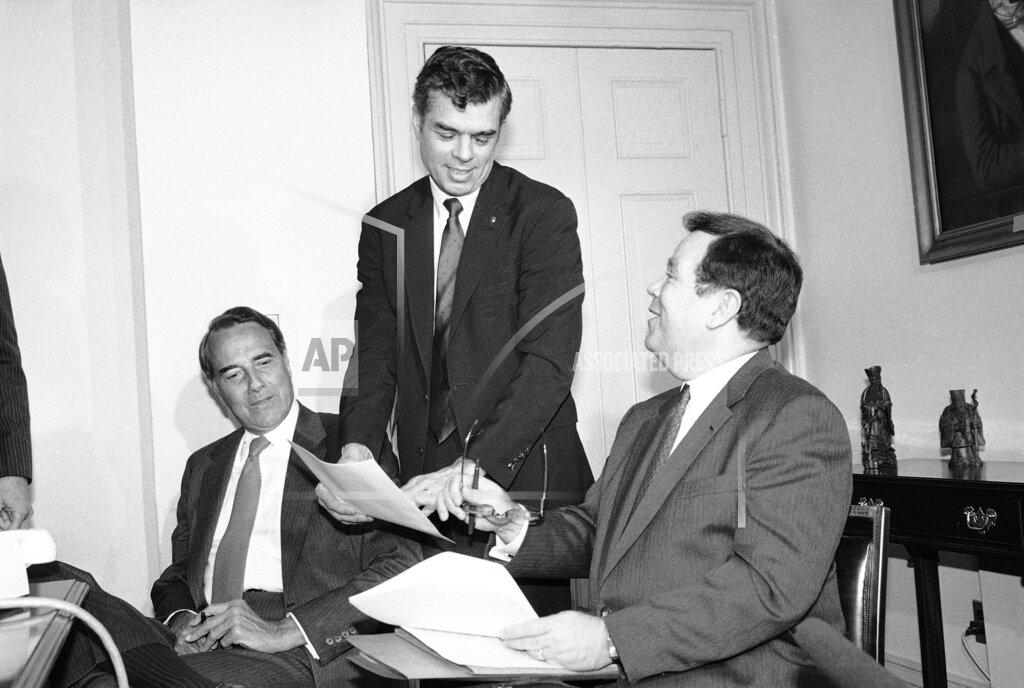
President Reagan meets with the leadership of the National Conference of State Legislators.
President Reagan participates in his 28th Press Conference. President Reagan said tonight that the plight of the nation’s farmers was not wholly of their own making and that his Administration “won’t pull the rug out from under anyone instantly.” In a news conference, Mr. Reagan also stressed that his Administration’s proposals for tax simplification were crucial to economic growth.
The economy grew at an annual rate of 4.9 percent in the final three months of last year, a markedly faster rebound from its summer slowdown than previously estimated, the Commerce Department said today. A month ago the department put the fourth-quarter growth of the gross national product – the total output of goods and services – at 3.9 percent. That itself was well above the estimate of 2.8 percent made shortly before Christmas. Although faster growth is often associated with higher levels of inflation, economists remained confident that prices would not surge from their recent increases of about a 4 percent annual rate. However, bond yields rose today because of the expectation that a stronger economy would lead to higher interest rates.
The next launching of the space shuttle Challenger, with Senator Jake Garn of Utah as one of the crew members, has been rescheduled for March 4, the National Aeronautics and Space Administration said today. Mr. Garn is chairman of an appropriations subcommittee with jurisdiction over funds for the space agency. The launching was originally scheduled for Wednesday but was postponed because many of the tiles that protect the spacecraft from heat in its re-entry into the atmosphere were loose. They were rebonded.
The Bank of Boston acknowledged it might have been unwittingly used by an organized crime family, the Angiulos, to launder as much as $2 million in cash. But William L. Brown, the chairman of the bank, insisted there was no evidence that any employee of the bank had “benefited in any way” from its dealings with the underworld group.
New York Police Commissioner Benjamin Ward said yesterday that Bernhard H. Goetz, who shot four young men on a subway train, had not acted in self-defense and should have been indicted “for some level of assault, right up to possible attempted murder.” Mr. Goetz shot two of the youths in the back, the Commissioner said repeatedly in an interview. The shootings have produced so dramatic a response that the name Bernhard Goetz is known beyond the borders of the United States. “I don’t think, legally, any lawyer believes that what Goetz did was self- defense, not as to the two with the holes in their back,” said Mr. Ward, taking a position that put him in direct conflict with Mayor Koch. Both men are lawyers.
William J. Schroeder, looking tired but saying he felt “real fine,” took a second brief trip outside his Louisville, Kentucky, hospital in a wheelchair, smiling and waving at reporters. “We’re going to live a normal life… I know it’s going to work,” said his wife, Margaret, who accompanied the second artificial heart recipient on the 10-minute excursion. Meanwhile, doctors said the third artificial heart patient, Murray P. Haydon, was recovering well but experiencing fatigue and some kidney failure.
Federal agents staging raids in nine states arrested 81 members of the Bandidos motorcycle gang on warrants charging them with narcotics, weapons and racketeering offenses. The gang is believed to control a major part of the U.S. methamphetamine — or “speed” — and PCP drug trade, the FBI said. FBI Director William H. Webster said in Washington that agents of the FBI; Drug Enforcement Agency; Bureau of Alcohol, Tobacco and Firearms and hundreds of state and local law enforcement officials were involved in the roundup, which was staged in Arkansas, Colorado, Louisiana, Missouri, South Carolina, South Dakota, Washington, Texas and Illinois.
Avowed white supremacist Gary Lee Yarbrough was convicted of assault for shooting at three FBI agents outside his home in Sandpoint, Idaho. Yarbrough testified at the trial in Boise that he did not intend to harm the agents, only to “get their attention.” Yarbrough faces up to 10 years in prison and a $10,000 fine on the federal conviction. He is believed to belong to the Order, a faction of the neo-Nazi group Aryan Nations. Yarbrough has also been linked to the shooting death of Jewish radio talk show host Alan Berg in Denver last year.
Twenty-three Cubans left Atlanta on a flight for Havana. They are the first of 2,700 unwanted refugees that Cuba has agreed to accept in return for allowing 20,000 Cubans to immigrate to this country each year.
A sanctuary leader was convicted of illegally aiding Salvadoran aliens in entering the United States. Jack Elder, the head of a shelter in San Benito, Tex., was found guilty by a Federal jury in Houston.
An Atlanta judge temporarily halted all construction of the Presidential Parkway designed to connect Jimmy Carter’s library near Emory University with downtown. The order by Superior Judge Osgood Williams is effective until 10 a.m. next Thursday, when Williams will hold a full hearing on whether Shepherd Construction Co. was legally issued a contract.
Terrorism in the United States dropped from 100 incidents in the early 1980s to 13 attacks last year, and Puerto Rican terrorists will be the United States’ “most sustained terrorist problem,” Assistant FBI Director Oliver Revell told the National Press Club in Washington. Revell said three types of terrorists are operating here: leftwing groups, right-wing groups, and groups supported by foreign countries, such as Iran and Libya. Included among the right-wingers, he said, are such groups as the Ku Klux Klan and the Aryan Nations.
American unions have fallen behind the pace of change and should adopt new, innovative methods for representing union members and responding to the contemporary concerns of workers, according to an unusually candid, 30-month study by the A.F.L.- C.I.O. that made many proposals to regenerate unions.
The U.S. Navy said today that it had narrowed to six the number of Gulf Coast cities it is considering as the home port for a battle group to be headed by the battleship USS Wisconsin. The group will also include a cruiser, a guided-missile destroyer and three frigates. For the city selected, it will mean about $100 million in construction and an annual military payroll of $50 to 60 million, the Navy said. Those selected, from 16 originally considered, were Mobile, Alabama; Pensacola, Florida; Lake Charles, Louisiana; Pascagoula, Mississippi; and Corpus Christi and the Houston-Galveston area in Texas. The Navy also said that Key West, Florida, was being considered as a site for reserve force units.
Some nuclear fuel melted in the reactor core during the 1979 accident at Three Mile Island, scientists disclosed in Middletown, Pennsylvania. Recent studies of rubble taken from the core show that temperatures reached about 5,100 degrees Fahrenheit, said Harold Burton, TMI project manager for EG&G Idaho. Previous examinations had indicated a maximum temperature of 4,700 degrees. But Burton and officials for GPU Nuclear Corp., TMI’s operator, said melted fuel does not mean that the plant was close to a meltdown, which could have released dangerous radiation outside the plant, because the building containing the reactor is intact.
Dust from a dry lake, swept hundreds of miles by 60-mile-an-hour winds that mixed it with rain, was blamed today for spattering hundreds of thousands of automobiles with white mud over 8,000 square miles of Southern California. Jim Birakos, deputy executive officer of the South Coast Air Quality Management District, said the gritty material was white alkaline dust that blew off the parched bottom of Owens Lake, a dry lake 175 miles north of Los Angeles.
More than $30 million designated for improving U.S. science education will not be spent this year because the National Science Foundation cannot prudently spend as much as Congress voted, foundation Director Erich Bloch told a House subcommittee. Bloch said the delay does not represent any backing away from the Reagan Administration’s commitment to improve science education.
Largest NBA crowd to date, 44,970 (Atlanta at Detroit).
Tim Raines is awarded a $1.2 million salary for 1985 by arbitrator John Roberts, the largest award to date through that process. The 25-year-old Raines hit .309 for the Expos last season and stole 75 bases.
New York Yankees owner George Steinbrenner gives manager Yogi Berra the dreaded vote of confidence. Steinbrenner says that Berra will remain Yankee skipper for the entire season, regardless of how badly the team might struggle. Berra will last only 16 games before being fired.
Dow Jones Industrial Average: 1279.04 (-4.09)
Born:
Maurice Stovall, NFL wide receiver (Tampa Bay Buccaneers, Detroit Lions, Jacksonville Jaguars), in Philadelphia, Pennsylvania.
Jamaal Westerman, NFL defensive end (New York Jets, Arizona Cardinals, Indianapolis Colts, Buffalo Bills, Pittsburgh Steelers), in Brooklyn, New York, New York.
Bob Burton, American speedcuber, in Newark, New Jersey.
Died:
Ina Claire [Fagan], 91, American stage and screen actress (“Ninotchika”), of a heart attack.
Louis Hayward, 75, British-American actor (“Lone Wolf”, “Survivors”), of lung cancer.








 History Diaries