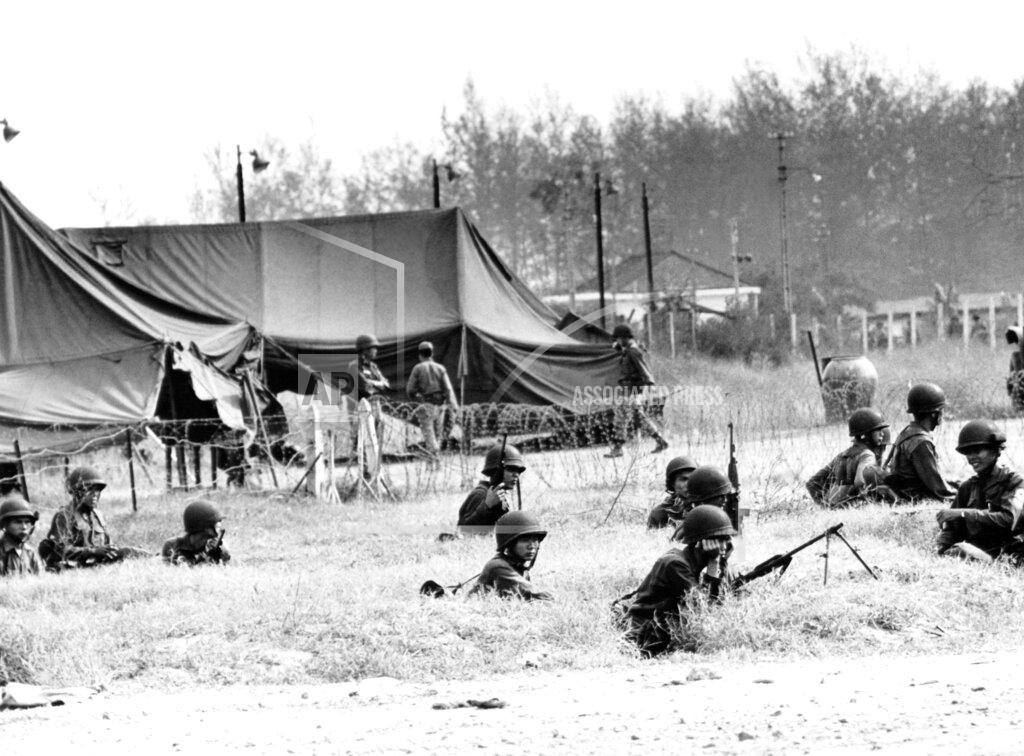
Lieutenant General Nguyễn Khánh regained control in Saigon today and called on the few remaining dissidents to surrender. A tape-recorded message from General Khánh was broadcast throughout the morning from the Government’s radio station, which his forces seized without gunfire from troops participating in a short-lived coup. Brigadier General Lâm Văn Phát, a leader of the coup, said at General Staff headquarters: “We have capitulated.” The whereabouts of Colonel Phạm Ngọc Thảo, the other leader, was unknown, according to The Associated Press. The dissident officers had had at their disposal 45 tanks, most stationed around their command headquarters at the offices of the Joint Chiefs of Staff. The chief of state, Dr. Phan Khắc Sửu, called a meeting of all factions to bring an end to the military uprising. He also asked that the opposing commanders withdraw their troops, a request that had not been heeded by midmorning.
The dissidents, many of them participants in an unsuccessful uprising against General Khánh last September, had held until dawn the strategic positions they seized yesterday with tanks and troops. Colonel Thảo, a former press attaché at the Vietnamese Embassy in Washington, had identified himself as the coup leader and had said that Lieutenant General Trần Thiện Khiêm, Vietnamese Ambassador in Washington, would replace General Khánh as military commander. But by last night the dissidents were indicating that they wished to negotiate a settlement. General Phát, who was expelled from the army for his role in the September action, met last night at Biên Hòa Air Base with Air Vice Marshal Nguyễn Cao Kỳ, the air force commander, who was loyal to General Khánh. General Phát proposed talks. With General Phát was Colonel Thảo. The men repeated to Marshal Kỳ their insistence that General Khánh be relieved of his post as commander in chief. A safe-conduct arrangement for the talks was made by Brigadier General Robert Rowland, commander of the United States Second Air Division, Reuters reported.
Early this morning the Seventh Airborne Brigade arrived here from Biên Hòa to show support for General Khánh. The troop movement indicated that Marshal Kỳ was again standing with General Khánh, as he did in September. The Biên Hòa forces headed immediately for the Government radio station. In addition, General Khánh sent a regiment of the Seventh Division from the Mekong delta to the capital. In a broadcast from the delta last night, General Khánh said he was sending troops to the capital and warned that if the rebels did not withdraw, he would attack. He set today as his deadline. Early this morning, a communiqué was read over the radio station, then in the dissidents’ hands, purporting to be from Dr. Sửu. It relieved General Khánh of his command. But as the airborne troops recovered the station, Dr. Sửu spoke in person and said he would call both General Khánh and the dissident leaders to ask them not to fight.
The position of the three-day-old civilian Government of Dr. Phan Huy Quát, the Premier, did not seem immediately affected by the military upheaval. The dissidents said that they would not unseat the new Premier, whose administration was approved by General Khánh and the Armed Forces Council.
Shipments of more than 80 tons of new Communist weapons and ammunition from North Vietnam were reported intercepted today after four days of fighting around a secluded cove along the coast of central Vietnam. Ground units advancing under Việt Cộng fire from surrounding high ground found caches containing nearly 3,000 individual and crew-manned weapons and at least 28 tons of ammunition, military spokesmen said. The arms were neatly packaged in waterproof nylon bags and stacked in several concealed depots within a few hundred yards of the water.
The wrecked hull of a heavily camouflaged patrol gunboat was found nearby. The craft was sunk at its concealed mooring by Vietnamese Air Force bombardment last Tuesday. In spotting the gunboat through the foliage an alert American helicopter pilot led the American and Vietnamese military commands to the largest weapons haul of the Vietnam war. First Lieutenant James S. Bowers of Lyndonville, Vermont, was on a routine helicopter flight south from Phú Yên, the capital of Tuy Hòa Province last Tuesday when he reported sighting the vessel moored under trees in Vũng Rô Bay, about 235 miles northeast of Saigon.
A United States military adviser was killed yesterday and another was wounded while accompanying a Vietnamese patrol that clashed with Communist guerrillas about 240 miles northeast of Saigon. In Quảng Tín Province, about 358 miles northeast of Saigon, government troops killed 34 guerrillas. The troops, supported by armored cars, suffered one killed and two wounded.
Two Việt Cộng mortar attacks were reported late last night on government units near Saigon. One hit the headquarters area of the 25th Division at Đức Hòa, about 15 miles west of the city, killing four Vietnamese soldiers and wounding 100. No American casualties were reported. The second was at Bến Cát, about 23 miles north of Saigon. Mortar rounds ripped into the Seventh Regiment headquarters area but no casualties were reported.
A faction of the armed forces attempted to remove Lieutenant General Nguyễn Khánh as commander in chief later today, after he had survived a military uprising. At a meeting of 15 members of the 20-man Armed Forces Council, with General Khánh present, a majority adopted a resolution of “no confidence” in him. Whether he could rally enough support to remain the nation’s leader was in doubt. Long before the attempted coup d’état — a brief and bloodless maneuver that began Friday — some of General Khánh’s colleagues on the council, notably Brigadier General Nguyễn Chánh Thi, were known to be looking for an opportunity to replace him.
At a council news conference this afternoon, General Thi declared: “Up to this minute, General Khánh is still commander in chief. In the near future we will talk about it.” Questioned about the no confidence vote, General Thi said: “This subject is very important and must remain a secret among the members of the Armed Forces Council.” The council meeting took place at Biên Hòa, the big air base near Saigon. The participants included the new civilian Premier, Dr. Phan Huy Quát, who took office last week under General Khánh’s supervision. There was no indication whether the Premier had voiced an opinion about the retention of General Khánh. Council members and the coup leaders maintained from the beginning of the uprising that the military shake-up did not affect Dr. Quát’s administration or the position of the chief of state. Dr. Phan Khắc Sửu.
General Khanh was not at the news conference. Council members said he was on an inspection tour in Phú Yên Province, where Government troops captured an 80-ton cache of Việt Cộng weapons, ammunition and other supplies. The general made a similar field tour last September after another coup attempt left his position unresolved. He proved able to retain command at that time, despite dissatisfaction in some military circles. This has made diplomatic observers cautious about predicting his immediate removal. According to pro-Government! officers, none of the coup leaders of the rebellion has yet been apprehended. The council said that if they did not surrender by 3 PM Sunday, they would be found and brought before a military court. Brigadier General Lâm Văn Phát, tactical leader of the coup, was seen shortly before noon in civilian clothes, getting into a vehicle at Tân Sơn Nhứt Air Base. With him was the former commander of the Seventh Division, Colonel Huỳnh Văn Tồn. Colonel Phạm Ngọc Thảo, General Phát’s chief accomplice, was last heard from at 8:30 AM when he slipped back into the Government radio station after it had been retaken by pro-Khánh troops. Broadcasting a final message to the nation, Colonel Thảo said the purposes of the uprising had been accomplished because General Khánh would soon be replaced. Then he disappeared.
[Ed: Thảo was years later revealed to be a Communist agent.]
In comments after the coup failed, the Armed Forces Council was inclined to suspend judgment on Colonel Thao’s superior in Washington, Lieutenant General Trần Thiện Khiêm. The general, Vietnamese Ambassador to the United States, was to return to Saigon as a leader if the coup succeeded. General Thi, who has been named “commander of the capital liberation forces” to deal with the windup of the revolt, said that General Khiêm’s statements in Washington, endorsing the rebellion, were “not official” and that no action against him was planned. Although the confusion seemed to offer the Việt Cộng an opening for sizable military advances, reports indicated that they had not seized it.
[Ed: This is no way to run a taco truck, let alone a country. I said what I said.]
Four United States F-101 jet planes on bombing missions over pro-Communist areas of Laos were shot down yesterday, the Peking radio said, quoting the Pathet Lao. Several other planes were damaged, the broadcast added. All the planes were said to have been shot down overSamneua Province, a Pathet Lao stronghold in northeastern Laos. The Peking radio said 12 F-101 jets and five T-28 planes, the latter of a type flown by Royal Laotian pilots, flew over Samneua Province between 1 and 8 PM. The broadcast said the planes were hit by Pathet Lao troops. It is known that there are radar-directed 37mm anti-aircraft guns in Laos and it is believed that they are manned by North Vietnamese troops.
The Defense Department confirmed today that a United States Air Force pilot, Maj. Robert F. Ronca of Norristown, Pa., was missing on a flight from a base in South Vietnam. The Department said it had no information on a Communist report that four F-101 jet fighters had been shot down in Laos.
Anastas I. Mikoyan, President of the Soviet Union, called today for a settlement of the crisis in Vietnam by “peaceful means.”
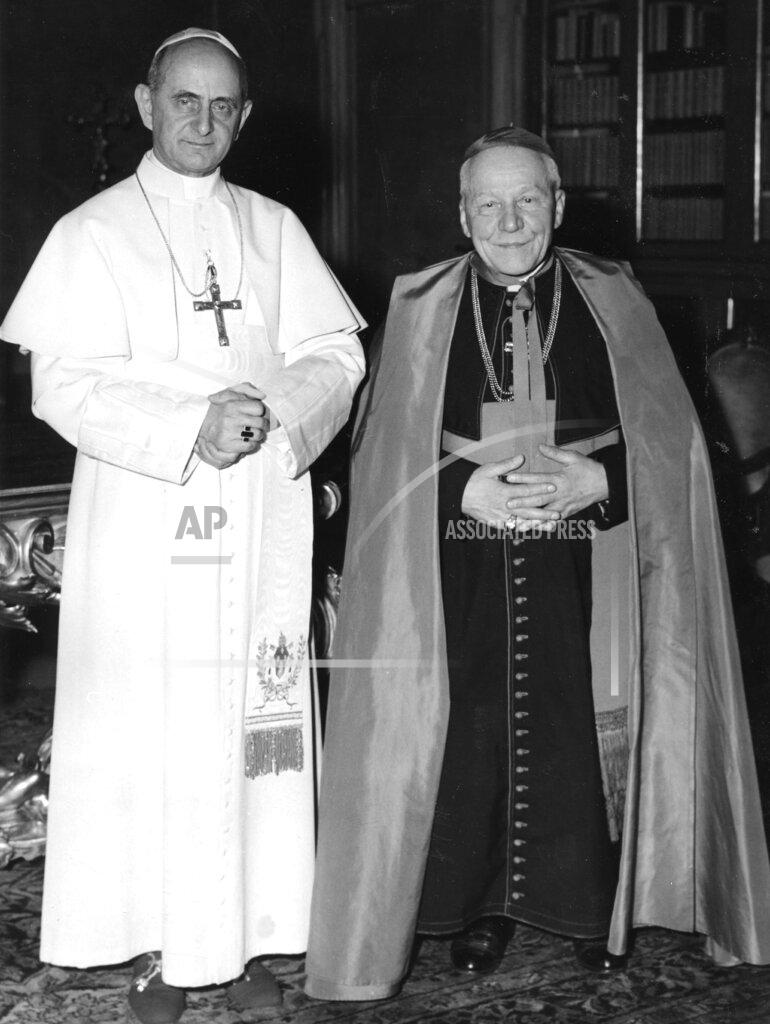
Pope Paul VI disclosed today that he had sought to make direct personal contact with various national governments involved in the Vietnam and other world crises to insist on peace.
The United States has again brushed aside French pleas for early negotiations over Vietnam and has indicated that its military actions there would depend upon Communist moves.
The Johnson Administration is considering retaliation against nations that have permitted mob attacks on United States embassies or have closed down United States Information Service Libraries. Deliberations on the matter have reached the White House level. They reflect the annoyance and concern within the Administration over the recent attacks on American offices. Thus far the United States Government has lodged protests, has demanded compensation for damages, and has issued warnings that violence can imperil diplomatic relations. The Administration suspects that these protests and warnings have gone unheeded in some countries and that it may be necessary to take a next step — to order certain retaliatory actions. In the case of some Communist countries, the Administration has already begun moving in this direction with private warnings that it is not prepared to consider expanded cultural and trade relations unless adequate steps are taken to curb mob attacks.
In Hungary, for example, where the legation was damaged in an attack last Saturday, the United States has made it clear, according to officials, that it is not prepared to consider at this time certain steps for increasing trade, cultural and diplomatic relations. Discussions are continuing in Budapest, but, for the moment, with much narrower scope. The effect of the attack was to add to long-standing weariness on the part of the United States. U.S. officials believe that the tactic being employed in Hungary is likely to be particularly effective in convincing the Communist countries that they must take adequate steps to control the attacks and protect American installations. Most of the Communist nations, including the Soviet Union, are interested in expanding trade and cultural relations with the United State.s As far as possible, it is the Administration’s desire not to take overt actions but rather to make its displeasure clear through inaction. This was the approach followed, for example, in the case of the United Arab Republic, where the John F. Kennedy Library in Cairo was burned last November. Partly as a result of this incident, the Administration has laid aside an Egyptian request for $35 million in additional surplus food.
The most immediate problem is Indonesia, and in this case officials are fearful that the Administration may be driven to overt action. Since August three United States Information Service Libraries have been seized and. closed by the Indonesian Government. The situation, in the opinion of Carl T. Rowan, director of the United States Information Agency, became intolerable this week when the library in Jakarta was closed and a mob stormed the library in Medan, tearing down the United States consular seal and putting up anti-American placards. The Government of President Sukarno has promised to reopen the libraries, but Mr. Rowan made it clear in an interview that he believed the time had come when the United States “should have more than promises.”
France has seized upon President Gamal Abdel Nasser’s current dispute with West Germany and his persistent difficulties with the United States and Britain to press her own diplomatic offensive in Cairo. A group of French businessmen met today with. Deputy Premier Abdel Meneim el-Kaissouny and other Cabinet officials to discuss a possible French role in the United Arab Republic’s second five-year plan, which starts this summer. Another French economic delegation, composed of Foreign Ministry experts, is scheduled to arrive Thursday to talk with the Egyptians about trade and possible French concessions on imports of Egyptian cotton and other farm products.
Japan and South Korea initiated today a draft treaty on basic relations. This was the most significant advance to date in negotiations toward mutual diplomatic recognition that have dragged on intermittently for 14 years.
Japan’s defense problem, under a Constitution that bans rearmament, has been emphasized by the furor over two secret documents said to contain a blueprint for national mobilization in the event of another Korean crisis.
Over 5,000 students from the Central University of Madrid marched in a silent protest after a planned lecture on cultural repression was prohibited by the Rector. Despite the peaceful nature of the defense, police forcibly dispersed the marchers and seriously injured some of them. The harsh response would lead to even more protests, including a boycott of classes by 17,000 students at the University of Barcelona.
A 24-year-old staff member of the Peace Corps in Caracas, Venezuela, was shot and killed last night by policemen who apparently mistook his party for terrorists. A Peace Corps volunteer, Joseph R. Rupley, 25, was wounded in the stomach during the encounter, which occurred near a police station in the Caracas suburb of San Bernardino after a day of political disturbances. The station had previously been shot at from a jeep by terrorists, and when a similar-looking jeep bearing the Peace Corps party passed, it was pursued and stopped.
The United Nations and Belgium entered into a global settlement of all claims brought by Belgian citizens for damages arising out of United Nations operations during the Congo Crisis, with $15 million dollars paid by the international organization.
The rebels in the Congo have discovered that they can disrupt a major part of the national economy by destroying the navigation markings on the Congo River and its principal tributaries.
A shy, 23-year-old private in the Ugandan Army, Stephen Bosco, was presented in Leopoldville today as proof of the Congo’s charges that her borders had been violated by Ugandan “Lumumbists.”
At Luluabourg (later renamed Kananga), the Congolese National Convention was formed by 49 tribal organizations, in association with the CONAKAT political party led by Moïse Tshombe, in order to win the 1965 legislative elections.
Communist China signed a treaty of friendship with the African republic of Tanzania today.
In Australia, Freedom Ride participants, including Charles Perkins, were ejected from the municipal swimming baths at Moree, New South Wales, after protesting against their segregationist policy of not admitting Aborigines.
Suat Hayri Ürgüplü was named as the new Prime Minister of Turkey, to form an interim government until new elections for the National Assembly could be conducted on October 10.
President Julius Nyerere concluded a visit to the People’s Republic of China with the signing of the Chinese-Tanzanian Treaty of Friendship.
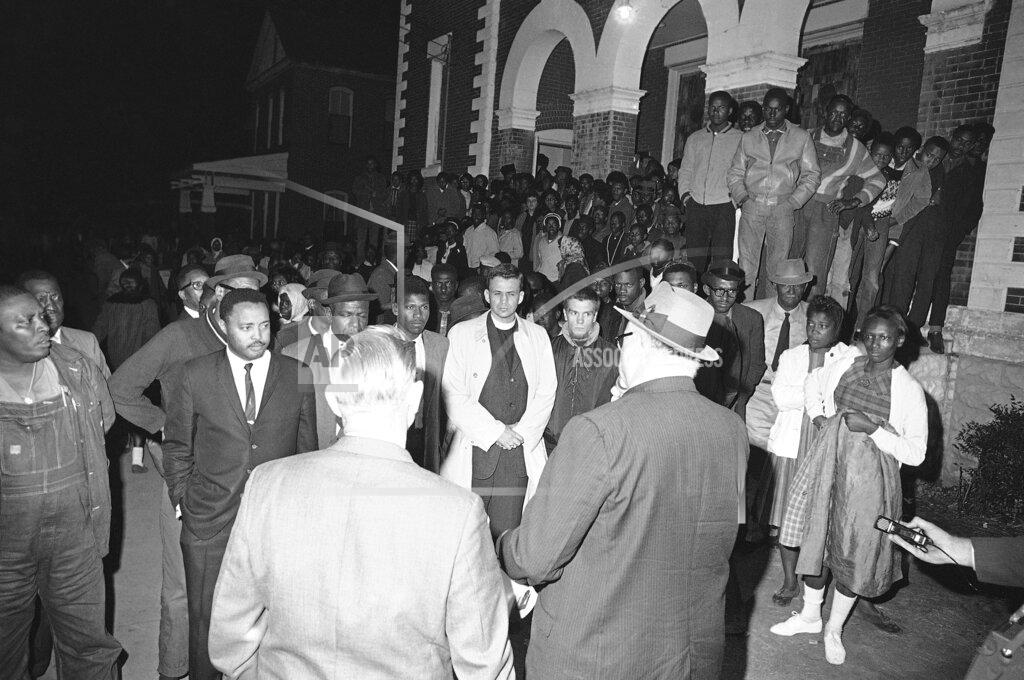
Governor George C. Wallace ordered state troopers today to stop night marches by Blacks in Selma and nearby Marion. Blacks have been demonstrating in the two communities for a speedup in registration of voters. In announcing the action in Montgomery the Governor said: “I have ordered state troopers to join law enforcement agencies of the counties and cities involved to stop nighttime demonstrations. Any demonstration evidently conducted for the purpose of creating a breach of the peace will be stopped.”
Night marches had been suspended by Black leaders for the weekend. Several persons were injured in Marion Thursday night when state troopers, called in by local authorities, dispersed demonstrators with night sticks. “No one,” Mr. Wallace said, “can contest the right of anyone to register and vote in Alabama if they are qualified under the laws of this state. No one can contest the right of peaceful assembly. However, mass demonstrations in the nighttime led by career and professional agitators with pro-Communist affiliations and associations is not in the interest of any citizen of this state, black or white… This is the same action taken by New York City in banning night demonstrations and marches,” he said.
In Selma, Wilson Baker, the director of Public Safety, prevented about 400 Blacks from marching into streets where Sheriff James G. Clark Jr. had scores of possemen stationed with guns and tear gas. Hosea Williams, a staff member of the Southern Christian Leadership Conference, Dr. King’s organization, led the Blacks from the church after requiring them to leave knives and other weapons inside. They were met at the steps by Mr. Baker and about 20 policemen. Mr. Williams refused to turn back and Mr. Baker ordered him arrested on a charge of unlawful assembly. Then he promised the others that if they would return to the church he would release Mr. Williams. Slowly the people filed back into the church. Mr. Williams was released immediately and went into a one-hour conference with Mr. Baker while the people sang freedom songs.
Mr. Williams, a former leader in the Savannah, Georgia, civil rights movement, announced to the audience that he and local leaders had left Mr. Baker with a list of demands on the white community. These included a stepup in voter registration, efforts to remove Sheriff Clark from office, pavement of streets in the Black section, rehiring of Blacks dismissed for participating in marches, hiring of Black policemen and firemen, and biracial negotiations. Mr. Williams said it was agreed that night marches would be suspended until Monday to give the whites time to comply.
Jimmy Lee Jackson, the 26-year-old Black who was shot in Marion Thursday night, remained in critical condition today.
To a stranger passing through Jonesboro, a little town of 4,000 in the pine forests of northern Louisiana, there is little evidence that the town differs in any way from hundreds of other Southern communities where segregation remains the way of life. White residents say “howdy” to each other and to white strangers when they pass on the sidewalk that connects the movie house, the feed and seed store, the auto accessory shops, and the chain drug store. Black résidents edge toward the curb when they pass a white man, and their heads bow ever so slightly.
In Jonesboro, as in hundreds of other small towns throughout the Deep South, the 1964 Civil Rights Act is obeyed only under the threat of legal action. Most eating places remain segregated; some have become “private clubs.” There is a “colored” sign over a ticket window in the bus station, and there are similar signs over the restrooms of the dimly lighted courthouse.
But Jonesboro is different. Here the Blacks, who make up about a third of the population, have organized themselves into a mutual protection association, employing guns and shortwave radios. The organization, called the Deacons for Defense and Justice, was quietly organized last summer. Percy Lee Bradford, a stockroom worker and the founder and president of the Deacons, said harassment from the Ku Klux Klan and allied groups had decreased markedly since the Deacons made their philosophy known. So far, the guns have not been fired. He expressed the philosophy simply: “We pray a lot, but we stay alert, too.”
The American Federation of Labor and Congress of Industrial Organizations is planning a major drive in coming weeks for an increase in the federal minimum wage and for other improvements in the wage and hour law. Members of the executive council of the A.F.L.-C.I.O. are expected to discuss the subject with Secretary of Labor W. Willard Wirtz when he confers with them on Monday at the opening session of the group’s winter meeting here. George Meany, president of the merged labor organization, has taken the view that the present minimum wage of $1.25 is below what government experts call a poverty wage for a family. When labor calls for a $2-an-hour minimum wage, according to Mr. Meany, it is not dreaming, being radical or unreasonable.
Ranger 8 photographed potential landing sites on the Moon for the Apollo program crewed missions before crashing into the surface. The probe “took a shallow trajectory that crossed the central highlands en route to the Sea of Tranquility, east of lunar meridian”, the area favored by the constraints of Apollo’s projected west to east orbit. As it steadily dropped in altitude, its cameras were turned on during the last 23 minutes of flight, and the probe transmitted 7,137 high resolution photos, gradually descending until it impacted, at 4:57 a.m. Eastern Standard Time, at a location 125 miles (201 km) east of the Sabine crater, “finally impacting 60 km [38 miles] northeast of where Apollo 11 would land four and a half years later.”
Four more Air Force Academy Cadets have been found guilty of violating the honor code and have resigned, officials announced today.
Attorney General Edward W. Brooke of Massachusetts charged today that Barry Goldwater’s bid for a “white backlash” vote was largely responsible for the Republican party’s crushing defeat last November.
The current monthly Journal of the American Bar Association has published an article contending that the equal-population principle for state legislatures is constitutionally sound. It predicts that chances for a constitutional amendment to change it are “dim indeed.”
The Labor Department has found that one-third of the first 100,000 trainees enrolled in the Federal manpower training program had been out of work for half a year or longer.
Officials of the United Mine Workers of America will begin to make plans next week to organize the 25,000 or more workers employed by small, nonunion soft-coal mines.These mines have become an increasingly painful thorn in the union’s flesh. The union estimates that they account now for about a quarter of the 480 million tons of bituminous coal mined annually. W. A. Boyle expressed his determination to bring the non-union mines under the union’s national bituminous contract in his first interview since he won his own mandate as president of the miners’ union last December.
Richard Cardinal Cushing was reported to be in good condition after having undergone a three-and-one-half-hour operation this morning in which a portion of his intestine was removed.
Henry Ford 2d, board chairman of the Ford Motor Company, and Mrs. Maria Cristina Vettore Austin, a 38-year-old Italian divorcee, were married in a quiet civil ceremony in a Washington hotel Friday night.
Henry Ford 2d has been automatically excommunicated from the Roman Catholic Church, a spokesman for the chancery office of the Archdiocese of Detroit said yesterday.
The Beatles record “That Means A Lot”; unhappy with the results, it was given to P.J. Proby to record; the original Beatles version was unreleased until 1996 on “Anthology 2”
Born:
Federica Moro, Italian actress and model (Miss Italy 1982), in Carate Brianza, Monza and Brianza, Italy.
Paul Faries, MLB second baseman, shortstop, and third baseman (San Diego Padres, San Francisco Giants), in Berkeley, California.
Tony Menéndez, Cuban MLB pitcher (Cincinnati Reds, Pittsburgh Pirates, San Francisco Giants), in La Habana, Cuba.
Mark Kachowski, Canadian NHL left wing (Pittsburgh Penguins), in Edmonton, Alberta, Canada.
Brian Hutson, NFL defensive back (New England Patriots), in Jackson, Mississippi.
Died:
Fred Immler, 85, German actor (“Zapata’s Gang”, “Madame DuBarry”).


 History Diaries