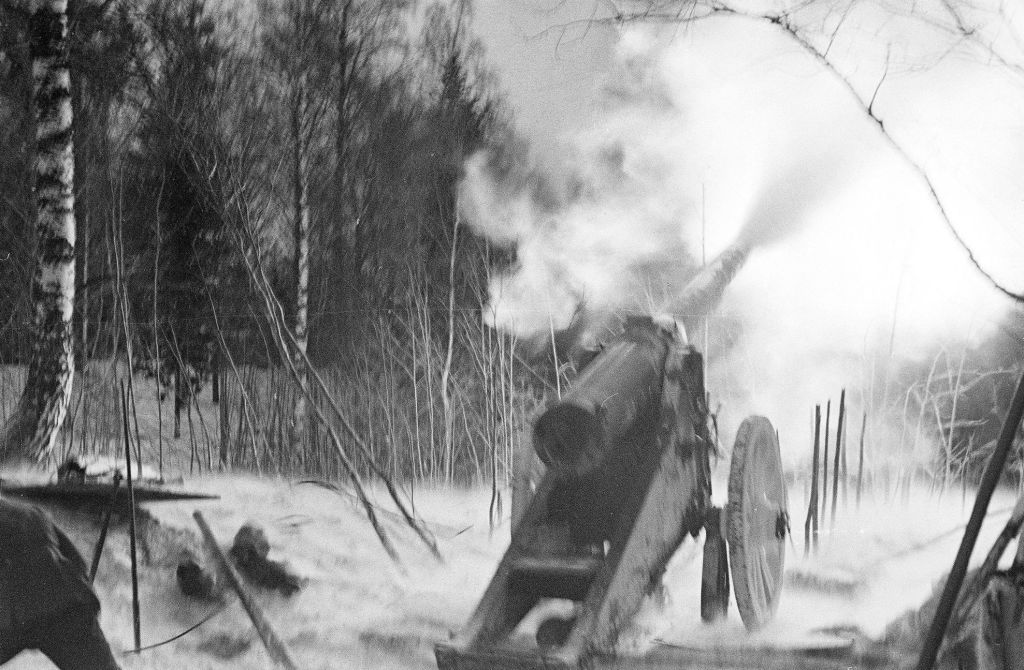
The Soviet 7th Army and 13th Army are preparing to renew their offensive.
The Soviets are gaining footholds within the V-line switch position.
Soviet units are building an ice road across the frozen Gulf of Viipuri.
Russian artillery tonight dropped shells regularly into the city of Viipuri, now a definite part of the front as a result of Soviet penetration into the Mannerheim fortified zone
Commander-in-Chief Field Marshal Carl G. E. Mannerheim promoted Jaeger Major-General Erik Heinrichs to Lieutenant-General and named him as the new commander of the Army of the Isthmus. A new I Army Corps was established on the Karelian Isthmus under the command of Jaeger Major-General Taavetti Laatikainen.
The commander of Group Talvela, Major-General Paavo Talvela, is appointed commander of III Army Corps. Talvela, too, is a jaeger.
On the Karelian Isthmus in Taipale, Finnish troops repulsed a strong enemy assault that was concentrated on the Terenttilä strongholds. The bodies of 300 Russian soldiers are left lying in the trenches.
The Finns have also suffered heavy losses: between 260 and 290 died yesterday in Kirvesmäki. The Larkko battalion which had been held in reserve, has lost 41 dead, 57 wounded and 45 missing in action.
The Soviet 18th Division attacked across the frozen Lake Suvanto in the Taipale Sector near Lake Lagoda in eastern Karelian Isthmus. Finnish defenders, with concentrated artillery fire, halted the attack after inflicting nearly 1,000 fatalities. The Soviet division suffers heavy losses on the Suvanto ice, which is black with the bodies of fallen Soviet troops. Between 700 and 1,000 dead enemy soldiers are strewn along the shores and the ice of the lake.
The Finns are forced to withdraw from Revonsaari island.
Further south the troops on the mainland pull back to Koivisto.
8,000 Swedish and 725 Norwegian volunteers begin relieving Finnish forces in Lapland for transfer to the Karelian front.
The volunteer Danish pilot Count Erhard Frijs is killed over Heinjoki when his Fokker fighter bursts into flames during aerial combat.
100 enemy bombers pound Uuras and Antrea.
King Gustav V of Sweden called a meeting of the Swedish Government in response to the controversy caused by the visit of Finland’s foreign minister, Väinö Tanner. King Gustav issued a statement confirming Sweden’s decision not to help Finland in its struggle the Soviets. He says: “from the first hour I informed Finland that she unfortunately could not count on military intervention from Sweden.”
Despite the King’s statement, schoolchildren in Linköping decided to publish an appeal for Sweden to help Finland and organized a collection to buy a fighter aircraft for Finland as a gift from the schoolchildren of Sweden.
Leading performers give a concert in Budapest to raise money for the Finnish Red Cross.
A Finnish spokesman in London said today that Finland’s supply of ammunition was dwindling so fast that shells were now being rationed in the Mannerheim Line.
Adolf Hitler orders more rapid progress with Operation Weserubung. Hitler, alarmed by the Altmark Incident of 16 February 1940, ordered his generals to hasten the planning of the invasion of Norway.
Field Marshal Hermann Goering, Germany’s economic dictator, today in effect decreed confiscation of all factories, farms and forest lands in former Polish territory now incorporated in the Reich.
A salient feature on the Western Front is German aggressiveness. Prior to the cold wave — and even while it lasted — the French had retained the initiative in the matter of scouting parties, both as regards number and daring. With the thaw the Germans have been reacting in an unusually determined manner. They are now launching raid upon raid and the resulting clashes are fierce, with relatively heavy losses in proportion to the forces engaged. For instance, the French announced today that one of their detachments was ambushed during the night with severe casualties-twenty killed and eight wounded. This appears to be one of the most important encounters that have occurred since the Allies’ strategic withdrawal in mid-October. The detachments sent out into No Man’s Land remain small on both sides, but the violence of the encounters probably has significance and the climax no doubt has yet to come.
The Norwegian legislature (the Storting) endorses the way the Norwegian coastal forces handled the Altmark Incident.
Accusing the British Government of acting in “open conflict with principles which it has itself so often proclaimed,” Norway served notice tonight she might put Britain on trial by taking the Altmark case before the League of Nations “or some other tribunal.”
Dr. Viorel Tilea, the Rumanian Minister, called on Viscount Halifax, the Foreign Secretary, today and handed him a note assuring Britain that Rumania had no intention of increasing her supply of oil to Germany under pressure from Berlin.
The Turkish Government tonight decided to apply the National Defense Law, which gives it virtually dictatorial powers, and newspapers warned the people that, as non-belligerent allies of Britain and France, they must prepare for a “supreme effort” this Spring.
Nighttime reconnaissance of the Heligoland Bight is performed by the RAF. Ice-bound German warships are bombed by 18 Wellingtons in bad weather without result.
Operation Nordmark, the sortie of heavy German warships, continues without spotting any convoys.
Four British trawlers were attacked off NE Scotland by a single Luftwaffe aircraft. The German bomber was driven off by the trawlers’ machine guns.
The Admiralty-requisitioned cargo ship Busk was scuttled as a blockship in Kirk Sound, Scapa Flow. She broke up in a gale in the winter of 1940–41 and was scrapped.
The British motorboat Fox sank in the Solent after a collision with the paddle steamer Lord Elgin. Her three crew were rescued.
At 0405 hours the unescorted British steam merchant Tiberton (Master Hugh Mason) was hit by one G7e torpedo from the German submarine U-23, commanded by Kapitänleutnant Otto Kretschmer. Tiberton broke in two and sank in 30 seconds about 33 miles east of Kirkwall, Orkney Islands, north of Scotland (58°07′N 2°39′W). The master and 33 crew members were lost. The 5,225 ton Tiberton was carrying iron ore and was bound for Immingham, England.
The Вое́нно-морско́й флот СССР (ВМФ) (Soviet Navy) Shchuka-class submarine ShCh-421 ran aground in Skorbeevskaya Bay. She was refloated on 6 March and taken in to Polyarny for repairs.
Convoy OG.19F forms at sea for Gibraltar.
The War at Sea, Monday , 19 February 1940 (naval-history.net)
Light cruiser GLASGOW arrived at Scapa Flow with rudder defects and then left for refitting at Belfast, where she arrived on the 24th. She later went on to Rosyth for refitting which was completed in early April.
Armed merchant cruiser ASTURIAS boarded and sent in for inspection Norwegian steamer SKRAMSTAD (4300grt).
Destroyer KIMBERLEY departed Scapa Flow on Northern Patrol.
Armed merchant cruiser WORCESTERSHIRE departed the Clyde on Northern Patrol.
Armed merchant cruiser ANDANIA arrived at the Clyde after Northern Patrol.
Destroyers GRIFFIN, INTREPID, IVANHOE, and VALOROUS arrived at Rosyth after a submarine hunt.
Destroyers JAGUAR and ILEX arrived at Rosyth.
Convoy OA.93GF sailed from Southend on the 16th escorted by destroyer WREN and sloop ENCHANTRESS, and OB.93GF from Liverpool on the 17th escorted by sloops ABERDEEN and DEPTFORD with twenty-eight ships. The two convoys joined on the 19th as OG.19F escorted by ABERDEEN and DEPTFORD, were joined by destroyer WISHART, and arrived at Gibraltar on the 24th.
A TM Convoy departed the Tyne escorted by the 19th Anti-Submarine Group and supported by destroyer JACKAL.
Convoy FN.98 departed Southend escorted by sloop PELICAN and destroyers VIVIEN and JERVIS, and arrived in the Tyne on the 21st. Convoy FN.99 did not sail.
Convoy FS.100 departed the Tyne escorted by sloops FLEETWOOD and HASTINGS and destroyers VALOROUS and JANUS, and arrived at Southend on the 21st.
Destroyer WOLVERINE joined convoy HX.19 at 0815 with destroyers VANOC and VANESSA joining shortly after. WOLVERINE attacked a submarine contact WSW of Cape Clear in 50 50N, 11 23W, while the other two destroyers continued with the convoy. Destroyer WINCHELSEA joined WOLVERINE to continue the hunt.
The 14th Anti-Submarine Striking Force attacked U-13 ESE of Duncansby Head in 58-30N, 1-30W, but did no damage.
Two German 250-ton U-boats were reported five miles off Vlieland in 53-16N, 05-00E at 1000 steering northwest and one 500-ton boat was reported six miles off Ijmuiden in 52-28N, 4-34E at 1300 steering southwest. French sloop AMIENS was ordered to join anti-submarine trawler LADY PHILOMENA to hunt for them, but did not join. AMIENS returned to Dunkirk early on the 20th.
Submarine SUNFISH at 0951 fired four torpedoes at U-14 in 54-28N, 07-11E.
Minelayer TEVIOTBANK was slightly damaged in collision with tug GOOLE No. 10 in Immingham Dock.
U-19 attacked tanker DAGHESTAN (5742grt) in 59 21N, 01 48W, but the attack failed due to torpedo defects.
Steamer TIBERTON (5225grt) was believed lost to unknown cause in the Moray Firth with all her crew. Uboat.Net and Rohwer’s “Axis Submarine Successes” confirm she was sunk by U-23 in 58.07N, 02.39W.
Swedish steamer START (1765grt) was seized in the Baltic by German warships, and taken to Bremerhaven.
Aircraft carrier HERMES arrived at Dakar after VO operations, escorted by destroyers DAINTY, DIAMOND, DEFENDER, and DECOY.
Today in Washington, the Senate considered minor bills, confirmed the nomination of Philip B. Fleming to be Wages and Hours Administrator, completed congressional action on the bill to establish Kings Canyon National Park, heard Senator Andrews urge adoption of a constitutional amendment to permit Congress to levy taxes for old age insurance, and adjourned at 4:21 PM until noon Thursday.
The House began consideration of the resolution to extend the reciprocal trade treaty program, passed a bill to expedite the airplane procurement program, approved a bill to authorize newly elected Presidents to present budgets of their own making and adjourned at 5:58 PM until noon tomorrow.
The Monopoly Committee resumed hearings on insurance company practices. The House Banking and Currency Committee questioned Jesse Jones, Federal Loan Administrator, on the Export-Import Bank Bill.
President Roosevelt began surveying today outlying Canal Zone defense possibilities on the Pacific side of the isthmus and their relation to a broader policy of Central American and hemispherical defense.
U.S. Republican House members, attacking reciprocal trade pacts, will lay the groundwork this week for one of their party’s big election year assaults on President Roosevelt and the New Deal. Some of their leaders conceded that there was little chance the house would defeat a resolution to extend the trade program for three years more. They were hopeful, however, that the house debate would arouse the country to the point where senate defeat of the measure would be assured. But if that fails, they said, they will nevertheless have laid the basis for one of the main fights of the presidential campaign. Debate on the resolution will begin late Monday and is expected to continue, with a possible interruption or two throughout the week. A preview of the prospective arguments was given in the majority and minority reports of the ways and means committee. The 10 Republicans insisted that the trade program had harmed the country and threatened greater harm.
Final action on the so-called Finnish Aid Bill was delayed again today as the House Banking and Currency Committee decided to seek further advice from the State Department as to its diplomatic and legal phases.
The House passed and sent to the Senate today a bill designed to insure that a new President should present his own budget to Congress after assuming office instead of having to operate under his predecessor’s budget for the first fiscal year of his term.
Defending technological progress and the efficiency of our Industrial processes as a boon to employment and an important factor in the creation of the substance from which government taxes are collected, Dr. Karl T. Compton, president of the Massachusetts Institute of Technology, tonight accused President Roosevelt of showing in his recent message to Congress a “profound lack of understanding and appreciation” of this progress. Dr. Compton outlined his views on modern progress at a dinner here in honor of thirty-seven inventors and research men of this area “whose work has enlarged employment or improved the standard of living.” The thirty-seven received scrolls from the National Committee on Modern Pioneers. Five hundred such awards are being made throughout the country this month at celebrations to mark the 150th anniversary of the establishment of the United States patent system. Leading up to his attack on the views expressed by President Roosevelt, Dr. Compton declared that it was disturbing to find our political leaders without a real appreciation of the part which science and invention might play “in a favorable environment” in solving the problems of unemployment and to increase earnings.
The House committee investigating the National Labor Relations Board tonight issued subpoenas for three Cabinet officers “or their representatives” to appear tomorrow for testimony in connection with charges by the committee’s counsel that NLRB had attempted to “blackjack” employers.
In today’s issue of TIME magazine, the article “Alcoholics Anonymous” Tells of the John D. Rockefeller dinner with 60 people, guests were members of Alcoholics Anonymous, with photo of Rockefeller. It describes how the organization was founded and how it works. This is the first issue of TIME magazine with an article about Alcoholics Anonymous.
The Amalgamated Clothing Workers of America, the largest C.I.O. affiliate in New York City, has served notice that it will not join with other C.I.O. unions in the formation of a local industrial union council, it became known yesterday.
A lashing gale driving stinging pellets of rain swept over the northeastern sector of the country yesterday in a repetition of the Valentine’s Day blizzard of last week, but without snow except in upper New York State.
Ernie Nevers resigns as head coach of the NFL Chicago Cardinals.
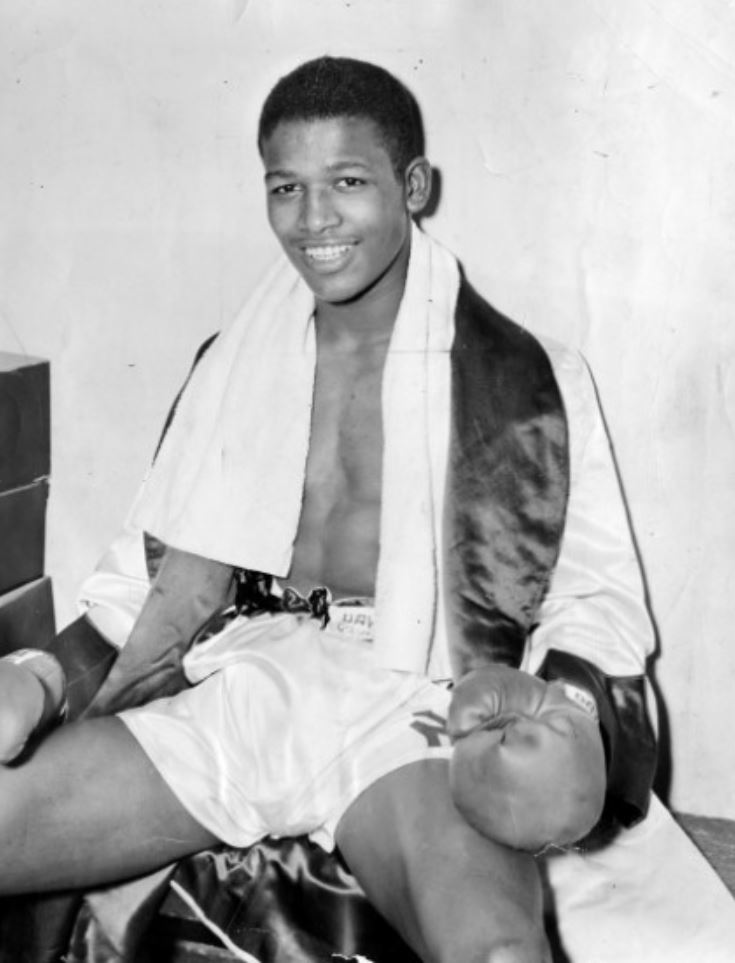
Sugar Ray Robinson (Walker Smith Jr.) wins New Yorks’ Golden Glove Tournament at Madison Square Garden.
The Mexican Attorney General’s office announced today the arrest and subsequent release of five supporters of the independent Presidential candidate, General Joaquin Amaro, who were suspected of plotting an armed revolution.
Chinese and Japanese officialdom seem to be attempting to outdo each other in extravagant claims or jeering denials of claims concerning the situation around Nanning, in Kwangsi Province. This disastrous warfare has become overclouded with accusations and outright lying until the actual situation is obscure. In Shanghai this evening the official Japanese Army spokesman insisted that the situation around Nanning up to last night was entirely quiet, thereby deriding the Chinese claim that the city was recaptured on Saturday. He said:
“The Chinese claims of victories are only a source of amusement to the Japanese Army because they are so utterly ridiculous. As an example of the absurdities that the Chinese propaganda machine is spreading, I will cite their statements to the effect that an antiwar revolution has broken out in Tokyo, for which reason, they say, the bulk of the Japanese forces in the Nanning area is being hurriedly returned to Japan. They also charge that our Emperor has been assassinated by the anti-war party, and they even say that Japanese naval vessels off Southern Kwangtung are flying their flags at half-mast. Their propaganda is unashamedly false and usually does not merit the dignity of a denial, nor deserve any more serious refutation than the mumbling of a man in his sleep.”
Shanghai has been partly amused and partly alarmed at the multiplicity of the propaganda rumors today, which seemingly originated with speculators in currency fluctuations. The most nearly credible report of actual conditions in Kwangsi insists that when Wang Ching-wei (slated by the Japanese to become the head of a Central Chinese government) last went southward he carried $20,000,000 in Chinese currency from his Japanese backers, which was given to Kwangsi troops, who assertedly had not been paid for eleven months.
Generalissimo Chiang Kai-shek, according to this report, withheld funds, fearing that Generals Pai Chung-hsi and Li Tsung-jen, Kwangsi leaders, might become too powerful. As a result of judicious use of this huge slush fund, it is said, the Japanese forces landed in Southern Kwangtung virtually unopposed and captured Nanning after a sensationally rapid advance inland through narrow mountain passes. Alarmed at this threat to its supply routes, Chungking is said to have raised a fund of $40,000,000, which was sent by airplane to Kwangsi and with which Chungking re-bought the loyalty of Chinese troops in that province, and they are now said to be encircling the Japanese forces at Nanning and cutting off their supply lines to the coast.
While advancing Chinese troops continued to battle Japanese units almost at the gates of Nanning, according to military dispatches from Kwangsi Province late today, further evidence of disaffection in the ranks of the invading army was reported.
Fires were said to be continuing to break out from time to time in Nanning and Chinese troops near the city claimed Japanese barracks. in the suburbs were among the buildings burned. A number of anti-war handbills, ascribed to subversive elements within the Japanese ranks, were reportedly found by Chinese soldiers in areas penetrated by the Japanese in their recent offensive from Nanning. Kwangsi dispatches claimed some of the bills referred to the putting to death of Japanese wounded by the Japanese command. Confusion in last week’s Japanese retreat to Nanning is cited as evidence of breaches in Japanese discipline. Observers here point out that the Japanese Army in South Kwangsi contained some thousands of Manchukuoan troops, among whom indiscipline may have arisen.
Although official confirmation was lacking, Chinese telegrams reaching Kweilin reported tonight that Nanning was completely under Chinese control. These dispatches claimed that 10,000 Japanese troops had withdrawn in a rout-like retreat. It was said they would return to Japan, and that two divisions of Japanese troops would remain for the defense of the Canton area.
Japanese dispatches reported today that the French-operated Hanoi-Kunming Railroad had been bombed for the second successive day and a bridge and tunnel damaged severely. Both the French and American Governments protested to Japan over previous air attacks on the railroad, which connects Chungking with French Indo-China. The Japanese said the latest raid was made yesterday. At the same time Chinese authorities announced passenger service on the road had been resumed after a week’s holdup while previous bombing damage was repaired. The Chinese said damage from a Japanese raid Saturday was slight.
Japanese and Chinese sources reported Japanese troops had effected a landing near Amoy and were invading the southeast Province of Fukien for the first time.
Japanese military spokesmen flatly denied a Chinese report that Japanese troops were withdrawing from Nanning.
The Japanese Foreign Office drops attempts to reopen trade negotiations with the United States as futile. Japan has made her “final offer” in an attempt to remedy the nontreaty status of trade with the United States, and “the situation now depends upon the future attitude of the United States Government,” Yakichiro Suma, the Foreign Office spokesman, said today.
Dow Jones Industrial Average: 148.46 (-0.26)
Born:
Smokey Robinson, American soul singer-songwriter (The Miracles – “You Really Got A Hold On Me”; “Tears Of A Clown”; “My Girl”), record producer and executive, in Detroit, Michigan.
Bobby Rogers, American pop and soul tenor vocalist (The Miracles – “You’ve Really Got a Hold on Me”), and songwriter (“Going To A Go-Go”; “The Way You Do the Things You Do”), in Detroit, Michigan (d. 2013).
Carlin Glynn, American actress (“The Best Little Whorehouse in Texas”-stage; “Three Days of the Condor”, “Sixteen Candles”), mother of actress Mary Stuart Masterson, in Cleveland, Ohio (d. 2023).
Saparmurat Niyazov, Turkmen politician (First Secretary of the Central Committee of the Communist Party of Turkmenistan, 1985-1991; President of Turkmenistan, 1990-2006), in Gypjak, Turkmen SSR, Soviet Union (d. 2006).
Chico Vaughn, NBA and ABA shooting guard and point guard (ABA Champions-Pipers, 1968; ABA All-Star, 1968; NBA: St. Louis Hawks, Detroit Pistons; ABA: Pittsburgh-Minnesota Pipers), in Portland, Oregon (d. 2013).
Bill Kelso, MLB pitcher (Los Angeles-California Angels, Cincinnati Reds), in Kansas City, Missouri.
Died:
Count Aage of Rosenborg, 52, Danish prince and officer of the French Foreign Legion.



 History Diaries