South Vietnamese and Western officials believe that parts of at least four North Vietnamese divisions are carrying out a carefully planned series of moves that will cut the only roads into the vast Central Highlands and isolate its population. At the same time Communist engineers have largely completed work on a 50‐mile road through the jungle and mountains that will effectively encircle Pleiku and Kon Tum, two of the highlands three cities. It is one of a network of roads the North Vietnamese have been building since the Paris peace agreements halted American bombing two years ago. So far in the Communists’ current campaign, which began, to intensify last December, they have not launched any sizable attacks in the highlands. Instead, intelligence officers say, they have veiled their movements through the heavy jungle, avoiding contact with government units and sending misleading radio messages. South Vietnamese commanders here in Pleiku, the military and economic center of the region, assert that the chess‐like maneuvers and the road pose a grave threat.
“If they do cut the roads, it is going to be very costly to dislodge them,” a staff officer remarked. “They could strangle us slowly.” Cutting highlands roads has been a favorite Communist tactic since a French armored column was destroyed in 1954 on Route 19 between Pleiku and the coast. During the 1972 offensive by the North Vietnamese they again cut the highway for several weeks and also closed Route 14 between Pleiku and Kon Tum. The sparsely populated highlands is ready‐made for ambushes because there are only two roads giving access to the coast — Route 19, which winds through the mountains from Pleiku to Quy Nhơn, and Route 21, up to Buôn Ma Thuột. Route 14, the only other usable road, runs north‐south, connecting Kon Tum, Pleiku and Buôn Ma Thuột.
The combined population of the three provinces most immediately affected — Kon Tum, Pleiku and Đắk Lắk (Darlac) — is 620,000. Pleiku and Kontum already have the look of dying frontier towns: dusty, spiritless and inhabited only by soldiers and camp followers. Pleiku’s fragile prosperity collapsed with the withdrawal of United States troops. Any morning now South Vietnamese soldiers, like the numberless stray dogs scavenging in piles of uncollected garbage, can be seen hunting for metal to sell as scrap. According to intelligence reports, the Communists appear, to be making four thrusts to interdict the highways:
- A regiment of the Third North Vietnamese Division has been detected moving south in Bình Định Province toward the lower end of Route 19.
- At the upper end of the highway, where it emerges from the Mang Yang Pass, two regiments attached to the 10th Division have been reported. They were apparently transported there by truck over the new road, which sweeps in a southeasterly are from north of Kon Tum toward Route 19 east of Pleiku and connects with it, over a dirt road.
- Between Pleiku and Buôn Ma Thuột on Route 14 the 320th Division has taken up ambush positions straddling the road, intelligence reports suggest.
East of Buôn Ma Thuột on Route 21, the 25th Regiment, an independent unit, is believed to be preparing to stop traffic. Another fresh North Vietnamese division, the 968th, has recently been detected moving into Pleiku from Laos. There are also indications that Communist units may attempt to swing farther south and isolate Quảng Đức Province, along the Cambodian border. Western analysts in Saigon say the Communists’ apparent moves accord with what is known about their strategy for 1975. The interdiction policy is outlined in a Communist resolution obtained by intelligence agents. The Communist moves are particularly worrisome because the Government of President Nguyễn Văn Thiệu seems unable to do anything to forestall them. For one thing, the 45,000 North Vietnamese combat troops estimated to be in the military region largely made up of the highlands are, nearly equivalent to the government force there, but most of the South Vietnamese are tied down guarding cities, roads and bridges.
The South Vietnamese have also been hurt by the sharp reduction in air support as a result of cutbacks in United States aid. Government officers say they have only one helicopter gunship available at night for the whole military region, and many helicopter pilots fly only six or eight hours a month. This has made it much more difficult to find Communist concentrations. The corps commander, Major General Phạm Văn Phú, is trying to train his troops in long‐range patrolling and commando techniques. General Phú, a stiff, direct but frail‐looking man who was captured as an officer with the French Army at Điện Biên Phủ, has had some small successes. South Vietnamese patrols are said to have cut the Communists new oil pipeline from the North Vietnamese border on six occasions recently.
North Vietnamese supply lines and caches have become easier to find and attack since the cease‐fire and the end of American bombing because Hanoi has been building roads in the western part of South Vietnam rather than in Laos. The North Vietnamese are also said to be less careful in guarding them and to have moved many antiaircraft guns near Saigon. Officials familiar with the program to train commandos are skeptical, for the South Vietnamese Army, encouraged by the Americans to depend on trucks and helicopters to ferry it into battle, has been notoriously lax in patrolling. The South Vietnamese in the highlands are beset by two other problems: growing heroin addiction among both pilots and combat troops and mounting disaffection among the Montagnard soldiers.
Cambodian insurgent antiaircraft fire hit two American cargo planes and two helicopters on supply missions to the besieged Mekong River port of Neak Luong today, military sources said. Insurgent gunners reportedly fired mortar rounds into the town at the rate of one a minute to block landings by supply planes. The sources said that the four aircraft had been hit by machine‐gun fire but had managed to drop their supplies by parachute and had been back to bases in Saigon and in Thailand.
The United Nations Security Council today scheduled its opening debate on Cyprus for tomorrow and members began consulting on some new negotiating basis for talks between the Greek and Turkish Cypriots. In requesting a Council debate, the Greek Cypriots had charged that the Turkish Cypriots proclamation of a separate state in the Turkish‐occupied part of the island had “wrecked” the existing negotiations. Many delegates agreed that some new forum would have to be devised to replace the negotiations that had been going on between Glafkos Clerides, the Greek Cypriot leader, and Rauf Denktaş, the Turkish Cypriot representative. The Greek Cypriots were said to want the Council to fix a deadline for Turkish compliance with earlier United Nations resolutions urging withdrawal of the Turkish troops and return of the 200,000 Greek Cypriot refugees who were expelled from their homes by Turkish forces. Privately, diplomats agree that neither the Western powers nor the Soviet Union is likely to try to compel Turkey to yield and the best that can be expected is that she will make some concessions as a gesture.
Portugal’s ruling Armed Forces Movement said it would take action against liberal politicians who are predicting civil war for the country. The threat appeared aimed at Francisco Carneiro and Foreign Minister Mario Soares who head the two parties that share posts with the Communist Party in the coalition cabinet dominated by the military. Both men have frequently said the military’s recent shift to the left has started to create a climate for civil war or possible coup.
Ferry service between France and Britain was halted as striking fishermen blockaded France’s major English Channel ports. About 30,000 fishermen began a three-day strike Tuesday to back demands for minimum prices for their catch and for compensation for higher fuel costs. They also are protesting low-priced fish imports from Britain, Belgium and Holland.
Twenty Moscow artists, working with the city’s Committee of Graphic Artists, were allowed to display some 60 paintings-most of them far off the standards of approved socialist realism-for one week on the walls of the beekeeping pavilion on the far edge of the giant Park of Economic Achievements. An enthusiastic crowd attended what was the most ambitious show of its kind since the unprecedented outdoor exhibit in a Moscow park last September 29.
An inquiry into the death of the bishop of Montauban, Msgr. Roger Tort, 56, whose body, reportedly “dressed with haste,” was found last month in the hallway of a hotel in a Paris area known for its sex shops and prostitutes, failed to give a clear picture of the circumstances of his death. But the report, signed by the archbishop of Paris, asserted that the facts surrounding the case “cannot justify interpretations throwing discredit on the evidence of a lifetime.”
Milan police reported the recovery of a large number of ancient pots, statuettes, paintings and other works of art which were stolen or taken in illegal excavations in Italy. A search of several apartments in nearby Brescia and a country villa produced half a dozen Renaissance paintings and a number of gilded candlesticks, crucifixes and other items. Most of the art objects were stolen from churches and private homes in northern Italy, police said.
A blonde armed with a submachine gun and accompanied by three men, burst into the Casale Monferrato jail in Italy and freed guerrilla leader Renato Curcio in a daring, commando-style operation, police said. Police said the woman who led the five-minute daylight raid may have been Curcio’s 30-year-old wife, Margherita.
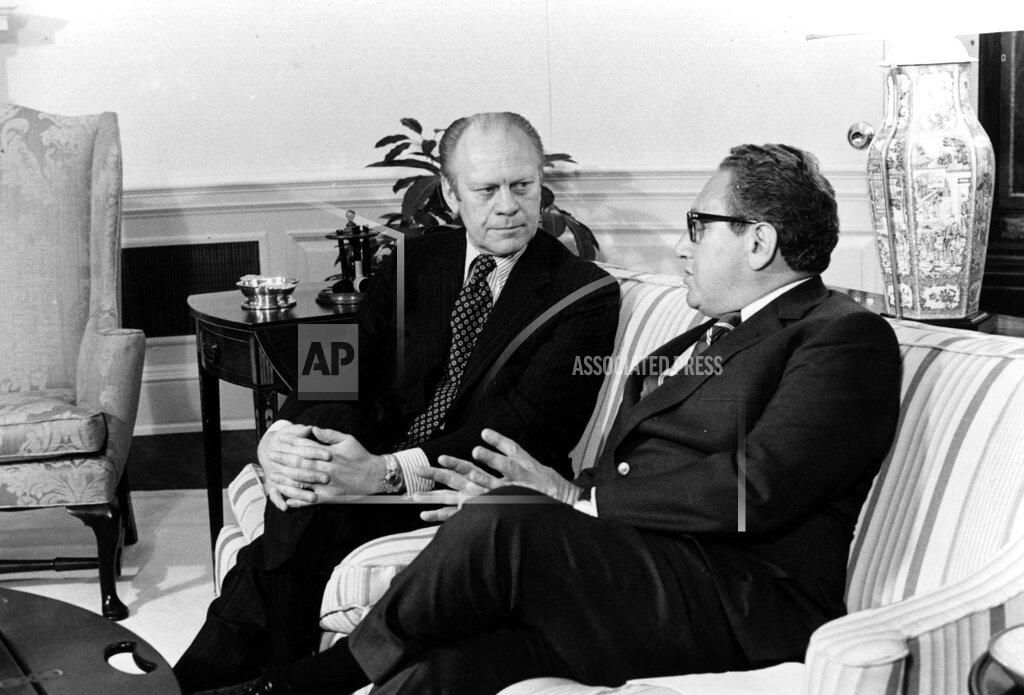
Secretary of State Kissinger returned to Washington today, heartened by “some progress” in his latest efforts to achieve a new Egyptian-Israeli accord but troubled by a Syrian campaign to thwart such an interim agreement. Returning to Washington from the Middle East and Europe, Secretary of State Kissinger reported “some progress” toward a framework to negotiate an Egyptian-Israeli accord. There were indications of concern at Syria’s position, with Soviet support, against a step-by-step settlement. He said relations with the Soviet Union were central to American foreign policy and said the Soviet Union had to take a part in the final settlement in the Middle East.
Sovet Union will supply Egypt with enough arms between now and June to make up for most of the losses sufered in the 1973 war with Israel, according to East European and Lebanese press sources here. However, some of the weapons are not as advanced as those requested by President Anwar el‐Sadat and the Egyptian army, the sources said. Egyptian refusal to accept Soviet military technicians with the requested weapons was a reason for Moscow’s reluctance to supply them, the sources reported.
The Canadian Government announced today a spending plan of $28.2 billion for the 1976 fiscal year, an increase of $2.8 billion, or 11 percent, over the expenditures planned for the fiscal year ending March 31.
Air traffic in eastern Canada was virtually halted and postal service in Toronto slowed to a trickle in the third day of a federal blue collar workers’ strike. Negotiations to end the strike resumed in Ottawa with a federal mediator. Both sides agreed to a 48-hour news blackout on talks, the first since the strike began Monday.
Two Congressmen urged the Senate Foreign Relations Committee today to reject the nomination of Nathaniel Davis to a high State Department post, alleging that he had been involved in covert political operations as Ambassador to Chile.
Police sources in Argentina’s industrial city of Cordoba said unidentified leftist guerrillas opened fire on a police patrol car with four officers inside, killing one and injuring the other three. Hours earlier, a powerful bomb ripped through the taxi drivers’ union headquarters there, causing extensive damage. No injuries were reported. The union chief blamed the bombing on leftist extremists and said it touched off a protest taxi strike that resulted in the shooting death of another union official in a dispute with a driver.
Shops and offices were closed and few people were on the streets in Asmara today after a night of fierce gun battles between Government troops and secessionist guerrillas, Ethiopian and foreign residents of the city reported by telephone. Casualties were thought to be high because of the intensity of the firing, which apparently began about 11 PM and continued until after dawn. The residents said that a 28‐year‐old Italian printer, Giuseppe Vaccaro, was among the casualties. He was reportedly killed by a stray bullet while waiting in a doorway to run for cover to a nearby cathedral. The only other known European killed in Asmara in recent weeks was also Italian. Ethiopian casualties since the fighting in Eritrea, the country’s northernmost province, started on February 1 are thought to total about 2,000. Government officials continue to withhold comment. Residents reported that Asmara was quiet tonight. They said that government troops were in control of the city, but that the guerrillas were able to start gun battles, especially at night.
The Senate voted to suspend for 90 days President Ford’s power to increase fees on imported oil by a 66 to 28 margin. Although this would be ample to override the promised Ford veto, Republicans in the Senate said the President was ready to compromise slightly to pick up the votes to sustain it. The President was said to be willing to shift some of the increased cost to gasoline.
The House Ways and Means Committee gave its final approval today to a $21.3-billion anti-recession tax-cut bill and in the process apparently set the stage for a fight next week over repeal of the oil depletion allowance.
The public’s disapproval of President Ford’s performance slightly outweighs approval — 43% to 39% — a Gallup Poll survey shows. The same survey also found that disapproval of Mr. Ford’s handling of economic matters outweighed approval by nearly 2 to 1. The findings were based on interviews with 1,541 adults in more than 350 locations taken in the period of January 31–February 3. His latest standing represents little change from previous surveys in December and January when the approved-disapproved proportions were about equal.
The House established a 10-member Select Committee on Intelligence to investigate all government intelligence agencies. Speaker Carl Albert of Oklahoma appointed Rep. Lucien N. Nedzi (D-Michigan) chairman. Two California Democrats on the panel are Don Edwards and Ronald V. Dellums. The House committee will join a special Senate committee and a presidential commission headed by Vice President Rockefeller. The investigations have been triggered by published allegations that the CIA and other agencies have systematically conducted illegal intelligence-gathering operations against American citizens in the last decade.
A federal grand jury in Washington indicted the lawyer who prepared former President Richard Nixon’s tax returns and the appraiser who valued the pre-presidential papers claimed for tax deduction. The jury said that Frank DeMarco, a Los Angeles lawyer, and Ralph Newman, a Chicago appraiser, prepared false documents backdating the gift of the papers to qualify for a deduction after the law permitting it had expired.
The Supreme Court ruled 7 to 2 that the Internal Revenue Service may compel banks to provide records about a much larger group of depositors while investigating suspected tax cheats. The dissenters said this would let the I.R.S. take “a shot in the dark” by unwarranted examination.
Significant reforms to the U.S. Freedom of Information Act went into effect, after both the House and the Senate had overridden a veto by President Ford in November.
The House of Representatives voted $347 million in grants and loans to help bail out the Penn Central and other bankrupt railroads. The 270 to 137 vote followed bitter debate in which opponents called it throwing good money after bad. A joint conference will be needed to resolve the difference with the Senate, which voted $275 million three weeks ago for the railroads.
The Defense Department for the first time publicly listed its foreign technical assistance and training contracts, reporting that foreign military personnel were being trained in 34 countries under contracts worth $727 million. The two largest programs are with Iran ($314 million) and Saudi Arabia ($362 million). The Saudi program includes the $77 million contract with the Vinnell Corporation to train four battalions of the Saudi Arabian National Guard.
Bernard Bergman and an aide refused to answer questions today at a Senate hearing about their nursing‐home operations, citing their Constitutional rights under the Fifth Amendment. Nevertheless, the hearing did produce new information about Mr. Bergman’s personal wealth and his business practices. Mr. Bergman and the aide, Mark Loren, were the only witnesses at a televised session of the Senate Special Committee on the Aging, which according to Senator Frank Moss, who presided, was seeking to learn why the Medicaid‐financed systern of nursing homes was “a colossal failure in the eyes of many of our older citizens.”
Representative George V. Hansen, Republican of Idaho, pleaded guilty today to two misdemeanor charges of violating the 1971 Federal Election Campaign Act by failing to file proper finance reports with the House Clerk.
A man described as a major New York City distributor in an international film piracy syndicate was arrested at his midtown laboratory, police said. FBI agents and police found 700 videotape copies of at least 516 separate films — including many current releases — in the offices of Picsonic Reproductions Corp. The owner, Sol Winker, was arrested on charges of violating laws pertaining to copyright infringements. Cassettes of the films, made at a cost of $17 each, allegedly sold at prices ranging from $100 to $225. Police said the piracy syndicate cost movie studios an estimated $1 billion a year.
Twelve percent of the pupils in New York City’s public junior and senior high schools are either potential or established alcoholics, a survey disclosed. Researchers Essie E. Lee and Gilbert M. Shimmel of the Hunter College faculty said 80% of the males and about 75% of the females admitted drinking. The survey of 10,000 students indicates that drinking habits begin even before they enter junior high, the report said. The drinking pattern is similar among all pupils questioned, the only difference being, according to Lee, “the more affluent drink a better grade of Scotch.”
Union leaders said they would ignore threatened criminal and civil contempt proceedings and press forward with the two-day-old strike by more than half of Delaware’s public school teachers. “All indications are that the strike is gaining momentum. said teachers’ spokesman Paul Ryan. “We believe the anti-strike provisions in the law are outrageous and we intend to fight the law itself. A school spokesman estimated that 79,000 of 131,000 students were out of classes A committee named by Governor Sherman W. Tribbitt met to discuss methods of paying for an 8% pay increase vetoed earlier by the governor.
Arlie Schardt, former director of the American Civil Liberties Union’s national office in Washington, D.C., was named director of the 54,000-member Environmental Defense Fund. The EDF is a nationwide organization of lawyers, economists and scientists which helped secure the ban on sales of two pesticides last year and was responsible for the report suggesting that cancer-inducing materials in New Orleans’ drinking water might be responsible for that city’s high cancer mortality rate. Schardt, a former journalist, was a leader in the ACLU’s campaign to impeach former President Richard M. Nixon.
Sulphuric acid spewed into the atmosphere by auto exhaust controls could create a great potential health hazard, a medical researcher told the Environmental Protection Agency. Dr. Bernard D. Goldstein testified in Washington that sulphuric acid at almost any level is harmful. An EPA study indicated catalytic exhaust converters, used nationwide on 1975 vehicles, give off sulphuric acid. The converters also convert carbon monoxide and hydrocarbons into relatively harmless substances.
Mohammed Ali, the world heavyweight boxing champion, disclosed yesterday that negotiations were under way for a title defense against George Foreman later this year in an “ancient setting” that closed-circuit TV promoters identified as Cairo.
The commissioners of baseball and football told the Commission on the Review of the National Policy Toward Gambling that betting on their games was a reality, but making it legal would be a disaster. Bowie Kuhn, for baseball, and Pete Rozelle, for football, said the integrity of the professional game must be maintained and warned spectators would suspect a fix if a player muffed an easy play.
Dow Jones Industrial Average: 736.39 (+5.09, +0.70%)
Born:
Sergey Prokopyev, Russian cosmonaut (Soyuz MS-09 (Expedition 56/57), 2018; Soyuz MS-22/Soyuz MS-23 (Expedition 67/68/69), 2022-2023), in Sverdlovsk, Russian SFSR, Soviet Union.
Daniel Adair, Canadian drummer and percussionist (Nickelback; 3 Doors Down), in Vancouver, British Columbia, Canada.
Adrian Ross, NFL linebacker (Cincinnati Bengals), in Santa Clara, California.
Ruslan Batyrshin, Russian NHL defenseman (Los Angeles Kings), in Moscow, Russian SSR, Soviet Union.
Died:
Luigi Dallapiccola, 71, Italian composer.







 History Diaries