Heavy fighting continued on the Karelian Isthmus. Finnish forces are still forced to retreat but the Soviet attack comes to a halt at the “V-Line,” the prepared Finnish intermediary defensive positions. The Soviet advance has completely cleared the Mannerheim Line. All the Finnish defenders are now established in their second line of defense. The Finnish 23rd Division, brought forward from the reserve, has been slow to arrive because of air attacks. The Red Army has assembled 35 divisions (organized under General Semyon Timoshenko) and the Finns, with 15 depleted divisions, are now on the defensive. There is no chance for the Finns to make a stand ahead of their prepared position because they are no match for Soviet armor on open ground. The Finns start digging in, but the Soviets are right behind them.
The enemy manages to break the defensive line in Postilampi near Kämärä station. The outnumbered Finnish troops are fighting enemy tanks on the open snow without anti-tank guns. The Finns are forced to retreat. The Soviet attack grinds to a halt at the intermediary defensive positions.
The Russians make strenuous efforts to take Suursaari island in Lake Muolaanjärvi. The attempt fails.
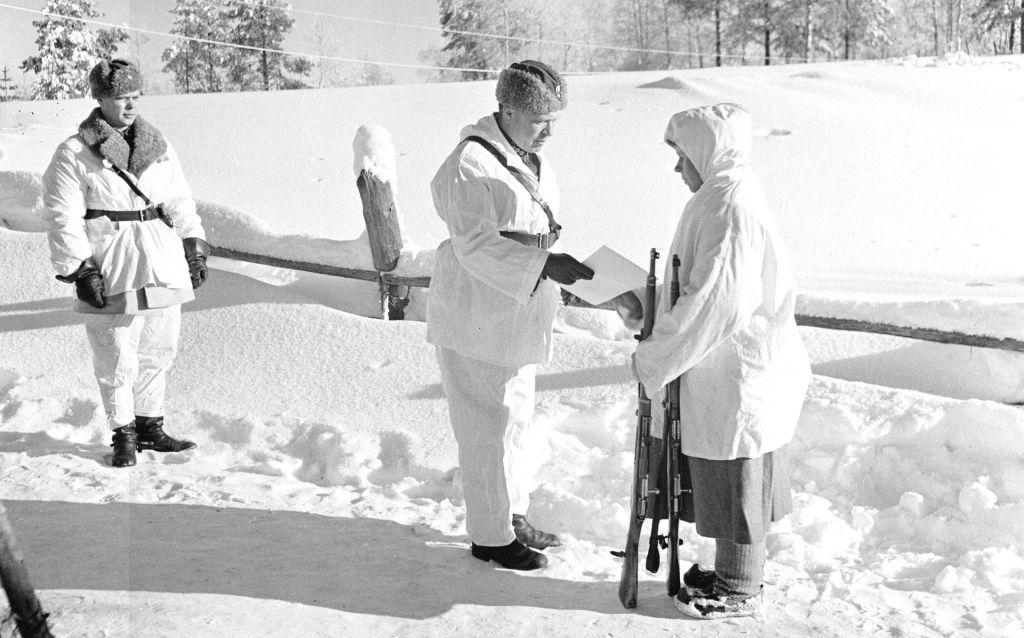
In Ladoga Karelia, in recognition of his prowess in the fighting on the River Kollaanjoki, Corporal Simo Häyhä is awarded a Sako target rifle donated by a Swedish sympathiser, Eugen Johansson. Häyhä has shot dead 219 enemy soldiers with his open-sight ‘pystykorva’ rifle, and approximately the same number again with a submachine gun and a rapid-fire rifle. His most successful tally for a single day has been 25 dead. Häyhä has previously been awarded the Medal of Liberty, a pocket watch and woollen gloves.
Commander-in-Chief Mannerheim addresses an appeal to his officers: “The whole future of our people hangs in the balance. Only our loyalty and endurance can save the day. I am sure every officer will do his duty.”
In Northern Finland, Soviet troops in Kuhmo launch a new assault on the Kuusijoki line in an effort to free the trapped 54th Division.
In the Gulf of Bothnia, a road is opened across the frozen sea between Vaasa and Umeå in Sweden.
Iisalmi suffers heavy enemy bombing. 41 people are killed in a direct hit on a bomb shelter. 130 enemy aircraft bomb Viipuri.
158 American Finnish volunteers arrive in Oulu.
An exhibition of captured war materiel opens in Helsinki Exhibition Hall. Proceeds from the exhibition are to be used to help the needy relatives of soldiers fallen in the war. Visitors to the exhibition can keep abreast of the latest figures from the front. There are, for example, two boards presenting the numbers of enemy aircraft shot down and tanks destroyed since the start of the war. Today’s figures are 387 aircraft and 1,050 tanks.
The Swedish press strongly criticizes Prime Minister Hansson and the Swedish Government’s decision not to help Finland.
The Swedish Prime Minister’s negative reply to Finland is received with satisfaction in Moscow. The Soviet leadership believes Finland’s fate has now been finally sealed.
The British and French press believe Sweden will come to regret the decision.
In Geneva, Miss Sophie Mannerheim delivers a hugely popular lecture on her father and the war.
The deep anxiety felt at the Vatican over the reverses which Finland is suffering received expression today in a strong editorial written by Guido Gonnella for the Osservatore Romano.
Reuters reports:
“Finland is doomed unless large forces — tens of thousands of men — can be sent to her assistance. This is the view of one who has been in Finland since the hostilities began. and has seen and studied Finnish defenses and Russian attacks. To try to forecast exactly what will happen and when is futile, because so much depends on what happens in other parts of Europe and the world. Many things are wanted by Finland. She requires more aircraft, especially fighters, considerably more ammunition, anti-aircraft guns and medicine, notably the famous British cure for pneumonia. All these are wanted in great quantities, but above all men are needed. Airplanes are of no use if there are no pilots to man them. Ammunition would be valueless and guns wasted if there were no men behind the guns to fire the ammunition.. Finland is lost unless men are forthcoming soon. Every day is of paramount importance, for men. cannot be sent over swiftly. The age of miracles is over.
“Finland cannot hold out forever against the Russian masses. Indeed, there will probably be no Finland, only a much larger Soviet State, by July this year, unless many thousands of men are immediately sent to her aid. While the Finns will be grateful for each single volunteer, soldier, sailor or pilot, they must have at least 100,000 to have a chance of saving the country, and not a man fewer than 200,000 to be sure of it. The Finns are most grateful of all for the money they have been receiving, notably from America, but as one Finn said with a sigh, “If only they could send us a man for each dollar bill!” The latest attacks on the isthmus and the pounding of the Mannerheim Line must have taken a tremendous amount out of the Finns. They have held their positions gallantly, but how can tens of thousands be expected to hold in check day after day, week after week, hundreds of thousands?”
Erich von Manstein presented the Manstein Plan to Hitler, detailing the war plan for the German invasion of France and the Low Countries. Hitler was impressed by the plan. The basics of the revised version of “Fall Gelb” (Case Yellow) were described to German Chancellor Adolph Hitler by General Erich von Manstein. As it was customary for new corps commanding officers to dine with the Führer, Hitler’s aide Colonel Schmundt arranged such a meeting for Hitler and Manstein. Manstein presented his plan for the invasion of France and the Low Countries, which impressed Hitler. Manstein’s plan was to change the point of attack for the German armored blitz from northern Belgium, where the Allies anticipated it, to the weakest point of the French line near Sedan, on the Meuse River. After breaking through the French defenses, the panzers should speed across northern France to the Channel coast near Abbeville. If the plan worked, the bulk of the Allied armies would be cut off in Belgium. After their destruction, von Manstein added, the rest of the French army could be enveloped and destroyed “with a powerful right hook.” Hitler soon approved von Manstein’s plan and issued new Army Operational Orders.
By 2 AM the boarding mission of the German tanker by the HMS Cossack (F 03) was complete and the HMS Cossack set sail for England with the prisoners liberated from the Altmark. The Altmark was carrying 299 British merchant seamen who been captured by the German pocket battleship SMS Admiral Graf Spee in late September and October of 1939.
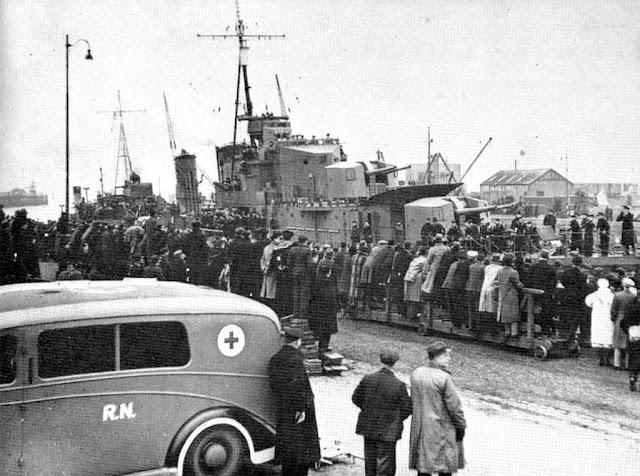
The men rescued from the Altmark are landed from Captain Vian’s HMS Cossack at Leith to great acclaim as the government issues a public announcement. Meanwhile, the Germans in Norway stage an elaborate funeral procession for their dead from the incident.
Norway protested the British neutrality violation of attacking the German ship Altmark in Norwegian waters.
Germany accused Britain of “piracy, murder and gangsterism” over the Altmark incident and also lodged a protest with Norway demanding compensation for failing to protect the German ship within Norwegian territorial waters. Norway in turn protested to Britain for infringing on the country’s neutrality.
The action of British naval units against the Altmark in Norwegian territorial waters has aroused tremendous indignation in German official quarters and the press against Britain and, to a lesser degree, Norway.
Dark hints of revenge for the British attack on the German steamer Altmark were published by an indignant Nazi press today. Wrathful official quarters took a grave view of the act. “The crime in Gjlesslngfjord presents us with an entirely new state of affairs in war policy and war technique, the effects of which cannot now be foreseen in the slightest degree,” raged Adolf Hitler’s own newspaper, Volkischer Beobachter.
The British Government plans to evacuate 400,000 children from the larger cities to rural areas.
Sir Samuel Hoare, Lord Privy Seal, warned in a speech in Nottingham today that unless Britain maintained her export trade she would lose the war. He pointed out the need for buying war supplies abroad with her export trade.
Soldiers with drawn revolvers and bayoneted rifles raided the Meath Hotel in midtown Dublin tonight and arrested thirteen alleged members of the Irish Republican Army.
The Turkish and Bulgarian governments signed a non-aggression pact, an agreement which reflected the new status quo in the Balkans.
At 0205 hours, the unescorted Norwegian steam merchant Kvernaas was torpedoed and sunk by the U-10, commanded by Oberleutnant zur See Joachim Preuss, four nautical miles (7.4 km) northwest of the Schouwenbank, Netherlands (51°50′N 3°19′E). Kvernaas (Master Ivar Sørensen) was hit by one torpedo from U-10 and sank within five minutes four miles northwest of Schouwen Bank, Netherlands. The crew abandoned ship in two lifeboats and was picked up after 4 hours by the Dutch steam merchant Oranjepolder. The vessel was en route to London, but turned back and landed the men at the pilot station in Hoek van Holland the next day. The 1,819-ton Kvernaas was carrying coke and was bound for Oslo, Norway.
Straggling behind Convoy OG.18, the British steam merchant Pyrrhus was torpedoed at 1553 hours and sunk by the U-37, commanded by Korvettenkapitän Werner Hartmann, in the Atlantic Ocean north of Cape Finisterre (44°02′N 10°18′W). Pyrrhus (Master William Thomas Spencer), a straggler from station #51 in convoy OG.18, was hit on the starboard side at #5 hatch by one torpedo from U-37 about 84 miles north-northwest of Cape Finisterre. She was the ship of the vice-commodore Vice-Admiral Alfred E. Evans, CB, OBE, RN and was about to rejoin convoy after having spent all day rounding up ships from convoy that had lost touch during a gale the previous night. The explosion broke the ship in two, causing the after part of about 160 feet to sink immediately. Eight Chinese crew members were lost. The master, 72 crew members (the ship was armed with one 4in and one 12pdr gun), the vice-commodore and his staff of four naval ratings abandoned ship in three boats in heavy sea and swell about 20 minutes after the hit. Three stragglers were following the ship and two of them, the British steam merchants Uskside and Sinnington Court stopped despite the danger of being torpedoed themselves, picked up the survivors and landed them at Gibraltar. The wreck of Pyrrhus was left adrift and eventually foundered two days later. The 7,418-ton Pyrrhus was carrying general cargo, including whisky, golf clubs and embroidery and was bound for Gibraltar and Manila.
At 2036 hours the Finnish steam merchant Wilja was hit aft by a G7a torpedo from U-48, commanded by Kapitänleutnant Herbert Schultze, caught fire and sank after five minutes south of Bishop Rock, in the Atlantic Ocean south west of the Isles of Scilly, United Kingdom (49°00′N 6°33′W). The U-boat had spotted an illuminated Dutch ship and a darkened vessel about 30 minutes earlier and attacked the latter. The other ship was Maasdam, which picked up the 27 survivors — the entire crew — and landed them in Havana, Cuba. The 3,396-ton Wilja was carrying general cargo, including tobacco, gum rosin, wheat and turpentine and was bound for Rotterdam, Netherlands.
The British cargo ship Baron Ailsa struck a mine and sank in the North Sea north of Inverness-shire (53°17′N 1°12′E) with the loss of two of her 36 crew. The survivors were rescued by the Royal Navy trawler HMT Beech.
The Dutch cargo ship Alkmaar ran aground on Ilhéu de Cima, Cape Verde Islands and was wrecked. Her crew was rescued by a Portuguese warship.
The Greek cargo ship Odysseus sank in the Atlantic Ocean off Cape Finisterre.
Convoy OB.93 departs Liverpool.
Convoy HG.19 departs Gibraltar for Liverpool.
The U.S. freighter Exhibitor was detained by British authorities at Gibraltar.
The War at Sea, Saturday, 17 February 1940 (naval-history.net)
Heavy cruiser NORFOLK arrived at Scapa Flow and departed to relieve heavy cruiser DEVONSHIRE on Northern Patrol. DEVONSHIRE reached Greenock on the 20th.
Light cruiser NEWCASTLE arrived at Scapa Flow after Northern Patrol, and destroyer KINGSTON departed Scapa Flow for Northern Patrol.
Destroyers DIANA, ENCOUNTER, and BRAZEN escorted two tankers from Rosyth to Aberdeen, after which they left with steamers HIRONDELLE (1243grt) and RUTLAND (1437grt). Destroyer KIPLING joined en route, with HIRONDELLE being taken into Lerwick and RUTLAND into Scapa Flow.
Submarines TRIBUNE and TRUANT exercised in the Firth of Forth with destroyer ELECTRA serving as the target ship.
Submarine URSULA departed Blyth on patrol, but had to return with engine problems.
Convoy BC.25 of five steamers, including BARON CARNEGIE and BATNA, which had sailed from Nantes on the 13th and 14th respectively, departed Quiberon Bay on the 16th. It arrived in Barry Roads on the 17th escorted by destroyer MONTROSE.
Destroyer WOLVERINE on convoy escort, attacked a submarine contact southwest of the Scilly Isle on the 17th in 49 38N, 06 40W and the 18th in 49-37N, 7-10W.
Sloop ABERDEEN, on convoy escort with OG.19F, attacked a contact southwest of Portland Bill in 50-10N, 2-52W.
Anti-submarine trawler PEARL (649grt) attacked a contact in Lune Deep in Morecombe Bay in 53-53N, 3-33W.
Destroyer HAVANT developed defects while on escort duty.
Convoy ON.14 with ten British, seven Norwegian, one Swedish, five Finnish and one Estonian ship departed Methil escorted by destroyers ESCAPADE, ESCORT, ECLIPSE, and ELECTRA and submarine NARWHAL. (There was no ON/HN.13.) ECLIPSE attacked a submarine contact in the Firth of Forth in 56-09N, 2-49W, and one merchant ship detached before the North Sea crossing. Light cruisers EDINBURGH and ARETHUSA left Scapa Flow on the 19th to rendezvous with the convoy at 0700/20th, and when German surface ships appeared in the North Sea, ON.14 put into Kirkwall, still on the 19th, but left next day once the German ships had returned to Wilhelmshaven, reaching Bergen on the 22nd.
U-10 sank Norwegian steamer KVERNAAS (1819grt) four miles NW of Schouwen Bank in 51 50N, 03 19E. The crew of 20 was rescued by Dutch steamer ORANJEPOLDER (856grt).
U-48 sank Finnish steamer WILJA (3396grt) southwest of the Scilly Isles in 49 00N, 06 33W and the 27 survivors were rescued by destroyer VANESSA and Dutch steamer MAASDAM (8810grt). VANESSA was escorting convoy OA.92 at the time, saw the sinking and attacked U-48 in 49 25N, 07 10. 6W. She was joined by destroyer WREN and sloop DEPTFORD at 1230 and 1520/18th, respectively. DEPTFORD left for Gibraltar at 1700/18th, and sloop ENCHANTRESS joined.
Convoy HG.19 of 35 ships departed Gibraltar with sloops LEITH and BIDEFORD as ocean escort from the 17th to 27th. Before then, on the 24th, the convoy split into two. HG.19 A was escorted in Home Waters by BIDEFORD and destroyer WHITSHED, and HG.19B by destroyers WALPOLE, WHITSHED, and MACKAY from the 24th to 27th when the convoy arrived at Liverpool.
U-37 was en route to join U-53 for attacks off Portugal on French convoys 10 RS, en route from Gibraltar to Brest, and 65 KS, en route from Oran/Casablanca to Brest/St Nazaire. Off Cape Finisterre, U-37 attacked British convoy OG.18, escorted by French destroyer PANTHÈRE and French auxiliary patrol vessel MERCEDITA, and torpedoed British steamer PYRRHUS (7418grt) in 44 02N, 10 18W. She broke in two, the aft section sank immediately, but the fore part stayed afloat for two days. Eight Chinese crew were lost and the survivors, including Convoy Vice Commodore Vice Admiral A. E. Evans CB, CBE and his staff were rescued by British steamers USKSIDE (2706grt) and SINNINGTON COURT (6910grt). Also in OG.18 were British steamers AGAPENOR (7392grt), PROMETHEUS (6095grt) and GLENIFFER (9559grt).
The joint U-boat operation also netted three other ships. On the 18th, U-37 sank independently sailing Greek steamer ELLIN (4917grt) 25 miles NW of Cape Finisterre, the crew being picked up by Spanish fishing vessel MANIN (251grt, and French steamer PLM 15 (3754grt) from convoy 10 RS in 43 37N, 09 15W with the loss of her entire crew. French anti-submarine trawlers LA TOULONNAISE (738grt) and LA SETOISE (738grt) carried out attacks on U-37.
U-53 sank Spanish steamer BANDERAS (2140grt) eight miles NW of Cape Velano, also on the 18th. Twenty-two crew were lost and six survivors rescued by Spanish fishing vessel TRITONIA (268grt). The U-boat also attacked French tanker GARONNE (3533grt) in convoy 10 RS, but malfunctioning torpedoes prevented any damage being done.
U-26 and U-50 had been ordered to operate with U-37 and U-53, but were too far away to join in time.
Lifting the veil of secrecy surrounding his cruise, President Roosevelt announced through an aide that he would arrive at the Panama Canal Zone early tomorrow for an inspection of the defenses of the Panama Canal. Brigadier General Edwin M. Watson, the President’s secretary and military aide, said that Mr. Roosevelt would confer with General Van Voorhis, commander of the Canal Zone, and with military, naval and civilian authorities. General Watson indicated that further information would be disclosed tomorrow night. It was assumed that the President would discuss the proposed additional set of canal locks and increases made in the defense garrison at the strategic link between the Atlantic and the Pacific. The mystery of the voyage was solved as the cruiser USS Tuscaloosa, carrying the President, and the convoying destroyers USS Lang and USS Jouett cruised in the Caribbean Sea off Nicaragua. Since leaving Pensacola, Florida, on Thursday the three warships have been setting the straightest course possible toward Panama. They passed Cape San Antonio, the western tip of Cuba, Friday noon and have maintained a uniform speed of 21 to 22.5 knots.
The reaction of the public to the question whether President Roosevelt will break the third-term precedent and seek to be re-elected next November has changed slightly since the outbreak of the war in Europe, but the consensus still is that he will run again and be reelected, according to survey figures announced yesterday by the American Institute of Public Opinion, of which Dr. George Gallup is director.
July 15th, 1940 was selected by Democratic National Committee Chairman James A. Farley as the date for the Democratic national convention in Chicago. Farley today announced July 15 as the opening date for the Democratic National Convention in Chicago, three weeks after the Republican convention at Philadelphia.
Under-Secretary of State Summer Welles and Myron C. Taylor, personal envoy of President Roosevelt to the Vatican, sailed yesterday on the Italian liner Rex as specially appointed representatives of the President and the State Department to travel about Europe and try to discover what possibilities exist in the war-torn countries for an early peace.
Senator Burton K. Wheeler (D-Montana), prospective challenger for the Democratic presidential nomination and stalwart isolationist, announced he would not seek democratic delegates in any primary where President Roosevelt’s name is entered. He said he would not be a party to any move that would split up “the Liberal and Progressive forces of this country.”
Senator Alben Barkley of Kentucky, the Democratic leader, indicated today that he thought Congressional slashing of appropriations would obviate the necessity for new taxes. President Roosevelt has recommended $400,000,000 of new levies to meet “emergency” defense costs, and thus keep the Federal debt within the $45,000,000,000 limit fixed by Congress. “It looks now as if that fight can be avoided,” Mr. Barkley told reporters. His statement was obviously prompted by the action of both House and Senate in trimming appropriations asked by the President.
Thomas E. Dewey completed tonight a swing across Nebraska in his campaign for the Republican Presidential nomination. Crowds greeted him as his train stopped during the day at North Platte, Kearney, Grand Island and numerous small towns.
The U.S. Communist Party’s national committee today selected New York City for its presidential nominating convention and set the date for May 30. William Z. Foster, national chairman, declared the party was “100 per cent” for re-nominating Earl Browder as its presidential candidate. Browder, general secretary, is under a four-year sentence for passport fraud and recently was defeated for a congressional seat from a New York City district.
Stalin and Hitler would envy the National Labor Relations Board if Congress followed the suggestion of the Congress of Industrial Organizations and empowered the board to send employers to jail for violation of the Wagner act, William Green, president of the American Federation of Labor, told members of the National Republican Club at a Saturday discussion luncheon yesterday.
Resumption of peace negotiations between the American Federation of Labor and the Congress of Industrial Organizations was urged yesterday by clergymen representing social and welfare agencies of the Catholic, Protestant and Jewish faiths.
A detailed audit of actual membership of C.I.O. unions and an amalgamation of them with companion ones in the American Federation of Labor are necessary conditions to a union of the competing organizations said an article in the A.F. of L. Weekly News Service today.
United States Lines sells the liner President Harding and seven cargo ships to a Belgian concern in an attempt to circumvent the ban on U.S. sea borne trade with Europe, imposed by the Neutrality Act.
A rare double ceremony of unusual significance will mark a milestone in the history of the United States Navy in late May or early June when the new 35,000-ton battleship North Carolina will be launched and the keel of the 45,000ton battleship Iowa will be laid on the same day at the navy yard in Brooklyn, it was learned yesterday.
Extensive construction by the navy of lighter-than-air craft, including the immediate building of a 650-foot dirigible and annual completion of two to four small blimps for scouting purposes, was recommended by a special board of experts to Secretary Edison today.
Reports that the Japanese were evacuating Nanning created a sensation in Chungking today. Chinese military authorities confirmed that there were heavy movements of Japanese troops from Nanning by the highway south to the seacoast, but they denied the complete withdrawal of Japanese forces from the city. Chinese troops were said to have advanced within a few miles of the South Kwangsi metropolis.
A conflagration was reported to be raging in Nanning and its suburban villages as the result of fires set by the departing Japanese at a number of different points. The Chinese say that since January 15 many Japanese transports have been concentrated off Yamchow, the Japanese coastal base south of Nanning. Along the Nanning-Yamchow highway a congested movement southward of Japanese troops. is reported to have been going on, together with equipment and many truck loads of wounded.
In an impromptu speech at a Chinese and foreign social gathering last night War Minister Ho Yingchin corroborated the reports of an apparent general Japanese evacuation of Nanning. He said that the Chinese were closing in around the city. Official Central News dispatches from Kwangsi said that Japanese resistance had collapsed and that confusion had reigned in Nanning since Thursday and that a general withdrawal was apparently under way. Most of the high Japanese officers are believed to be already in Yamchow, these dispatches said. The Chinese forces are said to be closing in on the flanks of the retreating Japanese south of Nanning in an effort to smash the retiring enemy troops.
Spontaneous sporadic celebrations broke out in Chungking as the news spread that Nanning was being evacuated. Trucks raced through the streets with their occupants throwing out lighted firecrackers, while happy crowds gathered before wall bulletins announcing the news. Reports of the Nanning evacuation had been preceded here by war dispatches announcing that the Chinese were continuing to inflict heavy casualties on the Japanese between Pinyang and Nanning as the invaders fell back from the Pinyang area, into which they had penetrated last week in an offensive designed to “smash” the Chinese Army near Kwangsi. The Chinese declare that they evaded this Japanese blow, counter-attacked and drove back the Japanese with severe losses.
Belief that the reopening of the Yangtze River, Central China’s main trade artery, would be delayed indefinitely or abandoned grew today when Foreign Minister Hachiro Arita declared Japan did not have to reopen the river, even though his predecessor had notified the United States of such an intention.
The British cargo ship Cheldale collided with Greystoke Castle ( United Kingdom) in the Indian Ocean 24 nautical miles (44 km) off Durban, South Africa with the loss of 16 of her 35 crew.
Dow Jones Industrial Average: 148.72 (+0.52)
Born:
Gene Pitney, singer-songwriter (“Town Without Pity”; “Hello Mary Lou”; “He’s A Rebel”), in Hartford, Connecticut (d. 2006).
Vicente Fernández, Mexican Grammy Award-winning singer, known as “El Rey de la Música Ranchera” (The King of Ranchera Music), actor, and film producer, in Huentitán El Alto, Jalisco, Mexico (d. 2021).
Willi Holdorf, German athlete (Olympic gold medal, United Team of Germany, decathlon 1964), in Blomesche Wildnis, Germany (d. 2020).






 History Diaries