South Vietnam turned yesterday to a mostly civilian Cabinet heavily weighted with physicians in an attempt to remedy the nation’s serious political ailments. The Cabinet had been approved by the military leaders. Further progress was made today toward a return to conventional civilian rule with the formation of a 20-member legislative body. The new group, selected by the Armed Forces Council headed by Lieutenant General Nguyễn Khánh, was as carefully balanced as the new Cabinet. Called the National Legislative Council, the body includes two representatives from the nation’s four main religions — Buddhist, Roman Catholic, Cao Đài, and Hòa Hảo — and two members each from Vietnam’s three geographical divisions. These are South, Central and North.
Representing the North are men born and educated in the section of Vietnam controlled since 1954 by the Communists. In addition, the legislative group, which replaces the High National Council that the military leaders dissolved last December, includes six representatives from the armed forces. In the new Cabinet, Premier Phan Huy Quát, a Deputy Premier and four of the 19 other ministers are medical doctors. As a group, the new ministers are younger, more politically oriented and more balanced in geography and religions than was the short-lived Government of Premier Trần Văn Hương.
In a brief ceremony yesterday afternoon at Gia Long Palace, the 56-year-old Premier, who was Foreign Minister last year in the regime of General Khánh, introduced his ministers to the Chief of State, Phan Khắc Sửu.
“Although these gentlemen have different political leanings,” the Premier said, indicating his ministers, “they all have the same desire to seek unity among the entire people.” His alert face solemn, he twice spoke of his determination to press the war against the Communists. The inclusion in the Quát Government of two Army generals and an Air Force lieutenant colonel seemed to indicate that the military forces would assume a responsibility for this Administration that they did not feel for former Premier Hương’s all-civilian Cabinet. The new Government, already known here as the “medicine Cabinet,” is authorized to remain in office until an elected national assembly drafts a permanent constitution. Observers here expect that the assembly elections, tentatively scheduled for March 21, will be postponed. While the Cabinet appeared to be a competent collection of men with some popular following, the atmosphere among Vietnamese and Americans here has been dispirited and cynical. A United States Embassy spokesman issued a perfunctory greeting to the Cabinet, South Vietnam’s ninth in the last 16 months. “We welcome the end of this interim period and look forward to close cooperation with this government,” he said.
United States jet fighters took off from Đà Nẵng in the direction of Laos on a secret mission today and returned four hours later. American officials declined to say how many planes — F-100 Supersabres and F-102 Delta Daggers — were involved or what their destination was. Jets from the Đà Nẵng base bombed Route 7, the Communists’ Hồ Chí Minh trail from North Vietnam through Laos to South Vietnam, last month.
Communist North Vietnam said today its naval patrol boats had intercepted four raiding commando ships from South Vietnam and damaged two of them. Colonel Hà Văn Lâu, chief of the Communist liaison mission, told the International Armistice Commission the “commando ships of the United States and Saigon administration” shelled Quỳnh That commune in Nghệ An Province at 12:30 AM (11:30 AM Wednesday, New York time). The Hanoi radio, reporting the colonel’s complaint, said the raiders were met with answering fire from the shore “by the local armed forces.”
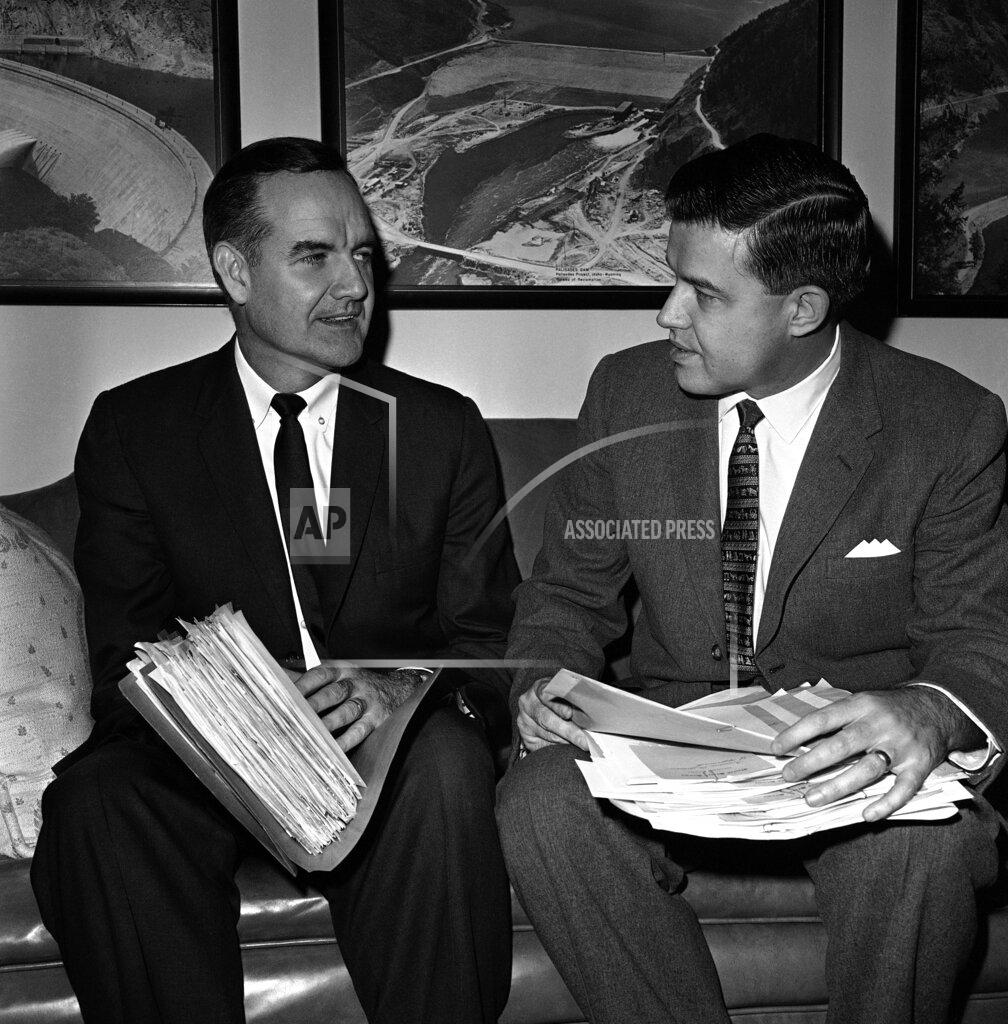
U.S. Senator Frank Church of Idaho became the first member of Congress to begin an open debate about American involvement in Vietnam, delivering a speech titled “We Are in Too Deep in Asia and Africa”, based on an article that he had written for The New York Times Magazine. Of him, it would be written later, “no senator had a longer career of opposition to the Vietnam War or a greater impact on American foreign policy than Frank Church.”
President Johnson said today the United States would persist in the defense of South Vietnam and would continue actions that are justified and necessary. The President spoke as debate on Vietnam began again in Congress. The Republican leadership strongly supported his policy of retaliatory air strikes against North Vietnam, while some Democrats urged a negotiated withdrawal from Vietnam.
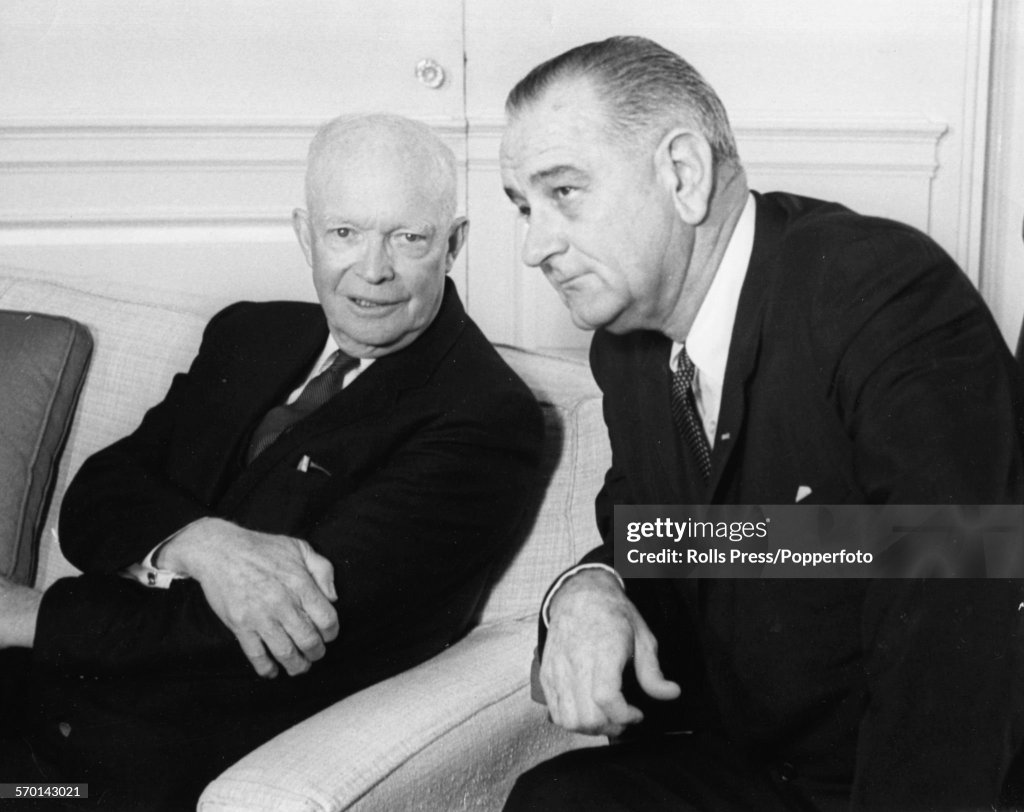
Mr. Johnson also held a surprise meeting with former President Dwight D. Eisenhower on policy in Vietnam. General Eisenhower made no statement after the meeting. The White House press secretary, George E. Reedy, said the two men talked for more than two hours during the morning and then had lunch together just before Mr. Johnson’s speech. Mr. Reedy said the general, who has been vacationing in Palm Desert, California, had come to Washington for a medical check-up at Walter Reed Army Hospital.
President Johnson’s statements on Vietnam were made at the conclusion of what was primarily an economic address before the National Industrial Conference Board. He neither threatened to continue air strikes against North Vietnam nor gave the Asian Communist capitals any assurance that they would stop. The President declared that “we seek no wider war,” but he also added: “We will persist in the defense of freedom and our continuing actions will be those which are justified and those that are made necessary by the continuing aggression of others. Those actions will be measured, fitting and adequate. Our stamina and the stamina of the American people is equal to the task.”
The Administration believes that high priority should again be given to vigorous anti-guerrilla warfare in South Vietnam, some informed sources said. But they did not rule out further airstrikes if provocation from North Vietnam made them necessary. Mr. Johnson was believed to have put deliberate stress on the need for stamina, since even successful combat against the Việt Cộng would be protracted.
In Congress, in the diplomatic corps and in mail reaching Washington, there is more and more talk in favor of “negotiation” over Vietnam. But the Administration continued today to shun that word or any other suggestion that it might wish to bargain for peace. “You’re right,” a prominent official remarked. “We trip over the word. And yet we hate to appear so stringent. It’s a real dilemma.” Foreign Minister Maurice Couve de Murville of France. arrived this evening. His visit is likely to produce even more public discussion about taking the problems of Southeast Asia back to the conference table. The French have been the most persistent advocates of a diplomatic solution rather than a military one and have tried to bring Washington and Peking toward a conversation.
President Johnson and Vice President Humphrey indicated in brief public comments, however, what their associates have been reiterating in private: that they see no alternative at the moment to standing militarily at the side of the South Vietnamese Government and that a call for negotiations or any other specific commitment to future tactics would further weaken the position of anti-Communist forces in Asia. The reasoning behind this position has not been made explicit. A number of high State Department officials have described themselves as embarrassed by uncertainty in conversations with colleagues in allied embassies.
Liu Shao-chi, head of state of Communist China, declared tonight that his country firmly supported North Vietnam in what he termed its “righteous struggle to counter United States imperialist aggression.”
The U.S. Department of Defense reported a record number of American casualties for the week of February 14 to February 20. The 37 Americans killed were more than had died in the first two years of American involvement in Vietnam; 32 had died in 1961 and 1962. Twenty-three of the men killed had died in the bombing of the Qui Nhơn barracks. One hundred ninety-six were wounded.
One of the most extraordinary international, political power plays in the last 20 years is in full swing, involving East and West Germany, the Middle East and U.S. interests. Today, West German Chancellor Ludwig Erhard attacked President Gamal Abdel Nasser of the United Arab Republic today in a bitter parliamentary debate on West Germany’s Middle East policy. The Chancellor accused Mr. Nasser of “meddling” with Germany’s vital interests by his invitation to Walter Ulbricht, the East German Communist leader, to visit Egypt. By inviting Mr. Ulbricht, Dr. Erhard declared, President Nasser associated himself “with those who divide the German state. This is a hostile act,” the Chancellor said. “He who hails the division of Germany cannot call himself a friend of Germany.”
In Washington the State Department acknowledged that West Germany had informed the United States in advance about its secret agreement to supply Israel with arms including American-made tanks, and that the United States had given its approval. The arms shipments were suspended when President Nasser denounced them.
Walter Ulbricht, the East German Communist leader, will not be In Moscow on March 1 to attend the conference of 26 Communist parties called by the Soviet Union in its ideological conflict with Communist China. This was made clear by an itinerary of Mr. Ulbricht’s trip to the United Arab Republic next week, published in the Communist newspaper Neues Deutschland. Mr. Ulbricht is to visit the province of Tahrir on March 1 and give a state banquet for President Gamal Abdel Nasser and his wife that evening. Mr. Ulbricht will return to East Germany the next evening.
The growing boycott of West Germany’s goods and services in protest against its halt in arms shipments to Israel is to be discussed in New York next week at meeting of a major Jewish group.
West German defense planners have quietly shelved a proposal for placing nuclear landmines along the East German border, observers here say. The West German Defense Minister, Kai-Uwe von Hassel, said recently that there were no plans to use such mines.
Soviet Marshal Vasily D. Sokolovsky, former Chief of Staff, said today that the Soviet Union had virtual parity with the United States in atomic submarines. “We have no fewer of them,” the 67-year-old military leader said in response to a question at a news conference. “The difference may be one or two. This does not alter the situation.” It was believed to be the first time that the Soviet Union had given an official indication of the strength of its nuclear fleet.
The United States at this date has 21 nuclear-powered regular submarines, 29 nuclear-powered submarines armed with Polaris intermediate-range missiles and one nuclear-powered submarine that fires the Regulus missile, which has a shorter range.
The Soviet Union is armed with nuclear-tipped global rockets equal to 100 million tons of TNT and supersonic planes carrying atomic rockets, Sokolovsky said.
U.S. Defense Secretary Robert S. McNamara will warn Congress today that Communist China’s expanding nuclear capacity poses “a most disturbing long-term prospect” for this country.
The United States ended a three-month freeze on voluntary contributions to the United Nations.
The Syrian government expelled U.S. diplomat Walter Snowdon, saying he had offered bribes for information to military officers. After a very brief trial, the Syrians would hang two of his spies, Farhan Attassi, 36, a Syrian-born but naturalized U.S. citizen with an American wife, and a Syrian officer, Major Moeen Hakimi.
A bomb blast in Vatican City heavily damaged the building occupied by the Swiss Guard, bodyguards for the Pope. Actor Claudio Volonté, the brother of Gian Maria Volonte, producer of the controversial play The Deputy, was arrested the next day and charged with being one of the two younger men who had planted the bomb.
Two hundred African, Asian and Polish students demonstrated outside the United States Embassy today against American policy in Vietnam. Polish policemen moved in quickly, forcing the shouting demonstrators across the street. Two embassy windows were smashed when the students hurled ink bottles. Four truckloads of Polish policemen were rushed to the residence of Ambassador John Moors Cabot, but there were no demonstrations there. One of the leaders of the demonstration was identified as an officer in the Cuban Embassy. Two American Embassy officials contended that Polish bystanders threw snowballs at the students when the latter hurled ink bottles at the American building.
The Indian Government told Parliament today that English would “continue to be the associate official language” as long as Indians who do not speak Hindi, the language of north-central India, wanted it.
The four parties that overthrew the Turkish Government of Premier İsmet İnönü on Saturday fell to quarreling among themselves today, much as Mr. İnönü had predicted.
A struggle to democratize the French Communist party widened today with publication of a sharp exchange between its Politburo and about 100 party intellectuals.
The United States announced today a pledge of $24.7 million for the 1965 operations of the United Nations Relief and Works Agency in Palestine, subject to the condition that the ineligible persons be removed from the relief rolls.
President Johnson announced today that the Administration was about to extend more than $700 million worth of tax relief to business. The relief will come in the form of a further liberalization of the standards under which business can write off the cost of new equipment. Without the planned change, business taxes would have risen by $700 million this year. Mr. Johnson announced the forthcoming change in depreciation standards in a speech before the National Industrial Conference Board in which he also appealed to business to help his Administration achieve its social as well as economic objectives. The conference board is a cooperative business research organization of which a great many of the largest corporations are members.
The Labor Department announced today that manufacturing payroll employment last month reached the highest level, after adjustment for seasonal factors, since July of 1953.
The House of Representatives approved today a three-year extension and financing program for the United States Arms Control and Disarmament Agency. The roll-call vote was 302 to 63. This action was taken after Democrats offered a surprise compromise and blocked an attempt by the Republicans to cut the Administration’s proposed four-year program to two years. The bill was sent to the Senate after the House vote.
Dean Burch, the Republican National Chairman, said today that his party must consolidate its gains in the South without resorting to racist appeals, “overt or covert.”
Secretary of the Interior Stewart L. Udall suggested today the need for a national energy policy to deal with such problems as developing the oil-rich shale lands in the West.
Senate Democratic whip Russell B. Long of Louisiana has said that southerners may forego a filibuster and actually support legislation which President Johnson soon will propose to protect Black voting rights.
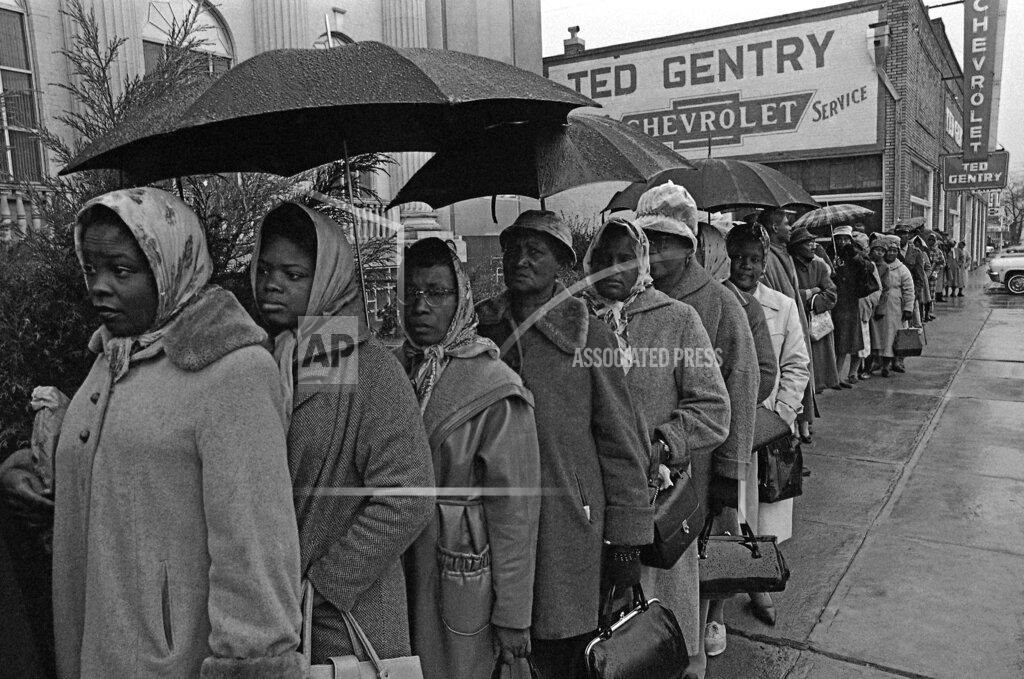
Black farmers and housewives told the United States Civil Rights Commission today that they had been subjected to day-to-day terrorism for asserting their political rights in Mississippi. A threat to kill, an effigy hanged from a mailbox, and unlighted automobiles cruising past a house at midnight were among the methods the witnesses said had been used to try to keep them from voting in one Mississippi county in the last two years. From another county came a report that the Ku Klux Klan had adopted a modern sales technique. A Black woman said that, after she and her husband tried to register to vote, a Klan delegation visited the house and left a printed calling card bearing a warning. An automobile mechanic told the commission of being jailed in McComb after a bomb was exploded in his yard one midnight last summer. He said his wife had tried to register to vote.
“Congratulations,” said one telegram from Tulsa, Oklahoma, after Sheriff Jim Clark of Dallas County, Alabama, struck a Black minister during a voter registration drive in Selma.
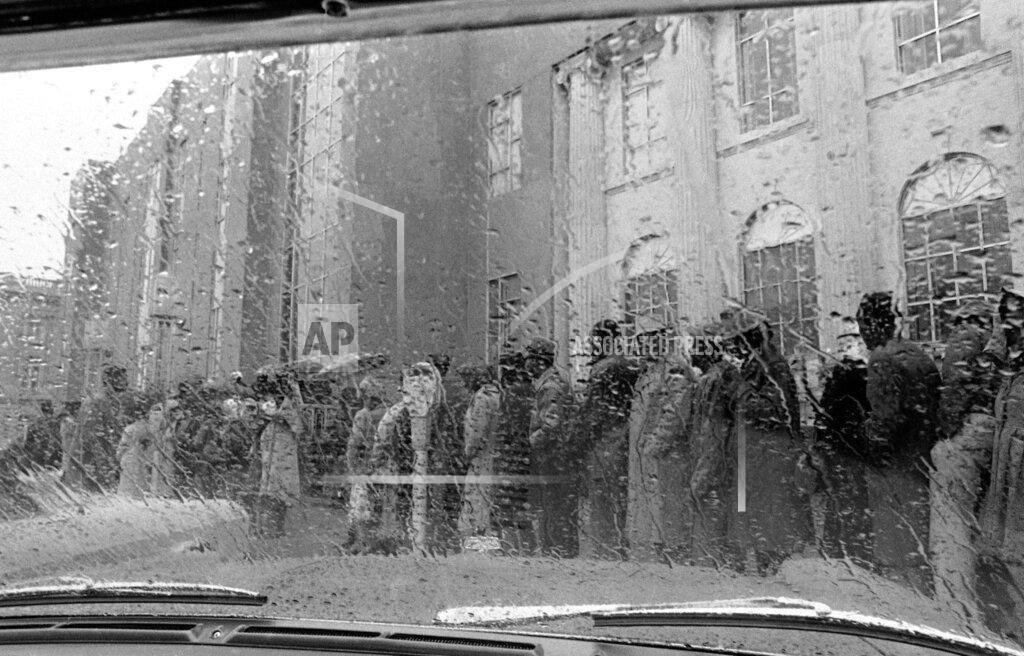
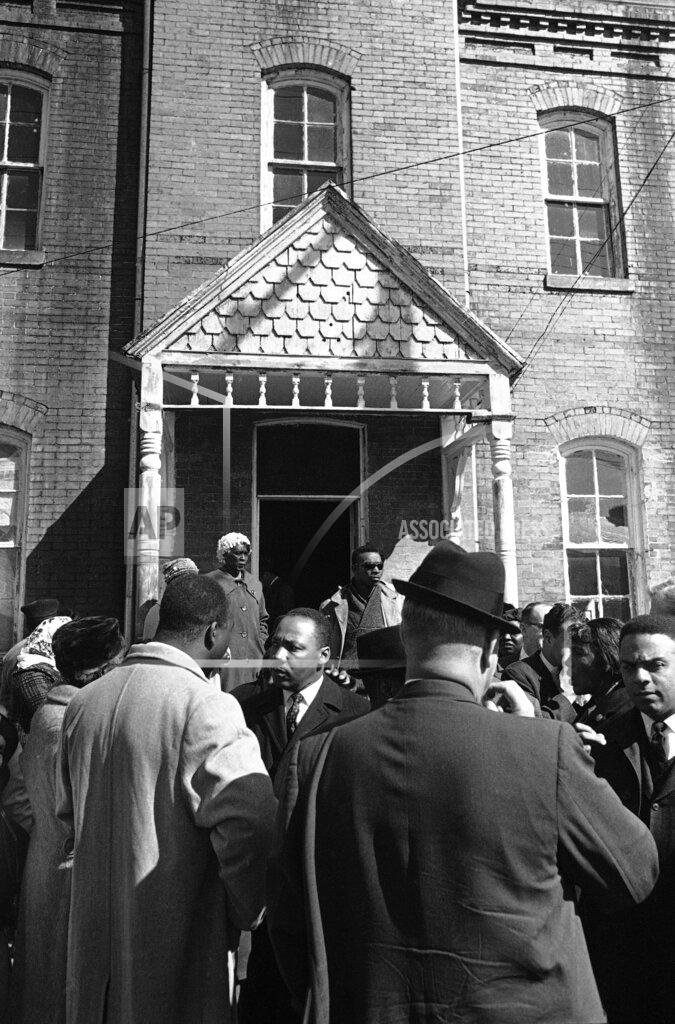
The Rev. Dr. Martin Luther King left a sickbed tonight and appealed to Blacks to adopt a more militant campaign in Selma. He said that night demonstrations and “broader forms of civil disobedience” might be needed to back up Black demands for easier voter registration and for removal of Sheriff James G. Clark Jr. from office.
It was the strongest speech Dr. King had delivered to a Black rally since the campaign to speed Black voting opened almost five weeks ago. Until tonight, Dr. King indicated he was prepared to let up in Selma and move the main thrust of the campaign into rural areas. Dr. King was in bed all day with a cold and fewer. Tonight, however, he met with local Black leaders in a strategy conference and later told his audience at Browns Chapel Methodist Church:
“We concluded in that meeting that Selma still is not right. Far from letting up our efforts in Selma and Dallas County, we’re going to broaden our activities here. We aren’t going to let up until Blacks can go down and register without a single stumbling block. Until Sheriff Clark is removed, the evils of Selma will not be removed. He is still beating our people. It is time for us to say to the businessmen, the Mayor and white power structure that they must take the responsibility for what Jim Clark does. It is time for us to say to those men, if you don’t do something about it we will engage in broader forms of civil disobedience. We might have to march out of this church tonight and stand at the courthouse all night long.”
Before Dr. King spoke, the 500 Blacks attending the meeting voted to institute a boycott against the downtown business section. The Rev. P. H. Lewis, a local leader, said the action was taken because whites who own or work in the business establishments have fired their maids for participating in the campaign.
Police clashed with 400 black students outside the Brooklyn Board of Education, as a boycott of New York City schools continued to grow. Four hundred boycotting Black students broke through police barricades outside Board of Education headquarters in Brooklyn yesterday in a brick-throwing, window-breaking riot. Three policemen were struck, one youth was injured and nine were arrested.
The hero rookie New York policeman who risked his life to foil a plot to blow up the Statue of Liberty and two other national shrines has won an unprecedented second promotion in two days.
The lunar probe Ranger 8 was launched from Cape Kennedy. The photographs it transmitted would help select landing sites for future Apollo missions. Ranger 8, a spacecraft designed to photograph a portion of the moon’s surface, was successfully launched into a moon-bound course from Cape Kennedy, Florida. Ranger 8 would transmit 7,137 lunar surface photographs before it crashed into the Moon as planned on February 20. This was the second successful mission in the Ranger series, following Ranger 7.
Space agency officials have told Congress that the national goal of landing Americans on the moon in this decade already may have become impossible to attain.
Vice Admiral Roy L. Johnson is nominated to become Commander in Chief of the United States Pacific fleet.
Academy Award-winning actress Patricia Neal suffered two near-fatal strokes at the age of 39, shortly after coming home for the day from filming of the movie 7 Women, and was rushed into emergency brain surgery. After being in a coma for weeks, she survived, and, on August 4, would give birth to the daughter she had been carrying, Lucy Dahl. After years of recovery, Neal would return to acting.
Commissioner Ford Frick suspends U.S.-Japan baseball relations until the dispute over Masanori Murakami’s contract with the Giants is resolved.
In Miami, Ken Harrelson wins the professional baseball players golf tournament carding a 72-hole total of 301. Finishing second two strokes behind is defending champion Albie Pearson. Five-time winner Alvin Dark finishes third with a 312.
Dow Jones Industrial Average: 882.93 (+1.58)
Born:
Michael Bay, American film director (“Armageddon”, “Pearl Harbor”); in Los Angeles, California.
Clayton Prince, American actor (“Hairspray”, Reuben-“Another World”), in Philadelphia, Pennsylvania.
Jim Bowie, Japanese-American MLB first baseman (Oakland Athletics), in Tokyo, Japan.
Died:
Joan Merriam Smith, 28, American aviator who had made a solo flight around the world in 1964 along the 1937 flight plan of Amelia Earhart, but who finished second to Jerrie Mock, who was attempting the feat at the same time. Smith and magazine writer Trixie Anne Schubert, were killed when their Cessna 100 plane crashed and exploded on Blue Ridge in the San Gabriel Mountains in California.
Tadeusz Lehr-Spławiński, 73, Polish scholar and academician.



 History Diaries